1859: Baltimore’s Plug Uglies

This date in 1859 saw the joint hanging of youths from a notorious Baltimore gang, and in honor of the occasion thousands upon thousands of curiosity-seekers packed Charm City from “all parts of the State, the District of Columbia, Virginia and Pennsylvania, and even New York city and Buffalo” to throng the hills and high points overlooking the Baltimore City Jail, where a fine view could be had of the nominally private gallows.

“The housetops, windows, trees and all other places from whence a more enlarged view could be obtained, were crowded with human beings,” reported the Baltimore Sun (Apr. 9, 1859). “A sea of faces met the eye far and near — men, women and children — old age and infancy — white and black — swelled up the vast multitude, drawn to witness the horrible spectacle.”

The doomed quartet were four men named Henry Gambrill, Marion Crop, Peter Corrie, and John Cryphus. Cryphus was a black man condemned for a knife murder committed under the name John Stephens, and he vainly protested all the way to the gallows that Stephens was not he.

The other three who hanged with him — our principal focus today — were entirely unconnected to him. Gambrill, Crop, and Corrie were all stalwarts of the “Plug Uglies”, who were at once a street gang and a political goon squad, involved (with several similar entities) in a number of election day poll riots in the 1850s. Baltimore was at this point America’s third-largest city, having boomed to 200,000 souls rather faster than its civic institutions could cope.

The city veered near to mob rule (for which it earned the sobriquet “Mobtown”): rival gangs of toughs like the Plug Uglies regularly fought deadly street battles involving hundreds of participants — especially around municipal elections which they shamelessly rigged with armed bullying and prodigious vote-stuffing.* The anti-Know Nothing mayoral candidate in 1858 simply conceded the election rather than invite “loss of life and the general disorder of the city.”


Plug Ugly ruffians boss a ward. (Via)

Affiliated with the nativist, anti-Catholic “Know-Nothing” movement,** the Plug Uglies’ nickname underscores the brutal tenor of their times:

[Baltimore’s gangs] carried pugnacious and frequently obscene banners and often brandished weapons. The awl was seen as a workingman’s weapon, and many were made and handed out at rallies. They were used to “plug” Democrats “ugly” and to prevent them from voting. (Source)

Not long before that peacekeeping 1858 mayoral concession, alliterative policemen Benjamin Benton and Robert Rigdon had arrested a Plug Ugly crony for disorderly conduct, when Henry Gambrill raced up to the grappling trio and shot Officer Benton in the head.

Officer Rigdon, who knew Gambrill well, testified against the goon in the resulting murder trial. So incensed were Gambrill’s pals that they contrived to assassinate Officer Rigdon in revenge: covered by a lookout, Marion Crop in the dark of night shot Rigdon through a window as the cop stood at his mantelpiece chatting with his wife. Both Crop and the lookout, Peter Corrie, were chased down and condemned for first degree murder at separate, and sensational, trials in January 1859.

Despite the power of the Know-Nothings, this outrage proved to fall well outside the range of the Plug Uglies’ impunity. If they could do this, then what institutional pillar of the city would remain standing?

No small sentiment went abroad to skip the assassins’ trials and proceed directly to the hanging — perhaps a problematic means by which to stave off anarchy. In a more promising vein, the affair catalyzed some long-sought political reform measures from the legislature to rein in political violence. And on a chilly, overcast morning in April, Marion Crop stood on the gallows and belted out a hymn for the nation’s gawkers, joined with varying enthusiasms by the other three doomed men.

Former friends, we now must leave you
All our earthly hopes are o’er
But in heaven we hope to greet you
There to meet to part no more.

When a few more moments wasted
And this dying scene is o’er
When this last dread grief we’ve tasted
We shall rise to fall no more.

Fast our sun of life’s declining
Soon it will set in endless night
But our hopes pure and reviving
Rise to fairer worlds of light.

Cease this mourning, trembling, sighing,
Death shall burst this sudden gloom
Then our spirits fluttering, flying
Shall be borne beyond the tomb.

Corrie and Crop were buried privately. Gambrill enjoyed a solem public funeral with a procession of a hundred or so carriages through the center of town. An estimated eight to ten thousand Know-Nothing sympathizers attended it.

* Full marks for period color to the gangs of that time, which included the Rip Raps, Black Snakes, Blood Tub, Regulators, Rough Skins, Double Pumps, and Calithumpians. The successful Plug Uglies, who spread to other cities than Baltimore, were the ones destined to give their name to the language as a synonym for a an urban rowdy. (It’s also the name of some bars.)

** Shortly after the events in this post, Baltimore would be distinguished by a massive, and deadly, riot against a column of federal troops being dispatched to Virginia in the immediate aftermath of Fort Sumter. Since the Battle of Fort Sumter itself had not resulted in any combat fatalities, it was this riot that laid in the ground the first bodies of America’s bloody Civil War.

† While the Know-Nothings’ national impact was limited, they essentially took over Maryland’s political apparatus in the 1850s and made it the party bastion. Know-Nothing nominee (and former U.S. President) Millard Fillmore carried only one state in the 1856 presidential election won by James Buchanan: Maryland.

On this day..

1852: “Brown”, lynched in California

In extending [Cesare] Beccaria‘s views on capital punishment to the history of lynching in the West, one begins to see that the “violent passions” of the mob were regularly invoked to justify their actions, but as Beccaria predicted, these passions were often little more than a ruse to justify the cold-blooded — and often premeditated — lynching of an accused criminal. Taken as a whole, the case list demonstrates that by and large, lynching had as much to do with vengeance as with the pursuit of justice.

The frequent invocation of San Francisco’s vigilance committees in many of the case records is clearly intended to link extrajudicial execution to “tradition,” an essential element found in the Tuskegee definition of lynching.* On a formal level, well over 50 percent of lynching cases that give a time, record that the lynching took place between midnight and 2 a.m. when the accused was usually encouraged to confess his or her crimes before being strung up. Sometimes they were allowed to make a statement, to smoke a cigarette, or confess to a priest, and after it was over, the bodies would usually be left to hang through the night. This public display of the body can be found in every case, with the shortest times usually lasting around thirty minutes, and the longest, until the bodies decayed.

In one instance, in the small village of Newtown, an African American man known only as “Brown” was apprehended for stealing money. The evidence was completely circumstantial but he was found guilty and sentenced to be hung by the mob on March 4, 1852. Unfortunately for Brown, the rope was a little too long, and once he was hanged to the tree, the branch slowly gave way — until his legs dangled to the ground. Struggilng in agony, the poor man was cut down in order to be properly hanged. Once he was fully revived, he was tied to a higher branch and the whole process was repeated. When he was finally cut down, a physician was asked to examine the body, at which point he annunced that if Brown’s body was left above ground for five minutes that he would regain consciousness. As a result, “he was therefore hastily dumped into a grave that had been dug and was half full of water, and quickly covered from sight.” Whether completely true or not, it’s hard to imagine that anyone could argue that this killing really served the greatest good.

* The Tuskegee lynching definition: “there must be legal evidence that a person has been killed, and that he met his death illegally at the hands of a group acting under the pretext of service to justice, race, or tradition,” where “a group” connotes three or more persons.

On this day..

1858: Henry Fife and Charlotte Jones, exonerating Monroe Stewart

On this date in 1858, Charlotte Jones and Henry Fife hanged side by side in Pittsburgh for murdering Jones’s elderly aunt and uncle the year before. But their dying confessions insistently exonerating their death-sentenced co-accused led the governor to pardon Monroe Stewart ahead of the latter’s scheduled hanging later that February.

Fife, Jones, and Stewart had been tried and convicted together in the so-called “McKeesport Murder” or “Wilson Tragedy”. The reader will infer that it entailed the murder of a man named Wilson in the city of McKeesport.

George Wilson, an elderly farmer, was Charlotte’s uncle: resident in a McKeepsort log cabin with his sister Elizabeth McMasters. He had a tightfisted reputation and a consequent stash of gold and silver coins and paper bills, amounting altogether to several hundred dollars.*

“Maddened by a thirst for gold and stimulated by drink I gave them the fatal blow that robbed them of life and sent their souls, without warning, to the bar of God,” Fife lamented in his scaffold confession. George Wilson had been stabbed to death; Elizabeth McMasters bludgeoned with a poker until her brains spattered the room.

Their 27-year-old niece, our Charlotte Jones, was the one who reported the murder but it would soon become painfully apparent that she had lacked the poise for this high-stakes bluff. She had already the reputation of a woman of low morals, and her suspicious eagerness to leave the vicinity brought her in for close questioning. It was not long before Jones served up a confession.

In her initial iterations of this statement, Jones implicated not only her lover, 22-year-old Irish shoemaker Henry Fife, but Fife’s friend Monroe Stewart. It seems that this was a bit of panicked vindictiveness on the part of Mrs. Jones, for Stewart had often counseled his friend to kick Jones to the curb.

This denunciation was enough to see all three condemned in an 11-day trial in July of 1857. Post-conviction, Fife would join Jones in admitting guilt, but both exculpated Stewart of any part in the crime. And in the subsequent odyssey of appeals and clemency petitions, it was really only Stewart’s fate that remained at issue.

When Pennsylvania’s high court squelched the trio’s last legal avenue, reported the Baltimore sun (Nov. 26, 1857), Stewart, “who had always displayed the most astonishing self-possession and calmness, appeared overwhelmed by the news, and betrayed a degree of emotion that he never before manifested.”

His whole hope centered on the Supreme Court. He believed firmly that there would be a reversal of the judgment of the court below in his case, and when he found the hope which had buoyed him up suddenly destroyed, his self-possession deserted him, and he gave himself up to a degree of anguish that surprised while it pained his fellow-prisoners. He still proclaims his innocence, and maintains that, though a thousand courts held otherwise, he is guiltless of the blood of the Wilson family.

Fortunately for him, Stewart did not hang with Fife and Jones but was slated to die a fortnight later.

By execution day, Jones was in a state of near-collapse — “utterly broken down and bewildered,” according to the Pittsburgh Gazette‘s report (as reprinted in the Harrisburg Patriot and Union, Feb. 17, 1858). “She cried bitterly, and every now and then uttered incoherent sentences — now stating that she desired to die, and again declaring that she was afraid of death and wished to live.” The lengthy execution prelude on the scaffold, as she multiplied over and over the terrors of her imminent death while Fife tried to console her through interminable prayers, statements, and other ceremonial niceties, must have been agony.

Jones’s statement (read by a spiritual counselor) and Fife’s (which he delivered himself) both owned the murder while insisting that Monroe Stewart had no part in it. Outgoing Gov. James Pollock* had had no time for this ploy in issuing Stewart’s death warrant, and even in the hours after the hanging newsmen speculated that this exculpation carried little credibility. But a new man, William Packer, had taken office between the death warrant and the executions, and Packer thought better than his predecessor of Stewart’s protestations. He pardoned Monroe Stewart days before his February 26 execution.

* In the hours after the crime, Fife buried sacks of $20 gold coins and silver half-dollars and dollars along the bank of the Youghiogheny River. He only had one chance to recover the money later and couldn’t find the hole; neither could the authorities when he later described the hiding place from his condemned cell.

Finally, in 1880, two boys accidentally ran across the cache … only to have a passing stranger with “a heavy red beard and red hair” immediately relieve them of the treasure and hurry off into the mists of history.

** Pollock later directed the Philadelphia mint and helped spearhead the first introduction of the “In God We Trust” motto on U.S. currency.

On this day..

1858: Owen McQueeney, Green Tent Murderer

Murderer Owen McQueen(e)y was hanged on this date in 1858 at Gallows Flat down the road from Old Geelong Gaol.

McQueeney, a wandering Irish robber with one distinctively sightless eye, committed something called the “Green Tent Murder” which consisted of the slaying of the pretty proprietress of a structure that went by that name.

The Green Tent was a grocery and tavern serving Australia’s ample population of itinerant gold-hunters in the environs of Meredith, Victoria — specifically the environs of present-day Green Tent Road.

Fresh off a jail term for horse-rustling, McQueeney turned up at the ‘Tent in July 1858 and began creepily haunting the pleasing mistress with the well-proportioned stock shelves.

Until, for no known provocation save plunder, McQueeney murdered the widow owner Elizabeth Lowe and fled.

The poor woman’s body was chanced upon soon thereafter and travelers’ reports of a dead-eyed and overladen swag-man making tracks for Geelong soon zeroed the search in on the desperado, still carrying Ms. Lowe’s incriminatingly distinctive property.

McQueeney, who was noted for his obnoxious bravado from the moment of his first police examination all the way to condemnation, evidently labored until almost the very last “under the infatuation that he would yet be reprieved … on the ground of the great aversion entertained by a large class of people to capital punishment under any circumstances. This belief of his in the morbid sympathies of his fellow-creatures, there can be no doubt, induced him to the last to disown his crime” even though he admitted to many other ones. Nevertheless, he continued his irascible act all the way to the noose, griping at the executioner for holding him too tight and pulling the hood down too soon.

Notwithstanding (or better owing to) his notoriety, McQueeney was sought out posthumously by a crippled woman, who besought the indulgence of the sheriff to touch McQueeney’s dead hands to her own in hopes of obtaining a curative from the legendary power of the hanged man’s hand.


Modeled on London’s Pentonville Prison, Old Geelong Gaol — officially HMS Prison Geelong — hosted six executions in its initial incarnation from the 1850s to the 1860s. Two occurred within its walls; McQueeney’s and three others took place in a paddock a few hundred meters away.

Old Geelong Gaol was converted in 1865 to an “industrial school” for street urchins, and 12 years after that into a prison-hospital. The dusty old place, famous for is spartan amenities, resumed life as a working gaol after World War II and only closed in 1991 — but never had another hanging after the 1860s. Today it is open for public tours, complete with gallows exhibit.

On this day..

1854: Aslak Hetta and Mons Somby, Sami rebels

On this date in 1854, two Sami men were beheaded for Norway’s Kautokeino Rebellion.

The indigenous Sami people — often known as Lapps, although this nomenclature is not preferred by the Sami themselves — had by this point become territorially assimilated to the states of the Scandinavian peninsula across which their ancestral homeland had once spanned.

The material benefits of this association for the Sami were much less apparent.

In Norway — our focus for this post — Sami shared little of the economic growth in the 19th century save for a startling proliferation of alcoholism.

In the 1840s a charismatic Sami preacher named Lars Levi Laestadius founded a Lutheran revival movement that went over like reindeer among his people. Religious enthusiasm and social critique went hand in hand: Laestadius’s hard anti-alcohol line and criticism of the comfortable state clergy touched deeply felt grievances, and Laestadius could deliver these messages in Sami dialects. Villages devastated by drink would go dry in response to his exhortations with pleasing results for the social fabric, further stoking adherents’ piety.

The most militant expression of this movement soon detached itself from any restraint Lars Levi Laestadius might hope to exercise upon it. Eventually it would move towards disruptive actions like interrupting services of the official clergy and protesting licensed alcohol merchants.

In a rising in November 1852, firebrand Laestadians attacked the trading post of Carl Johan Ruth, the liquor merchant in the Finnmark village of Kautokeino. Both Ruth and the local sheriff, responding to the disturbance, were slain in the ensuing fray and several other buildings in town torched. A counterattack managed to quell the disturbance — killing two rebels in turn — and eventually 17 men and 11 women were condemned to sentences ranging from short prison terms to lifelong prison terms to (our concern, of course) execution.

The two leaders of the mob, Aslak Hetta (English Wikipedia entry | Norwegian) and Mons Somby (English Wikipedia entry | Norwegian), were both beheaded at the Arctic Circle town of Alta.

After decapitation, the men’s bodies were buried at Alta’s Kafjorddalen Church, but their severed heads went off to the Royal Fredrik’s University (today the University of Oslo) for scientists to probe. The heads eventually went missing until a search turned them up at a cranium collection in Copenhagen in 1997, which returned them at the behest of the descendants for burial back with the trunks from which they parted ways 160 years ago today.

A 2008 Nils Gaup-directed feature film, The Kautokeino Rebellion, dramatizes these events. (Synopsis | review) Armas Launis, a Finnish composer with an interest in ethnography, also wrote a libretto (Finnish link) in honor of Aslak Hetta after residing among the Sami for some time.


As of this writing, the full movie is also available on YouTube provided you can understand Norwegian, or read Spanish subtitles.

* Laestadianism still exists today. According to Wikipedia, “Because of doctrinal opinion differences and personality conflicts, the movement split into 19 branches, of which about 15 are active today.” Said Wikipedia entry enumerates all 19 groups, ranging from the Conservative Laestadians (approximately 115,000 adherents) all the way down to the Sten group (15 adherents) and the Kontio group (5 adherents).

On this day..

1851: John McCaffary, the last hanged by Wisconsin

On this date in 1851, the domestic abuser John McCaffary (or McCaffrey) was publicly hanged in Kenosha, Wisconsin.* His crime — singularly ill-concealed — was a noisy row with his wife Bridgett that ended with him tipping her into a rain barrell and holding her in it until she stopped moving.

Neighbors alerted by Bridgett’s shrieks arrived to find the newly-minted widower redwet-handed, and his late wife stuffed in the backyard butt.

There had been a few executions in Wisconsin before McCaffary’s, but this was the first one after Wisconsin attained statehood in 1848. It was attended by a large crowd of 2,000 to 3,000 onlookers — a third of them female, to the special chagrin of newsmen.

And those 2,000 to 3,000 onlookers, as it turned out, witnessed something never to be repeated. From that day until this, the state of Wisconsin has never again put a human to death.**

The crowd played a part in that eventuality. Wisconsin was a reforming northern state — in a few years, the anti-slavery Republican Party would be founded there — and the spectacle of public enjoyment under the gallows struck as regrettable the sorts of people who, say, write Madison Democrat editorials. (“Murder before the people, with its horrors removed by the respectability of those engaged in its execution.” (Source))

Christopher Latham Sholes, a Kenosha publisher whose main claim to historic fame was later inventing the first commercially successful typewriter,† was seated in the Wisconsin State Assembly in 1852 as a Free Soiler. He too had denounced the execution in his newspaper — “the crowd has been indulged in its insane passion for the sight of a judicially murdered man … we hope this will be the last execution that shall ever disgrace the mercy-expecting citizens of the State of Wisconsin.” (See It Happened In Wisconsin, 2nd, or this link.) As a legislator, he put his political capital where his editorials were and spearheaded a successful campaign to get rid of capital punishment.

On July 12, 1853, Wisconsin followed the example of its neighbor, Michigan, and abolished the death penalty full stop.


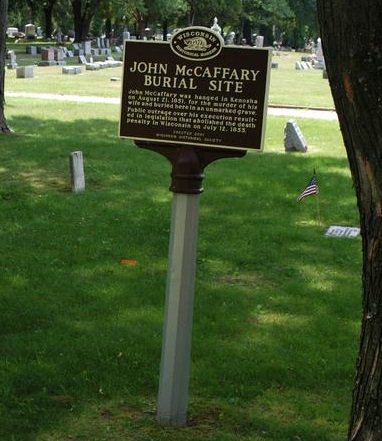
Burial marker for McCaffary in Kenosha’s Green Ridge Cemetery, erected in 2001. ((cc) image from Matt Hucke.) The McCaffary house on Court Street is also a registered historic landmark, and possibly haunted by Bridgett’s ghost.

There’s a handy roundup of resources related to the McCaffary execution here.

* The present-day name. Kenosha was then known as Southport.

** According to Invitation to an Execution: A History of the Death Penalty in the United States, there was an 1868 Wisconsin execution under Oneida (not Wisconsin) law, conducted on tribal lands.

† Said typewriter also debuted the now-standard QWERTY keyboard layout.

On this day..

1850: Five Cayuse, for the Whitman Massacre

On this date in 1850, five Cayuse were publicly executed in Oregon City for the Whitman Massacre.

Beginning in earnest in the 1830s, Anglo settlement in the Oregon Country presented for the native inhabitants of the Pacific Northwest the same Hobson’s choice that had confronted tribes further east long before: resist or accommodate.

The New York-born couple Marcus and Narcissa Whitman* were two of the most notable figures among the hundreds, and then thousands, of settlers pouring into the territory every year. In 1836, they founded on the banks of the Walla Walla River a Christian mission to the nomadic Cayuse who roamed the territory. It’s in present-day Washington State, which was then part (with the current U.S. states of Oregon and Idaho) of a single frontier territory collectively known as Oregon.

The Whitmans’ early settlement, offering medicine, education, and (of course) proselytizing, proved a success at first; it would become for several years a waypoint on the developing Oregon Trail.

White diseases came with the settlers.

The Cayuse people had already dwindled (pdf) to just a thousand or two after the decimations of smallpox and other plagues swept the region in the decades preceding. Now, outbreaks of measles were ravaging those remaining.

Marcus Whitman, a doctor as well as a spiritualist, proved unable to check the new epidemic. Rumors went abroad that the missionaries were bewitching or poisoning the Cayuse, as the vanguard of a coming territorial conquest; the Whitmans themselves were very keen to the hostile feeling the situation had engendered and had even heard whispers that they were the targets of assassination plots. Bravely, they stayed.

“Perhaps God thought it for the best that your little child should be called away,” Narcissa Whitman said in strange consolation to the grieving mother of an Anglo child who also succumbed to measles in 1847. “It may calm the Indians to see a white child taken as well as so many natives, for otherwise we may all be compelled to leave within two weeks.” (pdf source, op. cit.; this document also reconstructs a detailed narrative of the unfolding tragedy)

But that remark was only days before the terrible November 29, 1847. On that cold autumn Monday, a small party of Cayuse led by a chief named Tiloukaikt fell on the mission and slaughtered both Whitmans plus another 11** inhabitants of the little compound.

Some 54 surviving women and children were taken hostage, and several of these died in custody as well. A Canadian official of the Hudson’s Bay Company hurried to ransom the captives at the price of 62 blankets, 63 cotton shirts, 12 muskets, 600 loads of ammunition, 37 pounds of tobacco, and a dozen flints.†

This quick response might have forestalled a worse tragedy for the missionaries — but as far as the Cayuse went, the die was already cast. A volunteer militia of Oregonians under Cornelius Gilliam soon mobilized to retaliate, driving many Cayuse into the Blue Mountains.

By mid-1848, spurred in part by the Whitman bloodbath, Congress officially incorporated the region as the Oregon Territory; arriving early in 1849, the new territorial governor Joseph Lane immediately opened negotiations with the Cayuse to hand over the perpetrators of the massacre. With federal troops arriving later in 1849, the Cayuse at last capitulated and gave up five warriors: Tiloukaikt, the leader; Tomahas; Kiamasumpkin; Iaiachalakis; and Klokomas. (There are numerous alternative transliterations of these names.)

They were tried in Oregon City, the territorial capital at the time — a town of 500 or so on the Willamette River Falls — in a landmark case: the first proper death penalty trial in the young territory.‡ This would fall a little short of modern standards, and not just because it was held in a tavern for want of a regular courthouse. The prosecution was not especially rigorous linking all the defendants to specific violent acts, but the defense’s recourse to Cayuse cultural practices that held shamans liable for the failure of their medicine conceded the point by implication. The judge‘s final instructions simply directed his jury to “infer” the defendants’ culpability by virtue of “the surrender of the Defendants by the Cayuse nation as the murderers, the nation knowing best who those murderers were.” So why even have the trial? Kiamasumpkin, against whom no evidence was ever individually presented, went to the gallows insisting that he didn’t even arrive to the Whitman Mission until the day after the massacre.

All five were condemned in the end, and executed by prominent early pioneer and lawman Joe Meek.§ “On the 3d of June an election and a hanging match took place at Oregon City,” ran the Aug. 22, 1850 story in the New York Tribune — for the Whitman massacre had been a matter of national interest. “The town was full of men and women, the former coming to see how the election resulted, and the latter to see how the Indians were hung.”

“Their tribe, the Cayuses, gave them up to keep peace with the whites. Much doubt was felt as to the policy of hanging them, but the popularity of doing so was undeniable.”

Fears that the quintuple hanging would stoke a running conflict with the Cayuse were not altogether misplaced, but over the subsequent years the dwindling tribe was simply dwarfed by over 30,000 newly arriving settlers lured by a congressional grant of free land. By 1855, the defeated Cayuse were forced onto the small Umatilla Reservation, ceding (along with the Umatillas and the Walla Wallas) 6.4 million acres to whites. The Cayuse tongue was extinct by the end of the century.


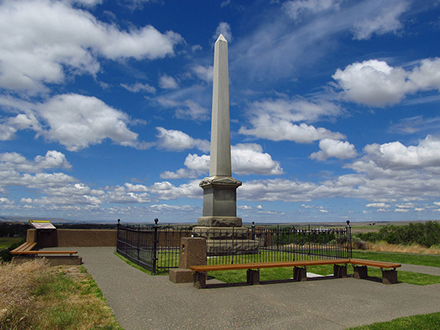
Present-day memorial obelisk at the site of the Whitman Massacre, now a national historic site. (cc) image from Jasperdo.

* Present-day Whitman College (Walla Walla, Wash.) is named for them.

** Figures of both 13 and 14 (inclusive of the Whitmans) are cited in various places for the Whitman Massacre’s body count; the discrepancy turns on whether one’s tally includes as a casualty Peter Hall, who escaped from the mission, fled to Fort Walla Walla, and then made a panicky attempt to reach The Dalles. Hall disappeared into the wilderness, and was never heard from again.

† Ransom covered gratis by the Hudson’s Bay Company.

‡ The Espy file‘s index of U.S. executions lists only a couple of undated executions many years before under informal frontier justice.

§ Cousin to the recent First Lady Sarah Childress Polk.

On this day..

1851: Sarah Chesham, poisoner

(Thanks to Meaghan Good of the Charley Project for the guest post. -ed.)

On this date in 1851, 41-year-old Sarah Chesham was hanged before a crowd of six to seven thousand people in Chelmsford, England. She’d been convicted of a single count of attempted murder, but the evidence indicates, and the public certainly believed, that she was responsible for several deaths and had perhaps even taught her deadly craft to other women.

Sarah lived in the village of Clavering in Essex. In January 1845, two of her six children died suddenly, one after the other, and were buried in a single coffin. Their deaths were written off as cholera, a common and deadly disease in those times. Yet, according to later accounts, just about everyone in Clavering knew the boys had been murdered.

In fact, Sarah’s reputation as a poisoner had been well known long before her sons’ untimely deaths.

In spite of the rumors, no action was taken until later that year — when Sarah was arrested on the charge of poisoning a friend’s illegitimate baby, a boy named Solomon Taylor. Solomon had been born healthy and thrived for the first few months of his life, but in late June 1845 he became sick, rapidly wasted away and died. His mother accused Sarah of murder.

Suspicious, the authorities exhumed the bodies of ten-year-old Joseph and eight-year-old James Chesham.

The boys’ corpses turned out to be saturated with arsenic.

James C. Whorton, in his book The Arsenic Century: How Victorian Britain was Poisoned at Home, Work and Play, describes what happened next:

An inquest quickly led to Chesham being indicted for murder, and she was brought to trial in the spring of 1847. The evidence against her seemed conclusive: her sons had arsenic in their bodies, police had found “an assortment of poisons” in her house, and during the trial there were clear attempts to coerce witnesses not to testify against her. Sarah Chesham was nevertheless acquitted of all charges.

The jury’s foreman for Joseph’s case explained, “We have no doubt of the child having been poisoned, but we do not see any proof who administered it.” After all, no one had actually seen Sarah giving arsenic to her sons.

After her trials for the murders of James and Joseph Chesham, Sarah was tried for Solomon Taylor’s murder. Again she was acquitted; there was no evidence of poison in the infant’s body. Whorton records,

The verdict struck most observers as outrageous, but even if it was correct, something very disturbing was going on. The woman’s neighbors had believed her to be spreading poison for years, yet had uttered not a word to authorities. “What is to be said,” a newspaper asked, “of a district where cold-blooded murder meets with all the popular favor which is shown to smuggling in Sussex?”

One can’t help but think of the many incidents in modern times when “everyone knew” about the child abuse going on in some local household, but nobody bothered to report it until after a tragedy occurred.

Chesham was released from custody, went home and resumed her life. Then, in 1849, her husband died. He had much the same symptoms his dead sons had, but suffered a great deal longer: it took months for him to die.

During his illness, the solicitous Sarah was constantly by his side. She gave him milk thickened with rice or flour and wouldn’t let anyone else feed him anything.

After Richard Chesham’s death, authorities seized a sack of rice from Sarah’s kitchen. It was contaminated with sixteen grains of arsenic. (Two or three grains can kill a healthy adult.) Richard had arsenic in his body as well, but only in traces.

Although her latest alleged victim had died, Sarah was charged only with attempted murder: Richard suffered from pulmonary tuberculosis and it was unclear whether it was the arsenic or the lung disease that caused him to die. (It’s theorized that Sarah, having learned something from her earlier trials, had poisoned her husband slowly in small doses rather than in one dose all at once, as she allegedly did with her children.)

The punishment was the same either way: death. Sarah would be the last woman in Britain to be hanged for attempted murder.

Sarah Chesham may have wanted to rid herself of an inconvenient husband, perhaps reasoning that he would die of consumption anyway so she might as well speed him along. In some other fatal poisonings in Essex during that time period, however, it appears the motive was the deceased’s burial club money.

Club Dead

Many of England’s poor and working-class subscribed to burial clubs for themselves and their families. These were a form of life insurance and meant to provide money for the funeral if a member died, thus sparing the person from a pauper’s grave or worse, the anatomist’s dissecting table.

Some people, however, subscribed for different reasons, as Whorton noted:

Yet there were, inevitably, some subscribers who were not at all averse to a child or spouse receiving a pauper’s send-off, and if sufficient economies were adopted in their disposal, there would be enough money left over to make murder worthwhile … If done right, profits were not inconsiderable. First of all, club dues were affordable for virtually anyone … Second, benefits were relatively generous. Manchester clubs, for example, paid out £3 as a rule, but some paid £4 or even £5; a basic funeral for a child could be financed for only £1 or £2.

Provided they came up with the money for subscription fees, there was nothing stopping people from joining multiple burial clubs at the same time and getting a big fat payout upon their relative’s untimely death. Wharton mentions one child from Manchester who belonged to nineteen burial clubs at once.

Poisoner Mary May, who was convicted of killing her half-brother and hanged in 1849, had subscribed to multiple burial clubs without her victim’s knowledge. After she poisoned him she got £10 in all. Some people got double or triple that sum. And this at a time when an unskilled laborer could expect to earn only about £27 annually.

Cases like Sarah Chesham’s and Mary May’s set off a moral panic about poisonings in the 1840s and 1850s. As the London Medical Gazette noted, twopence could buy enough arsenic to kill one hundred people.

The press had everyone convinced that hundreds, perhaps thousands, of people were poisoning others for profit. Newspapers devoted a great deal of space to poisoning trials and speculated that these cases were only a few of a “multitude” of murders that went unpunished — and that this multitude was growing. Jill Ainsley wrote about this at length and says,

According to the press, the bodies subjected to forensic examination represented the tip of the iceberg of poisoned corpses. Poison narratives routinely assumed that poisoners were caught only once their lethal practice was well established. Once a particular individual was suspected in one death, their pool of alleged victims automatically expanded to include anyone else they had contact with who subsequently died. The implications of references to large families “all of whom were dead” were clear to regular readers of crime reports.

Women in particular were liable to suspicion.

In fact, the papers alleged that in Essex there was a “secret society” of female poisoners who conspired together to murder people with arsenic, and that the general public was aware of the situation and accepted it. There is no actual evidence that such a conspiracy existed, never mind that it was condoned by the locals.

It is true that the number of prosecutions in poisoning cases rose during this time period, but that was probably because of the application of the Marsh test, invented in 1836 by chemist James Marsh.

The Marsh test was the first reliable test for arsenic in the human body and it was extremely sensitive. Before that, just about the only way to figure out if something was poisoned was to give some of the suspect substance to a dog and see if it died.

Arsenic during the nineteenth century was cheap, plentiful and used in a myriad of things, from wallpaper coloring to makeup to sheep dip. In small amounts it made a good rat poison, and that’s usually what it was used for.

Since it came in the form of a grainy white powder that could easily be mistaken for flour, salt or sugar, a lot of people got poisoned — not all of them intentionally, either.

There were not a few suicides and many, many accidents. Ainsley, who studied the Essex poisonings at length, believes it’s entirely on the cards that the arsenic that killed James and Joseph Chesham got into their systems accidentally.

It was partly due to the notoriety of Sarah Chesham’s crimes that the British parliament passed the Sale of Arsenic Regulation Bill in 1851. The law required arsenic sellers to record the name of each buyer and to sell it only to people they knew personally. It also required arsenic to by dyed some other color so people would no longer mistake it for food.

Getting back to Sarah: after her execution, her family was permitted to claim her body for burial in the local churchyard. But before the internment could take place, the body was stolen, probably for dissection, by a person or persons unknown. It was never recovered.

Part of the Themed Set: Arsenic.

On this day..

1857: Jean-Louis Verger, doctrinaire

On Saturday, January 3, 1857, the Archbishop of Paris Marie-Dominique-Auguste Sibour had just reached the church of Saint-Etienne-du-Mont when Jean-Loiuis Verger stepped out of a crowd — out of obscurity — and plunged a long Catalan knife fatally into Sibour’s chest.

The assassin Verger (English Wikipedia entry | French) was a 30-year-old ordained priest who had accumulated a quarrelsome reputation among his ecclesiastical peers. The previous year, he had been laid under an official interdiction for preaching against the Catholic Church’s controversial new doctrine of the Virgin Mary’s Immaculate Conception.

Some reports had Verger crying out “No goddesses!” as he daggered the archbishop. “It is nowise the person of the Archbishop of Paris whom I wished to strike, but, in his person, the dogma of the Immaculate Conception,” Verger told the magistrates who judged him within days. There wasn’t a whole lot of doubt about the trial, so why wait around? But Verger’s vendetta wasn’t only theological; his suspension meant he wasn’t getting paid, and as his fury mounted over it he went so far as to post himself at the door of a church with a placard proclaiming that he was starving.

Archbishop of Paris was a surprisingly dangerous job in the mid-19th century. Sibour got the post because his predecessor was shot dead negotiating at a barricade during the 1848 revolution; in 1871, Archbishop Georges Darboy was taken hostage by the Paris Commune and executed by his captors when the national government invaded the city.

On this day..

1855: Emmanuel Barthelemy, duelist

The winner of England’s last fatal duel was hanged at Newgate on this date in 1855 … but not for the duel.

Both participants in that duel, Emmanuel Bart(h)elemy and Frederic Cournet, were French emigres* who had commanded Parisian barricades during the 1848 revolution.

On its surface the duel was one of those trivial affairs of honor: Barthelemy heard that Cournet (otherwise unknown to him) had repeated some defamatory rumors about Barthelemy already abroad in France, and challenged Cournet on that basis; Cournet at first dissociated himself from any such smears, but upon better consideration thought he considered Barthelemy’s notice a little on the ultimatum side and took exception to that.

The consequent set-to was delayed some time by negotiations over every element of its ceremony. When at last it was arranged, it unfolded thus:**

it should commence with pistols, the combatants, being 40 paces apart, advancing 10 paces before firing if they chose, and having two shots each, miss-fires not counting; that the choice of position, the choice of pistols, and the signal for firing should be determined by tossing up; that if the pistols proved ineffectual swords should be resorted to to terminate the affair.

Cournet won the toss and got to choose his position and take the first shot. Barthelemy had to stand stock-still as Cournet

advanced his 10 paces and fired, but though on 14 similar occasions he had never failed to hit his opponent this time he missed. Barthelemy then told him that he had his life in his hands, but would surrender his right to fire if Cournet would agree to terminate the duel with swords. [Barthelemy had wanted swords to be the dueling weapon in the first place -ed.] Cournet declined to do so, saying that he would stand his adversary’s fire and take his second shot. Barthelemy then levelled his pistol, but … it snapped. He put a fresh cap on and it snapped a second time,† and it was then agreed that he should use Cournet’s pistol, which was loaded and handed to him. Before discharging it, however, he again offered ineffectually to terminate the contest with swords. He then fired, and with fatal precision.

Barthelemy himself and all four of the seconds involved (both Barthelemy’s and Cournet’s) were arraigned in this case, but the jury returned only a manslaughter verdict. Barthelemy served a few months; he would have to exercise fatal precision once again to find a different route to the scaffold.

In his non-duelling life, Barthelemy was a mechanical engineer, and it was in this capacity that a soda-water manufacturer named George Moore employed him to repair his machinery at 73 Warren Street, just off Fitzroy Square.

Late the night of Friday, December 8, Barthelemy showed up with a veiled woman at the place and asked for Moore. Minutes later, the servant-girl saw all three emerge struggling violently together from their private meeting. As she raced to the door to scream for help she saw the Frenchman raise a pistol and fire …

“Murder!”

Her screams started attracting the neighbors as Barthelemy burst past her, but an iron gate in front of the house obstructed him. Before more people could assemble he fled back into the house and locked it shut behind him.

Moore’s neighbor, a former East India Company man named Charles Collard, thought quickly to his own grief. Collard raced around the back side of the house where a garden opened onto another street, and arrived just in time to catch Barthelemy vaulting over the garden wall. Collard pounced on him, and in the ensuing melee Barthelemy shot him, too.

This was all too late for Barthelemy, for the delay had brought an onrushing of neighbors and passersby who quickly subdued the gunman. Somehow — nobody quite knew how — his companion was nowhere to be found. She had vanished from the house leaving only her veil, and as she had surely not escaped by the front gate it was thought that she must have found some way to slip out the back casually amid the commotion and made a nonchalant escape. She was never seen again.

Moore was found quite dead in his home: he’d been shot through the head, and the marks on his body indicated that the fatal wound had been preceded by some whacks with a cane. Collard lingered on many hours in agony — long enough for his captured murderer to be brought before him and Collard to deliver a signed j’accuse identifying Barthelemy as the villain.

Barthelemy must have had a way with jurors because even in convicting him for murder on this occasion, the panel still recommended mercy. There seems to have been some thought that the mysterious dispute in the house might have been a spontaneous affair qualifying as manslaughter, while the murder of Collard might have passed (since Collard grabbed Barthelemy) as self-defense. The crown unsurprisingly did not share this exceptionally generous view of a man who had already been in the dock for homicide in the past and declined to extend mercy.

Barthelemy disdained the religious entreaties of his captors, scandalizing the right-thinking with bon mots like “it is no use to pray to God, as God will not break the rope.” Indeed, He did not.

* It was perhaps fitting that Frenchmen, a people with an abiding enthusiasm for the duel, who transacted this milestone encounter. En garde!

** Per the London Times of Oct. 28, 1852, summarizing evidence presented in court.

† Upon post-duel examination it emerged that Barthelemy’s pistol had failed to discharge because of a bit of linen rag stuck in the breach. This eyebrow-raising fact gave rise to the suspicion of foul play, though on whose part and to what end is less distinct. Both guys ended up with a shot at one another with the exact same pistol. Cournet just missed his.

On this day..