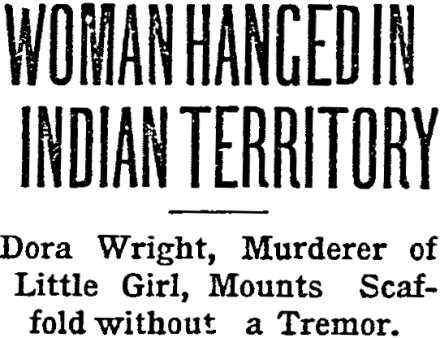
1903: Dora Wright, in Indian Territory

On this date in 1903, Dora Wright was hanged at McAlester in Indian Territory — the present-day U.S. state of Oklahoma.

Wright beat and tortured to death a 7-year-old orphan in her charge named Annie Williams. Wright tormented the little girl over several months until she finally succumbed to a thrashing in February 1903. It was, the local paper said, “the most horrible and outrageous” crime in memory in the area; Wright’s jury only needed 20 minutes’ deliberation to condemn her.

As Oklahoma was yet four years shy of statehood, “Indian Territory” jurisdiction — and with it any decision on executive clemency — fell to U.S. President Theodore Roosevelt. The inclination of the Rough Rider is aptly conveyed by the words of Attorney General Philander Knox‘s brief on the case to the President, which were released for press consumption:

The real facts in this case are that this woman tortured to death a little child seven years old, her niece, whom she was pretending to care for and support. She whipped the child most unmercifully with large switches, struck it about the hand and face so as to cause wounds sufficient to produce death, burned holes in its legs and thighs with a heated poker, and committed other nameless atrocities upon the person of the child. The testimony shows that the woman pursued a course of cruelty which was fiendish and barbarous … The only ground upon which her pardon is sought is that she is a woman, and that the infliction of the death penalty upon a woman would be a shock to the moral sense of the people in the community.

T.R. was incredulous at the feminine special pleading.

“If that woman was mean enough to do a thing like that,” Roosevelt said, “she ought to have the nerve to meet her punishment.”

Wright did have that nerve in the end, and was noted for the calm with which she comported herself on the scaffold. (She was hanged alongside another fellow, Charles Barrett, who shot a man dead in a robbery.)


From the Duluth (Minn.) News-Tribune, July 18, 1903.

On this day..

1900: Bill Brown, Sonnie Crain and John Watson

(Thanks to Meaghan Good of the Charley Project for the guest post. -ed.)

On this date in 1900, Sonnie (or Sonny) Crain and William “Bill” Brown, both 40, and John Watson, 59, were hanged side by side a quarter-mile from the Warren County Jail in McMinnville, Tennessee.

This was an integrated execution: Brown and Watson were white, and Crain was black.


From the April 27, 1900 American Citizen (Kansas City, Mo.)

The gallows was contained in a 30-by-30-foot enclosure and had been built especially for this day’s event. There were twenty official witnesses. A crowd of about two thousand waited outside the fence, hoping to catch a glimpse of the execution, but their view was obscured by a canvas curtain drawn hanging from the top of the gallows.

John Watson

Watson, a Civil War veteran who’d fought at Shiloh, had committed his crime on December 21, 1898. He shot a neighbor, 40-year-old James Hillis, white, after an argument about some corn and some fence rails.

Hillis walked away from the fight. Watson fetched his shotgun, waited for his chance then shot Hillis on the road that evening, in front of the victim’s daughter. Hillis lived for a few hours after the shooting and named Watson as his attacker.

The killer had a reputation for violence; he’d allegedly shot and seriously wounded a black man in a drunken rage in 1893, but was acquitted at trial. He had also served a term in federal prison for making and selling moonshine, and he was stone drunk on his own apple brandy at the time of Hillis’s murder.

His defense, one of temporary insanity caused by alcohol, didn’t fly with the jury.

Bill Brown was an illiterate tenant farmer; his victim was his wife of ten years, Mary Fults Brown. Bill was tired of his wife and attempted to leave her, but everywhere he went she just followed him. He and his brother, John “Bud” Brown, decided she had to die.

On May 5, 1898, In accordance with the plan, Bill invited a friend, Bill Rogers, to spend the night. Bill made sure to leave the door unlocked, and while Mary and the guest were sleeping, Bud Brown sneaked into the house, shot his sister-in-law and fled. Bill then woke up Rogers, crying, “Lordy, lordy, someone’s shot Mary!”

Bill told Rogers the shooter had fired through the open window, but this didn’t make sense because Mary had been asleep beside her husband and Bill was lying between her and the window. He claimed he didn’t own a gun, but a search of the house turned up a recently fired pistol hidden in a trunk.

It didn’t take long for Bill to crack. He confessed to his role in Mary’s death and implicated his brother Bud (who, incidentally, had a prior record for beastiality with a mare).

The brothers were to be tried separately and Bill went first. He was convicted and sentenced to death, but his conviction was appealed on the grounds that one of the jurors had mistakenly believed he was sitting at the trial of Bud Brown, not Bill Brown. (Like Sauron and Saruman, they’re easily confused.)

Seriously?

The appeals court judge couldn’t believe it when Bill’s attorney made this ludicrous assertion, and threatened to hold him in contempt for making a mockery of the proceedings and wasting the court’s time. Then Bill’s attorney brought in the juror in question, who admitted his error. (The confusion arose in part because Bill and Bud, neither of whom testified at the trial, were sitting next to each other at the defendant’s table.)

While Bud Brown was awaiting his first trial, Bill was waiting his second trial, and John Watson was awaiting the outcome of his appeal, they were all housed in a jail cell with Sonnie Crain.

Crain had been convicted of second-degree murder for shooting Will Snellings in a dispute over a craps game, and was sentenced to ten years in prison. He was housed in the jail while his case was under appeal.

On May 22, 1899, as the Brown brothers slept, Crain bludgeoned them both in the head with a piece of his bed, killing Bud and critically injuring Bill. He later said the brothers had threatened him and he’d acted in self-defense, but the authorities had another theory as to motive.

The jailer was away at the time of the murder and had placed his wife in charge, and there was some evidence that Watson and Crain had conspired together to murder their cellmates in order to create a diversion so they could escape when the jailer’s wife came to get Crain.

Crain (who denied any plan to escape from jail and insisted to his dying breath that he’d acted in self-defense) was convicted of Bud Brown’s murder and sentenced to death. Although Bill Brown’s wounds were very serious and he was not expected to live, he recovered from his injuries in time to be hanged alongside the man who’d tried to kill him and the other man who’d possibly conspired in his attempted murder.

So now that no one is confused … the three ultimately set to die in this labyrinthine affair were hanged at 11:50 a.m. on April 25, attended by two black ministers and two white ones. Crain and Brown were stoic, but Watson’s nerves failed him on the scaffold and he cried and shook as the noose was placed around his neck.

It was the last public(ish) hanging ever in McMinnville.

On this day..

1907: Emile Dubois, Valparaiso popular saint

On this date in 1907, Emile Dubois was shot in Valparaiso, Chile for murder.

The French-descended Dubois (English Wikipedia link | Spanish) was credited with a string of homicides in Valparaiso spanning 1905-1906. (Although the first murder attributed to him, and the only one he was formally convicted of, was that of an accountant in Santiago.)

The official version of our man’s career is roughly this: in September 1905, he killed a merchant named Reinaldo Tillmanns; in October, he killed another one named Gustavo Titius — robbing both.

The following April, he stabbed the French trader Isodoro Challe, although he did not rob him. In June, he attacked an American dentist in his office, although the dentist fought him off and the assailant fled.

All this was rolled up into the indictment when “Emile Dubois” was finally captured that summer. This was the name he gave, but his Colombian documents were sketchy; his real name might have been Luis Amadeo Brihier Lacroix, or heaven knows what else.

The crime spree alone would be interesting enough for this site, but it’s really the least interesting thing about this unusual man.

Dubois exerted a curious magnetism. He was handsome, certainly, but more than that: he was gracious, impossibly serene in the face of the dangerous charges against him, and his adherence to his innocence was calm and unshakable. Dubois’s intelligence was impossible to miss; he spoke ironically with inspectors, like their fellow-man instead of their prey. “He had ideas above those of a common criminal,” wrote one biographer. (Spanish link)

His long time loose on his crime spree — if indeed the attributed crimes were really all his — had served to direct popular scorn at the police who were unable to locate the criminal. At the same time, the victims in these cases were wealthy foreign “usurers” with limited purchase on public sympathy. (Especially as Valparaiso endured a natural disaster.) Meanwhile, in the courtroom itself, Judge Santa Cruz was so convinced of Dubois’s guilt that he cut a vindictive Javert-like figure hounding the accused to his death.*

Guilty or innocent, the wry and gentlemanly Dubois compared very favorably to the other characters in his drama.

Dubois played the part unerringly to the last, when he declined a blindfold and unpertubedly puffed a cigar as he faced his four-man firing detail with open eyes and the command “¡Ejecutad!”

Dubois’s last statement reasserted his innocence without vitriol or bitterness. “It was necessary that someone be held responsible for these crimes, and that someone was me,” he said. (More Spanish)

Then he died.

And after that Christ-like exit, he lived.

Dubois, who was obviously an utter obscurity prior to his arrest, went on to a surprising posthumous life as a popular folk saint. His brightly-painted grave in Valparaiso is a pilgrimage shrine forever crowded with votive offerings from followers convinced of Dubois’s powers of divine intercession (and, accordingly, his innocence).

* Dubois to the priest sent to confess him before execution: “You should be taking the judge’s confession, not mine. The judge who ordered my murder. Go inspire his repentance.” (Source)

On this day..

1909: C.Y. Timmons

(Thanks to Meaghan Good of the Charley Project for the guest post. -ed.)

Minutes after midnight on this date in 1909, an Oregon plasterer named C.Y. Timmons was hanged at the state prison in Salem, Oregon for the murder of Estella, his wife of two years.

On October 21 the previous year, he had put an ax in the back of her head, slit her throat from ear to ear with a straight razor and then attempted to take his own life with the same razor. The two were discovered by the neighbors at 7:30 the next morning when a partially unclothed C.Y. came knocking on their door, “covered in blood from head to foot.”

C.Y.’s wound, as R. Michael Wilson explains in his accounting of the case in Legal Executions After Statehood in North Dakota, South Dakota, Wyoming, Montana, Idaho, Washington and Oregon, was serious but not fatal, and it responded to medical treatment: “The gash had missed the veins and arteries but had severed the trachea, but it had sealed and prevented him from drowning in his own blood.”

Timmons quickly regained his ability to speak and told authorities Estella had cut his throat while he was sleeping. He grabbed the razor from her hand, slit her throat in self-defense, and then finished her off with an ax. Then he lay down and waited until dawn before he went and asked for help.

The truth came out, however, and at his trial in mid-January 1909, C.Y. admitted that he’d gone round the bend with jealousy over his younger wife’s* affair with one Robert Hornbuckle. C.Y. and Estella had been quarreling for a long time about her relationship with Hornbuckle. Only the day before the murder, the couple had met with an attorney to procure a divorce — a drastic measure in that day and age.

During the meeting, Estella told the lawyer that her husband had a violent temper, especially when he had been drinking, and that he had threatened her life on numerous occasions.

C.Y. apparently believed his victim’s alleged infidelity would outrage the jury into acquitting him. Not so; they deliberated a whopping 35 minutes before finding him guilty. C.Y. broke down in tears when the verdict was read. And, for what it’s worth, all evidence indicates that Estella’s “affair” with Hornbuckle existed only in her husband’s imagination.

C.Y.’s hanging was as gruesome as his crime, as Wilson records:

[A]t 12:31 p.m., the trap was sprung and Timmons dropped six feet, one inch. The force of the drop caused the neck wound to open and for some time the hanging figure breathed through the gaping wound beneath the rope, and the body was drenched with blood. The attending physicians differed on whether Timmons’ neck was broken in the fall, but later examination proved that the vertebrae had been dislocated. This complication, breathing through the open wound, prevented pronouncement of death until 12:54 p.m., and the body was allowed to hang another seven minutes to ensure he was dead.

The murderer was buried separately from his victim, at the Lee Mission Cemetery in an unmarked grave.

* Her age was given in different accounts as either 19 or 21; C.Y. Was 37. Another pathetic detail to her tragic life: Estella was an orphan, raised in an orphanage after her parents both died of tuberculosis.

On this day..

1902: Privates Edmond Dubose and Lewis Russell, deserters to the Philippine Resistance

“Hello, nig. Didn’t know you’d come. What do you think you’re going to do over here!”

“Well, I doan know, but I ruther reckon we’re sent over hah to take up de White Man’s burden.”

-Exchange between a white and a black soldier (respectively) deployed to the Philippines.*

On this date in 1902, two African-American U.S. Army privates were hanged before a crowd of 3,000 at Guinobatan, Philippines for deserting to the anti-occupation insurgency.

The 7,000 black soldiers deployed to put down Philippine national resistance against the American occupation faced an obvious conundrum: they were second-class citizens back home, fighting a savage war to keep Filipinos second-class citizens abroad.

Men in such situations have been known to square that circle by going over to join their fellow downtrodden.

In the Philippines,

Each black soldier resolved for himself the quandary caused by service against the insurrectos. Some, like Lieutenant David Gilmer, believed their unswerving dedication would ultimately improve the lot of all black people. Others simply reasserted their faith in America: “all the enemies of the U.S. government look alike … hence we go along with the killing, just as with other people.” But the Filipinos recognized the existence of the black soldier’s dilemma by advocating racial solidarity against white oppressors and by offering commissions to defectors.**

Here’s an example appeal the Philippine resistance made to black U.S. troopers (source):

It is without honor that you are spilling your costly blood. Your masters have thrown you into the most iniquitous fight with double purpose — to make you the instrument of their ambition and also your hard work will soon make the extinction of your race. Your friends, the Filipinos, give you this good warning. You must consider your situation and your history; and take charge that the blood of … Sam Hose [a recent lynch mob victim] proclaims vengeance.

It was very small numbers actually induced by such messages to go so far as desertion. Leave hearth and home behind forever to fight a guerrilla resistance on the far side of the world against an overwhelming empire liable to kill you on sight? That’s a difficult sell.

But there were some buyers. Some 29 known African-American deserters are known, according to E. San Juan, Jr., most famously David Fagen, an enlisted man in the U.S. Army commissioned a captain in the Filipino resistance. And others not prepared to go all the way over nonetheless understood the appeal. One African-American soldier wrote to a Filipino friend lamenting the sight of white Americans “establish[ing] their diabolical race hatred in all its home rancor in Manila … the future of the Filipino, I fear, is that of the Negro in the South.”

When the letter was found, its author, Sgt. Major John W. Galloway, was demonstratively busted to private and dishonorably discharged.

“One ever feels his twoness,” W.E.B. DuBois mused of the black American experience at about this time in The Souls of Black Folk. “An American, a Negro; two souls, two thoughts, two unreconciled strivings; two warring ideals in one dark body.”


Soldiers of the 9th Cavalry on Luzon Island.

Edmond† Dubose and Lewis Russell, whose firsthand voice we do not have, must have felt those unreconciled strivings, too. These two enlisted men slipped out of the 9th Cavalry‡ in August 1901 while that regiment was conducting anti-insurgency operations in Albay, and were next seen fighting with those same insurgents.

Captured, they were among approximately 20 U.S. soldiers death-sentenced for desertion.

General Adna Chaffee, a veteran of the U.S. Indian Wars and latterly fresh from crushing China’s Boxer Rebellion, approved the hangings — as did the U.S. President, Theodore Roosevelt. (Roosevelt later announced that future desertion cases would not be capitally punished, so Dubose and Russell were the only two executed for that crime during the U.S. war against Philippine independence.)

* Army and Navy Journal, XXXVII (Nov. 11, 1899)

** Michael C. Robinson and Frank N. Schubert, “David Fagen, An Afro-American Rebel in the Philippines, 1899-1901,” Pacific Historical Review, Vol. 44, No. 1 (Feb., 1975)

† Also called “Edward” by at least one press report.

‡ The 9th Cavalry was one of the original “Buffalo Soldiers” units.

On this day..

1909: Remy Danvers

On this date in 1909, French double-murderer Remy Danvers was guillotined in Carpentras.


From Le Matin, January 27, 1909.

Danvers, already a career criminal, signed on as a farmhand at age 22 in 1907 — a period when capital punishment in France was in abeyance owing to the presidency of a death penalty opponent who systematically blocked executions.

On February 1, 1908, he shot that farmer dead to steal some money he learned was available in the house … and for good measure shot his wife too, as she begged him on her knees for her life. He got caught trying to dump the burlap-sacked corpses in the Rhone. (Here’s a French-language summary, from the original Le Figaro report.)

Because of the de facto death penalty moratorium, Danvers didn’t sweat his death sentence too much. However, the outrages of the Pollet gang finally restored the guillotine to the French criminal justice scene earlier in January of 1909. Danvers turned out to be the very next victim in its path.

Shortly before the sentence was carried out, the public prosecutor appeared in Danvers’ cell to advise the doomed man of his appeal’s rejection, and the consequent imminent removal of his head. Fortified by rum, a visibly upset Danvers managed to get through it, but execution-starved French folk crowded a scene that authorities attempted to restrict. Someone snapped this photo:

The unruly public, the New York Times opined, “undoubtedly will hasten Parliamentary action toward making future executions private.”

That date was still some years away, but a France increasingly discomfited by its history of public executions did institute laws forbidding attendees from filming or photographing executions. (Those laws didn’t work, but there they were just the same.)

There’s more about Remy Danvers in this guillotine.cultureforum.net thread (French).

On this day..

1907: Three “terrorists” in an Odessa public garden

Chicago Daily Tribune Jan 18, 1907

Hang Terrorists in Public Gardens.

ODESSA, Jan. 17. — The public gardens was the scene of a triple execution today. Three terrorists were hanged in a row after having been condemned to death for the armed robbery of a shop. Their trial took place before a drumhead court martial.


New York Times Jan 18, 1907

ODESSA, Jan. 17. — The public gardens here to-day were the scene of a triple execution. Three Terrorists condemned to death for the armed robbery of a shop were hanged in a row. They obtained only $3.50 from the store they robbed.


This atrocity (derogated as “Field Courts Martial which endeavor to confuse ordinary civil offenses with revolutionary acts leading to the almost daily execution of offenders, who in civilized lands would receive only the most trivial sentences.”) appeared in a petition for the U.S. Congress to condemn the Russian crackdown against agitators in the waning 1905 revolution.

Mark Twain was among the worthies* who lent their name to the appeal:

We, the undersigned, believe that it is time for civilized nations to protest against the atrocities practiced by the Russian Government in its prolonged warfare against its own people.

The subject is one which interests all nations, as a matter of common humanity. On more than one occasion governments have taken action for the amelioration of termination of abhorrent conditions existing in foreign countries. Many instances might be cited, but we content ourselves, as sufficient for our present purposes in citing the case of the Bulgarian atrocities in 1877, when Russia, in taking advantage of the general horror excited by the inhumanities of the Turkish forces within the dominions of the Sultan, intervened in the name of humanity, to rescue the inhabitants of Bulgaria from their deplorable condition. Fifty years before, various European powers, of whom Russia was one, intervened to redeem the Greek inhabitants of the Sultan’s dominions from barbarities and oppression. In seeking now some entirely pacific means of inducing the Russian Government to ameliorate the condition of its subjects, we are asking for nothing which the Russian Government has not itself in times past afforded a good precedent.

This petition and protest rest solely and entirely upon the instances wherein the Russian Government is disregardful of the usual customs of civilized nations; and wherein it is guilty within its borders of flagrant violation of the terms of agreement of the Geneva Treaty of 1864 and 1868 between the Nations, and also the Second Convention of the Peace Conference at the Hague in 1902.

One notices that among the behaviors viewed by this petition’s congressional sponsors as “disregardful of the usual customs of civilized nations” when conducted by tsarist Russia were acts that in other times members of that august body would rise to defend: “Tortures are applied to prisoners within fortresses and prisons to elicit information.”

* Signers also included: New York judge Samuel Greenbaum; “Battle Hymn of the Republic” author Julia Ward Howe; explorer George Kennan (cousin of the famous American diplomat of that name); future Supreme Court Justice Louis Brandeis; and others.

On this day..

1900: John Filip Nordlund, Mälarmördaren

On this date in 1900, John Filip Nordlund was beheaded with Albert Dahlman‘s axe at Sweden’s Västerås County Jail.

The second-last person executed in Sweden (English Wikipedia entry | Swedish) was the author of an infamously fiendish murder spree aboard a ferry steamer crossing Lake Mälaren for Stockholm on the evening of May 16, 1900: shortly after the Prins Carl‘s departure from Arboga, Nordlund, armed with two revolvers and two blades, went on a rampage through the boat (Swedish link), shooting or stabbing everyone he saw.

The spree left five dead, including the ship’s captain, and several others wounded. Then Nordlund lowered a lifeboat into the water and rowed away with about 800 stolen kronor … and the opprobrium of the nation.


Nordlund stalks the Prins Carl, from this verse pdf (Swedish).

Police were able to track him from the descriptions of witnesses to a train station and arrest him the very next day. Their maniac would turn out to be a 25-year-old career thief, only released the month before from his latest prison stint.

Although captured trying to flee, Nordlund from the first projected resignation — even relief, writing his parents that he would be well rid of a society he had never felt part of. Certainly the sentence was in little doubt given the infamy of the crime (Nordlund was almost lynched after arrest), and the man made no attempt to defend himself or mitigate his actions in court, nor to seek mercy after conviction.

Nordlund was the third person executed in Sweden in 1900 alone, but there would be no more patients for Dahlman for a decade … until 1910, when Sweden conducted its first and only guillotining. The country has not carried out a death sentence since.

Besides being the penultimate executee in Swedish history, John Filip Nordlund is also the last man in Europe beheaded manually (rather than with Dr. Guillotin’s device) other than in Germany.

On this day..

1907: Evstolia Ragozinnikova

On this date in 1907* an audacious would-be suicide bomber was executed by tsarist Russia.

Thousands of Russians immersed themselves in the late 1900s in revolutionary struggle after the Romanovs bloodily stopped the 1905 revolution. So many of them were executed that the gallows became known as “Stolypin’s Necktie”, after the sitting Prime Minister.

Twenty-one-year-old conservatory pianist and singer Evstolia Ragozinnikova got involved in a plot to assassinate the said Stolypin. (It was only one among several such plots, one of which finally succeeded in 1911.)

But “Tolia” feigned madness and then escaped the psychiatric hospital where she’d been confined. She rejoined her Socialist-Revolutionary conspirators, some of whom tried to get her to flee to Milan to further her musical studies.

Instead of concert houses, Ragozinnikova raised the curtain on her magnum opus on October 28* with a bid to land a Guy Fawkes-like blow against the autocracy.

Communist-turned-anticommunist Whittaker Chambers would, much later, remember in his correspondence with William F. Buckley the power that deeds like Ragozinnikova’s had to inspire, notwithstanding Lenin’s eventually-orthodox disavowal of terrorism. For Chambers, it was not material immiseration but spiritual disinheritance, existential despair — the sort that made artists into suicide bombers — that was the true midwife of Communism.

I may presume in supposing that the name of Ragozinikova is unknown to you. But the facts are these. In 1907, the Russian government instituted a policy of systematically beating its political prisoners. One night, a fashionably dressed young woman called at the Central Prison in Petersburg and asked to speak with the commandant, Maximovsky. This was Ragozinikova, who had come to protest the government’s policy. Inside the bodice of her dress were sewed thirteen pounds of dynamite and a detonator. When Maximovsky appeared, she shot him with her revolver and killed him. The dynamite was for another purpose. After the murder of Maximovsky, Ragozinikova asked the police to interrogate her at the headquarters of the Okhrana. She meant to blow it up together with herself; she had not known any other way to penetrate it. But she was searched and the dynamite discovered. She was sentenced to be hanged.

Awaiting execution., she wrote her family: ‘Death itself is nothing, … Frightful only is the thought of dying without having achieved what I could have done How good it is to love people. How much strength one gains from such love.’

Chambers aside, she’s not so well attested on the English-lanuage Internet; there’s a bit about her in Russian here and here, as well as some references to both Ragozinnikova and her peers in an academic pdf, “Women in the World of Gender Stereotypes: The Case of the Russian Female Terrorists at the Beginning of the 20th Century” by Nadezda Petrusenko in International Journal of Humanities and Social Science, April 2011.

* Gregorian dates. By the local Julian calendar in Russia, she committed her murder on October 15, and was hanged on October 18.

On this day..

1900: Coleman Gillespie

(Thanks to Meaghan Good of the Charley Project for the guest post. -ed.)

The story behind Coleman Gillespie’s execution on this day in 1900 actually begins on February 21, 1856: on that winter’s day, a small group of hostile Rogue River Indians murdered more than half of Christina Edson’s family at their home in what would become the state of Oregon.

The victims included John Geisel, Christina’s husband of 13 years, and their sons Andrew, 5, Henry, 7, and John, 9.

Christina, her three-week old infant Annie and her thirteen-year-old daughter Mary were spared and force-marched into captivity at an Indian camp twelve miles away. Along the way they had to pass the burning houses and dead bodies of their neighbors. 24 people were killed and 60 homes burned in all.

The pioneers wanted vengeance and they got it: the rebellious Indians were defeated in May 1856 and mobs lynched more than a dozen of them, including the man who betrayed the Geisel family. In July of that year, more than 700 Indians were forced to relocate to two different reservations.

All in all, it was a terrible tragedy.

And four decades later, indirectly, it claimed its last victim.

Long-suffering: Christina Edson

Christina, somehow, put her life back together after surviving two weeks in captivity with her daughters. She never had any more children, but she remarried three times (divorcing twice, and being left a widow with her final husband’s death in 1883).

In 1887, Christina filed a claim with the federal government seeking compensation for the loss of her first husband and sons and their farm, which the Indians had burned down. It took twelve years to get through all the red tape. In the end her application was successful and she was granted a monthly pension.

Christina turned 77 years old in 1899. Although her grown-up daughters wanted her to move in with them, she cherished her independence and lived alone in a cabin in Gold Beach, Oregon. Her very first pension check, for $75, arrived Monday, September 18, 1899.

On September 19, her cabin burned to the ground.

The postman found her charred corpse lying sprawled on her bed in the ruins. She’d been tortured and strangled. The fire was arson, and authorities presumed Christina had been killed for her money; her pension check was missing.

The brutal murder of this elderly pioneer horrified the community. As Diane Goeres-Gardner explains in her book Necktie Parties: Legal Executions in Oregon 1851-1905,

Christina Edson had seen her husband and sons tortured and burned by the Indians. The savages could be excused because they were fighting for their rights to the land they once owned. [Christina’s murder] was even more horrifying because it was done in cold blood for a few dollars.

The police got a lead when the check was cashed in Roseburg by one C.O. White, who was brought in for questioning. He said he’d bought the check at a discount from Coleman Gillespie, a known criminal with two prior convictions for theft.

Arrested a few days later, Gillespie quickly broke down and confessed in writing to Christina Edson’s murder. He named his co-conspirator as Charles Strahan, a commercial salmon fisherman who had mysteriously disappeared. There were rumors that he’d tried to flee the area but had drowned in the Rogue River, and other reports that he’d drowned in an ordinary fishing accident: whatever the case, he was never seen again, neither alive nor dead.

Authorities thought the fisherman a red herring — that Gillespie had acted alone and, having heard of Strahan’s disappearance, tried to share the blame with the convenient phantom. Gillespie’s statements about Christina Edson’s murder over time evolved to shift ever more responsibility onto the missing “accomplice”, until Gillespie was all but denying his own presence at the murder scene. He didn’t really seem to realize that, at the end of the day, he was legally just as guilty whether or not he himself had done the killing.

He found out on August 23, 1900, when he was condemned to die for robbery and murder.

When Coleman Gillespie was hanged six weeks later — the first and last legal execution in Curry County — his neck didn’t break. He expiated every penny of the discounted $75 pension check slowly strangling at the end of the rope.

On this day..