1908: Khudiram Bose, teenage martyr

The investigations following upon the recent raids on Anarchist dens here prove the existence of a revolutionary plot on a vast scale and show that there was a systematically organized “college” … where bombs were manufactured and instruction in explosives was given … The prisoners talk freely of their “heroic conduct” and “noble design,” while refusing to impart any informaton incriminating those working behind the scenes and furnishing the funds. They all confess, however, that their minds have been fired by writings in the Press and speeches on platforms.

London Times

It’s a timeless story, really; with a tweak here or there, the excerpt above could do for reportage on seditious movements by the hundredfold. As it happens, its dateline is May 11, 1908 — Calcutta.

Separatist stirrings on the subcontinent were then manifesting themselves in the explosive revolutionary language of the day, and the chief magistrate of that ancient city of Calcutta — Kingsford by name, as in charcoal — was a character notorious for his harshness toward the movement. The year before, he’d had a 15-year-old flogged for trying to stop a British soldier beating Indian activists.

Among the more militant types excited to wrath against Kingsford was an 18-year-old Bengali who would have the privilege of martyrdom for the cause of national self-determination.

Khudiram Bose sought the judge out in Muzaffarpur and, with another young revolutionary, attempted to assassinate him in April 1908 by tossing a couple of bombs into Kingsford’s carriage.

Minor problem: it was the wrong carriage.

Instead of popping the nefarious judge, the bombs killed the wife and daughter of a barrister.

The other assassin committed suicide when cornered by police, but Bose would meet his end via the judiciary.

Bose played his patriotic martyr’s role to the hilt in the few brief weeks before his hanging, and found himself on the leading edge of a growing movement of anti-British bombers. “People are prepared to do anything for the sake of swarajya [home rule] and they no longer sing the glories of British rule,” one contemporary newspaper (quoted here) put it. “They have no dread of British power. It is simply a question of sheer brute force.” The editor was convicted of seditious libel.

One can now find plentiful Khudiram Bose hagiographies celebrating the youthful freedom fighter … regardless of his target selection.

On this day..

1905: Chief Zacharias Kukuri

On this date in 1905, in the midst of Germany’s genocidal destruction of the Herero people in its Southwest Africa colony (present-day Namibia), the Otjosazu chief Sacharias Kamaituara Kukuri was hanged in Windhoek.

More than half the Herero population perished following an abortive attempt to resist German colonization during this unfortunately little-remembered period, perhaps the very first of the 20th century’s ample store of genocides.

Our man’s execution occurred at the moment of a policy pivot: after the horrific extermination policy initially practiced by General Lothar von Trotha, Germany’s Herero policy was “moderating”. Von Trotha’s extermination order had been officially reversed by Berlin; by November of 1905, the murderous general would be recalled to Germany. Instead, they’d be collecting the Herero into concentration camps.

It was into the Windhoek camp that Kukuri arrived as the wounded prisoner of a German ambush.


The concentration camp under the walls of Windhoek’s Alte Feste (Old Fort). Today, the fort is a museum … and the camp, forgotten, is the grounds of a high school. (Source)

Of course, it goes without saying that, even if state policy no longer aimed officially at racial annihilation, the system of concentration camps continued the de facto genocide: the systematic destruction of Herero life in order to incorporate the population as a subject proletariat (enlightened self-interest — the colony’s “economic future would be completely destroyed by the extermination of the indispensable labor power” — is what finally trumped von Trotha). At the same time, camps structured a punitive neglect of Herero living conditions, a years-long “period of suffering” in which Herero died of overwork, malnutrition, disease and neglect as surety against any future resistance. Courts-martial of fighting-age men alleged to have had some hand in resisting by arms the German onslaught completed the salutary lesson.

Missionary sources provide us with eyewitness accounts of conditions in the camps. Missionaries stationed in the Herero Konzentrationslager reported to their superiors in Germany on the extensive and unchecked rape, beatings and execution of surrendered Herero by German soldiers. Missionary Kuhlmann spoke of the delight of settler women witnessing the drawn-out public hangings of captured Herero in Windhoek. At one such hanging, a drooling Herero fighting for his life was berated” ‘You swine, wipe your muzzle’. (pdf source)

Kukuri fell into this last category.

His fate is especially poignant for us (and, convenient to date) thanks to the memoirs of Friedrich Meier, one of the many German Christian missionaries who had poured into Namibia ever since it became a German colony. As Meier’s account of swapping Biblical allusions with Kukuri in the shadow of the latter’s gallows underscores, these missionaries had achieved some inroads.

I did not see the slightest trace of fear on him, instead it was as if he were going to a wedding. ‘Muhonge’, he said at one stage, ‘oami otja Elias mohamakuao na je otjinga me keende kejuru metemba,’ i.e. ‘Muhonge, like Elias, I too travel to heaven in a waggon.’

Having arrived at the execution site, I noticed how he kept looking at the gallows, at which preparations were still taking place. I feared for his tranquility and asked him to stop looking at it. ‘Muhonge,’ he said to me, ‘I hear everything, why should I not look at it? For is it not “my wood” [my cross]?’

When we finally stood underneath the gallows, we prayed together that beautiful song: ‘So then take my hand and lead me.’

German:

English:

Possibly he noticed that I was worried about him. Anyway when I was finished he said, ‘It would appear that you still fear that I am afraid, but have I not told you: “When a father calls his child, does that child then fear to go to him?” Give my wife, who is in Okahandja, my greetings and tell her that I have died in the faith of the lord Jesus, so too tell my children if you should ever see them.’ I asked him again to be infatuated with the lord Jesus. ‘Lord Jesus, you help me,’ with this, after he had given me his hand, he climbed up the ladder. Soon the noose was laid around his neck. And then — never will I forget that moment — the unheard-of happened, as he fell the noose slipped and the wretch fell to the ground. He lost consciousness for a moment, so too, the observers were dumbstruck. Today I still see how his eyes sought me out. Soon, however, two soldiers were there, they lifted him up, and then a little to the side, on orders of the major who led the proceedings, he was shot.

Kukuri’s grave can still be seen at the Gammans cemetery (German link) in Windhoek.

His memory as an emblem of Herero dignity under persecution also remains in present-day Namibia.

Anette Hoffmann (in “The Merits and Predicaments of Opacity: Poetic Strategies of Evasion and Resistance” for the fall 2007 Research in African Literatures) relates a later “praise poem” for 1959 Herero martyrs, whose allusion to the hanged chief (as “Hauzeo”) emphasizes his agency, rather than his victimhood.

For he as the son of the chief Kukuri and must die since Samuel Maherero had escaped to Botswana. They said that if they kill him, then that could serve as a symbol that they had exterminated the sovereignity of the Herero … he was taken to a tree near the White’s cemetery in Otjomuise, which is still here today. I can show you his grave. He is still there until now, near the railway line to Aris … when he was taken to the tree, the tree of Hauzeu, as you hear about it, it was said: now you will be hanged to die. Heavily wounded as he was, he had a rope around his neck and was hanged. However, his weight broke the rope. Then the Germans said he was innocent and had to be released. But he himself insisted to be hanged again … [he said] “I have come to see the children of Tjamuaha’s house, those left in the camps of enslavement: to see them with my own eyes … this is why I have come: take me up the tree.” They did and he died. He lies at Hauzeu’s tree. He had given himself to be hanged.

On this day..

1903: George Chapman, Ripper suspect

(Thanks to Meaghan Good of the Charley Project for the guest post. -ed.)

On this date in 1903, the wife-poisoner George Chapman was hanged at Wandsworth Prison in the United Kingdom.

He had at least three deaths on his record … and, if you fancy, possibly quite a few more.

Chapman was born Severin Antoniovich Klosowski in the village of Nargornak, Poland on December 14, 1865, the son of a carpenter. At the age of fifteen he was apprenticed to a surgeon, and five years later he ended his medical studies in Warsaw. Just how much medical training he actually had is hard to determine, but the fact is that after he moved to the UK in 1887 or 1888, he worked not in the medical field but as a hairdresser’s assistant and later in his own barbershop.

In 1890, Chapman (still going by his birth name) married Lucy Baderski, having conveniently forgotten all about the wife he’d left back in Poland. His Polish wife found out about Lucy, however, and went to Britain to settle things. Bizarrely, for a short time the three of them all lived together, before Klosowski’s first wife threw up her hands and returned to Poland.

Klosowski’s relationship with Lucy Baderski was very troubled, and Klosowski was abusive. In one incident, he attacked her with a knife and threatened to cut her head off. Lucy was saved only because a customer suddenly came into the barbershop and Klosowski had to tend to him.

In 1892 she left him, although she was pregnant; they had emigrated to New Jersey by this time, and the beleaguered wife returned to England, where she had his daughter in May of that year.

Klosowski followed her back to England a few weeks later, but they separated for a final time not long afterward.

The following year, Klosowski took up with an Englishwoman named Annie Chapman. This, too, ran aground on Kloslowski’s violence and unfaithfulness, but he left her with daughter (whom he refused to support) and she left him with a surname (probably to assimilate and to escape his previous relationship entanglements).

From here on in, he goes by George Chapman.

Sometime after Annie left him, Chapman took up with Mary Isabella Spink, a woman who lived in the same boardinghouse. She was married and had a son, but her husband had deserted her.

They entered into a false marriage, like Chapman had done before with Lucy, and set up a successful barbershop with “musical shaves.” Mary would play the piano while Chapman did the barbering. For awhile they got a lot of money from the shop, but that didn’t stop Chapman from brutally beating Mary on a regular basis and even trying to strangle her. Eventually their barbershop failed and Chapman became a pub manager, living in the apartment upstairs.

Late in the year in 1897, Mary began suffering nausea and crippling stomach pains. Her husband stayed at her side constantly, tending to her needs and paying for a doctor, but Mary just got worse and worse and wasted to a skeleton. She finally died on Christmas Day. That morning Chapman found her dead, cried a little and went downstairs to open the pub.

The cause of death was listed as phthisis, or pulmonary tuberculosis. A few months later, Chapman sent Mary’s orphaned son to the workhouse.

Chapman needed help with the pub, so he hired Bessie Taylor, a former restaurant manager. What follows is familiar: a love affair, a fake marriage, and domestic violence. Then Bessie became sick, showing the same symptoms Mary Spink had. To avoid curious stares, Chapman moved them into London and leased another pub. Bessie was operated on but her condition didn’t improve.

Like Mary, she died on a holiday: Valentine’s Day in 1901. The cause of death was exhaustion from diarrhea and vomiting, secondary to an intestinal obstruction. Chapman made Bessie’s family pay for the funeral.

In August 1901, he hired the teenage Maud Eliza Marsh for a barmaid. They had another bogus marriage, but Chapman quickly grew tired of her. Maud got sick the same way his previous two wives had. Chapman got a doctor for her and mixed her medication himself. Her parents insisted that she be hospitalized.

Maud showed great improvement there and was released after a few weeks, only to become sick again once back at home with Chapman.

Her father, who had gotten suspicious, called in another doctor for a second opinion, but then Maud died quite suddenly. The doctor insisted on an autopsy, and found 693 milligrams of antimony in her body. The doctor determined that the final dose of poison had been more than 600 milligrams, an enormous amount — evidently Chapman had panicked when he realized Maud’s family suspected him.

Chapman was arrested and charged with murder.

Antimony is an almost perfect poison: odorless, colorless and nearly tasteless. However, it also acts as a preservative. When the authorities exhumed Mary Spink and Bessie Taylor, they saw both bodies were in much better condition than they ought to have been.

Mary had been in the ground five years, but one witness said her face was “perfect” and it looked like she’d been dead for less than a year. Bessie looked positively fresh.

Chapman was convicted of Maud Marsh’s murder in March 1903; the jury deliberated only eleven minutes.

He died without ever admitting his guilt. He never even admitted to being Severin Klosowski, although Lucy Baderski visited him after the trial.

There have been many poisoners, but most of the time the murderer has some tangible gain in mind, such as an inheritance or insurance policy. This doesn’t appear to have been the case with Chapman.

He liked money as much as anyone else, it’s true, and would stoop to crime to get it. (Once he torched his pub for the insurance money, but the police became suspicious when they found out all the furniture had been removed from the premises before the fire started. The insurance company refused to pay, and Chapman had to move, but for some reason he was not prosecuted.)

Still, he really didn’t gain financially from his wives’ deaths. Mary Spink gave him £500, but he let her live for a few years after that. Maud Marsh and Bessie Taylor left him nothing.

Chapman may simply have wanted the women out of the way so he could take up with someone else.

But in that case, he could have chosen better for a quick, clean murder. When a person is given antimony in a single large dose, they usually to expel it by vomiting, and are left relatively unharmed.

The way to murder someone using antimony is give it to them slowly and patiently in small doses over a period of weeks or months. It is a lingering, painful death — but it also taxes the discipline of the poisoner. Chapman wasn’t the slow-and-steady type.

Public interest in Chapman didn’t die with him and remains alive and well, because of the Jack the Ripper case.

This infamous and never-identified killer strangled and mutilated five prostitutes in London’s East End during 1888, and many hobbyists think Chapman and the Ripper may have been the same man.

Frederick George Abberline, who headed the Ripper investigation, had strong suspicions against him, summarized in an interview with the Pall Mall Gazette:

As I say, there are a score of things which make one believe that Chapman is the man; and you must understand that we have never believed all those stories about Jack the Ripper being dead, or that he was a lunatic, or anything of that kind. For instance, the date of the arrival in England coincides with the beginning of the series of murders in Whitechapel; there is a coincidence also in the fact that the murders ceased in London when Chapman went to America, while similar murders began to be perpetrated in America after he landed there.* The fact that he studied medicine and surgery in Russia before he came over here is well established, and it is curious to note that the first series of murders was the work of an expert surgeon, while the recent poisoning cases were proved to be done by a man with more than an elementary knowledge of medicine. The story told by Chapman’s wife of the attempt to murder her with a long knife while in America is not to be ignored.

Philip Sugden, author of The Complete History of Jack the Ripper, noted, “An impressive array of circumstantial factors can be alleged against Chapman.”

  • Chapman was definitely living in London during the time of the Ripper killings, which cannot be said of other suspects such as Frederick Deeming or Michael Ostrog.
  • Chapman’s youthful medical apprenticeship would seem to supply him with the grisly surgical expertise the Ripper displayed.
  • Chapman approximately matched witness descriptions of the Whitechapel fiend.
  • Also, curiously enough, one of the Ripper victims was named Annie Chapman — the same name as his estranged lover.
  • Perhaps most importantly, Sugden points out, Chapman was not only violent and a misogynist but also a known killer: “There must have been few men, even in late Victorian London, capable of multiple murder. The Ripper was one. Chapman was another.”

Sugden thought Chapman was a much better Ripper candidate than any of the other suspects he discussed in his book, but that didn’t mean he was definitely or even probably the real Ripper: “That Chapman committed crimes of which we have no present knowledge I can well believe. That he was Jack the Ripper is another matter.”

The main problem with the Chapman-Ripper theory is the fact that he poisoned his wives, rather than use some more demonstratively violent method of homicide.

Serial killers’ methods do evolve and adapt, but rarely change that drastically. “To exchange knife for hammer, gun or rope, weapons of violence all, is one thing,” Sugden observes. “To forsake violence in favor of subterfuge, as is alleged of Chapman, is quite another.”

It is for that reason that John Douglas, when he talks about the Ripper murders in his book The Cases That Haunt Us, rules out Chapman as a suspect.

Whether Chapman was Jack the Ripper or not, he certainly was an evil, vicious bastard in his own right.

R. Michael Gordon has written a book about his crimes, titled The Poison Murders of Jack the Ripper: His Final Crimes, Trial and Execution.

* This is not strictly accurate. There was one Ripper-type murder, of a prostitute named Carrie Brown, in a New Jersey hotel in 1891. Whether the Ripper actually committed the crime is open to speculation.

On this day..

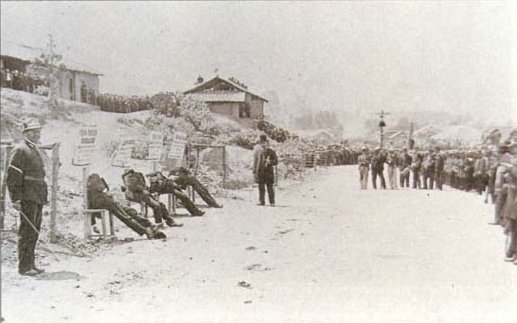
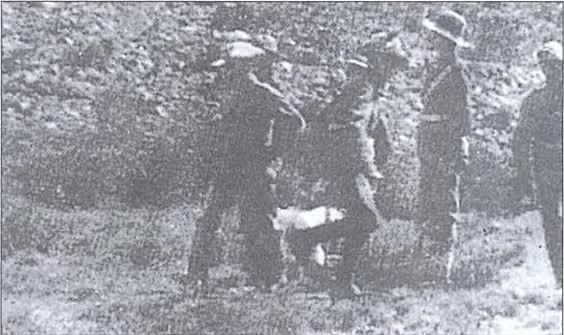
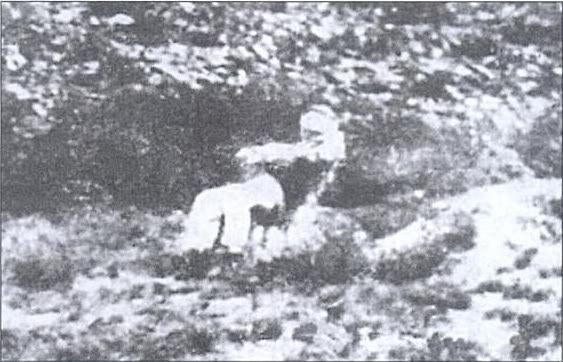
1905: Two murderers beheaded in French Indochina

On this date in 1905, this happened in French Indochina:

“Annamites” — a term that will not get you a warm welcome in Southeast Asia today — were residents of the French protectorate of Annam. It, along with Tonkin to its north and Cochinchina to its south, comprise present-day Vietnam: “Annamite” was also sometimes generalized as a colonialist synonym for all Vietnamese. (Here’s a 1947 Life magazine article by William Bullitt that does just that in its warning about the burgeoning war wherein “Annamites — half starved and weakened by malaria, gentle by nature but courageous” had started “kill[ing] every Frenchman they can.”)

Postcard pictures on this post via BeheadedArt.com, which delivers what it promises. (Clicker beware.)

On this day..

1906: The would-be assassins of General Rafael Reyes

BOGOTA, Colombia, Tuesday, March 6. — The three men who on Feb. 10 attempted to assassinate Gen. Reyes, the President of the Republic of Colombia, were shot to-day at the spot where the attack took place.

-New York Times, March 8

Reyes had parlayed a successful military career into politics (Spanish link), and was the elected-ish but also dictatorial president of Colombia.

He had the misfortune to ascend to this illustrious post on the heels of a bitter civil war that had seen its Panama department break clean away. To Reyes’ administration would fall a variety of civil society infrastructure projects (more Spanish): constitutional reform, military modernization, a central bank, reconciliation with the Liberal party.

Marco Salgar (left) and Roberto Gonzalez, two of the failed assassins.

He couldn’t make these omelets without breaking a few eggs and his authoritarian power was challenged with at least two coup attempts and multiple assassination plots, as well as a bid by other Colombian territories to break away and join up with Panama.

But the most notorious angry-with-Reyes event was the 10th of February 1906 — also the title (Spanish again) of a book of photographs documenting the incident — when three gunmen ambushed Reyes on the outskirts of Bogota and somehow all managed to miss both the president and his daughter.

Reyes’ vengeance was extrajudicially old-school: the executions he arranged were not permitted under Colombian law at all, and by having them publicly shot at the scene of the crime, he added a downright medieval twist of lese-majeste.


Images from here. These are the three shooters mentioned by the Times, as well as a fourth accomplice.

However rough his methods, Reyes did accomplish some important reforms for his country, and he did have the grace to resign his position in 1909 under fire for financial and diplomatic mismangement. (The man’s five-year administration has its own periodization in Colombian historiography: the quinquenio.) There have been worse entries in the annals of dictatorship.

On this day..

1906: Johann Otto Hoch, bluebeard

On this date in 1906, still implausibly claiming his innocence, “Johann Otto Hoch” was hanged for the murder of his wife.

Though Hoch died “merely” for that one homicide, he was suspected of numerous others in a prolific career of avaricious bigamy.

Born as Jacob Schmidt in Germany a half-century or so before he hanged, Hoch immigrated to the U.S. in the 1880s and started wife-hopping for fun and profit, recycling names almost as frequently. (Hoch just happens to be the alias he was using when arrested: actually, it was the name of one of his victims, “a warped keepsake stored in an evil mind.”)

It’s a classic scam, really: woo, wed, and walk out — taking the spurned spouse’s assets with. Rinse and repeat. In 1905, Charlotte Smith of the Women’s Rescue League estimated that “no less than 50,000 women who have been married, robbed and deserted by professional bigamists.” (Chicago Tribune, Sept. 5, 1905)

“Marriage was purely a business proposition to me,” Hoch eventually admitted.

Sometimes Hoch was content to vanish with the cash (with nice twists, like a hat left by a riverbank to suggest drowning). Other times, he went above and beyond the standard in the professional-bigamy industry and availed the expedient of loosing the matrimonial bonds (and the purses of life insurers) by graduating himself to widowhood.

Precisely how many women he poisoned off with arsenic isn’t known exactly, but it’s thought to range into the double digits. And when he was on his game, he was known to churn through the ladies at breakneck speed. His last murder victim, and the one he hanged for, was Marie Walcker of Chicago … but as Marie lay dying of her husband’s expert ministrations, Johann, bold as brass, proposed to Marie’s sister Amelia. Those two “lovebirds” married a week later and within hours, the groom had disappeared, pocking $1,250.

Call Amelia doltish if you will, but she went straight to the police. It turned out it was Hoch who recklessly set himself up for capture with this whirlwind double-dip courtship, and the very freshly buried evidence of his recent malignity was easily retrieved from his late ex’s stomach. When arrested in New York, Hoch had a hollow pen full of arsenic.

Naturally, the marriage proposals poured in as Hoch awaited trial early in 1905.

Hoch was actually within moments of hanging in July 1905 when his defense team finally managed to raise the last $500 necessary to lodge an appeal. That’s right: justice with a co-pay. The legislature had considered, but had not passed, a law giving every death-sentenced person the right to appeal to the Illinois Supreme Court, and in lieu of such a measure, an appellant had to pony up for the privilege.

On this day..

1902: Gideon Scheepers, Boer guerrilla

Scheepers lives because they shot him.”

-Hermi Baartman, Graaf-Reinet Museum

On this date in 1902, Kommandant Gideon Jacobus Scheepers was shot by the British for his exploits in the Boer War.

The young Dutch-descended Scheepers (here’s his Afrikaans Wikipedia page) was a soldier from the still-independent Boer states which were being reduced in this war to British dependencies.

In 1901, late in the proceedings, Scheepers took a column of irregulars into the British Eastern Cape Province and wrought havoc behind the lines. Some exploits are the stuff of legend, like the time he rode into a town, released all the Boer prisoners, locked up the British magistrate, and hauled down the Union Jack — to the delight of the Boer locals.

He would spend that year giving the British much better than he got, but the war was also infamously dirty.

According to David Harrison’s The White Tribe of Africa: South Africa in Perspective, “Scheeepers’ men also flogged and shot natives who helped the British, looted as well as burned farms, and executed Boer ‘traitors’.”

Was any of that criminal?

Since Scheepers was over enemy lines, the Boers who joined him could be held liable for treason … but that didn’t hold for Scheepers himself. His execution turned on holding these unsavory acts as war crimes: his 30-count charge sheet included seven arsons, seven murders, and various and sundry abuses of prisoners and blacks. Scheepers was really sore about the last; natives were supposed to be kept out of the fighting, but the prisoner very credibly insisted that the ones he “murdered” were under arms as scouts for the British.

“We Afrikaners will never find justice under the English,” Scheepers wrote as a prisoner. “Everything is for the kaffirs.”

(There’s a vociferous defense of Scheepers from a pro-Boer history here, and a more sober one by a London press correspondent here.)


Scheepers is read the death warrant on January 17, 1902 — before Graaf-Reinet townspeople assembled by British orders.

For non-Loyalist Boers and for many throughout the world — the U.S. House of Representatives even moved a resolution calling for Scheepers to be accorded POW status according to the Geneva Convention — it smacked of a setup.


Gideon Scheepers (mostly obscured by his guards) tied to a chair for execution.


Just shot, Gideon Scheepers slumps backward in his chair.

While martyrdom guaranteed Scheepers a lasting legacy, bizarre posthumous turns helped elevate it into legend. When the dead man’s family turned up after hostilities to retrieve his bones, the grave turned out empty, leading to a years-long saga with colorful frauds presenting bogus remains, a mentally ill man doing the Grand Duchess Anastasia act and claiming to be Scheepers, and the actual corpse remaining stubbornly elusive.

The bereaved mother’s ultimately fruitless search for her son’s final resting place inspired the poem “Gebed om die Gebeente”(“Prayer for the Bones”), by D.J. Opperman. (Here’s a translated version.) That verse was recently set to music as a cantata by composer Hendrik Hofmeyr.

Scheepers’ allies, however, had simply been beaten in the field. On May 31, 1902 they capitulated to the British.

If we are asked why in 1978 a memorial should be erected for a man who died in 1902, then the answer is simple. The life and work of this man was such that history placed him in the heroes’ gallery and nothing and no one can deprive him of that place.

-Nationalist Prime Minister John Vorster upon the unveiling of a Scheepers monument

This interesting “On the Trail of Gideon Scheepers” series has a detailed and richly illustrated narrative of the man’s final year.

On this day..

1900: Louisa Josephine Jemima Masset

(Thanks to Meaghan Good of the Charley Project for the guest post. -ed.)

On this day in 1900, 36-year-old Louisa Josephine Jemima Masset (also called “Louise” in some accounts) was hung for the murder of her young son the previous year. She was the first woman, indeed the first person, to be executed in London in the brand spanking new 1900s.

Her crime, even by today’s standards, was shocking and there is little doubt that had it occurred today, Louisa would be featured on blogs with names like People You’ll See In Hell. (Actually, she got a TV miniseries in the early 1990s.)

The story of the murder and Louisa’s trial and death were recorded in detail in John J. Eddleston’s A Century of London Murders and Executions. Capital Punishment U.K. provides additional details, and the trial records can be seen here.

Our story begins a little after six on Friday, October 27, 1899, when a lady at the Dalston Junction train station in London found the body of a small boy shoved behind the door to the women’s lavatory. The child was naked, bloody and partially covered with a black shawl, and a bloodstained brick lay nearby.


Dalston Junction: Mind the gap. (cc) image from Matt From London

The post-mortem determined that the child had been beaten “with much violence” on the head and face, but the actual cause of death was suffocation. He probably died only about an hour or two before his body was found. There was no indication of his identity, so his description was published in the newspapers with hopes that someone would recognize him.

Someone did: the following Monday, a children’s nurse named Helen Eliza Gentle came forward and identified the murdered boy as Manfred Louis Masset, age three and a half, who had been in her charge until the previous Friday.

Manfred was illegitimate and had been in Helen Gentle’s care since shortly after birth. Louisa, his mother, doesn’t seem to have been the maternal type. She paid 37 shillings a month for his care and would visit him once every two weeks and take him to the park. The money supposedly came from Manfred’s father in France; Louisa herself earned a living as a day governess and gave piano lessons.

The arrangement with Helen Gentle ended when Louisa told Helen that she was sending Manfred to France to be with his father. Helen handed the child over to her at 12:45 p.m. on October 27, only hours before his death.


The day before giving him up, Helen Gentle took this picture of the tot to remember him by.

When she was tracked down at her brother-in-law’s house, Louisa denied having harmed her son and stated she didn’t even know he was dead until she read about it in the newspaper. She admitted the story about taking Manfred to France a lie and said she only wanted to transfer him to another carer, as she thought Nurse Gentle wasn’t educating him properly. Louisa claimed she had met two women, one of them a schoolmistress, in the park a few weeks earlier. She arranged to enroll Manfred for the price of £18 per annum, and handed the little boy over on October 27.

When pressed, however, Louisa couldn’t remember much about these women or their school. The police smelled a rat and took her into custody for murder.

At Louisa’s trial in December, she stuck to her story about giving Manfred to a schoolmistress. She said she’d handed him over at the train station at 4:00 p.m., along with a £12 deposit towards his school tuition, then took the 4:07 train to Brighton. No one at the station saw the two women Louisa described. However, three witnesses at the train station remembered seeing Louisa and Manfred, who was crying, hanging about the station for over an hour on the afternoon of Manfred’s death: one of those same witnesses saw and spoke to Louisa at the station at 6:50 p.m., nearly two hours after Louisa claimed to have left, and said her little boy wasn’t with her anymore.

The icing on the cake was when the brick used to batter Manfred was shown to be same kind as those in Louisa’s garden.

Louisa’s story was partially true; she did go to Brighton that day, hours later than she said, and Manfred’s clothes turned up in the waiting room of the train station there. Eudor Lucas, Louisa’s next-door neighbor, said they had spent the weekend together in Brighton, sleeping in the same bed, and he had “had connection” with her.

The jury must have been outraged by their blatantly immoral behavior, and in any case the evidence against Louisa was overwhelming. The jury got the case on December 18 and took thirty minutes to convict her. She was hung just three weeks later.

On this day..

1908: John Boyd, by John Radclive

On this date in 1908, John Boyd managed six fitful hours of sleep, had a breakfast of toast, poached eggs and tea, and then went to the Don Jail gallows for murdering his paramour’s rival suitor.

Canada had long before ceased public executions. Prior to Boyd’s execution, Don Jail hangings had occurred in a jail yard — technically behind prison walls, but easily peeped upon by curiosity-seekers willing to obtain higher ground. Boyd’s execution introduced a new privacy measure: it was the first of 26 hangings to occur in an interior chamber completely away from public eyes, the same place where Canada eventually held its last hangings in 1962.

But apart from this minor milestone, we notice on this date the hurried and disturbed departure of prolific hangman John Radclive. “Another poor soul gone,” he was overheard to say as he left.

Radclive is the subject of an empathetic Toronto Star profile that’s well worth the read.

He was Canada’s first professional hangman, with 69 recorded executions and perhaps just as many which the uneven documentation of the day failed to note. Predecessor of the better-known Arthur Ellis, Radclive learned his trade direct from William Marwood, and was put on the federal payroll as a full-time executioner in 1892.

He had a swagger in his ill-starred step back then: he once started a brawl boasting in a pub that he had “come to hang a Frenchman, and hoped it would not be the last.” By the time he got to Boyd and beyond, he was ready for the last. Alcoholism had wasted his nerves (and his liver: he died of cirrhosis in 1911). In 1910 Radclive told a psychiatrist,

“Now at night when I lie down, I start up with a roar as victim after victim comes up before me. I can see them on the trap, waiting a second before they meet their Maker. They haunt me and taunt me until I am nearly crazy with an unearthly fear.”

On this day..

1903: Willis, Frederick, and Burton van Wormer

I know the vicinity of our old Dutch settlements to have been very subject to marvelous events and appearances. Indeed, I have heard many stranger stories than this …

-Washington Irving, “Rip Van Winkle”

On this date in 1903, an“unusual if not unprecedented” execution occurred when three brothers died one after the other in the Sing Sing electric chair. (Correction: at Clinton Prison, not Sing Sing.)

Willis, Frederick, and Burton van Wormer — stock, as their name suggests, of vintage Dutch family whose more reputable products ca be found on various Empire State placenames — were doomed for the Christmas Eve, 1901 murder of their uncle.

The family tree’s branching over generations had put family enmities between relatives; in this case, working stiff John van Wormer’s home in Columbia County, N.Y. was mortgaged to his brother-in-law (and the eventual murder victim), richie-rich Peter Hallenbeck. After John passed away, Peter lowered the boom and foreclosed on the widow, booting John’s sons out of the house.

The boys got even with an unsubtle gangland masked home raid, riddling their Uncle Scrooge with bullets.

(Signs of the times: the murder happened mere weeks after William McKinley‘s assassination, and testimony had one of the boys bragging with reference to the fatal gut-shot wound inflicted on the late president. “I made a Czolgosz shot. I shot him in the stomach.”)

Though these three attracted national public sympathy — someone even telegrammed a bogus reprieve signed, “The President of the United States” in a vain stab at delay — their case was pretty open-and-shut.

Since they were doing death as a brother act, it was only fair that they sort out precedence within the family: the condemned themselves decided the order of their execution, with Willis first, Frederick second, and Burton third. The whole thing took 15 minutes.

But leave it to the youngest child to stick out from the crowd. Frederick, the baby of the family, actually managed to survive the electric chair, sort of. Not walk clean away from it like Willie Francis would do, but impolitely revive when he was supposed to be laid out dead like folk used to do back in the bad old hanging days.

The executions went off without a hitch and the brothers were pronounced dead. Later, after they’d been laid out in the autopsy room, a guard saw one of them out in the autopsy room, a guard saw one of them, Frederick Van Wormer, move a hand. Then an eye flickered. The prison doctor was immediately summoned. Putting a stethoscope to the “dead” man’s heart, he discovered it was still beating. Frederick’s heart (it was determined later) was bigger than that of anyone executed up to that date, so two charges of full current had failed to kill him. The convict was carried back to the chair and kept in it until he was dead beyond the shadow of a doubt. [he died without actually being re-executed -ed.]

In part because of accidents like these during the early decades of the electric chair, numbers of people weren’t convinced it was as deadly as it was supposed to be. (Source)

They’re not kidding about that brain bit, either.

A fellow by the name of Edward Anthony Spitzka autopsied the van Wormers, “direct[ing] my attention especially to the brains. The opportunity afforded by this triple execution was certainly most rare, and a similar case will not soon occur again,” and found Frederick with a robust 1.6 kg brain, compared to less than 1.4 kg for his siblings. Now that JSTOR has opened its oldest journal content, you can read all about Spitzka’s meddlings in the van Wormer grey matter here.

Additional historical artifacts: an original invitation to the proceedings.

On this day..