On this date in 1915, “the sentences of the court-martial on a batch of 45 mutineers of the 5th Light Infantry were promulgated in public” — as the Straits Times reported — “and, in the case of 22 who were condemned to death, the sentences were executed on the spot.”
A crowd of fifteen thousand watched the spirited Indian sepoys shot dead for revolting the previous month.
This demoralized 800-strong garrison of Punjabi Muslims — who had, it need hardly be added, a noble history of insurrection to think upon — was already deployed far from home to look after the imperial interests of the London gentry while British lads mustered for bayonet charges in No Man’s Lands.
The last straw for these sepoys was a rumor that they were to be shipped to the European theater and made to turn their weapons against the Turkish sultan, their Muslim coreligionist.*
On February 15, 1915, helpfully covered by the celebratory fireworks of the Chinese New Year, about half the garrison left its barracks, attacked its British officers, and started killing any European they came across. (Many British familes took refuge in jail cells.)
Around 40 died in a few days before a mixed British-French-Russian-Japanese force arrived to crush the revolt. It was just one among a number of insurrectionary outbreaks during the war to rattle Britain’s possessions in Asia and elsewhere.
Punishments meted out this day were not the end of it at all; the court of inquiry sat until May, sentencing several dozen to death and many others to prison terms or penal transportation.
And if the mutiny never really threatened British control of Singapore, the ethnic and religious fissures it exposed in the imperial order have obvious resonances (pdf) for our present day.
In order to distinguish mutineers from peaceable citizens, all Indian residents were required to register and obtain passes. This aroused considerable anger, which was exacerbated by the cavalier attitude of some registration officers, who acted as if all Indians were to blame.
* The Ottomans had also issued a call to jihad with the onset of war, hoping to drive just this sort of wedge among Britain’s colonies.
One hundred years ago today, Thomas Jennings was ushered the scaffold … while Thomas Jennings’s fingerprints ushered in a new age of policework (pdf).
Hegemonic authority had been on a long march towards a forensic regime that could affix an oft-ephemeral identity to the profoundly corporeal body.
In the late 19th and early 20th century, investigative techniques and jurisprudence marched double time to keep pace with new techniques — from photography to the unwieldy system of Bertillonage.
A variety of American institutions — the U.S. Army, a number of prison systems — had begun systematically cataloging their respective inmates’ fingerprints in the preceding years, but it was in the Jennings case that the system really earned its whorls. It was the first U.S. murder case pinned on fingerprint evidence.
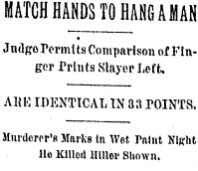
In September 1910, a Chicago homeowner in the present-day Beverly neighborhood surprised an intruder, and was shot dead. (pdf) In the course of the fight or the flight, the prowler splooshed his left hand into some wet paint on a railing.
Thomas Jennings, a paroled burglar, was arrested near the scene, and his fingerprints shown to match those left in the grieving Hiller household. A prosecution expert even gave a courtroom demonstration of dusting for prints.
This was as novel to judges as to jurymen, and given the dearth of other positive evidence against Jennings, the Illinois Supreme Court was called upon to deliberate upon the humble dactylogram. In the summer of 20111911, it stopped Jennings’ hanging just hours before it was to take place.
But its final word in December 20111911 only fitted the homebreaker’s noose.
We are disposed to hold from the evidence of the four witnesses who testified, and from the writings we have referred to on this subject, that there is a scientific basis for the system of fingerprint identification, and that the courts cannot refuse to take judicial cognizance of it …
Such evidence may or may not be of independent strength, but it is admissible, with other proof, as tending to make out a case. If inferences as to the identity of persons based on voice, the appearance or age are admissible, Why does not this record justify the admission of this fingerprint testimony under common law rules of evidence.
Courtrooms all around the world soon agreed, and within a generation the awesome investigative power of the fingerprint had fugitives going so far as to slice or burn off those incriminating little pads of flesh — the crime scene gold standard until the advent of DNA testing.
Jennings was hanged this date in a state-record five-man batch (the others, Ewald and Frank Shiblawski, Philip Sommerling, and Thomas Schultz, had all committed an unrelated murder together).
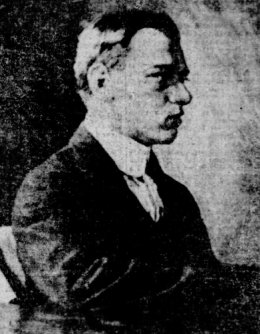
A century ago today, 20-year-old Albert Walter strolled the 15 feet from the death cell to the Sing Sing electric chair, calling out “Good-bye boys” to his fellow-prisoners as he died for the murder of 15-year-old Ruth Wheeler in a possible white slavery crime two years earlier.
Wolter left a note steadily — all the reports remark on the youth’s sangfroid; he took a nap while the jury went to deliberate with his life in its hands — avowing his innocence, and indulging the “hope there may come a time when the conscience of the perpetrator will overpower him, and he will come to the front and acknowledge his guilt.” He charitably added for “those who have maliciously prosecuted and killed me, for them I pray God’s forgiveness.”
Lots of New Yorkers would have had to ask it.
Despite his cool under fire, Wolter was overwhelmingly acclaimed the guilty party, the evidence against him being as close to airtight as circumstantial gets.
Newsmen ravenous for virginals despoiled by outlanders instantly sunk fangs into the story of the layabout 18-year-old German immigrant — idle lifestyle the product of parasitism upon the drudgery of a young countrywoman toiling 12-hour days at a bakery — who lured the “saintly” stenographers’ school graduate to his apartment with the promise of work and had her charred and headless trunk bundled up on the fire escape by morning. (Other charred remains, and Wheeler’s monogrammed signet ring, were retrieved from inside the apartment.)
Reporters soon sketched the persona of a burgeoning little pimp who had already routed several girls into prostitution. In amid the decadence and displacement of fin de siecle industrialization, you couldn’t ping a more heart-racing (pdf) moral panic than white slavery.*
Congress was at that very moment in the process of legislating the (still-extant) Mann Act named for the Illinois legislator who sponsored it after a notorious 1909 Chicago case.
But the Big Apple, as the country’s largest city and its gateway for Europe’s polyglot huddled masses, was the reputed center of the whole reputed business.
This illustration from Fighting the Traffic in Young Girls is outstandingly captioned:
“THE FIRST STEP. Ice cream parlors of the city and fruit stores combined, largely run by foreigners, are the places where scores of girls have taken their first step downward. Does her mother know the character of the place and the man she is with?”
The men and the women who engage in this traffic are more unspeakably low and vile than any other class of criminals. The burglar and holdup man are high-minded gentlemen by comparison. There is no more depraved class of people in the world than those human vultures who fatten on the shame of innocent young girls. Many of these white slave traders are recruited from the scum of the criminal classes of Europe.
And in this lies the revolting side of the situation. On the one hand the victims, pure, innocent, unsuspecting, trusting young girls — not a few of them mere children. On the other hand, the white slave trader, low, vile, depraved and cunning, — organically a criminal.
While the Empire State enacted its own Wolter-inspired law charging schools with vetting the employers who recruit their graduates, Wolter entered the criminal justice system on greased lightning (just like he left it). He was a condemned murderer within five weeks of Ruth Wheeler’s death.†
Wolter himself (evidently surprised to learn that he was old enough for the death penalty; that may not have been the case where he was from) tried to put the blame on a phantom Teuton, one “Frederick Ahner” who was the mastermind in Wolter’s own fall and who must have done the Wheeler business while Wolter was out at the park. That’s “the perpetrator” to whom Wolter’s last letter refers: his conscience never led Ahner to so much as materialize, much less to confess.
The fate of Wolter’s bakery-girl cohabitant — and, one might think, prospective accessory — Katchen “Katie” Mueller was very different. She precipitously aligned herself with her lover’s prosecutors, urged “My dear Al” to confess (almost successfully), and got respectable patronage “to break away from the life she had been leading”. A year after Wolter’s electrocution, Mueller’s redemptive next marriage made the society pages.
* Wolter may have been (pdf; see p. 61 footnote) a specific inspiration of the 1919 Theodore Dreiser play “The Hand of the Potter”, which is all about the era’s white slavery panic.
** Similar dubious (pdf) vice-crusader porn is to be had in (among many other period pieces) a 1911 tract by another Chicago prosecutor, Clifford Roe. Though The Great War on White Slavery is in the public domain, I haven’t been able to locate a complete text online — only this excerpt.
† On the other hand, the then-protracted period of 22 months required to proceed from conviction to execution made Wolter “dean of the death house” by the time he died.
On this date in 1916, Sergeant John Robins of the 5th Battalion, Wiltshire Regiment — demoted for the occasion to Private — was shot “at a point on the beach 400 yards North of the mouth of the Gully Ravine” for disobeying orders.
This redundantly named topography was a feature of an ill-starred (for the British) peninsula Robins’s army was quite ready to see the back of: Gallipoli.*
Winston Churchill’s brainchild for a knockout punch in the First World War had long since come to grief — the enduring grief of the British, Australian, and New Zealand troops who died by the thousands under Ottoman guns whilst attempting to seize the Dardanelles, open the Black Sea, knock the Turks out of the war, and expose the Central Powers’ soft underbelly.
It didn’t do any of those things, but it did help Mel Gibson’s career.
The first days of 1916 were the very last days of the Gallipoli campaign, by which time the object was just to get out.
Actually, the invaders’ positions had been steadily, stealthily evacuated over the preceding weeks — successfully slipping away without alerting the Ottomans to the opportunity for a turkey shoot. The evacuation, at least, was a triumph.
Sergeant Robins was a part of this hot mess; he’d once had to flee from his bed when the Turks surprised his camp and overran it. But it didn’t seem to be jangled nerves that did him in so much as the everyday infirmity of the flesh.
By December 1915, a quarter of his unit was laid up on the sick rolls, but when Robins begged off a patrol assignment for unwellness, the powers that be didn’t reckon him among the legions of ill — but court-martialed him for refusing an order. A rather stunned Robins attempted to explain:
On the night in question I was not well enough to go out. I was eight and a half years in India where I suffered a good deal from fever and ague, and I still get fits of this. I had been suffering from this for several days off and on, and the wet weather had greatly affected me. I have been out here for nearly five months and this is the first trouble I have ever been in. I have always done my duty. This would not have happened if I had been quite well. At the time I did not realise the seriousness of what I did.
He realised the seriousness when he was shot at 8 a.m. on January 2, 1916. A week later, his unit — all his countrymen’s units — were out of Gallipoli.
On this date in 1915, a quintet of African Americans died in South Carolina’s electric chair during a 70-minute span.
Joe Malloy was put to death for killing two white men four years before; the other four executed on this date were convicted together of murdering 73-year-old Confederate veteran John Q. Lewis. They were John Crosby, Nelse Brice, and — our principal concern today — Thomas and Meeks Griffin.
In this case, and even though public opinion was predictably inflamed at the aged veteran, the Griffins weren’t lynched: indeed, prominent white people in the community, such as the mayor and the sheriff, rose to the Griffins’ defense to the extent of signing a petition for executive clemency. They didn’t believe then that the thief whose accusation condemned the brothers was credible.
More than likely they suspected Lewis’s 22-year-old black mistress, Anna Davis, and/or her husband — and undoubtedly, they would have known exactly why this scandalous angle was not pursued in court.
Still, South Carolina’s governor reckoned that they’d had their day in court, the victims deserved closure, and whatever other equivalents of the familiar modern-day rationales one might care to name.
Almost surely, this distant injustice would be lost to time were it not for the Griffins’ famous great-nephew, the radio host Tom Joyner.
Joyner only recently discovered (via Henry Louis Gates Jr.‘s research for a PBS documentary*) his kinship with these executed men; his grandmother had moved away to Florida to bury the family tragedy.
But the broadcaster exhumed it with gusto, and, two years ago, was able to secure a posthumous pardon from South Carolina based on the weakness of the original case. It’s thought to be the first official posthumous pardon the state has granted to any executed persons.
But we do want to extend the Palmetto State the credit due to all its sons whose signatures graced the disregarded clemency petition way back when. More than that: The State editorialized, confusedly but forcefully, against the manifest racial discrepancies in capital sentencing on the occasion of this quintuple-execution. (Oct. 1, 1915) These questions, ever present, are more sincerely grappled with in this column than we can manage today.
* You can watch the big reveal when a flabbergasted Joyner first hears about his ancestors: it’s quite a moment.
On this date in 1912, a prolific Springfield thief died in the electric chair.
No, not Snake.
This fellow was Bertram G. Spencer, whose Boston Brahmin name belied a deceptively modest station.
A brakeman by day, Spencer lived a double life as Massacusetts’ boldest burglar in the evenings, when he would raid homes around Springfield at times when he was likely to be caught. (Hey, he did have a day job.) He frequently was intercepted, but for two years nobody ever got the drop on him and the numerous conversations he had with his victims were not enough to crack the case.
This villain comes up short of positively Moriartyesque by virtue of his amateurish chops in acquisition; one of the mystery burglar’s noted characteristics was the frequency with which he passed over the most valuable booty in the house in favor of some inconsequential bauble.
With his penchant for brandishing a weapon at the folks he bumped into, it was only a matter of time before somebody died for one of those inconsequential baubles. On March 31, 1910, schoolteacher Martha A. Blackstone became that somebody when in a panicking reaction to Spencer’s home invasion she failed to pipe down and let him rob — and he shot her dead.
Forensics then languishing in a primitive state, Spencer kept getting away with his larcenous (and then murderous) spree with little more than the expedient of wearing a kerchief and hat to hide his face. How were they ever going to find the guy — unless he did something ridiculous like drop a monogrammed locket on the scene?
Period postcard shows images connected to the Spencer crimes centered around the “B.G.S.” locket he dropped at one site, leading to his detection. Just to really make sure he hung himself, the locket contained pictures of his mother and sister.
Upon arrest, police tossed his home and discovered (quoth the New York Times) “black masks, slouch hats,” and “a big revolver, fully loaded” under his pillow. No word on whether he was twirling his mustache, too.
Where the relieved well-to-do of Springfield perhaps saw only a somewhat preposterous villain — inspired, according to the Springfield Republican, by “a daredevil bravado, a love of the spectacular and a lack of pecuniary calculation which strongly suggested either the monomania of an unbalanced mind or a romantic vanity fed on by penny dreadfuls” — other practitioners in the emerging field of psychiatry saw a systemic breakdown.
Indeed, Spencer became the topic of an open tug-of-war over handling defendants with putative mental disorders in the criminal justice system. The district attorney at the time had Spencer committed without trial, and his doing so — rather than contesting Spencer’s sanity in court — contributed to his loss at the polls in 1910. (The new guy, in his remarks on the case, reclassified Spencer from “insane” to the more prosecutable “moral imbecile.”)
If the public was certain enough about Bertram Spencer’s sanity to elect a guy just to try him, it will come as no surprise that the testimony about Spencer’s abusive childhood and manic-depression cut no ice with a jury of his peers.
While our burglar went to his juridical death (last words: “good night”), a Massachusetts psychologist named Lloyd Vernon Briggs took up the man (alongside more luminous criminals like presidential assassin Leon Czolgosz) as one of his case studies for a 1914 book, The Manner of Man That Kills. A lengthy pdf of the Spencer material — it’s all public domain — is available here.
Briggs viewed mentally disordered prisoners as people who were ill-served by the criminal justice system: more than that, as instances where a society failed itself by failing to recognize potentially criminal mental illness before it metastasized into actual crime, and the adversarial judiciary as a factor in that dysfunction.
Dr. L. Vernon Briggs … made it his goal to end the courtroom spectacle of dueling psychiatrists. …
Briggs was an indefatigable advocate of the psychological links between mental illness and murder. He believed that mental illness and moral degradation were the root causes of crime and violence. … Briggs insisted that the “real offender is society and not the children in the form of men, not the mentally diseased” who commit violent crime.
…
When mentally ill people landed in court, Briggs believed that the law’s adversary procedures undermined scientific truth and the legal protection provided a defendant. He wanted to bridge the gulf between law and psychiatry by intervening in the process before a mentally ill defendant appeared in court. He was especially critical of the “spectacle in our courts of two or more physicians pitted against one another, testifying to diametrically opposite opinions as to the mental condition and responsibility” of the defendant. Such a procedure, he said, not only humiliates the mentally ill defendant but increases the likelihood that a mentally ill capital defendant will be sentenced to death and executed … Briggs lobbied the public and the legislature for a law that required all capital defendants to undergo a psychiatric examination by neutral experts as son as they were taken into police custody.
…
Briggs was appalled [at Spencer’s case]. He contended that all of the psychiatrists who examined Spencer knew he was insane at the time of the murder and at the trial. Some thought he was medically insane but not legally insane. Briggs denounced the distinction between medical insanity and legal insanity as without a difference. The awful result of the confusion between psychiatry and the law was the unnecessary execution of an insane person. “The whole legal machinery of the State,” he wrote angrily, “had been put in motin to crush this defective and uphold the Majesty ofthe Law and so it came about that Bertram G. Spencer, a defective from birth, with the mind of a child, was tried for his life and sentenced to death and executed with a smile upon his lips.”
On this date in 1916 — true story — this happened.
Five-ton circus elephant Mary (yes, she has her own Wikipedia page) was in Kingsport, Tennessee on the chintzy fairgrounds touring circuit with Sparks World Famous Circus.
Billed as as “The Largest Living Land Animal on Earth,”* this exotic creature was a prime draw for the circus — and also a beloved pet of the Sparks family.
Unfortunately, this valuable asset was placed in the temporary stewardship of an inexperienced “under keeper” whom the circus had had to scoop up at a recent stop to cover staff turnover. Between shows on September 12, that fellow somehow (accounts conflict) enraged Mary, and (again according to one version among several) she
“collided its trunk vice-like [sic] about [the under keeper’s] body, lifted him 10 feet in the air, then dashed him with fury to the ground … and with the full force of her biestly [sic] fury is said to have sunk her giant tusks entirely through his body. The animal then trampled the dying form of Eldridge as if seeking a murderous triumph, then with a sudden … swing of her massive foot hurled his body into the crowd.”
It’s apparent in this report that the facts of an already-sensational event almost instantly began disappearing into its spectacle. See the largest land animal on earth! See it maul its handler to death! But what happened next lifted Mary all the way to legend.
The owners knew they had to euthanize the “mankiller,” or if they didn’t know they were soon persuaded by mushrooming press attention and towns threatening to ban the Sparks circus.
But how? They couldn’t shoot Mary to death — she apparently survived gunshots from the vengeful crowd in the immediate aftermath of the trampling; firearms just didn’t pack the wallop to put down a pachyderm in 1916. The area didn’t have the sort of electrical juice available that Thomas Edison had once used to drop a circus elephant during his weird campaign for the electric chair.
The choice for the baleful logistical task of killing a 10,000-pound evildoer was hanging, selected over “crushing it between railroad cars.”
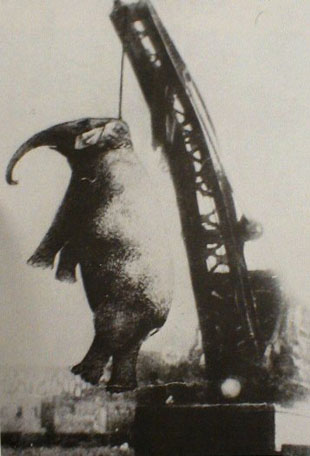
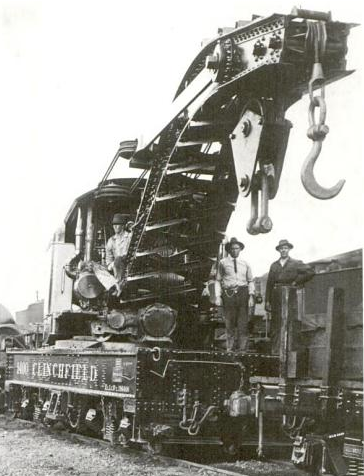
And for stringing up “Murderous Mary”, you need no ordinary gallows. No, for this job, you’re using the hoist on a train derrick and an industrial-strength chain for a noose.
The actual train derrick that hanged Mary the elephant. The leftmost man, seated on the machine, is the “executioner” who worked the controls, according toThe Day They Hung the Elephant.
The railroad was game for the operation, provided the circus would come to it. So on this date, the circus train cars loaded up for the nearest usable train derrickscaffold at Erwin, Tennessee.
There, a procession of all five Sparks elephants — the routine was supposed to keep Mary compliant, and it did the trick even though some observers later remembered the condemned creature behaving unusually skittishly — marched to the railyard.
There Mary was noosed with a 7/8″ chain and hoisted up. The chain broke, and the animal shattered its hip crashing to the ground; another, still larger, chain, did the trick on the second try.
There’s something about this event abidingly piteous, even shameful. It may be for that reason that it’s also abidingly mysterious. The particulars about what happened on the day they hanged the elephant and what became of the body (a steamshovel dug a grave, but the exact location was never marked and there’s a wild story that it was dug up later for ivory) are the topics of conflicting, nth-hand rumors. Some in Erwin don’t to this day want to discuss the matter. Others, just the opposite.
Image (c) John Pugh of SourceToSea.net and used with permission.
* Sparks evidently kept the “largest living land animal” marquee in use for Mary’s successor, as indicated by this 1919 poster (pdf) for the show.
On this day in 1915, serial uxoricide George Joseph Smith was hung by the capable John Ellis at Maidstone Prison in the UK.
Smith had committed three murders and various forms of larceny as well; he’d earned his noose several times over.
Two things tend to trip people up when they’ve seemingly committed the perfect crime: either they brag about it to impress others, or they repeat the crime using the same methodology as before, since it worked so well the first time. Either of those actions greatly increases the risk of the criminal’s getting caught.
Smith made the latter mistake. He was in a sense a victim of his own success.
Smith was born on January 11, 1872. His criminal record began when he was sent to a reformatory at nine and served a seven-year sentence. In young adulthood he was in and out of prison on theft- and fraud-related convictions.
His complicated marital career began when he married Caroline Beatrice Thornhill, a domestic servant, in 1898. Smith persuaded her to steal from her employers. Caroline served time in prison as a result, and implicated her husband, who got two years for his role in the thefts.
After George Smith’s release, Caroline thought it wise to put a few thousand miles between herself and her estranged husband, and so she left the UK for Canada. She never filed for divorce, however.
Smith remained legally married to her for the rest of his life, so none of his numerous other marriages were legal.
Unlawfully Wedded …
The guy wasn’t good-looking, but he could charm like any good con artist. A year after his marriage to Caroline, Smith bigamously married another woman. He cleaned out her saving account and then deserted her.
Between 1908 and 1914, he married no fewer than seven additional women, usually under an alias, and deserted most of them after a short time, sometimes only a matter of days — but not before he helped himself to their possessions and bank accounts.
Smith initially limited himself to scamming gullible spinsters out of their life savings by luring them into bigamous marriages … The moment Smith had his hands on his new bride’s money, he would disappear. Usually telling her he was going out on an errand — to pick up a newspaper or buy a pack of cigarettes — he would never return. On one occasion, he brought his newlywed wife to the National Gallery of Art and, after viewing some paintings, excused himself to go to the bathroom. She never saw him — or her life savings — again.
That particular bride was named Sarah Faulkner. Smith had already plundered £350 in cash from her and her jewelry as well, and while she was waiting for him to return from the loo he was back at their hotel, swiping her clothing and the rest of her money.
The only wife that didn’t fit this pattern was Edith Pegler.
Smith was away from her side for months at a time on “business trips” and when he returned it was always to ask for money, but he never left her for good and they remained together for seven years. As to whether he actually harbored some form of affection for her or whether he just didn’t want to kill his cash cow while it was still milkable, we can only speculate.
Yet all these women were, in a sense, lucky.
Smith may have broken their hearts and taken their cash, but he left them their lives.
… ‘Til Death Do Us Part
The first unlucky wife was Bessie Mundy, whom Smith murdered on July 13, 1912.
They’d married in August 1910, but he left her after persuading her to give him £150 in cash. On the way out the door, he accused her of giving him a venereal disease.
Eighteen months later, Bessie ran into Smith on the street. Somehow, the charmer got his ex to forgive him and resume their relationship.
In fact, Smith wanted to get his hands on Bessie’s £2,500 inheritance, but it was in trust and he couldn’t touch it.
After their reunion, the couple drew up mutual wills, naming each other as beneficiaries. Bessie willed her husband £2,579. Less than a week later, she was mysteriously dead.
Smith rented a house for them in Herne Bay and had a new cast-iron bathtub installed. Tragically, Bessie drowned in the bath. Her husband said he’d been out buying dinner and returned to discover the body.
Since Smith claimed his bride suffered from epilepsy and that she’d had a seizure the day before she died, it was easy to believe she’d simply had an unfortunate accident.
In spite of his newfound wealth, Smith had Bessie consigned to a pauper’s grave and even returned the slightly-used bathtub to the ironmonger for a £1 17s. refund.
This, perhaps, is where Smith might have counted himself lucky and checked out of the homicide business — or at least thought about a different m.o. Instead, hubris and habit got him hanged.
The Brides of Bath murder victims: from left to right, Bessie Mundy, Alice Burnham, and Margaret Lofty.
Next to go was Alice Burnham, who was making a goodly living as a nurse. Smith married on November 4, 1913, and became her widower on December 13.
Alice and her new husband were honeymooning at a seaside boardinghouse in Blackpool when she drowned in the bathtub while he was supposedly out getting eggs.
Smith, who claimed she had a weak heart, had insured her life for £500. She too was buried on the cheap.
Margaret Elizabeth Lofty died in her London home a little over a year later, on December 18, 1914. Newspapers reported she had drowned in the bathtub while her husband — identified as Robert Lloyd — was out buying tomatoes. He and the landlady found the body. Lofty and “Lloyd” had married only the day before and, appropriately enough, the ceremony was performed in the city of Bath.
Although it was initially classified as death by misadventure, Margaret’s murder ultimately lead to Smith’s downfall.
Rotten luck, it was: Alice Burnham’s father read an account of her death in the newspaper and, even though the husband had a different name, he couldn’t help but notice that Margaret’s death was suspiciously similar to his daughter’s.
Joseph Crossley, who was the couple’s landlord at the time of Alice’s death, noticed the same thing. Since both the Burnhams and Crossleys had taken a dislike to Smith from the get-go, they both wrote the police, asking them to open an investigation.
Authorities quickly determined that George Joseph Smith and Robert Lloyd were the same man. They sure had the same playbook.
Margaret had made out a will just hours before she died, naming her husband the sole heir to her estate. She had also withdrawn her life savings from the bank the same day, and three days before she had taken out a £700 life insurance policy on herself, with her husband as the beneficiary. Ka-ching.
When the grieving widower showed up at the insurance office to collect on Margaret’s policy, he was arrested. Lloyd/Smith was initially charged with putting a false name on a marriage certificate, but bigamy and murder charges would follow fast.
When news of the arrest was published, a police chief from Kent read the story and told the London police about Bessie Mundy’s death, which was strikingly similar to the other two.
Forever Hold Your Peace
But how could he could have drowned the women in the tub, without leaving marks of violence on their body?
Margaret had only a small bruise on her elbow. For answers, the police turned to renowned pathologist Bernard Spilsbury. The first thing he did was exhume the bodies to determine whether the women had, in fact, drowned. They had.
After experimenting with the very same bathtub Margaret Lofty died in, he determined how it might have happened. John Brophy, a crime writer, describes it chillingly:
With honeymoon playfulness he would enter the room where his bride was already in the bath, admire her naked beauty, bend over her fondly, and, still murmuring endearments, hold her feet. Suddenly, he would tug her feet upward, jerking her head at the end of the bath, below the water, so that in a few moments she would be drowned with no bruises on the body or other signs of assault or resistance.
Effective. Actually, you can see why he stuck to his system.
When Smith went to trial, it was only for the murder of Bessie; British law didn’t permit him to be tried for multiple murders in one go. However, the prosecution wanted to bring evidence in the Lofty and Burham deaths into the trial, arguing that they indicated a criminal “system.”
The judge allowed it, setting a precedent that would be used in later criminal cases.
In pretrial investigations later described in court, Spilsbury demonstrated his murder theory using Bessie’s bathtub and a female police officer in a bathing suit. It worked all too well: she lost consciousness immediately and they had to drag her out of the tub and perform artificial respiration to revive her.
No wonder the jury was only out for twenty-two minutes before it delivered a guilty verdict.
Caroline Thornhill, Smith’s legal wife, returned to Britain for his trial. She married a Canadian soldier the day after his execution.
The “Brides in the Bath” case has remained vividly alive in British memory.
The historian Harold Nicholson compared Smith’s behavior to Adolf Hitler’s in his 1939 book, Why Britain is at War; Smith was mentioned in novels by Evelyn Waugh, Agatha Christie and Dorothy Sayers, and in 1952 the case was made into an episode for the true-crime radio show The Black Museum.
On this date in 1915, New York City cop and New York City mafioso Charles Becker was electrocuted at Sing Sing for engineering a hit on bookie Herman Rosenthal.
This case of police corruption and gangland gunplay owned the Big Apple’s headlines in the early nineteen-teens — it even gets a callout in The Great Gatsby. Whether it was rightly decided has been hotly contested ever since.
Sing Sing had already prepared for Becker’s death.
Invitations had been despatched in the middle of July to those chosen to witness the execution. There were three dozen in total, and they went to doctors and to a sanitary engineer, to representatives of the press, and to the operators of several wire services. One, scarcely surprisingly, was sent to Swope of the World, but the reporter — to his undoubted chagrin — was recuperating from a bout of rheumatic fever and his doctor had forbidden him to attend. Swope despatched another World reporter in his stead; the man arrived at Ossining bearing a large sheaf of handwritten instructions setting out in considerable detail exactly how the story should be covered. Preparations were also made to cater for the needs of the large body of newsmen expected to descend on Sing Sing without the benefit of invitations. Linemen spent several days installing additional telegraph wires and Morse code senders in a shack opposite the death–house.
Inside the condemned cells, white curtains were fitted across the bars of all the cells that Becker would have to pass on his way to the execution chamber, so that the other inmates would not be able to see him as he walked by. In the execution chamber, guards tested each piece of equipment. The lieutenant’s electrocution was scheduled to be the first at which a new system of signals would be used, as the New York Times reported:
Instead of the old method, by which the executioner signalled with his arm to the man in charge at the power plant, there is a little electric button behind the chair, and above it is tacked a placard bearing the following gruesomely suggestive instructions: “Five bells, get ready; one bell, turn on the current; two bells, turn on more current; three bells, turn on less current; one bell, shut off current; six bells, all through.”
New York’s newspapers remained predominantly hostile to the condemned man. The Times spoke for most of the Manhattan press when it observed that Becker’s death sentence was a punishment not just for Herman’ s death, but for the arrogance Rosenthal’s killer had displayed during his strong–arm days: ‘He paid for the times when “Big Tim” called him “Charlie”. He paid for his one–time power, that almost of a dictator, over the underworld of New York. And he paid for his pride in all this.’ Several dailies had issued their reporters with instructions to study Becker carefully for signs of weakness or incipient collapse; in the end, opinion seemed evenly divided between those who thought that the policeman continued to display an ‘iron nerve in the face of doom’ and those who discerned the onset of a nervous breakdown.
The lawyers were more generous. [Williiam] Bourke Cockran paid tribute to his client’s astounding self–control: ‘His hand is just as cool and his voice as steady as can be.’ John McIntyre said that he had never previously doubted the verdict of a jury in a murder trial. ‘But in this case I say that if Becker is executed tomorrow I will carry to my grave the conviction that at least one innocent man has suffered the death penalty.’ And Joseph Shay, another of the lieutenant’s old attorneys, released a statement of his own: ‘I believe that Becker is dying a martyr, and that his innocence will be established in time, perhaps by the deathbed confession of Vallon or Webber. Rose is too low to confess even on his deathbed.’
Becker himself was woken early on his last morning. At 8am his prison clothes were exchanged for special black cotton shirt and trousers, made without metal buttons or wire stitching; he was given black felt slippers instead of shoes. A guard shaved a spot on his temple, ready for the electrode. Another appeared carrying a pair of shears and neatly slit Becker’s trouser leg almost to the knee. When the time came this would allow the death–house guards to affix a second wire to the condemned man’s calf.
The next portion of the day was passed in writing: a love letter for his wife, a final statement for the press. At two in the afternoon the policeman saw his relatives for the last time. His brothers John, the detective, and Jackson, now a Wall Street broker, found him sitting in his cell, gazing at a small photograph of Helen that he kept on the wall. The meeting was so difficult that the two men were relieved when one of the other prisoners along death row broke the awkward silence by singing ‘Rock of Ages’. Becker joined in with the chorus.
Helen Becker reached Sing Sing, pale and breathless from her journey, soon after 11pm. Her husband had been waiting for her with increasing anxiety for most of the evening. Becker was so popular in the death–house that he had received special permission to spend more than an hour and a half with his wife in the warden’s room. The guards, who had been given strict instructions to keep their eyes on the prisoner at all times, turned their backs as the couple embraced for the final time. ‘No condemned man at the prison had ever had such sympathetic treatment,’ observed the World.
Helen left the prison at 1.30 in the morning, and Becker was returned to his cell. ‘I am tired of the world and its injustice to me,’ he told Father Curry, the New York priest. ‘My happy life has been ruined; I have not been given a chance a mere dog would get.’ Warden Osborne, coming to say good-bye at 2.30am, found his prisoner awake and sitting on the edge of his cot, ‘his chin sunk in his hands’. At four, Father Cashin heard Becker’ s last confession, which contained no admission of guilt and ended with the firm assertion: ‘I am sacrificed for my friends.’
The execution was set for 5.45am. Outside the walls, a double line of guards poked long sticks through the fence that marked the limit of the prison grounds to keep back the crowds assembling there. Inside, the executioner – a small, sharp-faced, balding electrician dressed in a baggy grey sack suit, a striped shirt, polka–dot tie and pointed patent leather shoes – checked his equipment for the final time.
Becker was the one hundred and sixteenth prisoner to die at Sing Sing since electrocution was first used to execute a man in August 1890. The victim on that occasion had been an axe-murderer named William Kemmler, who was accidentally subjected to ‘a far more powerful current than was necessary’ and died ‘in convulsive agony’, flames jetting from the base of his spine and purplish foam spewing from his lips. The technique for electrocuting a man had been refined somewhat since then, but it was still common for the death-house to fill with the odour of burning flesh and scorched hair as the moistened electrical conductors placed against the condemned man’s skin dried out. A lengthy electric shock could ‘turn blood into charcoal and boil a brain’. When a prisoner was ready to enter the chamber, he was issued with thick muslin underwear, and little wads of cotton would be forced into his ears and nostrils to prevent scalding brain fluids spurting forth uncontrollably when the current was applied.
Thomas Mott Osborne, who had vowed never to be present when a man in his charge was being executed, walked away from the death–house at 5am, leaving Deputy Warden Johnson to bring the policeman from his cell. Becker, who was still awake when Johnson came for him, went quietly to his death. A dozen steps took him from his cot to the door leading to the execution chamber. At 5.42 the witnesses clustering inside saw a narrow red door swing open, and the condemned man entered the room. He walked with a strange, hobbled gait, his knees locking involuntarily. His face was a mask. The chair, surprisingly insubstantial, stood on a thick rubber mat almost in the centre of the room. There was no glass and no partition to separate Becker from the witnesses who had come to watch him die, the nearest of whom sat only 10 feet away. The electric chair itself, the man from the American observed, ‘had had a double coat of varnish and its metal fixtures had been burnished for the occasion.’ Straps dangled loosely from its arms and legs, and a heavily–insulated wire hung from a goose-necked fixture above it. The policeman’s guards, anxious to spare the condemned man the agony of a lengthy wait, hurried so much with the buckles that they neglected to secure one of the restraints that stretched over his chest. Becker’s last words, uttered as another leather strap was fastened across his mouth, were a recitation of the Catholic litany: ‘Into Thy hands, O Lord, I commend my spirit.’
Five bells rang, then one. The executioner took his hands out of his pockets and threw a long wooden lever on the wall. The raucous drone of electricity filled the room, a green flash shot from the equipment and Becker’s muscular body lurched forward against the straps, his head twisting sideways and upwards as though attempting to escape the shock.
Charley Becker was the largest man ever brought into the execution chamber at Sing Sing, and it may be for this reason that his electrocution was horribly botched. Too little current was applied at first, so that the death agonies became protracted. The temperature within the dying man’ s body rose to 140 F, the loose strap across his chest burst open, flames were seen to spurt from his temple, and despite the administration of 1,850 volts for a full 60 seconds, Charles Farr, the death–house doctor, found Becker’s heart ‘not only still beating, but pounding strongly.’ In the end it took nine minutes and three separate jolts to kill the prisoner, though the representative of the World observed that ‘to those who sat in the grey-walled room and listened to the rasping sound of the wooden switch lever being thrown backward and forward, and watched the greenish-blue blaze at the victim’s head and feet and the grayish smoke curling away from the scorched flesh, it seemed an hour.’ The whole affair was described in later years as ‘the clumsiest execution in the history of Sing Sing.’
As the reporters gathered to witness the execution filed out of the chamber, they were handed copies of Becker’s final letters. The first was addressed to Governor Whitman:
You have proved yourself able to destroy my life. But mark well, Sir, these words of mine. When your power passes, the truth about Rosenthal’s murder will become known. Not all the judges in this State, nor in this country, can destroy permanently the character of an innocent man.
The second letter was a final testament. Becker had spent much of the night memorising it, in the hope of being allowed to deliver it himself, but the guards had not permitted this.
‘I stand before you,’ this statement began,
in my full senses knowing that no power on earth can save me from the grave that is to receive me, and in the presence of my God and your God I proclaim my absolute innocence of the crime for which I must die. You are now about to witness my destruction by the State … And on the brink of my grave, I declare to the world that I am proud to have been the husband of the purest, noblest woman that ever lived, Helen Becker. This acknowledgement is the only legacy I can leave her. I bid you all goodbye. Father, I am ready to go.
CHARLES BECKER
When most of the reporters had left, Becker’s corpse was removed to the autopsy room for the usual examination, arms dangling, head hanging back, legs swinging. Dr Farr stripped the black cotton shirt from the lieutenant’s hulking body, and was startled to discover that it concealed the little photo of Helen that Becker had kept on the wall of his cell. The dead man had pinned it to his undershirt, with the face turned inward, over his heart.
On this date in 1915, Private Herbert Burden was shot for desertion — at age 17, still too young to even legally enlist in the Northumberland Fusilliers he’d deserted from.
This teenager rashly joined up at the outbreak of hostilities, fudging his age up by two years to qualify. It’s more than likely that he, and his real age, were known to the recruiters who signed him up. (He wasn’t the only child soldier in that war.)
A few months on into this less-noble-than-advertised perdition, with friends and comrades becoming burger meat all around him at the dreadful Battle of Bellewaarde Ridge,* the kid panicked and ran.
Burden is the “model” for the memorial statue a later, more soft-hearted British Empire put up in 2001 commemorating 306 British and Commonwealth soldiers shot during the first World War for desertion and cowardice.
* Here’s a book about an Irish battalion that was nearly annihilated in the battle.


 Hegemonic authority had been on a
  In September 1910, a Chicago homeowner
  Wolter


 On the night in question I was not well enough to go out. I was eight and a half years in India where I suffered a good deal from fever and ague, and I still get fits of this. I had been suffering from this for several days off and on, and the wet weather had greatly affected me. I have been out here for nearly five months and this is the first trouble I have ever been in. I have always done my duty. This would not have happened if I had been quite well. At the time I did not realise the seriousness of what I did.

 This fellow was Bertram G. Spencer, whose Boston Brahmin name belied a deceptively modest station.

 On this day in 1915, serial uxoricide
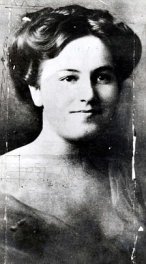

 This case of police corruption and gangland gunplay owned the Big Apple’s headlines in the early nineteen-teens — it even gets a callout in The Great Gatsby. Whether it was rightly decided has been hotly contested ever since.
 This teenager rashly