1989: Sandra Smith and Yassiem Harris

(Thanks to Richard Clark of Capital Punishment U.K. for the guest post, a reprint of an article originally published on that site. The images accompanying this post are also provided by Mr. Clark. -ed.)

Sandra Smith was the last woman to be hanged in South Africa (with her boyfriend Yassiem Harris).

Background.

Sandra Smith was a 22-year-old coloured woman (official South African designation during the apartheid era) who was married to a trawlerman called Philip and had two small children. Philip spent long periods at sea and sent money back for Sandra and the children. She began having an affair with Yassiem Harris, who was 3 years her junior, in the autumn of 1983 and soon they were deeply in love. Harris had been involved in crime since the age of 13 and had convictions for theft and fraud and was also a drug user. Philip found out about the affair from his neighbours and in March of 1986, he finally threw Sandra out. She and Harris now began living together in a rented apartment but soon the money that Philip used to give her ran out and their finances became tight.

The crime.

To make ends meet, they tried renting video recorders from shops and then selling them but this didn’t net them any real money. Harris, who was unemployed, also spent time hanging about outside a girl’s school and got to know some of the girls, including Jermaine Abrahams. He soon found out where she lived and from his conversations with Jermaine, he concluded that her family were quite wealthy.

They hatched a plan to break into the Abrahams’ family home and steal her mother’s jewelry and anything else of value. Harris had also found out that her parents left for work at 7.00 a.m. in the morning and she left for school about 7.40 a.m.

The victim, Jermaine Abrahams.

Smith and Harris arrived at the house about 7.30 a.m. on September the 1st, 1986, and Harris was let in by Jermaine on the pretext of him wanting to use the telephone. They tied Jermaine up but were disturbed by someone knocking at the door. She started to shout for help and struggle so they then tried to strangle her with a dish cloth. Harris now fetched a knife from the kitchen and repeatedly stabbed Jermaine in the neck. Amazingly, she didn’t die from her injuries and managed to get to her feet and stagger a few paces before collapsing. Harris carried Jermaine to her parents bedroom and made her show him where the jewelry and valuables were kept. He wrapped the poor girl in a duvet and then cut her throat, leaving her to bleed to death. He and Smith collected up what they wanted and then left the house.

Two weeks later, while Smith was being questioned by the police regarding the video scam, she surprised the interviewing officer by confessing to the killing of Jermaine. “I wouldn’t have been able to live with it,” she said. In her statement she told the police, “He pulled the scarf tight across her mouth and then cut her throat.”

On the 15th of September 1986, Sandra Smith was formally charged with the murder and 5 days later Harris was arrested and also charged with it.

Trial.

At their committal hearing at the Mitchell’s Plain Magistrates’ Court on the 23rd of September, they pleaded guilty to murder, alternatively to culpable homicide, and to stealing R2,000 worth of jewelry.

They were tried together at the Cape Town Supreme Court on December the 1st, 1986, before Mr. Justice Munnik, the Judge-President of the Cape Court, and two assessors. South Africa did not use the jury system, although its court proceedings were based upon British law, but instead a system of a judge and assessors. Both were represented by counsel and both attempted to shift the blame on to the other. Smith maintained that Harris had done the actual killing and Harris claimed to have been dominated by Smith, although they both admitted being present during the murder.

Sandra Smith was embarrassed by the revelations of her sex life with Harris in court and seemed at times more concerned with these than the fact that she was on trial for her life.

Having heard all the evidence, Mr. Justice Munnik gave a full reasoned judgement in which he described Harris as “an appalling witness.” He said it was clear that it was Harris who had stabbed the girl and slit her throat to prevent her identifying them. He also rejected Harris’ defence claim that he been dominated by Smith which had been refuted by the psychiatrist giving evidence for the prosecution. He accepted that Smith was demanding but not dominant, and there was no evidence to indicate that she forced Harris to kill Jermaine, nor that she had done anything to prevent the murder. He thus concluded that they were both equally responsible for the crime under the doctrine of “common purpose.” Thus on the 11th of December 1986, they were both formally convicted of the murder of Jermaine Abrahams and with robbery with aggravating circumstances and remanded for sentence.

Eleven days later they were brought back to the court and received the mandatory sentence for murder — that they be hanged by the neck until they were dead. Additionally, Harris received a 10-year prison sentence for robbery and Smith was given seven years for it. Sandra Smith became hysterical when she was sentenced to death and had to be taken struggling and screaming to the cells.

They were transferred to the country’s only death row, at Pretoria Central Prison, a modern facility on the outskirts of the capital where all South African executions were carried out. Their appeals were turned down and the review of the trial transcripts to determine whether to recommend that the state president grant clemency carried out by the Ministry of Justice failed to find any mitigating circumstances. As clemency was not forthcoming, their execution date was set for the 2nd of June 1989. Apparently, only around one in 50 people convicted of homicide were actually hanged at this time, the majority serving a prison sentence.

Execution.

At 6.50 a.m. on that morning, Smith was taken to meet Harris for the first time in over two and a half years. Together with two other men who had been convicted of murder, they were led the 52 steps to the pre-execution room next to the gallows. The death warrants were read to them and they were given the opportunity to say their last words. Their hands were handcuffed behind them and white hoods placed over their heads, these having a flap at the front which was left up until the last moment.

They were now led forward by warders into the large and brightly lit execution room. It was some 40 feet long with white painted walls. They would have seen the gallows beam running the length of the room and the 7 large metal eyes from which the four nooses dangled. (Seven prisoners could and often were hanged at once on this gallows.) The picture shows very much what Smith and Harris would have seen as they were led to the gallows. The chain hoist on the middle metal eye is used for raising the trapdoors after an execution.
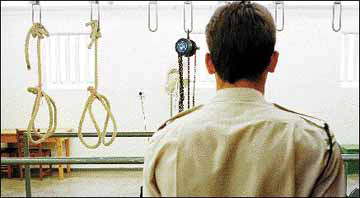
They were positioned side by side, on painted footprints over the divide of the trap and held by warders while the hangman placed the nooses around their necks. He then turned down the hood flaps and when all was ready, pulled the lever plummeting them through the huge trapdoors.

They were left to hang for 15 minutes before being stripped and examined by a doctor in the room below. Once death had been certified, the bodies were washed off with a hose and the water allowed to drain into a large gully in the floor. A warder put a rope around each of their bodies and with a pulley lifted them to allow the rope to be taken off. They were then lowered onto a stretcher and placed directly into their coffins before taken to a public cemetery for burial.

Although executions in South Africa were held in private, the procedure was described in detail by the then hangman, Chris Barnard, in an interview before he died. He officiated at over 1,500 hangings there.

South Africa hanged 1,123 people at Pretoria Central prison between 1980 and 1989, Solomon Ngobeni being the last on November 14th, 1989. Surprisingly perhaps, almost all of these were for “ordinary” murders rather than politically motivated crimes and most attracted very little publicity.

According to the South African Department of Correctional Services, two other coloured women were hanged for murder in the years 1969 to 1989, Gertie Fourie, on the 20th of May 1969 and Roos de Vos, on the 12th of December 1986. A total of 14 women were executed between 1959 & 1989, out of a total of 2,949 hangings.

President De Klerk ordered a moratorium on executions in 1990 and capital punishment was abolished altogether by the incoming black government of Nelson Mandela on the 7th of June 1995.

Comment.

We cannot know why Smith and Harris went to the Abrahams’ home while they knew Jermaine would still be there or whether they had actually formed any intention to kill her. Neither of them had any record of violence prior to the murder. My guess is that they panicked when she started to call for help from the person who knocked on the door and they tried to silence her. However, it seems hard to believe that Harris really thought she wouldn’t identify him to the police as soon as they had left and he may well have decided to kill her for this reason. It is claimed that Smith wanted Jermaine dead as she was jealous of her having some sort of relationship with Harris. In any event, Jermaine suffered a horrible and agonising death at their hands.

We cannot know, either, which one of them did the actual killing or whether they both took equal part in it. But there was clear “common purpose” established under law, and there were no obvious mitigating circumstances to allow the state to reduce the sentence on either of them. South Africa had the highest rate of judicial execution in the world during the 80’s so they would surely have known the penalty for murder but like so many people, gave no thought to it until it was too late.

Sadly, it is so typical of the kind of brutal and senseless murder that happens all too frequently and one that led to cruel deaths for three young people.

On this day..

1980: Kim Jaegyu, intelligence chief

On this date in 1980, the former intelligence chief of South Korea was hanged for assassinating President Park Chung-hee.*

In this surreal affair — known after its date as the “10.26 incident” in South Korea — the head of the Korean Central Intelligence Agency popped the autocratic head of state during a private dinner party at a secret KCIA compound.

He then returned to another dinner party at the compound and, without disclosing what he had done, reported an “accident” and started dropping suggestions to a general that this might be an opportune moment to arrange martial law. Instead, the two repaired to a bunker. There, several hours’ confused wind-gauging by a hastily assembled cross-section of the country’s power brokers (not knowing their own chief spook had pulled the trigger) gave illustration to the Ovid maxim that “treason doth never prosper: what’s the reason? If it prosper, none dare call it treason.”

Only two participants, Kim Chae Kyu and Kim Kye Won, had witnessed the assassination, and neither disclosed the killer … Without an explanation from these two, the others present were left to speculate whether the killings were truly accidental, organized by North Koreans, or perpetrated as part of a South Korean conspiracy, large or small. They could not rule out the possibility that some among them … were part of a plot. Without knowing the balance of power, both civilian ministers and military officers worried about making a wrong move … (Source)

The truth, eventually, would out. But the reason for this shocking internecine turn by a supposed confidante of the president? The murder was too well-planned to square with initial reports of an argument gone out of control. It seems a coup, but if so, our assassin disastrously — almost delusionally — miscalculated the post-Park lay of the land. Maybe we have to entertain the defendant’s own far-out claim to have struck against the authoritarian concentration of presidential power.

I shot the heart of Yusin Constitution like a beast. I did that for democracy of this country. Nothing more nothing less.

The controversial 2005 flick The President’s Last Bang offers a darkly comic look at the twisted mise en scene in the intelligence compound that fateful 10.26 … and doesn’t find a lot of participants worth admiring.

Whatever its cause, South Korea’s unanticipated transition was a wobbly one. Even as the spymaster who had set it in motion was hanged this date with some of his conspiring security men, successor dictator Chun Dwoo-hwan was crushing a student uprising in Gwangju.**

* Park had survived previous assassination attempts, often authored by North Korea — including one that slew his wife in 1974.

** This uprising resulted in a death sentence against future South Korean president Kim Dae-jung — obviously not carried out. Under Kim’s administration years later, Chun was himself condemned to die for the massacre; Kim returned the gesture of clemency.

On this day..

1989: Ted Bundy, psycho killer

Qu’est-ce que c’est?

It was 20 years today that Ted Bundy, the signature sexual psychopath in a golden age of serial killers,* rode the lightning in Florida’s Starke Prison.

Executed Today is pleased to mark the occasion with a conversation with Louisville crime writer Kevin M. Sullivan, author of a forthcoming2009 book on Ted Bundy … and a man who knows how the world looks from inside Bundy’s ski mask.


Ted Bundy is obviously one of the most iconic, written-about serial killers in history. Why a book about Ted Bundy? What’s the untold story that you set out to uncover?

The desire, or drive, if you will, to write an article about Ted Bundy and then create a 120,000 plus word book about the murders, was born out of my crossing paths with his infamous murder kit. Had Jerry Thompson [a key detective on the Bundy case -ed.] left Bundy’s stuff in Utah that May of 2005, well, it would have been an enjoyable meeting with the former detective, but I’m certain it would have all ended quietly there. Indeed, I doubt if I’d even considered writing an article for Snitch [a now-defunct crime magazine -ed.], much less a book about the killings. But it was having all that stuff in my hands, and in my home, and then being given one of the Glad bags from Ted’s VW that made it very real (or surreal) to me, and from this, a hunger to find out more about the crimes led me forward.


Ted Bundy’s gear, right where you want it — image courtesy of Kevin M. Sullivan. (Check the 1975 police photo for confirmation.)

Believe me, in a thousand years, I never would have expected such a thing to ever come my way. I can’t think of anything more odd or surreal.

ET: You mentioned that you think you’ve been able to answer some longstanding questions about Bundy’s career. Can you give us some hints? What don’t people know about Ted Bundy that they ought to know?

I must admit, when I first decided to write a book about the crimes, I wasn’t sure what I’d find, so the first thing I had to do was read every book ever written about Bundy, which took the better portion of three or four months.

From this I took a trip to Utah to again meet with Thompson and check out the sites pertaining to Bundy and the murders in that state. Next came the acquisition of case files from the various states and the tracking down of those detectives who participated in the hunt for the elusive killer.

Now, no one could have been more surprised than me to begin discovering what I was discovering about some of these murders. But as I kept hunting down the right people and the right documents, I was able to confirm these “finds” at every turn. And while I cannot reveal everything here, It’s all in the book in great detail. Indeed, you could say that my book is not a biography in the truest sense, but rather an in-depth look at Bundy and the murders from a vantage point that is quite unique. I wish I could delve further into these things now , but I must wait until it’s published.

The Bundy story has a magnetic villain and a host of victims … was there a hero? Was there a lesson?

The real heroes in this story are the detectives who worked day and night for years to bring Ted Bundy to justice. And if there’s a lesson to be learned from all of this, it is this: It doesn’t matter how handsome or articulate a person might be, or how nicely they smile at you, for behind it all, there could reside the most diabolical person you’ll ever meet! We need to remember this.

But how can you act on that lesson without living in a continual state of terror? Bundy strikes me as so far outside our normal experience, even the normal experience of criminality, that I’m inclined to wonder how much can be generalized from him.

Actually, (and I might say, thank God here!) people as “successful” as Ted Bundy don’t come our way very often. I mean, the guy was a rising star in the Republican Party in Washington, had influential friends, a law student, and certainly appeared to be going places in life. Some were even quite envious of his ascension in life. However, it was all a well-placed mask that he wore to cover his true feelings and intentions. On the outside he was perfect, but on the inside a monster. He just didn’t fit the mold we’re used to when we think of a terrible killer, does he?

Now, there are those among us — sociopaths — who can kill or do all manner of terrible things in life and maintain the nicest smile upon their faces, but again, just beneath the surface ticks the heart of a monster, or predator, or what ever you might want to call them. Having said that, I’m not a suspicious person by nature, and so I personally judge people by their outward appearance until shown otherwise. Still, it’s difficult (if not impossible) to see the “real” individual behind the person they present to us on a daily basis.

You worked with case detectives in researching your book. How did the Ted Bundy case affect the way law enforcement has subsequently investigated serial killers? If they had it to do over again, what’s the thing you think they’d have done differently?

They all agree that today, DNA would play a part of the investigation that wasn’t available then. However, in the early portion of the murders, Bundy made few if any mistakes, as he had done his homework so as to avoid detection. As such, even this wouldn’t be a panacea when it came to a very mobile killer like Bundy who understood the very real limitations sometimes surrounding homicide investigations.

I can’t help but ask about these detectives as human beings, too. Clearly they’re in a position to deal with the heart of darkness in the human soul day in and day out and still lead normal lives … is a Ted Bundy the kind of killer that haunts or scars investigators years later, or is this something most can set aside as all in a day’s work?

They are, first of all, very nice people. And you can’t be around them (either in person, or through numerous phone calls or emails) for very long before you understand how dedicated they are (or were) in their careers as police officers. They are honorable people, with a clear sense of duty, and without such people, we, as a society, would be in dire circumstances indeed.

Even before Bundy came along, these men were veteran investigators who had seen many bad things in life, so they carried a toughness which allowed them to deal with the situations they came up against in a professional manner. That said, I remember Jerry Thompson telling me how he looked at Ted one day and thought how much he reminded him of a monster, or a vampire of sorts. And my book contains a number of exchanges between the two men (including a chilling telephone call) which demonstrate why he felt this way

How about for you, as a writer — was there a frightening, creepy, traumatic moment in your research that really shook you? Was there an emotional toll for you?

Absolutely. But the degree of “shock”, if you will, depends (at least for me) on what I know as I first delve into each murder. In the Bundy cases I had a general knowledge of how Bundy killed, so there wasn’t a great deal that caught me by surprise, as it were. Even so, as a writer, you tend to get to know the victims very well through the case files, their family members or friends, and so on. Hence, I’ll continue to carry with me many of the details of their lives and deaths for the remainder of my life. And so, lasting changes are a part of what we do.

However, I did a story a few years back about a 16 year old girl who was horribly murdered here in Kentucky, and this case did cause me to wake up in the night in a cold sweat. Perhaps it was because I have a daughter that was, at the time, only a few years younger than this girl, and that some of what transpired did catch me off guard, so to speak, as I began uncovering just what had happened to this very nice kid.

Watch for Kevin M. Sullivan’s forthcoming The Bundy Murders: A Comprehensive History from McFarland in summer or fall of 2009.

* In fact, the term “serial killer” was coined in the 1970’s by FBI profiler Robert Ressler, as an improvement on the sometimes inaccurate category of “stranger killer”.


Additional Bundy resources from the enormous comment thread:

On this day..

1980: Four Iraqi Turkmen

On this date in 1980, a professor, a soldier, a bureaucrat and a businessman were hanged by Saddam Hussein in his campaign to cow Iraq’s Turkic ethnic minority.

The ethnic and religious quiltwork of Iraq is much more nuanced than Sunni vs. Shia — and this blog has noticed its deadly potential before.

This day’s hangings belong to an earlier era, of the Ba’athist secular pan-Arab aspiration that had Hussein quashing minority national aspirations. (Though the anti-minority stance was hardly unique to him.)

Nejdet Kochak, Abdullah Abdurrahman, Riza Demirji and Adil Sherif were ethnic Turkmen (or Turkomen), ethnically and linguistically distinct Moslem descendants of those far-flung peoples of the Eurasian steppes.

More to the point, they were relatively prominent voices for Turkoman civil rights in the face of harsh state suppression.

This being Saddam Hussein’s Iraq, the problem had an easy solution. The four were made examples of, convicted of spying for their brother Turks in Turkey, and hanged — but not forgotten.

On this day..

1980: Islamic extremists for the Grand Mosque seizure

At dawn this date in 1980, the kingdom of Saudi Arabia publicly beheaded over 60 Islamic extremists who had seized Mecca’s holy Al-Masjid al-Haram the preceding November — one of the formative and strangely forgotten events in the birth of radical Islam.

Saudi Arabia’s uneven but unmistakable modernization generated friction extending to the royal family itself.

On November 20, 1979, with 100,000-plus pilgrims bustling in Islam’s holiest shrine on the hajj, a few hundred multinational messianic militants took it over with a cache of smuggled firearms.

For two embarrassing weeks, the Saudi government struggled to respond, bumbling a couple of military operations and delicately negotiating the ecclesiastical permission it would require to commit violence within the Grand Mosque. (Strict Moslim prohibitions against same had left the kingdom’s unarmed guards essentially defenseless against the initial takeover.)

In exchange for that fatwa, the House of Saud struck a Faustian bargain: agreeing to roll back secularization and impose strict Islamic law.

The balance of military materiel, of course, would prove to be no contest at all; Riyadh had troops, heavy armament, and now, permission to use them (and to damage the mosque … which they did). Most of the Mahdists were slain in the decisive assault; the survivors* (except for a few who were underage) were publicly beheaded in various cities around Saudi Arabia on this date, including the operation’s leader, Juhayman al-Otaibi.

But their deed — second-tier news at the time in a United States distracted by the Iranian Revolution — would have dramatic long-term repurcussions. Though intimations of deeper bin Laden family involvement** seem sketchy, it certainly appears to have inspired the 22-year-old Osama bin Laden; he soon made his way to fight the Soviets in Afghanistan, a war that began in earnest just days after the end of the siege and to whose prosecution Saudi Arabia and the west would gratefully direct Islamist energies.

Meanwhile, the Saudi government’s pact with the clergy that gained it permission to assail the Grand Mosque saw it subsequently bankroll Wahhabi religious instruction in Saudi Arabia and beyond … arguably the hand that rocked the cradle of present-day Islamic radical movements like al-Qaeda.

Much of what is latterly recalled about this affair by Anglophones comes courtesy of journalist Yaroslav Trofimov’s recent book The Siege of Mecca: The 1979 Uprising at Islam’s Holiest Shrine. (Review | Another | Book home page).

In this clip, the author discusses the legacy of the siege with Fareed Zakaria.

* The Saudi government put out the figure of 63 executions. Some sources now report 67.

On this day..

1984: Alpha Otis O’Daniel Stephens: hear it live

On this date in 1984, Alpha Otis O’Daniel Stephens was electrocuted in Georgia for the execution-style murder of Roy Asbell after the latter surprised Stephens in the course of a burglary.

Stephens makes these pages for two reasons:
First, he survived his initial electrocution, requiring a second application of the lethal current — awful, though not exactly unheard-of.

Second, it emerged years later that the Georgia Department of Corrections was making audio recordings of its executions as a secret archive of the proceedings.

Several hours’ worth of these (subsequently leaked) recordings from various different Georgia electrocutions are available at SoundPortraits.org.*

We begin our trip back in time to Georgia’s execution chamber with the atmospheric sound of the warrant for his execution being read to the condemned and the witness — nicely juxtaposing the sentence of death with the body responsible for administering it: the Georgia Department of Offender Rehabilitation.

[audio:Alpha_Otis_O’Daniel_Stephens_warrant.mp3]

But the real action is the sound behind the curtain as prison officials realize the electrocution has not killed their man, wait agonizing minutes for the still-living body to cool enough for doctors to examine it officially, and begin the execution cycle anew. From the sound of it, they only barely killed him with the second pass: the officials are worrying openly that it looks like he’s still breathing very late in the procedure.

This file, obviously, comes with a content advisory sticker — though it lacks any directly identifiable hideous sound from the chair, or the prisoner, or the witnesses, the routine narrative of a prison bureaucrat as a man dies dreadfully in the next room is an altogether different order of horror.

[audio:Alpha_Otis_O’Daniel_Stephens_botched_execution.mp3]

This audio file was helpfully clipped by Dysfunctional Playground from the Pacifica radio Democracy Now! broadcast which aired it; the clip is itself an abridged version of a 20-minute original with long silences and unintelligible content excised.

The transcript of the abridged clip as aired by Democracy Now! follows below. Willis Marable, the main speaker on the tapes, was an assistant warden.


UNIDENTIFIED: Carry out the execution by the order of the court. There’s no reason to delay.

UNIDENTIFIED: Very well. On my count of three, press your buttons. One, two, three.

WILLIS MARABLE: The execution now has begun. There was one small jerk from the condemned at the time the execution was initiated. He is sitting very still now, and we are also now into the second phase of the execution. We are now into the third phase of the execution. No movement from the condemned. No activity, no movement from the witnesses. He appears to be relaxing a little bit more now. There’s sixty seconds remaining on the third phase of the execution. There is a slight movement from the condemned’s head. He seems to be moving his head from side to side slightly.

UNIDENTIFIED: I show the time is 12:19.

WILLIS MARABLE: Commissioner, he is still moving his head, and he seems to have slumped down in a relaxing-type position in the chair. But his head is moving from side to side slightly. Commissioner, Mr. Low, the execution is completed at this time. The electrical panel box is secured and locked. I do not detect any movement from the condemned at this time. He seems to have stopped moving his head and also his arms.

UNIDENTIFIED: I show the time is 12:20.

UNIDENTIFIED: You are in the lapse time countdown, is that correct?

WILLIS MARABLE: Yes, sir. We’re into the first minute of the lapse time now. No movement from any of the witnesses, and at this time no movement from the condemned. We have now completed one minute of lapsed time, four minutes remaining. Two minutes of lapsed time completed at this time, three minutes remaining. Still very little movement from any of the witnesses, and I detect no movement from the condemned at this time.

UNIDENTIFIED: I show the time is 12:22.

WILLIS MARABLE: Commissioner?

COMMISSIONER: Yes?

WILLIS MARABLE: Mr. Low?

COLONEL LOW: Yes.

WILLIS MARABLE: There is some slight movement. He’s still moving his head slightly. The only thing we can do is continue until the physicians can check him after the lapse time has expired.

COLONEL LOW: Don’t vary from your checklist.

WILLIS MARABLE: OK, sir. OK, we have completed three minutes of lapsed time, two minutes remaining. Commissioner? Mr. Low?

COLONEL LOW: Yes.

WILLIS MARABLE: He is still moving his head slightly, kind of a bobbing up-and-down movement. Commissioner?

COMMISSIONER: Yes.

WILLIS MARABLE: Mr. Low? We have completed four minutes of lapsed time. We have one minute remaining. And from my vantage point I do detect or it seems to be that he is breathing. Commissioner? Mr. Low? We have completed the five minutes lapsed time. Stand by for the physicians’ check. Commissioner?

COMMISSIONER: Yes?

WILLIS MARABLE: It appears the doctors agree with me that he’s still breathing. You want us to check him and then go through it again, or just go ahead and go through it again?

COMMISSIONER: Check him, and then go through it again. Definitely check him. Don’t vary from the checklist.

WILLIS MARABLE: Alright.

COMMISSIONER: Have them check him.

WILLIS MARABLE: OK. [inaudible] We’re going to do it again?

UNIDENTIFIED: It doesn’t say so.

WILLIS MARABLE: OK.

UNIDENTIFIED: It remains on.

WILLIS MARABLE: OK.

UNIDENTIFIED: The time is 12:26 and thirty seconds.

WILLIS MARABLE: Commissioner?

COMMISSIONER: Yes.

WILLIS MARABLE: The doctors have verified that he is still alive.

COMMISSIONER: Repeat the execution.

WILLIS MARABLE: Very well. You ready to go again?

COMMISSIONER: Better check all the connections. Val?

VAL: Yes, sir.

COMMISSIONER: Did you tell the witnesses that you’re repeating?

VAL: No, I didn’t.

COMMISSIONER: I think you should tell them.

VAL: OK. You want me to just advise them that—

COMMISSIONER: Just advise them—

VAL:—repeating the process and not go into any detail?

COMMISSIONER: That’s right.

VAL: OK.

WILLIS MARABLE: Commissioner? The superintendent is entering the execution chamber and approaching the mic at this time to advise the witnesses that we will proceed again with the execution.

COMMISSIONER: Well, listen, you can’t tell them—tell them there were some vital signs remaining, so the execution will repeat. See if you can get that message to them.

WILLIS MARABLE: It’s too late now. He’s already briefed them, and he’s on the way back in, sir.

COMMISSIONER: Fine, alright.

UNIDENTIFIED: I show the time is 12:28.

UNIDENTIFIED: OK, Commissioner, we’ll proceed at this time.

COMMISSIONER: Proceed.

UNIDENTIFIED: On my count of three, you press your button. One, two, three.

WILLIS MARABLE: Commissioner? Mr. Low? The execution is initiated again at this time. The condemned made one big jerk, and now he is relaxing in the chair. I do not detect any other movement from the condemned at this time. We have completed the first and second phase of the execution. We are now into the third phase. I do detect his head moving from side to side again. We’re still into the third phase of the execution. Commissioner? Mr. Low?

COMMISSIONER: Yes.

WILLIS MARABLE: He is still at this time moving his head from side to side and appears to be breathing. We’ll continue it just like we did previously.

UNIDENTIFIED: We’re going to have to check that [inaudible].

WILLIS MARABLE: We have fifteen seconds remaining on the third phase of the execution. Commissioner, Mr. Low, the third phase of the execution is completed. The equipment is switched off, secured at this time. We are now into the five-minutes lapse time.

COMMISSIONER: What is the status on the condemned?

WILLIS MARABLE: Sir, he appears to be breathing to me.

COMMISSIONER: You’re going to have to have them check those sponges and check their connections or something. There’s something they don’t have connected right, Willis.

WILLIS MARABLE: Yes, sir. Do you want us to go ahead and complete this whole thing and then—

COMMISSIONER: Yeah, complete the phase, and then you’re going to have to make the check.

WILLIS MARABLE: OK, sir. Commissioner, Mr. Low, we have completed one minute of lapse time. We have four minutes remaining. I might also advise at this time that I do not detect any movement from him at this time. He appears to have stopped moving. Still no movement from any of the witnesses. They were just sitting very still, observing the condemned in the chair.

UNIDENTIFIED: I show the time at 12:32.

WILLIS MARABLE: We have now completed two minutes of phase time, lapse time. We have three minutes remaining. I might also add that I do not detect any movement from the condemned. Commissioner, Mr. Low, we have now completed three minutes lapse time. We have two minutes remaining. There is still no movement from the condemned. Commissioner, Mr. Low, we have completed four minutes of lapse time. We have one minute remaining. Still no detectable movement from the condemned. He does seem to have stopped moving entirely. Commissioner, Mr. Low, we have completed our five minutes lapse time. Stand by for the physicians’ check.

At this time, the superintendent and the two physicians are entering the execution chambers for their check. The first doctor is now in the process of making his check for vital signs.

UNIDENTIFIED: I show the time at 12:36. I show the time is 12:37.

WILLIS MARABLE: The second doctor is still in the process of conducting his check for vital signs. The superintendent is at this time, Commissioner, Mr. Low, is still in the process of briefing the witnesses that at 12:37 hours this date the condemned was pronounced dead. He has instructed all witnesses to depart the witness room. Back to the front of the institution. At this time, the curtains are drawn.

* Here’s another recorded Georgia execution we’ve featured.

On this day..

1985: Mahmoud Mohamed Taha, progressive Islamic theologian

On this date in 1985 progressive Islamic theologian Mahmoud Mohamed Taha was publicly hanged at a prison in Khartoum North, Sudan.

Seventy-five years old at his death, Taha spent his youth in the nationalist movement against British control of Sudan where he emerged as the standard-bearer of the liberal/secular Republican Party.

After Sudan won independence in 1956, both Taha and his party maintained — in the face of official hostility that waxed and waned with the changing regimes — nonviolent support for political openness, national unity between Muslims and non-Muslims, and a theology pointing to reform within Islam. Specifically, Taha embraced a women’s movement and opposed the imposition of sharia, at least in the absence of a radical modernization of the Islamic religious law.

The introduction of sharia in 1983 brought matters to a head, and not only with Taha: civil war broke out — the conflict between the Muslim north and the Christian and animist south only recently and imperfectly abated.

Taha and four other Republicans were tried for their intransigence in a two-hour trial under a seemingly muddled mixture of secular and religious law.

Among the hundreds of attendees of Taha’s hanging this day were his four “co-conspirators.” They were themselves under sentence of death to be carried out January 20th, unless they should recant. All four recanted. Hundreds of other Republicans were held around the country on lesser charges until they did likewise.

The next year, with a new government in place, the Sudanese Supreme Court declared the proceedings against the Republicans to have been in error.

Little of Taha’s work has been translated, but his Second Message of Islam is available in English and presents a conception of the faith so unfamiliar in the west that one reviewer mitigates his praise with the regret that “it is nonsensical to talk of reforming Islam, a religion which is doctrinally irreformable.”

Taha’s thought also has a scholarly evaluation in Quest for Divinity: A Critical Examination of the Thought of Mahmud Muhammad Taha. More information by and about Taha and the Republicans is here.

On this day..

1989: Nicolae and Elena Ceausescu

On this date in 1989, 71-year-old dictator Nicolae Ceausescu and his wife Elena were condemned by a secret military tribunal and immediately shot in Targoviste as Communism in Romania suddenly, stunningly collapsed.

The last of the Revolutions of 1989 that toppled Communism through much of Eastern Europe in a matter of weeks left the indelible image of the man who had dominated Romanian politics since the mid-60’s bewildered as a party-summoned mass rally at Bucharest’s Revolution Square turned against him.

It was to be Ceausescu’s last public address. Within a day, the country had slipped from his control; before week’s end, he would face a firing squad with “The Internationale” on his lips at the conclusion of a drumhead trial.

In a confused political situation — the police who intercepted Ceausescu and his wife held them for several hours, attempting to divine which way the winds were blowing before handing them over to the mutinous army — Romanian state television would soon broadcast footage of the trial and the first couple’s corpses (though not the execution itself).

Caution: This video contains graphic footage

Immediately afterwards, Romania abolished the death penalty. Nicolae and Elena Ceausescu remain the last people executed in that country.

On this day..

1987: Jacek Lazar condemned

On this date in 1987, according to the sentence read to him in the climactic scene of The Decalogue no. 5,* Jacek Lazar was condemned to hang for the senseless murder of a taxi driver. (“Lazar” was fictional, but he had a real-life inspiration.)

The movie, plainly reflecting the director’s opposition to the death penalty, is the most overtly political of Krzysztof Kieslowski‘s ten-film cycle exploring the themes of the Ten Commandments. But it is far from tendentious.

The supposed date of the actual execution, depicted here, is not identified.

If one credits the dates, this hanging would be among the last performed in Poland. After April 1988, death sentences were no longer carried out, and Poland formally abolished the death penalty in the late 90’s — thanks in no small part to this film.

* Or Dekalog, per its Polish rendering. This particular installation of the series is also referred to as “A Short Film About Killing”.

On this day..