1961: Adnan Menderes

On this date in 1961, the Turkish Prime Minister deposed in the previous year’s military coup was hanged at the island of Imrali.

Condemned at the same trial as his comrades in government,* Adnan Menderes delayed his execution with an unsuccessful suicide bid. Revived from a sleeping pill-induced coma, the gag about Istanbul was that he would soon be fit enough to hang.

Twenty-four hours and one involuntary stomach-pumping later, and he was.

The 62-year-old Smyrna/Izmir native had had a memorable run. He served in Ataturk’s army, then toppled Ataturk’s political party: Menderes won the first three free elections in Turkey in 1950, 1954, and 1957, a feat never since replicated. He was notorious for his temper and sensitivity to criticism, reportedly given to smashing things in his office and demonstrably given to firing ministers and aides for even trifling differences of opinion. Just months before his ouster, he’d survived a plane crash in England — “the former Premier,” observed the New York Times,** “might have gone down in Turkish history as a great patriot and champion of the people” if he had died in it.

His ignominious end didn’t blacken his name to posterity. Years later, he (and the officials who preceded him to the gallows) was posthumously pardoned and reburied in an Istanbul mausoleum. Today, he’s so far from public opprobrium that his name can be found on public accommodations like airports and ferries

There’s more information about Menderes available online in Turkish, including this biography and this film:

* Among the co-defendants also condemned but reprieved was Mahmut Celal Bayar, President of the Republic of Turkey. Bayar died in 1986 at age 103, supposedly the longest-lived head of state or head of government in all of history.

** September 17, 1961.

Part of the Daily Double: Turkey’s “Left-Wing Coup”.

On this day..

1961: Fatin Rustu Zorlu and Hasan Polatkan

On this date in 1961, two former Turkish ministers of state were hanged together on the island of Imrali.*

A ten-month trial on the island of Yassiada had ended just the previous day, condemning 15 to death; 12 sentences were commuted, leaving only the biggest fish to fry.

Zorlu, the former Foreign Minister, and Polatkan, late the Finance Minister, were both implicated in the financial crimes often characteristic of high office. Zorlu was also condemned for helping instigate a notorious 1955 anti-Greek riot. The two were helicoptered to Imrali for a pre-dawn hanging.

Zorlu, at least, was reported to have died game. He helped slip the noose over his own neck, and at his hanging “asked that he be allowed to kick away the chair himself. Permission was granted.” (Los Angeles Times, September 18, 1961)

* Tangentially, the prison on Imrali is the one American drug-smuggler Billy Hayes subsequently escaped from. Hayes went on to write Midnight Express, later adapted for the silver screen by Oliver Stone.

Part of the Daily Double: Turkey’s “Left-Wing Coup”.

On this day..

1972: Mohamed Oufkir

When last we met Mohamed Oufkir in these pages, he was violently suppressing an attempted coup against Morocco’s King Hassan II.

Mohamed Oufkir’s wife and six children were “disappeared” to a desert prison, not to emerge for 18 years. Daughter Malika, a royal favorite in happier times, wrote Stolen Lives about that ordeal. (Interview | Another)

We find him today, 13 months later as the arrow of time flies, in the same story — on the other end of the gun-barrel.

At around 4 o’clock this afternoon, a stunning attempt on the monarch took place as he flew back to Morocco from France. The king’s 727 was attacked by F-5 fighters of the Moroccan Air Force, surviving, it is said, when the quick-thinking king himself took the radio, pretended to be a flight engineer, and informed the attacking fighters that the pilots were dead and the king mortally wounded.

The ruse tricked the attacking pilots into allowing the crippled plane to make its landing in Rabat; they returned too late to strafe the airfield when they realized their mistake.

This quashed coup was swiftly laid at the door of Oufkir, the powerful Defence Minister.

Oufkir was declared to have committed suicide late this night, or else in the small hours of August 17; this still-standing official explanation has always had its doubters, with more extravagant versions implicating the offended sovereign himself in dealing out the punishment. Probably not, but here’s foreign correspondent Stephen O. Douglas’s reconstruction in Morocco Under King Hassan:

[Interior Minister Mohamed] Benhima said that when Oufkir arrived at the Skhirat palace at 11 p.m. he was met in an anteroom by General Mawlay Hafid and Colonel Dlimi, and when he realised that the king knew he had masterminded the plot he pulled out a revolver saying, ‘I know what to expect.’ Benhima added, ‘The two witnesses tried to stop him. In the struggle he fired three shots, one wounding him in the chest, the second I don’t know where, but the third was the most fatal.’ He said this was ‘the truthful and authentic version’.

‘General Oufkir committed suicide. He was not killed. It has been asked if it was a suicide of loyalty or a suicide of treason. Well then, I am authorised to tell you, to certify that since 1 p.m. today, and considering the elements of inquiry we have in our possession, I can affirm that it was a suicide of treason and not a suicide of loyalty,’ Benhima said.

Later at the same news conference, Benhima indicated he was just as astonished as most of the journalists. He said he and Oufkir were ‘great friends. We appreciated each other very much and had confidence in each other. We had a common denominator: our loyalty, and I think we wore the same decoration, given to us on the same day for the same reasons. He was a great patriot, a great minister. As I just told one of your colleagues, I cannot figure how he could have done what he did. But he is one of the most attractive people I have known, and what I have said about him today is painful to me, but the truth had to be told.’

I learned later that during the fatal night a military ambulance took Oufkir’s blood-stained body back to his Souissi house where it was placed on the floor of a playroom. His wife Fatima was away on vacation on the Mediterranean coast and there were very few people in the house. They found Oufkir had four bullet wounds, three in the back and the fourth having gone through the nape of his neck and out through his left eye, shattering his glasses, the coup de grace. Suddenly someone decided it was a mistake to send the corpse back to his family and it was hastily retrieved the same night. Thus evidence that he may have been ‘suicided’ disappeared.

Hassan somehow escaped the day with his crown, but with two attempts to overthrow him over the previous 13 months and a need to purge the many unreliable Oufkir loyalists in the armed forces — well, as the London Times put it (Aug. 22, 1972), “short of his incredible good fortune there is little else that can be cited in real terms to guarantee the perpetuation of his rule.” You could have made good coin wagering informed observers of the time that Hassan would live and reign another 27 years and be internationally saluted at his peaceful death at age 70.

On this day..

1976: Lt. Col. Abu Taher

At 4 a.m. this date in Dhaka Central Prison, Lt. Col. Abu Taher was hanged for treason.

A series of coups in the mirrored-sunglasses era of military governance shook the young state of Bangladesh:

  • The autocratic Sheikh Mujibur Rahman was toppled by a revolt of junior officers on August 15, 1975;
  • Senior brass in turn felled the ruling junta on November 3, 1975, jailing powerful officer Ziaur Rahman;
  • A quick counter-coup of junior officers — also remembered as the “sepoy mutiny”* — mounted by leftist war hero Abu Taher on November 7 put Ziaur Rahman’s hand back on the helm of state.

While November 7 is still marked in Bangladesh as National Revolution and Solidarity Day, its author got short shrift from its beneficiary.**

Abu Taher, a retired officer and a hero of the 1971 Bangladesh Liberation War that had detached the former East Pakistan from Islamabad, had visions of social revolution. But three coups in as many months is the sort of thing to rattle the new big man, and Zia consolidated his own power by eliminating threats to both left and right political flanks.

A mere 17 days after doing that National Revolution and Solidarity thing, the guy with the mass movement (pdf) of armed men was arrested for treason. He faced a military tribunal the following year.

Taher scorned the charges against him, but of course the fix was in.

* An allusion to colonial history.

** However, Taher’s own date of martyrdom is also still marked by his posthumous partisans.

On this day..

1971: Ten failed putschists in Morocco

On this date in 1971, four generals, five colonels and a major who had attempted a coup d’etat in Morocco less than three days before were shot without trial at the military barracks in Rabat.

The senior officers* had taken military cadets and stormed the palace where birthday celebrations for King Hassan II were taking place. They captured the monarch himself before the cadets themselves wavered, and loyal troops successfully counterattacked. Ninety-two people, including the Belgian ambassador, were killed in the affair; the king was at their state funeral on this date at the time the putschists were being shot.

This selection of the coup’s leadership gunned down this day in Rabat did not make an end to the reverberations; other trials followed later in the year, and some others who were implicated were simply “disappeared”.

Although we lack the testimony of any of the coup leaders themselves for their motivations, it occurred in the context of political and social upheaval in post-colonial Morocco. Frank H. Braun (“Morocco: Anatomy of a Palace Revolution That Failed”, International Journal of Middle East Studies, Vol. 9, No. 1 (Jan., 1978)) argues that it was rooted in an eclipse of the traditional prerogatives of the military — and especially of the Berber nobility, who can be said to be the authors of the attempt.

So too can its failure be ascribed to the scant support this parochial and backward-looking cause commanded; non-Berber officers didn’t join the plot. Even so, with one of his government’s traditional pillars of support so heavily compromised (and decimated by this day’s executions and other reprisals), the coup led Hassan II to somewhat liberalize Morocco’s constitution the following year.

Which did not exactly still the tumultuous power politics scene in Rabat.

Mohamed Oufkir, the general who had coolly suppressed the 1971 coup** to become the preeminent military officer in the country, mounted his own bid for power in 1972 and suffered the same fate as this date’s doomed rebels.

* Notably, Mohamed Medbouh (French link), “one of my closest collaborators” in the estimation of the king himself (but also of “the mentality of a jackal”). His surname actually meant “cutthroat,” and was earned by his father’s literally having his throat cut — and surviving — in the 1920’s.

** A Berber himself, Oufkir may have been aware of the earlier coup — and cunning enough not to commit himself until he saw which way the wind was blowing.

On this day..

1294: Rane Jonsen, Marsk Stig conspirator

On an unknown date in 1294, the former page of the late Danish King Eric V was put to death for regicide outside Roskilde.

Rane Jonsen or Jonsson (here’s his short Danish Wikipedia page) had been present at the hunt during which the former monarch, more popularly known as “Erik Glipping”, was murdered by unknown assailants in 1286.

The convention — and the official verdict of state — have it that Jonsen contrived to admit marsk Stig Andersen Hvide and fellow conspirators to the vulnerable king’s presence for the purpose of murdering him, possibly revenging the king’s rape of Andersen’s wife. “Marsk Stig” and Rane both fled, and were condemned along with seven other men by the Danish Assembly in the spring of 1287.

Although there is little remaining primary documentation, it does seem that the guilt of these people was decided above all by political expedience. It was Stig Anderson’s opponents who got control of the government (and the regency of 12-year-old Erik Menved), conveniently declaring the guilty parties to be their own rivals, who had formerly been close to Erik Glipping.*

Our page, himself a noble, got the short end of the stick in all this; he energetically denied the story that he had stood aside to permit the murder of his liege, claiming that he fought back albeit unarmed and outnumbered.

But as an emblem of the perfidy of the king’s inner circle, you couldn’t do much better than Rane theatrically planting his sword into a table and standing aside to signify the king’s vulnerability. You can just picture that story being retold with a meaningful ahem to the boy-king Eric VI.

In fact, it was retold: wrongful conviction or no, this episode (in its official version, with Rane and Stig as evildoers) was the basis for a number of entries in the rich Danish ballad genre.

Though popularly cited as medieval ballads, disputed dating places different verses anywhere from Rane Jonsen’s own time to three centuries later.** In any era, they offer some lovely exemplars of the art.

This book reproduces several; topical for this entry is an imagining of the fugitive regicide’s plight, both sad (for his hopelessness) and menacing (for his violent seizure of a bride) — disconcertingly delivered in a repetitious lullaby singsong.

Ranild bade saddle his charger gray,
‘Twas told me oft before,
“I’ll be the Algrave’s guest today,
“Tho’ friends I have no more.”

Ranild rode up to his castle gate
‘Twas told him oft before
Where ermine-clad the Algrave sate,
Tho’ friends he had no more.

“Hail noble Algrave, here I come,
‘Twas told thee oft before
“To fetch my trothplight Kirstin home,
“Tho’ friends I have no more.”

Then up and spake her mother dear,
“‘Twas told thee oft before,
“For thee is bride no longer here,
“For friends thou hast no more.”

“I’ll either with the maid return,
“‘Twas told you oft before
“Or else your house and chattels burn,
“Tho’ friends I have no more.”

“Nay set not thou the house on flame,
“‘Twas told thee oft before,
“E’en take the bride thou ‘rt come to claim,
“Tho’ friends thou hast no more.”

In mantle wrapt the gentle maid,
‘Twas told her oft before,
On Ranild’s good gray horse was laid,
Tho’ friends he had no more.

No other bridal bed had they,
‘Twas told her oft before,
Than bush, and field, and new made hay,
For friends he had no more.

“The wood has ears, the mead can see,
“‘Twas told thee oft before,
“A wretched outlaw’d pair are we,
“For friends I have no more.”

“And had you not King Erick slain,
“‘Twas told you oft before,
“We still might in the land remain,
“But friends we have no more.”

“Stay, Kirstin, stay, such words forbear,
“‘Twas told thee oft before,
“Where strangers are, take greater care,
“For friends we have no ore.”

With that he slapp’d her cheek so red,
“‘Twas told thee oft before,
“It was not I, smote Erick dead,
“Tho’ friends I have no more.”

From the same source, our day’s principal meets his end:

Report is rife in all the land
Ranild at last is caught;
He surely had never gone from Hielm,
His doom had he bethought;
A death of torture he must die,
As he has long been taught.

Ranild he stepp’d within the door,
‘Good evening’ bade the king,
And all the guard of gentlemen,
Who round him stood in ring;
“Christ! may no son of loyal Dane
“Such trouble on him bring!

“But, O King Erick, noble liege,
“Remember you no more;
“The best was I of all the swains
“Your father’s livery wore;
“And you through wood and flowery mead
“In arms so often bore?”

“Full well I know thou servedst here
“For clothes and food and pay;
“And, like a vile and treacherous knave,
“My father didst betray;
“For which the stake thy carcase bears,
“If I but reign a day.”

“My hands and feet hack from my limbs,
“Tear from my head these eyes;
“With racking tortures martyr me,
“The worst you can devise;
“So much the wrong I’ve done your house
“For vengeance on me cries.”

“Thine eyes put out, that will we not,
“Nor lop thy hands or feet;
“But with a traitor’s hardest death
“The worst of traitors treat;
“And on our father’s murderer take
“Such vengeance as is meet.”

As forth from Roskilde he was led,
He wrung his hands anew,
And tears to see him go to die
Wept ladies not a few;
He turn’d him round, and bade them all
A thousand times Adieu.

They led him forth to where the rack
Stood ghastly on the plain;
“O Christ, from such a martyring death
“Protect each honest Dane!
“Had I but stay’d at Hielm this year,
“And there in safety lain!

“Now were there here one faithful friend,
“Who home for me would go,
“And would my sorrowing wife Christine,
“Her path of duty show!
“O Christ, look on my children dear!
“O comfort thou their woe!

“And you, I pray, good Christian folk,
“Who here are standing round,
“A pater noster read for me,
“That grace for me be found;
“And that this night I reach the land,
“Where heavenly joys abound.”

Marsk Stig, however, is the primary focus of these dramas; he raided shipping from his island base on Hielm (Hjelm), dying of natural causes in 1293. Some additional translated ballads about this character are available here.

But since this is poetry, take a moment to dig the original Danish,† which should be at least partially comprehensible to any English- or German-speaker.

Marsti ind aff dorren tren
med suerd i hoyre hend:
kongen sidder hannem op igien,
saa giorlig han hannem kende

>>Hor du, Ranil Ienssen!
oc vilt du verie mit liff:
jeg giffuer dig min soster
oc halff min rige in min tid.<< Det vor Ranil Iensson, han hug i borde oc balck; det vil ieg for sanden sige: hand veriet sin herre som en skalck De stack ham ind at skulder-bende, oc det stod ud aff halss; det vil ieg for sandingen sige: det vaar alt giort med falsk. De stack hannem ind at skulder oc ud aff venster side: >>Nu haffuer wi giort den gierning i dag,
all Danmarck baer for stor quide<<.

Stig burst through the door,
his sword in his right hand;
the king sat upright
and recognized him.

“Hear me, Rane Jonson!
If you defend my life
I will give you my sister
and half of my kingdom.”

Rane Jonson swung his sword
and stuck it in the table and in the wall;
in truth,
he betrayed his lord shamefully.

They stabbed him in the shoulderbone
and out through the neck;
in truth,
they did it all deceitfully.

They stabbed him in the shoulder
and out through the left side.
“Now we have done the deed today,
all Denmark bears too heavy a load”

* Discussed at length in “Killing Erik Glipping. On the Early Days of a Danish Historical Ballad” by William Layher in Song and Popular Culture, 45, 2000. Layher reports that the Norwegian government (which received the fugitives) and the Danish were still trading nastygrams over the propriety of the convictions in the early 1300s. On the instigation of the Archbishop of Lund, who supported the exiles, the Church interdicted sacraments to Denmark for several years around the turn of the century.

** See Layher again. At least one contemporaneous bard, minnesinger Meister Rumelant, is known to have composed on the famous murder.

† Extract and translation from Layher, once again.

Part of the Themed Set: The Ballad.

On this day..

1980: Kim Jaegyu, intelligence chief

On this date in 1980, the former intelligence chief of South Korea was hanged for assassinating President Park Chung-hee.*

In this surreal affair — known after its date as the “10.26 incident” in South Korea — the head of the Korean Central Intelligence Agency popped the autocratic head of state during a private dinner party at a secret KCIA compound.

He then returned to another dinner party at the compound and, without disclosing what he had done, reported an “accident” and started dropping suggestions to a general that this might be an opportune moment to arrange martial law. Instead, the two repaired to a bunker. There, several hours’ confused wind-gauging by a hastily assembled cross-section of the country’s power brokers (not knowing their own chief spook had pulled the trigger) gave illustration to the Ovid maxim that “treason doth never prosper: what’s the reason? If it prosper, none dare call it treason.”

Only two participants, Kim Chae Kyu and Kim Kye Won, had witnessed the assassination, and neither disclosed the killer … Without an explanation from these two, the others present were left to speculate whether the killings were truly accidental, organized by North Koreans, or perpetrated as part of a South Korean conspiracy, large or small. They could not rule out the possibility that some among them … were part of a plot. Without knowing the balance of power, both civilian ministers and military officers worried about making a wrong move … (Source)

The truth, eventually, would out. But the reason for this shocking internecine turn by a supposed confidante of the president? The murder was too well-planned to square with initial reports of an argument gone out of control. It seems a coup, but if so, our assassin disastrously — almost delusionally — miscalculated the post-Park lay of the land. Maybe we have to entertain the defendant’s own far-out claim to have struck against the authoritarian concentration of presidential power.

I shot the heart of Yusin Constitution like a beast. I did that for democracy of this country. Nothing more nothing less.

The controversial 2005 flick The President’s Last Bang offers a darkly comic look at the twisted mise en scene in the intelligence compound that fateful 10.26 … and doesn’t find a lot of participants worth admiring.

Whatever its cause, South Korea’s unanticipated transition was a wobbly one. Even as the spymaster who had set it in motion was hanged this date with some of his conspiring security men, successor dictator Chun Dwoo-hwan was crushing a student uprising in Gwangju.**

* Park had survived previous assassination attempts, often authored by North Korea — including one that slew his wife in 1974.

** This uprising resulted in a death sentence against future South Korean president Kim Dae-jung — obviously not carried out. Under Kim’s administration years later, Chun was himself condemned to die for the massacre; Kim returned the gesture of clemency.

On this day..

1355: Marino Faliero, Doge of Venice

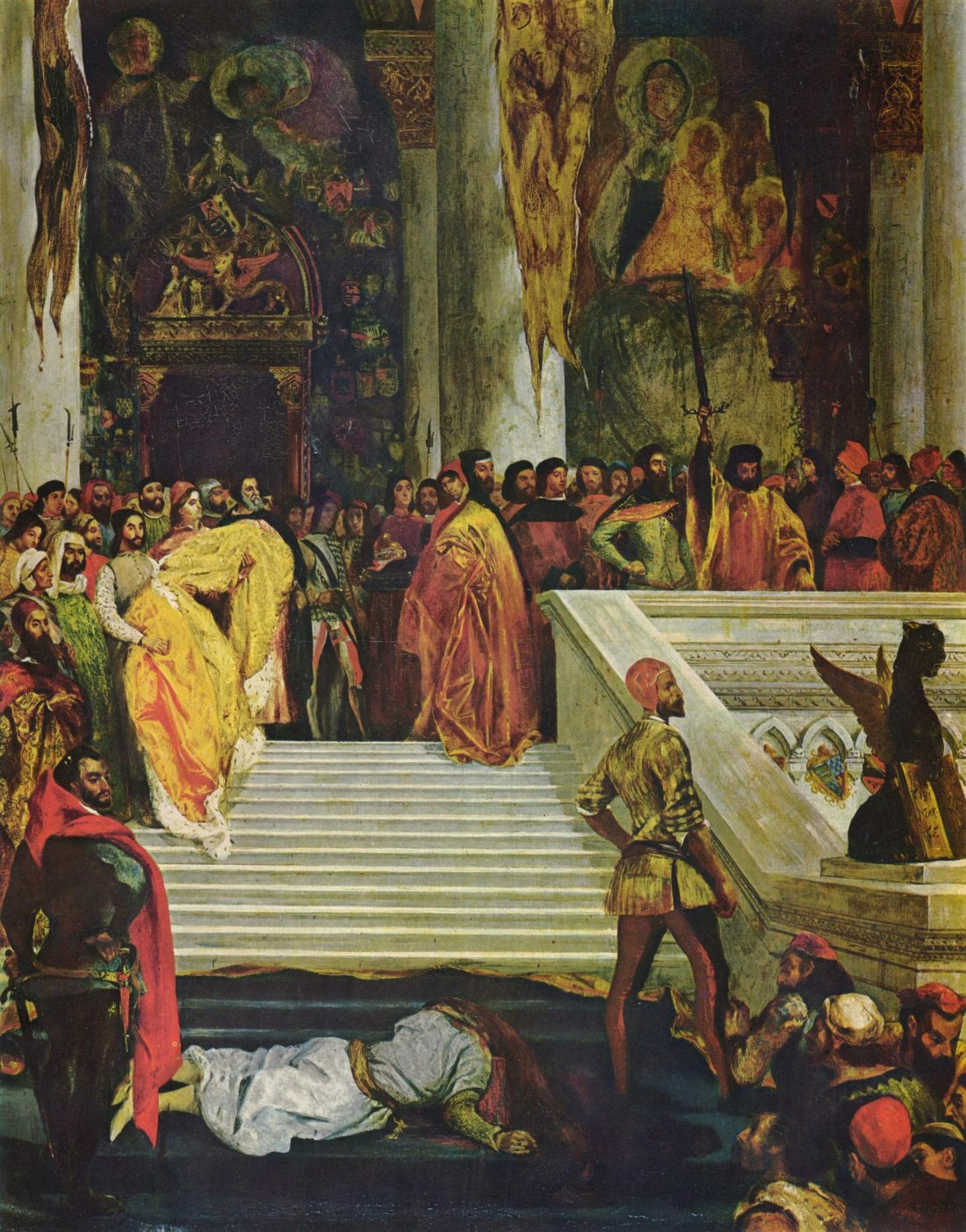
On this date in 1355, Marino Faliero* was escorted to the spot where he had been crowned Doge of Venice scant months before. There, he was ceremoniously relieved of his robes of state … and then his head.


The Execution of Marino Faliero, by Eugene Delacroix (1827).

Some fog surrounds the day’s proceedings, product not only of time but of the Doge’s executioners’ damnatio memoriae upon their victim. What was written was circumspect; even Faliero‘s portrait in the great hall of the Doge’s Palace was veiled.

What is known — or at any rate, was admitted by the elderly first citizen — is that the ruler attempted a coup against the overweening power of Venice’s great families.

The putsch was supposed to occur on April 15, with the bell of St. Mark’s Cathedral tolling on a fabricated hue and cry. In the tumult, the Doge’s supporters meant to cut down the nobles who flexed the real political muscle in the maritime republic and consolidate ducal power.

Why?

The salacious version has the old goat in a tiff with a noble, who made fun of his May-December marriage —

Marino Faliero of the beautiful wife,
Others enjoy her while he maintains her

A tribunal of fellow-nobles let the rascal off with a slap on the wrist.

Power being what it is, and princes and nobilities being born for conflict with one another across the centuries in Europe, one may as well discern a straightforward political intent — heightened, perhaps, by the then-dire state of Venice’s naval contest with Genoa.

Downright Byronic under either scenario … and Byron wrote a play about Faliero. The doomed ruler gives throat to quite a magnificent curse upon his city, with all the foresight of Byron’s half-millennium of hindsight:

I perish, but not unavenged; far ages
Float up from the abyss of time to be,
And show these eyes, before they close, the doom
Of this proud city, and I leave my curse
On her and hers for ever! —

          — She shall be bought
And sold, and be an appanage to those
Who shall despise her! — She shall stoop to be
A province for an empire, petty town
In lieu of capital, with slaves for senates,
Beggars for nobles, panders for a people!

Amidst thy many murders, think of mine!
Thou den of drunkards with the blood of princes!
Gehenna of the waters! thou sea Sodom!
Thus I devote thee to the infernal gods!
Thee and thy serpent seed!
[Here the Doge turns, and addresses the executioner.]
          Slave, do thine office!
Strike as I struck the foe! Strike as I would
Have struck those tyrants! Strike deep as my curse!
Strike — and but once!

This sort of thing knocking about among litterateurs in the 19th century practically guarantees an opera.

* Or simply “Marin Falier”, in the Venetian dialect.

On this day..

1552: Edward Seymour, deposed Lord Protector

The set of any given Tudor-era costume drama is a walking Who’s Who of scaffold superstars, most notably, of course, the wives of Henry VIII. That king’s bed did not cease exuding power and danger with Henry’s death.

With Henry’s demise, the crown fell to the only legitimate son the old man had produced in a lifetime of trying, the sickly 9-year-old Edward VI, son of Henry’s beloved* third wife Jane Seymour.

Jane’s brothers had leveraged their late sister’s favor into political muscle, and Edward Seymour smoothly outmaneuvered rival factions late in Henry’s life to set himself up as the true ruler of England during the boy king’s regency.

Created Duke of Somerset and Lord Protector,** Edward ran the country for going on three years, executing the other Seymour sibling as a rival along the way.

But the power of the king’s office without the attendant legitimacy turned out to be a double-edged blade.

Edward inherited a campaign against Scotland (and France) to secure the betrothal of the king to the young Mary Queen of Scots, then just beginning her own lifetime as a political and matrimonial football.

That wearisome (and costly) military scenario could only exacerbate the enmities a somewhat tin-eared Somerset generated in the course of everyday politics at the treacherous Tudor court. Catholics resented his liberal religious policy (Thomas Cranmer produced the first Book of Common Prayer on Edward Seymour’s watch); noble rivals wheedled and flattered the youthful king in his charge; and Edward Seymour’s populist political style rubbed stodgier nobles the wrong way without quite satisfying discontent among commoners† who rebelled widely in 1549, a year of terrible harvests and economic breakdown. By October of 1549, he had been politically isolated and was supplanted by John Dudley. (Guess what happened to him.)

Interestingly, that transition initially looked to be as bloodless a coup d’etat as 16th century England could enjoy: Seymour did a couple months in the Tower of London but accepted his place and not only rejoined the Privy Council but dynastically married his daughter to Dudley’s heir.

All it took, however, was an ounce of paranoia on Dudley’s part to suspect the former Lord Protector of plotting against him. The peers of the realm wouldn’t convict him of a trumped-up treason charge, but “compromised” with a felony conviction that had, for old man Somerset, the exact same result.

We have an account of the Duke’s oddly portentous end from diarist Henry Machyn, whose record of the scene in the original text of Early Modern English we present here beside its “translation” — courtesy of Machyn diaries here and here.

[The xxij of January, soon after eight of the clock in the morning, the duke of Somerset was beheaded on Tower hill. There was as] grett compeny as have bene syne . . the kynges gard behynge there with ther ha[lbards, and a] M1. [i.e., a thousand] mo with halbards of the prevelege of the Towre, [Ratcliffe,] Lymhowsse, Whyt-chapell, Sant Kateryn, and Strettford [Bow], as Hogston, Sordyche; and ther the ij shreyfs behyng th[ere present] seyng the execusyon of my lord, and ys hed to be [smitten] of, and after shortely ys body was putt in to a coffin, [and carried] in to the Towre, and ther bered in the chyrche, of [the north] syd of the qwyre of sant Peters, the wyche I beseeche [God] have mercy on ys sowlle, amen! And ther was [a sudden] rumbelyng a lytyll a-for he ded, as yt had byn [guns] shuttyng [i.e., shooting] and grett horsys commyng, that a M1. [i.e., a thousand] fell [to the] grond for fere, for thay that wher at the on syd [thought] no nodur butt that one was kyllyng odur, that [they fell] down to the grond on apon anodur with ther halb[ards], they thought no nodur butt that thay shuld . . . . . sum fell in to [the] dyche of the Towre and odur plasys, . . . and a C. [i.e., 100] in to the Towre-dyche, and sum ran a way for [fear.] He [the Duke of Somerset] was beheaded soon after eight o’clock in the morning, being brought to his execution the sooner to prevent the concourse of the people, who would be forward to see the last end of one so well beloved by them. It was the greatest company as have been seen. The King’s guard being there with their arms, there were a thousand more with halberds of the privilege of the Tower, from Ratcliff, Limehouse, Whitechapel, St. Katherine, and Stratford Bow, as Hoxton, Shoreditch.

And there the two sheriffs being there present seeing the execution of my lord. And his head to be off. And after shortly his body was put into a coffin and carried into the Tower and there buried in the church of the north side of the choir of St. Peter. The which I beseech God have mercy on his soul. Amen.

And there was a sudden rumbling a little before he died as it had been guns shooting and great horses coming, that a thousand fell to the ground for fear. For they that were at the one side thought no other but that one was killing other. That they fell down to the ground, one upon another with their halberds. They thought no other but that they should flee. Some fell into the ditch of the Tower and other places, and a hundred into the Tower ditch, and some ran away.

* Henry was buried next to Jane, a meek spouse who had stayed out of politics, given him an heir, and died from the birth.

** Not the realm’s most famous Lord Protector, of course, but the last to exercise the office as it had been traditionally understood, for the protection of an underage sovereign.

† Notably, Somerset ordered a commission to look into nobles enclosing common land, a burning issue throughout the century. Some think this raised hopes in the hoi polloi for a resolution to the great class conflict that the Duke didn’t have the juice to implement.

On this day..

1961: Patrice Lumumba

No brutality, no torture has ever made me plead for mercy, because I prefer to die with my head up, with unshakable faith and deep confidence in the destiny of my country, rather than live in submission and spurning of scared principles.

-Patrice Lumumba’s last letter to his wife

One person’s “murdered under controversial circumstances” is another person’s “executed.” By most unbiased accounts, Patrice Lumumba was both.

A strident anti-colonialist caught in the most inflammatory of Cold War power struggles, Lumumba remains a controversial figure.

In 1956, Patrice Lumumba was a mail clerk in Belgian Congo recently out of prison for embezzlement of post office funds. Though previously involved with the Liberal Party of Belgium, a colonialist political party, after prison, he helped found the Mouvement National Congolais, a pro-independence national party (an important distinction at the time, as most pro-independence parties were at least partially tribal in nature).

Convicted in 1959 of inciting an anti-colonial riot and sentenced to 6 months in prison, Lumumba was released early as Congo won its independence and the MNC became an important political force. Just how important became apparent the following June, when the 35-year-old Lumumba was ratified as the newly independent Congo’s first prime minister.

From criminal to high statesman in just over a year, Lumumba took his new power in stride, and watched in disgust as the deposed King Baudouin of Belgium attended the new nation’s first Independence Day celebration, and before a fawning international media condescendingly congratulated Belgium’s colonial beneficence to its former slave plantation.

Struck from the day’s official celebrations in favor of the the lukewarm exhortations of the new President Kasa-Vubu, Lumumba found time on the day’s unofficial program. Strident, emotional, and unabashed in its anticolonialist, nationalist, and pan-Africanist bent, Lumumba’s famous speech was roundly criticized by the domestic and foreign press, but well-received by the crowd and ultimately delivered directly to history.

Lumumba’s tenure as prime minister was short-lived, however.

Mere weeks after independence, a mutiny on army bases broke out in reaction to Lumumba’s ill-fated decision to leave the military out of a government pay raise. The resulting anarchy quickly spread throughout the country, and the province of Katanga, with the support of King Baudouin and powerful mining companies, declared independence. As United Nations troops failed to quell the situation, Lumumba appealed to the Soviets, whose intervention succeeded only in causing Lumumba’s political support to crumble.

Kasa-Vuba dismissed Lumumba in September; in response, Lumumba declared Kasa-Vuba deposed — quite illegally, as it happens — and appealed to the Senate, from whom he managed to win a vote of confidence.

At this point, in the heat of the Cold War, things got interesting.

Deposed again, this time in a CIA-endorsed coup, Lumumba found himself under house arrest and under the protection of UN troops. Not certain whether to trust the rule of the various laws surrounding him, Lumumba slipped out under the cover of night and escaped to nearby Stanleyville (now Kisangani), where he believed he had enough supporters to set up his own government — and army, whom one supposes he had by then resolved to pay rather better.

Pursued by forces loyal to the new government, Lumumba was captured and arrested in early December 1960 and charged with “inciting the army to rebellion.” Devoid of his former UN protection, the man who would be the leader of a newly free nation watched as he became a pawn in a much larger struggle. UN Secretary General Dag Hammarskjöld appealed to the process of law –- whatever that was –- while the USSR jumped a step ahead, demanding that Lumumba be immediately released and reinstated as prime minister and all UN forces withdrawn.

So much for that. The UN Security Council convened, and, a week later, the USSR’s resolution was defeated. Another, Western-backed resolution that would have given the UN power to act as impartial arbitrator was vetoed by the USSR.

At this point, caught between hostility of Cold War politics and the ever-hazy idea of “international law,” Lumumba languished in the military barracks of an even more hostile government. Hearing of plans for his transfer to barracks at the now-subdued Katanga province, Lumumba was wild on the plane trip and was forcibly restrained after appealing to other passengers to intervene on his behalf. Late at night after his arrival at his new prison, Lumumba was driven to an isolated spot and executed by firing squad. News of his death was not released until three weeks later, when it sparked protests in several European cities over the role of the Belgian government, which denied any involvement.

The extent of US and Belgian involvement in Lumumba’s death remains the subject of ongoing speculation. So does the question of what might have been.

On this day..