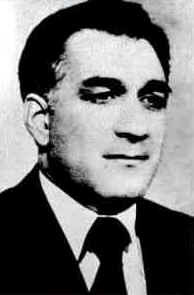
1979: Hafizullah Amin

On this date in 1979, the 104-day term of Afghan president Hafizullah Amin met a violent end as a Soviet-engineered coup raised the curtain on a war destined to bring misery to both Cold War combatants.

The Soviet Union’s ongoing intervention in Afghan politics had through the 1970’s steadily mired it deeper into an unstable political situation.

Now, it was running out of patience with the country’s president, Hafizullah Amin.

He’d got the best of rival Nur Mohammad Taraki in a power struggle that September, but to the political chaos and the blossoming Islamic insurgency roiling his country, Amin added a level of brutality that was all his own, and a streak of diplomatic independence that was distinctly unwelcome in Moscow.

Amin was a Communist himself, and both he and the predecessor he’d murdered had wanted ever-increasing Soviet aid to keep the country stable.

But that proved to be a Faustian bargain.

Though Kabul radio would announce that Amin had been tried and summarily executed for “crimes against the state,” the short-lived dictator’s fate had been decided two weeks before when the Soviet Politburo passed a secret resolution for his ouster — having lost whatever confidence it had once held in him as a dependable satellite governor.

“The Soviet Union,” said the New York Times in a more innocent time,

has seemed deeply troubled by the inability of either the Taraki or Amin governments to put down the rebellions in Afghanistan, which have been largely tribal but also militantly anti-Communist.

Amin survived a KGB poisoning, so the Red Army dispensed with subtlety by raiding the palace, plucking their preferred satrap out of exile in eastern Europe to take Amin’s place.

It would not see the last of Afghanistan until 10 years, 15,000 Soviet dead, and hundreds of thousands of Afghan casualties later.


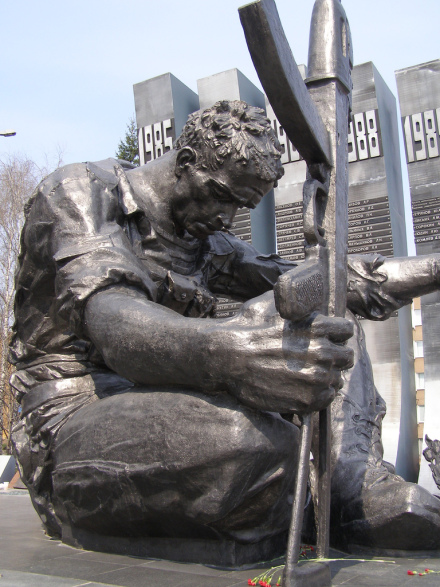
A memorial in Ekaterinburg, Russia, to the Soviet dead in the Afghan war. Image courtesy of beatdrifter (Andy Holmes).

On this day..

1939: The 18 corpses of the rebellion

On this date in 1939, 18 junior officers of the Thai military were shot in Bangkok.

Ostensibly condemned for being part of a coup plot to depose the adolescent King Ananda Mahidol in favor of his abdicated predecessor Prajadhipok, they were in reality the casualties of a purge by the Field Marshal-turned-Prime Minister Phibun Songkhram.

It’s alternatively transliterated “Phibun Songkhram” or “Pibunsonggram”, and familiarly abbreviated to “Por”, but by any name he dominated Thai politics for a generation.

One of the military leaders of the bloodless 1932 Siamese Revolution that made the country a constitutional rather than an absolute monarchy, Phibun had in 1938 muscled his way to the Prime Ministership.

Beset by assassination attempts linked to royal revanchists to whose purposes the young turk’s programme was deeply inimical, Phibun determined to break the back of monarchism en route to a modernized, militaristic nationalism (pdf) that would be right at home in the imminent world war.*

As 1939 opens, we join the narrative of Paul Handley’s The King Never Smiles:

Phibun swept the capital and arrested 50 royals, nobles, and soldiers in the clique of his People’s Party rival Colonel Song Suradej for plotting his overthrow …

Whatever the truth behind the cabal, its quashing came to represent the final victory of the 1932 revolutionists and the constitutionalists over the monarchists. To mark it, Phibun commissioned a huge monument to the constitution, later called Democracy Monument, in the middle of the city’s main thoroughfare, Rajadamnoen (“royal progress”) Avenue.


The Democracy Monument in Bangkok.

The eighteen officers who took it in the shorts on this date were not joined by condemned VIPs like royal blood Prince Rangsit, who copped a commutation. It’s widely thought now that the “Songsuradet Rebellion” — or aptly-named “Rebellion of 18 Corpses” — was trumped-up, if not an phantasm altogether.

The Democracy Monument was not the only bulwark of Thai nationalism thrown up by Phibun in the year between the “conspirators'” January arrest and their deaths this day.**

He dropped the old absolutist name “Siam” in favor of the more nationalistic “Thailand” in June of that year; made the date of the 1932 revolution a national holiday; stripped the language of class-distinctive structures; and pressed irredentist claims against neighboring French colonies.

And if the royal house was efficiently marginalized by Phibun, it would yet develop in the latter part of the century into one of the region’s weightiest political entities† … intertwined with the Thai military Phibun helped hoist to pride of place, a formula that has left coups and unstable governments a presistent feature of the political landscape down to the present day.

* And subsequently, too. Despite aligning with the Axis powers during World War II, Phibun was a feted anti-Communist dictator as Washington started counting dominoes in Southeast Asia in the 1950’s.

** The Wikipedia page for the rebellion claims that the executions were carried out in batches of four per day. A New York Times report of December 6, 1939 said that all 18 had been executed the previous day.

† The current King Bhumibol Adulyadej, who coincidentally turns 81 today, is the world’s longest-reigning monarch as of this writing … with no shortage of concern about the conflict his passing may unstop.

On this day..

284: Aper, by Diocletian

On this date* in 284, one of Rome’s greatest emperors claimed the purple by summarily executing his rival before the approving army in Anatolia.

The Emperor Diocletian christened his reign with a bit of scaffold theatricality, but he might have been the real perp.

For half a century, the Roman Empire had waded through crisis. In its political manifestation, a parade of forgettable emperors had marched through the throne room, each to be assassinated, overthrown, or otherwise disposed of by some equally forgettable aspirant en route to a similarly unenviable end.

At length, out of this unpropitious bunch, rose one Diocles, a low-born Dalmatian of classical education whose martial gifts saw him rise through the legions. His opportunity came when the emperor Carus, barely a year on from succeeding his assassinated predecessor, died on campaign against Persia allegedly struck by lightning (quite possibly a euphemism for something more dagger-like), leaving his son Numerian in charge.

As the army meandered back to the friendly confines, Numerian secluded himself in his litter. And after a while, the litter started to stink.

Sometime on the journey, he’d been secretly killed — but by whom?

The principals this day are our leading suspects. (And it’s a little mystifying in either case just what was gained by leaving the body hidden so long.) We turn to Gibbon to narrate what must have been a riveting — not to mention definitive — proceeding adjudicating between them a few kilometers past Nicomedia (moder Izmit, Turkey) towards Chalcedon (now the Kadikoy district of Istanbul).

A general assembly of the army was appointed to be held at Chalcedon, whither Aper was transported in chains, as a prisoner and a criminal. A vacant tribunal was erected in the midst of the camp, and the generals and tribunes formed a great military council. They soon announced to the multitude that their choice had fallen on Diocletian, commander of the domestics or body-guards, as the person the most capable of revenging and succeeding their beloved emperor. The future fortunes of the candidate depended on the chance or conduct of the present hour. Conscious that the station which he had filled exposed him to some suspicions, Diocletian ascended the tribunal, and raising his eyes towards the Sun, made a solemn profession of his own innocence, in the presence of that all-seeing Deity. Then, assuming the tone of a sovereign and a judge, he commanded that Aper should be brought in chains to the foot of the tribunal. “This man,” said he, “is the murderer of Numerian;” and without giving him time to enter on a dangerous justification, drew his sword, and buried it in the breast of the unfortunate praefect.** A charge supported by such decisive proof was admitted without contradiction, and the legions, with repeated acclamations, acknowledged the justice and authority of the emperor Diocletian.

Though there isn’t any direct evidence of it, posterity is entitled to suspect on grounds of means, motive and opportunity, that the eventual beneficiary of Numerian’s demise — the emperor henceforth known as Diocletian — was its true author.

Whether obtained by fair means or foul, Diocletian put the laurels of state to good use, stabilizing government by introducing the “Tetrarchy” — the rule of the empire’s eastern and western halves by two emperors (“Augusti”) each aided by a “Caesar” who was also the heir apparent.

Diocletian’s two decades in power before his anomalous voluntary retirement constitute a watershed in the late history of Rome, and not only because the cycle of imperial assassinations and civil war took a welcome generation-long hiatus.

Although he’s also remembered for initiating the last major persecution of Christians, his administration set the stage for the rise of Constantine the Great, the Galilean’s first imperial champion. Constantine’s father was one of the original tetrarchs, the Caesar of the west.

And in the longer term, Diocletian’s division of the empire between east and west would sow the seed of the later separation of Byzantium and Rome, and the corresponding division in the Christian world. No surprise, then, that the first ruler profiled in Lars Brownworth’s 12 Byzantine Rulers podcast is this date’s executioner:

[audio:http://www.12byzantinerulers.com/audio/02-Diocletian.mp3]

More audiophilia about Diocletian and the tetrarchs in this lecture from Isabelle Pafford’s UC-Berkeley course on Roman history. (The first 6:45 or so consists of class business and carryover from previous lectures.)

[audio:http://webcast.berkeley.edu/media/s2008/hist106b/hist106b_20080425.mp3]

* As with much in the ancient world, sourcing is tenuous, and there is some scholarly debate over whether the events in this post should be ascribed to November 20, or to November 17, or to September 17, or to some other date. Since this blog, notwithstanding its title, embraces the occasional execution whose date is uncertain, I am prepared to wave aside textual uncertainty in the interest of a ripping good story.

** According to the Historia Augusta, Diocletian had a superstitious reason to carry out this bloodthirsty act personally.

This story my grandfather related to me, having heard it from Diocletian himself. “When Diocletian,” he said, “while still serving in a minor post, was stopping at a certain tavern in the land of the Tungri in Gaul, and was making up his daily reckoning with a woman, who was a Druidess, she said to him, ‘Diocletian, you are far too greedy and far too stingy,’ to which Diocletian replied, it is said, not in earnest, but only in jest, ‘I shall be generous enough when I become emperor.’ At this the Druidess said, so he related, ‘Do not jest, Diocletian, for you will become emperor when you have slain a Boar (Latin: Aper).’ ” … It is now well known and a common story that when he had killed Aper, the prefect of the guard, he declared, it is said, “At last I have killed my fated Boar.” My grandfather also used to say that Diocletian himself declared that he had no other reason for killing him with his own hand than to fulfill the Druidess’ prophecy and to ensure his own rule. For he would not have wished to become known for such cruelty, especially in the first few days of his power, if Fate had not impelled him to this brutal act of murder.

Part of the Themed Set: The “Ex” Stands For “Extrajudicial”.

On this day..

1954: Hossein Fatemi, before the blowback

At dawn this date in 1954, the last Foreign Minister of democratic Iran was shot in Tehran.

It was a year since the dramatic events of 1953, when a CIA-backed coup d’etat overthrew Iranian Prime Minister Mohammed Mossadegh (or Mosaddegh, or Mossadeq, or Mosaddeq) for contemplating oil nationalization.

Over several chaotic days of “Operation Ajax” (or TPAJAX), the Mossadegh government repulsed a first coup attempt, then succumbed to another.

After Mossadegh initially appeared to have maintained his hold on power, the autocratic Shah Mohammad Reza Pahlavi fled for his life to Iraq and thence to Rome. Fatemi, Mossadegh’s forceful young foreign minister, excoriated the Shah in words that themselves raised the specter of execution.

A traitor is afraid. The day when you, O traitor, heard by the voice of Teheran that your foreign plot had been defeated you made your way to the nearest country where Britain has an embassy. (Quoted in the New York Times.)

Either way, it was high stakes for all concerned in oil country. There’s been contentious debate over the extent to which the affair was also a Cold War proxy conflict — or whether the involvement of the country’s Communist party was incidental, a smokescreen, or an outright stalking-horse for the west.

The coup against Mossadegh has emerged as a major historical turning point — and after the Shah was himself dramatically overthrown in the 1979 Iranian Revolution, not necessarily so successful for American foreign policy goals as it seemed at the time.

Appropriately — in fact, with eerie prescience given the events that then lay a generation in the future — a recently declassified 1954 CIA report on the coup made the first known use of a neologism that has since grown increasingly familiar: blowback.

Possibilities of blowback against the United States should always be in the back of the minds of all CIA officers involved in this type of operation. Few, if any, operations are as explosive as this type.

Maybe those possibilities should be in the front of the mind.

Today, there’s a street named for Fatemi in Tehran, and — strange to say — still some number of Americans who anticipate the greeting due liberators should they ever manage to roll a tank down it.

On this day..

1945: Vidkun Quisling, who made his name as a traitor

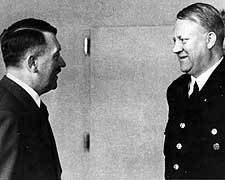
On this date in 1945, eponymous Nazi collaborator Vidkun Quisling was shot at Oslo’s Akershus Fortress for high treason.

By the time of his death, the Nazi collaborator (English Wikipedia page | Norwegian) had already given his surname to English and other languages as a synonym for traitor.

Just deserts for his efforts as chief of the fascist party Nasjonal Samling to aid the Nazi conquest of his home country. Quisling interrupted a radio broadcast on April 9, 1940 to proclaim himself Prime Minister* and order cooperation with invading Germans.

Although Quisling’s lack of popular support compromised his value even as a puppet, he remained as Minister President of Norway through the war — a crucial tool in Germany’s counter-encirclement jousting with Britain, nicely explained at the outset of Frank Capra’s American propaganda flick Why We Fight:

He enjoyed public regard commensurate with his station.


A 1944 cartoon in Sweden (which remained tenuously neutral and unoccupied during the war) indicates that Quisling had already made his name a byword for treachery. The caption reads:
“I am Quisling.”
“And the name?”

Norway had abolished capital punishment in 1905, but its government-in-exile reinstated it expressly for dealing with high-level collaborators.

Though Quisling himself may have deserved this and worse, the justice and legality of so doing has been controversial ever since.


The site of Quisling’s execution. Some other shots from his trial are in this 60-year Norwegian-language retrospective.

* Thought to be the first on-air putsch in history.

On this day..

1911: Several revolutionaries on Double Ten Day

On the tenth day of the tenth month — Double Ten Day, as it has since been remembered in China and the Chinese diaspora — the quick execution of a few revolutionaries signaled the surprising end of China’s 2,000-year-old imperial government.

Actually, the collapse of imperial rule wasn’t such a surprise: China’s last dynasty had foundered in the face of the 19th century challenges of European colonialism; driven by multitudinous grievances, popular revolts and reform movements had buffeted China in recent years, most seriously the turn-of-the-century Boxer Rebellion.

The Qing Dynasty was a tinderbox. But one never knows what spark will set the flame.

On October 9, 1911, revolutionaries in the central China town of Wuchang — today merged with neighboring towns into the city of Wuhan — lit the fuse literally when a bomb they were building for a planned insurrection accidentally went off.

In the ensuing scramble, police raided the joint and found incriminating lists of thousands of revolutionary recruits. Arrests followed fast, and several (three*) of the arrested were summarily put to death on the morning of the tenth.

But the plot’s apparent misfortune actually turned out to be its spur to victory.
Realizing that their identities were exposed to the authorities, and that they were in danger of immediate execution, the revolutionaries … revolted.

Their military forces mounted a successful municipal coup d’etat.

While the central government dilated, insurrectionary Wuchang appealed to the provinces for solidarity, and within weeks the Wuchang Uprising had blossomed into full-fledged revolution: the Xinhai Revolution, to be exact. By the following February, China’s last child-emperor had been forced to abdicate.

For the first time in millennia, the fallen dynasty was not succeeded by another dynasty. Though the new state was itself heir to the myriad contradictions and weaknesses that dogged the Qing, it was a definitive turning point: China became Asia’s first democratic republic, the polity that today is Taiwan.

* The names Peng Chufan, Liu Yaocheng and Yang Hongsheng are proposed in this history.

Update: This excellent History Today article for the Double Ten centennial also specifies three executions, and even includes this outstanding public domain image from the Francis Stafford collection.

On this day..

1973: Victor Jara, among thousands in Chile’s September 11

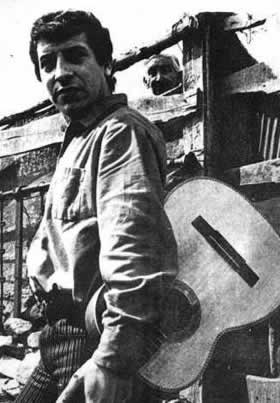
At an unknown time on this evening in 1973, or else the early hours of the following day, Chilean putschists ushering in the Pinochet dictatorship machine-gunned folk singer Victor Jara near the Santiago stadium that today bears his name.

“I don’t see why we need to stand idly by and let a country go communist due to the irresponsibility of its own people,” said Henry Kissinger of Allende’s election. Victor Jara had another idea.

Four days before, Chile’s September 11 had seen General Augusto Pinochet topple the elected leftist government of Salvador Allende, murdering the president in his palace. (Or, go some accounts, Allende committed suicide — “pausing only twice to reload.”)

A long pall of evil settled over the country, with all the accustomed chilling familiars: “disappeared” people, mirrored shades, Jeane Kirkpatrick.

The day after the CIA-backed coup, popular folk singer and activist Victor Jara, a pioneer of the Nueva Cancion (“New Song” movement) then teaching at Santiago’s Technical University, was among thousands of undesirables rounded up and packed off to a makeshift prison camp at the city’s Chile Stadium — a stadium Jara had performed at.*

Left there to the tender mercies of a thuggish Chilean officer, Jara was beaten and tortured over the intervening days — evocative but possibly undependable tradition holds that the guitarist’s hands were cut off, shattered or otherwise destroyed. According to the U.S.-based United States Institute of Peace,

[t]he the last day Víctor Jara was seen alive was September 15. During the afternoon he was taken out of a line of prisoners who were being transferred to the National Stadium. In the early morning of the next day, September 16, shantytown dwellers found his body, along with five others, including that of Littré Quiroga Carvajal, near the Metropolitan Cemetery. As the autopsy report states, Víctor Jara died as a result of multiple bullet wounds (44 entry wounds and 32 exit wounds).

The Commission came to the conviction that he was executed without due process of law by government agents, and hence in violation of his fundamental human rights.

To say the least.

And as the text implies, Jara was only the most recognizable name among unknown hundreds killed as the military cemented its control of the country.

Jara remains larger-than-life martyr figure in Latin America and liberation movements worldwide, but he’s almost unknown north of the Rio Grande. Pinochet was our bastard; in the weird way history writes its own geography, Jara became a political emblem behind the Iron Curtain for the perfidy of the capitalist powers: obscure in Peoria, but a household name in Potsdam, as the credit roll from this 1978 East German film suggests.**

That’s Jara himself on the soundtrack, of course. The pat conclusion for such a figure is that his art is his legacy, and that Jara’s body of work as against Pinochet’s will be a walkover in posterity. Is that enough? Pinochet died in his bed at age 91; earlier this year, the Jara case was closed in underwhelming fashion. Thirty-five years down the road, most authors of Pinochet’s human rights depredations are dead or lost or decrepit. Justice delayed is justice denied.

Victor’s widow, Joan Jara — today director of the Fundacion Victor Jara (it’s a Spanish-only site); you can hear her interviewed on Democracy Now! for the 25th anniversary of her husband’s death in 1998 — managed to leave the country with some of his works.

Her publication of a poem he wrote while imprisoned, an untitled, unfinished work generally known as “Estadio Chile,” made it a signature cry of hope amid desperation. Here it is in the Spanish rough-hewn under the shadow of death; there’s an English translation here.

Somos cinco mil
en esta pequena parte de la ciudad.
Somos cinco mil
¿Cuantos seremos en total
en las ciudades de todo el pais?
Solo aqui, diez mil manos que sembran
y hacen andar las fabricas.

¡Cuanta humanidad
con hambre, frio, panico, dolor
presion moral, terror y locura!

…¡Y Mexico, Cuba y el mundo?
¡Que gritan esta ignomonia!

Somos diez mil manos menos
que no producen.
¿Cuanto somos en toda la Patria?
La sangre del companero Presidente
golpea mas fuerte que bombas y metrallas.
Asi golpeara nuestro puno nuevamente.

¡Canto que mal me sales
cuando tengo que cantar espanto!
Espanto como el que vivo
como el que muero, espanto.

De verme entre tanto y tantos
momentos de infinito
en que el silencio y el grito
son las metas de este canto.
Lo que veo nunca vi,
lo que he sentido y lo que siento
hara brotar el momento…

Whether or not it’s enough, his work is his legacy after all.

* Some 7,000 people were held at Chile Stadium in the days after the coup, most later moved in with other detainees at the larger Estadio Nacional. The USIP excerpt alludes to Jara being pulled out for execution during such a move.

** In a similar vein, Stanford has a small online exhibit of Jara-themed East German propaganda art. Not to be outdone, there’s a Soviet rock opera about Jara, and an asteroid discovered by a Soviet astronomer was named in Jara’s honor within a week of his execution.

On this day..

1944: Eight July 20 plotters

On this date in 1944, Nazi Germany’s juridical vengeance against Hitler’s near-assassins commenced.

Barely two weeks after Col. Stauffenberg‘s bomb had barely missed slaying the Fuhrer, eight of his principal co-conspirators stood show trials at the Volksgerichtshof (People’s Court) before hectoring prig Roland Freisler.

The outcome, of course, was foreordained.

Apparently orders had come down from on high to make the deaths as degrading as possible; this batch, convicted August 7-8, was hanged naked this day at Berlin’s Plotzensee Prison on thin cord (piano wire, say some sources, although it’s not clear to me whether this is literally true) suspended from meathooks while cameras rolled. Video and stills from the ghastly scene were shipped back to Hitler’s bomb-damaged Polish outpost for the edification of the powers that be.

The eight fitted for those nooses were:

Many hundreds more would follow, both at Plotzensee and throughout the Reich where persons distantly connected to the plotters and various miscellaneous resistance figures were swept up in the purge.

On this day..

1963: 21 Iraqi Communists

On this date in 1963, Iraq’s infant Ba’ath government executed at least 21 soldiers — all Shi’a — who had participated in a Communist coup attempt on July 3.

The Ba’ath were newly in the saddle after overthrowing Qasim earlier that year, and would be ousted again a few months hence before their definitive seizure of power several years later.

For the moment, they were a fledgling government trying to tilt away from the Soviet bloc and towards the west while navigating a minefield of domestic politics. If the coup really occurred as described, it was the fruit of an Iraqi Communist Party with daggers drawn for the regime after the Ba’athists had massacred their membership with CIA help in the course of offing Qasim. (The name is also transliterated Qassim or Kassem.) If it was bogus, it was probably an official cover story to keep massacring Shi’a Communists.

The affair, in either guise, amounted to a minor hazard in the jagged path of the Ba’ath — but of course, we come by that judgment with benefit of hindsight. Far more interesting to follow, courtesy of this site‘s library of historic cables, the perceived unfolding of the situation through the anxious American diplomatic pouch:

On this day..

1794: Maximilien Robespierre, Saint-Just and the Jacobin leadership

On this date in 1794, the curtain — and the blade — fell on the Terror.

Maximilien Robespierre, who had breakfasted the previous day as master of France, was guillotined this evening with his chief lieutenants and partisans.

His fall came as sudden and inevitable as his rise had been unpredictable.

Five years before, Robespierre was an unprosperous Arras attorney of fashionably liberal philosophies, and you wouldn’t have given a sou for the prospects of his being remembered five minutes after he died. Yet it would come that his inseparable lieutenant Saint-Just would remark with understatement, “The words we have spoken will never be forgotten on earth.”

The historic convocation of the Estates-General thrust him onto the political stage where he would make the dread name that follows him, starting off in the Revolution’s inception as a far-left deputy. He took a notable early stand against the death penalty, with several arguments that are quite familiar by our day:

The first obligation of a legislator is to form and preserve public morals, the source of all freedom, source of all social happiness. When in running to a particular goal he turns away from this general and essential goal he commits the most vulgar and dire of errors. The king must thus present to the people the purest model of justice and reason. If in place of this powerful, calm and moderate severity that should characterize it they place anger and vengeance; if they spill human blood that they could spare and that they have no right to spread; if they spread out before the people cruel scenes and cadavers wounded by torture, it then alters in the hearts of citizens the ideas of the just and the unjust; they plant the seed in the midst of society of ferocious prejudices that will produce others in their turn. Man is no longer for man so sacred an object: we have a less grand idea of his dignity when public authority puts his life at risk. The idea of murder inspires less fear when the law itself gives the example and the spectacle. The horror of crime is diminished when it is punished by another crime. Do not confuse the effectiveness of a penalty with the excess of severity: the one is absolutely opposed to the other. Everything seconds moderate laws; everything conspires against cruel laws.

For Robespierre, it was an abomination for the nation to deal out death within its community, but his Rousseauan elevation of the collective and abstract People made extirpating existential threats to the community itself an altogether different matter.

The future tyrant’s anti-death penalty case for executing the deposed Louis XVI, flowing directly from those principles, makes interesting reading and is excerpted at length (all emphases added) here for its topicality:

When a nation has been forced to resort to the right of insurrection it returns to a state of nature as regards its tyrant. How can the latter invoke the social compact? He has annihilated it. The nation can preserve it still, if it thinks fit, in whatever concerns the interrelations of its citizens: but the effect of tyranny and insurrection is to break it entirely as regards the tyrant; it is to throw them into mutual war; the tribunals, the judiciary procedures, are made for the members of the city. … The right to punish the tyrant and that to dethrone him are the same thing. The one does not admit of different forms from the other. The tyrant’s trial is insurrection; his judgment is the fall of his power; his penalty, whatever the liberty of the people demands.

Peoples do not judge like judiciary courts. They pass no sentences; they hurl the thunderbolt. They do not condemn kings: they thrust them back into oblivion; and this justice is not inferior to that of courts. If they arm themselves against their oppressors for their own safety, why should they be bound to adopt a mode of punishing them which would be a new danger to themselves?

As for me, I abhor the penalty of death so lavish in your laws, and I have neither love nor hatred for Louis. Crimes only I hate. I have asked the Assembly, which you still call Constituent, for the abolition of the death penalty, and it is not my fault if the first principles of reason seem to it moral and political heresies. But if you never bethought yourselves to invoke them in favor of so many unfortunates whose offenses are less their own than those of the government, by what fatality do you remember them only to plead the cause of the greatest of all criminals? You ask an exception to the death penalty for him alone against whom it can be legitimate! Yes, the penalty of death generally is a crime, and for that reason alone, according to the indestructible principles of nature, it can be justified only in cases when it is necessary for the safety of individuals or the social body. Public safety never demands it against ordinary offenses, because society can always guard against them by other means and make the offender powerless to harm it. But a dethroned king in the bosom of a revolution which is anything but cemented by laws, a king whose name suffices to draw the scourge of war on the agitated nation, neither prison nor exile can render his existence immaterial to the public welfare: and this cruel exception to ordinary laws which justice approves can be imputed only to the nature of his crimes.

It is with regret that I utter this fatal truth. But Louis must die, because the country must live.

“Pity is treason.”

Months later, as head of the Committee of Public Safety — the Orwellian name harkens to the body’s power to judge who lay inside the community and who, lying outside, made war upon it — he would find an inexhaustible fifth column of kindred threats to the Revolution.

But Revolutionary France really was in a war for its survival, against external and internal foes alike. The monarchist for whom crime multiplied upon crime every day after the Tennis Court Oath has the easiest time of this period, for every step brings a new monstrosity. And it is well enough to call Robespierre illiberal, to shudder at his prim and icy persona.

But if the French Revolution’s liberte, egalite, fraternite is a legacy for celebration — as it is to much of the west, and much of the world — one must grapple with the place of this man and his methods.

Merely because they are the paths not taken, one hardly seems entitled to assume that at that tumultuous moment the rule of a constitutional monarchy heir to all the monstrosity of the ancien regime, the government of the Girondins who had launched the nearly fatal war against Austria, or that of Danton‘s haute bourgeoisie would necessarily have delivered France to a better place, or even a different one.

For a Dickens, Robespierre’s Terror is simply the appalling wrong turn of a high-minded movement. For Trotsky, “the Incorruptible”* is the admirable sword of France’s bourgeois revolution who effects the needful task of annihilating the feudal nobility, who presses fearlessly forward seeing that the only alternative is the slide into Bonaparte. Between the two lie many readings of the man.

Whether an aberration, a visionary, or a necessity, he waded a sea of blood for his frightening twins Virtue and Terror.

The fall of 9 Thermidor preceded Robespierre’s execution by a full — and very eventful — day. Arrested by the Convention, he was promptly liberated by his base in the Paris Commune which came within a whisker of overthrowing the Convention at that very moment. Instead, a frantic few hours of marshaling the armed power of the Revolution’s rival claimants to leadership ensued ending in a fray which saw the Robespierrists overpowered.

Robespierre was shot through the jaw in the process of signing an appeal to arms — some say a botched suicide, but a wound from the invading national guard is more generally believed; at any rate, the bloodied document with his signature begun “R-o-” is one of the age’s most arresting historical artifacts.

Horrifically injured, he lay most of the following day exposed for public derision before he was hauled with his party to the guillotine, re-erected in the Place de la Revolution for this most memorable execution. In Carlyle’s florid (and free) narration:
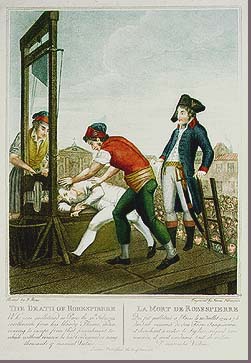
Robespierre lay in an anteroom of the Convention hall, while his Prison-escort was getting ready; the mangled jaw bound up rudely with bloody linen: a spectacle to men. He lies stretched on a table, a deal box his pillow; the sheath of the pistol is still clenched convulsively in his hand. Men bully him, insult him: his eyes still indicate intelligence; he speaks no word. … -O reader, can thy hard heart hold out against that? His trousers were nankeen; the stockings had fallen down over the ankles. He spake no more word in this world.

Fouquier had but to identify; his Prisoners being already Out of Law.** At four in the afternoon, never before were the streets of Paris seen so crowded. From the Palais de Justice to the Place de la Revolution … it is one dense stirring mass; all windows crammed; the very roofs and ridge-tiles budding forth human Curiosity, in strange gladness. … All eyes are on Robespierre’s Tumbril, where he, his jaw bound in dirty linen, with his half-dead Brother, and half-dead Henriot, lie shattered; their “seventeen hours” of agony about to end. The Gendarmes point their swords at him, to show the people which is he. A woman springs on the Tumbril; clutching the side of it with one hand; waving the other Sibyl-like; and exclaims: “The death of thee gladdens my very heart, m’enivre de joie;” Robespierre opened his eyes; “Scelerat, go down to Hell, with the curses of all wives and mothers!” — At the foot of the scaffold, they stretched him on the ground till his turn came. Lifted aloft, his eyes again opened; caught the bloody axe. Samson wrenched the coat off him; wrenched the dirty linen from his jaw: the jaw fell powerless, there burst from him a cry; — hideous to hear and see. Samson, thou canst not be too quick!

Samson’s work done, there bursts forth shout on shout of applause. Shout, which prolongs itself not only over Paris, but over France, but over Europe, and down to this generation. Deservedly, and also undeservedly. O unhappiest Advocate of Arras, wert thou worse than other Advocates? Stricter man, according to his Formula, to his Credo and his Cant, of probities, benevolences, pleasures-of-virtue, and such like, lived not in that age. A man fitted, in some luckier settled age, to have become one of those incorruptible barren Pattern-Figures, and have had marble-tablets and funeral-sermons. His poor landlord, the Cabinet-maker in the Rue Saint-Honore, loved him; his Brother died for him. May God be merciful to him, and to us!

Part of the Themed Set: Thermidor.

* Even his enemies agreed — sometimes adding it to the bill of particulars against him — that Robespierre lived a life of personal moderation; he lived as a boarder with a working-class family, and disdained to avail the politician’s typical harvest of political graft.

** The Convention had decreed Robespierre’s outlawry when he escaped custody; his immediate execution was, of course, akin to the logic he had once turned against the king.

On this day..