1890: Major Panitza, by Stefan Stambolov

Sophia, June 28, 1890

With reference to my telegram of this day’s date, I have the honour to report that this morning Major Panitza was conducted from his place of confinement in town to the camp of Bali Effendi, close to Sophia, where the troops are quartered for the summer, and in presence of the whole brigade drawn up in military file he was shot by a peloton of twenty-four soldiers.

Major Panitza fell uttering the cry, “Long live Bulgaria.”

After the execution, Major Marinoff, the Commandant of the Sophia garrison, addressed a short speech to the troops, in which he said that Major Panitza had met his death in just punishment for treason against his Prince and country, and that a similar fate would be dealt out to whosoever should prove a traitor to the interests of the Fatherland.

The troops maintained a perfectly impassive attitude throughout the proceedings, and the execution of the condemned in the presence of the garrison shows that the Government wished to make an example which should be a warning to the officers to refrain from the political intrigues that had during the last few years become so prevalent, and that were dangerously undermining the discipline and loyalty of the army.

British and foreign state papers, vol. 83

Having recently gained independence by backing its Slavic brethren against its longtime Ottoman master in the Russo-Turkish War, Bulgaria was enjoying all the perquisites of being a minor power pressed between major powers.

The leading concern of its able, authoritarian, and justifiably paranoid leader* Stefan Stambolov — “the only Prime Minister in Europe who receives his visitors with a revolver lying next to the ink-stand on his desk,” in the New York Times’ description — was the interest of Bulgaria’s “benefactors” in St. Petersburg in turning this breakaway Ottoman province into an ever more pliant Russian instrument.

Whether it was the coreligionists or their coin who inspired it, many in Bulgaria felt sincere loyalty to Russia; in an age of empires, it wouldn’t have been unreasonable statecraft to opt for the security of dependency.

With that object in mind, Major Panitza hatched a dangerous plot to overturn the Bulgarian government. His plot conjured an equally dangerous reprisal from Stambolov — who was determined to keep as much independence as Bulgaria could sustain.

Despite fairly widespread sympathy in the army and the populace for Panitza’s plot, and of course in the face of entreaties of Russia, Stambolov had the execution carried out with impolitic dispatch just weeks after the court-martial did its work.**

Many outside of Bulgaria saw statesmanlike quality in Stambolov, but his severe rule exemplified by his unpopular ruthlessness towards Major Panitza made him many enemies at home. Stambolov was himself assassinated shortly after resigning from government in 1895, and his corpse abused en route to its resting place.

* Generally transliterated “Stambouloff” or “Stambuloff” during his own lifetime, this gentleman got control of the state by mounting a counter-coup against a Russian putsch. Since the Russians still succeeded in definitively dethroning the sitting Bulgarian king, Stambolov’s hand alone guided the unsteady Bulgarian ship of state for a time.

Stambolov eventually installed an Austro-Hungarian noble as Prince Ferdinand I (the two came to hate each other). Later titled “tsar”, Ferdinand was the grandfather of Simeon II, who achieved the unusual distinction of becoming Prime Minister of Bulgaria through democratic election in 2001.

** Panitza’s co-conspirators got various prison terms, including the former Commandant of the Sofia garrison, a gentleman sporting the Strangelovian moniker Lieutenant-Colonel Kissoff.

On this day..

1908: Two Persian constitutionalists

TEHERAN, June 24.

Two of the Nationalist leaders, Malik-Mutikalamin and Mannchir Khan, were hanged in the Royal camp to-day. Anxiety is felt regarding the fate of the others, including the President, notwithstanding the verbal promise of the Shah to spare their lives.

The house of Zahir-ed-Dowleh, now Governor of Resht, has been bombarded and looted. A state of terrorism exists.

Troops are guarding the approaches to the British Legation, with orders to shoot fugitives seeking sanctuary there.

London Times, June 25, 1908

On this date, two Persian constitionalist liberals were summarily hanged by the Shah as two factions fought for the future of Iran.

A Constitutional Revolution was shaking that country’s ruling dynasty when the throne passed and the new Shah, Mohammad Ali Shah Qajar, mounted a coup dissolving the newborn parliament and reversing the country’s 1906 constitution. (According to the Shah, constitutionalism was un-Islamic.)

On June 23, the Shah’s Cossacks — he had Russian support, arranged with the connivance of other European powers — bombarded Iran’s parliament, capturing in the process a number of constitutional delegates.

Two in particular, both of them prominent Azali Bab’i exponents of the constitution, would interest the Shah.

Mirza Jahangir Khan (left), and Malek al-Motakallemin.

Journalist, revolutionary, and intellectual Mirza Jahangir Khan Shirazi was a well-known spokesperson of the reformist cause through his paper Sur-e Esrafil. Malek al-Motakallemin was a dissident essayist and preacher with an interest in Persia’s Zoroastrian ancient history.

Their hanging this day calmed the capital for the moment, but hardly settled matters in Iran. (Indeed, one could say matters have never been settled in Iran.) By the next year, Mohammad Ali Shah Qajar was out on his ear (he’d die in exile) — succeeded by the last monarch of the Qajar dynasty.

On this day..

1979: Ignatius Kutu Acheampong, former dictator of Ghana

On this date in 1979, former Ghanaian military strongman Ignatius Kutu Acheampong was shot in the aftermath of Jerry Rawlings’ successful coup d’etat.

Acheampong had executed a coup of his own in 1972 and run the unsteady West African state for most of the 1970s — a period of economic and political crisis — until he himself was toppled by another General, Fred Akuffo.

Acheampong was retired to his home village by the new regime, but he would not enjoy such satisfactory treatment when a national revolution ended Akuffo’s reign and brought junior officer Jerry Rawlings to power.

Less than two weeks after Rawlings was installed as Ghana’s new head of state, Acheampong was executed on a charge of corruption. This would not sate the considerable popular anger at the outgoing military clique, which went on to gorge itself on Akuffo and five others later that same month.

Former NFL defensive back Charlie Peprah is Acheampong’s grandson.

On this day..

1956: Juan Jose Valle, Peronist putschist

On this date in 1956, the Argentine military junta crushed a Peronist revolt with the summary execution of its leader, Juan Jose Valle.

Gen. Pedro Eugenio Aramburu had overthrown the populist Juan Peron government in 1955, and now ruled Argentina as President.

General Valle was shouldered out for his affiliations with the former regime: throughout the months following the coup, the Peron party was systematically proscribed and its leaders barred from politics.

In exile, Peron urged radical action by these disenfranchised followers, and Valle attempted to mount a revolt in June 1956.*

This operation was well-scouted by the government, and crushed instantly — with a couple dozen of its adherents summarily shot. (Spanish link)

Well, the Peronist party slogan was, “Our Lives for Peron.”

Valle avoided the initial slaughter, but he was captured in an apartment in Buenos Aires on this date and shot at the city’s National Penitentiary in the evening.

“Shot for trying to overthrow the government” doesn’t quite sound off the scale of typical coup outcomes, but in Buenos Aires in 1956, these executions were shockingly disproportionate relative to the handling of many recent unsuccessful coups. Actually, the Aramburu government had just that February repealed the death penalty as a statutory option for plotting a coup.

But it wasn’t using statutes to handle the Valle coup: it declared martial law, and handled subversives at its own discretion. (It rescinded martial law and ceased any further executions on June 13.)

The authorities’ brutal response was something of a turning point in Argentine political relations and culture. Throughout the Peronist decade even the harshest critics of the regime could not accuse it of executions of this sort, even though coups had been attempted against it. Bloodshed on this scale for political reasons was unprecedented in the political and military history of Argentina.

Politics and Education in Argentina

Aramburu himself would catch a bit of the blowback for authoring this “turning point”: in 1970, the former president was kidnapped (Spanish-language site) by the pro-Peron Montoneros guerrillas and himself summarily executed shortly thereafter — allegedly in specific retaliation for having shot Gen. Juan Jose Valle.

And the literary fallout was hardly more complimentary. Argentine writer Felix Luna penned La Fusilacion (The Firing Squad) the next year;** set during Argentina’s 19th century civil wars, it’s plainly informed by that country’s more contemporaneous problems.

* Valle’s top co-conspirator was another general, Raul Tanco. In a strange coda, Tanco managed to escape execution by claiming asylum in the Haitian embassy. Pro-government gunmen kidnapped him from that refuge and turned him over to the army, but in a gesture of diplomatic courtesy, Aramburu returned Tanco to the embassy unharmed, with apologies to the Haitians for the breach of decorum.

** It’s also a 1962 movie.

On this day..

193: Didius Julianus, who bought the purple from the Praetorians

On this date in 193, Didius Julianus lost the rulership of Rome for which he had paid so dearly.

And his life.

Julianus‘s path to these doleful pages begins with the assassination of the notorious Emperor Commodus at the end of 192.

That man’s successor, Pertinax, was a notable bust with the Praetorian Guard, the elite imperial bodyguard whose status as the only military unit in Rome made it potential — and here, actual — kingmakers.

The Praetorians expected the payoff that had become customary for new executives, and when Pertinax proved less than liberal on that particular budget item, they turned right around and overthrew him.

To see that there would be no mistake the next time around, the Praetorians dispensed with the pretense and brazenly auctioned the purple.

Roman aristocrat and historian Cassius Dio was a witness to this hot mess.

Didius Julianus, at once an insatiate money-getter and a wanton spendthrift, who was always eager for revolution and hence had been exiled by Commodus to his native city of Mediolanum, now, when he heard of the death of Pertinax, hastily made his way to the camp, and, standing at the gates of the enclosure, made bids to the soldiers for the rule over the Romans. Then ensued a most disgraceful business and one unworthy of Rome. For, just as if it had been in some market or auction-room, both the City and its entire empire were auctioned off. The sellers were the ones who had slain their emperor, and the would-be buyers were Sulpicianus and Julianus, who vied to outbid each other, one from the inside, the other from the outside. They gradually raised their bids up to twenty thousand sesterces per soldier. Some of the soldiers would carry word to Julianus, “Sulpicianus offers so much; how much more do you make it?” And to Sulpicianus in turn, “Julianus promises so much; how much do you raise him?” Sulpicianus would have won the day, being inside and being prefect of the city and also the first to name the figure twenty thousand, had not Julianus raised his bid no longer by a small amount but by five thousand at one time, both shouting it in a loud voice and also indicating the amount with his fingers. So the soldiers, captivated by this excessive bid and at the same time fearing that Sulpicianus might avenge Pertinax (an idea that Julianus put into their heads), received Julianus inside and declared him emperor.

Cassius Dio, Book 74

The ignoble achievement is the only thing Didius Julianus is now remembered for.

While Julianus and the Praetorian guard were conducting their damnable business in the capital, three Roman generals in the provinces claimed the throne for themselves.

For centuries the Roman legions had been scattered beyond the Italian peninsula as a hedge against military coups. But after decades of relative stability at the top,* Rome was about to get a bracing reminder of what civil war looked like.

Praetorians — a few cohorts worth of men not in fighting trim — were fine for bullying Senators, but in an outright civil war, they were no match for the legions. The Praetorian Guard’s power to arbitrate the succession was contingent upon the beneficiary’s capacity to cement his own legitimacy by commanding the loyalty of (most of) the state apparatus.

And it turned out that buying the sceptre on spqrBay was not the way to get folks to bend their knees to it.

Septimius Severus, the imperial claimant nearest to the capital, commenced a relentless and virtually unresisted march on Rome, co-opting the troop garrisons and towns as he swept down the peninsula and spurning Julianus’s desperate diplomatic entreaties.

Cassius Dio’s record of Julianus scrambling to defend Rome against Severus is full of black humor.

Julianus … caused the senate to declare Severus a public enemy, and proceeded to prepare against him. In the suburbs he constructed a rampart, provided with gates, so that he might take up a position out there and fight from that base. The city during these days became nothing more nor less than a camp, in the enemy’s country, as it were. Great was the turmoil on the part of the various forces that were encamped and drilling, — men, horses, and elephants, — and great, also, was the fear inspired in the rest of the population by the armed troops, because the latter hated them. Yet at times we would be overcome by laughter; for the Praetorians did nothing worthy of their name and of their promise, for they had learned to live delicately;** the sailors summoned from the fleet stationed at Misenum did not even know how to drill; and the elephants found their towers burdensome and would not even carry their drivers any longer, but threw them off, too. But what caused us the greatest amusement was his fortifying of the palace with latticed gates and strong doors. For, inasmuch as it seemed probable that the soldiers would never have slain Pertinax so easily if the doors had been securely locked, Julianus believed that in case of defeat he would be able to shut himself up there and survive.

In the end, Severus took Rome without striking a blow: the Praetorians switched sides again, and the Eternal City delivered itself from the one usurper to the other. Cassius Dio, again, in media res

the soldiers, convinced by letters of Severus that if they surrendered the slayers of Pertinax and themselves kept the peace they would suffer no harm, arrested the men who had killed Pertinax … We [the Senate] thereupon sentenced Julianus to death, named Severus emperor, and bestowed divine honours on Pertinax. And so it came about that Julianus was slain as he was reclining in the palace itself; his only words were, “But what evil have I done? Whom have I killed?” He had lived sixty years, four months, and the same number of days, out of which he had reigned sixty-six days.

(Actually, Julianus had killed someone: foreseeing that the Praetorians were liable to turn coat yet again, Julianus had the Praetorian prefect who sold him this lemon of an empire put to death for trying to cut a deal with Severus. Despite this negative feedback, the transaction took place on a strict no-refunds, no-exchanges basis.)

A harsh deal for Didius Julianus was a pretty good one for the Roman Empire. Septimius Severus cleaned up his other rival claimants, and ran the empire capably for the next generation.

Kick back with this review of the the dreadful interlude of Didius Julianus with episodes 98 and 99 of the enjoyable History of Rome podcast.

* “The period in the history of the world during which the condition of the human race was most happy and prosperous,” in the judgment of Edward Gibbon.

** The Praetorians were also de-motivated because their promised donative had not been forthcoming.

On this day..

1797: Gracchus Babeuf, for the Conspiracy of Equals

If the “revolutionary extremist” exists at all as an identifiable type, he exists in purest incarnation in Gracchus Babeuf. No revolutionary better fits the description “narrowminded to the point of genius”; few have defined their heaven more clearly or crusaded so fanatically, ascetically, so religiously to bring it to earth.

Gracchus Babeuf: The First Revolutionary Communist

On this date in 1797, Francois-Noel Babeuf lost his head for the Conspiracy of Equals — the last Jacobin upheaval of the French Revolution, or the first Communist upheaval of post-Revolution modernity.

Francois-Noel — he styled himself “Gracchus” after the populist Roman tribunes — was a young man of Desmoulins‘ generation but from a considerably more hardscrabble background. Like the starry-eyed Dantonist scribbler, Babeuf discovered himself a brilliant journalist and pamphleteer with the onset of the Revolution; he did several prison stints during various revolutionary phases of the early 1790s for his too-radical-for-school opinions.

He did another in 1795 under the French Directory for his firebreathing rag Le Tribun du Peuple, which was particularly unfashionable stuff during the post-Robespierre Thermidorian regime.

Nothing daunted, Babeuf emerged from prison the leading apostle of the Parisian proletariat which had by then been decisively separated from power.

The order of the day was class consolidation with the spoils of the aristocracy apportioned among a new oligarchy of wealth. As France rushed headlong towards Bonaparte and Bourbon restoration, Babeuf was the man left to rally “the party which desires the reign of pure equality.”

The French Revolution was nothing but a precursor of another revolution, one that will be bigger, more solemn, and which will be the last.

The people marched over the bodies of kings and priests who were in league against it: it will do the same to the new tyrants, the new political Tartuffes seated in the place of the old.

Manifesto of the Equals, 1796

One can see why later revolutionaries — Marx included; Babeuf makes a cameo in the Communist Manifesto — would adopt this sort of thing as a harbinger of the next century’s revolutions.

And if the Directory had known who Nicholas II would be, it would have had no intention of going the way of his family.

Instead, it shut him down in February, 1796: Napoleon Bonaparte personally carried out the operation, just days before he wed Josephine.


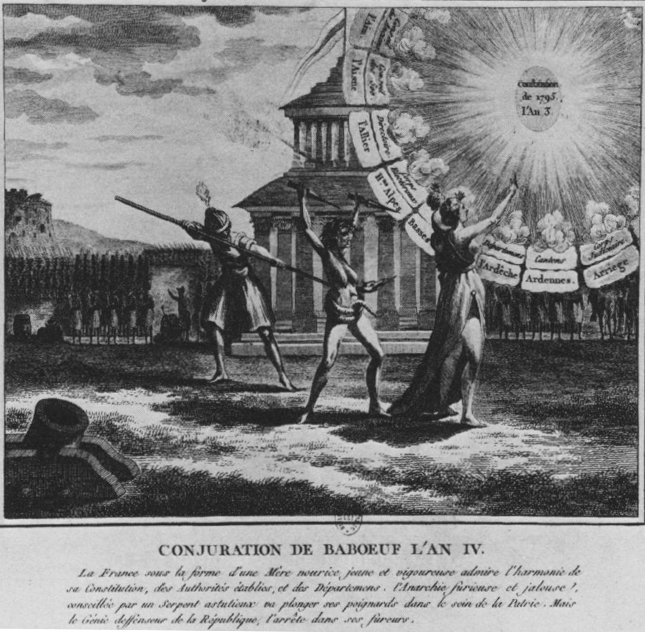
The Babeuf Conspiracy. Anonymous French print.

Babeuf’s party comes down to us as a “conspiracy,” under which word the state would charge him and which his follower Philippe Buonarroti would later rebrand the “Conspiracy of Equals”. It was not so much a grassy-knoll type of conspiracy as it was an underground organization.

When its adherents placarded Paris with the seditious “Analysis of the Doctrine of Babeuf” as the city endured a potentially dangerous economic crisis in April 1796, the government was put to a test of its strength.

It passed.

Having infiltrated Babeuf’s network, it arrested the principals on the eve of the Conspiracy’s intended insurrection. They were hailed out of Paris (a safeguard against sympathetic risings) to the commune of Vendome and there put on trial.* Babeuf and his associate Augustin Alexandre Darthe were condemned to death on May 26th and guillotined the very next day.

The last gasp of the French Revolution dropped with their heads into the basket.

Revolutionary Babeuvism, however, had scarcely just begun.

I don’t know what will become of the republicans, their families, and even the babies still at their mothers’ breasts, in the midst of the royalist fury that the counter-revolution will bring. O my friends! How heart-rending these thoughts are in my final moments! … To die for the fatherland, to leave a family, children, a beloved wife, all would be bearable if at the end of this I didn’t see liberty lost and all that belongs to sincere republicans wrapped in a horrible proscription.

-Babeuf’s last letter to his family

* The trial of Babeuf was itself a jurisprudential milestone: it was the first French trial to be transcribed verbatim.

What might look today like a nifty little advance for efficient judicature was bitterly controversial in 1797. The French Revolution had overturned an ancien regime practice of professional magistrates accepting legal testimony by written deposition and deciding matters behind closed doors. The liberte, egalite, fraternite way would instead demand that testimony be given live in the courtroom where citizen jurors could weigh its credibility.

Babeuf’s lawyer, Pierre-Francois Real, protested against the court stenographers, arguing that “The law insists that the system of written depositions not be restored in any way. That system will undoubtedly return if any means are used to save testimony given orally.”

There’s a fascinating disquisition on the curious and contradictory development of this issue and the way it “violates … common assumptions about the advance of textuality in the West” during the French Revolution in Laura Mason, “The ‘Bosom of Proof’: Criminal Justice and the Renewal of Oral Culture during the French Revolution” The Journal of Modern History, March 2004.

On this day..

1860: General Jaime Ortega y Olleta, for a Carlist uprising

This date marks 150 years since the admittedly little distinguished execution of turncoat General Jaime Ortega y Olleta for attempting to aid a Carlist uprising in Spain.

Hoping to exploit the Spanish military’s preoccupation with a conflict in Morocco, the Carlist pretender Infante Carlos and his brother Don Fernando attempted to topple their cousin Queen Isabella II.

They landed at San Carlos de la Rapita (Spanish link) bound for death or glory … or maybe just an “absurd fiasco”.

Ortega (Spanish Wikipedia link), dignified in the Encyclopedia Britannica‘s estimation as a “featherheaded officer”, turned coat to support this ill-fated adventure. Alas for him, none of the men under his command did likewise, nor did the populace.

The rising (more Spanish) collapsed immediately; Ortega was captured, court-martialed on April 17, and shot the following morning. (The New York Times recounts the story of his last hours from the Barcelona papers here.)

General Featherhead was the only casualty.

The would-be monarchs for whom he threw away his life were spared at the price of renouncing their claims, which renunciation they then attempted to renounce once back in exile. For some reason, nobody took them seriously; they died under suspicious circumstances the following year. Their nephew would later lead the last (likewise unsuccessful, but at least less embarrassing) Carlist war in Spain.

On this day..

1986: Mamman Jiya Vatsa, warrior-poet

On this date in 1986,* Nigerian Major-General Mamman Jiya Vatsa was shot (along with nine others) by command of his childhood friend — the dictator Ibrahim Babangida, whom Vatsa was allegedly plotting to overthrow.

A gifted writer since youth, Vatsa was just a nameless twenty-something junior officer in the early 1970s when he emerged onto the national literary scene.

In the 15 years before his death, Vatsa churned out 20-plus volumes, mostly poetry. He had a special inclination for writing for children.

Simultaneously, his star ascended in his professional sphere.

Risen to General, Vatsa was part of the Supreme Military Council of the previous dictator.

But by December of that year,
Vatsa and dozens of others were arrested.

Testimony against them — much of it of the speculative or torture-induced variety — described a ring of officers piqued at the Babangida coup (Vatsa was out of the country when it occurred) and keen to undo it. The scheme would have been only one of many such hatched or imagined in an unstable political situation that surely made the new big man nervous.

In the end, “only” ten (the nine others are named here) were stood up against the wall for the alleged plot. Many others, however, were imprisoned or purged, a lasting injury to the Nigerian brass that particularly crippled its air force.

Babangida, of course, rejected clemency appeals from the Vatsa family he knew well. He has since justified his harshness by arguing that Vatsa would have continued plotting against him in prison or in forced retirement. “Rawlings did it in Ghana,” Babangida said. “And you know Vatsa was very stubborn.”

The fatal tribunal’s judge** is less certain, and is hardly the only one to doubt Vatsa’s guilt outright.

I don’t know, nobody ever asked.
That was how some heroes died.
They died.

-Vatsa, “They Died” (Voices from the Trench)

* Some sources give March 6 as the execution date, but contemporaneous western press reports (admittedly an impeachable source) prefer the 5th. For instance, the March 6 Chicago Tribune says the executions occurred on “Wednesday” (the 5th).

** Ironically, Vatsa himself had once sat on a tribunal for another group of failed putschists, the 1976 Dimka coup.

On this day..

2010: Five for the assassination of Sheikh Mujibur Rahman

Shortly after midnight this morning — local time at Dhaka Central Jail — five officers who in 1975 assassinated Bangladesh founding father Sheikh Mujibur Rahman (and most of his family) were hanged for the crime.

Justice so long delayed still tasted sweet to a celebratory crowd.

The 34 1/2 years were mostly passed with the killers safe under an Indemnity Act predictably granted by the coup government that profited from the murder. (Though that government wasn’t afraid to hang members of its base.)

That act was revoked after a generation’s military rule with the 1996 election of Mujib’s daughter Sheikh Hasina Wazed, who was lucky enough to be in West Germany when her family was slaughtered.

Even so, the case has had a tortuous path since through the Bangladeshi judiciary.

Once it finally reached the terminus, the government did the hemp necktie routine with dispatch just this side of seemly. Only hours after the doomed men’s last appeal was turned aside, Lt. Col. Syed Faruque Rahman, Lt. Col. Sultan Shahriar Rashid Khan, Lt. Col. Muhiuddin Ahmed, Maj. A.K.M. Mohiuddin Ahmed, and Maj. Bazlul Huda were hanged.

Their hanging does not close the book on the Mujib assassination.

Seven other death sentences in absentia remain; six of those condemned are still alive, and at large abroad. Bangladesh is trying to get them back.

On this day..

1989: Henri Zongo and Jean-Baptiste Boukary Lengani

This evening in 1989, the number two and three men in Burkina Faso’s military government were seized and summarily executed for allegedly plotting a coup of their own.


Lengani and Zongo

Henri Zongo and Jean-Baptiste Boukary Lengani certainly had the pedigree for it; they’d conspired along with Blaise Compaore in the 1983 putsch that brought Thomas Sankara to power … and then Zongo, Lengani and Compaore had overthrown Sankara four years later.

On this date, a triumvirate increasingly strained by personal rivalries and economic disagreements was unilaterally dissolved.

According to the official announcement, Zongo and Lengani planned to seize the airport while President Compaore was out of the country, shooting down his returning plane if necessary.

Whether accurate or pretext, their elimination (along with two other conspirators) helped Compaore consolidate his hold on Burkina Faso — a country he still governs to this day.

On this day..