1894: Joe Dick, “allowed to go anywhere he desired”

On this date in 1894, a young Indian named Joe Dick was executed outside the courthouse of Eufaula in present-day Oklahoma.

At the time, Eufala was part of the Muscogee Creek jursidiction of Indian Territory. Until the 1898 Curtis Act, the tribal governments in Indian Country enjoyed full legal jurisdiction, up to and including application of the death penalty.

One interesting feature of that jurisdiction (previously noted in these annals) was the absence of standing jails to incarcerate death-sentenced prisoners. Joe Dick was only loosely guarded and on “Christmas week, he told the officers that were guarding him that he was of a lively nature and would like to attend some of the dances that were going on through the country.” They happily loaned him a horse and saddle, and Joe Dick was as good as his word: after dancing all night, he returned and “reported the next morning for breakfast.”

On another occasion, with firewood running short, an officer John Hawkins set Dick loose in the woods with a cart. The murderer came back three hours later, loaded with firewood. “After that, he was allowed to go anywhere he desired, if he would promise to report for duty at meal times.”

Hawkins and a fellow-officer named Bob Roberts conducted the execution by musketry — both shooting Dick dead through the heart from five yards’ distance as Dick stood against a large tree. (In the Indian Territory, only the Cherokee had enough death penalty cases to warrant a standing gallows; other nations generally carried out executions by shooting.)

Dick had opportunistically murdered a man named Thomas Gray against whom he held a grudge. Chancing upon Gray at work in an orchard one day, Dick simply shot him and rode away. Dick confessed the crime.

On this day..

1821: Ketaukah and Kewahiskin, the first hangings in the Michigan Territory

From the Salem (Mass.) Gazette, Jan. 18, 1822.

Executions — Two Indians,* Ketaukah and Kewahiskin [elsewhere given as Kewaubis -ed.] were hanged at Detroit on the 27th ult. the former for the murder of Dr. W.S. Madison, the latter for the murder of Charles Ulrick.

The criminals (says the account) often acknowledged the justice of their sentence,** and in their way they had prepared themselves to meet its execution.

For several weeks past they appeared very anxious to obtain presents of tobacco, pipes, &c. none of which they used, but carefully laid them aside as an offering to the Great Spirit on the day of their death.

They had contrived a sort of drum, by drawing a piece of leather over the vessel that contained their drink, and often engaged in their solemn death dance. On the night previous to their execution, they continued their death dance to a very late hour, and commenced it again early in the morning.

They had been presented, among other things, with some red paint — with this they painted on the wall of their cell numerous figures of men, quadrupeds, reptiles, &c. — on their blankets were also painted many figures — among the rest, an Indian, hanging by the neck, was observed.

From the jail they were taken to the Protestant Church, where an appropriate discourse was delivered to the assemblage by Mr. J.S. Hudson (one of the gentlemen belonging to the Mission family).

They appeared throughout the whole of the solemn preparatory steps to be perfectly collected — they walked firmly to the gallows, and previously to ascending to the drop, shook hands with the Rev. Mr. Juvier, Mr. Hudson, the Sheriff and Marshal, and several other gentlemen who stood near them.

They ascended the steps of the drop in a manner peculiarly firm — after which, they asked, through the interpreter, the pardon of the surrounding spectators, for the crime they had committed.

They then shook hands and gazed for a few minutes on the assemblage and on the heavens, when their caps were drawn over their faces, and they were launched into eternity.

* Ketaukah was of the Ojibwe (Chippewa) people, while Kewahiskin was a Menominee. (Source) The two men were not associates of each other prior to their shared condemnation, and their crimes were completely unrelated.

** Be that as it may, Ketaukah tested the jurisdiction of the Territorial Court (Michigan had not yet been admitted to statehood). He argued (like Tommy Jemmy in New York) that Anglo juries had no jurisdiction over his crime, which had been committed against a white doctor on Winnebago land. He also demanded the inclusion of Indians on the jury; complications of a potential language barrier within the jury pool, and the matter of whether an interpreter’s presence at jury deliberations would vitiate the verdict, defeated that motion. (For the jurisdictional question, see American Indians and State Law: Sovereignty, Race, and Citizenship, 1790-1880. For the jury composition, see the footnote on page 123 of this masters thesis.)

On this day..

1888: Tsimequor, indigenous Snuneymuxw

(Thanks to Meaghan Good of the Charley Project for the guest post. -ed.)

On this date in 1888, Tsimequor, a member of the Snuneymuxw First Nation, was executed in Nanaimo, British Columbia for a bizarre murder that clashed Aboriginal and white Canadian cultures.

What happened is explained in Jeffrey Pfeifer and Ken Leyton-Brown’s book Death By Rope: An Anthology of Canadian Executions:

The matter that brought Tsimequor to public attention arose out of a tribal custom designed to help members of the community better deal with grief following the death of a child. The custom dictated that when a child died, it was the practice for all other persons in the tribe who bore the same name to immediately change their names. In this way, relatives of the deceased child would be less likely to be reminded of their loss.

Tsimequor’s son Moses died in 1888 and, as per custom, all the Snuneymuxw who were named “Moses” changed their names to something else.

But there was one little boy in the community whose name was Moïse — “Moses” in French — and Tsimequor demanded that he change his name as well. The four-year-old’s parents refused, and days later somebody killed their son.

Had it been solely in the hands of the Snuneymuxw, the crime might have been forgiven. But to the Canadian legal authorities killing a four-year-old because of his name was unambiguously capital murder, and so Tsimequor was arrested and brought to trial. He maintained his innocence, but was convicted on November 7, 1888 and sentenced to death.

Pfeifer and Leyton-Brown record:

Surprisingly, there was considerable sympathy for Tsimequor expressed in the local newspaper, which pointed out that the crime had been committed “through superstition” and noting that Tsimequor had had no legal counsel to defend him at the trial. According to one newspaper report, “a sentence designed to educate Aboriginal people would be more appropriate.” There was however no doubt which tradition would be followed in this case.

Tsimequor was hanged in the Nanaimo Gaol five weeks after his trial.


Privy Council minutes determining that ‘law should be allowed to take its course’ with the hanging of the indigenous man Tsimequor in 1888

On this day..

1854: Aslak Hetta and Mons Somby, Sami rebels

On this date in 1854, two Sami men were beheaded for Norway’s Kautokeino Rebellion.

The indigenous Sami people — often known as Lapps, although this nomenclature is not preferred by the Sami themselves — had by this point become territorially assimilated to the states of the Scandinavian peninsula across which their ancestral homeland had once spanned.

The material benefits of this association for the Sami were much less apparent.

In Norway — our focus for this post — Sami shared little of the economic growth in the 19th century save for a startling proliferation of alcoholism.

In the 1840s a charismatic Sami preacher named Lars Levi Laestadius founded a Lutheran revival movement that went over like reindeer among his people. Religious enthusiasm and social critique went hand in hand: Laestadius’s hard anti-alcohol line and criticism of the comfortable state clergy touched deeply felt grievances, and Laestadius could deliver these messages in Sami dialects. Villages devastated by drink would go dry in response to his exhortations with pleasing results for the social fabric, further stoking adherents’ piety.

The most militant expression of this movement soon detached itself from any restraint Lars Levi Laestadius might hope to exercise upon it. Eventually it would move towards disruptive actions like interrupting services of the official clergy and protesting licensed alcohol merchants.

In a rising in November 1852, firebrand Laestadians attacked the trading post of Carl Johan Ruth, the liquor merchant in the Finnmark village of Kautokeino. Both Ruth and the local sheriff, responding to the disturbance, were slain in the ensuing fray and several other buildings in town torched. A counterattack managed to quell the disturbance — killing two rebels in turn — and eventually 17 men and 11 women were condemned to sentences ranging from short prison terms to lifelong prison terms to (our concern, of course) execution.

The two leaders of the mob, Aslak Hetta (English Wikipedia entry | Norwegian) and Mons Somby (English Wikipedia entry | Norwegian), were both beheaded at the Arctic Circle town of Alta.

After decapitation, the men’s bodies were buried at Alta’s Kafjorddalen Church, but their severed heads went off to the Royal Fredrik’s University (today the University of Oslo) for scientists to probe. The heads eventually went missing until a search turned them up at a cranium collection in Copenhagen in 1997, which returned them at the behest of the descendants for burial back with the trunks from which they parted ways 160 years ago today.

A 2008 Nils Gaup-directed feature film, The Kautokeino Rebellion, dramatizes these events. (Synopsis | review) Armas Launis, a Finnish composer with an interest in ethnography, also wrote a libretto (Finnish link) in honor of Aslak Hetta after residing among the Sami for some time.


As of this writing, the full movie is also available on YouTube provided you can understand Norwegian, or read Spanish subtitles.

* Laestadianism still exists today. According to Wikipedia, “Because of doctrinal opinion differences and personality conflicts, the movement split into 19 branches, of which about 15 are active today.” Said Wikipedia entry enumerates all 19 groups, ranging from the Conservative Laestadians (approximately 115,000 adherents) all the way down to the Sten group (15 adherents) and the Kontio group (5 adherents).

On this day..

1971: Victor Apaza Quispe, Arequipa folk saint

From Frank Graziano’s Cultures of Devotion: Folk Saints of Spanish America:


In Arequipa, there is active devotion to Victor Apaza Quispe, who was born in the Miraflores district in 1932. Apaza led a vagrant life supported by odd jobs after fleeing his abusive father. In a variant version that he related to inmates, he was sold by his father into farm labor. Apaza married in 1953, continued a life of transient jobs and petty crime, drank heavily, and physically abused his wife and daughter until he finally abandoned the home. When he returned ten years later, the marriage was beyond repair. In January 1969, Apaza dreamed that his wife was unfaithful to him. He went to the location revealed in the dream and saw the shadowy figure of a man escaping. His wife, also there, was not as fortunate. Apaza beat her to death with a rock.

It was later revealed that the crime was premeditated and carefully planned. Apaza originally denied responsibility but confessed his guilt once the evidence mounted against him. Later, during appeals for clemency, he again declared his innocence. He was convicted partially on the evidence of his two daughters, who wittingly or unwittingly offered testimony that supported the death penalty. Apaza did not understand the sentence until his lawyer translated it for him into Quechua. He hugged his lawyer, the two of them crying, and then collapsed into his chair.

People in the courtroom were shocked by the death sentence. The rarity of the event — this would be the first execution in Arequipa — resulted in extensive press coverage. Apaza suddenly gained a celebrity derived less from his crime than from the punishment. The press represented him as a poor, simple man and a good Christian. According to Apaza’s defense attorney, “the very foundation of society was shaken” when the public learned that Apaza had been sentenced to death. Horror and indignation were aroused because the imminent execution was “an unjust action of human justice.” Divine justice would make amends.

Apaza faced the firing squad in prison on September 17, 1971. (The drama is intensified in some folkloric versions by locating the execution in Arequipa’s main plaza.) Arequipa’s residents were outraged, even traumatized, and some fifteen hundred attended Apaza’s funeral. They organized themselves into squads, taking turns to carry the coffin.

Apaza had been in prison for two years before he was executed. Like Ubilberto Vasquez Bautista in Cajamarca, he became a model prisoner and something of a populist. Fellow inmates described Apaza as a good, hardworking, honest man. In 1971, the 531 men incracerated with him sent a letter to the court petitioning clemency, in part because Apaza had proven himself to be “an honorable man and dedicated to his work.” The prison chaplain, a Jesuit, found Apaza to be pious and God-fearing, and the warden thought he was a “completely good” man. Later, retrospective press accounts described Apaza and Ubilberto together as “innocent men crushed by the Kafkaesque and labyrinthine cruelties of the administration of justice in Peru.”

Book CoverThe devotees with whom I spoke in Arequipa knew little about Apaza. Even the official rezador, a man who prays for tips at the shrine, did not have the story clear. Many devotees had a vague idea that Apaza had been executed under circumstances that suggested injustice, however, and the key word offered by all was “innocent.” Some believed that the true killer confessed the crime after Apaza was executed.

When I asked devotees how they knew that Apaza was innocent, one woman astonished me with her answer: “because a sinner cannot work miracles.” I later encountered this same response in other devotions. Once a folk saint’s fame for miracles is accepted as true, then this truth — this evidence — revises backward to create the conditions necessary for the production of miracles. Miracles make Apaza’s apparent guilt impossible, so the verdict is reversed. Innocence causes miracles, and miracles cause innocence. Miracles occur within the circularity defined by these parameters.

Apaza is miraculous, like all folk saints of this prototype, because “he died innocent and is beside Our Lord.” “You were shot, you suffered,” people said when they requested the first miracles, because these misfortunes qualified Apaza for sainthood.

On this day..

1731: Jose de Antequera, Paraguayan comunero rebel

On this date in 1731, Jose de Antequera had his head cut off in Lima for leading a comunero rebellion against the Spanish crown in Paraguay.

Antequera, a judge, began his revolution legally in 1721 by affirming an impeachment the city council of Asuncion (Paraguay’s present-day capital) against the unpopular Spanish governor. Antequera, conveniently, also happened to be the guy who would succeed the unpopular territorial governor.

The conflict between the two would-be governors spiraled into a wider revolt for local autonomy pitting criollo settlers against the crown, though it would likely be overstating matters to call this a true bid for independence. One notable sore spot between the two parties was the prerogatives of Jesuit Reductions: these mission settlements for Christianizing natives (particularly prominent in Paraguay for the Guarani people) had originally been placed at the far fringes of Spain’s New World reach, and they enjoyed a wide autonomy, sustaining themselves economically with the yerba mate trade. For the Guarani, these were also welcome refuges from the brutal encomiendas; Guarani militias stoutly repelled slave raiders.

For these prerogatives, the Jesuits and the Guarani were loyal to the Spanish crown as against the local settlers better inclined to view the Reductions (and the potential slaves who inhabited them) as assets they’d like to get their own hands around. Antequera accordingly expelled the Jesuits near Asuncio and for a few years his word was law in Paraguay. Guarani troops mustered by the crown helped put the rebellion down, taking Antequera into custody and forwarding him to the notoriously severe Marquis of Castelfuerte, the Peruvian viceroy.

Society at Lima was in [Antequera’s] favor. Great efforts were made to delay his trial. But the viceroy was resolved to punish him, and sentence of death was passed. The judges, the university, the municipality, petitioned for pardon, as well as the people of all classes. The stern old marquis refused to listen, and Antequera was brought out for execution in the great square of Lima on July 5, 1731. There were cries for pardon, and the mob began to throw stones. Hearing the tumult, the viceroy came out on horseback and ordered his guards to fire. Antequera fell dead, as well as the two priests by his side, and several others. The viceroy then ordered the body to be taken to the scaffold and beheaded. His conduct received the approval of the king by decree of September, 1733. (Source)

The Spanish had not heard the end of Antequera.

During his imprisonment, Antequera befriended and inspired a fellow-prisoner named Fernando Mompo. After Antequera’s execution, Mompo returned to Paraguay brandishing the late rebel governor’s banner: “The authority of the commune is superior to that of the King himself!” Mompo launched a recrudescence of the comunero rebellion in the early 1730s. Mompo too shared Antequera’s fate.

A change in the political winds decades later led to the Spanish king Charles III himself expelling the Jesuits — and posthumously exonerating Jose de Antequera.

On this day..

1850: Five Cayuse, for the Whitman Massacre

On this date in 1850, five Cayuse were publicly executed in Oregon City for the Whitman Massacre.

Beginning in earnest in the 1830s, Anglo settlement in the Oregon Country presented for the native inhabitants of the Pacific Northwest the same Hobson’s choice that had confronted tribes further east long before: resist or accommodate.

The New York-born couple Marcus and Narcissa Whitman* were two of the most notable figures among the hundreds, and then thousands, of settlers pouring into the territory every year. In 1836, they founded on the banks of the Walla Walla River a Christian mission to the nomadic Cayuse who roamed the territory. It’s in present-day Washington State, which was then part (with the current U.S. states of Oregon and Idaho) of a single frontier territory collectively known as Oregon.

The Whitmans’ early settlement, offering medicine, education, and (of course) proselytizing, proved a success at first; it would become for several years a waypoint on the developing Oregon Trail.

White diseases came with the settlers.

The Cayuse people had already dwindled (pdf) to just a thousand or two after the decimations of smallpox and other plagues swept the region in the decades preceding. Now, outbreaks of measles were ravaging those remaining.

Marcus Whitman, a doctor as well as a spiritualist, proved unable to check the new epidemic. Rumors went abroad that the missionaries were bewitching or poisoning the Cayuse, as the vanguard of a coming territorial conquest; the Whitmans themselves were very keen to the hostile feeling the situation had engendered and had even heard whispers that they were the targets of assassination plots. Bravely, they stayed.

“Perhaps God thought it for the best that your little child should be called away,” Narcissa Whitman said in strange consolation to the grieving mother of an Anglo child who also succumbed to measles in 1847. “It may calm the Indians to see a white child taken as well as so many natives, for otherwise we may all be compelled to leave within two weeks.” (pdf source, op. cit.; this document also reconstructs a detailed narrative of the unfolding tragedy)

But that remark was only days before the terrible November 29, 1847. On that cold autumn Monday, a small party of Cayuse led by a chief named Tiloukaikt fell on the mission and slaughtered both Whitmans plus another 11** inhabitants of the little compound.

Some 54 surviving women and children were taken hostage, and several of these died in custody as well. A Canadian official of the Hudson’s Bay Company hurried to ransom the captives at the price of 62 blankets, 63 cotton shirts, 12 muskets, 600 loads of ammunition, 37 pounds of tobacco, and a dozen flints.†

This quick response might have forestalled a worse tragedy for the missionaries — but as far as the Cayuse went, the die was already cast. A volunteer militia of Oregonians under Cornelius Gilliam soon mobilized to retaliate, driving many Cayuse into the Blue Mountains.

By mid-1848, spurred in part by the Whitman bloodbath, Congress officially incorporated the region as the Oregon Territory; arriving early in 1849, the new territorial governor Joseph Lane immediately opened negotiations with the Cayuse to hand over the perpetrators of the massacre. With federal troops arriving later in 1849, the Cayuse at last capitulated and gave up five warriors: Tiloukaikt, the leader; Tomahas; Kiamasumpkin; Iaiachalakis; and Klokomas. (There are numerous alternative transliterations of these names.)

They were tried in Oregon City, the territorial capital at the time — a town of 500 or so on the Willamette River Falls — in a landmark case: the first proper death penalty trial in the young territory.‡ This would fall a little short of modern standards, and not just because it was held in a tavern for want of a regular courthouse. The prosecution was not especially rigorous linking all the defendants to specific violent acts, but the defense’s recourse to Cayuse cultural practices that held shamans liable for the failure of their medicine conceded the point by implication. The judge‘s final instructions simply directed his jury to “infer” the defendants’ culpability by virtue of “the surrender of the Defendants by the Cayuse nation as the murderers, the nation knowing best who those murderers were.” So why even have the trial? Kiamasumpkin, against whom no evidence was ever individually presented, went to the gallows insisting that he didn’t even arrive to the Whitman Mission until the day after the massacre.

All five were condemned in the end, and executed by prominent early pioneer and lawman Joe Meek.§ “On the 3d of June an election and a hanging match took place at Oregon City,” ran the Aug. 22, 1850 story in the New York Tribune — for the Whitman massacre had been a matter of national interest. “The town was full of men and women, the former coming to see how the election resulted, and the latter to see how the Indians were hung.”

“Their tribe, the Cayuses, gave them up to keep peace with the whites. Much doubt was felt as to the policy of hanging them, but the popularity of doing so was undeniable.”

Fears that the quintuple hanging would stoke a running conflict with the Cayuse were not altogether misplaced, but over the subsequent years the dwindling tribe was simply dwarfed by over 30,000 newly arriving settlers lured by a congressional grant of free land. By 1855, the defeated Cayuse were forced onto the small Umatilla Reservation, ceding (along with the Umatillas and the Walla Wallas) 6.4 million acres to whites. The Cayuse tongue was extinct by the end of the century.


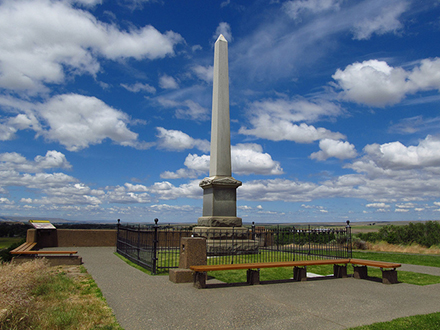
Present-day memorial obelisk at the site of the Whitman Massacre, now a national historic site. (cc) image from Jasperdo.

* Present-day Whitman College (Walla Walla, Wash.) is named for them.

** Figures of both 13 and 14 (inclusive of the Whitmans) are cited in various places for the Whitman Massacre’s body count; the discrepancy turns on whether one’s tally includes as a casualty Peter Hall, who escaped from the mission, fled to Fort Walla Walla, and then made a panicky attempt to reach The Dalles. Hall disappeared into the wilderness, and was never heard from again.

† Ransom covered gratis by the Hudson’s Bay Company.

The Espy file‘s index of U.S. executions lists only a couple of undated executions many years before under informal frontier justice.

§ Cousin to the recent First Lady Sarah Childress Polk.

On this day..

1866: Mokomoko and the Maori killers of Carl Volkner

On this date in 1866, five Maori men hanged for the murder of a German proselytizer.

Hesse-born Carl Sylvius Völkner* arrived in New Zealand as a Lutheran missionary in 1849; by 1861, he was directing an Anglican-run mission at Opotiki, the center of Maori Te Whakatohea territory.

Unfortunately for Volkner, his mission to win souls overlapped with the British mission to win land.

This same early 1860s period saw a sharpening of the European-Maori conflict on the North Island where Volkner kept his mission — the bloodshed in turn fostering the militant Pai Marire or Hau Hau faith in place of the settlers’. Though the Te Whakatohea weren’t directly involved in this war, they had felt its effects: refugees, food shortages, disease outbreaks.

Volkner, who was seen by Maori as a pro-government character and a British spy,** was warned that under the fraught circumstances he might be wise to extend his most recent trip to Auckland indefinitely and wait for things to simmer down.

He did not heed that warning.

On March 2, 1865, the day after Volkner’s return to Opotiki, a group of Pai Marire hanged the missionary to a willow tree outside his Church of St. Stephen, then butchered the dead body.

The Pai Marire leader Kereopa Te Rau then preached from the church’s pulpit with Volkner’s severed head at his side, in the course of which he tore the eyeballs from his grisly prop and, calling one “the Queen” and the other “Parliament”, theatrically devoured them. (Kereopa Te Rau is nicknamed “Kai whatu”, “the eyeball eater”.)

Old eyeball eater would eventually hang for this display as well, but he avoided capture until the 1870s — so this narrative takes its leave of him here.

The slaughter of the European evangelist at the very steps of the protomartyr’s church in turn fired the fury of white New Zealand.

The most immediate response was the government’s landing 500 soldiers in Opotiki in September 1865. From there they raided throughout Te Whakatohea territory (confiscating some 240,000 hectares that would feed white settlers’ surging demand for real estate) and put crops to the torch until the tribe surrendered up some 20 chiefs for punishment of the Volkner affair.

Five of those eventually hanged for their participation: Heremita Kahupaea, Hakaraia Te Rahui, Horomona Propiti and Mikaere Kirimangu … and a man named Mokomoko who was then and remains now the most controversial execution of the bunch.

Mokomoko’s guilt was sharply disputed by eyewitnesses who gave conflicting accounts of whether he was even present at the church on March 2. It was Mokomoko’s rope that strangled Carl Volkner, but the man himself insisted that he was not present. (The three witnesses who placed him on the scene said he carried the rope, suggesting participation far exceeding a bystander.)

Maori tradition preserved Mokomoko as an emblem of wrongful persecution, along with his song Tangohia mai te taura i taku kaki kia waiata au i taku waiata (Take the rope from my neck that I may sing my song):

Violent shaking will not rouse me from my sleep
They treat me like a common thief
It is true that I embrace eternal sleep
For that is the lot of a man condemned to die.

Shielded from the harsh light
With narrow eyes I reflect on the retribution taken at Hamukete
Remember how I was taken on board ship (chained)
The memory of it burns me with shame.

Bring me justice from distant lands to break my shackles
Where the sun sets is a government in Europe
It is for them to say that I must hang
Then shut me in my coffin box.

Under pressure from Mokomoko’s descendants, latter-day New Zealand has made a number of gestures of apology for Mokomoko’s hanging over the past 20-odd years, culminating in a posthumous pardon.

* A copse of rocks sprouting out of New Zealand’s Bay of Plenty is named for our man — the Volkner Rocks, also known as Te Paepae o Aotea.

** He sent reports to the government about subversive activity.

On this day..

1897: Choka Ebin, by his own relatives

(Thanks to Meaghan Good of the Charley Project for the guest post. -ed.)

On this day in 1897, Choka Ebin (Eben), a full-blooded Creek Indian, was executed in Perry, Oklahoma for the murder of Laura Anthony. He’d killed her just three weeks before, on May 23, and was arrested that same day. The law required Ebin’s own tribe to try and sentence him, and his own nearest kin to perform the execution — a precaution against the execution initiating a blood feud.

Ebin remained free between his conviction and his execution. He was supposed to die on June 4, but sent word that he was too sick to ride to town, and got a ten-day reprieve. On June 14 he dutifully appeared and turned himself in to the authorities.

He was placed on his knees on a chair, and his father and brother, Riley and Palko, took positions twelve paces back and fired their Winchester rifles.

The bullets hit the target dead center: shot in the heart, Ebin died within seconds. Riley and Palko then put his body in a coffin and took it home to bury. (Here’s a short contemporary newspaper blurb in a pdf)

On this day..

1649: Saint Jean de Brébeuf, missionary to the Huron

It was on this date that the Jesuit missionary Saint Jean de Brébeuf was martyred by indigenous Iroquois near present-day Midland, Ontario.

(cc) image from Patrick Shanks

Brebeuf was of Norman stock, kin to poet Georges de Brebeuf.

Ordained in 1622, Brebeuf soon decamped to the New World to Christianize the natives.

There he teamed up with another Jesuit missionary named Gabriel Lalemant and established the Sainte-Marie among the Hurons mission.

As the name advertises, this outpost aimed to minister to the Hurons (Wyandot); to that end, Brebeuf — who learned the local tongue well enough to write a catechism and a dictionary — composed the still-beloved Christmas song “Huron Carol”.

Brebeuf’s own missives recording Huron established him an energetic chronicler who has been styled Canada’s first serious ethnographer. For instance, Brebeuf on the POW treatment he saw the Huron dish out:

when they seize some of their enemies, they treat them with all the cruelty they can devise. Five or six days will sometimes pass in assuaging their wrath, and in burning them at a slow fire; and they are not satisfied with seeing their skins entirely roasted, — they open the legs, the thighs, the arms, and the most fleshy parts, and thrust therein glowing brands, or red-hot hatchets … After having at last brained a victim, if he was a brave man, they tear out his heart, roast it on the coals, and distribute it in pieces to the young men; they think that this renders them courageous … we hope, with the assistance of Heaven, that the knowledge of the true God will entirely banish from this Country such barbarity. (From the Jesuit Relations, volume 10)

Well … not just yet.

Brebeuf regrettably foreshadowed his own ghastly fate, for during his ministry, the Huron and Iroquois went to war. No fewer than eight men posted to Brebeuf’s mission were martyred during 1640s Huron-Iroquois wars.

On March 16, 1649, Iroquois captured Brebeuf and Lalemant, and subjected them to a horrific death just like the sort of thing Brebeuf had seen inflicted by the Huron. Other Jesuit missionaries recorded the tortures from eyewitness accounts given in the subsequent weeks:

As soon as they were taken captive, they were stripped naked, and some of their nails were torn out; and the welcome which they received upon entering the village of St. Ignace was a hailstorm of blows with sticks upon their shoulders, their loins, their legs, their breasts, their bellies, and their faces, — there being no part of their bodies which did not then endure its torment.

Father Jean de Brebeuf, overwhelmed under the burden of these blows, did not on that account lose care for his flock; seeing himself surrounded with Christians whom he had instructed, and who were in captivity with him, he said to them: “My children, let us lift our eyes to Heaven at the height of our afflictions; let us remember that God is the witness of our sufferings, and will soon be our exceeding great reward. Let us die in this faith; and let us hope from his goodness the fulfillment of his promises. I have more pity for you than for myself; but sustain with courage the few remaining torments. They will end with our lives; the glory which follows them will never have an end.” “Echon,” they said to him (this is the name which the Hurons gave the Father), “our spirits will be in Heaven when our bodies shall be suffering on earth. Pray to God for us, that he may show us mercy; we will invoke him even until death.”

Some Huron Infidels — former captives of the Iroquois, naturalized among them, and former enemies of the Faith — were irritated by these words, and because our Fathers in their captivity had not their tongues captive. They cut off the hands of one, and pierce the other with sharp awls and iron points; they apply under their armpits and upon their loins hatchets heated red in the fire, and put a necklace of these about their necks in such a way that all the motions of their bodies gave them a new torture. For, if they attempted to lean forward, the red-hot hatchets which hung behind them burned the shoulders everywhere; and if they thought to avoid that pain, bending back a little, their stomachs and breasts experienced a similar torment; if they stood upright, without leaning to one side or the other, these glowing hatchets, touching them alike on all sides, were a double torture to them. They put about them belts of bark, filled with pitch and resin, to which they set fire, which scorched the whole of their bodies.

At the height of these torments, Father Gabriel Lallement lifted his eyes to Heaven, clasping his hands from time to time, and uttering sighs to God, whom he invoked to his aid. Father Jean de Brebeuf suffered like a rock, insensible to the fires and the flames, without uttering any cry, and keeping a profound silence, which astonished his executioners themselves: no doubt, his heart was then reposing in his God. Then, returning to himself, he preached to those Infidels, and still more to many good Christian captives, who had compassion on him.

Those butchers, indignant at his zeal, in order to hinder him from further speaking of God, girdled his mouth, cut off his nose, and tore off his lips; but his blood spoke much more loudly than his lips had done; and, his heart not being yet torn out, his tongue did not fail to render him service until the last sigh, for blessing God for these torments, and for animating the Christians more vigorously than he had ever done.

In derision of holy Baptism, — which these good Fathers had so charitably administered even at the breach, and in the hottest of the fight,—those wretches, enemies of the Faith, bethought themselves to baptize them with boiling water. Their bodies were entirely bathed with it, two or three times, and more, with biting gibes, which accompanied these torments. “We baptize thee,” said these wretches, “to the end that thou mayst be blessed in Heaven; for without proper Baptism one cannot be saved.” Others added, mocking, “we treat thee as a friend, since we shall be the cause of thy greatest happiness up in Heaven; thank us for so many good offices, — for, the more thou sufferest, the more thy God will reward thee.”

These were Infidel Hurons, former captives of the Iroquois, and, of old, enemies of the Faith, — who, having previously had sufficient instruction for their salvation, impiously abused it, — in reality, for the glory of the Fathers; but it is much to be feared that it was also for their own misfortune.

The more these torments were augmented, the more the Fathers entreated God that their sins should not be the cause of the reprobation of these poor blind ones, whom they pardoned with all their heart. It is surely now that they say in repose, Transivimus per ignem et aquam, et eduxisti nos in refrigerium.

When they were fastened to the post where they suffered these torments, and where they were to die, they knelt down, they embraced it with joy, and kissed it piously as the object of their desires and their love, and as a sure and final pledge of their salvation. They were there some time in prayers, and longer than those butchers were willing to permit them. They put out Father Gabriel Lallement’s eyes and applied burning coals in the hollows of the same.

Their tortures were not of the same duration. Father Jean de Brebeuf was at the height of his torments at about three o’clock on the same day of the capture, the 16th day of March, and rendered up his soul about four o ‘ clock in the evening. Father Gabriel Lallement endured longer, from six o’clock in the evening until about nine o’clock the next morning, the seventeenth of March.

Before their death, both their hearts were torn out, by means of an opening above the breast; and those Barbarians inhumanly feasted thereon, drinking their blood quite warm, which they drew from its source with sacrilegious hands. While still quite full of life, pieces of flesh were removed from their thighs, from the calves of the legs, and from their arms, — which those executioners placed on coals to roast, and ate in their sight.

They had slashed their bodies in various parts; and, in order to increase the feeling of pain, they had thrust into these wounds red-hot hatchets.

Father Jean de Brebeuf had had the skin which covered his skull torn away; they had cut off his feet and torn the flesh from his thighs, even to the bone, and had split, with the blow of a hatchet, one of his jaws in two.

Father Gabriel Lallement had received a hatchet- blow on the left ear, which they had driven into his brain, which appeared exposed; we saw no part of his body, from the feet even to the head, which had not been broiled, and in which he had not been burned alive,—even the eyes, into which those impious ones had thrust burning coals.

They had broiled their tongues, repeatedly putting into their mouths flaming brands, and burning pieces of bark, — not willing that they should invoke, in dying, him for whom they were suffering, and who could never die in their hearts. I have learned all this from persons worthy of credence, who have seen it, and reported it to me personally, and who were then captives with them, — but who having been reserved to be put to death at another time, found means to escape.

But let us leave these objects of horror, and these monsters of cruelty; since one day all those parts will be endowed with an immortal glory, the greatness of their torments will be the measure of their happiness, and, from now on, they live in the repose of the Saints, and will dwell in it forever.

Brebeuf’s intercultural legacy allegedly lives on in sport form. Though it’s unverifiable folklore, it is said that Brebeuf saw Iroquois tribesmen playing the game of baggataway and, reckoning the sticks used to manipulate the ball resembled bishops’ croziers, conferred upon the game the name lacrosse.

Europeanized versions of this game (“with a few genteel refinements”) remain wildly popular in Canada, and are growing throughout North America. Lax bros can be found especially in the environs of well-heeled private high schools … like Brebeuf Jesuit Prep School (Indianapolis, Indiana).

On this day..