1926: Petrus Stephanus Hauptfleisch, mother-murderer

(Thanks to Meaghan Good of the Charley Project for the guest post. -ed.)

At 7:00 a.m. on this date in 1926, alcoholic and all-around loser Petrus Hauptfleisch was hanged in South Africa for the murder of his elderly mother nearly two years earlier. The case is detailed in Rob Marsh’s book Famous South African Crimes, available to read for free here.

Hauptfleisch had lived with his mother well into adulthood. When World War I started, he joined the army and served in Europe for four years.

After his return to South Africa in 1919, he demonstrated signs of having grown up a bit: he got a job as a butcher, married and had a young child. He and his wife fought constantly, however. He had a violent temper and drank heavily, to the extent that eventually none of the local businesses would sell him liquor anymore.

Finally his wife left him and he moved back in with Mom, but he was abusive to her as well and over Christmas 1924 she had him arrested after he threatened to kill her.

But once he sobered up and was released from custody, Mom let him move back in. Perhaps she felt she had to, since Petrus was haupt-fleisch und blut. Whatever her reason, the sins of the son were soon visited upon the mother.

Hauptfleisch claimed his mother accidentally set the kitchen on fire on January 13, 1925 and burned to death. The autopsy, however, didn’t support his story: all indications were that Mrs. Hauptfleisch had been suffocated or strangled to death and then burned afterward. There was no sign of soot or ashes in her bronchial tube or lungs, strong evidence that she hadn’t been breathing when the fire started, and there were other indications of asphyxiation. The postmortem lividity indicated she’d been lying flat on her back at the time of death, not face-down as Hauptfleisch said he’d found her.

Authorities believed Hauptfleisch was driven to homicide partly because of greed (he was the sole heir to his mother’s £600 estate) and partly out of personal rancor over that whole arrest thing.

After he was convicted and the sentence of death was passed upon him, Hauptfleisch issued a statement acknowledging that he had not been a good son, but protesting his innocence of this “most dastardly” crime. He would maintain his innocence until he died.

On this day..

1907: Evstolia Ragozinnikova

On this date in 1907* an audacious would-be suicide bomber was executed by tsarist Russia.

Thousands of Russians immersed themselves in the late 1900s in revolutionary struggle after the Romanovs bloodily stopped the 1905 revolution. So many of them were executed that the gallows became known as “Stolypin’s Necktie”, after the sitting Prime Minister.

Twenty-one-year-old conservatory pianist and singer Evstolia Ragozinnikova got involved in a plot to assassinate the said Stolypin. (It was only one among several such plots, one of which finally succeeded in 1911.)

But “Tolia” feigned madness and then escaped the psychiatric hospital where she’d been confined. She rejoined her Socialist-Revolutionary conspirators, some of whom tried to get her to flee to Milan to further her musical studies.

Instead of concert houses, Ragozinnikova raised the curtain on her magnum opus on October 28* with a bid to land a Guy Fawkes-like blow against the autocracy.

Communist-turned-anticommunist Whittaker Chambers would, much later, remember in his correspondence with William F. Buckley the power that deeds like Ragozinnikova’s had to inspire, notwithstanding Lenin’s eventually-orthodox disavowal of terrorism. For Chambers, it was not material immiseration but spiritual disinheritance, existential despair — the sort that made artists into suicide bombers — that was the true midwife of Communism.

I may presume in supposing that the name of Ragozinikova is unknown to you. But the facts are these. In 1907, the Russian government instituted a policy of systematically beating its political prisoners. One night, a fashionably dressed young woman called at the Central Prison in Petersburg and asked to speak with the commandant, Maximovsky. This was Ragozinikova, who had come to protest the government’s policy. Inside the bodice of her dress were sewed thirteen pounds of dynamite and a detonator. When Maximovsky appeared, she shot him with her revolver and killed him. The dynamite was for another purpose. After the murder of Maximovsky, Ragozinikova asked the police to interrogate her at the headquarters of the Okhrana. She meant to blow it up together with herself; she had not known any other way to penetrate it. But she was searched and the dynamite discovered. She was sentenced to be hanged.

Awaiting execution., she wrote her family: ‘Death itself is nothing, … Frightful only is the thought of dying without having achieved what I could have done How good it is to love people. How much strength one gains from such love.’

Chambers aside, she’s not so well attested on the English-lanuage Internet; there’s a bit about her in Russian here and here, as well as some references to both Ragozinnikova and her peers in an academic pdf, “Women in the World of Gender Stereotypes: The Case of the Russian Female Terrorists at the Beginning of the 20th Century” by Nadezda Petrusenko in International Journal of Humanities and Social Science, April 2011.

* Gregorian dates. By the local Julian calendar in Russia, she committed her murder on October 15, and was hanged on October 18.

On this day..

1749: Bosavern Penlez, whorehouse expropriator

To the memory of the unfortunate
BOSAVERN PEN LEZ
Who finished a Life, generall well reported of,
By a violent and ignominious Death.
He was the Son of a Clergyman,
To whom he was indebted for an Education, which he so wisely improv’d
As to merit the Love and Esteem of all that knew him.
But actuated by Principles, in themselves truly laudable
(When rightly directed, and properly restrain’d)
He was hurried by a Zeal for his countrymen,
And an honest Detestation of Public Stews
(The most certain Bane of Youth, and the Disgrace of Government)
To engage in an Undertaking, which the most Partial cannot defend,
And yet the least Candid must excuse.
For thus indeliberately mixing with Rioters, whom he accidentally met with,
He was condemn’d to die:
And of 400 Persons concerned in the same Attempt, he only suffer’d,
Tho’ neither Principal, nor Contriver.

How well he deserved Life, appears
From his generous Contempt of it, in forbidding a Rescue of himself;
And what Returns he would have made to Royal Clemency,
Had it been extended to him, may fairly be presumed
From his noble Endeavours to prevent the least Affront to that Power,
Which, tho greatly importun’d, refused to save him.

What was denied to his Person, was paid to his Ashes,
By the Inhabitants of St. Clement Danes,
Who order’d him to be interr’d among their Brethren,
Defray’d the Charges of his Funeral,
And thought no Mark of Pity or Respect too much
For this Unhappy Youth,
Whose Death was occasioned by no other Fault
But a too warm Indignation for their Sufferings.

By his sad Example, Reader be admonish’d
Of the many ill Consequences that attend an intemperate Zeal.
Learn hence to respect the Laws — even the most oppressive;
And think thyself happy under that Government
‘That doth truly and indifferently administer Justice,
‘To the Punishment of Wickedness and Vice,
‘And to the Maintenance of God’s True Religion and Virtue.’

On this date in 1749, Bosavern Penlez — surely one of the all-time great names to hang on a gibbet — was put to death to the sorrow of all of England. You know how they say that horse thieves are not hanged for stealing horses, but that horses might not be stolen? Bosavern Penlez was hanged that whorehouses might not be torn down by mobs of angry sailors.

(Fourteen other less remarkable folk were hanged for less remarkable crimes at the same time. Just another mass execution day at Tyburn.)

A petition of over 300 St. Clement Danes residents for sparing the two men condemned in the riots. (From the General Advertiser, Oct. 11, 1749.) John Wilson received the solicited pardon; Bosavern Penlez did not.

On the first three days of July in 1749, the Strand in London saw a running series of riots after a mob of angry sailors descended on a whorehouse where some of their brethren had been robbed and abused. Those sailors pulled down that bordello and then moved on to the nearby bawdy-houses, eventually also ransacking the Star Tavern owned by a character named Peter Wood.

Gendarmes had to be called out to control the situation (and this done without proper legal authorization), but somehow not the mob’s ringleaders nor its inciters nor its most enthusiastic wreckers wound up in legal jeopardy.

Only two faced death: John Wilson, a journeyman shoemaker. And Bosavern Penlez, a young wig-maker who’d been out drinking in the neighborhood. And both of these seemed to have just been caught up accidentally or opportunistically in events.

They were comprehensively damned by the testimony of Peter Wood, the aggrieved procurer of Star Tavern, and his wife — disreputable people of whom a neighbor remarked, “I would not hang a dog or a cat upon their evidence.” But then, besides the eyewitness testimony, Bosavern Penlez was also apprehended with a bundle of linens he had evidently liberated from the Wood’s devastated cathouse, linens whose source he unconvincingly claimed not to remember. So the picture one has is that Wilson was perhaps little more than a passerby … but Penlez was a distinct, if minor, participant who could more or less be shown to have got himself tanked and treated the mayhem like it was a gift certificate to Bed, Bath & Beyond.

Not exactly saintly but also not a cardinal sin. Public sentiment for these fellows’ clemency was intense, starting right with the jury that convicted them but also recommended mercy.

Only Wilson was spared, however.

According to the Newgate Calendar, George II was mightily disposed to pardon both, but justice John Willes, who heard the case personally, vigorously opposed the royal mercy for “no regard would be paid to the laws except one of them was made an example of.”

Penlez, in the end, was the one made example of.

His hanging this date in 1749 would bleed into an election held later that same autumn, almost dealing a serious setback to the sitting Pelham government. Those events are detailed in Malvin Zirker’s introduction to this out-of-print volume.

And the resultant fusillade of pamphlets and public protests asserting a maximalist take on Penlez’s purity induced novelist Henry Fielding to enter the fray with a manifesto of his own strongly supporting the young man’s execution.

Readers of Fielding’s fiction might start at the rigidity of his editorial line.

Penlez’s defenders couldn’t really argue that he was completely innocent. Still, they contested the justice of the death penalty for such a character whose involvement in the whole thing was so tertiary and happenstance, not to mention influenced by drink. Doubly so that it was attested by the word of such a villain as Peter Wood. In the words of one pro-Penlez polemic, Wood would “run at every one, like a mad Dog, … indifferent who it was he hang’d by his Oath.”

Fanny Hill author John Cleland entered the fray on the side of the accused; his The Case of the Unfortunate Bosavern Penlez is aghast at “shedding the Blood of this young Man for the Example-sake … such a Severity being too much for the Nature of the Guilt actually chargeable on him, [and] will serve rather to confound and destroy all Ideas of Right and Wrong.”

Penlez was convicted not as a thief — which charge would have given the jury leave to find that the value of his linens amounted to less than the threshold necessary to hang him — but under the Riot Act which directly mandated death for “unlawfully, riotously, and tumultuously assembled together, to the disturbance of the publick peace.” Wood’s eyewitness testimony to the effect that Penlez (and Wilson, too) smashed up windows and furniture in his house and threatened him was essential to establishing a part in the tumultuous assembly.*

As this level of guilt was popularly doubted, our friend Henry Fielding — himself the very magistrate** who had engineered the suppression of the disturbance, having returned on the third day of it from a weekend away from London — took up his pen post-hanging to support the government’s handling of Penlez from arrest all the way to the scaffold. His A True State of the Case of Bosavern Penlez produces the witness accounts sworn before him as magistrate during the riots themselves, and reproves those Penlez supporters whose anger at his execution made the “malefactor” into “an object of sedition, when he is transformed into a hero, and the most merciful prince who ever sat on any throne is arraigned of blameable severity, if not of downright cruelty, for suffering justice to take place.”

If, after perusing the evidence which I have here produced, there should remain any private compassion in the breast of the reader, far be it from me to endeavour to remove it. I hope I have said enough to prove that this was such a riot as called for some example, and that the man [Penlez] who was made that example deserved his fate. Which, if he did, I think it will follow, that more hath been said and done in his favour than ought to have been; and that the clamour of severity against the government hath been in the highest degree unjustifiable.

* The Ordinary of Newgate reported that Penlez, who long remained cagey on the point, admitted in the end entering the bawdy-house during the riot, but disavowed any attack upon its owner. Wilson, for what it’s worth, always denied having entered the house and insisted Wood had misidentified him.

** Henry Fielding was the half-brother of magistrate and policing pioneer John Fielding. The Fieldings’ mutual roles in the creation of London’s first professional investigators to supplant the problematic “thief-taking” system of private, rewards-driven prosecution, is the subject of The First English Detectives: The Bow Street Runners and the Policing of London, 1750-1840.

On this day..

1929: Constantine Beaver, Alaskan native

On this date in 1929, Alaskan native Constantine Beaver hanged in Fairbanks, Alaska.

Described as a “woodsman”, Beaver shot his friend Egnatty Necketta during a drunken altercation the previous December.

Neither Beaver himself nor the several witnesses spoke or understood English, so much of the trial was conducted via interpreters. The jury, in finding him guilty, availed an option to remain silent as to the penalty, punting the decision to the judge — who went with hanging. Several jurors then protested, too late, that they hadn’t understood that was a possible outcome of their silent penalty decision.

In pre-statehood Alaska under federal governance, it was U.S. President Herbert Hoover 4,000 miles away in Washington who would have the final say in this affair — riding high, as it happened, at the very moment of the stock market peak right before the economic meltdown that would define his presidency.

Hoover said no.

Hopeful throughout the greater part of the night that a stay of execution would arrive Beaver bore himself with fortitude when informed that he must die. His only wish was that the intervening time might speed by so that his mental agony might be ended.

When Beaver reached the death chamber he broke into a tribal chant which continued until the floor opened beneath him.

It was “the saddest affair I’ve had to witness,” said a U.S. deputy who was present at the execution. And it was the last hanging ever conducted in Fairbanks.

Of possible interest: “American Indian Executions in Historical Context” by David V. Baker, a lengthy pdf.

On this day..

1857: Return Ward, dismemberer

Headline: Shocking Murder of a Female - The Body Burned: Arrest of her husband!

On this date in 1857, a “hulking lout” with the unusual handle of Return Jonathan Meigs Ward was hanged in Toledo for Sylvania, Ohio’s most shocking murder.

Ward makes his notorious entry in the annals of Ohio crime by killing his wife after which, in the words of a wire story, he “sits up nights, with his door locked, cuts her into small pieces, and burns up her remains in the stove. This process occupied several days, in which time he drew largely on the shops around for shavings, and the unsavory scent went forth from the chimney, and filled the nostrils of those who happened to be in that vicinity.”
That’s from the April 2, 1857 Lowell (Mass.) Daily Citizen and News, and indicates that this itinerant character had become a national story. Ward, indeed, appears to have perpetrated a couple of theretofore unsolved homicides in his past, and the experience of dislimbing a previous murder victim to box him in a crate is just the sort of thing to give a man the sang-froid to dice up and incinerate his late spouse.

Anyway, the neighbors being unsatisfied with Ward’s accounts of his wife’s absence, they started poking around his place and turned up the bone fragments he hadn’t been able to completely burn away. Though the evidence against him was circumstantial, it was pretty overwhelming — and a jury took less than a half-hour in a standing-room-only courtroom to convict.

Ward went with the old “accidentally killed her during a domestic fight and cut her all to pieces in my panic” story. You know, the classic. In a post-conviction quasi-confession to the Toledo Blade, he took that tack while giving a stomach-churning description of how he annihilated the corpse (here reprinted by the Newark Advocate, April 15, 1857). Warning: Skip this if detailed descriptions of human dismemberment aren’t your thing.

I tore the clothes open, from the throat down. I then took a small pocket knife and opened the body, took out the bowels first, and then put them on the stove, upon the wood; they being filled with air would make a noise in exploding, so I took my knife and pricked holes through them to prevent the noise; then took out the liver and heart, and put them in the stove; found it very difficult to burn them; had to take the poker and frequently stir them before they could be destroyed; found the lungs very much decayed. I then took out the blood remaining in the cavity of the body, by placing a copper kettle close to the same and scooping it out with my hands. I then dipped portions of her clothing in the same, and burnt it together, fearing if I put the blood in the stove alone, that it might be discovered. I then made an incision through the flesh, along down each side, broke off the ribs and took out the breast bone, and throwing it into a large boiler, unjointed the arms at the shoulders, doubled them up and placed them in the boiler; then severed the remaining portions of the body, by placing a stick of wood under the back and breaking the back bone over the same, cutting away the flesh and ligament with a knife. Then tried to sever the head from the body; it proving ineffectual, I put the whole upper portion of the body into the boiler. Then took a large carving knife and severed the lower portion of the body, unjointed the legs at the knee, and again at the hip joint; cut the thighs open and took out the bones and burnt them up; they burned very rapidly.

On Thursday night, I commenced burning the body, by placing the upper and back portions of the same, together with the head, in the stove. On Friday morning, finding it had not been consumed, I built a large fire by placing wood around and under it, and in a short time it was wholly consumed, except some small portions of the larger bones and of the skull. The remaining portions of the body were kept in the boiler and in tubs, under the bed, covered up with a corded petticoat, and were there at the time the first search was made on Saturday, by Constable Curtis. — Hearing on Saturday evening that the citizens were not satisfied with the search made by Mr. Curtis, I proceeded on Sunday morning to destroy the remainder of the body by burning the same in the stove, cutting the fleshy parts of the thighs in small strips, the more readily to dispose of them. On Monday morning I took up the ashes in a small bag, sifting out the larger pieces of bone with my hands, placing the same in my overcoat pockets, which I scattered in various places in the fields, at different time. Also took the major portion of the trunk nails, together with the hinges, and scattered them in different places. I then burned her trunk and every vestige of her clothing, disposing of small portions at a time, to prevent their creating too much smoke.

Though the hanging itself occurred behind prison walls — and just as well, since the jittery Ward was unmanned and incoherent — Toledo was reportedly thronged with curiosity-seekers on the day of the execution.

That curiosity hasn’t disappeared in the intervening years.

Just in time for the 150th death-iversary of Return Ward in 2007, Gaye Gindy recaptured the case for these latter days in her Murder in Sylvania, Ohio: As Told in 1857.

Part of the Themed Set: Ohio.

On this day..

1960: Phineas Tshitaundzi, the panga man

On this date in 1960, South Africa conducted a mass execution of 15 miscellaneous criminals (14 black, one white) in Pretoria Prison.

The headline attraction was one of the 14 blacks: Phineas Tshitaundzi, the “panga man” or any number of related headline-worthy nicknames — the panga slasher, the panga maniac. (“Panga man” can also just be any old fellow with a panga, like an agricultural worker.)

A panga is a machete, and Phineas Tshitaundzi wielded this intimidating instrument during a 1950s spree terrorizing white lovers’ lanes around Johannesburg. “He would assault the men and rape the women — to whom, it was said, he then gave bus fare home,” wrote Jean and John Comaroff in Law and Disorder in the Postcolony.* “There could hardly have been a more intense figuration of the dark, erotically charged menace that stalked the cities in the white imagination.”

The assaults were non-fatal — panga man was the only one of the 14 blacks hanged this day not on the hook for murder — but the many survivors whose affairs were on the illicit side had injuries to cope with beyond those inflicted by the blade.

Tshitaundzi was finally caught as a result of fencing some of the proceeds of his crimes, whereupon it transpired that the terrifying perpetrator had been so difficult to capture because he’d been working as a mild-mannered 40-year-old “tea boy” at police headquarters itself, a position that allowed him to stay wise to various attempts to ensnare him.

The terrible “panga man” was installed in a kitschy exhibit in the police museum opened by his employes turned captors.

* The full chapter from this anthology can be read in pdf form here.

On this day..

1921: Jake Martin and Putnam Ponsell

One needn’t look to far to find venom and cruelty around the institution of capital punishment.

But the human potential is wonderfully plastic, and without unduly romanticizing the act of strangling on a hemp rope a fellow who has committed homicide, even this extremity carries the potential for catalyzing reconciliation across the threshold of death itself.

This date’s public hanging in Crestview, Florida of Jake Martin and Putnam Ponsell was marked by a remarkable display of contrition and forgiveness that symbolically brought the hanged men back into the community they had wronged even as they were dropped to their deaths.

Martin and Ponsell had hitched a ride with a local and then beaten him to death and rifled the body — that was on July 4, less than 12 weeks before execution.

We will venture to impute to these fellows genuine repentance. At court, Ponsell confessed to the crime without any guarantee from the state. He then testified against Martin, who denied the charge and then “broke down and made a full confession.” (Macon Telegraph, Sep. 8, 1921)

(Martin, granted, broke down only after conviction. Ponsell’s firm and open-hearted embrace of responsibility was openly admired by observers.)

This human sentiment would be reciprocated. Here’s the remarkable newspaper report from execution date (a wire story run in a number of papers, this version from the Augusta Chronicle, Sep. 24, 1921).

Murderers Pay Death Penalty While Crowd Boosts Collection.

Crestvew, Fla., Sept. 23 — A double execution took place here today when Putman[sic] Ponsell and Jake Martin, paid the death penalty for the murder of John Tuggle on July 4th, near this place. The trap was sprung at 19 minutes past 12 and the men were pronounced dead in 18 minutes.

A crowd estimated at 10,000 persons had gathered to witness the hanging which was a public one.

Both Ponsell and Martin admited their guilt just before the execution and a letter from the mother of John Tuggle was read to the men in which she said that she had forgiven them.

A collection was taken up in the rod for the benefit of the wife and two children of Ponsell and he wife and one child of Martin who are destitute and more than a thousand dollars was contributed.

(No doubt this touching reconciliation with the gallows crowd was greatly aided by the circumstance of Martin and Ponsell’s whiteness.)

According to this recent news story, our quiescent bludgeoner Ponsell left behind a letter addressed “To Young Mankind.” The actual contents of this straighten-up-and-fly-right manifesto do not appear to be available online, unfortunately.

Martin and Ponsell didn’t save their lives. But maybe a Dostoyevsky might have hoped that they saved their souls.

On this day..

1902: Ernest Loveswar, the last hanging in Meade County

From the public-domain (1924) The Black Hills trails : a history of the struggles of the pioneers in the winning of the Black Hills by Jesse Brown and A.M. Willard:

BRUTAL DOUBLE MURDER

In the year of 1902, a couple of young men from Sioux City, Iowa, located on a homestead in eastern Meade county, South Dakota, and there they had built a cabin, fenced their claims and were making great efforts to establish for themselves a home out on the broad prairie. They were fine, industrious and honorable young fellows and at odd times worked among the ranchmen in the neighborhood in order to make the money for their several needed improvements.

In the early days of the west the latch string was hung out and everybody that came to the home of the man on the prairie was welcome whether the hour of coming be day or night.

On the 4th day of June, 1902, William Horlocker came riding into Sturgis upon a foaming horse and reported to the sheriff, John Smith, that the day before upon going to the cabin occupied by the men, George Puck and Henry Ostrander, he noticed that the door was ajar and in walking in he found before his startled eves the evidence of a foul murder and in going to the bed in the room he found it occupied by two forms who were strangely still beneath the covers. He turned the covering down and beheld their faces smeared with blood and crushed in a horrible manner. As investigation by the authorities failed to disclose any immediate clue but on the 6th day of June, 1902, a young half breed Indian had attended a picnic at Whitewood and had passed to one of the merchants in that little town a check for 125.00 drawn upon a Rapid City bank, made payable to Ernest Loveswar and purporting to have been signed by George Puck. The next day the check was returned to Whitewood by the Rapid City bank on the grounds that it was an absolute forgery. The cashier of the Whitewood bank thereupon called up Henry Perkins, cashier of the Meade County Bank at Sturgis, who immediately reported this information to Jesse Brown, acting deputy sheriff. Brown at the time was alone in town as both the sheriff and deputy were absent on other duties and he immediately proceeded to ascertain the whereabouts of the Indian, Loveswar, as he realized the check was an important clue pointing to the Indian as being implicated in the murder. Before he had proceeded very far he was met by Mr. Smith, the sheriff, who was returning from the inquest and who upon learning of the news from Brown decided to rest his horses and proceed out into the country in search of the Indian.

Accordingly Smith and Brown, after a change of teams went to the Smith ranch on the Belle Fourche river, made another change of teams, and then after a night of travelling arrived at the place where they expected to find the man, Loveswar. Here, hiding their team behind some bushes just about sunup they quietly proceeded to the house, each one to take a separate door to prevent the escape of the Indian if any attempt should be made. There happened to be but, one door leading into the kitchen and as they came quietly without warning they greatly frightened the lady who was preparing breakfast. Paying no attention to her screams. Brown quickly moved to an adjoining room where he soon had Mr. Loveswar under arrest as he had left his guns in the kitchen. A close search of the Indian failed to reveal anything that would connect him with the crime. However, the Indian was taken along Avith the two men and a stop was made for a time at the Jewett’s road house where Sheriff Smith, who had not been asleep for two days and nights rested for awhile. While he was resting Mr. Brown did not ask the Indian any direct questions as to his knowledge of the crime but volunteered the information that the party, whoever it was, that had committed the deed made a mistake. The Indian thereupon became interested and asked in what way and Brown replied, “In not burning the cabin.” This had the effect of causing the Indian to appear to be very much occupied in deep study and convinced Brown that he had the right man.

The next day the prisoner was taken to the sheriff’s office in Sturgis and very closely examined and questioned but he denied any knowledge of the crime whatever. He was finally asked where he was on the night of the murder and he replied, “At the Pete Culbertson ranch and that no one had seen him because it was late and he had slept in the barn.” The officers told him that two cowboys slept in the barn that same night and that no one else slept there, and in this way several other excuses volunteered by the Indian were rebutted until finally he weakened, broke down and cried and admitted killing the two men.

In his confession he told that he went to the home of the boys and asked them to permit him to stay all night. They told him to come in and gave him a cot to sleep on and he waited until they were in a deep sleep then he quietly took Puck’s gun from the wall, placed it to Puck’s head and his own gun to Ostrander’s head and then pulled the triggers of both guns at the same time. Then he procured an axe and crushed the skull of Ostrander but spared the head of Puck. After covering the faces of the dead men with the blankets he carried Puck’s gun away, but on the road near a Cottonwood tree he threw it away.

The gun was later picked up by Frank Smith and Doctor McSloy. In due course of time a charge of murder was placed against the Indian to which he entered a plea of guilty but Judge Rice refused to accept the plea and ordered that a regular trial be held. States Attorney McClung introduced the evidence on the part of the State and Michael McMahon appeared for the defendant. The evidence on the part of the State of course was mostly circumstantial and the defendant on the other hand had no witnesses except himself. He took the witness stand and denied everything and claimed that the confession had been obtaind by duress and that he had been annoyed and bothered so that he did not remember what he had confessed to but the fact that he had told where the gun he had taken from Puck might be found and that the gun later was found just where he said it would be, and despite the fact that he explained the possession of the check as being the difference paid to him in a horse trade made with Puck whom he claimed wrote it out in the field, explaining the difference of the check signature and the original signature on file at the bank, the jury after retiring brought in a verdict of ”Guilty” and placed the penalty at death.

Also see this auction lot of Loveswar hanging photos.

Thereafter on the 6th day of August he was sentenced to be hanged on the 19th day of September, 1902.

The sentence was duly carried out on that day before a number of invited officials and within an enclosure erected at the side of the court house. This was the last legal hanging in Meade county.

The Indian made out and delivered to Jesse Brown the following written confession : “I am going to write just what I have done in this matter, just the truth so that you all may know. Well, I had a quarrel with Ostrander. I come pretty near having a fight with him. It was about a girl but I will not tell who the girl was but he said he would take her away from me. I waited to get him alone but they were always together so I had to kill both of them. I had nothing against Puck. Well, I went to that house about dark. They said, ‘Stake out your horse and come in.’ I did just that and went to bed. When they were asleep I get up and take Puck’s gun off the wall, held guns in each hand, placed one to Puck’s head and one to Ostrander’s head and pulled both triggers. The thing was done. I ain’t got time to look things around the house. I looked for money but found none, I get blank checks and gun. Now this is all.”

(Signed) “Ernest Loveswar.”

On this day..

1904: Zenon Champoux, French degenerate

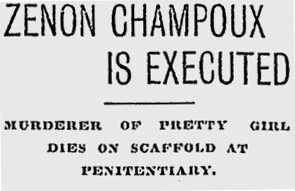
On this date in 1904, the state of Washington carried out its first execution under the auspices of a new law requiring that hangings be held in that state’s penitentiary in Walla Walla.*

Its subject was French-Canadian laborer Zenon Champoux, and his crime was as flamboyant as his moniker: publicly planting a knife in the forehead of a dance hall girl who did not return his affections.

The first man executed under the auspices of the Evergreen State, we admit, is a milestone that’s a bit on the smaller side.

But we think his name stands out admirably in the annals, especially paired with a characterization like the Seattle Star gave him: French degenerate.

“Zenon Champoux, French Degenerate” — it’s the scoundrel who’s rogering your girl, or else the branding on his designer condoms. On this date in 1904, it was just the guy at the end of his rope.

* Previously, hangings had been conducted by counties, in public. Laws removing them to the auspices of the state and behind the walls of a prison were in vogue at the time.

Washington went on to abolish the death penalty in 1913, only to reinstate it again in 1919.

On this day..

1915: Nurse Edith Cavell, “patriotism is not enough”

Early this morning in 1915, the German military occupying Belgium shot aid worker Edith Cavell at Brussels for aiding the British war effort.

The matronly nurse had been condemned only the day before by a German military court for helping Allied soldiers escape from behind German lines — charges Cavell readily admitted. The British chaplain who attended her the night before her death reported her saying (not actually her last words, but recalled as her parting sentiment, as it were):

But this I would say, standing as I do in view of God and eternity, I realize that patriotism is not enough. I must have no hatred or bitterness toward any one.

So naturally, she immediately became the Entente’s bloody banner of the barbarous Hun, helping dramatically ramp up recruitment for the other team’s set of moral cretins.

The thing is, the Germans actually had a point. Cavell ran a nursing school in Brussels, and courageously stuck around when the Germans smashed through Belgium as World War I opened. She’s sometimes remembered as getting in hot water for treating the wounded regardless of nationality, but she did a lot more than that: she got involved with an underground railroad funneling Allied soldiers back to enemy countries.

It was one of those impossible trials of conscience that wartime brings: Cavell, whose hospital was subsumed by the Red Cross during the war, should technically have remained neutral; her actions did bring material aid to Germany’s foes.

However, Belgian, French and English troops caught behind lines by the Germans’ lightning advance were in danger themselves of summary execution, as were civilians who harbored them. Neutrally treating them and handing them over as POWs might have been tantamount to killing many of them, especially in the first few months of the war. Though Edith Cavell said that “I am happy to die for my country,” her actions look more humanitarian than nationalistic — the best choice to be made when no good ones are available. Patriotism of a higher order, if you like.

Probably Cavell’s was a case tailor-made for executive clemency, but Germany was keen to send one of those proverbial messages: civilians in occupied countries had best stay out of the war. Despite the frantic lobbying of England’s ambassadors (and, ominously for Germany, those of the United States), the sentence was carried out on both Cavell and a fellow-traveler in her network, Belgian Philippe Baucq.

Clumsy propagandists, the Kaiser’s boys badly misjudged the message so sent.

In the face of intense international outcry, Germany soon found itself defending its actions (.pdf), and then commuting the sentences (.pdf again) of Cavell’s other collaborators.

None of this abated Cavell’s stupendous propaganda value to Germany’s enemies. And — holy wow, the graying 49-year-old gets made over into quite the heartbreaker in most of these.

The nurse’s repute — and she was said to have struck a Joan of Arc-like chord in those parts — caused a renaissance for the name “Edith” among French and Belgian newborns, most notably singer Edith Piaf (born in December 1915). While Cavell’s sacrifice did nothing to stem her name’s declining Anglo (or at least American) popularity, there is a Mount Edith Cavell named for her in Canada, and a plethora of monuments and public spaces dedicated to her throughout the Allied powers’ lands. (Here are just a handful.) And she still packs enough symbolic punch for the current British Prime Minister Gordon Brown to deploy her in the propagandist’s subtler modern arts.

There’s plenty more about her online, but world headquarters (with information about the Cavell Festival) is edithcavell.org.uk. There’s also a stupendous collection of text and images (several already used in this post) at the sometimes slow-loading but endlessly fascinating site The Great War in a Different Light.

Dutch speakers might enjoy this podcast:

[audio:http://veertienachttien.web-log.nl/mijn_weblog/files/068_va_edith_cavell.mp3]

On this day..