1793: Adam Philippe, Comte de Custine

The best defense would have been a good offense for French General Adam Philippe, Comte de Custine — guillotined in Paris this date in 1793 for inadequacy in command of the French revolutionary armies fighting continental monarchist armies.

You must be this tall to go on the General Moustache* ride, and poor results in the field at this time could leave you shorter. Losing to the enemy looked an awful lot like conspiring with the enemy, especially when there was a “Comte” in your name.

Custine spent the winter of 1792-1793 coughing up French conquests across the Rhine. (In his defense, several of them were things that he’d previously conquered himself.)

Recalled once to Paris to justify himself, the bewhiskered general was defended by no less than Robespierre, and thereafter returned to the field. Given this background, it was not wise of him to resume the losing streak — but he did.*

The resultant second recall saw the moustache — and its associated head — permanently shaved for treacherously throwing battles like the 1919 White Sox. This met with the great approval** of Hebert‘s Pere Duchesne :

“Epitaph on General Custine”

Here lies an headless General—(I’ll say dead)
As many living Generals want an head.

You have just done something worthy of me by denouncing Custine. You have brought into broad daylight his plots and his treason. If we had waited a few more days to recall him freedom would have been fucked. This infamous rascal, after having had the French in Frankfurt massacred, after having abandoned Mainz, after having allowed Valenciennes to be encircled, after having delivered Condé, only awaited the right moment to lead his army into a slaughter and to deliver the coup de grace to the republic by sacrificing its last resources. Fortunately, the bugger has been put to the side. His crimes have been proved, let his head promptly fall under the national razor, but let his not be the only one! Let all the scoundrels who compose his headquarters also be shortened. Pursue, denounce without rest the infamous Tourville, who was the right arm of Lameth, and who will deliver Maubeuge if we leave him in command. Make known the swindler Lapallière, and especially the ci-devant marquis de Verigni, known in all the gaming houses under the name of Debrulis. Tell the Sans Culottes in the army that this rat has emigrated twice. Don’t forget Leveneur, the intimate friend of Lafayette, and the henchman of Custine. Don’t allow these bandits a moments rest until they’ve been chased and punished as traitors.

Custine’s son also got the chop for defending his old man.

Surviving the purge: Adam Philippe’s then-three-year-old grandson, Astolphe Custine. Custine would become famous as “the de Tocqueville of Russia,” and for his aphoristic and still-current travelogue La Russie en 1839.

* Actual nickname.

** And characteristically profane. Pere Duchesne would not have had a lot of patience for coy little cunnilingus references where a salty sans-culotte f-bomb would do instead.

On this day..

1527: Jacques de Beaune, baron de Semblançay

On this date* in 1527, Jacques de Beaune was hanged on the gallows of Montfaucon for peculation.

Beaune (French Wikipedia entry) was an aged man well into his 70s or 80s, and had served four kings’ treasuries, rising to become Superintendent of Finance for Francis I.

His slow-motion ruin began with France’s military involvement in Italy earlier that decade, in which capacity the French commander near Milan suffered a grievious reverse and had to abandon Lombardy.

Furious buck-passing ensued:

  • The commander blamed the defeat on a lack of pay for his Swiss mercenaries;
  • The paymaster — Beaune — blamed the lack of funds for the mercs on the Queen Mother, Louise of Savoy‘s calling in a debt

The ensuing investigation revealed this story to be true, but Beaune was obliged to retire from the court because of the Queen Mother’s fury at him.

And that might have been that, but for the further French misadventures in Italy.

In 1525, Francis himself contrived to be captured at the Battle of Pavia, elevating Louise of Savoy to regent in his absence. By the time the spendthrift king had been ransomed back, his treasury was nigh empty and Louise knew just the person to blame.

An audit of Semblancay’s accounts intended to turn up some loose ducats embarrassingly showed that the noble was actually a creditor of the king, but

on 13 January 1527, after Semblancay had returned to Paris on business, he was arrested and thrown in the Bastille … the king and his council … had been looking for ways of raising within five days 370,000 livres needed for the payment of troops. Semblancay was known to be a very rich man and the prospect of confiscating his property must have been tempting. (Source)

Semblancay was tried by a handpicked favorite of the court, with the predictable result on a somewhat nebulous embezzlement/corruption thing; a jailhouse snitch once in the great lord’s employ gave evidence against him. The doomed man, perhaps untroubled to be relieved of the infirmities of his advanced age, was supposed to have been downright chill walking through Paris to his death, and he was met with respect by a citizenry that could hardly help sympathizing with this wizened but serene victim of the royal wrath.

Poet Clement Marot** recorded the scene thus:

Lorsque Maillart, juge d’Enfer, menoit
À Monfaulcon Samblançay l’ame rendre,
À votre advis, lequel des deux tenoit
Meilleur maintien ? Pour le vous faire entendre,
Maillard sembloit homme qui mort va prendre
Et Samblançay fut si ferme vieillart
Que l’on cuydoit, pour vray, qu’il menast pendre
À Montfaulcon le lieutenant Maillart.
When Maillart, judge of Hell,
To Montfaucon led Samblançay to give up his soul,
Which of the two, in your mind,
Had the better demeanour? To enlighten you,
Maillart seemed the man whome death would take
And so sturdy an old man was Samblançay,
That one truly believed that it was he who led
Lieutenant Maillart to be hanged at Montaucon.

This case is less well-remembered today than it ought to be; to contemporaries, the hanging of France’s treasurer for corruption was an awfully noteworthy event.† (Opinions at the time seemed to be split on the justice of the matter, even though Semblancay was posthumously rehabilitated; later generations have more strongly gravitated to the understanding that he was railroaded.)

And it launched an ensuing, decade-long project of Francis’s, to squeeze wealthy financiers through the commission de la Tour Carree and thereby get in the good graces of the early modern bond markets unsettled by France’s 1520s fiscal faceplant.

There’s a nasty apparent allusion in Rabelais’s Pantagruel to this procedure:

We noticed in a great Press from twenty to twenty-five huge Gallows-birds round a great Table [bourreau, punning bureau] covered with green Cloth, staring at each other, with their Hands as long as Crane’s Legs and their Nails two Feet long at least, — for they are forbidden ever to pare them, so that they become as crooked as Bills or Boat-hooks — and just at that time was brought in a great Bunch of Grapes which they gather in that Country, from the Vine called Extraordinaire, the Grapes from which often hang on Poles. As soon as the Bunch was laid there, they put it under the Press, and there was not a Berry from which they did not squeeze Oil of Gold, insomuch that the poor Bunch was carried off so drained and stripped, that there was not a Drop of Juice or Liquor left.

Most of those Tour Carree prosecutions didn’t result in executions — “merely” confiscations of lands and titles which could be re-sold, and sentences which could be commuted for a fine. R.J. Knecht, in The Rise and Fall of Renaissance France, 1483-1610, puts the king’s profit on such confiscations into the millions of livres.

But to make those shakedowns seem a small price to pay, the threat of Semblancay’s example must have lurked in the background for targeted nobles.

(Semblancay himself had been reckless enough not to accept an initial mostly-exoneration in the inquiry that preceded his arrest and trial, since part of it required him to “repay” supposed debts to Louise of Savoy. His appeal against that part of the judgment might have set him up to be the cautionary example for everyone else.)

Guillaume de La Perrierre captured the vibe with one of his “emblems” in Le Théâtre des bons engins, number XL:

The Beaune name would scintillate to posterity through such illustrious descendants as Renaud de Beaune (French link), a notable archbishop; and, more salaciously, Escadron Volant all-star Charlotte de Beaune Semblançay, who seduced powerful nobles at Catherine de’ Medici’s behest.

A lengthy French history of our day’s early modern moneybags can be perused here; when visiting Tours, you can revisit the days when he was in the chips by crashing at one of the many buildings he put, the Hotel de Beaune-Semblancay.

* Sentence was pronounced on Friday, Aug. 9, but a stay granted until Monday, Aug. 12 for the condemned man to pursue his appeal to the king. Some sources give Aug. 9 as the execution date, and some Aug. 11; both of these appear to be incorrect. See David Graham in An Interregnum of the Sign: The Emblematic Age in France – Essays in Honour of Daniel S.Russell.

** There’s another (translated to English) meditation Marot wrote on Semblancay here, in the first-person voice of the hanged man. Marot was a friend of the eventually-executed French linguist and translator Etienne Dolet, and his own unorthodox opinions would eventually require him to flee the realm for his life.

We do note that in this era of combative pamphleteering, the geezer who made himself a tycoon by administering the taxes wasn’t universally supported by the literary set. Roger de Collerye (cited here) hooted Jacques de Beaune into the hereafter with the verses,

Tremblez, tremblez, larrons gros & petiz!
Retirez vous, gens trop fins et subtilz!
Absentez vous bientost & prenez terre,
Gens de finances et tresoriers gentilz
Qui d’attrapper estes tant ententifz.
Sur vous surviegne tempeste & tonerre!
Craignez la court qui vous donna la guerre
Bien asprement, quant je l’ay pance,
Souvieigne vous de la mort Sant Blancey!

† It happened yet again in September 1535, to Jean Poncher. Historically, proximity to the French crown’s revenues was also proximity to the gallows.

On this day..

1676: Marie-Madeleine-Marguerite d’Aubray, Marquise de Brinvilliers

This date’s story is amply but succinctly conveyed by the public-domain entry in the 19th century tome Biography, or Third Division of the “English Encyclopedia”.

(Paragraph breaks have been added for readability.)


Brinvilliers, Marie Marguerite, Marquise de (English Wikipedia entry | French) who obtained infamy as a poisoner in the time of Louis XIV, was a daughter of the Dreux d’Aubrai, a lieutenant civil, or judge having a certain limited jurisdiction, at whose hands she received a careful education.

In 1651, whilst still very young, she became the wife of the Marquis de Brinvilliers, with whom she resided at her father’s house, in Paris. Her husband, who was the colonel of the Regiment de Normandie, entertained at his house a young officer of cavalry of the Regiment de Tracy, named Gaudin de Sainte-Croix, a native of Montauban, and the illegitimate member of an illustrious family. He was unprincipled enough to encourage the unlawful passion which the marchioness conceived for him; and her father, in consequence, procured in 1663 a lettre de cachet against Sainte-Croix, who underwent a year’s incarceration in the Bastille.

During his confinement he learned from a fellow-prisoner, an Italian named Exili, the art of preparing subtle poisons; a secret which, upon his enlargement, he communicated to his mistress, who determined to poison her father and the other members of her family. Having first wantonly essayed her art upon the patients of the Hotel-Dieu, she proceeded, with the aid of a servant named Jean Amelin, or La Chaussee, to take the lives of her father, her two brothers, and her sister.

This feat she accomplished gradually between the years 1666 and 1670. More than once she poisoned her husband; but Sainte-Croix, whose prudence shrank from the obligation of marrying the terrible widow, each time preserved the life of the Marquis by the administration of an antidote.

Sainte-Croix died suddenly in July, 1672, in the act, it is said, of compounding a subtle poison, against the effects of which he was left unprotected by the accidental fracture of a glass mask which he wore as a defence against the fumes of his deadly drugs.*

As no relative came forward to claim his property, it was taken possession of by the public authorities, who, instead of complying with the written instructions of Sainte-Croix,** dated May 25th, 1672, that a particular casket should be delivered to Madame de Brinvilliers, examined it, together with above thirty letters which he had received from her. There was also found a promise on her part to pay Sainte-Croix a sum of 30,000 libres, bearing the date of June 20th, 1670, eight days after the poisoning of the “lieutenant civil,” her father. The casket proved to be full of packets of various poisons, to each of which was affixed a label indicating the peculiar effects it was calculated to produce.

The Marchioness, fatally compromised by these and other circumstances, sought safety in flight, repairing first to England, then to Germany, and finally to Liege, where she was apprehended.

Being taken to Paris, she denied her guilt; but after her condemnation made a confession, in which, and in a kind of autobiography, she charged herself with more and greater horrors than had seemed possible to rumour or suspicion.


The Marquise de Brinvilliers, shortly before her execution, by Charles LeBrun

She was executed at seven o’clock on the evening of the 16th of July, 1676, being first beheaded and afterwards burnt. As her application and use of poison, which went by the name of poudre de succession, seemed to be growing prevalent, Louis XIV instituted a special court for the investigation and punishment of this species of crime.


This tale, uniting the attractions of bodice-ripper, true crime, and costume drama, has been adapted to stage and literature numerous times.

Alexandre Dumas pere, a true aficionado of historical crime and scandal, turned it into a much lengthier piece, from which we morbidly excerpt his description of the water torture the criminal endured prior to beheading — beginning with the sentence of the court.


“That by the finding of the court, d’Aubray de Brinvilliers is convicted of causing the death by poison of Maitre Dreux d’Aubray, her father, and of the two Maitres d’Aubray, her brothers, one a civil lieutenant, the other a councillor to the Parliament, also of attempting the life of Therese d’Aubray, her sister; in punishment whereof the court has condemned and does condemn the said d’Aubray de Brinvilliers to make the rightful atonement before the great gate of the church of Paris, whither she shall be conveyed in a tumbril, barefoot, a rope on her neck, holding in her hands a burning torch two pounds in weight; and there on her knees she shall say and declare that maliciously, with desire for revenge and seeking their goods, she did poison her father, cause to be poisoned her two brothers, and attempt the life of her sister, whereof she doth repent, asking pardon of God, of the king, and of the judges; and when this is done, she shall be conveyed and carried in the same tumbril to the Place de Greve of this town, there to have her head cut off on a scaffold to be set up for the purpose at that place; afterwards her body to be burnt and the ashes scattered; and first she is to be subjected to the question ordinary and extraordinary, that she may reveal the names of her accomplices. She is declared to be deprived of all successions from her said father, brothers, and sister, from the date of the several crimes; and all her goods are confiscated to the proper persons; and the sum of 4000 livres shall be paid out of her estate to the king, and 400 livres to the Church for prayers to be said on behalf of the poisoned persons; and all the costs shall be paid, including those of Amelin called Lachaussee. In Parliament, 16th July 1676.

The marquise heard her sentence without showing any sign of fear or weakness. When it was finished, she said to the registrar, “Will you, sir, be so kind as to read it again? I had not expected the tumbril, and I was so much struck by that that I lost the thread of what followed.”

The registrar read the sentence again. From that moment she was the property of the executioner, who approached her. She knew him by the cord he held in his hands, and extended her own, looking him over coolly from head to foot without a word. The judges then filed out, disclosing as they did so the various apparatus of the question. The marquise firmly gazed upon the racks and ghastly rings, on which so many had been stretched crying and screaming. She noticed the three buckets of water prepared for her, and turned to the registrar — for she would not address the executioner — saying, with a smile, “No doubt all this water is to drown me in? I hope you don’t suppose that a person of my size could swallow it all.” The executioner said not a word, but began taking off her cloak and all her other garments, until she was completely naked. He then led her up to the wall and made her sit on the rack of the ordinary question, two feet from the ground. There she was again asked to give the names of her accomplices, the composition of the poison and its antidote; but she made the same reply as to the doctor [namely, that she had no accomplices besides Sainte-Croix and did not know how to make the poison or its antidote], only adding, “If you do not believe me, you have my body in your hands, and you can torture me.”

The registrar signed to the executioner to do his duty. He first fastened the feet of the marquise to two rings close together fixed to a board; then making her lie down, he fastened her wrists to two other rings in the wall, distant about three feet from each other. The head was at the same height as the feet, and the body, held up on a trestle, described a half-curve, as though lying over a wheel. To increase the stretch of the limbs, the man gave two turns to a crank, which pushed the feet, at first about twelve inches from the rings, to a distance of six inches. And here we may leave our narrative to reproduce the official report.

“On the small trestle, while she was being stretched, she said several times, ‘My God! you are killing me! And I only spoke the truth.’

“The water was given: she turned and twisted, saying, ‘You are killing me!’


The torture of the Marquise de Brinvilliers. (Click for a larger image.)

“The water was again given.

“Admonished to name her accomplices, she said there was only one man, who had asked her for poison to get rid of his wife, but he was dead.

“The water was given; she moved a little, but would not say anything.

“Admonished to say why, if she had no accomplice, she had written from the Conciergerie to Penautier, begging him to do all he could for her, and to remember that his interests in this matter were the same as her own, she said that she never knew Penautier had had any understanding with Sainte-Croix about the poisons, and it would be a lie to say otherwise; but when a paper was found in Sainte-Croix’s box that concerned Penautier, she remembered how often she had seen him at the house, and thought it possible that the friendship might have included some business about the poisons; that, being in doubt on the point, she risked writing a letter as though she were sure, for by doing so she was not prejudicing her own case; for either Penautier was an accomplice of Sainte-Croix or he was not. If he was, he would suppose the marquise knew enough to accuse him, and would accordingly do his best to save her; if he was not, the letter was a letter wasted, and that was all.

“The water was again given; she turned and twisted much, but said that on this subject she had said all she possibly could; if she said anything else, it would be untrue.”

* According to Anne Somerset in The Affair of the Poisons: Murder, Infanticide, and Satanism at the Court of Louis XIV, this story of Sainte-Croix’s death by accidental exposure to his own toxins is “a myth” that developed in view of subsequent events.

“In fact,” writes Somerset, “his end was far more prosaic. He died after a long illness, having received the last rites and performed his final devotions with terrible piety.”

** Because Sainte-Croix died in debt, and his possessions were inventoried for his creditors.

On this day..

1346: Simon Pouillet

From the Grandes Chroniques de France:

En celuy an, le samedi premier jour de juillet, fu fait à Paris une horrible justice, — né onques mais n’avoit esté faite semblable au royaume de France. Combien que nous lisons que l’empereur Henri en fist une autèle, et en Angleterre aussi, une autre fois en avint une autre semblable, toutes voies à Paris onques mais n’avoit esté telle , — d’un bourgois de Compiègne appellé Symon Pouilliet, assez riche, qui fu jugié à mort et mené aux halles de Paris; et fu estendu et lié sur un estal de bois, ainsi comme la char en la boucherie, et fu ylec copé et desmembré, premièrement les bras, puis les cuisses et après le chief ; et après pendu au gibet commun où l’en pent les larrons. Et tout pour ce qu’il avoit dit, si comme l’en luy imposoit, que le droit du royaume de France appartenoit mieux à Edouart, roy d’Angleterre, que à Phelippe de Valois. De laquelle mort tout honteuse, France pot bien dire la parole de Jhésucrist qui disoit : « Ci sont les commencemens des douleurs, » si comme il sera monstré par après.

The gist of the bolded bit:

a wealthy Compiègne bourgeois called Simon Pouilliet was broken and dismembered in Paris, and gibbeted on the common gallows. And all for saying that the right of the kingdom of France belonged more to Edward, king of England, that to Philippe of Valois.*

Come and see the violence inherent in the system!

There was cause, however, for the House of Valois to be oversensitive to Pouillet’s treasonable take on royal genealogy: it was at least plausibly true.

Edward’s interest in actualizing his nominal claim to the French throne had by this point precipitated the opening dynastic skirmishes of what would eventually (a hundred-plus years later) become remembered as the Hundred Years’ War.

And as the chronicle concludes on a note of melancholy, Simon Pouillet’s horrific butchery would be an omen of his realm’s coming sorrows.

Eight weeks later, the English sowed the battlefield of Crecy with the flower of French chivalry and established a foothold at Calais that would help sustain generations of bloodily inconclusive combat.

Then, from 1348, the Black Death ravaged Europe, bringing for its survivors the economic shock of a labor shortage, weird social movements like the flagellants, and a pervasive sense of fatalism that ate at humanity’s social bonds.

A few years after that, the French king, Philip’s successor John the Good, was actually captured by the English at the Battle of Poitiers, and ransomed as a hostage for a ruinous sum.

There’s no record whether the wind whistling through the remains of Simon Pouillet dangling on Montfaucon whispered “I told you so.”

* Pouillet had not acted on this notion — he’d merely been popping off, possibly while sauced. The absence of any actual intent on the speaker’s part, however, did not lessen the treason, as explained in The Law of Treason and Treason Trials in Later Medieval France:

The general royal position on treason by words was summed up in 1432 by Jean Barbin, king’s proctor in the Parlement of Poitiers, in the prosecution of the Fleming Hennequin Bize. ‘By word and by deed’, he began, ‘one commits the crime of lese-majesty: by deed when one makes an attempt on the person of the princeps; and by word when one speaks sinisterly of him or his acts.’ Barbin asserted furthermore that it was worse ‘to disparage by word than to injure by deed’, but he neglected to explain why.

On this day..

1669: Roux de Marsilly, employer of the Man in the Iron Mask?

On this date in 1669, a French Huguenot agent was publicly broken on the wheel in Paris.

On the dangerous political chessboard of 17th century Europe, the allegiance of Restoration England — governed once again by a dynasty with known Catholic sympathies — was a great prize for contending Catholic and Protestant powers on the mainland.*

While Charles II of England and the Catholic Louis XIV of France maneuvered towards a secret accord that would lead to devastating war against the Protestant Netherlands, Roux de Marsilly was busy in London trying to enlist England into a Protestant alliance against France.

Finding the avenues blocked, Marsilly retired to Switzerland and was there abducted by French spies who knew what he was up to.

A trumped-up rape charge served that country’s statecraft, and despite an offer by the prisoner to spill some beans in exchange for his life — and then a suicide attempt —

hee wounded himself … for he knew before hee should dye, butt he thought by dismembering himself that the losse of blood would carry him out of the world …

— Roux could not avoid his fate. In fact, out of fear that Marsilly could still succumb to his self-injury, they

sent word … which made his execution be hastened. Saturday about 1 of the clock he was brought on the skaffold before the Chastelet and tied to St. Andrew’s Crosse all which was while he acted the Dying man and scarce stirred, and seemed almost breathless and fainting …

they went to their worke and gave [Marsilly] eleven blows with a barre and laid him on the wheele. He was two houres dying.

(Both quotes above from this correspondence.)

For all those two agonizing hours, Roux de Marsilly really only merits a footnote in a different story.

The Man in the Iron Mask

The mysterious Man in the Iron Mask was first documented in French custody later in the summer of 1669, and he would remain a guest of the Bourbon dungeons until 1703.

The identify of this person — or maybe persons, since it’s been argued that there are multiple threads conflated into the one legend — has never been conclusively established, much to the profit of literature.

One of the stronger contenders for the crownmask, however, is a prisoner named “Eustace Dauger”, who may in fact have been Roux de Marsilly’s former valet, one “Martin”.

The case for Martin-as-Dauger-as-masked-man is made most comprehensively by Andrew Lang in The Valet’s Tragedy and Other Stories.

The hypothesis, roughly outlined, is that England and especially France were trying to tie up the loose ends of whatever plots Marsilly had authored, and got hands on his servant to interrogate him about the highly sensitive machinations he might have been privy to.

Possibly having established that Martin/Eustace had no actual information to betray, he still remained under lock and key out of some admixture of bureaucratic inertia and the remorseless paranoia of the security state. Crazy.

[T]he Man in the Iron Mask (if Dauger were he) may have been as great a mystery to himself as to historical inquirers. He may not have known WHAT he was imprisoned for doing! More important is the probable conclusion that the long and mysterious captivity of Eustache Dauger, and of another perfectly harmless valet and victim, was the mere automatic result of the ‘red tape’ of the old French absolute monarchy. These wretches were caught in the toils of the system, and suffered to no purpose, for no crime. The two men, at least Dauger, were apparently mere supernumeraries in the obscure intrigue of a conspirator known as Roux de Marsilly.

…

Marsilly was publicly tortured to death in Paris on June 22, 1669. By July 19 his ex-valet, Dauger, had entered on his mysterious term of captivity. How the French got possession of him, whether he yielded to cajolery, or was betrayed by Charles II., is uncertain. … By July 19, at all events, Louvois, the War Minister of Louis XIV., was bidding Saint-Mars, at Pignerol in Piedmont, expect from Dunkirk a prisoner of the very highest importance–a valet! This valet, now called ‘Eustache Dauger,’ can only have been Marsilly’s valet, Martin, who, by one means or another, had been brought from England to Dunkirk. It is hardly conceivable, at least, that when a valet, in England, is ‘wanted’ by the French police on July 1, for political reasons, and when by July 19 they have caught a valet of extreme political importance, the two valets should be two different men. Martin must be Dauger.

* And, of course, for the Catholics and Protestants in England. This struggle would come to a head in due time, to the grief of the Stuarts.

On this day..

1797: Gracchus Babeuf, for the Conspiracy of Equals

If the “revolutionary extremist” exists at all as an identifiable type, he exists in purest incarnation in Gracchus Babeuf. No revolutionary better fits the description “narrowminded to the point of genius”; few have defined their heaven more clearly or crusaded so fanatically, ascetically, so religiously to bring it to earth.

–Gracchus Babeuf: The First Revolutionary Communist

On this date in 1797, Francois-Noel Babeuf lost his head for the Conspiracy of Equals — the last Jacobin upheaval of the French Revolution, or the first Communist upheaval of post-Revolution modernity.

Francois-Noel — he styled himself “Gracchus” after the populist Roman tribunes — was a young man of Desmoulins‘ generation but from a considerably more hardscrabble background. Like the starry-eyed Dantonist scribbler, Babeuf discovered himself a brilliant journalist and pamphleteer with the onset of the Revolution; he did several prison stints during various revolutionary phases of the early 1790s for his too-radical-for-school opinions.

He did another in 1795 under the French Directory for his firebreathing rag Le Tribun du Peuple, which was particularly unfashionable stuff during the post-Robespierre Thermidorian regime.

Nothing daunted, Babeuf emerged from prison the leading apostle of the Parisian proletariat which had by then been decisively separated from power.

The order of the day was class consolidation with the spoils of the aristocracy apportioned among a new oligarchy of wealth. As France rushed headlong towards Bonaparte and Bourbon restoration, Babeuf was the man left to rally “the party which desires the reign of pure equality.”

The French Revolution was nothing but a precursor of another revolution, one that will be bigger, more solemn, and which will be the last.

The people marched over the bodies of kings and priests who were in league against it: it will do the same to the new tyrants, the new political Tartuffes seated in the place of the old.

–Manifesto of the Equals, 1796

One can see why later revolutionaries — Marx included; Babeuf makes a cameo in the Communist Manifesto — would adopt this sort of thing as a harbinger of the next century’s revolutions.

And if the Directory had known who Nicholas II would be, it would have had no intention of going the way of his family.

Instead, it shut him down in February, 1796: Napoleon Bonaparte personally carried out the operation, just days before he wed Josephine.


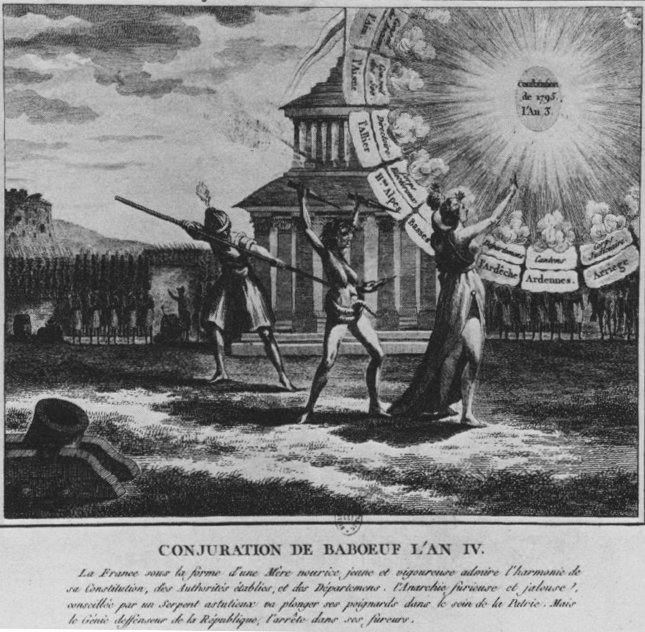
The Babeuf Conspiracy. Anonymous French print.

Babeuf’s party comes down to us as a “conspiracy,” under which word the state would charge him and which his follower Philippe Buonarroti would later rebrand the “Conspiracy of Equals”. It was not so much a grassy-knoll type of conspiracy as it was an underground organization.

When its adherents placarded Paris with the seditious “Analysis of the Doctrine of Babeuf” as the city endured a potentially dangerous economic crisis in April 1796, the government was put to a test of its strength.

It passed.

Having infiltrated Babeuf’s network, it arrested the principals on the eve of the Conspiracy’s intended insurrection. They were hailed out of Paris (a safeguard against sympathetic risings) to the commune of Vendome and there put on trial.* Babeuf and his associate Augustin Alexandre Darthe were condemned to death on May 26th and guillotined the very next day.

The last gasp of the French Revolution dropped with their heads into the basket.

Revolutionary Babeuvism, however, had scarcely just begun.

I don’t know what will become of the republicans, their families, and even the babies still at their mothers’ breasts, in the midst of the royalist fury that the counter-revolution will bring. O my friends! How heart-rending these thoughts are in my final moments! … To die for the fatherland, to leave a family, children, a beloved wife, all would be bearable if at the end of this I didn’t see liberty lost and all that belongs to sincere republicans wrapped in a horrible proscription.

-Babeuf’s last letter to his family

* The trial of Babeuf was itself a jurisprudential milestone: it was the first French trial to be transcribed verbatim.

What might look today like a nifty little advance for efficient judicature was bitterly controversial in 1797. The French Revolution had overturned an ancien regime practice of professional magistrates accepting legal testimony by written deposition and deciding matters behind closed doors. The liberte, egalite, fraternite way would instead demand that testimony be given live in the courtroom where citizen jurors could weigh its credibility.

Babeuf’s lawyer, Pierre-Francois Real, protested against the court stenographers, arguing that “The law insists that the system of written depositions not be restored in any way. That system will undoubtedly return if any means are used to save testimony given orally.”

There’s a fascinating disquisition on the curious and contradictory development of this issue and the way it “violates … common assumptions about the advance of textuality in the West” during the French Revolution in Laura Mason, “The ‘Bosom of Proof’: Criminal Justice and the Renewal of Oral Culture during the French Revolution” The Journal of Modern History, March 2004.

On this day..

1871: Hostages of the Paris Commune

The fall of the Paris Commune on May 28, 1871 launched many a leftist insurrectionary into the martyrs’ firmament.

But the last semaine sanglante that engulfed the Commune there was blood enough for many martyrdoms.

On this date in 1871, just days before the Commune gave way, it executed a clutch of hostages (French link) in desperate reprisal for the Versailles army’s cruelties. For the Commune, it was too little ruthlessness and much too late. For the 52 who stood up against the wall this date, they were just as dead.

These unfortunates were marched from La Roquette prison — whose inmates by dint of timely resistance only narrowly avoided a more extensive massacre — to Rue Haxo and slaughtered.

A number of them were men of the cloth. In 1938, the Catholic church of Notre Dame des Otages was erected on the site and dedicated to the victims’ memory.


A crucifix at Notre Dame des Otages. Copyrighted image used with permission.

(The markers on the spot have settled on 52 as the number of the victims, which might be the historically authoritative count; different sources, however, provide slightly different numbers.)

On this day..

1946: Marcel Petiot, Vichy serial killer

Paris, 1942.

On the run from the Gestapo — as a Jew or a Gypsy, a common criminal or a Resistance fighter whose cover is blown — you get wind of a man who can help.

“Dr. Eugène” will (for a fee) spirit you over the Pyrenees and thence to South America. In his house at rue le Sueur, you make the arrangements. One small matter: the tropics requires an inoculation, which le bon docteur will readily provide. One small prick of the needle and then …

The needle contained cyanide and the destination turned out to be a lime pit, and so “Dr. Eugène” — Marcel Petiot — was guillotined this date in 1946.

His opportunistic exploitation of the dangerous Vichy years is what he’s famous for, but Petiot had decades of crime behind him by the time he got his phony “underground railroad” up and running.

From youthful compulsive thieving, Petiot graduated into a shady medical practice in Villeneuve-sur-Yonne where he was the resident black market abortionist.

He’s thought to have killed a mistress there, and maybe a couple of others, but was able to segue into a political career by winning the mayoralty of Villaneuve when he sabotaged his opponent’s campaign appearances. The sticky-fingered Petiot naturally plundered the town treasury and was forced out of office in 1931.

By the time the war years had rolled around, Petiot had judiciously relocated to Paris where he retained his capacity for professional advancement in the face of profoundly disturbed behavior: he was institutionalized for kleptomania the same year he was appointed an official médecin d’état-civil.

So he had the requisite two-faced background for his whackadoodle wartime “escape route”, which he creepily code-named “Fly-Tox.”

Twists and turns elided — trutv.com and crimemagazine.com both have detailed biographies/case histories — Petiot’s enterprise was quasi-exposed early in 1944 when the stink of incinerating bodies prompted neighbors to summon the police and uncover his charnel house.

Amazingly, Petiot was able to beg off with the claim that he was a Resistance activist — these were French police — and that the victims were Nazis or collaborators who had been eliminated by his network on orders. The Gestapo had sniffed him out too late in the war to do anything about him, but its judgment that Petiot was a “dangerous lunatic” actually turned out to bolster the deranged doctor’s case that he was an anti-fascist.

The alibis fell apart as the war wrapped up, and Petiot was finally recognized in a Paris manhunt and brought to trial for 27 homicides. Police thought 60-plus was more like it — maybe even into the hundreds — but secured 26 of the 27 counts. That’s more than enough to do a man to death, especially since they were the for-fun-and-profit murders of desperate people already on the run from the late and hated occupying army. Bit of a touchy subject in France in ’46.

But there was good news.

This London Times (May 27, 1946) observed that Petiot’s beheading marked

the first time that the guillotine has been used since the war. Until now executions have been by firing squads. Although gruesome, it is one more indication of the return of this country to normal civil ways of life.

On this day..

1794: Antoine Laurent Lavoisier, father of modern chemistry

On this date in 1794, French scientist Antoine Laurent Lavoisier was guillotined in Paris for “adding water to the people’s tobacco.”

Portrait of Monsieur de Lavoisier and his Wife, chemist Marie-Anne Pierrette Paulze, by Jacques-Louis David (1788) Marie assisted Lavoisier in the laboratory; she also studied art under David the better to illustrate the resulting publications.

Tobacco-watering was the least of Lavoisier’s pastimes.

The man’s resume* of 50 busy years in chemical and biological experimentation included

  • Proving the law of conservation of mass
  • Naming oxygen and hydrogen
  • Demonstrating oxygen’s role in combustion and respiration
  • Writing the first chemistry textbook, with the first list of elements

Unfortunately, Lavoisier funded these eggheaded avocations with an investment in the Ferme générale, the hated tax-farming syndicate to which the crown outsourced its revenue-squeezing operations.

This is just the sort of operation one would expect to find in the crosshairs of the French Revolution’s Terror: hence, watering the people’s tobacco.

(Allegedly, Jean-Paul Marat also had it in for Lavoisier personally, on account of the latter’s having blown off Marat’s pre-Revolution scientific efforts.)

The company was shut down in 1790.

But at the height of the Terror, Lavoisier and 27 fellow tax-farmers of the Ferme were rounded up and quickly condemned.

Lavoisier’s appeal for a stay of execution to complete some experiments met a brusque refusal from the people’s tribunal: “The Republic has no need for scientists.”

Mathematician Joseph Louis Lagrange, whom Lavoisier had helped escape the Revolution’s proscription, left the chemist his epigrammatic epitaph:

It took only an instant to cut off that head, and a hundred years may not produce another like it.

* And yet,

[i]n spite of his great services it is impossible to overlook the sins of Lavoisier in appropriating to himself discoveries made by chemists who were his contemporaries or predecessors. Oxygen was first discovered by Hales in 1727, and had already been prepared from mercuric oxide by Priestley in 1774, by Bayen in the same year, and still earlier by Scheele in 1771. It was at a dinner at Lavoisier’s house that Priestley confidentially communicated his discovery to Lavoisier, in 1774; in 1778 Lavoisier then claimed for himself the discovery of the composition of water, whilst, as is now known, Blagden, a friend of Cavendish, when visiting Paris in 1781, told Lavoisier that Cavendish had discovered the composition of water in a very simple manner by burning inflammable air (hydrogen), as water alone was formed during this combustion.

Lavoisier and Laplace immediately repeated the experiment and then communicated the discovery to the French Academy in 1783.

These facts certainly do not obscure the fame of the great scientist when we remember his eminent services, but in the interests of historic accuracy and justice it is impossible to pass them over in silence.

On this day..

1314: Jacques de Molay, last Templar Grand Master

On this date in 1314, the last Grand Master of the Knights Templar was burned in Paris.


Illustration of Jacques de Molay and Geoffroi de Charney burning on Paris’s Île de la Cité.

In a boring materialist history, Jacques de Molay was simply the head of an overrich military order whose crusading raison d’etre had become passe* with the Templars’ expulsion from the Holy Land.

Scores of trumped-up heresy charges did the work of ecclesiastical assassination for this renowned brotherhood originally founded to safeguard pilgrims in the Holy Land. (There’s a fine podcast episode on the Templars’ history here.)

This appears to be some sort of legitimate history. How droll!

Ruthless French King Philip the Fair, who owed the Templar banks a ton of cash, mounted in 1307 a, um, surprise nationalization — with the magnificently coordinated arrest of hundreds of members of the order on Friday, Oct. 13, 1307.**

This was, on the face of it, quite an infringement by the secular power upon the Church, but since Pope Clement V was Philip’s very own sock puppet — to the extent of relocating the papacy to Avignon the better to attend to his master — it was all good. Plus, of course, everyone made out with a big pile of loot.

As the interested parties jockeyed over those confiscated estates, there ensued for the once-powerful, now-proscribed order a years-long saga of torture, burnings (of lower-ranking Templars), salacious Baphomet-worship revelations, juridical maneuvering, and, finally, a compromise life-saving confession which Molay and his associate Geoffroi de Charney dramatically spurned.

The cardinals dallied with their duty until March 1314, when, on a scaffold in front of Notre Dame, Jacques de Molay, Templar Grand Master, Geoffroi de Charney, Master of Normandy, Ilugues de Peraud, Visitor of France, and Godefroi de Gonneville, Master of Aquitaine, were brought forth from the jail in which for nearly seven years they had lain, to receive the sentence agreed upon by the cardinals, in conjunction with the Archbishop of Sens and some other prelates whom they had called in. Considering the offences which the culprits had confessed and confirmed, the penance imposed was in accordance with rule—that of perpetual imprisonment. The affair was supposed to be concluded when, to the dismay of the prelates and wonderment of the assembled crowd, de Molay and Geoffroi de Charney arose. They had been guilty, they said, not of the crimes imputed to them, but of basely betraying their Order to save their own lives. It was pure and holy; the charges were fictitious and the confessions false. Hastily the cardinals delivered them to the Prevot of Paris, and retired to deliberate on this unexpected contingency, but they were saved all trouble. ‘When the news was carried to Philippe he was furious. A short consultation with his council only was required. The canons pronounced that a relapsed heretic was to be burned without a hearing; the facts were notorious and no formal judgment by the papal commission need be waited for. That same day, by sunset, a pile was erected on a small island in the Seine, the Isle des Juifs, near the palace garden. There de Molay and de Charney were slowly burned to death, refusing all offers of pardon for retraction, and bearing their torment with a composure which won for them the reputation of martyrs among the people, who reverently collected their ashes as relics.’

–A History of the Inquisition of the Middle Ages, Vol III

Not bad, but the for a real plot twist, check the Templars’ turn — most famously in Dan Brown’s leaden bestseller The Da Vinci Code, but more entertainingly rendered as nonfiction “speculative history” in Holy Blood, Holy Grail — as mystic guardians of Christological secrets.†

Their most sensational secret: the Holy Grail.

In this reworking, the Cup of Christ is not the San Greal but the Sang Real, God’s own royal bloodline, by way (for some reason) of the French Merovingian dynasty.

The Templars and Jacques de Molay himself, this story goes, are just part of a centuries-long vanguard of Christianity’s mystical underground. Say, is that Jacques on the Shroud of Turin?

Thither this blog dares not venture, but those with the requisite inclination towards the occult will find limitless explorations of the theme for ready sale. All we ask, gentle reader, is that you kindly cut us in on the action by using our handy affiliate links.

In what may be yet another mystical just-so story, Molay is said to have foretold, as the flames consumed him, the deaths of his persecutors.

Pope Clement, Chevalier Guillaume de Nogaret [the prosecuting inquisitor], King Philip! I summon you to the Tribunal of Heaven before the year is out!

The curse worked: none of those gentlemen lived to see 1315. Someone, somewhere, has also attributed every bum turn for the French crown since then to Molay’s anathema. There’s a legend that an onlooker at Louis XVI‘s execution dipped his handkerchief in Citizen Capet’s Sang Real and cried out, “Jacques de Molay, tu es vengé!”

* Other expeditions called “Crusades” did continue after the Templars, but Christendom’s occupation of the Holy Land was toast until Lawrence of Arabia days.

** The date of this action is a possible origin of the whole paraskevidekatriaphobia superstition, but probably not really.

† It is a fact that these guys liked sweeping their crusading conquests for supposed holy relics, like this Roman nail recently unveiled from a Templar fort that was reverentially “handled by a lot of people over a long period of time.”

On this day..