On this date in 1535, as a 25-year-old religious dissident named John Calvin fled Paris, the merchant who had hosted his circle’s Protestant salons was reduced to ashes in Paris.
Though France would ultimately remain Catholic, the Protestant Reformation found rich soil and enjoyed a measure of early official tolerance for reasons of statecraft.
But a sharp crackdown was provoked when Protestants engineered the placement of anti-Catholic posters in several towns during a single night in October 1534 — the so-called Affair of the Placards.
This spelled the end of the circle of dissidents who met at the Rue Saint-Martin.* Young Calvin high-tailed it out of town — a period of wandering and living incognito that would wash him up on the shores of Lake Geneva — but the owner of that Rue Saint-Martin house, Etienne de la Forge (aka Stephanus Forgeus) was denounced to the authorities.
* Calvin apparently had an appointment during this period in Paris to meet a scholar he would later execute, Michael Servetus, but the tete-a-tete never came off.
On this date in 1823, French physician Edme Castaing expiated upon the scaffold history’s first conviction for murder with morphine.
The good doc used the drug, a new twist on an ancient remedy only recently brought to market, apparently to poison off one of two wealthy brothers with the connivance of the other wealthy brother, the latter of whom stood in danger of being disinherited.
And then, the beneficiary of that crime wrote a will of his own to the profit of the poisoner.
Do not try this at home.
Castaing, naturally, poisoned off the other brother, too, and relieved some considerable financial distress along with, one must think, the burdensome company of a complete dullard.
“The science of toxicology,” however, “was not greatly advanced at this time, and … the above conclusion was based on presumption rather than fact.”
While today, such a case might be ripped from CSI, in 1823 it entailed an uncertain trial with varying (and wrong) medical testimony and a circumstantial trail of witnesses drawing flailing rebuttals from the accused that ran towards the unconvincing and the contradictory. (Follow the twists and turns from a contemporary chronicle here.)
Quite convicted in the public eye (a verdict history has had little cause to revisit), Castaing was judicially acquitted of the murder of Hippolyte Ballet, and doomed by the barest 7-5 majority verdict for the second Ballet boy. The London Times complained in its report of the execution (printed Dec. 9, 1823), that
[t]he faculty speak in very harsh and unmeasured terms of Dr. Pellatan, who neither described with care and accuracy, what he himself observed on opening of the body of Ballet, nor gave them the means of forming an opinion themselves, by bringing to Paris the intestines of the deceased. The physicians join the rest of the world in ascribing Ballet’s death to substances administered by Castaing, but they regret that criminal justice could not, owing to the neglicence or ignorance of Pellatan, obtain more satisfactory proofs of the crime. Beyond his own confessions, contradictions, and admissions, there was confessedly no ground to convict him.
A few years later, Victor Hugo (we keep meeting him here) had the title character in “The Last Day of a Condemned Man” occupying Castaing’s former cell, and evidently thought the matter possessed sufficient notoriety to name-check the headless poisoner decades afterwards in Les Miserables.
Among all the strange and pathetic love-stories of the Revolution, when hearts were won within prison walls and wedded by the guillotine, is there another as fantastic and wonderful as that of Adam Luchs? (Source)
Adam Lux (as he’s better known, and a fitter name to his character could hardly be invented), German Republican turned French Revolution representative, was so lovestruck by the arresting figure of Charlotte Corday that it was downright … mortifying.
Many were men to whom the Norman maid played muse, like the poet Andre Chenier.
But Lux was something else.
Thrilled by this chaste heroine’s sacrificial blow against the Revolution’s monster, Lux was supposed to have fallen madly in love with the murderess the one time he actually saw her, on her serene way to the scaffold.
Eros thus yoked to Thanatos, the besotted fellow promptly hurled himself after the exaltation of death. Imitation, after all, is the sincerest form of flattery.
Certainly knowing it to be fatal, Adam Lux published under his own name a vindication of Ms. Public Enemy #1 and her “tyrannicide,” and generally went extravagantly mooning about in this sort of vein as he prepared to get his head cut off this date in 1793:
The guillotine is no longer a disgrace. It has become a sacred altar, from which every taint has been removed by the innocent blood shed there on the 17th of July. Forgive me, my divine Charlotte, if I find it impossible at the last moment to show the courage and the gentleness that were yours! I glory because you are superior to me, for it is right that she who is adored should be higher and more glorious than her adorer!
Adam came off a little needy, you’d have to say.
Not surprisingly, he didn’t get the girl in the end.
Red is the garb thou wearest, red is the deed thou hast done,
And red on a land of blood rises the morning sun.
Kings have ridden this road, conquerors mailed in gold,
But none in such red triumph as this that we behold.
Rose, thro’ a rose-red dawn, go to thy valourous fate,
Queen of all roses thou, splendid and passionate.
And lo ! at thy feet I fling, here, in the gallows-cart,
Passionate even as thine, the rose-flower of my heart.
Turn but a moment toward me, stoop in thy raiment red,
I answer thee look for look, I am warmed and comforted.
Twins are we of one womb, fated sister and brother,
Nursed on the bare bruised breasts of Freedom our great Mother!
Thou, whom none could master, proud and glorious head,
Come, O Rose, to my bosom, come when thou art dead!
They have shorn the beautiful hair, they have bound the strong fair hands,
Signal me with your eyes that love still understands!
Signal, and I will follow : I dwell where thou must dwell,
I shall know thy blood-red raiment either in heaven or hell!
Lo! at thy feet I fling, here, in the gallows-cart,
Passionate even as thine, the red rose of my heart!
Six hundred years ago today, onetime royal favorite Jean de Montagu* was, at the instigation of his powerful noble rival, beheaded in Paris and his body hung up at Montfaucon.
Montagu (French link) was the 50-something scion of an ennobled notary — or else the illegitimate produce of King Charles V, whose ennobled notary had been induced to claim him. Regardless his blood, the lad made himself quite wealthy with a virtuous cycle of administrative acumen and political connection, winning a variety of honorary posts and riches aplenty he did not shy from displaying. Typical “New Money” type.
Sadly for Montagu, this cycle crested during the reign of Charles VI, also known as Charles the Mad for his bouts of illucidity.
“History,” wrote Barbara Tuchman, “never more cruelly demonstrated the vulnerability of a nation to the person of its chief of state than in the affliction of France beginning [with Charles’ first spell of insanity] in 1392.”
Charles the Mad’s erratic tenure would help bring French fortunes to the low ebb from which Joan of Arc would retrieve them.
Montagu’s period sob story was that his wealth earned him the enmity of nasty Duke of Burgundy John the Fearless,** who induced King Charles during one of the latter’s episodes to affix on Montagu responsibility for the crown’s financial shortfalls. Our day’s victim was arrested on October 7, 1409, tortured into a confession, and beheaded in Paris October 17.
Montagu’s surviving family had the verdict reversed within three years, which would have been a better deal for them had the family’s main branch not been wiped out three years after that at the Battle of Agincourt.
For the wider benefit of posterity, the beheaded lord also left a fair collection of endowed building projects in his lands in Marcoussis, including (French links all): the usual village church; a Celestine monastery; and a picturesque castle unfortunately devastated during the French Revolution but once resembling this:
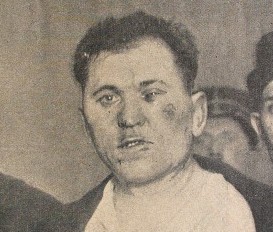
On this date in 1932, deranged Russian emigre Paul Gorguloff was guillotined for murdering President Paul Doumer four months before.
The forgettable Paul Doumer — distinguished for reasons quite beyond his control as the penultimate President of the Third Republic — was a week short of his one-year anniversary in office when the nutbar gunned him down at a Parisian book fair.
Disturbed 37-year-old Gorguloff had some impenetrably incoherent justification for the murder having to do with some “Idea” formed in a trance-like state.
From the moment of my arrival in Paris, and even in the train, I had a sort of hypnotic obsession that I must kill the President. I went and prayed in Notre Dame; then I drank heavily, and gradually decided to kill myself, the idea almost supplanting that of assassination. After drinking I conceived the idea of getting arrested to prevent me from committing the crime, so I asked a policeman on the Boulevard Saint-Michel a lot of stupid questions, hoping that he would ask for my papers and, finding them not to be in order, arrest me. All the time the Devil was saying: “Kill yourself, if you like, but only after you have killed the President.” Until 2 o’clock in the afternoon on the day of the crime I drank in a bar, emptying a bottle of cognac in the hope that I would get too drunk to do anything. Nevertheless I finally went to the book exhibition in the Rue Berryer, where the President was expected. After I had spoken with M. Farrere [he was later shot in the arm by Gorguloff] and looked at a few books, the President arrived. I was in a kind of hypnotic sleep, and fired without really knowing what I was doing. (The Times of London, May 18, 1932)
Whatever this daemon may have amounted to in Gorguloff’s mind, he cherished it; the brief trial was punctuated by repeated invocation of the never-explicated “Idea”:
France, listen to me! I am the apostle of my Idea. My crime was a great protest in the name of the miserable ones who wait ‘over there’ [in Russia] … My Idea is more precious than my life. Take my life, but save my Idea. (The Times of London, July 26, 1932)
The “idea” may have been fame. Gorguloff’s defense counsel — understandably pinning its hopes on an insanity defense (French link) — entered into the record a request the assassin had forwarded Czech authorities to be launched in a rocket to the moon; a correspondent for Le Matindiscovered that the killer had nursed similarly half-baked plots to do in Hindenburg, Lenin, and Czech President Thomas Masaryk instead/as well.
Gorguloff was beheaded just before 6 a.m. outside La Sante Prison in Paris.
The execution stemmed from a civil war fought by crown against nobles struggling to preserve their feudal rights — and specifically, a 1465 battle won by the nobles’ intrepid standard-bearer Charles the Bold. Louis was grumpy at his governor of Paris for not relieving him in time, and when the wheel of courtly politics turned sufficiently, that incident supplied enough suspicion to destroy Melun.
The war, caused by the League of the Public Good, which restored liberty and fortune to Chabannes, deprived his enemy, the count de Melun, not only of both, but of life also. When we are told that Melun was so addicted to pleasure, luxury and sloth, as to have acquired the name of the Sardanapalus of his times, we can form no very flattering estimate of his character. Yet he stood high in the good graces of Louis XI, and participated largely in the spoils of Chabannes. In his capacity of governor of Paris and the Bastile, he was also entrusted with the custody of that nobleman. It was not till after the battle of Montlheri that Louis began to suspect him. The monarch had, indeed, some excuse for suspicion. Melun had at least been criminally negligent, in a post which demanded the utmost vigilance. He had prevented a sally from the city during the battle, which might have turned the scale in the king’s favour, and he had been ignorant of, or winked at, a correspondence carried on with the chiefs of the League by some of the disaffected citizens. These indications of treachery were strengthened by two circumstances; some of the cannon of the Bastile had been spiked, and the gates of the fortress, on the side next the country, had been left open while the besiegers were making an attack. The escape of Chabannes might also afford a reason for doubting his keeper’s fidelity. Louis, however, was, at this moment, too closely pressed by his numerous enemies to enter into an investigation of the subject; and he, therefore, only dismissed the governor.
The Battle of Montlhery
Melun retired to his estates, and imagined that the storm was blown over. He was mistaken. As soon as Louis had disembarrassed himself, he instituted a rigid enquiry into the conduct of his disgraced favourite. One of the most active in pushing it on was a man who was indebted to the count for his rise in life; the cardinal Balue, of whom further mention is about to be made. The result of the enquiry was, a charge of having maintained a secret correspondence with the heads of the League, especially with the duke of Britanny. Melun was in consequence arrested, and conveyed to Chateau Galliard, in Normandy, by the provost Tristan l’Hermite, of infamous memory.*
The trial was commenced without delay, and, as he refused to confess to any crime, he was put to the torture. With respect to his correspondence with the chiefs of the League, he avowed it, but pleaded that it had the king’s sanction. It is probable that this was really the case. Many motives might have induced the king to allow of his officer corresponding with the enemy. But Louis had now resolved upon the destruction of Melun; and, as he never scrupled at falsehood when he had any point to gain by it, he denied that he had given the permission. By adding that he had long had cause to be dissatisfied with the prisoner, he gave a broad hint as to what kind of verdict he desired.** The judges, as in duty bound, pronounced Melun guilty, and he was consigned to the scaffold. His execution took place in 1468. Of his confiscated property, a considerable portion was bestowed on Charbannes.
It is said, that the executioner having only wounded him at the first stroke, Melun raised his head from the block, and declared, that he had not deserved death, but that, since the king willed it, he was satisfied. If this be true, we must own that tame submission to the injustice of a despot was never more strikingly displayed.
Had Melun lived but a little longer, he might have triumphed in the downfall and punishment of his ungrateful enemy, the cardinal, which took place in 1469 … The cardinal, and his his friend and agent William d’Harancourt, bishop of Verdun, were in close correspondence with his enemies.†
Though Melun generally goes down as a guy who caught a bum rap — probably even Louis XI thought so, given the subsequent fall of Melun’s rivals — this 19th century history of France observes that such consideration turns on noblesse oblige, for while “such crime on the part of a burgess was considered worthy of death, nobles practised breach of faith as a pastime, and a lucrative one, until it was rendered a serious matter by sending the guilty to the scaffold.”
* For instance, in Victor Hugo’s The Hunchback of Notre Dame, Tristan l’Hermite is the man dispatched by Louis XI to seize Esmeralda from the cathedral for hanging.
She is of stately Norman figure; in her twenty-fifth year; of beautiful still countenance: her name is Charlotte Corday, heretofore styled d’Armans, while Nobility still was … A completeness, a decision is in this fair female Figure: ‘by energy she means the spirit that will prompt one to sacrifice himself for his country.’ What if she, this fair young Charlotte, had emerged from her secluded stillness, suddenly like a Star; cruel-lovely, with half-angelic, half-demonic splendour; to gleam for a moment, and in a moment be extinguished: to be held in memory, so bright complete was she, through long centuries!–Quitting Cimmerian Coalitions without, and the dim-simmering Twenty-five millions within, History will look fixedly at this one fair Apparition of a Charlotte Corday; will note whither Charlotte moves, how the little Life burns forth so radiant, then vanishes swallowed of the Night.
Hapless beautiful Charlotte; hapless squalid Marat! From Caen in the utmost West, from Neuchatel in the utmost East, they two are drawing nigh each other; they two have, very strangely, business together.
Or was it strange at all?
Implacable in her purpose, utopian in her design, unafraid to plant a butcher’s knife into the chest of an enemy of France, Corday has a little something in common with her mortal foe.
These make casting too easy: Marat, bad because he was ugly and ugly because he was bad; Charlotte, therefore, just the reverse. (She was also a virgin; they made sure to check at the autopsy.) Our Norman assassin’s looks have inordinately exercised her interlocutors from the moment of her arrest; her prosecutors, too, understood them as essential.
“Not at all pretty,” a contemporaneous government article (cited in Crisis in Representation) put about. “She was a virago, brawny rather than fresh, without grace, untidy as are almost all female philosophers and eggheads … an old maid … with a masculinized bearing … [who] had thrown herself absolutely outside of her sex.”
And there it is. Charlotte Corday’s power to excite both rapture and repulsion is plainly rooted in the unexpected contradiction between her sex and her crime. If she is a resolute political assassin, surely she is not feminine … or is it the other way around?
Take Andre Chenier‘s engorged ode: “Fair, young, resplendent, led to the executioners, you seemed to be riding in your bridal car … You alone were a man and vindicated the human race. And we, vile eunuchs, a cowardly and soulless herd, we know how to repeat some womanly whimper, but the steel would weigh heavy in our feeble hands. … One scoundrel less crawls in this slime. Virtue applauds you. Hear the majestic sound of its virile praise, heroic maid.” This is “throwing herself outside of her sex” in the affirmative sense of uplifting herself beyond mere womanhood, a girl so heroic she might almost qualify as a dude.
Place it at the historical pivot into a modernity unready to reckon with the place of the woman, and confusion reigns.
“The spectacle of such wickedness, beauty, and talent united in the same person,” a newspaper recorded, “the contrast between the magnitude of her crime and the weakness of her sex, her appearance of actual gaiety, and her smile before the judges, who could not fail to condemn her, all combined to create an impression on the spectators that is difficult to portray.”*
Still, this judgment offers more insight than some latterly “tributes,” like this Anglo magazine piece 30 years later: “an ornament and an honour to the sex of woman … Woman is the child of feeling. From this source spring up all her good and bad qualities. It is seldom ambition or policy which leads her on to any enterprise: it is the passions. … it was under the influence of such feelings that Charlotte Corday performed that act, which virtuous and generous minds, so far from considering a crime, will look upon as one of the most heroic deeds of recorded history.”
Which is a fascinating form of sexism, since it was precisely Corday’s unearthly calm — masculine virtue! — that awed the Revolutionary Tribunal. But everything about Charlotte Corday is up for interpretive grabs; Nina Rattner Gelbart even argues, in “The Blonding of Charlotte Corday” (Eighteenth-Century Studies 38.1 (2004)) that though a real-life brunette, her depictions trend increasingly flaxen-haired.**
As for Charlotte Corday her work is accomplished; the recompense of it is near and sure. The chere amie, and neighbours of the house, flying at her, she ‘overturns some movables,’ entrenches herself till the gendarmes arrive; then quietly surrenders; goes quietly to the Abbaye Prison: she alone quiet, all Paris sounding in wonder, in rage or admiration, round her. …
On Wednesday morning, the thronged Palais de Justice and Revolutionary Tribunal can see her face; beautiful and calm: she dates it ‘fourth day of the Preparation of Peace.’ A strange murmur ran through the Hall, at sight of her; you could not say of what character. Tinville has his indictments and tape-papers the cutler of the Palais Royal will testify that he sold her the sheath-knife; “all these details are needless,” interrupted Charlotte; “it is I that killed Marat.” By whose instigation? — “By no one’s.” What tempted you, then? His crimes. “I killed one man,” added she, raising her voice extremely (extremement), as they went on with their questions, “I killed one man to save a hundred thousand; a villain to save innocents; a savage wild-beast to give repose to my country. I was a Republican before the Revolution; I never wanted energy.” There is therefore nothing to be said. The public gazes astonished: the hasty limners sketch her features, Charlotte not disapproving; the men of law proceed with their formalities. The doom is Death as a murderess. To her Advocate she gives thanks; in gentle phrase, in high-flown classical spirit. To the Priest they send her she gives thanks; but needs not any shriving, or ghostly or other aid from him.
On this same evening, therefore, about half-past seven o’clock, from the gate of the Conciergerie, to a City all on tiptoe, the fatal Cart issues: seated on it a fair young creature, sheeted in red smock of Murderess; so beautiful, serene, so full of life; journeying towards death,–alone amid the world. Many take off their hats, saluting reverently; for what heart but must be touched? Others growl and howl. Adam Lux, of Mentz, declares that she is greater than Brutus; that it were beautiful to die with her: the head of this young man seems turned. At the Place de la Revolution, the countenance of Charlotte wears the same still smile. The executioners proceed to bind her feet; she resists, thinking it meant as an insult; on a word of explanation, she submits with cheerful apology. As the last act, all being now ready, they take the neckerchief from her neck: a blush of maidenly shame overspreads that fair face and neck; the cheeks were still tinged with it, when the executioner lifted the severed head, to shew it to the people. ‘It is most true,’ says Foster, ‘that he struck the cheek insultingly; for I saw it with my eyes: the Police imprisoned him for it.’†
In this manner have the Beautifullest and the Squalidest come in collision, and extinguished one another. Jean-Paul Marat and Marie-Anne Charlotte Corday both, suddenly, are no more. ‘Day of the Preparation of Peace?’ Alas, how were peace possible or preparable, while, for example, the hearts of lovely Maidens, in their convent-stillness, are dreaming not of Love- paradises, and the light of Life; but of Codrus’-sacrifices, and death well earned? That Twenty-five million hearts have got to such temper, this is the Anarchy; the soul of it lies in this: whereof not peace can be the embodyment! The death of Marat, whetting old animosities tenfold, will be worse than any life. O ye hapless Two, mutually extinctive, the Beautiful and the Squalid, sleep ye well,–in the Mother’s bosom that bore you both!
While the assassin went contentedly to her death, and left smitten admirers in her passing, more realistic politicians saw that all her magnificent stoicism, all her self-sacrifice, had doomed the liberals who were her political fellow-travelers and opened the door to the very Terror she meant to avert. (And also that the gesture might have been better directed elsewhere, since Marat was already dying.)
What meaning this leaves one with — any at all? — is the subject of the Peter Weiss play-within-a-play Marat/Sade, which sets a cast of lunatics in the Napoleonic era under the direction of the Marquisde Sade to portraying Marat’s rendezvous with Charlotte Corday.
* Cited by Elizabeth R. Kindleberger in “Charlotte Corday in Text and Image: A Case Study in the French Revolution and Women’s History,” French Historical Studies, Vol. 18, No. 4 (Autumn, 1994).
** Also of interest from Gelbart is the Vichy government’s affinity for our murderess: “Antisemitism made of Marat a Jew and a vile creature, dark, dirty, satanic, a bloodthirsty monster. In contrast, Corday was pure, saintly, beautiful, virginal, and of course fair.”
† The slap given Charlotte Corday’s severed head is historically attested by the French press (which was aghast); the famous story about it of a much more fantastic quality is that the severed head blushed — and, in the phrasing of Englishwoman Helen Maria Williams, “exhibited this last impression of offended modesty.” The legend of Charlotte’s crimsoned cheeks always comes up in the backstory of the guillotine’s experiments to determine if a head retained consciousness; Charlotte’s blush may in fact be credited as one of the reasons these experiments actually came to pass.
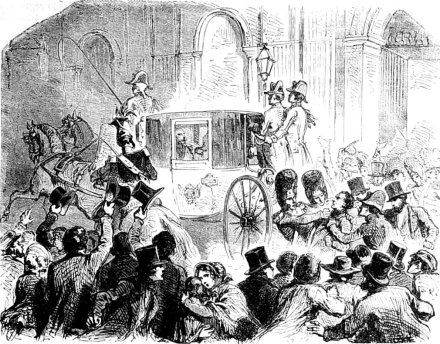
Early this Monday morning in 1836, Louis Alibaud — having been condemned to death by the Chamber of Peers at trial the preceding Friday and Saturday — lost his head for taking a shot at oft–shot–at French King Louis-Philippe.
As related by the London Times (July 6, 1836),
at half-past 6 in the afternoon of the 25th of June, 1836; the windows of the carriage were lowered, and it was passing through the gate [of the Tuileries palace] leading to the Pont Royale, when a man, who had been standing by a post in the court, raise [sic] a cane gun and discharged it against the King. By a miraculous chance the King was lowering his head to salute the National Guard under arms, and the ball passed just four lines above his head, and entered one of the angles of the carriage, settling about an inch deep in an oak beam.
The assassin was immediately arrested; he was a young man, of about 25 years of age, dressed in a dark coat, cloth pantaloons, and black hat, and wearing under his chin a thick brown beard.
Naturally, this line had neither the intent nor the effect of securing clemency, and he was repeatedly cautioned by the court against pursuing it; all concerned knew precisely where matters were headed, of course, and the state had no interest in providing a public forum for sedition.
On this date in 1574, Gabriel de Lorges was beheaded in Paris for treason.
Known by the time of his death as the Comte de Montgomery (English Wikipedia entry | French) — though the title was punitively stripped from the man and his heirs, causing him to spit at the scaffold, “tell my children, if they are not able to reclaim their position, I curse them from the grave” — Lorges’ treason was going Protestant and fighting for the Huguenots in the wars of religion ravaging France.
But his claim to fame, and indeed (if quite unjustly) one of the explicit charges laid against him, was a regicide that fueled those wars and helped bring down the Valois dynasty.
The ol’ lance-in-the-eye
The vigorous 40-year-old French king Henri II seemingly had the Valois in good shape and anti-Huguenot policy firmly in the saddle.
In 1559, though, the sporting monarch put his own butt in the saddle at a joust with our day’s principal, then a captain of Henri’s Scots Guards (and a Catholic).
Gabriel’s shattered lance somehow found a chink in the king’s visor and managed to tolchock the royal gulliver just beside the eye.* After a week and a half in agony, Henri succumbed to the injury.**
Henri’s sudden death was bad news for France, because the oldest† of his seven children was only 15 years old, and feeble. He died the next year.
As the widowed Italian queen Catherine de’ Medici struggled over the ensuing decades to find a stable Valois heir among her brood, the aggressively Catholic House of Guise‡ flexed its political muscle to the resentment of the Bourbons and the Huguenot lords, and pitched France towards civil war.
Our errant knight, meanwhile, although forgiven by the dying Henri II, had despairingly retired and hurled himself into study that soon converted him to the Protestant party.
Quickly distinguishing himself as perhaps the ablest Huguenot commander, Montgomery was in Paris in 1572 during an ostensible truce for interparty dynastic nuptials when the Catholic faction sprang the St. Bartholomew’s Day massacre.
Though Montgomery was a specific target for assassination that day, he somehow managed to escape. He gave the Catholics fits for the two years left him, enough that the crown tried to buy him off. (Like most Protestants, he was distrustfully defiant after the horrors of St. Bartholomew’s Day.)
He was finally overcome in 1574; as Henri’s second son had just kicked the bucket without an heir, Catherine assumed the regency while a third boy was fetched from Poland, and got herself some gratifying but untoward revenge on the inadvertent author of her family’s unfolding ruin.
No time was lost in condemning [Montgomery] to the penalties of high treason; he was beheaded at the Greve, his body quartered, and his family degraded from their nobility. Previous to his execution, he was cruelly tortured to make him confess the existence of the late admiral‘s conspiracy, but the pain drew no such acknowledgment from him, and mangled and wounded as he was, he went to the scaffold with remarkable serenity. We have an account, given by a contemporary, of his steady attachment to his principles: “He would not confess to the Archbishop of Narbonne, who went to him in the chapel to admonish him; nor would he take or kiss the crucifix, which is usually presented to those who are being led to execution; nor in any way attend to the priest, who had been placed in the cart by his side. A cordelier thinking to draw him out of error, began to speak to him, and said that he had been abused. Looking at him steadily, he answered, ‘How! abused? and if I have been it is by those of your order: for the first person who ever handed me a Bible in French, and made me read it, was a cordelier like you; and therein I have learned the religion which I hold, which alone is the true religion, and in which, having since lived, I wish now by the grace of God to die.'”
(Some sources place Montgomery’s execution on May 27, which I believe confuses his date of death with his date of capture.)
Just like Montgomery himself, the Huguenot cause proved resistant to every policy of Catherine or the Guises; this day’s execution only screwed up the nerve of a party that had been given notice on St. Bartholomew’s Day that their lot must be to conquer or die. Since Henri II’s boys could neither, over 30 years’ time, produce an heir nor master their foes at arms, the Huguenots conquered when the throne finally passed to a Bourbon.
A public-domain biography of Gabriel de Lorges, comte de Montgomery, can be enjoyed by French-speakers here. For the English-speakers, Alexandre Dumas’ fictionalized treatment, The Two Dianas, is freely available in translation.
* French surgeon Ambroise Pare attended the dying monarch. Pare’s grim description of the king’s injuries appears in this biography of the physician, which also reports that Henri’s caregivers
secured the heads of four criminals that had been beheaded and experimented upon them with a lance in order to ascertain the probable course of the splinters.
** The fatal joust is alleged to be one of the vindicated prophecies of Nostradamus. Prophecy or no, the family had bad luck with sports; Henri came in line for the throne when his older brother dropped dead after playing tennis.
† Henri II’s immediate heir Francis II was married to Mary, Queen of Scots. After the death of her husband, she unhappily shipped back out to Scotland to contest the English throne, with unsatisfactory results.
On this date in 1795, the Mountain that had so recently dominated revolutionary France was destroyed by the blade.
This largely forgotten date is actually a significant milestone of those years’ imbroglio: the date on which the French bourgeoisie achieved its revolution by slaying the last sans-culottes-affiliated deputies in punishment for the last sans-culottes uprising.
In the year since the fall of Robespierre, a White Terror had purged his former adherents — or in class terms, had put Madame Guillotine to work pushing the Paris working class out of its former political authority.
The latter’s last hurrah of resistance was the Prairal Rebellion of May 20, 1795, when a mob stormed the Convention.
[I]t billows free through all Corridors; within and without, far as the eye reaches, nothing but Bedlam, and the great Deep broken loose! … Insurrection rages; rolls its drums; will read its Paper of Grievances, will have this decreed, will have that.
… National Representation, deluged with black Sansculottism, glides out; for help elsewhere, for safety elsewhere; here is no help.
About four in the afternoon, there remain hardly more than some Sixty Members: mere friends, or even secret leaders; a remnant of the Mountain-crest, held in silence by Thermidorian thraldom. Now is the time for them; now or never let them descend, and speak! They descend, these Sixty, invited by Sansculottism: Romme of the New Calendar, Ruhl of the Sacred Phial, Goujon, Duquesnoy, Soubrany, and the rest. Glad Sansculottism forms a ring for them; Romme takes the President’s chair; they begin resolving and decreeing. Fast enough now comes Decree after Decree, in alternate brief strains, or strophe and antistrophe, — what will cheapen bread, what will awaken the dormant lion. And at every new decree,* Sansculottism shouts “Decreed, decreed!” and rolls its drums.
Fast enough; the work of months in hours, — when see, a Figure enters … And then Gilt Youth, with levelled bayonets, countenances screwed to the sticking-place! Tramp, tramp, with bayonets gleaming in the lamp-light: what can one do, worn down with long riot, grown heartless, dark, hungry, but roll back, but rush back, and escape who can? The very windows need to be thrown up, that Sansculottism may escape fast enough. Money-changer Sections and Gilt Youth sweep them forth, with steel besom, far into the depths of Saint-Antoine. Triumph once more! The Decrees of that Sixty are not so much as rescinded; they are declared null and non-extant. Romme, Ruhl, Goujon and the ringleaders, some thirteen in all, are decreed Accused. Permanent-session ends at three in the morning. Sansculottism, once more flung resupine, lies sprawling; sprawling its last.
The so-called Cretois were hailed before a tribunal; six were condemned to death on this date.**
They dramatically attempted to cheat the headsman by stabbing themselves after the trial, somehow passing down the line without intervention a single knife smuggled by Goujon.
Three of them died of their self-inflicted injuries. The other three went immediately to the guillotine.
“They were,” Carlyle concludes, “the Ultimi Romanorum … Sansculottism sprawls no more. The dormant lion has become a dead one; and now, as we see, any hoof may smite him.”
** Other less treasonably culpable former Montagnards who had not cast their lot squarely with the Thermidorians were proscribed or otherwise cut off from power in the aftermath of the Prairal rebellion.




 Known by the time of his death as the Comte de Montgomery (

