1794: Alexandre de Beauharnais, widowing Josephine for Napoleon

On this date in 1794, Napoleon Bonaparte’s future Empress became a widow.

Alexandre de Beauharnais — excuse me, that’s Alexandre François Marie de Beauharnais, Vicomte de Beauharnais to you — a liberal noble from Martinique who had served as a general in the American Revolution, was a pol with some juice in the earlier stages of the French Revolution, even declining to become Minister of War in June 1793.

It was a long fall to a short chop when he was accused of allowing Mainz to fall to the Germans through incompetence and/or insufficient revolutionary ardor. His brother Augustin was also among the day’s batch.

Just another forgettable aristocrat, shaved by the national razor.

But surviving Beauharnais — in prison herself at this moment, and in some danger of following his footsteps were it not for the imminent coup of Thermidor — was his wife by arranged marriage, 31-year-old sugar plantation heiress Josephine, later immortalized by remarrying the officer who would go on to bend all Europe to his will, Napoleon Bonaparte.

Thanks to his widow’s well-chosen conquest, Beauharnais’ children, dynastically married off under Napoleon’s adoption, would go on to sire a plethora of European royalty.

Part of the Themed Set: Thermidor.

On this day..

1794: Three generations of Noailles women, but not the Marquise de Lafayette

On this date in 1794, three women of the Noailles family were guillotined in Paris.

The grandmother, mother and sister of Adrienne Noailles all shed their blue blood on the scaffold (grandpa, with impeccable timing, had died of natural causes the previous summer) for their aristocratic stock — the eldest had been Marie Antoinette‘s etiquette tutor.

They are noteworthy of themselves because their courageous Catholic confessor, one Abbe Carrichon, made good a promise to accompany them to the very shadow of the blade to give them absolution and left to us in a description of these pious ladies’ nerve-wracking journey on the tumbrils one of the surprisingly few first-hand narrative descriptions of the Terror’s guillotine at work. We’ll come to it momentarily.

But they are noteworthy, too, for the fourth kinswoman who stood in the same mortal peril but did not join them. Adrienne was the wife of the the Marquis de Lafayette.

Adrienne and Lafayette had hitched wagons in their teens — an arranged match, but one that evidently blossomed into real love between like-minded partners — before the Marquis ran off to become that famous imported general and patron of the American Revolution.

Such liberal credentials made him an early star in the French Revolution, but by the time of the Terror the reformist gentleman rated a hidebound right-winger on the political spectrum and in short order a refugee in Prussia and Austria; neither his name nor (obviously) his title would have availed him safety had he had the misfortune to be captured in France.

A (possible) portrait of the Marquise de Lafayette, c. 1790. (More.)

But American regard for the name remained high — and at a time when virtually the whole world set its hand against France. Future U.S. president James Monroe arrived in Paris as ambassador just after the Terror, when his predecessor Gouverneur Morris had delicately impressed upon the Committee of Public Safety the damage Adrienne’s beheading would do to one of France’s few remaining friendly foreign relations. Together with his wife Elizabeth, who visited the still-imprisoned Adrienne in an intentionally theatrical gesture, Monroe was able to procure her eventual her release.

(Adrienne decamped to Austria where her husband was considered not a dangerous reactionary but a dangerous radical, and had been imprisoned on that ground. She voluntarily shared his dungeon until Napoleon forced their release. There’s a short account of her life from the New York Times here (pdf))

If Adrienne’s married name was insufficient to purchase the lives of her own family, the latter have acquired a measure of remembrance in their death in one of the Revolution’s most human and emotional scenes, and not least because one is conscious in the account that the priest who gives them comfort and absolution and whose narrative remains for us was himself running a mortal risk at every step (he confesses in the narrative to his nerve having failed him in such a mission on a previous occasion, as it nearly fails him this time).

Here — because it is of such deep interest not only to the theme not only of this week, but of this blog altogether — is the Abbe Carrichon’s account excerpted at length, as drawn from Madame de Lafayette and Her Family, a biography in the public domain and available free at Google Books. (There is another free biography whose focus is the Marquis Lafayette that also treats this episode here.)

One day, as the ladies were exhorting each other to prepare for death, I said to them, as by foresight: ‘If you go the scaffold and if God gives me strength to do so, I shall accompany you.’

They took me at my word and eagerly exclaimed: ‘Will you promise to do so?’ For a moment I hesitated.

‘Yes,’ I replied, ‘and so that you may recognize me, I shall wear a dark blue coat and a red waistcoat.’ … On the 22nd of July on a Tuesday morning, as I was just going out, I heard a knock. I opened the door and saw the Noailles children with their tutor. The children were cheerful … the tutor looked sad, careworn, pale, haggard. ‘Let us go to your study,’ said he, ‘and leave the children in this room.’ We did so. He threw himself on a chair.

‘All is over, my friend,’ he said. ‘The ladies are before the Revolutionary Tribunal. I summon you to keep your word. I shall take the boys to Vincennes to see [their sister]. While in the woods I shall prepare those unfortunate children for their terrible loss.’

Although I had been prepared for this news, I was greatly shocked … I soon recovered myself, and after a few questions and answers full of mournful details, I said to M. Grellet:

‘You must go now, and I must change my dress. What a task I have before me! Pray that God may give me strength to accomplish it.’

…

Thoughtful and irresolute, I slowly retraced my steps to the ‘Palais de Justice,’ dreading to get there and hoping not to find those for whom I was seeking. I arrived before five o’clock. There were no signs of departure. Sick at heart, I ascended the steps of the Saint-Chapelle, then I walked slowly unto the Grande salle, and walked about. I sat down, I rose again, but spoke to no one. From time to time I cast a melancholy glance towards the courtyard, to see if there were any signs of departure. My constant thought was that in two hours, perhaps one, they would be no more. I cannot say how overwhelmed I was by that idea, which has affected me all through life on such occasions, and they have been only too frequent. While a prey to these mournful feelings, never did an hour appear to me so long or so short as the one which elapsed between five and six o’clock on that day. Conflicting thoughts were constantly crossing my mind, which made me suddenly pass from the illusions of vain hopes to fears, alas! too well founded. At last I saw from a movement in the crowd, that the prison door was on the point of being opened. I went down and placed myself near the outer gate … The first cart was filled with prisoners and came toward me. It was occupied by eight ladies whose demeanor was most edifying. Of these seven were unknown to me. The last, who was very near me, was the Marechale de Noailles. A transient ray of hope crossed my heart when I saw that her daughter and grand-daughter were not with her, but alas! they were in the second cart.

…

I heard one near me say: ‘Look at the young one; how anxious she seems. See how she is speaking to the other one.’ For my part, I felt as if I had heard all they were saying. ‘Mama, he is not there.’ ‘Look again.’ ‘Nothing escapes me — I assure you he is not there!’ The first cart stopped before me during at least a quarter of an hour. It moved on, the second followed. I approached the ladies, they did not see me. … I followed the cart over the bridge, and thus kept near the ladies, though separated from them by the crowd. Mme. de Noailles still looking for me, did not perceive me. … I felt tempted to turn back. Have I not done all that I could, I inwardly exclaimed? Everywhere the crowd will be greater; it is useless to go any further. I was on the point of giving up the attempt. Suddenly the sky became overclouded, thunder was heard in the distance. I made a fresh effort. A short distance brought me before the carts to the Rue Saint-Antoine, nearly opposite the too famous La Force [prison]. At that moment the storm broke forth, the wind blew violently; flashes of lightning and claps of thunder followed in rapid succession; the rain poured down in torrents. I took shelter at a shop door. In one moment the street was cleared; the crowd had taken refuge in the shops and gateways. … By a precipitate and involuntary movement I quitted the shop door and rushed towards the second cart and found myself close to the ladies. Mme. de Noailles perceived me, and, smiling, seemed to say:

‘There you are at last! How happy we are to see you! How we have looked for you! Mama, there he is!’

… all the irresolution vanished from my mind. By the grace of God, I felt possessed of extraordinary courage. Soaked with rain and perspiration I continued to walk by them …

…

We were close to the carrefour preceding the Faubourg Saint-Antoine. I went forward, examined the spot, and said to myself, ‘This is the place for granting them what they so much long for.’

The cart was going slower. I turned towards the ladies and made a sign which Mme. de Noailles understood perfectly.

‘Mama, M. Carrichon is going to give us absolution,’ she evidently whispered. They piously bowed their heads with a look of repentance, contrition and hope. Then I lifted my hand, and, without uncovering my head, pronounced the form of absolution and the words which follow it distinctly and with supernatural attention. Never shall I forget the expression on their faces. From that moment the storm abated, the rain diminished, and seemed only to have fallen for the furtherance of our wishes. I offered up my thanks to God, and so did, I am sure, those pious women. Their exterior appearance spoke contentment, security and joy. …

At last we reached the fatal spot. I cannot describe what I felt. What a moment! What a separation! What an affliction for the children, husbands, sisters, relations, and friends who are to survive those beloved ones in this valley of tears! There they are before me full of health, and in one moment I shall see them no more. What anguish! Yet not without deep consolation at beholding them so resigned. … A ring of numerous spectators soon formed, most of whom were laughing and amusing themselves at the horrible sight. It was dreadful to be amongst them.

While the executioner and his two assistants were helping the prisoners out of the first cart, Mme. de Noailles’s eyes sought for me in the crowd. She caught sight of me. What a wonderful expression there was in those looks! Sometimes raised towards heaven, sometimes lowered towards earth, her eyes so animated, so gentle, so expressive, so heavenly, were often fixed on me in a manner which would have attracted notice if those around me had had time for observation. I pulled my hat over my eyes without taking them off her. I felt as if I could hear her say: ‘Our sacrifice is accomplished; we have the firm and comforting hope that a merciful God is calling us to him. How many dear to us we leave behind! but we shall forget no one. Farewell to them, and thanks to you. Jesus Christ who died for us is our strength. May we die in Him. Farewell. May we all meet in heaven!’

It is impossible to give an idea of the animation and fervour of those signs, the eloquence of which was so touching that a bystander exclaimed: ‘Oh, that young woman, how happy she seems, how she looks up to heaven, how she is praying! But what is the use of it all?’ and then, on second thoughts, ‘Oh, the rascals, the bigots!’

The mother and daughter took a last farewell of each other and descended from the cart. As for me, the outer world disappeared for a moment. At once broken-hearted and comforted, I could only return thanks to God for not having waited for this moment to give them absolution, or, what would have been still worse, delayed it until they had ascended the scaffold. We could not have joined in prayer while I gave and they received this great blessing as we had been enabled to do in the most favourable circumstances possible at such a time. I left the spot where I was standing and went over to the other side, while the victims were getting out. I found myself opposite to the wooden steps which led to the scaffold. An old man, tall and straight, with white hair and a good-natured countenance, was leaning against it. I was told he was a fermier general. Near him stood a very edifying lady whom I did not know. Then came the Marechale de Noailles [the grandmother] exactly opposite me, dressed in black taffetas, for she was still in mourning for her husband. She was sitting on a block of wood or stone which happened to be there, her large eyes fixed with a vacant look. … All the others were drawn up in two lines looking towards the Faubourg Saint-Antoine. From where I stood I could only see Mme. d’Ayen [the mother], whose attitude and countenance expressed the most sublime, unaffected, and devout resignation. She seemed only occupied with the sacrifice she was about to make to God, through the merits of the Saviour, his divine son. She looked as she was wont to do when she had the happiness of approaching the altar for holy communion. I shall never forget the impression she made on me at that moment. It is often in my thoughts. God grant that I may profit by it!

The Marechale de Noailles was the third person who ascended the scaffold. The upper part of her dress had to be cut away in order to uncover her throat. I was impatient to leave the place, yet I wished to drink the cup of bitterness to the dregs and to keep my promise, as God was giving me strength to do so, even in the midst of all my shuddering horror. Six ladies followed; Mme. d’Ayen was the tenth. How happy she seemed to die before her daughter! The executioner tore off her cap, as it was fastened by a pin which he had forgotten to remove; he pulled her hair violently, and the pain he caused was visible on her countenance.

The mother disappeared; the daughter took her place. What a sight to behold that young creature, all in white, looking still younger than she really was, like a gentle lamb going to the slaughter! I fancied I was witnessing the martyrdom of one of the young virgins or holy women whom we read of in the history of the church. What had happened to the mother also happened to her; the same pin in the removal of her cap, then the same composure, the same death. Oh! the abundant crimson stream that gushed from her head and neck; how happy she is now, I thought, as her body was thrown into that frightful coffin!

May Almighty God in his mercy bestow on the members of that family all the blessings which I ask and entreat them to ask for mine! May we all be saved with those who have gone before us to that happy dwelling where revolutions are unknown, to that abode which, according to the words of Saint Augustine, has truth for its King, Charity for its law, and will endure for eternity!

(Also in this batch: Gen. Louis-Charles de Flers, who was recalled on trumped-up charges of treason by Revolutionary commissars after he lost a battle against the Spanish in the War of the Pyrenees.)

Part of the Themed Set: Thermidor.

On this day..

Themed Set: Thermidor

Paris, 1794

It is Thermidor — Month of Heat — by that queer artifact of the times, the Revolutionary calendar, and in the blistering summer the guillotine rots its own scaffold.

It is the climax of that emblematic moment of the French Revolution, often wrongly standing to casual observation as synonymous with the entire revolution. Jarring indeed how brief the span of those pregnant, dangerous days, that upon the storming of the Bastille the guillotine had not yet been erected and from that traditional birthdate of the Revolution were eclipsed successively the Bourbon monarchy, the Constitutionalist Assembly, the Girondin liberals, Marat, Danton … culminating in the bloody hegemony of Robespierre and the fatal test between the Jacobins and their enemies.

By the spring and summer of 1794, Paris is delivered fully to Robespierre. “Terror,” he says, “is only justice prompt, severe and inflexible; it is then an emanation of virtue; it is less a distinct principle than a natural consequence of the general principle of democracy, applied to the most pressing wants of the country.” A blip on the screen chronologically, this period seems endless to those who survive it, and it reverberates endlessly to those who succeed it.

In this Revolution-era cartoon, legendary Parisian headsman Sanson, having run out of victims, guillotines himself.

For the next week, join Executed Today in 1794’s Month of Heat as day by day the Terror rages at its apex, inscrutably suffering citizens to live or die — until of a sudden it succumbs to its own rot.

On this day..

1766: Jean-François de la Barre, freethinker martyr

On this date in 1766, a 20-year-old French chevalier’s freethinking proclivities got him beheaded and burned for impiety in one of Bourbon France’s most notorious episodes of religious chauvanism.

Check that date again. This is 69 years after the British Isles’ last execution for blasphemy; Voltaire was alive, and already in his dotage — and the fact that young Chevalier de la Barre was reading him was proclaimed as evidence. Such a benighted proceeding with the French Revolution on the horizon calls Dickens to mind:

it was the epoch of belief, it was the epoch of incredulity,
it was the season of Light, it was the season of Darkness

The luckless youth and a couple of friends had pissed off a local judge, which got ugly for them when the unexplained vandalism of a town crucifix availed the opportunity for the magistrate to wield a sledgehammer against a fly.

De la Barre’s volume of Voltaire was tossed onto the pyre with him. That Enlightenment colossus made a measured posthumous effort at having the boy rehabilitated* — primarily for the benefit of his more judicious friend, who had fled the country and required his death sentence in absentia be lifted in order to inherit the family estate — but the verdict was not set aside until the French Revolution, a few months after the end of the Terror.

France’s overall secular trajectory since has rendered this date a sort of national freethinkers’ holiday, Chevalier de la Barre Day. A statue of its namesake stands in Paris’ Montmarte:

* Voltaire’s writings on the case in the original French are collected by the Association Le Chevalier de la Barre here.

On this day..

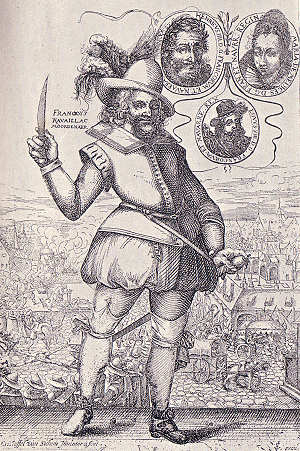
1610: Francois Ravaillac, because Paris was worth more than a mass

On this date in 1610, the fanatical Catholic who assassinated Henri IV of France was ripped apart on the Place de Greve.

The road to this man’s calvary begins long before his infamous crime, even long before the birth of his illustrious victim.

The Protestant Reformation — so richly represented in the executioner’s annals — had fractured France in the 16th century.

After decades of voluptuously indecisive Catholic-versus-Hugeunot slaughter, matters had finally been settled by the man upon whom French absolutism would erect its (ill-fated) edifice.

Henri IV, the first Bourbon monarch and a Huguenot, had unified the country by the sword, capped by his memorably politic conversion to Catholicism in 1593 to win over the holdout capital of Paris — the occasion of his understated declaration that “Paris is worth a mass”.

Let us tarry here to appreciate “the good king Henri” in a kaleidoscope of flattering artwork to the tune of Vive Henri IV, the monarchy’s unofficial anthem after its subject’s passing:

Did you catch that last image?

Henri’s fine gesture of sectarian triangulation and the reign of relative calm it inaugurated were naturally resented by godly partisans of both camps who either considered his conversion a betrayal or considered the king a closet Protestant.

At the crazed end of this latter spectrum, we meet our day’s principal, Francois Ravaillac.

Readers unconstrained by time may enjoy this Tolstoyan trek into the regicide’s mind and milieu, but it will suffice us to say that the modern shotgun-wielding postal clerk who just seemed like a quiet, harmless type to all his coworkers might like the cut of Ravaillac’s jib. A bit of a loner, a bit of a professional washout, with a penchant for religious visions and a passel of ill-arranged grievances … by this point in the movie, that’s about what you expect the police profiler to be reciting.*

It is only right that such a contemporary-sounding lone nut story ought to have a vigorous conspiratorial counternarrative.

There has always been a strong suspicion that behind Ravaillac’s hand was the work of the scheming Catholic Duc d’Epernon, perhaps even with the complicity of Henri’s wife Marie de’ Medici, who had conveniently been crowned as queen the day before the murder** and promptly teamed up with Epernon to cement an alliance with a traditional French rival, the ultra-Catholic Habsburgs.

Balzac, for one, had no doubt about it:

all of [her] actions were prejudicial to France … Marie de’ Medici wasted the wealth amassed by Henri IV.; she never purged herself of the charge of having known of the king’s assassination; her ‘intimate’ was d’Epernon, who did not ward off Ravaillac’s blow, and who was proved to have known the murderer personally for a long time. … [T]he victory Richelieu at last won over her (on the Day of the Dupes) was due solely to the discovery the cardinal made, and imparted to Louis XIII, of secret documents relating to the death of Henri IV.

The historical jury is out on that question, presumably for good.

If Ravaillac was a conspirator, he proved to be a damned good one, denying under repeated torture that he had any accomplices. On this date, the tortures reached their crescendo and conclusion — to the horrible delight of the Parisian mob, as reported by Alistair Horne (via The Corner):

On 27 May, still protesting that he had acted as a free agent on a divinely inspired mission, Ravaillac was put to death. Before being drawn and quartered, the lot of the regicide, on the Place de Grève scaffold he was scalded with burning sulphur, molten lead and boiling oil and resin, his flesh then torn by pincers. Then his arms and legs were attached to horses which pulled in opposite directions. One of the horses “foundered,” so a zealous chevalier offered his mount; “the animal was full of vigour and pulled away a thigh.” After an hour and a half of this horrendous cruelty, Ravaillac died, as the mob tried to prevent him receiving last rites. When he finally expired,

“…the entire populace, no matter what their rank, hurled themselves on the body with their swords, knives, sticks or anything else to hand and began beating, hacking and tearing at it. They snatched the limbs from the executioner, savagely chopping them up and dragging the pieces through the streets.”

Children made a bonfire and flung remains of Ravaillac’s body on it. According to one witness, Nicholas Pasquier, one woman actually ate some of the flesh. The executioner, supposed to have the body of the regicide reduced to ashes to complete the ritual demanded by the law, could find nothing but his shirt.

Ravaillac was the last Frenchman drawn and quartered for a century and a half — but his punishment as a regicide formed the precedent for that handed down in 1757 to Damiens.

* No need, though, as Francois wasn’t hard to catch: he stepped up to Henri’s carriage when it was caught in a traffic jam on May 14, 1610, and stabbed the king to death plain as can be. He was lucky (sort of) to avoid a lynching.

** Rubens later painted a gaudy celebration of this event.

On this day..

1315: Enguerrand de Marigny, on Montfaucon

On this date in 1315, an obscure petty noble who had become the king’s right-hand man was hanged by his rivals a few months after his royal sponsor expired.

Late in the epoch-making reign of King Philip the Fair — under whose rule the papacy was hijacked to Avignon and the Templars were crushed — Enguerrand de Marigny was the man loyally keeping the books.

Since Philip was a stubbornly spendthrift fellow, that meant Marigny’s chief pursuit was the creative extraction of new revenues, through fresh taxes and the debasement of coinage. His public esteem suffered commensurately, little aided by the fact that his duties made him fabulously wealthy and the most powerful man in the country, give or take a king.

Said monarch was vigorous in that age-old pastime of the feudal monarchy, centralization of the power scattered among the nobility, further to which end he was happy to promote a competent administrator of scanty lineage and dependable loyalty.

Aggrieved lords, like the grasping Charles de Valois, were ready with their grudges against the unpopular minister when Philip shuffled off in November 1314. When charges of financial impropriety didn’t stick, they cooked up an allegation of sorcery — just then coming into vogue as a trump card in the game of judicial homicide.

Enguerrand hung two years upon the monumentally terrifying Montfaucon Gibbet (the link is to the structure’s French Wikipedia page), but everyone felt just terrible about it later. (the link is French, again) An actual inquiry — they skipped that step when they strung him up — exonerated the luckless minister, allowing his heirs to retrieve his body and a chunk of his fortune from the sympathetic king; Charles was so pursued by guilt that on his deathbed, he sent out a fat dispensation of alms with the request that recipients pray for both Enguerrand de Marigny and himself.

It worked … at least for Marigny’s reputation.

None can tell, after this lapse of time, whether this remorse proceeded from weakness of mind or sincerity of heart, and which of the two personages was really guilty; but, ages afterwards, such is the effect of blind, popular clamor and unrighteous judicial proceedings, that the condemned lives in history as a victim and all but a guileless being. (Source)

It was no hard feelings from Enguerrand’s little brother, Jean. The family influence had landed him a bishopric, and he held the job until his death in 1350, even repelling an English siege of Beauvais during the Hundred Years’ War.

A European Haman?

Enguerrand de Marigny comes in for a passing notice as T.H. White affectionately surveys the Middle Ages in The Once and Future King:

What an amazing time the age of chivalry was! Everybody was essentially himself — was riotously busy fulfilling the vagaries of human nature … [a] coruscating mixture of oddities who reckoned that they possessed the things called souls as well as bodies, and who fulfilled them in the most surprising ways.

…

[Y]ou might have seen Enguerrand de Marigny, who built the enormous gallows at Mountfalcon, [sic] himself rotting and clanking on the same gallows, because he had been found guilty of Black Magic.*

That Marigny erected the gallows on which he hung is an oft-repeated claim, an instance of a whole subgenre of moralistic folklore in which death-dealing inventors are hoisted on their own petard. These stories are not always dependable — contra rumor, for instance, Dr. Guillotin was not guillotined — and today’s protagonist may not have a firm hold on this small consolation, either.

Here is Victor Hugo’s rendering of the structure’s history in The Hunchback of Notre Dame.

Montfauçon was, as Sauval says, “the most ancient and the most superb gibbet in the kingdom.” …

Let the reader picture to himself, crowning a limestone hillock, an oblong mass of masonry fifteen feet in height, thirty wide, forty long, with a gate, an external railing and a platform; on this platform sixteen enormous pillars of rough hewn stone, thirty feet in height, arranged in a colonnade round three of the four sides of the mass which support them, bound together at their summits by heavy beams, whence hung chains at intervals; on all these chains, skeletons; in the vicinity, on the plain, a stone cross and two gibbets of secondary importance, which seemed to have sprung up as shoots around the central gallows; above all this, in the sky, a perpetual flock of crows; that was Montfauçon.

At the end of the fifteenth century, the formidable gibbet which dated from 1328, was already very much dilapidated; the beams were wormeaten, the chains rusted, the pillars green with mould; the layers of hewn stone were all cracked at their joints, and grass was growing on that platform which no feet touched. The monument made a horrible profile against the sky; especially at night when there was a little moonlight on those white skulls, or when the breeze of evening brushed the chains and the skeletons, and swayed all these in the darkness. The presence of this gibbet sufficed to render gloomy all the surrounding places.

The mass of masonry which served as foundation to the odious edifice was hollow. A huge cellar had been constructed there, closed by an old iron grating, which was out of order, into which were cast not only the human remains, which were taken from the chains of Montfauçon, but also the bodies of all the unfortunates executed on the other permanent gibbets of Paris. To that deep charnel-house, where so many human remains and so many crimes have rotted in company, many great ones of this world, many innocent people, have contributed their bones, from Enguerrand de Marigni, the first victim, and a just man, to Admiral de Coligni, who was its last, and who was also a just man.

Hugo — who, let us admit, is not to be depended upon for history — has elevated Marigny to the very first victim of the Montfaucon gallows, but the reader will also notice that the same passage dates the edifice’s construction thirteen years after Marigny’s own execution.

Helpless Historiography

Montfaucon the execution site had a rich history. There seem to have been at least two separate gallows sites (the link is French) on the hill, and its vintage as an execution space dates back to the 13th century. (more French)

About this point, this blog runs against the limits of its writer’s access to primary documentation and werewithal to pursue it. Sources seem mightily confused on the embryonic era of Montfaucon; at least two other ministers — Pierre de La Brosse, a confidante of the previous king, and Pierre Remy, another royal treasurer hanged a generation after Marigny — also have their own claim to have been hanged on the structure they erected.

It may be that this was actually true of Remy, a less dramatically captivating figure with an official portfolio similar to Marigny’s, and the two simply became conflated in legend. Something certainly seems to have been built during his time, and it may have been the stone replacement for the original gallows.

The suggestion of someone who researched it more thoroughly than I have (another French page, but worth the visit if only for the pictorial schematics) is that the landmark structure may have predated all these men.** Brosse and Marigny, in this conception, may simply have worked various repairs upon it that became magnified in the retelling, while the gallows Remy set up might have been those on the secondary location, erected as a stopgap during a more thorough reconstruction of the permanent site, and/or reserved for more vulgar elements than ministers of the crown.

* Readers may appreciate an annotation of other references White makes in his fantasy classic.

** We find repeated claims that the alleged “sorceror” Marigny engaged for his capital crime was hanged below him, which would support that notion; I have been unable to identify the provenance of this detail, however.

On this day..

1757: Robert-Francois Damiens, disciplined and punished

On this date in 1757, Robert-Francois Damiens became the last Frenchman to suffer the dreadful punishment of drawing and quartering.

Damiens attempted to assassinate King Louis XV, inflicting, however, only a slight dagger wound.

He may be best-known today as the subject of the jarring opening passage of Foucault’s Discipline and Punish, in which the full flower of this medieval torture* is described in detail by way of contrasting it with the regimented penal institutions that would sprout up in a few decades’ time. Here’s Foucault’s rendering of the scene:

On 1 March 1757 Damiens the regicide was condemned “to make the amende honorable before the main door of the Church of Paris”, where he was to be “taken and conveyed in a cart, wearing nothing but a shirt, holding a torch of burning wax weighing two pounds”; then, “in the said cart, to the Place de Grève, where, on a scaffold that will be erected there, the flesh will be torn from his breasts, arms, thighs and claves with red-hot pincers, his right hand, holding the knife with which he committed the said parricide, burnt with sulphur, and, on those places where the flesh will be torn away, poured molten lead, boiling oil, burning resin, wax and sulphur melted together and then his body drawn and quartered by four horses and his limbs and body consumed by fire, reduced to ashes and his ashes thrown to the winds” (Pièces originales…, 372-4).

“Finally, he was quartered,” recounts the Gazette d’Amsterdam of 1 April 1757. “This last operation was very long, because the horses used were not accustomed to drawing; consequently, instead of four, six were needed; and when that did not suffice, they were forced, in order to cut off the wretch’s thighs, to sever the sinews and hack at the joints…

“It is said that, though he was always a great swearer, no blashemy escaped his lips; but the excessive pain made him utter horrible cries, and he often repeated: ‘My God, have pity on me! Jesus, help me!’ The spectators were all edified by the solicitude of the parish priest of St Paul’s who despite his great age did not spare himself in offering consolation to the patient.”

Bouton, an officer of the watch, left us his account: “The sulphur was lit, but the flame was so poor that only the top skin of the hand was burnt, and that only slightly. Then the executioner, his sleeves rolled up, took the steel pincers, which had been especially made for the occasion, and which were about a foot and a half long, and pulled first at the calf of the right leg, then at the thigh, and from there at the two fleshy parts of the right arm; then at the breasts. Though a strong, sturdy fellow, this executioner found it so difficult to tear away the pieces of flesh that he set about the same spot two or three times, twisting the pincers as he did so, and what he took away formed at each part a wound about the size of a six-pound crown piece.

“After these tearings with the pincers, Damiens, who cried out profusely, though without swearing, raised his head and looked at himself; the same executioner dipped an iron spoon in the pot containing the boiling potion, which he poured liberally over each wound. Then the ropes that were to be harnessed to the horses were attached with cords to the patient’s body; the horses were then harnessed and placed alongside the arms and legs, one at each limb.

“Monsieur Le Breton, the clerk of the court, went up to the patient several times and asked him if he had anything to say. He said he had not; at each torment, he cried out, as the damned in hell are supposed to cry out, ‘Pardon, my God! Pardon, my Lord.’ Despite all this pain, he raised his head from time to time and looked at himself boldly. The cords had been tied so tightly by the men who pulled the ends that they caused him indescribable pain. Monsieur le [sic] Breton went up to him again and asked him if he had anything to say; he said no. Several confessors went up to him and spoke to him at length; he willingly kissed the crucifix that was held out to him; he opened his lips and repeated: ‘Pardon, Lord.’

“The horses tugged hard, each pulling straight on a limb, each horse held by an executioner. After a quarter of an hour, the same ceremony was repeated and finally, after several attempts, the direction of the horses had to be changed, thus: those at the arms were made to pull towards the head, those at the thighs towards the arms, which broke the arms at the joints. This was repeated several times without success. He raised his head and looked at himself. Two more horses had to be added to those harnessed to the thighs, which made six horses in all. Without success.

“Finally, the executioner, Samson, said to Monsieur Le Breton that there was no way or hope of succeeding, and told him to ask their Lordships if they wished him to have the prisoner cut into pieces. Monsieur Le Breton, who had come down from the town, ordered that renewed efforts be made, and this was done; but the horses gave up and one of those harnessed to the thighs fell to the ground. The confessors returned and spoke to him again. He said to them (I heard him): ‘Kiss me, gentlemen.’ The parish priest of St Paul’s did not dare to, so Monsieur de Marsilly slipped under the rope holding the left arm and kissed him on the forehead. The executioners gathered round and Damiens told them not to swear, to carry out their task and that he did not think ill of them; he begged them to pray to God for him, and asked the parish priest of St Paul’s to pray for him at the first mass.

“After two or three attempts, the executioner Samson and he who had used the pincers each drew out a knife from his pocket and cut the body at the thighs instead of severing the legs at the joints; the four horses gave a tug and carried off the two thighs after them, namely, that of the right side first, the other following; then the same was done to the arms, the shoulders, the arm-pits and the four limbs; the flesh had to be cut almost to the bone, the horses pulling hard carried off the right arm first and the other afterwards.

“When the four limbs had been pulled away, the confessors came to speak to him; but his executioner told them that he was dead, though the truth was that I saw the man move, his lower jaw moving from side to side as if he were talking. One of the executioners even said shortly afterwards that when they had lifted the trunk to throw it on the stake, he was still alive. The four limbs were untied from the ropes and thrown on the stake set up in the enclosure in line with the scaffold, then the trunk and the rest were covered with logs and faggots, and fire was put to the straw mixed with this wood.

“…In accordance with the decree, the whole was reduced to ashes. The last piece to be found in the embers was still burning at half-past ten in the evening. The pieces of flesh and the trunk had taken about four hours to burn. The officers of whom I was one, as also was my son, and a detachment of archers remained in the square until nearly eleven o’clock.

“There were those who made something of the fact that a dog had lain the day before on the grass where the fire had been, had been chased away several times, and had always returned. But it is not difficult to understand that an animal found this place warmer than elsewhere” (quoted in Zevaes, 201-14).

Among the throngs in attendance that day was Casanova who, according to his memoirs, rented out a windowed flat to watch that stomach-churning torture for four hours with some male friends and female companions.

One of the legendary libertine’s friends found this moment, serenaded by the prisoner’s “piercing shrieks”, opportune for an altogether different adventure of the flesh:

The three ladies packing themselves together as tightly as possible took up their positions at the window, leaning forward on their elbows, so as to prevent us seeing from behind. The window had two steps to it, and they stood on the second; and in order to see we had to stand on the same step, for if we had stood on the first we should not have been able to see over their heads. I have my reasons for giving these minutiae, as otherwise the reader would have some difficulty in guessing at the details which I am obliged to pass over in silence.

…

Tiretta kept the pious aunt curiously engaged during the whole time of the execution, and this, perhaps, was what prevented the virtuous lady from moving or even turning her head round.

Finding himself behind her, he had taken the precaution to lift up her dress to avoid treading on it. That, no doubt, was according to the rule; but soon after, on giving an involuntary glance in their direction, I found that Tiretta had carried his precautions rather far, and, not wishing to interrupt my friend or to make the lady feel awkward, I turned my head and stood in such a way that my sweetheart could see nothing of what was going on; this put the good lady at her ease. For two hours after I heard a continuous rustling, and relishing the joke I kept quiet the whole time. I admired Tiretta’s hearty appetite still more than his courage, but what pleased me most was the touching resignation with which the pious aunt bore it all.

Casanova’s Complete Memoires are available free online; this episode is recounted in the first chapter of “Paris and Holland”.

* Damiens’ punishment was in fact already archaic at the point when it was inflicted. Somewhat unsure of itself, the court sought precedent in the last regicide executed — Francois Ravaillac, who in 1610 was also the most recent person to suffer this horrific penalty. The clumsiness of the Damiens’ execution can surely be attributed to the art being a century and a half out of practice.

On this day..

1963: Jean-Marie Bastien-Thiry, model for the Jackal

On this date in 1963, clutching a rosary, French officer Jean-Marie Bastien-Thiry was shot by a firing squad in the Paris suburb Ivry-sur-Seine for attempting to assassinate Charles de Gaulle.

Perhaps no anticolonial struggle left a more considerable intellectual and cultural footprint than the Algerian War of Independence against France. It gashed the French polity as well; the right violently rejected the swelling sentiment to end their country’s 132-year occupation. It is often said that the conservative Charles de Gaulle was the only man who could have engineered the departure with the support of a sufficient portion of the populace — but a sufficient portion by no means meant all, and every blunder multiplying the [French] body count was laid on de Gaulle’s head besides.

On August 22, 1962 — just weeks after that war successfully expelled the European power — an assassins’ team led by Bastien-Thiry (collaborating with the far-right Organisation de l’armée secrète) unleashed a machine gun fusillade at de Gaulle’s car. Hundreds of shots were fired; miraculously, the president and all his aides all escaped unharmed.

Although the actual gunmen were reprieved by their intended target, their manager was not. Said de Gaulle,

The French need martyrs … I gave them Bastien-Thiry. They’ll be able to make a martyr of him. He deserves it.

Certainly Bastien-Thiry had that in mind. At his trial (as recorded by a sympathetic French-language website), he addressed his conduct to posterity:

Nous avons exercé le droit de légitime défense contre un homme, au nom de ses victimes, au nom de nos concitoyens et au nom de nos enfants ; cet homme est ruisselant de sang français et il représente la honte actuelle de la France. Il n’est pas bon, il n’est pas moral, il n’est pas légal que cet homme reste longtemps à la tête de la France ; la morale, le droit et la raison humaine s’unissent pour le condamner. La vérité que nous avons dite, et que bien d’autres que nous ont dite avant nous, restera attachée au nom de cet homme, où qu’il aille et quoi qu’il fasse. Un jour cet homme rendra compte de ses crimes : devant Dieu, sinon devant les hommes.

Bastien-Thiry’s sensational plot, and the ongoing efforts of the OAS to murder de Gaulle, inspired Frederick Forsyth’s novel The Day of the Jackal, and a classic 1973 film of the same title:

Part of the Themed Set: The Written Word.

On this day..

1463: Not François Villon

Je suis François, dont ce me poise,
Né de Paris emprès Ponthoise.
Or d’une corde d’une toise
Saura mon col que mon cul poise.*

-F. Villon, LE QUATRAIN
“Que feit Villon quand il fut jugé à mourir.”

On this day in 1463 François Villon vanished into thin air — along with his mastery for words and for mischief.

Posterity is left to write blog entries about his miraculous deliverance from the gallows; to credit him with influence on Fin de siècle poets, contemporary cinema and god knows what else; to speculate about his destiny; to explain the motives for his disreputable lifestyle (oh, why, my dear reader, are we so presumptuous?); and, well, to read his verse.

[audio:Villon_ballade_du_concours_de_Blois.mp3]

The epithets “thief” and “rogue” are de rigueur when a discourse demands an allusion to his name. The man was a villain, all right. Villon’s official criminal career started with a drunken brawl murder. He got entangled with a gang. He stole, imbibed and rollicked. He was banished, imprisoned and tortured.

One prim Scotsman, a trained lawyer and a beloved writer, wields rather harsh albeit stunningly eloquent prose to depict our pauvre Villon. To Stevenson, Villon was “the first wicked sansculotte”, a “sinister dog”, “the sorriest figure on the rolls of fame”, whose “pathos is that of a professional mendicant who should happen to be a man of genius”.

Incidentally (I hope the reader will forgive this digression given the general topicality of the issue), Stevenson, a harsh judge of Villon’s ignoble nature, says this about waterboarding:

[Villon] was put to the question by water. He who had tossed off so many cups of white Baigneux or red Beaune, now drank water through linen folds, until his bowels were flooded and his heart stood still. After so much raising of the elbow, so much outcry of fictitious thirst, here at last was enough drinking for a lifetime. Truly, of our pleasant vices, the gods make whips to scourge us …

A different take on Villon’s despicable life is voiced by another poet, Osip Mandelstam:

Villon’s sympathy to the society’s scumbags, to everything that is vile and criminal is not demonism. The nefarious company, to which he was so quickly and intimately drawn, captivated his feminine nature with great temperament and powerful rhythm of life, which he could not find elsewhere in the society.

… With odd brutality and rhythmic ardor, he depicts in his ballad [The Ballad of the Hanged], how wind swings the bodies of the wretched, to and fro, as it will … Even death he endows with dynamic qualities, and here manages to manifest his love to rhythm and movement … I think that Villon was allured not by demonism, but by the dynamics of crime …

(Mandelstam’s original is in Russian; this translation is mine)

In the autumn of 1462 François Villon was arrested. He expected to be hanged. Instead, on this date, parliament granted him a pardon and banished him from Paris (for the third time, no less).

What happened to the poor vagabond, medieval Parisian desperado, that troubadour of the rascals?

The trail goes cold — the yellowed parchments fall silent. He vanished into thin air …

* Below is a rather unsatisfactory and uncredited translation found here, which nevertheless conveys the idea:

Surname? Villon, just my luck.
Born? In Paris, near Pontoise.
You wonder what my backside weighs?
Ask my neck when they string me up.

On this day..