1284: Tekuder, Mongol sultan

On this date in 1284, the deposed Mongol ruler Tekuder was put to death.

The Mongols had conquered half the world on the back of steppe horses and religious toleration. Mongols variously adopted Nestorian Christianity, Buddhism, and Islam, as well as tribal shamanism; it even sponsored debates among the rival confessions. What counted in the end for the men who commanded its armies was wins and losses.

Our man Tekuder was the son of Hulagu Khan, a grandson of Genghis Khan who exemplified pluralistic competence. The son of a Christian but an eventual convert to Buddhism, Hulagu Khan’s signal achievement in the religious arena was done by his sword-arm: he defeated and destroyed the Abbasid Caliphate.

In time, three of the four large khanates comprising the Mongol ascendancy would declare themselves for Islam … but in the 13th century the doctrine most likely to get you in trouble was simply to be too doctrinaire.

Hulagu’s son and heir Tekuder, though once baptized into his parents’ Christian faith, turned to Mohammed’s faith with a convert’s zeal and demanded the compliance of his military brass. He declared the Ilkhanate of Persia and Mesopotamia a Muslim sultanate, and tilted Mongol diplomacy away from the Franks and towards Mamluk Egypt.

This split Tekuder’s coalition between Muslims on one side, and Christians and Buddhists on the other, and “the whole of the old Mongol party of malcontents, Buddhists and Nestorians alike, rallied to”* Tekuder’s own nephew Arghun.** One may infer from this entry which man prevailed.

Arghun enjoyed a successful seven-year reign with an incidental appearance in the Marco Polo saga: Arghun appealed to his great-uncle Kublai Khan to send him a wife, and Marco Polo was a part of the party that escorted that woman to Persia in 1291-1293.

Marco Polo would proceed back home to Venice after this voyage, laden with Spice Road riches after a quarter-century’s absence.

Arghun Khan of Persia, Kublai’s great-nephew, had in 1286 lost his favourite wife the Khatun Bulughan; and, mourning her sorely, took steps to fulfil her dying injunction that her place should be filled only by a lady of her own kin, the Mongol Tribe of Bayaut. Ambassadors were despatched to the Court of Kaan-baligh to seek such a bride. The message was courteously received, and the choice fell on the lady Kokachin, a maiden of 17, “moult bele dame et avenant.” The overland road from Peking to Tabriz was not only of portentous length for such a tender charge, but was imperiled by war, so the envoys desired to return by sea. Tartars in general were strangers to all navigation; and the envoys, much taken with the Venetians, and eager to profit by their experience, especially as Marco had just then returned from his Indian mission, begged the Kaan as a favour to send the three Firinghis in their company. He consented with reluctance, but, having done so, fitted the party out nobly for the voyage, charging the Polos with friendly messages for the potentates of Europe, including the King of England. They appear to have sailed from the port of Zayton (as the Westerns called T’swan-chau or Chin-cheu in Fo-kien) in the beginning of 1292. It was an ill-starred voyage, involving long detentions on the coast of Sumatra, and in the South of India, to which, however, we are indebted for some of the best chapters in the book; and two years or upwards passed before they arrived at their destination in Persia. The three hardy Venetians survived all perils, and so did the lady, who had come to look on them with filial regard; but two of the three envoys, and a vast proportion of the suite, had perished by the way. Arghun Khan too had been dead even before they quitted China; his brother Kaikhatu reigned in his stead; and his son Ghazan succeeded to the lady’s hand. We are told by one who knew both the princes well that Arghun was one of the handsomest men of his time, whilst Ghazan was, among all his host, one of the most insignificant in appearance. But in other respects the lady’s change was for the better. Ghazan had some of the highest qualities of a soldier, a legislator and a king, adorned by many and varied accomplishments; though his reign was too short for the full development of his fame.

-The Travels of Marco Polo

* Quote from The Empire of the Steppes: A History of Central Asia.

** We have met Arghun Khan in passing in these pages, as the executioner of Georgian prince Demetre II, the Self-Sacrificer.

On this day..

2008: Jose Medellin, precedent

On this date in 2008, Mexican national Jose Medellin was executed by Texas, pleasurably sticking its thumb in the eye of the International Court of Justice.

U.S. state and local officials have often displayed the ugly-American tendency to view binding treaty obligations as a Washington thing of no moment to the likes of a Harris County prosecutor. So when Medellin was arrested for the 1993 rape-murder of two teenage girls in a Houston park, the idea of putting him right in touch with Mexican diplomats to assist his defense was, we may safely suppose, the very farthest thing from anyone’s mind.

Yet under the Vienna Convention, that is exactly what ought to have occurred. The idea is that consular officials can help a fellow on foreign soil to understand his unfamiliar legal circumstances and assist with any measures for his defense — and by common reciprocity, every state is enabled to look after the interests of its nationals abroad.

A widespread failure to do this, in death cases and others, has involved the United States in a number of international spats over the years.

Jose Medellin was among more than 50 Mexican prisoners named in one of the most noteworthy of these: the Avena case, a suit by Mexico* against the United States in the International Court of Justice.

In its March 31, 2004 Avena decision, the ICJ found that U.S. authorities had “breached the obligations incumbent upon” them by failing in these instances to advise the Mexican nationals it arrested of their Vienna Convention rights, and of failing in almost all those cases likewise to advise Mexican representatives that a Mexican citizen had been taken into custody.

“The appropriate reparation in this case,” the 15-judge panel directed, “consists in the obligation of the United States of America to provide, by means of its own choosing, review and reconsideration of the convictions and sentences of the Mexican nationals.”

If you think the Lone Star State’s duly constituted authorities jumped right on that “obligation,” you must be new around here.

Several years before, the United Nations Special Rapporteur on Extrajudicial, Summary or Arbitrary Executions visited the United States and filed a report complaining “that there is a generalized perception that human rights are a prerogative of international affairs, and not a domestic issue.”

“Domestic laws appear de facto to prevail over international law, even if they could contradict the international obligations of the United States,” the Special Rapporteur noted.

Texas, famed for not being messed with, took a dim view indeed to being bossed about from The Hague. Indeed, the very concept of foreign law and international courts is a gleefully-thrashed political pinata among that state’s predominant conservative electorate.

U.S. President George W. Bush — a former Texas governor who in his day had no time at all for appeals based on consular notification snafus — in this instance appealed to Texas to enact the ICJ’s proposed review.† In fact, he asserted the authority to order Texas to do so.

Texas scoffed.

“The World Court has no standing in Texas and Texas is not bound by a ruling or edict from a foreign court,” a spokesman of Gov. Rick Perry retorted.

This notion that America’s federalist governance structure could insulate each of her constituent jurisdictions from treaty obligations undertaken by the nation as a whole naturally seems preposterous from the outside. But in the U.S., this dispute between Washington and Austin was resolved by the Supreme Court — and the vehicle for doing so was an appeal lodged by our man, Medellin v. Texas.

The question at stake in Medellin was whether the treaty obligation was binding domestic law on its own — or if, by contrast, such a treaty required American legislative bodies to enact corresponding domestic statutes before it could be enforced. The high court ruled for the latter interpretation, effectively striking down Avena since there was zero chance of either Texas or the U.S. Congress enacting such a statute.

Medellin, the decision, spelled the end for Medellin, the man — and, at least for now, the end of any prospect of effectual intervention in American death penalty cases by international tribunals.

* Mexico, which no longer has the death penalty itself, has the heavy preponderance of foreign nationals on United States death rows at any given time.

** The Texas Attorney General’s press release announcing Medellin’s execution included a detailed appellate history of the case which pointedly excluded anything that happened in the ICJ.

† The Bush administration did take one effective step to avoid a similarly embarrassing situation in the future: it withdrew the U.S. from the consular notification convention.

On this day..

1483: Anthony Woodville, Earl Rivers

On this date in 1483, Anthony Woodville, 2nd Earl Rivers, was beheaded with his nephew Sir Richard Grey and royal chamberlain Sir Thomas Vaughan at Pontefract Castle.*

These noble heads rolled a bare 10 weeks after the death of King Edward IV to whom Woodville was certainly quite loyal: the Earl’s sister, Elizabeth Woodville, was Edward’s queen Consort.

This marked the acme of the family’s meteoric, single-generation rise from gentleman nobodies. Anthony’s dad, Richard Woodville, vaulted the family into the nobility with an illicit marriage to the Duke of Bedford’s widow. Their pretty daughter Elizabeth scandalized Britain’s elite by conquering Edward’s heart and his hand in 1464 — though this was her second marriage: the first, to Sir John Grey of Groby, had produced two children, one of whom was the Richard Grey who went to the block with Sir Anthony Woodville.

But while heads were still attached to shoulders, Woodville employed his in literary pursuits: he’s credited with publishing (via the pioneering English printer William Caxton) some of the very first books in English: Earl Rivers’s own translation into “right good and fayr Englyssh” of Jean Mielot‘s Cordyale, or Four last thinges (image); and, the 1477 Dictes and Sayings of the Philosophers, another Rivers translation that he knocked out while on pilgrimage to Santiago de Compostela. It’s distinguished as the first English printed book that dates itself (November 18, 1477).


Earl Rivers presents Edward IV with the fruits of movable type.

But for sure, circa Regna tonat — especially here during the long-running War of the Roses for control of the English throne.

The reason that Anthony Woodville and not his father was the current Earl Rivers was because dad had his own head cut off when King Edward was temporarily deposed in 1469. (Exile to Bruges was also the reason that the second Earl Rivers met William Caxton.)

After Edward came roaring back at the Battle of Tewkesbury in 1471, the Woodville family would have been feeling pretty well set up: their Yorkist faction seemed to have won as decisive a victory as could be imagined over the Lancastrians.

But King Edward’s early death meant that Anthony’s nephew Edward V inherited all too early — which is to say that he did not truly inherit at all. The 12-year-old Edward and his younger brother Richard, Duke of York, both of them children of Elizabeth Woodville, were the boy-princes left to the care of Edward IV’s brother Richard, Duke of Gloucester.

Now, they believe it; and withal whet me
To be revenged on Rivers, Vaughan, Grey:
But then I sigh; and, with a piece of scripture,
Tell them that God bids us do good for evil:
And thus I clothe my naked villany
With old odd ends stolen out of holy writ;
And seem a saint, when most I play the devil.

Shakespeare’s Richard III, Act 1, Scene 3

The next part of the story is quite notorious, and it directly concerns the Woodvilles: the reason that Richard infamously disappeared those tragic princes into the Tower of London was because they were in Elizabeth Woodville’s own custody — and Richard, soon to seize power for himself as King Richard III, feared that if given the opportunity to gather themselves the Woodvilles and not he would dominate English politics.

Events could easily have turned out differently — even with Richard on the blade end of the Woodvilles’ executioner. In the chaotic days following Edward’s death, as news made its way ponderously around the realm, Richard raced to get ahead of the Woodvilles before they were secure in their patrimony. On April 30 of 1483, Richard intercepted the royal party traveling to London and took king into custody along with Rivers, Thomas Vaughan, and Richard Grey.

Gloucester-cum-Richard III acted with dispatch from that point. He had Elizabeth Woodville’s marriage to the late king invalidated, effectively disinheriting her children. While Gloucester made ready for his coronation, Anthony Woodville and his friends made sad poetry and last wills and testaments.

Glories are fleeting. Two years later, Richard III was unhorsed, too.

“I dye in right, beware you dye not in wrong.”

Purported last words of Sir Thomas Vaughan

* There are some citations equivocating on Vaughan’s precise death-date. Yet another man, Sir Richard Haute (Hawte) is also sometimes numbered a fourth in the doomed party; however, a man of this name took part in Buckingham’s Rebellion against King Richard III, and received a pardon in 1485.

On this day..

1886: Tabby Banks and Tom Honesty, for election rejection

This date in 1886 gives us the double execution of two men named Banks and Honesty — words we don’t hear in the same sentence every day, amirite?


Baltimore Sun, June 5, 1886: the source of all newspaper quotes in this post.

That’s Tabby Banks and Tom Honesty, to be exact, “two full-grown and powerful negroes” who to nobody’s satisfaction denied all the way to the gallows that they had murdered a white 18-year-old, Joseph McFaul, outside the (still-extant) Taylor Hotel on November 14, 1884. The sources I have located do not explicate any beef specifically known to have existed between these individuals; they do, however, situate the conflict squarely within America’s political environment in that electoral year. It is not only in passing that we have noted the parties’ racial identities.

Days before McFaul died, former hangman Grover Cleveland was elected President — the first Democrat to win the office since before the Civil War.

It might be better to say that Cleveland was the first Democrat to hold the office. The tossup 1876 presidential election was more-or-less won by New York Democrat Samuel Tilden, but he was bilked of the prize in an electoral college bargain that exchanged another Republican presidency for the end of Reconstruction.

In the 1870s and 1880s, northern whites were steadily coming around towards Southern whites’ distaste for the ongoing rigor necessary to enforce the putative equality of ex-slaves with their former masters.

Recognizing that such lethargy among white elites in effect amounted to abandoning the field to the violent reassertion of white supremacy, blacks were deeply apprehensive about 1884. Some even feared that chattel slavery might be restored outright. For all the growing indifference of the Republicans, the potential election of the Democrat Cleveland, T. Thomas Fortune wrote during the campaign, “would be a cold afternoon for this country and especially for the Negro and the laboring classes.” (Via)

This is presumably why McFaul, a Democrat taking part in a celebratory parade for Cleveland’s election, would have been hateful to Banks and Honesty. According to the Baltimore Sun, those latter two had previously “traversed the [march] route, threatening to kill some democrat.” Later, McFaul chanced to nominate himself their target by stepping into an alley, where the two churls “immediately attacked him.” Some passing Samaritan saw what was happening and managed to pull McFaul out of the alley and onto the street; still, his assailants did not disdain to press the assault in public view and clobbered the young man with a rock.

Everyone parted and went their separate ways, but young McFaul was a dead man walking. His skull fractured by the stone, he died that night in his sleep.

President Cleveland, of course, did not restore slavery. He took little interest in the situation of black Americans and did nothing to check the onset of Jim Crow, but in this he was not so different from his Republican contemporaries. Nobody among the nation’s white elite had a belly for the fight any longer.

Frederick Douglass had to concede in a Washington, D.C. speech of 1886 that “as far as the colored people of the country are concerned, their condition seems no better and not much worse than under previous administrations.”

Lynch law, violence, and murder have gone on about the same as formerly, and without the least show of Federal interference or popular rebuke. The Constitution has been openly violated with the usual impunity, and the colored vote has been as completely nullified, suppressed, and scouted as if the fifteenth amendment formed no part of the Constitution, and as if every colored citizen of the South had been struck dead by lightning or blown to atoms by dynamite. There have also been the usual number of outrages committed against the civil rights of colored citizens on highways and by-ways, by land and by water, and the courts of the country, under the decision of the Supreme Court of the United States, have shown the same disposition to punish the innocent and shield the guilty, as during the presidency of Mr. Arthur.

On this day..

1859: Baltimore’s Plug Uglies

This date in 1859 saw the joint hanging of youths from a notorious Baltimore gang, and in honor of the occasion thousands upon thousands of curiosity-seekers packed Charm City from “all parts of the State, the District of Columbia, Virginia and Pennsylvania, and even New York city and Buffalo” to throng the hills and high points overlooking the Baltimore City Jail, where a fine view could be had of the nominally private gallows.

“The housetops, windows, trees and all other places from whence a more enlarged view could be obtained, were crowded with human beings,” reported the Baltimore Sun (Apr. 9, 1859). “A sea of faces met the eye far and near — men, women and children — old age and infancy — white and black — swelled up the vast multitude, drawn to witness the horrible spectacle.”

The doomed quartet were four men named Henry Gambrill, Marion Crop, Peter Corrie, and John Cryphus. Cryphus was a black man condemned for a knife murder committed under the name John Stephens, and he vainly protested all the way to the gallows that Stephens was not he.

The other three who hanged with him — our principal focus today — were entirely unconnected to him. Gambrill, Crop, and Corrie were all stalwarts of the “Plug Uglies”, who were at once a street gang and a political goon squad, involved (with several similar entities) in a number of election day poll riots in the 1850s. Baltimore was at this point America’s third-largest city, having boomed to 200,000 souls rather faster than its civic institutions could cope.

The city veered near to mob rule (for which it earned the sobriquet “Mobtown”): rival gangs of toughs like the Plug Uglies regularly fought deadly street battles involving hundreds of participants — especially around municipal elections which they shamelessly rigged with armed bullying and prodigious vote-stuffing.* The anti-Know Nothing mayoral candidate in 1858 simply conceded the election rather than invite “loss of life and the general disorder of the city.”


Plug Ugly ruffians boss a ward. (Via)

Affiliated with the nativist, anti-Catholic “Know-Nothing” movement,** the Plug Uglies’ nickname underscores the brutal tenor of their times:

[Baltimore’s gangs] carried pugnacious and frequently obscene banners and often brandished weapons. The awl was seen as a workingman’s weapon, and many were made and handed out at rallies. They were used to “plug” Democrats “ugly” and to prevent them from voting. (Source)

Not long before that peacekeeping 1858 mayoral concession, alliterative policemen Benjamin Benton and Robert Rigdon had arrested a Plug Ugly crony for disorderly conduct, when Henry Gambrill raced up to the grappling trio and shot Officer Benton in the head.

Officer Rigdon, who knew Gambrill well, testified against the goon in the resulting murder trial. So incensed were Gambrill’s pals that they contrived to assassinate Officer Rigdon in revenge: covered by a lookout, Marion Crop in the dark of night shot Rigdon through a window as the cop stood at his mantelpiece chatting with his wife. Both Crop and the lookout, Peter Corrie, were chased down and condemned for first degree murder at separate, and sensational, trials in January 1859.

Despite the power of the Know-Nothings, this outrage proved to fall well outside the range of the Plug Uglies’ impunity. If they could do this, then what institutional pillar of the city would remain standing?

No small sentiment went abroad to skip the assassins’ trials and proceed directly to the hanging — perhaps a problematic means by which to stave off anarchy. In a more promising vein, the affair catalyzed some long-sought political reform measures from the legislature to rein in political violence. And on a chilly, overcast morning in April, Marion Crop stood on the gallows and belted out a hymn for the nation’s gawkers, joined with varying enthusiasms by the other three doomed men.

Former friends, we now must leave you
All our earthly hopes are o’er
But in heaven we hope to greet you
There to meet to part no more.

When a few more moments wasted
And this dying scene is o’er
When this last dread grief we’ve tasted
We shall rise to fall no more.

Fast our sun of life’s declining
Soon it will set in endless night
But our hopes pure and reviving
Rise to fairer worlds of light.

Cease this mourning, trembling, sighing,
Death shall burst this sudden gloom
Then our spirits fluttering, flying
Shall be borne beyond the tomb.

Corrie and Crop were buried privately. Gambrill enjoyed a solem public funeral with a procession of a hundred or so carriages through the center of town. An estimated eight to ten thousand Know-Nothing sympathizers attended it.

* Full marks for period color to the gangs of that time, which included the Rip Raps, Black Snakes, Blood Tub, Regulators, Rough Skins, Double Pumps, and Calithumpians. The successful Plug Uglies, who spread to other cities than Baltimore, were the ones destined to give their name to the language as a synonym for a an urban rowdy. (It’s also the name of some bars.)

** Shortly after the events in this post, Baltimore would be distinguished by a massive, and deadly, riot against a column of federal troops being dispatched to Virginia in the immediate aftermath of Fort Sumter. Since the Battle of Fort Sumter itself had not resulted in any combat fatalities, it was this riot that laid in the ground the first bodies of America’s bloody Civil War.

† While the Know-Nothings’ national impact was limited, they essentially took over Maryland’s political apparatus in the 1850s and made it the party bastion. Know-Nothing nominee (and former U.S. President) Millard Fillmore carried only one state in the 1856 presidential election won by James Buchanan: Maryland.

On this day..

1513: Pietro Boscoli and Agostino Capponi, but not Niccolo Machiavelli

Niccolo Machiavelli‘s exile from Florentine politics — and subsequent entry into the intellectual canon — was cinched this date in 1513 when two of his friends (or possibly co-conspirators) were executed for a plot against the Medici.

Before he was an adjective, Machiavelli was a powerful minister of state for the Florentine Republic — the polity ensuing the 1498 execution of Savonarola.

Days after that stern friar burned to ashes on the Piazza della Signoria, Machiavelli was named the secondo segretario fiorentino,* alongside a primo segretario counterpart, the older and more cautious Marcello Virgilio Adriani.

What a moment this was to be a Florentine! The mighty Medici had been chased out of Florence and with the fall of Savonarola and his grim morals police the humanist dream of a classical republic suddenly seemed within grasp.

Machiavelli was just 29 years old when he reached this office, bursting with a patriot’s reckless exuberance — and a virile young man’s hedonism. He delighted in whores and in boozing around with his Chancery cronies Agostino Vespucci** and Biagio Buonaccorsi.

The correspondence of these indiscreet young Turks fill with profane and cutting takes on the leading citizens of Florence; Machiavelli, who was known in his own time as a playwright and not a political philosopher, was even bold enough to put such ridicule in print. The 1504 play Le Maschere is tragically lost, but by surviving accounts it lampooned “under feigned names, many citizens who were still living.”†

A few books about Niccolo Machiavelli

While not scribbling pasquinades and getting laid, the Second Secretary had matters of state to attend to. We have met him in these pages, as the Florentine ambassador to the court of Cesare Borgia; Machiavelli could not help but admire the condottiero‘s ruthlessness. Machiavelli also represented Florence in Rome, Spain and France.

Showing an equal aptitude for politics by other means, Machiavelli moved the Florentine military muscle towards a citizen militia, presciently replacing its dependence on mercenaries. In 1509 this force captured Pisa.

But Machiavelli’s excessive regard for this strategic advance married to his excessive affinity for the republic of Piero Soderini undid him in the end. While the First Secretary, Adriani, quietly cultivated contacts of various political persuasions, Machiavelli went all in against the stirring Medicean party. This became a problem when the fortunes of peninsular war drove Florence’s French allies away, leaving the city ripe for recapture by Giuliano de’ Medici, who also happened to be the brother of the pope in waiting.

In 1512, a hastily-assembled city militia of about three or four thousand infantry and 100 men-at-arms met an overwhelming Spanish-Papal-Medicean force at Prato. Scrambling to defend a lost cause, Machiavelli had mustered about a third of the militia and was trying to organize the city’s defenses. Florence’s crushing defeat in this battle and the ensuing civic massacre in Prato (with “countless murders, sacrileges and rapes”) convinced the Florentines to depose Piero Soderini and throw open the gates to Giuliano de’ Medici.

This was the end of Machiavelli the statesman … and, of course, the birth of Machiavelli the philosopher. The ensuing 15 years’ frustrating exile left him no other outlet for his political passions save his pen; needless to say, works like The Prince and Discourses on Livy retain exalted seats in the canon down to the present day. (They made little impression on Machiavelli’s contemporaries; Florentines still knew him for the plays he kept writing.)

A few books by Niccolo Machiavelli

When evening comes, I return home and enter my study; on the threshold I take off my workday clothes, covered with mud and dirt, and put on the garments of the court and palace. Fitted out appropriately, I step inside the venerable courts of the ancients, where I nourish myself on that food that alone is mine and for which I was born; where I am unashamed to converse with them and to question them about the motives for their actions, and they, out of their human kindness, answer me. And for four hours at a time I feel no boredom, I forget all my troubles, I do not dread poverty, and I am not terrified of death. I metamorphose into them completely.

-Machiavelli, December 10, 1513

The cautious primo segretario Adriani, who could better see where the winds were blowing, survived the transition by having the wisdom not to align himself with the losing party. Whatever the verdict of posterity, the 1510s were Adriani’s time to bask in the center of events while Machiavelli did his work of ages in obscurity.

But what cinched Machiavelli’s unhappy permanent banishment from Florentine politics — notwithstanding unctuous expedients like dedicating The Prince to the Medici ruler — were the events culminating in two February 23, 1513 beheadings.

Machiavelli had been dismissed in November 1512. Four months later, a nascent (or wildly exaggerated) anti-Medici conspiracy led by a republican named Pietro Boscoli came to light. Its chief, and paltry, evidence was little more than a written list of around 20 fellow-travelers, upon which appeared the name of Niccolo Machiavelli. It’s more than likely that the “treason” comprised merely to the idle chatter of some disaffected republicans, but after a generation in exile the newly restored Medici dynasty wasn’t taking any chances.

For the onetime Second Secretary, this meant prison and torture by the strappado. Three months on, he was released to his estate with no political succor save the haunts in his head.

But the head he got to keep — and that was better than one could say for Pietro Boscoli.

Boscoli and one Agostino Capponi were beheaded early in the morning of February 23, a bare eight hours after their death sentences were announced. Their last hours were recorded as a Recitazione by a young friend named Luca della Robbia: the tender Passion scene of Boscoli in particular struggling to come to grips with his shockingly sudden fate. The full narrative can be found in translation by Alison Knowles Frazier in The Art of Executing Well: Rituals of Execution in Renaissance Italy. We excerpt a little taste below:

At about 8 o’clock, having had his supper, Boscoli was brought with his legs in irons to the chapel where … he was told that he had to die …

Pietro Paolo cried out “Oh Pietro Paolo, oh poor Pietro Paolo! What has become of you!”

Then I, moved by the greatest compassion, seeing my beloved friend in such great distress, went first to him as lovingly as I could, with a gesture full of mercy, and greeted him like this: “God save you, dearest friend. ‘Do not fear those who kill the body, for they cannot kill the soul.’

Poor Pietro Paolo struggles on here for 15-odd pages in evident anguish, veering between practical considerations of the family he is leaving behind and whom to rustle up as his last-minute confessor, and his uncertain spiritual readiness for death (he was particularly upset at being told of his fate after dinner, for “I am too loaded down with food, and I have eaten salty things, so that I don’t feel able to join my spirit to God”). Della Robbia stays with him the whole time; in the latter’s introduction, he says he “noted diligently all his words, both questions and replies, and kept them in my memory … that such a great and well-formed example of strength and spiritedness would not be lost” and recorded them faithfully later on.

By the end, Boscoli has reconciled his mind to the scaffold.

He is escorted down the stairs from the chapel of the Bargello to its interior courtyard where

leaving the first step, he encountered the Confraternity’s‡ crucifix.

“What am I to do?” [Boscoli] said.

“This is your captain, who comes to arm you,” the friar responded. “Greet him, honor him, ask him to make you strong.”

Then he said, “Greetings, Lord Jesus. I adore you, hanging on the cross. Make me, I beg you, like to your Passion. True Lord, I ask you for peace.”

And thus, going down the second step, he kept commending himself, saying, “‘Into your hands, Lord, I commend my spirit. You redeemed me, Lord, God of truth.’” When he was on the little platform of the stair, he said, “Is it enough, a good preparation towards God? For I feel some battle. Recall to me those three things.”

Then I, who was behind him, said, “Well you know that it is enough. Say to him, Fra Cipriano, that verse by David, ‘Your ear heard the preparation of their heart, Lord.’

“Okay, yes,” the friar replied, “Your ear heard the preparations …,” and told him once again the three things.§

And he answered, and said, “‘Let your ear hear the preparation of my heart, Lord Jesus.'”


Then the executioner, because he wanted to put a kerchief over his eyes, asked his forgiveness and offered to pray to God for him.

“Go ahead and do your duty,” Pietro Paolo said. “And when you have put me at the block, leave me like that for a bit and then finish me off, and that you pray God for me, I accept.”

The reason why he asked for a little time at the block, was that he had all night long always desired a great joining with God and he didn’t feel that he had achieved it as he desired, so that he hoped in that last moment to make a great effort and so to offer himself wholly to God …

And placing himself down, and the executioner, giving him the shortest time, cleanly removed his head, which, so cut, continued to move its mouth for a time.

Agostino Capponi, whom della Robbia has seen only glancingly over his long narrative, follows Boscoli. Although Capponi required two blows of the executioner’s blade, he perhaps went into the hereafter with a soul better at peace — for he “retained on his face a certain wry expression, perhaps not distant from true sincerity.”

* Summary of Machiavelli’s career based on William Landon’s Politics, Patriotism and Language: Niccolò Machiavelli’s «Secular Patria» and the Creation of an Italian National Identity.

** Machiavelli’s clerk Agostino Vespucci — a cousin of the explorer Amerigo Vespucci for whom the American continents were named — made the headlines recently when discovery of a scribble he left in the margin of a 16th century text established the identity of the long-mysterious first lady of Renaissance art, Mona Lisa: she was Lisa del Giocondo, the wife of a Florentine cloth merchant.

† Landon says the primo segretario Adriani encouraged Machiavelli to publish this play, even though Adriani himself is one of its targets — in Landon’s view, because Adriani was playing a long game for power, and revenge: quietly encouraging Machiavelli’s excesses while positioning himself politically to profit from his consequent fall.

‡ The Confraternity of the Blacks: a lay brotherhood associated with Florence’s [former] Chiesa di Santa Maria Vergine della Croce al Tempio, tasked with the spiritual assistance of prisoners condemned to death.

§ Shortly before proceeding to execution, Boscoli steeled himself for the ordeal by resolving that “In this journey I have to have three things. I have to believe the faith. I have to have firm hope that God will pardon me. And the third is that I have to suffer this death for love of Christ and not for others.”

On this day..

1815: Six militiamen, Andrew Jackson’s electoral dirty laundry

If present-day electoral politics strike you as disreputable, take comfort in the knowledge that the Republic has survived its share of low-down, brass-knuckle campaigns in the past. The presidential election of 1828 might have been the very dirtiest.

This race pitted incumbent John Quincy Adams, the silver-spoon New Englander and son of Federalist founding father John Adams, against Andrew Jackson, the uncouth self-made westerner of Scotch peasant stock. Jackson was [in]famous for his duels, and his willingness to push the envelope on acceptable use of the military forces he commanded. Some foes saw him as an American Napoleon; some supporters, likewise.

One of the juiciest gobs of slung mud in that 1828 campaign involved Jackson’s actions as a Major General during the War of 1812, and specifically right around the Battle of New Orleans.

Karl Rove would have approved of this tactical attack on the strength of a candidate, for it was to this service that Jackson owed his national repute. De Tocqueville, who considered Jackson “a man of violent temper and very moderate talents,” said that he “was raised to the Presidency, and has been maintained there, solely by the recollection of a victory which he gained, twenty years ago, under the walls of New Orleans.”*

At any rate, back in 1815, when army regulars were engaged on the east coast (or in the quixotic attempt to invade Canada), battle in the south and west pitted shaky American militia against British-allied Indian tribes in dirty, bloody ethnic cleansing.

Immediately prior to New Orleans, Jackson, west Tennessee’s biggest landowner and therefore its militia commander, took his forces south to Alabama, combined them with other militia, and routed the Creek, ending the Creek War subplot to the War of 1812. ‘Twas this conquest gave Jackson his “Old Hickory” nickname for controlling the Muscogee Creeks of Hickory Ground.

Cool beans for A.J., but not everyone on his team was equally excited.

After the Creek surrendered at the newly-raised Fort Jackson — vanity, vanity, all is vanity! — a number of soldiers stationed there with the 1st Regiment West Tennessee Militia started agitating to pack up and leave, even with the British navy still lurking. Come September, some even went so far as to demonstratively tramp out of Fort Jackson, vowing to return to hearth and home.

These were not enlisted soldiers of a standing army, so they did not necessarily conceive themselves bound to fight the British in Louisiana or the Creeks in Alabama: rights and obligations and loyalties were still being sorted out in the young Republic. These deserters had, however, been mustered that June for an announced six-month term, and September was only three months later. Moreover, these weren’t the only rumblings of desertion in Jackson’s ambit, and since he was potentially facing the prospect of defending the whole Gulf Coast against the world’s preeminent military power using nothing but a motley collection of farmers, Indian allies, pirates, and what-have-you, Old Hickory was not inclined to countenance anything that could erode his forces’ tenuous unity. Like George Washington before him, Jackson shot some malcontents today to pre-empt trouble tomorrow.

On November 21, 1814, Jackson ordered the six deserters/mutineers to court-martial. The next day, he departed to New Orleans where he would cover himself with glory.

After winning that battle, Jackson adjudicated a message from the Alabama court-martial, announcing six men condemned who had not been recommended for leniency.

As is well-known, the War of 1812 had officially been settled by treaty for weeks at this point, but it took approximately f.o.r.e.v.e.r for word to get around in these pre-telegraph days. Jackson didn’t know the war was over: he did know that British ships were still lurking around in the Gulf. (They also didn’t know the war was over.)

So Jackson behaved just as if he had a going conflict on his hands and sent back confirmation of the sentences. His six mutineers were shot kneeling on their coffins before 1,500 troops in Mobile, Ala. on February 21, 1815. Only after that did everybody (British included) find out that there wasn’t anything left to fight for.

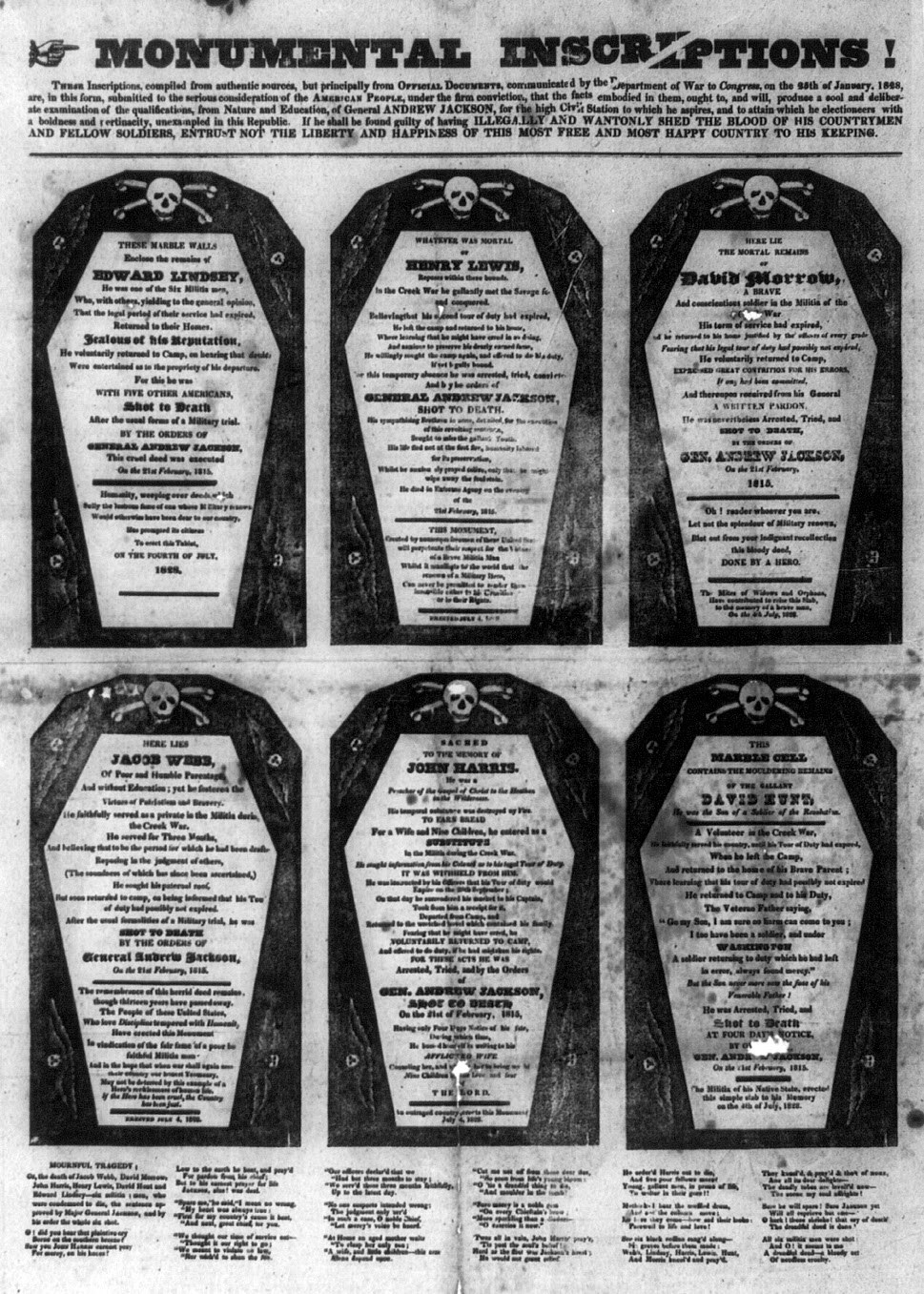
But when Andrew Jackson eventually ran for U.S. President in 1828, the poor militiamen were exhumed (only metaphorically!) to traduce the general, whose reputation already ran to the bloodthirsty. This was a country where a great many of the men casting ballots would be, actually or potentially, subject to militia duty: the prospect of a frontier Queeg actually executing militia was calculated to impair Jackson’s famous appeal to the common man and raise the specter of the president as a potential strongman.

Propaganda pamphlets circulated this execution story widely that year, the swiftboating of the 19th century.

Their inevitable inclusion of six coffin-shaped blocks to symbolize the dead men this date eventually gave to anti-Jackson broadsides the name “Coffin Handbills” — a term that eventually extended to the entire genre of political libels. This linguistic relic is surely due for a bicentennial resurrection.

Sordid campaigning over Jackson’s questionable military freelancing was somewhat ironic in 1828, since Jackson also had that reputation from his extra-legal Florida incursions, after the War of 1812. Those adventures rankled many within the Monroe administration, but were stoutly defended by Monroe’s Secretary of State — none other than John Quincy Adams. (Adams’s own signature graces the 1819 treaty with Spain which ceded Florida; it was largely secured by Jackson’s depredations.)

Irony or no, the attacks had to be dealt with.

Jackson’s partisans responded with equal vigor. For instance, newspapers (the excerpt below comes from the May 1, 1828 Maryland Gazette) carried a lengthy vindication penned by a Jackson partisan and fellow-Tennessean then sitting his first term in Congress … but destined in time to follow Jackson to the White House.**

I had supposed it scarcely possible that any candid, intelligent man, could for a moment doubt the correctness of General Jackson’s conduct, in relation to this subject … No man has ever been more misrepresented and slandered by his political adversaries than Gen. Jackson, and upon no subject more than that in relation to the execution of the ‘six militia men.’ …

The corps to which the ‘six militiamen’ belonged, was stationed at Fort Jackson. Between the 10th and 20th of September 1814, before the period even of three months, much less six months, had expired, an alarming mutiny, such as was seldom ever witnessed in any army, took place in the camp, of which these ‘six militia men’ were the ringleaders. Harris who seems to have been the principal, several days before the mutiny broke out, carried about a subscription paper thro’ the camp, obtaining the signatures of all who would agree to go home. In defiance of their officers commanding the post, they on the 19th of September 1814, violently and tumultuously assembled together, to the number of near two hundred, broke open the public stores, took out provisions, demolished the bake house, shot down breves, and in the face of authority, left the camp on the next morning ‘at the end of revielle beat;’ yelling and firing scattering guns as they departed, proclaiming to all who would, to follow them.

Th proceedings of the court martial were forwarded to General Jackson then at New Orleans, for his approval. The six ringleaders were not recommended to mercy by the court martial. No palliating circumstances existed in their case, known to him. He knew they had been tried by a court martial composed of their fellow citizens and neighbours at home. The news of peace had not then arrived. The enemy’s forces were still in our waters and on our border. When an attack might be made was unknown, and the militia under General Winchester‘s command at Mobile, were ‘threatening to mutiny.’ … General Jackson saw that the salvation of the country was still in jeopardy, if subordination was not preserved in the army. He approved the sentence, and these six unfortunate, tho’ guilty men, were executed. This approval of the sentence of the court martial was made at New Orleans on the 22d of January, 1815. The first intimation which the General had of the news of peace even by rumour, was received on the 18th or 19th of February, 1815 … Col. G.C. Russell, who commanded on the day the sentence of the court martial was carried into execution, states in a letter of the 29th of July, 1827, that ‘we had no knowledge of a treaty of peace having been signed at Ghent, till more than a month after the approval of the sentence, and fifteen or twenty days after its execution.’ The official news of peace did not reach General Jackson until the 18th of March, 1815, and on the 19th of the same month, the British commander received the official intelligence from his government. It was not until after this period that the British forces left their position on that border of the union.

The effect which the execution of these men produced in the army was most salutary. Not a whisper was afterwards heard of the mutiny which had threatened General Winchester’s command. Subordination was restored, and all the troops in the service were willing, and did without a murmur perform their duty. Mutiny and desertion were no longer heard of in that part of the military service.

it is impossible to conceive how censure can attach to General Jackson. At the time he approved the sentence of the six ringleaders, he pardoned all those who had been recommended to mercy by the court martial that tried them. At the time of the execution all acquiesced in its justice. Every officer in the army responded to the importance of the example, for the good of the service. At that time the whole country was satisfied. Not a whisper of censure was heard against the commanding General, or any member of the court martial in reference to it.

James K. Polk

Polk, indeed, advised his friend Jackson closely during the latter’s 1828 campaign, and specifically counseled an active campaign to rebut the “six militiamen” attacks.

Polk’s energetic response and others like it must have worked well enough: Jackson crushed John Quincy Adams as handily as he had once done the Creeks, and wound up with his hatchet face on the American $20 bill.

* The De Tocqueville quote in the text is the part germane to this post, but it disdainfully goes on to pronounce New Orleans “a victory which was, however, a very ordinary achievement and which could only be remembered in a country where battles are rare. Now the people who are thus carried away by the illusions of glory are unquestionably the most cold and calculating, the most unmilitary, if I may so speak, and the most prosaic of all the nations of the earth.” Sniff.

** And to follow Jackson’s policy of dubious southerly land-grabs.

On this day..

1476: Israel, the last execution of the Trent blood libel trial

We have covered in these pages the horrific blood libel trial that sent most of the Jews of Trent to execution for the supposed ritual murder of the child Simon of Trent.

The moral panic (and torture-aided interrogation) that broke out when Trent’s Jews were suspected of having killed a Christian child led to a batch of executions in June 1475. But that was only the first act of a drama that would reach all the way to the courts of popes and emperors in the subsequent months … a conflict that would not end even when the last “murderer”, Israel, was broken on the wheel on January 19, 1476.

Trent lay at the southern fringe of the Habsburg Holy Roman Empire,* literally halfway from Vienna to Rome … and Trent’s ambitious prince-bishop Johannes Hinderbach was likewise beholden to both those poles of authority.

The sitting pope, Sixtus IV, was pretty sympathetic to Jews in general and very definitely not okay with Hinderbach’s theater of torture and execution. Sixtus was certainly also feeling plenty of pushback from other Jewish communities in Europe to make sure Trent wouldn’t be a precedent for similar freakouts in the future, and from Christian elites who didn’t want muddleheaded fanatics running around.

In Trent, “the Jews” meant literally three households — a tiny handful of people. By contrast, in cosmopolitan, humanist Rome, Jews were prominent among the intelligentsia and their presence taken for granted. Sixtus had Jewish “advisors and physicians in the papal court. They were teachers of music, theater, and science. Rome was a center of Hebrew literature and publishing … Sixtus IV, like most of his predecessors, took his role as a defender of Jews from violence more or less for granted.”**

Sixtus ordered the proceedings halted “because many and important men began to murmur,” and instituted an apostolic commission to investigate.

But Hinderbach and the Trentini refused to cooperate (Italian link) with the investigation. Hinderbach, for his part, was all-in on the Simonino story: just like today, nobody on the hook for a wrongful execution is going to advance his career by acknowledging that fact.

Resentfully, Hinderbach put his unwelcome papal visitor Battista Dei Guidici up in a crappy room, and “many people, moved more by furor than reason, temerity than devotion, threatened to kill the commissioner in the streets of the city, if he did not confirm the miracles and the asserted martyrdom” of little Simon. If anyone in Trent thought otherwise, he did not dare make it known to the closely-watched investigator.

Trent still had Jews in prison at this point, but Hinderbach resolutely prevented the pope’s agent from interviewing with them. “It was to be feared,” Hinderbach said, “that if he talked to them, he or his men could give some sign to the Jews, who would be rendered more obstinate, since they were always saying, ‘A man will come to free us.'”

Book CoverThese quotes are via R. Po-Chia Hsia’s Trent 1475: Stories of a Ritual Murder Trial, which is likewise our guide for the tense diplomatic battle ensuing over the autumn of 1475.

After having bribed a servant to deliver word to the imprisoned Jewish women that they had an advocate, Dei Guidici relocated to nearby Venetian territory — “where innocent people are not killed, where Christians do not plunder Jews, as it was in Trent” — and papers started flying.

Dei Guidici appealed to — and eventually ordered — Hinderbach to release the remaining Jews in his custody, while the pope sent out directives quashing any preaching on Simon’s “martyrdom.” Italian Jews poured into Dei Guidici’s offices appealing for their fellows and attesting that they could not travel through Trent for fear of mob violence.† A verse from a Veronese rabbi dating to late 1475 curses the nearby city: “Hills of Trent, may you not have rain or dew / Seven times may you fall and not rise.”

Hinderbach, for his part, sent his own envoys to German cities that had persecuted Jews for ritual murder in the past to get his own paper trail establishing that, yes, the Hebrew liked a good drink of Christian blood. More significantly, as a prince-bishop, Hinderbach also sent his own appeals up the Holy Roman Empire’s secular chain of command, objecting to the ecclesiastical meddling.

Hinderbach’s only concession to his apostolic scold was to release the children he had in custody. In October 1475, his political machinations with the Habsburgs yielded authorization from the powerful Tirolean Archduke Sigismund to resume judicial proceedings against “the Jewish men and women you have in prison” and “render justice as it should be, and let the death sentences be carried out.”

Interrogations for six Jewish men still in custody resumed on October 25, again with the aid of the horrible strappado to confirm and elaborate upon the already-determined official story of Simon’s martyrdom.

Denial — or even confessing, but guessing the wrong detail to “admit” — was not an option, as this October 26 interrogation record indicates.

He was asked whether he saw the murdered boy.

JOAFF [one of the Jewish households’ servants]: In the ditch.

PODESTA: Think again.

JOAFF: In the antechamber of the synagogue.

PODESTA: Anywhere else?

JOAFF: No.

He was ordered stripped, tied by the rope, and hoisted up.

JOAFF: Let me down, I’ll speak the truth.

PODESTA: Speak it on the ropes.

JOAFF: I have never done anything evil.

He was hoisted up and dropped.

This continues until Joaff has been dropped enough times to agree that he saw Simon’s body on Saturday night, on a bench in the synagogue. They knew that was the truth because it confirmed what they already wanted to hear.

This would be the end of Trent’s Jewish men in January 1476.

Israel, a 23-year-old copyist, was the last to die, and his fate is particularly poignant.

He had half-escaped the pall of death by accepting baptism the previous spring, and lived freely during the following months under the name Wolfgang. Dei Guidici interviewed him, one of the few productive sessions the pope’s man was able to arrange in Trent, and learned thereby of the details of Hinderbach’s interrogations.

Once Dei Guidici withdrew to Venetian soil, Jews of that principality would begin reaching out to “Wolfgang” in their efforts to communicate with the remaining imprisoned Jews.

This skullduggery came came apart when the persecution fired back up in October, and Israel was re-arrested, and put again and repeatedly to the rope. He was a man bound to be crushed by the legal machinery arrayed against him, but it was not only that. As Israel was well-traveled, he was tortured for information about ritual murders in other German cities; his forced denunciation of 14 named Jews in Regensburg initiated a blood-libel proceeding in that city that was only aborted by intervention from the Emperor himself.

And while Israel struggled to portray himself as a faithful convert and appeal to little Simon for an exculpatory miracle that never came, he at least once threw aside the mask to give his tormenters a piece of his mind.

PODESTA: What did he think of the Christian faith?

ISRAEL: He wants to say the truth. He does not believe in anything of the Christian faith … It is a joke to say that God came down from heaven to earth, walked around and lived among men. He believes only in God and nothing more. He believes also that the Jewish faith is right and holy.

PODESTA: Does he believe that it is right, according to Jewish law, that Jews kill Christian children and drink and eat their blood as he himself had said.

ISAREL: He believes firmly that it is right that Jews kill Christian children and eat their blood. He wants to have Christian blood at Easter, even now that he is baptized he wants to die a Jew.

Four other Jews from Trent died by hanging earlier in January 1476. The last one put to death was Israel on January 19 — “thief, eater and drinker of Christian blood, poisoner, blasphemer, traitor, and an enemy of Christ and Godly majesty.”

Even his death did not finally put a stop to the affair, for the women of the Jewish community were still in prison, and still being tortured as late as March. They would eventually accept baptism as the price of their release.

Meanwhile, Hinderbach and Dei Guidici carried their scrap to the curia. Hinderbach’s dogged advocacy of his burgeoning cult of Simon — and the odd ad hominem against his foe here and there — won some allies against Dei Guidici’s protests against “the peril which would be incumbent on the Christian religion, on account of the dealings in Trent, and the lies that would reach the ignorant.”

In the end, the Church decided it on political grounds. It could not encourage more Trents; neither could it invite the scandal of disavowing the one that had already taken place. It upheld Hinderbach’s conduct while also reiterating standing prohibitions against blood-libel trials or oppressing the Jews.

Hinderbach very naturally took this as vindication and spent the balance of his life propagating the Simonino cult. Artwork throughout northern Italy, some of it still visible in situ today in its original public monuments and chapel frescoes, attested to his success.


The Martyrdom of Simonino, by Gandolfino d’Asti.


The Martyrdom of Saint Simonio, from the Trento school of Nicklaus Weckmann. (Via)

Indeed, the city of Trent itself‡ still has a street-viewable bas-relief depiction of Simonino’s ritual murder, with the Latin inscription:

In the dungeons of these buildings, where once a synagogue stood, and now a shrine, the blessed martyr Simon of Trent, in his 29th month of life, was killed with excruciating pain by the Jews in the deep of the night of April 10, 1475 A.D.

The Simon of Trent cult — never the face of Christianity that the institutional church really wanted to feature — was only officially suppressed in the 20th century with the Second Vatican Council.

* Trent’s position on the frontier of the Italian and German worlds is also the reason the next century’s major anti-Reformation Council of Trent was held there.

** Sixtus wasn’t all good news for Jews. More from political necessity than affirmative desire, he also authorized the Spanish Inquisition and appointed Torquemada.

† During this time, Dei Guidici also managed to extract a Trent resident named Anzelino Austoch. Under Dei Guidici’s torture, Austoch accused the man named der Schweizer, “the Swiss” — the very man who had suggested that the Jewish homes be searched for Simon’s body — of committing the murder. Dei Guidici clearly believed that either the Schweizer, or Austoch, or both, had actually killed Simon and intentionally framed the city’s Jews.

‡ Trent does not, of course, still avow the legitimacy of these proceedings; the city has elsewhere put up plaques apologizing for it.

On this day..

2015: Ahmed Ali and Ghulam Shabbir, Pakistan terrorists

Pakistan this morning has hanged at the central jail of Multan two members of the long-banned Sipah-e-Sahaba Sunni militant party.

Pakistan has been on an execution bender in recent weeks, following the terrorist massacre of 140-plus people at a Peshawar school on December 16.

Directly following that attack, Pakistan lifted a running moratorium on executions and began finalizing death sentences against various people with years-old terrorism death sentences having no particular connection to Peshawar; it carried out four cathartic hangings on December 20.

Ahmed Ali and Ghulam Shabbir both had death sentences from years-old murders (1998 and 2000) that Pakistan characterized as “terrorist” killings.

There have been a total of nine hangings since the Peshawar massacre, and at least eight more people have had mercy pleas officially rejected by Pakistan President Mamnoon Hussain, and could be executed soon.

While this is a fine clip for three weeks’ work, it might just be the tip of the iceberg: Pakistan has threatened to execute up to 500 prisoners over the coming months.

On this day..

1502: Ramiro d’Orco, discarded by Cesare Borgia

On this date in 1502, Ramiro d’Orco (Ramiro de Lorqua or de Lorca) was put to death in the main square of the city he had governed mere days before.

In 1498, Cesare Borgia, the bastard son of Pope Alexander VI, resigned his cardinalate* to pursue a conqueror’s laurels.

Dynastically allied with France and backed by il papa‘s ducats and decrees, Cesare seized control of Romagna after Alexander helpfully pronounced his vicars there deposed.

As Borgia extended his sword up and down the peninsula, he left his Spanish steward Ramiro d’Orco in Romagna’s capital of Cesena as his governor. D’Orco was a capable, cruel ruler. But his fall likely owed as much to his master’s gifts for the condotierro racket as to d’Orco’s overeager resort to torture and public executions .

Borgia’s conquests multiplied his rivals, fellow condotierri who feared that he could soon come to dominate Italy. The discovery of one plot by former allies against him might have inspired Borgia to consider the damage that the captain of Romagna could do, should he shift his loyalties.

Borgia, not present for events, had d’Orco arrested by surprise on December 22. He was on Christmas condemned to death for graft, and by the next day’s light his black-bearded head surmounted a bloody pike. Borgia also thereby reaped the benefits of d’Orco’s brutality while also dissociating his own person from the resentment those methods had engendered.

Niccolo Machiavelli, Florentine emissary to the Borgia court, watched Cesare’s career closely. In The Prince, Machiavelli is full of skepticism for rulers who come to power through the “fortune” of inheritance or another ruler’s patronage — but Cesare Borgia rates an exception. The conqueror “laid sufficiently good foundations to his power.”

When the duke occupied the Romagna he found it under the rule of weak masters, who rather plundered their subjects than ruled them, and gave them more cause for disunion than for union, so that the country was full of robbery, quarrels, and every kind of violence; and so, wishing to bring back peace and obedience to authority, he considered it necessary to give it a good governor. Thereupon he promoted Messer Ramiro d’Orco, a swift and cruel man, to whom he gave the fullest power. This man in a short time restored peace and unity with the greatest success. Afterwards the duke considered that it was not advisable to confer such excessive authority, for he had no doubt but that he would become odious, so he set up a court of judgment in the country, under a most excellent president, wherein all cities had their advocates. And because he knew that the past severity had caused some hatred against himself, so, to clear himself in the minds of the people, and gain them entirely to himself, he desired to show that, if any cruelty had been practised, it had not originated with him, but in the natural sternness of the minister. Under this pretense he took Ramiro, and one morning caused him to be executed and left on the piazza at Cesena with the block and a bloody knife at his side. The barbarity of this spectacle caused the people to be at once satisfied and dismayed.

* In fact, he was the first cardinal ever to resign the position.

On this day..