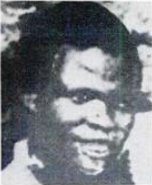
1945: Lena Baker

What I done, I did in self-defense, or I would have been killed myself. Where I was I could not overcome it.

-Lena Baker’s final statement

The state of Georgia has only ever electrocuted a single woman: African-American maid Lena Baker, put to death on this date in 1945 for murdering her abusive employer.

Baker was a sharecropper and a former sex worker hired to care for white mill owner Ernest Knight as he recuperated from a broken leg. This, as Baker’s biographer Lela Bond Phillips puts it, “developed into a sexual relationship.”

A twisted, sometimes-violent relationship.

Both Knight and Baker were alcoholics, and the Knight liked to keep his domestic in the gristmill for days on end.*

As an interracial liason, it was also entirely taboo; Knight’s son tried everything to separate his dad from this scandalous arrangement, including moving the family and beating up Baker.

Knight pere was even more committed to keeping her.

On the night of April 29-30, 1944, the elder Knight locked Baker up in the mill, after she’d attempted to flee him. Baker testified that after Knight got back from church — it was Sunday, after all — Baker tried to leave over Knight’s threats. The two fought over Knight’s pistol, and the fight ended when the pistol discharged through Knight’s head. As to how it went off or who pulled the trigger, Baker said she didn’t know.

Although the irascible, hard-drinking Knight wouldn’t have won any popularity contests among his white neighbors, this breach of the color line was prosecuted both vigorously and speedily: a one-day trial that August (the all-white, all-male jury goes without saying, right?) sufficed to send the maid to her death.**

She’s (obviously) the subject of the 2008 film Hope & Redemption: The Lena Baker Story.

* Virtual imprisonment of domestic labor: not a thing of the past.

** In 2005, the Georgia Board of Pardons and Paroles — which turned down Baker’s clemency application in early 1945 — issued a posthumous pardon suggesting that a non-death penalty manslaughter charge would have been the more appropriate conviction. Baker’s family and defenders read that as vindication; there’s a detailed NPR story about it here.

On this day..

1870: Wyatt Outlaw lynched by the Ku Klux Klan

On this date in 1870, the lynching of a mulatto freedman in Alamance County, North Carolina sounded the tocsin for ex-Confederates’ rollback of Reconstruction.

Perhaps America’s most tragic period, the aftermath of the Civil War saw a too-brief attempt to enforce ex-slaves’ civil rights, before it succumbed to violent counterattack. The prevailing historiography in the century-long era of Southern apartheid that followed remembered it as a time of impertinent Negroes ravishing Dixie’s virtue by being seated in the legislature and giving orders to their natural betters.

Winners write history, after all.

Those of the pro-Republican coalition at the time, before Northerners folded their hand, had a mind to write a different history.

Alamance County was one epicenter of this aborted alternative. The enclave was cool to secession from the beginning, and in the early years of Reconstruction had a live black-white coalition. Wyatt Outlaw, a mixed-race Alamance native who had fought for the Union, was a local leader in it. A member of the antislavery Union League, which registered freedmen as voters throughout the South, he was appointed a town commissioner for Graham, N.C. under the state’s new constitution.

This made him a prime target of Ku Kluxers. On the night of February 26, 1870, an armed party of white supremacists about 100 strong raided his home and strung him up on an elm tree facing the county courthouse. Pinned to his corpse for the edification of the morning’s churchgoers was a note:

“Beware you guilty — both white and black.”

North Carolina Governor William Holden complained to the U.S. Senate of federal unwillingness to act against such outrages.

What is being done to protect good citizens in Alamance County? We have Federal troops, but we want power to act. Is it possible the government will abandon its loyal people to be whipped and hanged? The habeas corpus should be at once suspended.

After another pro-Reconstruction politician was murdered later that year, Holden boldly took the initiative himself and called out the troops to arrest suspected Klansmen. But the right-wing Democratic party won midterm elections in 1870, and promptly impeached Holden for this atrocious tyranny; he was the first U.S. governor ever removed from office by impeachment.*


A “carpetbagger” ally of Wyatt Outlaw named Albion Tourgee — a judge who stood as one of North Carolina’s most prominent and hated advocates for African American equality — later wrote a novel about his experiences, A Fool’s Errand, by One of the Fools. Now in the public domain and available free online, this book’s portrayal of the Reconstruction South is receiving renewed scholarly appreciation** — including Tourgee’s catalogue of terrorism against emancipated blacks and the Republican government. The novel was a sensation (pdf) in its time.

One of the characters in Fool’s Errand is a nearly exact representation of Wyatt Outlaw: “Uncle Jerry Hunt”, who resists the Klan. It is “chiefly through Uncle Jerry’s persuasions, and because of his prominence and acknowledged leadership, this spirit had gone out among the colored men of the county.” He meets a graphic end that almost journalistically reports Outlaw’s real fate.

It was a chill, dreary night. A dry, harsh wind blew from the north. The moon was at the full, and shone clear and cold in the blue vault.

There was one shrill whistle, some noise of quietly moving horses; and those who looked from their windows saw a black-gowned and grimly-masked horseman sitting upon a draped horse at every corner of the streets, and before each house, –grim, silent, threatening. Those who saw dared not move, or give any alarm. Instinctively they knew that the enemy they had feared had come, had them in his clutches, and would work his will of them, whether they resisted or not. So, with the instinct of self-preservation, all were silent–all simulated sleep.

Five, ten, fifteen minutes the silent watch continued. A half-hour passed, and there had been no sound. Each masked sentry sat his horse as if horse and rider were only some magic statuary with which the bleak night cheated the affrighted eye. Then a whistle sounded on the road toward Verdenton. The masked horsemen turned their horses’ heads in that direction, and slowly and silently moved away. Gathering in twos, they fell into ranks with the regularity and ease of a practiced soldiery, and, as they filed on towards Verdenton, showed a cavalcade of several hundred strong; and upon one of the foremost horses rode one with a strange figure lashed securely to him.

When the few who were awake in the little village found courage to inquire as to what the silent enemy had done, they rushed from house to house with chattering teeth and trembling limbs, only to find that all were safe within, until they came to the house where old Uncle Jerry Hunt had been dwelling alone since the death of his wife six months before. The door was open.

The house was empty. The straw mattress had been thrown from the bed, and the hempen cord on which it rested had been removed.

The sabbath morrow was well advanced when the Fool [i.e., Tourgee himself] was first apprised of the raid. He at once rode into the town, arriving there just as the morning services closed, and met the people coming along the streets to their homes. Upon the limb of a low-branching oak not more than forty steps from the Temple of Justice, hung the lifeless body of old Jerry. The wind turned it slowly to and fro. The snowy hair and beard contrasted strangely with the dusky pallor of the peaceful face, which seemed even in death to proffer a benison to the people of God who passed to and fro from the house of prayer, unmindful both of the peace which lighted the dead face, and of the rifled temple of the Holy Ghost which appealed to them for sepulture. Over all pulsed the sacred echo of the sabbath bells. The sun shone brightly. The wind rustled the autumn leaves. A few idlers sat upon the steps of the court-house, and gazed carelessly at the ghastly burden on the oak. The brightly-dressed church-goers enlivened the streets. Not a colored man was to be seen. All except the brown cadaver on the tree spoke of peace and prayer–a holy day among a godly people, with whom rested the benison of peace.

The Fool asked of some trusty friends the story of the night before. With trembling lips one told it to him,

“I heard the noise of horses–quiet and orderly, but many. Looking from the window in the clear moonlight, I saw horsemen passing down the street, taking their stations here and there, like guards who have been told off for duty, at specific points. Two stopped before my house, two opposite Mr. Haskin’s, and two or three upon the corner below. They seemed to have been sent on before as a sort of picket-guard for the main body, which soon came in. I should say there were from a hundred to a hundred and fifty still in line. They were all masked, and wore black robes. The horses were disguised, too, by drapings. There were only a few mules in the whole company. They were good horses, though: one could tell that by their movements. Oh, it was a respectable crowd! No doubt about that, sir. Beggars don’t ride in this country. I don’t know when I have seen so many good horses together since the Yankee cavalry left here after the surrender. They were well drilled too. Plenty of old soldiers in that crowd. Why, every thing went just like clock-work. Not a word was said–just a few whistles given. They came like a dream, and went away like a mist. I thought we should have to fight for our lives; but they did not disturb any one here. They gathered down by the court-house. I could not see precisely what they were at, but, from my back upper window, saw them down about the tree. After a while a signal was given, and just at that time a match was struck, and I saw a dark body swing down under the limb. I knew then they had hung somebody, but had no idea who it was. To tell the truth, I had a notion it was you, Colonel. I saw several citizens go out and speak to these men on the horses. There were lights in some of the offices about the court-house, and in several of the houses about town. Every thing was as still as the grave,–no shouting or loud talking, and no excitement or stir about town. It was evident that a great many of the citizens expected the movement, and were prepared to co-operate with it by manifesting no curiosity, or otherwise endangering its success. I am inclined to think a good many from this town were in it. I never felt so powerless in my life. Here the town was in the hands of two or three hundred armed and disciplined men, hidden from the eye of the law, and having friends and co-workers in almost every house. I knew that resistance was useless.”

“But why,” asked the Fool, “has not the body been removed?”

“We have been thinking about it,” was the reply; “but the truth is, it don’t seem like a very safe business. And, after what we saw last night, no one feels like being the first to do what may be held an affront by those men. I tell you, Colonel, I went through the war, and saw as much danger as most men in it; but I would rather charge up the Heights of Gettysburg again than be the object of a raid by that crowd.”

After some parley, however, some colored men were found, and a little party made up, who went out and saw the body of Uncle Jerry cut down, and laid upon a box to await the coming of the coroner, who had already been notified. The inquest developed only these facts, and the sworn jurors solemnly and honestly found the cause of death unknown. One of the colored men who had watched the proceedings gave utterance to the prevailing opinion, when he said,–

“It don’t do fer niggers to know too much! Dat’s what ail Uncle Jerry!”

And indeed it did seem as if his case was one in which ignorance might have been bliss.

The multitalented, ahead-of-his-time Tourgee might well have uttered the same sentiment in 1896, when he was the lead attorney on the losing side of Plessy v. Ferguson — the Supreme Court’s landmark sanction of the color line that Uncle Jerry’s hangmen had drawn.

There are a couple of interesting journal articles touching on Alamance County during Reconstruction which are freely available as pdfs from the Journal of Backcountry Studies: “Other Souths”: The Civil War and Reconstruction in Alamance County, North Carolina and Scalawags Among Us: Alamance County Among the “Other Souths”.

* Narrowly beating Nebraska’s David Butler, who got the boot a few months later. Holden remains the only governor to suffer this indignity in North Carolina history; there has been a recent push in the Raleigh legislature to posthumously pardon him. Holden’s own memoirs are also available free online.

** Along with the book’s contention that northern Republicans were to blame for vacillating on Reconstruction. “This cowardly shirking of responsibility, this pandering to sentimental whimsicalities, this snuffling whine about peace and conciliation, is sheer weakness … [the North is] a country debauched by weak humanitarianisms, more anxious to avoid the appearance of offending its enemies than desirous of securing its own power or its own ends.”

On this day..

1845: John Gordon, the last hanged in Rhode Island

Last year, the Rhode Island General Assembly approved a measure posthumously pardoning John Gordon — who on February 14, 1845 was the last man executed in that state.

Gordon’s hanging, for the murder of a prominent industrialist who had bad blood with Gordon’s brother, was long notorious in Rhode Island as one secured on highly uncertain evidence in an atmosphere of anti-Irish prejudice.

Executed Today is pleased to welcome on this occasion University of Rhode Island labor historian Scott Molloy, author of Irish Titan, Irish Toilers and a major advocate of the Gordon pardon.

ET: Can you set the scene — what’s going on in Rhode Island at this time, and what are the tensions surrounding Irish immigrants?

SM: Rhode Island was the site of the first factory in America in the 1790s, called Slater Mill. It really changed the face of Rhode Island and eventually the rest of the US.

In Rhode Island, curiously, as more and more people left the farms to work on the mills, they had an unusual requirement that really didn’t make any difference years earlier: in order to vote, you had to have so much land. (Specifically, $134 worth of land.)

By 1840, not only were the usual suspects not able to vote — women, people of color, Native Americans — 60% of native-born white male Rhode Islanders were also unable to vote. It meant that just a handful of people ruled the state, compared to the time of the American Revolution when just about every white male could vote. And immigrants in particular — and in those days, that was the Irish — were basically precluded from voting. You had a residency requirement, a property qualification. It made Rhode Island almost unique in New England, almost like a southern state.

A group of reformers came to the forefront, a guy named Thomas Wilson Dorr, a blueblood aristocrat, Harvard-educated, one of the best legal minds of the country. He threw his lot in with the reformers to try to get people the right to vote. It really polarized the state in 1842.

The Irish were sympathetic, but Irish priests tried to keep them out of it because they wanted to acclimate. But because a lot of the animosity toward people having the right to vote was directed at Irish immigrants. People blamed the Irish even though the Irish didn’t get particularly involved in the Dorr War.

Often times they got blamed for everything whether they did it or not. And of course we face the same situation with immigrants today.

What was the crime and how did the Gordons come to be the focus of the prosecution?

In 1843, a Yankee industrialist out in Cranston by the name of Amasa Sprague was found on New Year’s Eve 1843 bludgeoned to death in what today we might call a hate crime. He had a gold watch still on him, he had money in his poket, and he had been beaten to death.

Amasa Sprague was a very influential guy. His older brother who helped run the mill with him and was the US Senator from Rhode Island had the local city council lift the liquor license from the Gordon family’s business, which for all intents and purposes ended their livelihood. This was Nicholas Gordon’s shop: John Gordon had only just crossed over from Ireland.

When Sprague was found dead about six months after the license was lost, they focused on the Gordon family. The authorities formed a posse and they went after this Irish family.

Book CoverHow did anti-Irish sentiment manifest itself at trial?

The juries in all three trials had no Catholics and no Irish that I’m aware of. There was a lot of religious and socioeconomic animosity.

At the time, the Supreme Court of the state would sit in on the whole trial just because it was a capital trial, and the trial judge would say in the transcript — which is still available (pdf) — he basically says to the jury, if you find testimony that contradicts itself between a Yankee and an Irish witness, you should give the Yankee testimony more credence.

Doesn’t the fact that John Gordon’s brothers were not convicted militate against the notion of overwhelming anti-Irish prejudice?

You can’t go overboard on these things. The juries — all three of them — they found one Gordon innocent and in the other case they had a hung jury. I don’t want to say they were completely prejudiced, because they weren’t, but almost everything else in Rhode Island at that time was stacked up against them.

The earlier Irish who came in the 1820s and 1830s were a little bit better off, a little bit better-educated [compared to later Irish immigrants after the potato famine]. The animus against the Irish was still intense; the Irish were seen as criminal, unskilled, uneducated, ignorant. The Protestant majority at the time, mostly of English heritage, kind of brought that over with them even though they had been there for a long time.

So how did the legal proceedings play out?

They put two of the recently immigrated brothers up for conspiracy for murder, but not the oldest brother. So John Gordon and his brother William go on trial first.

The jury came back with a guilty verdict for John Gordon, who didn’t have much of an alibi, but a not guilty verdict for William, who did have an alibi. So you’ve got a conspiracy conviction with only one conviction.

Then they put Nicholas Gordon on trial, and the jury comes back deadlocked. His second trial is not going to be until the spring of 1845. In the interim, his brother John was to be hanged, Valentine‘s Day 1845 — rather than wait to see what happened at Nicholas Gordon’s trial and whether there even is a conspiracy.

The defense petitions the governor and the general assembly to hold off the execution until after the trial of the oldest brother. The governor washes his hands of it, and the general assembly votes very narrowly to go ahead with the execution.

So they hang him, and what’s interesting in that part of it is an itinerant, traveling Catholic priest — a guy named Father John Brady — hears John Gordon’s last confession.

Well, they invite the elite of providence inside the prison to watch the hanging. (There’s about 1,000 Irish outside the prison in support of John Gordon.) When they put the noose around his neck, the priest is with him, and the priest berates the elites and authorities, and he says, John, you are going before a just God who has seen way too many of your countrymen.

I always argue in my writings that this guy, he’s an immigrant, he’s uneducated, he’s just been in America for a few months. I just can’t believe that this guy would ever lie to the priest hearing his last confession, and the priest would never berate the elites unless he’d heard a confession of innocence.

After John Gordon’s hanging, his brother Nicholas goes on trial as planned, and they come back with another hung jury — this time, with a majority voting him as innocent. They were going to try him again except about 18 months later, Nicholas dies of natural causes.

I’ve seen a lot of people describe growing up hearing unambiguously that this was a wrongful execution. Is that how it was perceived right from the start? How universal was/is that perception?

There was such a collective feeling of guilt about this that in 1854, Rhode Island abolished the death penalty and John Gordon was the last person ever executed there.

There’s one flaw in the law. This was added late in the 20th century, that anyone convicted of killing a prison guard during an escape could still be killed. And there was an incident, I remember it as a kid maybe 30 years ago, but they still didn’t condemn even that person to death. But Rhode Island has never changed that.

None of us who ever testified ever said categorically that John Gordon was innocent, because we just can’t prove that. But we did say that he never got a fair trial, just like Sacco and Vanzetti in the 1920s.

We did in our research was come up with two or three suspects who had much better reason to assassinate Sprague. But there were no witnesses to the case. It was all circumstantial evidence. I have to say, every time I look at the case — there are some pieces of evidence that would make the Gordons look very guilty. There are other aspects of it that make them look very innocent. If it was in today’s world, the police would interrogate them as people of interest.

It’s not as cut-and-dried as some people make it. All I know is that they got an unfair trial.

Gordon was posthumously pardoned last year. How did that campaign get going, and how receptive were folks in the capitol?

The problem was a lot of people had forgotten the case. I had been writing for a number of years op-ed pieces in the Providence Journal, and mentioned John Gordon from time to time.

But it was an 80-year-old guy named Ken Dooley, and he grew up a couple miles from the murder site near Cranston, and he was a playwright. He came back home and remembered his grandmother singing some little ditty of a song 70 years ago saying something like “Poor Johnny Gordon”, and so he researched it, and he wrote a play.

And they put it on in Cranston, and over the couse of the month several thousand people saw it. A state representative, an Irish guy, saw the play four or five times and then introduced that into the general assembly trying to obtain a posthumous pardon — just to say that the evidence didn’t support the execution.

And Gov. Chaffee, who comes from an ancient Yankee family in Rhode Island, signed the damn thing. It was that play that this guy wrote and we were all amazed that this kind of came out of the blue. We held a lot of events around it — had church services, put up ceremonial headstones. I always tell people that I want this on my headstone: that I had a hand in getting John Gordon pardoned.


There are some excellent resources already available online concerning the Gordon case, including:

On this day..

1951: The first four of the Martinsville seven

On this date in 1951, the first of two batches comprising the “Martinsville Seven” — black, all — went to the Virginia electric chair for gang-raping a white woman. (The remainder were executed on Feb. 5)


Newspaper scan (click for larger image) via Mr. Beaverhousen (cc).

Somewhat forgotten today, the Martinsville Seven were in their day the locus of radical activism against Jim Crow in the South — very much like Willie McGee, who was put to death in Louisiana later that same year.

In fact, this case generated a bit of a legal milestone: a month before the executions began, the U.S. Supreme Court declined an appeal seeking relief on the then-novel grounds of equal protection — rather than due process.

The argument was that the Old Dominion’s superficially race-neutral rape statute was anything but; that argument was buttressed by data showing that Virginia had executed 45 black men for raping white women from 1908 to 1950, but never once in that period executed any white man for raping a black woman. (The high court only declined to take the appeal; it wouldn’t get around to explicitly ruling equal protection claims based on racial patterns out of bounds until 1987’s McCleskey v. Kemp.)

This seems to be the debut use for this gambit, bound to become an increasingly powerful one both in and out of the courtroom during the civil rights movement.

And it was available — and necessary — here because the Martinsville Seven basically looked guilty as sin. Their confessions and the victim’s accusation and the testimony of a young eyewitness said that, drink-addled, they had opportunistically grabbed a white Jehovah’s Witness housewife when she was proselytizing on the wrong side of the tracks.

Eric Rise, author of The Martinsville Seven: Race, Rape, and Capital Punishment, noted in a scholarly article,*

certain striking characteristics distinguished the proceedings from classic “legal lynchings.” The evidence presented at trial clearly proved that nonconsensual sexual intercourse with the victim had taken place. All seven defendants admitted their presence at the scene, and although some of the men may not have actually consummated the act … The prosecution emphasized the preservation of community stability, not the protection of southern womanly virtues, as the dominant concern of Martinsville’s white citizens. Most significant, the trial judge made a concerted effort to mute the racial overtones of the trials. Although white juries decided each case, blacks appeared in every jury pool. Race-baiting by prosecutors and witnesses, notably evident at Scottsboro and other similar trials, was absent from the Martinsville proceedings. By diligently adhering to procedural requirements, the court attempted to try the case “as though both parties were members of the same race.”**

The standard playbook for fighting a “legal lynching” case was leveraging outrage over a plausibly innocent convict and an outrageous kangaroo court.†

Paradoxically, by taking these elements out of the mix (relatively speaking), the Martinsville Seven perfectly isolated the extreme harshness of the penalty and the structural discrimination under which it was imposed. The NAACP took up the case on appeal strictly for its discriminatory characteristics, steering for its part completely clear of any “actual innocence” argument.

These challenges posed discomfiting questions that jurists shrank away from. The Virginia Supreme Court, in denying an equal protection application, fretted that actual legal relief could mean that “no Negroes could be executed unless a certain number of white people” were, too. Timeless.

Though a later U.S. Supreme Court would completely overturn death-sentencing for rape, based in part on its overwhelming racial slant, justices have generally avoided meddling to redress broad statistical patterns rather than identifiable process violations specific to particular cases.

Those questions of substantive — rather than merely procedural — equality in the justice system remain potently unresolved, still part of Americans’ lived experience of the law from death row to the drug war to driving while black. As if to underscore the point in this instance, just two days prior to the first Martinsville executions, the Wall Street bankster acting as American proconsul in conquered Germany pardoned imprisoned Nazi industrialist Alfried Krupp, and restored him to the fortune he had amassed working Jewish slaves to death during the war. It was a very particular quality of mercy the U.S. showed the world in those days. (The Martinsville case was known, and protested, worldwide.)

Carol Steiker (she used to clerk for liberal Justice Thurgood Marshall, who as an NAACP lawyer worked on the Martinsville case) argues‡ that the Martinsville Seven’s legacy is linked to their later obscurity, for “[t]heir attempt to present statistical proof of discrimination in capital sentencing represents a ‘road not taken'” — neither in 1951, nor since.

The road taken instead had Joe Henry Hampton, 22, Howard Hairston, 21, Booker Millner, 22 and Frank Hairston, 19 electrocuted one by one this morning in 1951. Their three co-accused, John Clabon Taylor, 24, James Luther Hairston, 23, and Francis DeSales Grayson, 40, followed them on February 5.

* “Race, Rape, and Radicalism: The Case of the Martinsville Seven, 1949-1951” in The Journal of Southern History, Aug., 1992.

** This quote an actual trial admonishment of the judge, Kennon Whittle.

† Graded on a curve: this is still Jim Crow Virginia. Six trials were wrapped up at warp speed in 11 days, with a total of 72 jurors — each one white. The implied comparison is something along the lines of, all seven tried together in the course of an afternoon, with a good ol’ boy defense attorney mailing it in.

‡ Review of Rise’s book titled “Remembering Race, Rape, and Capital Punishment” in the Virginia Law Review, Apr., 1997

On this day..

1936: Allen Foster, who fought Joe Louis

More than twenty-five years ago, one of the southern states adopted a new method of capital punishment. Poison gas supplanted the gallows. In its earliest stages, a microphone was placed inside the sealed death chamber so that scientific observers might hear the words of the dying prisoner to judge how the human reacted in this novel situation.

The first victim was a young Negro. As the pellet dropped into the container, and the gas curled upward, through the microphone came these words: “Save me, Joe Louis. Save me, Joe Louis. Save me, Joe Louis…”

It is heartbreaking enough to ponder the last words of any person dying by force. It is even more poignant to contemplate the words of this boy because they reveal the helplessness, the loneliness and the profound despair of Negroes in that period. The condemned young Negro, groping for someone who might care for him, and had power enough to rescue him, found only the heavyweight boxing champion of the world. Joe Louis would care because he was a Negro. Joe Louis could do something because he was a fighter. In a few words the dying man had written a social commentary. Not God, not government, not charitably minded white men, but a Negro who was the world’s most expert fighter, in this last extremity, was the last hope.

-Martin Luther King, Why We Can’t Wait

This story isn’t precisely accurate as Dr. King told it, but the factual basis for this empathetic legend is Allen Foster.

On this date in 1936, Foster was the first man executed by lethal gas in North Carolina — and en route to this minor distinction he punched his ticket for commemoration in civil rights literature when he flourished a flamboyant uppercut to witnesses as he was led to the gas chamber and cried out, “I fought Joe Louis!” It was an allusion to having matched with the world champ when both were youngsters in Alabama.

This coincidental brush with celebrity was about as strange as the fact that it occurred in a gas chamber at all.

After the arrival of the electric chair, the South adopted it virtually across the board; North Carolina had switched from hanging to electrocution in 1910.

But the Tarheel State was also generally more progressive than its neighbors;* V.O. Key would write of North Carolina, “It has been the vogue to be progressive. Willingness to accept new ideas, sense of community responsibility toward the Negro, feeling of common purpose, and relative prosperity have given North Carolina a more sophisticated politics than exists in most southern states.”

Part of that “sophisticated politics” was, in the 1930s, a growing debate about the application — indeed, the mere existence — of capital punishment.

According to Trina Seitz’s “The Kiling Chair: North Carolina’s Experiment in Civility and the Execution of Allen Foster” (North Carolina Historical Review, Jan. 2004):

North Carolinians were beginning to doubt the effectiveness of the sanction and the method used to enforce it. Furthermore, private citizens, humanitarians, and state institutions alike were increasingly scrutinizing the demographics of those being put to death.

Though this scrutiny did not lead so far as actual abolition, it provided the receptively reformist environment for Mitchell County Dr. Charles Peterson’s “pet project” of switching the execution protocol to lethal gas.

The reason for his fascination with gas seems to be obscure; the method had never been employed east of the Mississippi. Maybe it had something to do with 1932’s remarkably smooth gassing of a North Carolinian from nearby Burke County in Nevada, the nation’s gas chamber pioneer.

Whatever the reason, Peterson took a seat in the legislature in 1935 and won adoption for his idea in this very first session.

Unfortunately for Peterson — and doubly so for Foster — North Carolina didn’t have quite the same facility with hydrogen cyanide, and Foster’s execution was a notorious botch that immediately got people back on the electrocution bandwagon.

Foster was doomed for raping a white woman — this may be progressive North Carolina, but it’s still the South — and according to Seitz’s rendering of the News and Observer‘s first-hand report:

“Good-bye.” The Negro’s lips framed the words so clearly that no man in the witness room could doubt what he had said. As he said it, he winked and then forced a smile at the faces peering in at him. Then he began to suffer. No man could look squarely into his eyes and fail to perceive that they were registering pain. The Negro fought for breath, knowing he was going to die and fighting to get it over with as quickly as possible …

he sucked the gas desperately until his head rolled back three minutes later, indicating to physicians that the man finally had lost consciousness. But after a period of quiescence, his small, but powerfully built torso began to retch and jerk, throwing his head forward on his chest, where witnesses could see his eyes slowly glaze … The torturous, convulsive retching continued spasmodically for a full four minutes.

Officially, it took about 11 minutes for Foster to die, and as those agonizing minutes dragged by a physician broke the witness room’s mortified silence by exclaiming, “We’ve got to shorten [the execution method] or get rid of it entirely.” Um, yeah? The prison warden was quoted the next day as saying that even hanging was preferable to this.

The ensuing political controversy, however, did not succeed in reverting the method to electrocution.

Like the original electric chair, North Carolina’s gas chamber was the beneficiary of some hasty technical fixes: heating the gas chamber (it was at the freezing point when Foster died; Colorado executioners advised North Carolina that this would impede the gassing); tweaking the chemical formula.

The very next week, a white murderer named Ed Jenkins followed Foster into the toxic plume, this time to rave reviews: he “died painlessly and the method of execution was humane”. These advances were enough to keep the gas chamber in place, although the state legislature considered several bills to return to electrocution from 1937 to 1943.

During one such debate, North Carolina playwright Paul Green testified to the assembly (per Seitz),

Some day the electric chair and the gas chamber will be set up in the State Museum as symbols of an age of horror and ignorance. School children will look at them and feel superior to us as they look back upon an era of ignorance

Three hundred sixty-two people ultimately died in North Carolina’s gas chamber. And as Green anticipated, the execution chair resides today in the state’s Museum of History.

* This is still true of North Carolina: it has employed the allegedly more humane method of lethal injection since 1984, when no other Southern state save Texas used the needle until the 1990s; that use has been sparing enough that its per-capita execution rate remains markedly lower than most other former Confederate states; and in 2009, North Carolina implemented a stillcontroversial Racial Justice Act empowering condemned prisoners to challenge their sentence with statistical evidence of racial disparity even though courts don’t require this at all.

On this day..

1802: Jacques Maurepas and his entire family

On this date in 1802, a Haitian general, his family, and his men, were butchered by French forces fighting to retain control of Saint-Domingue.

Haing recently mastered the French Revolution, Napoleon Bonaparte — ever one for keeping it in the family — late in 1801 dispatched his brother-in-law* and brother-in-arms Leclerc to suppress the Haitian Revolution.

Over the course of 1802, Leclerc made headway towards accomplishing just that, as much with carrots as with sticks.

Maurepas was one of the Haitian commanders tasked by Toussaint L’Ouverture with defending Saint-Domingue, in his case, Port-de-Paix. Faced with a French landing, Maurepas burned the town to the ground and withdrew for an effective guerrilla resistance in the mountains.

But he eventually came to terms with the French, as did other Haitian officers, L’Ouverture included — reintegrating forces back with the French on the understanding that all that liberte, egalite, fraternite stuff would at least extend as far as not reintroducing slavery.

The French had other plans for their lucrative once-and-future colony, and when the Haitians caught wind of them, trouble resumed — now under the leadership (since the French had sagely deported L’Ouverture) of Jean-Jacques Dessalines.**

Leclerc had the, er, “fortune” of succumbing to yellow fever shortly after Dessalines’ promising revolt got underway; he was succeeded by the brutal Rochambeau, who threw away the carrots and relied on naked violence to control the island. (Again, not uncharacteristic of Napoleonic conquests.)

Maurepas had not actually gone over to Dessalines, but the fact that he was a black Haitian general was reason enough for his white French superior officer to arrest him preventively. Immediately upon assuming command, Rochambeau made an example of Maurepas.

The sea off the Cape was chosen to be the theatre of an execution, unparalleled in what is called civilized life. For fear that Maurepas, who had gained distinction under Toussaint L’Ouverture, after having embraced the side of France, should join the insurgents, Leclerc had written to him to come by sea, with his family and his troop, to take the command of the Cape, which he destined for him as a reward for his services. No sooner had he arrived than he and his soldiers were seized and disarmed. Rochambeau ordered preparations to be made for a barbarous punishment in order to put the negro general to death, with his troop, consisting of 400 blacks. It was also put in deliberation whether death should be inflicted on his children, in order to prevent them from rising up to avenge their father.

After having been bound to the mast of a vessel, Maurepas was frightfully insulted. His wife, his children, and his soldiers were brought to be drowned under his eyes. The executioners were astounded when they beheld a father fix his dying eyes by turns on his children, his wife, and his companions in arms, undergoing a violent death; while they, on their part, turned their eyes away from a father, a husband, a general, whose countenance was disfigured by the tortures he was enduring. After being made to contemplate each other’s sufferings, they were all tossed into the ocean. They died without complaining in a manner worthy the champions of liberty. With a reversal of the order of nature, the father died last; he also suffered most.

Thus died Maurepas, whose character was a compound of frankness and severity. Thrice had he repulsed the French at the gorge of Trois-Rivières; he had at once the glory and the misfortune to go over to the French with victorious arms. The elevation of his soul equalled his valor. He preserved a tender feeling for the master whose slave he had been; he caused funeral honors to be paid to that master, and when his grave had been negligently prepared, he threw off his upper garment in order to perform the pious office properly. Among men of his own blood he was a powerful chief. A spirit of order and justice prevailed in his life. His riches, which were considerable, were given up to pillage. It would almost seem as if so much excellence were subjected to so much ignominy, expressly to show that while black men are capable of any virtue, white men are capable of any crime. Certainly, my narrative is replete with instances which, beyond a question, prove that moral as well as mental excellence is independent of the varieties of color.

This brutal punishment, preceded by vile perfidy, filled the camps of the insurgents with horror. That horror was augmented when Rochambeau, at the Cape, put to death five hundred prisoners. On the place of execution, and under the eyes of the victims, they dug a large hole for their grave, so that the poor wretches may be said to have been present at their own funeral.

Far from cowing the rebels into submission, this savagery fired more ferocious resistance from men, women, and children who now perceived that their race subjected them to wholesale and arbitrary cruelty that no display of loyalty could overcome.

A terrible retribution was determined upon. Dessalines erected 500 gibbets, and hanged half a regiment of French that he had captured by a bold countermarch. A war of extermination followed, and in December, 1803, aided by an English squadron, the French were compelled to evacuate the island.

January 1, 1804 is Haiti’s Independence Day.

* By way of marriage to Napoleon’s sister Pauline. Pauline enjoyed the Saint-Domingue adventure more than did her spouse; she sported with lovers and balked at returning to France. “Here,” she noted, “I reign like Josephine; I hold first place.”

This character is the subject of a recent biography.

** After expelling the French and becoming the first ruler of independent Haiti, Dessalines took a page from Napoleon’s own playbook and crowned himself Emperor.

On this day..

1985: Benjamin Moloise, revolutionary poet

On this date in 1985, poet Benjamin Moloise was hanged in Pretoria for murdering a (black) policeman in apartheid South Africa.

Moloise’s controversial execution occurred in the context of violent resistance to apartheid in South Africa’s black townships and an ultimately fatal crisis for the apartheid state.

The black majority, long treated as second-class citizens by the white powers-that-be, turned to increasingly confrontational tactics aiming to break official power at the township level. Attacks on black officials and police officers who administered state authority at that level were part and parcel.

Moloise was convicted in a plot to kill such an officer in 1983. (The African National Congress claimed responsibility for the killing, and said that Moloise wasn’t involved.)

His hanging approached as the township rising grew into a mass movement that the hardline government of P.W. Botha answered mostly with force* — so, little surprise that Botha spurned both American and Soviet entreaties not to hang Moloise and little surprise that the execution further escalated racial violence.

Furious black protesters rioted in downtown Johannesburg itself, which (like much of white South Africa) had theretofore remained mostly immune to the violence gripping the townships. Here’s a French news report on Moloise’s execution and its aftermath.

All of which dovetailed with a dramatic fall in South Africa’s international position, vividly symbolized by the months-long collapse of the rand — which bled about three-quarters of its value in 1985. International outrage at the blood shed to enforce South Africa’s color line subjected it to a cascade of diplomatic and economic sanctions in the mid-1980s.

Apartheid went out with the Cold War at the end of the decade — vindicating Moloise’s poetic final message, subsequently a staple message at anti-apartheid rallies.

I am proud to be what I am …
The storm of oppression will be followed
By the rain of my blood

I am proud to give my life

My one solitary life.

* It had implemented a state of emergency that very summer. At the same time, Botha pursued tweaks around the edges of apartheid to preserve it: weeding out “petty apartheid” provocations like whites-only/coloreds-only facilities, and implementing a new constitution with a tricameral, race-based parliament.

Part of the Themed Set: Illegitimate Power.

On this day..

1816: Camilo Torres, Manuel Rodriguez, and other leaders of independent New Granada

On this date in 1816, Spain hanged the leaders of a breakaway former New World possession in a vain effort to maintain control of what is now Colombia.

The United Provinces of New Granada was la Patria Boba, the “foolish fatherland” of Colombia: a welter of rival provinces and municipalities which capitalized on the mother country’s fall to Napoleon to declare independence and immediately commence fratricidal civil war.

The United Provinces had leave of several years for this foolishness before the Peninsular War ended with the restoration of Ferdinand VII, who promptly dispatched a massive expedition under the notorious command of Pablo Morillo to bring these disobedient satellites to heel … and to hemp.

The gentlemen whose death-day we commemorate today were the ones at the seat of government when the music stopped playing. Those positions, and even the forms of government itself, had been regularly reshuffled in the Patria Boba as federalist and anti-federalist, republican and royalist, threw their respective weights (and armies) around.

Morillo, who is still infamous in Colombia for his cruelty, had the most weight of all.

As Morillo’s reconquista invaded the Provinces, Camilo Torres (English Wikipedia page | the much more detailed Spanish) resigned the presidency. Torres is best-remembered now as the author of the Memorial de Agravios (Spanish link; it translates as “Memorial of Grievances” or, more Office Space-ishly, “Memorandum of Grievances”).

This incendiary document prophetically insisted that

the union between America and Spain [rest on] the just and competent representation of its people, without any difference among its subjects that they do not have because of their laws, their customs, their origins, and their rights. Equality! The sacred right of equality. Justice is founded upon that principle and upon granting every one that which is his.

-Memorial de Agravios, as translated in The Independence of Spanish America, by Jaime Rodriguez

Stuff like this was liable to get you on Morillo’s enemies list political office or no; cowing — or killing — seditious intellectuals was part of his whole project.

Torres, his predecessor and vice president (same guy) Manuel Rodriguez, and several other ministers of state were nabbed together trying to make an escape to sea.

Morillo had them subjected to a snap trial, and Torres and Rodriguez were executed this date along with Pedro Felipe Valencia (Spanish link) and Jose Maria Davila; simultaneous property confiscation left the men’s survivors penniless. (Later, Simon Bolivar would personally support the widow Torres.)

Once hemp got through with the necks this day, old-fashioned blades did their redundant work: Torres’s head was hewed off and mounted in Bogota for public viewing.

It’s noteworthy that the author of this sort of nasty warning to the public would later sign his name opposite his New World antagonist Simon Bolivar in a Treaty of Armistice and Regularization of War (more Spanish) undertaking to stop murdering prisoners and non-combatants and fight only “as do civilized peoples” — one of the seminal documents in the development of human rights and the law of war.

Spanish speakers may appreciate this timeline site on the life and times of Camilo Torres.

* Torres, that Colombian Tom Paine, took some overt inspiration from the recent American Revolution, arguing that “to exclude the Americas from such representation … would forever alienate their desires for such a union.” After all,

If the English government had taken such an important step, perhaps today it would not rue the separation of its colonies. But a feeling of pride and a spirit of vanity and superiority led to the loss of those rich possessions.

On this day..

1991: Warren McCleskey

Twenty years ago today, Warren McCleskey died in Georgia’s electric chair for the murder of a police officer.

Yet the “question reverberates: Did Warren McCleskey deserve the chair? For the question to outlive him is a damning commentary on capital punishment in the United States.”

The most reverberating commentary on this case was the 1987 Supreme Court decision McCleskey v. Kemp — a landmark 5-4 ruling that still shapes the way judges handle purported racial discrimination in the criminal justice system.

McCleskey (the decision, not the man) “marked the end of an era in death penalty jurisprudence … reject[ing] the last major challenge to the death penalty in America” from the generation of legal tinkering reaching back to the 1960s.

McCleskey v. Kemp was decided on April 22, 1987, at which time just 70 humans had been executed since the “modern” era of capital punishment began in the 1970s. (Today, the count is well beyond 1,200.)

The victims attributed to those 70 were 83% white (77 of 93),* even though blacks and whites are murder victims in roughly equal numbers — suggesting on its face that white victims are treated as disproportionately “valuable” by prosecutors, juries, and/or judges. This was, prospectively, the case with Warren McCleskey himself, an African American who in the course of an armed robbery had gunned down (or maybe not: see below) a white off-duty policeman.

McCleskey’s appellate team marshaled a statistical study by Iowa Prof. David Baldus indicating that black murderers (to a small extent) and killers of white victims (to a greater extent) were indeed more likely to receive a death sentence in Georgia, even when controlling for dozens of other variables. “According to this model,” wrote Justice Lewis Powell for the majority, “black defendants, such as McCleskey, who kill white victims have the greatest likelihood of receiving the death penalty.”

Though it accepted evidence of a discriminatory pattern,** the high court nevertheless ruled that McCleskey was not entitled to appellate relief unless he could demonstrate that that it was at work in his specific case.

And with some reason: the import of granting constitutional relief to a claim of “endemic racism in the system” would open a Pandora’s box of appeals from America’s burgeoning carceral state.

McCleskey’s claim, taken to its logical conclusion, throws into serious question the principles that underlie our entire criminal justice system … if we accepted McCleskey’s claim that racial bias has impermissibly tainted the capital sentencing decision, we could soon be faced with similar claims as to other types of penalty.

Let justice be done though the heavens fall?† Not on our dime, buddy.

This reasoning too backtracked from equal protection concerns that had helped lead a similarly bare 5-4 majority to strike down then-existing capital statutes 15 years before in an appeal originating from the same state — Furman v. Georgia. That old regime had then been replaced with a death penalty system supposedly capable of minimizing arbitrariness. McCleskey served notice that justices wouldn’t be going out of their way to hunt arbitrariness any time soon.

The Court’s remaining liberal lions — it still had such a thing in 1987 — dissented furiously from McCleskey. William Brennan replied to the majority:

Warren McCleskey’s evidence confronts us with the subtle and persistent influence of the past. His message is a disturbing one to a society that has formally repudiated racism, and a frustrating one to a Nation accustomed to regarding its destiny as the product of its own will. Nonetheless, we ignore him at our peril, for we remain imprisoned by the past as long as we deny its influence in the present.

He also found “fear that recognition of McCleskey’s claim would open the door to widespread challenges … seems to suggest a fear of too much justice.”

mccleskey_presentation_314

Brennan was on the losing side of this judgment in a larger historical sense as well — at least, the brief span of history to unfold since Warren McCleskey sat in the electric chair.

McCleskey author Lewis Powell retired a few weeks after issuing it, and not long thereafter expressed regret for the McCleskey decision.‡ Relentless death penalty foes Brennan and Thurgood Marshall would hang up the spurs within a few years. (The circus Senate hearing to place Clarence Thomas in Thurgood Marshall’s seat was ongoing when Warren McCleskey finally died.)

But the deciding vote in McCleskey was cast by freshman Reagan-appointed justice Antonin Scalia, and he’s still going strong.

Scalia was then the Court’s emerging conservative paladin, though he was so new to the Court that McCleskey’s litigators hoped he might be amenable to their suit as a swing vote. Far from it: after Thurgood Marshall’s death in the early 1990s, his donated papers were found to contain a Scalia memo that rubbished the McCleskey majority’s mere consideration of the Baldus study.

I disagree with the argument that the inferences that can be drawn from the Baldus study are weakened by the fact that each jury and each trial is unique, or by the large number of variables at issue. And I do not share the view, implicit in [Powell’s draft opinion], that an effect of racial factors upon sentencing, if it could be shown by sufficiently strong statistical evidence, would require reversal.

Since it is my view that the unconscious operation of irrational sympathies and antipathies, including racial, upon jury decisions and (hence) prosecutorial [ones], is real, acknowledged by the [cases] of this court and ineradicable, I cannot honestly say that all I need is more proof.

Shorter Scalia: racism happens, so what?§ (Ultimately, Scalia opted not to file a separate opinion explicitly making this case; he just signed on to the majority opinion.)

As squishy regret-prone jurists have left Scalia’s Court since, and hard-right ideologues joined it, 1987’s militant reactionary is now one Rick Perry victory away from being the highest court’s median vote. Now that’s moving the Overton Window.

As one might imagine, death penalty jurisprudence at One First Street NE in these latter days has become correspondingly rougher — and the problems raised by McCleskey have scarcely abated.


Although the McCleskey case is what our day’s principal is best known for, he was also caught up in one of the more everyday — but not the less disreputable — toils of the system: the phony jailhouse informant. Very late in the appeals process, McCleskey’s lawyers were finally able to show that the fellow-prisoner who testified that McCleskey admitted the shooting to him was in fact a police plant operating on a quid pro quo to reduce his own sentence. (It’s amazing how often defendants spontaneously confess to these guys; the Troy Davis case which climaxed last week also featured a jailhouse snitch.) Somehow, prosecutors forgot all along to mention that arrangement even when directly asked.

The Supremes ruled, Kafkaesquely, that this issue was procedurally out of order because McCleskey hadn’t raised it earlier, neatly ignoring that the reason he hadn’t raised it was that prosecutors were actively concealing the fact. That’s the subject of the other SCOTUS case under our man’s name, McCleskey v. Zant.

(At issue was whether McCleskey was himself the triggerman. Since he was part of the robbery gang, he was legally on the hook for capital murder whether or not he personally fired the shot; but, his death sentence turned in reality on the jury’s belief that McCleskey was the individual killer — a detail supplied by the suspect police informant. None of McCleskey’s confederates faced execution.)

The final drama this date was a “chaotic” mess of last-minute legal maneuverings, with McCleskey strapped into the chair at one point, then interrupted from his last statement to be returned to his cell, then finally hauled back to the lethal device after an early-morning telephone poll of Supreme Court justices.

* Execution demographic counts via the Death Penalty Information Center’s executions database.

** While the McCleskey court accepted Prof. Baldus’s statistical interpretations even while rejecting their constitutional import, a vigorous pro-death penalty case is made here against the reading that the modern American death penalty is racially discriminatory to any great extent.

† This Latin phrase — fiat justitia ruat caelum — is actually engraved above the sitting justices at the Georgia Supreme Court.

‡ The regret was about more than Warren McCleskey; Powell’s biographer described a complete change of heart in the June 23, 1994 New York Times:

when the retired Justice Powell said he had changed his mind about the McCleskey case, I thought he meant that he would now accept the [Baldus] statistical argument.

“No,” he replied, “I would vote the other way in any capital case … I have come to think that capital punishment should be abolished.” …

Justice Powell’s experience taught him that the death penalty cannot be decently administered. As actually enforced, capital punishment brings the law itself into disrepute.

§ See Dennis Dorin, “Far Right of the Mainstream: Racism, Rights, and Remedies from the Perspective of Justice Antonin Scalia’s McCleskey Memorandum,” Mercer Law Review, 1994.

On this day..

1867: Bridget Durgan, “hardly human”

On this date in 1867, Irish immigrant maid Bridget Durgan (or Durgin, or Dergan) was hanged in New Brunswick, New Jersey for murdering the mistress of the house.

In this instantly sensational case, Durgan at first represented herself the party raising the hue and cry with the neighbors as her mistress was slaughtered by two unknown visitors. (Since it was a doctor’s house, the “unknown visitors” part wasn’t an unusual circumstance.)

Unfortunately our maidservant conducted this office without recognizing that her own dress was bloodstained and would implicate her in the crime — as would the suspicious circumstance that the homicide took place on the very eve of Durgan’s involuntary termination date, the victim having judged her contribution to the household inadequate.

If Durgan’s published confession is to be believed — and many didn’t believe it, since the condemned woman’s stories varied wildly before settling on the rather pat version that none of the other suspected participants were involved — she had come down in the world from a less abject birth in Ireland, transferred upon her victim a hatred conceived for a previous mistress in a previous household, and done the deed in some confused attempt to supplant Mrs. Coriell.

(This confession offers a florid narration — and illustration (pdf) — of the dying woman staying Bridget’s coup de grace long enough to give her infant child one last kiss.)

So, from the standpoint of criminal heinousness and public outrage over same, this was definitely the sort of thing to hang a body.

Difficult questions of weighing the proper level of culpability for offenses committed by those with a seemingly diminished mental capacity were at this time becoming a hot topic in criminology; in a few years, a madman who assassinated a president would make them national news.

Poet and women’s rights activist Elizabeth Oakes Smith, then entering her seventh decade, went to see Bridget Durgan. It was, she said, a habit of hers to “visit the prisons … that I may the better understand my own sex in every aspect.”*

Smith published a study (pdf; the same analysis was also printed in the New York Times) of our unhappy subject for the edification of the popular press. It’s quite an interesting read for a window on the social outlook in the post-Civil War North, doubly so when recalling as one reads that Smith is attempting to argue a case for clemency for her subject, and against the death penalty in general.

In the scale of human intelligence I find Bridget Durgin on the very lowest level. She has cunning and ability to conceal her real actions; and so have the fox, the panther, and many inferior animals, whose instincts are not more clearly defined than those of Bridget Durgin …

Ain’t nothin’ but mammals: left, Bridget Durgan, as illustrated in her confessions (pdf); center, a panther ((cc) image from Iain Purdie); right, a cunning fox ((cc) image from Jakob Newman).

her hair combed close to her head … give the observer an opportunity to notice her strong animal organization. She is large in the base of the brain, and swells out over the ears, where destructiveness and secretiveness are located by phrenologists, while the whole region of intellect, ideality and moral sentiment is small …

Her texture, temperature, all are coarse; hair coarse and scanty, forehead naturally corrugated and low, nose concave and square at the nostrils, leaving a very long upper lip … her eyes wavering constantly. They open across, not below, the ball, and the pupil is uncommonly small; I should say she would be naturally dim-sighted. It is purely the eye of a reptile in shape and expression. The jaws are large and heavy, but the mouth is small … narrow gums, catlike in shape, with pointed teeth.


(cc) image from Jarrod Carruthers.

There is not one character of beauty, even in the lowest degree, about the girl — not one ray of sentiment, nothing genuine, hardly human …

I looked upon Bridget Durgin without prejudice, and I describe her without exageration. She was born without moral responsibility, just as much as the tiger or the wolf is so born;

Tiger ((cc) image from Chris Ruggles); wolf ((cc) image from C. Young Photography).

and the question naturally arises, what is the duty of a wise, humane and just legislator in her case … whether it is right to take an irresponsible, morally idiotic creature, and she a woman, whose sex has had no voice in making the laws under which she will suffer, and hang her by the neck till she is dead, is a question for our advanced civilization to consider.

Durgan, who bore all the public opprobrium of a Casey Anthony — plus points for being unattractive,** and for class-based moral panic, and for actually being convicted — had little chance to avoid her sentence, as Smith herself admitted.

When the time came, she met her fate steadily (in some quarters, this was also held against her insofar as it could support the “dumb animal” narrative) and yanked aloft on an upward-jerking gallows, ushered to the afterlife by a couple thousand people who crowded adjoining buildings for a view into the jailhouse yard. (A spectators’ platform collapsed.) This bit of technological wizardry was poorly engineered and, rather than efficiently snapping Durgan’s neck as was its intent, strangled the murderess to death instead.

“More abominable curiosity, more mawkish sentimentality, more religious affectation, has been expended on this bloodthirsty animal than we remember in the case of almost any other modern criminal,” complained The New York Times.

* Smith had another reason for familiarity with prisons: her son Appleton Oaksmith, late a filibuster in William Walker‘s party, did time during the Civil War for pro-Confederate gun-running and slave trading. His mother helped secure him a pardon.

** The New York Times (May 21, 1867) had simply called our hated Irishwoman “ordinary-looking.” We’ve seen with, for instance, Charlotte Corday that observers are wont to shape perceived feminine beauty according to perceived criminal monstrousness, and vice versa.

Part of the Themed Set: Americana.

On this day..