1741: Cook, Robin, Caesar and Cuffee

On this date in 1741, four black men were burned in New York City.

This is the third execution date in that year’s great suppression of a purported slave conspiracy, and it is here that its wantonly inquisitorial character clearly comes to the fore. Accusations under the gallows (or in this case, the pyres) topple like domino-tiles into fresh arrests and new accusations, until from a couple of luckless thieves there are 30-plus souls in the grave.

Eleven days prior, when two slaves named Cuffee and Quack had burned at the stake for this sensational plot, a sham offer of clemency had been extended them with the very fagots beneath their feet. Under this extortion the men had owned the plot, a confession the court privileged as the truth of dying men (for they were burnt anyway, despite their compliance), they duly named as co-conspirators several of those we find in the next tranch of slaves tried before the colony’s highest court.

(We must do Cuffee and Quack the justice of noting that by the time they burned, all those who were to be tried next were already in jail with them, arrested upon the information of another fellow-slave informing to save his own skin. Perhaps the men at the stake supposed their fellows already burnt flesh, and their own accusations strictly ornamental.)

By this point in events, the court was convinced past arguing that a white barkeep named Hughson (whose own Executed Today entry is fast approaching) had played host to large meetings of New York’s Negros, where they drank together and leered at the white servant and toasted one another’s plans to destroy the city. When slaves were wrung for information about the “plot” it was largely to name those who had participated in these supposed meetings. But since a master conspiracy against white New York was now presumed — its alleged leaders had been the first to die — little was required to damn a man but to place him at one of these slaves’ sabbaths. Trials could now become quite perfunctory on any one person’s actual role or misdeeds: just tie him to the satanic cabal.

Even the crown’s own opening statement to the court on June 8 basically promised to mail it in.

It will, I doubt not, appear to you, upon hearing our Witnesses for the King on this Trial, that these six Negroes are some of the Conspirators who combined with those principal Incendiaries, Hughson and his Family, to set on fire the King’s House, and this whole Town, and to kill and murder the Inhabitants.

But as I have already, upon the Trial of the Negro Quack, for burning the King’s House, and of another Negro called Cuffee, for burning Mr. Philipse’s Storehouse, and likewise on the last Trial of Hughson, his Wife and Daughter, and Kerry, endeavoured to set forth their Heinousness of so horrible and detestable a Conspiracy; and the Dangers this City and Province may still be exposed to, until Examples are made of all such as have been concerned in this most wicked Plot; I think I have no Need upon this Trial, to say any Thing further on either of these Heads; not doubting but when you have heard the Crimes which these Criminals stand charged with, proved against them, you will find them Guilty.

The six in question were appended to the horrible and detestable Conspiracy as bullet points in depositions full of denunciations: namely, by the white servant Mary Burton, who was the Abigail Williams character of this particular witch hunt; by Cuffee’s and Quack’s tricked confession at the stake; and by three other slaves — Sandy, Sarah,* and Fortune — who had all been arrested themselves and gave their evidence under the pall of their own probable execution for any failure in cooperation.**

The court would surely reply here that such a society can rarely be penetrated but by dirty hands and compromised witnesses.** Seen in such a light, the roles imputed to these six would have been terrifying.

  • Jack was a “captain” in the cell and resolved “his Knife was so sharp, that if it came a-cross a white Man’s Head, it would cut it off” (according to Sandy); he with Cook “used to be at the Meetings at Hughson’s, when they were talking of firing the Town and murdering the People” (Mary Burton)
  • Cuffee and Caesar “fired Van Zant’s Storehouse” (according to the dying confessions of both Quack and the previous Cuffee) with Caesar declaring for good measure that “he would kill the white Men, and drink their Blood to their good Healths: This about a Fortnight or Three Weeks before the Fort burnt.” (Sandy)
  • Robin “had a Knife there, and sharpened it; and consented to help kill the white Men, and take their Wives.” (Sandy)
  • Jamaica “(being a Fidler) said, he would dance over [white New Yorkers] while they were roasting in the Flames; and said, he had been Slave long enough.” (Mary Burton)

There is at times a suspicious confluence of language — and a repeated fixation on black men seizing white women — that suggest the interrogator’s influence. Nevertheless, depositions overlapping on a number of key points have persuaded not only the slaves’ jurors but some of their latter-day interlocutors that they truly were party to a most audacious design. Every one of them was condemned to death. Jamaica, the fiddler, received the liberality of a three-day wait; the other five were all to burn the very next afternoon — June 9, 1741.

Their actual execution is a one-sentence afterthought in a record already by the morrow speeding along to the next proceedings: “This Day also, The Negroes Cook, Robin (Chamber’s) Caesar (Peck’s) Cuffee (Gomez’s) were executed according to Sentence.” The reader will notice that where five were doomed, only four have died. The fifth, Jack — that fell captain whetting his sharp blade for white throats — was busy that morning saving his own neck by supplying evidence for the crown, straight from the center of the plot. So Jack instead remained in the courtroom, detailing for his prosecutors (soon to be his pardoners) a fresh roster of prey, even as his comrades were wrenched from the courthouse’s basement jail and set alight in downtown Manhattan.

* Our very partial compiler Daniel Horsmanden admits that this witness “was one of the oddest Animals amongst the black Confederates, and gave the most Trouble in her Examinations; a Creature of an outragious Spirit: When she was first interrogated upon this Examination about the Conspiracy, she absolutely denied she knew any Thing of the Matter … her Conduct was such upon the Whole, that what she said, if not confirmed by others, or concurring Circumstances, could not deserve entire Credit.”

** In fact, the court did make this argument (“if Pagan Negroes could not be received as Witnesses against each other … [then] the greatest Villanies would often pass with Impunity”), for it was also defending itself as early as July of 1741 against contemporary whites who doubted that any actual terrorist conspiracy existed among the slaves. The anonymous New England critic whose letter surviving to us compares New York in 1741 to Salem in 1692 noticed “that such Confessions unless some certain Overt Act appears to confirm the same are not worth a Straw; for many times they are obtained by foul means, by force or torment, by Surprise, by flattery, by Distraction, by Discontent with their circumstances, through envy that they may bring others into the same condemnation, or in hopes of a longer time to live, or to die an easier death.” This was a soul ahead of its time.

On this day..

1741: Cuffee and Quack, “chained to a stake, and burnt to death”

This date in 1741 marked the first official execution for the alleged New York slave conspiracy of 1741.

Nineteen days before, two slaves named Caesar and Prince had hanged, nominally for theft but believed by the populace (and the court) primary instigators of a staggering plot to put New York to the torch, murder the city’s whites, and reign as kings on the ashes of their masters’ city.

Cuffee was, alongside those already-executed Caesar and Prince, part of a trio of slaves known to hang about together at the house of barkeep and fence John Hughson. Already notorious about town for a gin-robbing incident that had seen all three publicly whipped in 1738, they had again burgled a linen store that February. (That’s the crime for which Caesar and Prince were executed.)

The evidentiary chain linking these commonplace prowlers to a spate of fires whose intent must be the annihilation of the city leaves quite a bit to be desired, but the burning spring of 1741 helped solder them together in part thanks to a white New Yorker spying Cuffee in what he thought was a suspicious position during a fire and raising the alarm. Cuffee fled, back to the home of Adolph Philipse — his owner, and also the uncle of one of the judges who would eventually condemn him — where a crowd of incited freemen chased him down and hauled him to gaol, “borne upon the People’s Shoulders.” His skulking seemed to confirm a widening suspicion, spiced by the mother country’s going war against dusky Spaniards, that the city’s Negroes must surely lurk behind a fortnight’s infernos. From this point on it appears as if New Yorkers — or at least the city’s elites — determined by consensus that they “must necessarily conclude, that [the fires] were occasioned and set on Foot by some villainous Confederacy of latent Enemies amongst us.”

Now, this appearance of consensus is an impression nearly three centuries distant, and is heavily shaped by the circumstance that there’s one predominant voice surviving the ravages of years to document for us the official proceedings: Daniel Horsmanden, who both judged and investigated the case and is thus heavily invested in its outcome. His A Journal of the Proceedings in the Detection of the Conspiracy Formed by Some White People, in Conjunction With Negro and Other Slaves, for Burning the City of New-York in America and Murdering the Inhabitants is Horsmanden’s record of how the plot or “plot” was uncovered; it was assembled in 1742 and presents trial and deposition records curated by Horsmanden with a view to persuading “such as have a Disposition to be convinc’d, and have in Reality doubted, whether any particular Convicts had Justice done them or not” — for by this time such doubts were dogging Horsmanden’s court, having hounded 30-odd people to death on evidence that was already viewed as highly impeachable.

There had been some wanton, wrong-headed Persons amongst us, who took the Liberty to arraign the Justice of the Proceedings, and set up their private Opinions in Superiority to the Court and Grand Jury; tho’ God knows (and all Men of Sense know) they could not be Judges of such Matters; but nevertheless, they declared with no small Assurance (notwithstanding what we saw with our Eyes, and heard with our Ears, and every one might have judg’d of by his Intellects, that had any) That there was no Plot at all!

Whether the entire slave conspiracy to burn New York was a phantom, or whether it did indeed reflect in whatever distorted way a some real mode of resistance, is a factual question that is permanently unanswerable.* But the cases certainly took on a witch hunt quality, and they bore many hallmarks of wrongful conviction that are familiar even today.

Our first two hangings, Caesar and Prince, were doomed by the decision of John Hughson’s teenage serving-girl to turn state’s evidence and denounce them. As Cuffee and Quack would be the first people formally tried for the arson wave, her evidence was buttressed in this case by another common prosecutor’s cheat: the prison snitch.

A (white) petty thief named Arthur Price, who was being held in New York’s dungeon along with the growing ranks of suspected terrorists, helpfully began informing on the people around him. It’s likely he was a longstanding underclass crony of the purported plotters.

At any rate, the civic-minded Price, “having been found by experience to be very adroit at pumping out the Secrets of the Conspirators … was ordered to put Cuffee (Mr. PHILIPSE’s Negro) into the same Cell with him, and to give them a Tankard of Punch now and then, in order to chear up their Spirits, and make them more sociable.” What do you know but the next morning, Price was ready to report that his inebriated cellmate had admitted the conspiracy to him, and had implicated Quack as the man who actually fired the fort.

Quack was promptly arrested. Arthur Price would give evidence against both at their trial, but having made himself an obvious stool pigeon his use as an informant was at an end since nobody would go near him any longer.

More key information against Cuffee and Quack came from two other slaves, whose “Negro evidence” — a distinct class of (significantly derogated) proof in New York courts — would also have been controversial. The crown’s attorney prosecuting the case felt obliged to go out of his way to justify to the jury the unsworn testimony of “Pagan Negroes” on the grounds that without such, “the greatest Villanies would often pass with Impunity.” But pagan or no, both Sandy (a minor) and Fortune were also men who were suspect in the plot. Perhaps as black slaves their king’s evidence could not be as strong as that of the white servant Mary Burton — but it might still be strong enough to save their lives. Sandy spent a week in the dungeon amid his alleged confederates, after which he was hauled before the grand jury and leaned upon until he cracked.

They told him, if he would speak the Truth, the Governor would pardon him, though he had been concerned in them; and this was the Time for him to save his Life by making a free and ingenuous Confession; or in Words to this Purpose. He answered, That the Time before after that the Negroes told all they knew, then the white People hanged them. The Grand Jury assured him, that it was false; for that the Negroes which confessed the Truth and made a Discovery, were certainly pardoned, and shipped off: [which was the Truth] And upon this Assurance he began to open, and gave the following Evidence.

Quack, Sandy said, had solicited Sandy to help him burn down Fort George — and Cuffee “said, D–m him, that hang him or burn him, he would set fire to the Town.” Fortune was among the numerous other names he named — whose “Design was to kill all the Gentlemen, and take their Wives, and that Quack and Cuffee were particular Persons that talked so.”

Strangely, before they suffered at the stake Cuffee and Quack were suffered to conduct a hopeless defense of their own — “indulged with the same Kind of Trial as is due to Freemen, though they might have been proceeded against in a more summary and less favourable Way,” in the crown’s summing-up. This was more than they were entitled to as slaves, and they used the court’s liberality to summon ten witnesses in an attempt to establish good character and alibi; notably, Quack’s owner John Roosevelt avowed that “Quack was employed most Part of that Morning the Fort was fired, from the Time they got up, in cutting away the Ice out of the Yard; that he was hardly ever out of their Sight all that Morning, but a small Time while they were at Breakfast; and that they could not think he could that Morning have been [from] their House so far as the Fort.” But even from a white property owner, these words were far too little against a consensus that had been shaped seemingly from the belly of the conspiracy — from Mary Burton’s evidence and Arthur Price’s evidence and Sandy’s and Fortune’s evidence: that Quack’s were the hands that set the most damaging fire in the arson campaign, and that Cuffee’s, along with Caesar’s and Prince’s, were the hands that directed him.

Their condemnation was a mere formality, albeit one whose rhetorical opportunities the court did not mean to neglect.

You both now stand convicted of one of the most horrid and detestable pieces of villainy, that ever satan instilled into the heart of human creatures to put in practice; ye, and the rest of your colour, though you are called slaves in this country; yet you are all far, very far, from the condition of other slaves in other countries; nay, your lot is superior to that of thousands of white people. You are furnished with all the necessaries of life, meat, drink, and clothing, without care, in a much better manner than you could provide for yourselves, were you at liberty; as the miserable condition of many free people here of your complexion might abundantly convince you. What then could prompt you to undertake so vile, so wicked, so monstrous, so execrable and hellish a scheme, as to murder and destroy your own masters and benefactors? nay, to destroy root and branch, all the white people of this place, and to lay the whole town in ashes.

I know not which is the more astonishing, the extreme folly, or wickedness, of so base and shocking a conspiracy; for as to any view of liberty or government you could propose to yourselves, upon the success of burning the city, robbing, butchering, and destroying the inhabitants; what could it be expected to end in, in the account of any rational and considerate person among you, but your own destruction? And as the wickedness of it, you might well have reflected, you that have sense, that there is a God above, who has always a clear view of all your actions, who sees into the utmost recesses of the heart, and knoweth all your thoughts; shall he not, do ye think, for all this bring you into judgment, at that final and great day of account, the day of judgment, when the most secret treachery will be disclosed, and laid open to the view, and everyone will be rewarded according to their deeds, and their use of that degree of reason which God Almighty has entrusted them with.

Ye that were for destroying us without mercy, ye abject wretches, the outcasts of the nations of the earth, are treated here with tenderness and humanity; and, I wish I could not say, with too great indulgence also; for you have grown wanton with excess of liberty, and your idleness has proved your ruin, having given you the opportunities of forming this villainous and detestable conspiracy; a scheme compounded of the blackest and foulest vices, treachery, blood-thirstiness, and ingratitude. But be not deceived, God Almighty only can and will proportion punishments to men’s offences; ye that have shewn no mercy here, and have been for destroying all about ye, and involving them in one general massacre and ruin, what hopes can ye have of mercy in the other world? For shall not the judge of all the earth do right? Let me in compassion advise ye then; there are but a few moments between ye and eternity; ye ought therefore seriously to lay to heart these things; earnestly and sorrowfully to bewail your monstrous and crying sins, in this your extremity; and if ye would reasonably entertain any hopes of mercy at the hands of God, ye must shew mercy here yourselves, and make what amends ye can before ye leave us, for the mischief you have already done, by preventing any more being done. Do not flatter yourselves, for the same measure which you give us here, will be measured to you again in the other world; ye must confess your whole guilt, as to the offences of which ye stand convicted, and for which ye will presently receive judgment; ye must discover the whole scene of iniquity which has been contrived in this monstrous confederacy, the chief authors and actors, and all and every the parties concerned, aiding and assisting therein, that by your means a full stop may be put to this horrible and devilish undertaking. And these are the only means left ye to shew mercy; and the only rea­sonable ground ye can go upon, to entertain any hopes of mercy at the hands of God, before whose judgment seat ye are so soon to appear.

Ye cannot be so stupid, surely, as to imagine, that when ye leave this world, when your souls put off these bodies of clay, ye shall become like the beasts that perish, that your spirits shall only vanish into the soft air and cease to be. No, your souls are immortal, they will live forever, either to be eternally happy, or eternally miserable in the other world, where you are now going.

If ye sincerely and in earnest repent you of your abominable sins, and implore the divine assistance at this critical juncture, in working out the great and momentous article of the salvation of your souls; upon your making all the amends, and giving all the satisfaction which is in each of your powers, by a full and complete discovery of the conspiracy, and of the several persons concerned in it, as I have observed to ye before, then and only upon these conditions can ye reasonably expect mercy at the hands of God Almighty for your poor, wretched and miserable souls.

Here ye must have justice, for the justice of human laws has at length overtaken ye, and we ought to be very thankful, and esteem it a most merciful and wondrous act of Providence, that your treacheries and villainies have been discovered; that your plot and contrivances, your hidden works of darkness have been brought to light, and stopped in their career; that in the same net which you have hid so privly for others your own feet are taken: that the same mischief which you have contrived for others, and have in part executed, is at length fallen upon your own pates, whereby the sentence which I am now to pronounce will be justified against ye; which is,

That you and each of you be carried from hence to the place from whence you came, and from thence to the place of execution, where you and each of you shall be chained to a stake, and burnt to death; and the lord have mercy upon your poor, wretched souls.

That sentence came down on May 29.

It was implemented the very next day, amid a mob scene.

With Quack and Cuffee staked to their pyres, they were harried to admit the plot with the promise of a reprieve from their horrible sentence. Even if mercy would only amount to moderating death by burning into death by hanging, it would be well worth having — and the frightened slaves grasped at the small succor left them.

The spectators at this execution were very numerous; about three o’clock the criminals were brought to the stake, surrounded with piles of wood ready for setting fire to, which the people were very impatient to have done, their resentment being raised to the utmost pitch against them, and no wonder. The criminals shewed great terror in their countenances, and looked as if they would gladly have discovered all they knew of this accursed scheme, could they have had any encouragement to hope for a reprieve. But as the case was, they might flatter themselves with hopes: they both seemed inclinable to make some confession; the only difficulty between them at last being, who should speak first. Mr. Moore, the deputy secretary, undertook singly to examine them both, endeavoring to persuade them to confess their guilt, and all they knew of the matter, without effect; till at length Mr. Roosevelt [Quack’s owner, who testified for his alibi -ed.] came up to him, and said he would undertake Quack, whilst Mr. Moore examined Cuffee; but before they could proceed to the purpose, each of them was obliged to flatter his respective criminal that his fellow sufferer had begun, which stratagem prevailed: Mr. Roosevelt stuck to Quack altogether, and Mr. Moore took Cuff’s confession, and sometimes also minutes of what each said; and afterwards upon drawing up their confessions in form from their minutes, they therefore intermixed what came from each.

Thus induced by prevaricating confessors amid a mob baying for their blood, both Quack and Cuffee implicated Hughson as the originator of the plot, and themselves as early principals, and named a good many others besides. (Quack also at last claimed responsibility for firing Fort George, as the court had found.)

But the quid for their quo was not the promised abatement of their sufferings. As Sandy had worried to the grand jury in a different context, white men’s reassurances to slave rebels whom they meant to destroy could prove … unreliable.

After the confessions were minuted down (which were taken in the midst of great noise and confusion) Mr. Moore desired the sheriff to delay the execution until the governor be acquainted therewith, and his pleasure known touching their reprieve; which, could it have been effected, it was thought might have been means of producing great discoveries; but from the disposition observed in the spectators, it was much to be apprehended, there would have been great difficulty, if not danger in an attempt to take the criminals back. All this was represented to his honour; and before Mr. Moore could return from him to the place of execution, he met the sheriff upon the common, who declared his opinion, that the carrying the negroes back would be impracticable; and if that was his honour’s order it could not be attempted without a strong guard, which could not be got time enough; and his honour’s directions for the reprieve being conditional and discretionary, for these reasons the execution proceeded.

* For contrasting perspectives, Peter Linebaugh and Marcus Rediker present this as a real instance of working-class rebellion in The Many-Headed Hydra, while Jill LePore’s New York Burning approaches it as mostly a concoction.

On this day..

1612: The slave rebels of Mexico City

On this date in 1612, Spanish colonial authorities smashed an alleged plot among Mexico City’s black slaves with a grisly mass execution.*

In Mexico as elsewhere in the Americas, African labor had been imported en masse in the 16th and 17th centuries; David Davidson estimated** that Mexico City had a black population ranging from 20,000 to 50,000. And as elsewhere in the Americas, they frequently resisted: Mexico City slave risings dating back to the 1540s had badly shaken the city, and led the viceroy Luis de Velasco to worry in 1553 that “this land is so full of Negroes and mestizos who exceed the Spaniards in great quantity, and all desire to purchase their liberty with the lives of their masters.”

The most illustrious name of this era was Gaspar Yanga, who was kidnapped into bondage from the Gold Coast, and escaped bondage by leading a large band of fugitive slaves into the highlands of Veracruz and founded an outlaw colony that still bears his name today.

Yanga’s palenque — known in his time as San Lorenzo de los Negros de Cerralvo — had to fend off military action by the Spanish authorities from 1609 until a truce in 1618.

Still, a truce was possible: a refuge like San Lorenzo offered slaves the unwelcome-to-their-masters prospect of escape from the scourge economy, but the real threat to New Spain was that purchasing liberty with lives bit.

As we have seen in the American South, the situation on the ground begat paranoia that makes it nigh impossible for later interlocutors to disentangle fact from fantasy: was there really a phenomenal slave rebellion nipped in the bud? Or just informers and torturers refracting the terrors of those outnumbered Spaniards?

The slaves in this case were said by a Portuguese merchant who overheard them to be readying themselves to exploit Spanish inattention during Holy Week celebrations, and to bloody those days by falling upon their masters and taking possession of the colony. In the inevitable rounds of arrests and torture that ensue, the alleged plot as recorded by the annalist Chimalpahin (Spanish link) sounds suspiciously like a psychosexual projection, for it

involved castrating any surviving Spanish males, making sexual slaves of white women, and gradually “blackening” the latter’s descendants.**

Certainly the punishment blackened Mexico City; our correspondent uses this same word to describe the condition of the gibbeted corpses when they were finally let down from their gallows on the feast of the Holy Cross. Even then, the flesh of the would-be slave kings could not rest: most were beheaded posthumously and mounted on pikes while six others were quartered for display on all the roads entering the capital. This in itself was a small moderation for the public good. Chimalpahin reports that doctors advised the state that “if all the dead were to be quartered and hung up in the main streets to rot, their stench will blow a sickness across the city.”

* Thirty-five is the execution count supplied by Chimalpahin; some sources give 33.

** “Negro Slave Control and Resistance in Colonial Mexico, 1519-1650,” The Hispanic American Historial Review, Aug. 1966.

† Maria Elena Martinez, “The Black Blood of New Spain: Limpieza de Sangre, Racial Violence, and Gendered Power in Early Colonial Mexico,” The William and Mary Quarterly, Jul. 2004.

On this day..

1829: The slaves of the Greenup revolt

On this date in 1829, the Kentucky town of Greenup strung up martyrs to the slave economy.

Our incident begins with a slaver by the name of Gordon who, with the aid of two assistants, was driving 60 blacks “including all sexes and ages” from the flesh markets of Maryland where he bought them west to the Mississippi — likely there to be “sold down the river” into barges bound for still harsher bondage deeper South. Melancholy slave coffles* like this one crisscrossed Kentucky’s highways routinely, columns of chattel lashed two by two to a long chain with a wagon train of provisions alongside. (Source) The awful migrations peaked in the summer months — timed to cotton plantations’ coming labor demands for the autumn harvest.

Despite the frequency and visibility of these transits, Kentucky remained an uneasy northern frontier of the Slave Power; in the coming Civil War it would become a literal battleground claimed by both North and South. Greenup was a river town, and just across the river lay Ohio, an abolitionist state. Kentucky’s proximity to free soil had invited bloody slave revolts in the past; here, the North-South nexus also helped to propagate the story of the Greenup incident.

An editor in nearby Portsmouth, Ohio, which was not merely free territory but a hub of the Underground Railroad, ran a story that soon volleyed around the Republic as newspaper after neighboring newspaper reprinted the remarkable bulletin copied ultimately from Portsmouth’s Western Tiller. This version of it (with line breaks added for readability) comes from the New-Hampshire Sentinel of Sept. 18, 1829. It’s verbatim from what the Western Tiller had reported almost a month before.

Affray and Murder!

A most shocking outrage was committed in Kentucky, about eight miles from this place, on the 14th inst. [14th of August, 1829] A negro driver, by the name of Gordon, who had purchased in Maryland about 60 negroes, including all sexes and ages, was taking them, assisted by an associated named Allen, and the wagoner who conveyed the baggage, to the Mississippi.

The men were handcuffed and chained together in the usual manner for driving those poor wretches, while the women and children were suffered to proceed without incumbrance.

It appears that, by means of a file, the negroes, unobserved, had succeeded in separating the irons which bound their hands, in such a way as to be able to throw them off at any moment. About eight o’clock in the morning, while proceeding on the state road leading from Greenup to Vanceburg, two of them dropped their shackles and commenced a fight, when the wagoner, Petit, rushed in with his whip to compel them to desist. At this moment every negro was found perfectly at liberty; and one of them seizing a club, gave Petit a violent blow on the head, and laid him dead at his feet; and Allen, who had come to his assistance, met a similar fate, from the contents of a pistol fired by another of the gang.

Gordon was then attacked, seized and held by one of the negroes, whilst another fired twice at him with a pistol, the ball of which each time grazed his head, but not proving effectual, he was beaten with clubs and left for dead.

They then commenced pillaging the wagon, and with an axe split open the trunk of Gordon, rifled it of the money, about $2,400, sixteen of the negroes then took to the woods.

Gordon in the mean time, not being materially injured, was enabled by the assistance of one of the [slave] women, to mount his horse and flee; pursued however, by one of the gang, on another horse, with a drawn pistol. Fortunately he escaped with his life, barely arriving at a plantation as the negro came in sight; who then turned about and retreated.

The neighborhood was immediately rallied, and a hot pursuit given — which we understand has resulted in the capture of the whole gang, and the recovery of the greater part of the money.

Seven of the negro men and women, it is said, were engaged in the murders, and will be brought to trial at the next court in Greenupsburg.

There are various reports afoot of the precise number of hangings effected on this date. The Espy file offers five names, but the newspapers of the time give it as four — as in this version from the Essex Gazette of Haverhill, Mass. (Jan. 2, 1830), which is likewise an nth-generation copy of the Western Times‘s initial reportage. The doomed men, that paper remarked, “all maintained to the last, the utmost firmness and resignation to their fate”; in spite of the predictably harsh punishment, it is interesting that they were allowed that traditional privilege of the condemned to expostulate under their hanging-nooses, even here to the point of vindicating the justice of their rebellion which would really have been tantamount to inciting other slaves to follow their example too.**

They severally addressed the assembled multitude, in which they attempted to justify the deed they had committed, on the principle acknowledged by all wise men,

That it is lawful in the sight of God and a principle implanted in the breast of every man by nature, to fight for freedom, and slay the tyrant who dares to deprive them of it.

This only they had done, and having failed to accomplish the sole object for which they slew their merciless oppressors, traffickers in human flesh, it remained for them to pay the forfeit of that failure with their lives.

One of them while standing upon the cart, just ready to be launched into eternity, exclaimed, several times — “Death! — Death, any time, in preference to slavery!”

During the whole time they stood under the gallows, not a joint was seen to tremble, nor a sigh heard to escape from them.


David Walker, a free-born North Carolina black man who moved to Boston and became a prominent abolitionist, dwells at some length on the story in his magnum opus, Walker’s Appeal. Directed at his African-American fellows, the Appeal here does not pause to justify the self-evident righteousness of slaves revolting against their captors — instead, it addresses the putatively “humane” action of the enslaved woman, who in Walker’s estimation in effect props up slavery as a whole when she rescues the near-murdered slaver Gordon. Indeed, while the sketchy information that survives about this failed revolt does not offer us the particulars of what unfolded in the hours immediately following the slaves’ breakout, the proximity of potential refuge across the sectional border invites one to wonder whether that ounce of compassion was not the difference preventing the slaves from reaching the Ohio River. Walker, at any rate, has no patience for sentiment in this instance.

Here a notorious wretch, with two other confederates had SIXTY of them in a gang, driving them like brutes … [until] by the help of God [the slaves] got their chains and hand-cuffs thrown off, and caught two of the wretches and put them to death, and beat the other until they thought he was dead, and left him for dead; however, he deceived them, and rising from the ground, this servile woman helped him upon his horse, and he made his escape.

Brethren, what do you think of this? Was it the natural fine feelings of this woman, to save such a wretch alive? I know that the blacks, take them half enlightened and ignorant, are more humane and merciful than the most enlightened and refined European that can be found in all the earth … there is a solemn awe in the hearts of the blacks, as it respects murdering men: whereas the whites, (though they are great cowards) where they have the advantage, or think that there are any prospects of getting it, they murder all before them, in order to subject men to wretchedness and degradation under them. This is the natural result of pride and avarice.

But I declare, the actions of this black woman are really insupportable. For my own part, I cannot think it was any thing but servile deceit, combined with the most gross ignorance: for we must remember that humanity, kindness and the fear of the Lord, does not consist in protecting devils. Here is a set of wretches, who had SIXTY of them in a gang, driving them around the country like brutes, to dig up gold and silver for them, (which they will get enough of yet.) Should the lives of such creatures be spared? Are God and Mammon in league? … Any person who will save such wretches from destruction, is fighting against the Lord, and will receive his just recompense. The black men acted like blockheads. Why did they not make sure of the wretch? He would have made sure of them, if he could.

Walker died suddenly of tuberculosis a few months after his Appeal hit print. As he forecast elsewhere in that same document, his widow received scant indulgence on her mortgage debt once the husband was out of the picture and the white real estate mogul George Parkman soon compounded the woman’s grief by throwing her out of the house. It was one of the countless little coldnesses Parkman inflicted en route to stacking up his own fortune … and to his years-later star turn as the victim of one of Harvard University’s most sensational murder trials.

* The witness who described this earlier 1822 scene of a 40-strong slave coffle marching perversely under the stars and stripes quotes an apt stanza from popular 18th century poet William Cowper, an ardent hater of slavery:

Ah! me, what wish can prosper, or what prayer,
For merchants rich in cargoes of despair?
Who drive a loathsome traffic, gauge and span,
And buy the muscles and the bones of man!

** Perhaps matters would have been handled differently a couple of years later, after Nat Turner‘s rebellion scared the pantaloons off slaveowners.

On this day..

1732: Pompey, poisoner of James Madison’s grandfather

On this date in 1732, a Virginia slave entered American presidential lore at the end of a noose.

The Madisons were “planters, and among the respectable though not the most opulent class”* resident in Virginia from the 1650s or so — and would in time bequeath the new American Republic its fourth president, James Madison.

We are concerned for today’s post with President Madison’s paternal grandfather, Ambrose Madison. Alas, concern will not necessarily translate to elucidation, for most of the Madison family’s records and correspondence were destroyed in the 19th century: the first Madison generations are shadowy historical figures. Ann Miller has pieced together the fragments in the short book “The Short Life and Strange Death of Ambrose Madison”, published by the Orange County (Va.) Historical Society, and that is the primary source for this post.**

Ambrose Madison was a local grandee of King and Queen County, with landholdings elsewhere in Virginia; it was Ambrose Martin who in the 1720s acquired (via his father-in-law, a land surveyor) the Orange County grounds that would become the great Madison estate Montpelier.

In 1732, Madison moved his family to the Montpelier property. By that time, he controlled 10,000 acres in present-day Orange and Greene Counties, and was gobbling up land elsewhere — like the new frontier of westward settlement, the Piedmont.

And of course, Madison owned human beings, too. The inventory of his estate from 1732 lists 29 black slaves by their first (sole) names: ten adult men, five women, and 14 children.

In the summer of 1732, Ambrose Madison took ill and started wasting away towards death. The fact was apparent to Madison and those around him; the last weeks of his life were taken up in settling affairs. (He made out a will on July 31.)

Shortly before Madison’s death on August 27, two of his slaves — a man named Turk and a woman named Dido — along with another slave, Pompey, property of a neighboring plantation, were arrested on suspicion of having poisoned Madison. No record survives to indicate how or why they would have done so.

If grievances can only be guessed-at, they are not difficult to guess. At the same time, for aught we know the trio might have been falsely accused: there had never been a murder in the vicinity, but Madison’s death came just months after a gang of slaves committed a series of armed robberies and shot at three white people.† As we have seen from later and better-documented slave resistance, southern whites were prone to great paranoia where the prospect of servile rebellion was concerned. And as Madison was a healthy fellow in his mid-thirties, attributing his unexpected death to poison was a natural move.‡

As Miller notes,

It is likely that Ambrose Madison’s case sent ripples of fear — even panic — through the region … the court [appeared] eager to have a quick trial (and, perhaps, to make quick examples of those found guilty and hopefully deter any other slave rebellions).

All three slaves were convicted together on September 6 of “feloniously Conspiring the Death” of Ambrose Madison. Pompey hanged the next day — after he’d been appraised (at £30) to compensate his owner for the destruction of property. Turk and Dido were only found to be “concerned in the said felony but not in such a degree as to be punished by death but … by Whipping.” They suffered 29 lashes apiece “on their bare backs at the Common Whipping post, and thereafter to be discharged”.

We must deny the fact, that slaves are considered merely as property, and in no respect whatever as persons. The true state of the case is, that they partake of both these qualities: being considered by our laws, in some respects, as persons, and in other respects as property … Let the compromising expedient of the Constitution be mutually adopted, which regards them as inhabitants, but as debased by servitude below the equal level of free inhabitants, which regards the slave as divested of two fifths of the man.

-(Future President) James Madison awkwardly defending the three-fifths compromise in the Federalist #54

Madison’s principal heir was his only son, James — a nine-year-old boy at the time of the events in this post.

The family brush with slave revolt did not deter this future Col. Madison from resuming (once he came of age) the family trade in land acquisition. He had 108 slaves of his own by the time that he died in 1801.

Col. Madison’s more famous son, the U.S. “founding father” and eventual president also named James, had slaves in the White House but was deeply conflicted about the horrid institution.

“He talked more on the subject of slavery than on any other, acknowledging without limitation or hesitation all the evils with which it has ever been charged,” a slavery abolitionist who visited Madison (post-presidency) reported of the evening’s tete-a-tete. “Mr. Madison spoke strongly of the helplessness of all countries cursed with a servile population, in a conflict with a people wholly free.” Madison eventually came to support the fantastical solution of resettling U.S. slaves to an African colony; still, beset by debts, he never quite saw his way to manumitting his own slaves — not even in his will.

Whether the fate befalling his grandfather ever entered into President Madison’s considerations on the subject is left to posterity’s imagination; the documents surviving in his hand never mention anything about grandpa Ambrose.

* Per James Madison, Sr., Ambrose Madison’s son and the U.S. president’s father.

** Since the primary sources available are so scarce, there seems to be little that can be said with confidence of Ambrose Madison’s personality. Miller suspects him a skinflint, on the basis of a merchant’s exasperated correspondence: “I am sorry to find you complain of the cost of the Goods I sent you” … and the same man again two years later: “have Ship’d the Goods you ordered … I don’t expect that you’ll like the Cotton, you order the Cheapest.”

† A slave named Jack, owned by Mildred Howell, was hanged on May 2, 1732 for this affair. The fate of his seven compatriots history passes over in silence.

‡ Miller notes in an appendix several other trials of slaves for poisoning in 18th century Virginia, including some that resulted in acquittal — possibly militating against the railroading hypothesis.

On this day..

1792: Three of the H.M.S. Bounty mutineers

On this date in 1792, three men were hanged from the yardarms of the H.M.S. Brunswick in Portsmouth Harbor.

Their crime was participating in that famous or infamous act of seaborne resistance, the Mutiny on the H.M.S. Bounty.

There are so many excellent resources already for enthusiasts of this adventure that a generalist site such as this one can scarcely hope to contribute. Much of the commentary through the years has gravitated towards asserting (by implication at least) the ought between the allegedly oversensitive first mate Fletcher Christian and his allegedly tyrannous captain William Bligh.

Their confrontation is too well mythologized to require commentary here. We only wish to note that this workplace spat occurred in furtherance of a mission whose purpose was the application of the lash to other laborers than the Bounty‘s Able Seamen.

Lord Byron fictionalized Bligh’s and other mariners’ accounts to render “The Island”, a poem surprisingly sympathetic (given Byron’s radical proclivities) to the officers mutinied upon. In it, he depicts the Eden-like plenty of Otaheiti

The gentle island, and the genial soil,
The friendly hearts, the feasts without a toil,
The courteous manners but from nature caught,
The wealth unhoarded, and the love unbought;
Could these have charms for rudest sea-boys, driven
Before the mast by every wind of heaven?

The Bread-tree, which, without the ploughshare, yields
The unreaped harvest of unfurrowed fields,
And bakes its unadulterated loaves
Without a furnace in unpurchased groves,
And flings off famine from its fertile breast,
A priceless market for the gathering guest …

Those fertile-breasted breadtrees were the object of Bligh’s voyage: they were to be acquired, potted, and sailed onward to the Caribbean where they’d be transplanted in hopes of providing a cornucopia … of profits to sugar plantations whose slaves’ hands an “unreaped harvest of unfurrowed fields” would free for an added margin in the export economy.*

The Bounty bartered for and potted up over 1,000 specimens during a protracted five-week layover Tahiti, a literal Bounty that the crew would prove to prefer to the floating despotism under Capt. Bligh.

Those mutineers turned the breadfruit-ship ’round and settled themselves back on Tahiti or on Pitcairn Island,* burning the Bounty in hopes of simply disappearing from imperial Britain’s circuits of maritime accumulation.

Cast adrift in the Pacific, Bligh somehow guided the 7-meter open launch 6,700 kilometers to Timor, losing only one of his 18 loyal passengers along the way — a feat of seamanship Bligh himself told all about in a first-person account. From the East Indies, Bligh caught a ride back to England and reported the insurrection to the Admiralty in March 1790, more than two years after his ill-starred voyage had set sail from Spithead.

So in 1791, a 24-gun ship called Pandora set out carrying a box of evils for the mutineers. The latter had, in this time, found the comforts of the South Pacific at least somewhat less congenial now that they proposed to make themselves permanent residents and moreover anticipated native deference to their race despite having opted themselves out of the authority that underwrote said privilege. Fletcher Christian himself is thought to be among the mutineers who died in conflicts with the natives.†

Still, the Pandora found 14 of the Bounty‘s former crew to round up and return for British judgment. (The Pitcairn settlement escaped notice altogether; it was only chanced upon by an American ship in 1808 by which time nobody had any interest in persecuting the last remaining mutineer.)

The three featured today were, perhaps surprisingly, the only ones to pass through all the filters from detention to execution, filters that one might have thought would winnow only fleetingly in the case of such an impudent rebellion.

  • To begin with, the Pandora ran aground on the Great Barrier Reef on its return voyage. Only at the last moment did a boatswain unlock the cell where the prisoners were being held — and only 10 of the 14 managed to escape being swallowed up by the seas.
  • The ensuing court-martial acquitted outright four of those remaining ten — men whom Bligh himself described as innocent loyalists who had been forced to remain with the mutineers.

The Admiralty court-martial had a job to fix the six other sailors in their right spots along the spectrum from “enthusiastic mutineer” to “passive participant” to “had to go along with events outside of their control.” It took a good deal of testimony from Bligh’s loyalists about who was armed, who gave a sharp word, and so forth, during the critical moments of Fletcher Christian’s coup. (Legal proceedings in the Bounty case are collected in their entirety here, part of a rich trove of primary sources related to the incident.)

In the end, all six whom Bligh did not vouch for got the same sentence — death — but the court endorsed several for royal mercy. The three who eventually hanged on October 29, 1792 were:

  • Able Seaman Thomas Burkitt or Burkett. Multiple witnesses made him an armed and active member of the mutiny from its very first stroke, assisting Fletcher Christian’s nighttime seizure of the sleeping captain.
  • Able Seaman John Millward. He too was placed among the armed mutineers by witnesses; in fact, prior to the mutiny, he had attempted with two other crewmates to abscond from the Bounty and spent three weeks hiding out in Tahiti before recaptured.
  • Able Seaman Thomas Ellison. Just 16 or 17 years old at the time of the mutiny, Ellison was made to hand over his watch at the helm to a mutineer. His efforts at court to portray himself as loyal to Bligh and only unwillingly swept up in events were contradicted by one of the men set adrift with the ex-captain, but have been favorably received by many later interlocutors. The Charles Nordhoff-James Hall novelization Mutiny on the Bounty presents Ellison as an innocent.

Three others condemned with this trio at the same court-martial who might have shared their execution date were spared that fate.

  • Able Seaman William Muspratt copped a stay and eventually a commutation of sentence based on having been prevented from calling his desired witnesses. He returned to active duty at sea.
  • James Morrison, notable for having built a schooner on Tahiti with which he attempted unsuccessfully to sail for the East Indies, was recommended for mercy by the court which condemned him. While incarcerated, Morrison wrote a journal giving his account of the mutiny; he too returned to active service as a gunner.
  • Midshipman Peter Heywood, the only officer charged, was like Morrison pardoned at the court’s recommendation. He put in many years of respectable service at sea, eventually retiring with the rank of post-captain. Anticipating his being tongue-tied when the pardon was announced to him, he had a note ready-written to hand the angel of his deliverance: “when the sentence of the law was passed upon me, I received it, I trust, as became a man; and if it had been carried into execution, I should have met my fate, I hope, in a manner becoming a Christian … I receive with gratitude my Sovereign’s mercy; for which my future life shall be faithfully devoted to his service.” (London Times, Oct. 30, 1792)

* This breadfruit scheme was the brainchild of Joseph Banks, an empire-minded botanist who was also a leading advocate of diverting the convict labor formerly exported to America to Australia instead.

After all the mutiny business had been sorted out, Bligh commanded a second, do-over voyage to dump breadtrees on Jamaica. Slaves’ distaste for the delicacy caused the voyage’s immediate objectives to fail; however, the imported fruit would eventually become a Jamaican culinary staple.

** Descendants of the Bounty mutineers and native women still inhabit Pitcairn to this day. It’s the smallest self-governing national jurisdiction in the world.

† The last mutineer on Pitcairn gave vague and contradictory accounts of Christian’s death. It was long rumored that he might actually have escaped Pitcairn and secretly returned to England: if so, he was never exposed.

On this day..

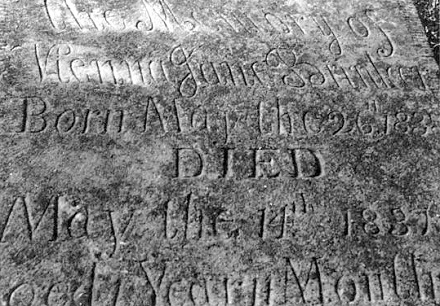
1838: The slave Mary, the youngest executed by Missouri

(Thanks to Meaghan Good of the Charley Project for the guest post. -ed.)

On this date in 1838, a teenage slave girl named Mary was hanged in Crawford County, Missouri. She had murdered Vienna Jane Brinker, a white child two weeks short of her second birthday.

Mary’s original owner was Abraham Brinker, Vienna Jane’s grandfather. Abraham was murdered by Indians southwest of Potosi in Washington County, Missouri in 1833. He died without a will and his widow, Fanny, and son, John, became administrators of his estate. John appropriated Mary for himself and eventually made her the babysitter for Vienna Jane, his daughter.

Mary, described as “shrewd” and “remarkably fond of children,” was “about thirteen” at the time she killed the toddler on May 14, 1837. That day Vienna Jane’s body was found in a stream on the Brinkers’ property. She’d been struck on the head and flung into the water, where she drowned.

Just why Mary committed the murder may never be known,* but she readily admitted killing Vienna Jane — at least, once Mary “was tied to a log” and interrogated with the sheriff, who “began to act as though he were going to whip Mary” — and her guilt was taken as given throughout her surprisingly protracted 15-month legal odyssey. The judge instructed Mary’s trial jury:

If the Jury shall find from the evidence that Mary, the accused person was under fourteen years when she committed the offense alleged in the indictment, then, unless they shall also find from the evidence that at the time when said offense was committed the said Mary had sufficient mind to know what act would be a crime or otherwise, they shall find for the defendant.

The jury found against her and sentenced her to death.

Mary’s lawyers — there were three of them — appealed on several grounds, but her age was not one of them. The appellate court granted her a second trial on a technicality, but she was convicted again and did not appeal further.

Writing of this case in her book Death Sentences in Missouri, 1803-2005, author Harriet Frazier remarks that “Mary remains the youngest known person ever put to death by the authority of the state of Missouri. It is no accident that she was a female and a slave.”

Willard Rand turned her case into a two-act play, The Trial of Mary, a Slave, which was performed in the Crawford County courthouse in 1990.

* This page on Brinker family history mentions speculation that Mary was revenging her own prospective sale, and/or that she might have had an illegitimate child by her master whom the family sold against Mary’s will.

On this day..

1801: Chloe

On this date in 1801, the teenage slave “negro Chloe” — as the press reports almost invariably called her — was hanged at Carlisle, Penn., for murdering her owner’s two young children.

Although a slave by every experience of her short life, Chloe and others of her generation actually existed in a legal twilight space between slave and free. Pennsylvania in 1780 had taken a step towards emancipation that was pioneering for its time but the halfest of half-measures: the Gradual Abolition Act made the children of slaves born in Pennsylvania after 1780 into indentured servants who would be manumitted by age 28.* As a result, dwindling numbers of grandfathered legal slaves remained in Pennsylvania until 1847, even as the state became an antebellum hotbed of abolitionist activism with a huge population of free blacks and slaves fled from Southern plantations via the Underground Railroad.

In Chloe’s case, she had been born to a slave in 1782, then willed when her owner William Kelso died in 1789 to William’s daughter Rebecca, who eventually sold Chloe on to a dealer.

In 1794, Chloe was bought and sold repeatedly: she was sold in July of that year, and then again in August, and then again in October, until an Irish merchant named Oliver Pollock finally bought her in March of 1795 and gave her a little bit of stability. In her eventual last confession, Chloe credited Pollock and his daughter as the only owners who took any care for her education.

Pollock, however, sold Chloe as well at the end of 1796. One wonders if the “high passion” to which she would eventually attribute her murders made her a notably ungovernable slave-child for all these passing masters, or whether it was all just happenstance — that she was just a commodity that could be liquefied in a pinch.

Whatever the case, Andrew Carothers — the man who bought Chloe from Pollock — would be her last master.**

The hard-working Andrew Carothers and his wife, Mary, had a little log cabin in Cumberland County, home to six children. Chloe was their first slave, to relieve Mary of her household labors while Andrew cleared a plot of forested land nearby, and the tone of Chloe’s last confession — widely published at the time of her execution — clearly implies a going resentment for Mary. Chloe will have just turned 18 years old when she commits her capital crimes; she’s grown out of childhood and through adolescence in this family, working as Mary’s constant domestic drudge and probably sleeping in the barn.

On January 24, 1801, the family realized that four-year-old Lucetta had gone missing. Andrew found her dead in the nearby creek where they drew water.

Since we’ve begun our story at the end we know the author of the deed in advance. Chloe would say that she had been given of late to “temptations” to do violence to her owners — sudden fancies that she would unthinkingly indulge. She had already tried and failed to murder the family’s youngest son, she said, and twice attempted to fire the barn.

On that fatal Saturday, Chloe had taken Lucetta to the creek when she needed to retrieve some water without, she said, intending any mischief. But the “temptation” came upon her there and she yielded to it readily, suffocating Lucetta and leaving her in the creek.

By returning nonchalantly and playing surprised that evening, Chloe evaded suspicion in this instance. It wouldn’t have been so implausible that an unattended little girl in a rural family might have fallen into a river and drowned, and a relieved Chloe “promised myself good days” without violent urges.

But, she said, Mary’s strict discipline soon undid those better angels. After Lucetta was buried on Sunday the 25th, Mary “made me strip off my short-gown, and gave me a severe whipping, with a cowskin; also on Tuesday she gave me another, and on the following Saturday she gave me a third.” For one who had so lately experienced the cruel pleasure of visiting lethal violence upon her tormenter’s own flesh and blood, this treatment was too much to bear. That weekend she lured another daughter, six-year-old Polly, to the creek and did her the same way.

Chloe was reported to have forsworn “any spite or malice against” her victims — “on the contrary, I loved them both.”

But, she said, she murdered them because their tattling on her misbehaviors set her up for Mary’s corrective hidings (“far beyond the demerit of the fault”); and, “the second and greatest motive … to bring all the misery I possibly could upon the family, and particularly upon my mistress.”

If suspicion had escaped Mary the first time around, it now insisted upon itself.

Mary’s account of matters also hit the papers; she said that on the Monday following Polly’s death she accused Chloe of the horrible crime. “She [Chloe] said she did not do it, had no hand in it, and full denied it till Monday was a week.” That must have been an excruciating week, doing the wash and preparing dinner with the sullen teenager who you’re also convinced is picking off your family and torturing to that effect. “I was much whipped by my master, to extort a confession,” Chloe recalled. At last the Carothers’ pressure overwhelmed their slave.

I said [to Chloe] it was not worth while to deny it, her countenance would condemn her, it was plain she had a hand in it — it was plain, for the children would have crawled on their hands and feet out of the run if somebody had not held them in … she might as well tell as not — I could not bear the sight of her about the house; I was sure she had done it.

Chloe eventually consented to confess not to Mary Carothers but to a neighbor, Mrs. Clendinen, who had a lighter personal touch and not so much acrimonious history with Chloe. Even so it was still another two weeks before they escorted Chloe to the sheriff. The spiritual instruction that her many owners had never bothered with in her life now became available to her as she approached death — obviously all-inclusive with ghostwriting services as well.

Oh! what have I done? In revenging the injuries I suffered, I have drawn the fierce indignation of heaven upon myself. The voice of the blood of two innocent children crieth against me from the ground. Is my sin too great, for the mercy of God to pardon? Is my stain too deep for the blood of Jesus to wash away? I am full encouraged to trust that, loud as the blood of these innocents cries for vengeannce, the blood of Jesus cries louder still for mercy and pardon and I trust that his unbounded goodness will not suffer me to perish.

The original source of both Chloe’s and Mary Carothers’s accounts are separate 1801 articles in Kline’s Carlisle Weekly Gazette: July 22 (Chloe) and June 24 (Mary). Both were subsequently reprinted by other newspapers around the young country.

* This law inconvenienced the political elites of the early Republic, since it also prohibited importing new slaves — even for the Southern congressmen who came to Philadelphia while that city served as the U.S. capital during the 1790s. George Washington, famous for crossing the Delaware, had to run his black slaves over that river to New Jersey periodically while he was president, lest they become automatically liberated by residing continuously in Pennsylvania for six-plus months.

That said, the Gradual Abolition framework did sustain a market in human chattel inasmuch as somebody’s compulsory labor unto age 28 was still a value that could be calculated and sold. The way to import slaves to Pennsylvania was to bring them in under the same transit auspices that Washington used, legally manumit them there into “indentured servitude” pending their 28th birthday, and then sell the indenture contract.

** John Carothers, Andrew’s cousin, had been poisoned in 1798 with his own wife Mary in another, unrelated Cumberland County death penalty case.

On this day..

1793: Philibert Francois Rouxel de Blanchelande, governor of Saint-Domingue

On this date in 1793, Philibert Francois Rouxel de Blanchelande was guillotined in Paris — victim of two revolutions an ocean apart.

Blanchelande (English Wikipedia entry | French) was a comfortable henchmen of the ancien regime, descended of a marshal.

At the outbreak of the French Revolution, Blanchelande was the governor of the Caribbean sugar colony of Saint-Domingue.

Like other New World colonies, Saint-Domingue’s brutal slave plantations generated vast wealth for the grand blancs, a tiny white oligopoly which was massively outnumbered by its black servile chattel. The demographics made for a perpetual source of conflict and danger — but that was the price of doing business for Europe’s sweet tooth.

The promised liberte, egalite, fraternite of 1789 fell into this tinderbox like a torch.

By 1791, slaves were in full rebellion. Mirabeau had once said that Saint-Domingue’s masters “slept at the foot of Vesuvius”; when it exploded, Blanchelande fell into the caldera with the grand blancs. The slave rebellion quickly overran the western third of Saint-Domingue — the germ of the imminent Republic of Haiti. But the situation on the ground in the early 1790s was extremely fluid, and perilous from the French perspective: Great Britain lurked at nearby Jamaica, scheming to swipe the lucrative island away from its rival amid the chaos. So here Britain accepted Saint-Domingue’s white refugees, and there she treated with black rebels to grant their emancipation in exchange for their allegiance.

The old royal hand Blanchelande was impotent to control the cataclysm with only a handful of troops, and he must have looked increasingly antiquated by the rapid progress of the Revolution too. A 1792 relief force of 6,000 soldiers arrived bearing word of the National Assembly’s too-little-too-late grant of political rights to free blacks, and bearing also Blanchelande’s replacement: a Girondin envoy named Leger-Felicite Sonthonax.

Both these steps were also swiftly overrun by the eruption. Blanchelande returned to Paris and was forgettably guillotined as a counterrevolutionary on April 15, 1793, not long after France and Britain officially went to war. “For losing Saint-Domingo,” Carlyle says a bit dismissively, and maybe that’s even right. But if so the loss reounded to the glory of the Jacobins. The Revolution’s ideals would soon come to mesh with the pragmatics of maintaining the allegiance of Saint-Domingue.

On February 4, 1794 — 16 Pluviose Year II, if you like the revolutionary calendar — the National Convention thrilled to “launch liberty into the colonies” (Danton) with a momentous proclamation abolishing slavery throughout the empire.

Slavery of the blacks is abolished in all the colonies … all men living in the colonies, without distinction of color, are French citizens and enjoy all the rights guaranteed by the constitution.


“Les Mortels sont égaux, ce n’est pas la naissance c’est la seule vertu qui fait la différence…” (Via).

On this day..

1865: Amy Spain, liberation anticipation

This date in 1865, just weeks before the final collapse of the Confederacy, a slave named Amy was hanged on a sycamore tree before the courthouse of Darlingon, S.C., for anticipating her liberty a little too exuberantly.

Mopping up after his march to the sea, Union Gen. William T. Sherman proceeded to South Carolina. After occuping the capital, Columbia, Sherman’s army made a northerly progression towards North Carolina.

In early March, Union Cavalry appeared in Darlington. Our 17-year-old principal, the domestic of a local lawyer named A.C. Spain,* exulted at this arrival.

“Bless the Lord, the Yankees have come!” Harper’s Weekly** would later report her to have exclaimed.

The long night of darkness which had bound her in slavery was about to break away. It was impossible to repress the exuberance of her feelings; and although powerless to aid the advancing deliverers of her caste, or to injure her oppressors, the simple expression of satisfaction at the event sealed her doom.

But the Union men were not long for the town. It was just a scout party; constrained by strategic objectives, and hindered by swollen early-spring rivers, the main body of Union forces passed Darlington by.

Anticipating an occupation that was not about to occur, Amy recklessly declared herself free and took some of the Spain household’s possessions — the fruit of her own involuntary labor. Whatever her exact actions in those days, they were frightfully punished — over the objection of A.C. Spain himself, who reportedly served as her advocate at the rebel military trial that condemned her.

Her persecutors will pass away and be forgotten, but Amy Spain’s name is now hallowed among the Africans, who, emancipated and free, dare, with the starry folds of the flag of the free floating over them, speak her name with holy reverence.

-Harper’s Weekly

* Spain was also a Confederate commissioner to Arkansas at the start of the Civil War, in which capacity he successfully urged Arkansas into the rebel camp.

** Septemer 30, 1865.

On this day..