1837: The slave Julius, property of John and Rebecca Matthews

(Thanks to Meaghan Good of the Charley Project for the guest post. -ed.)

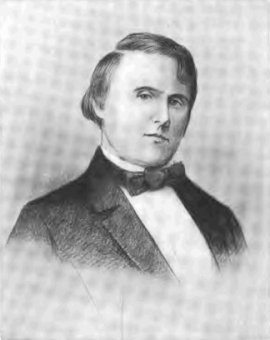
On this date in 1837, a slave named Julius, property of John and Rebecca Matthews, was hanged for the attempted murder of his mistress. He was 20 years old. The story of his crime is told in detail in Lewis L. Laska’s Legal Executions in Tennessee: A Comprehensive Registry, 1782-2009.

Julius was the Matthews family’s only slave and was apparently mentally disabled; Rebecca said he had “but half sense” and John said he “had just sense enough to be a good negro.”

Both John and Rebecca emphasized that Julius was docile, obedient and apparently quite attached to his owners, who had three small children. They were baffled when he brutally assault Rebecca and tried to kill her.

On the day of the attack, John was absent. Julius went out corn-shucking with Littlebury Fallin and his uncle William Fallin, both of them white men. He came home at 6:00 p.m., drunk, did some household chores and made a large fire in the fireplace.

At 7:00, Rebecca heard some whistles outside the house and asked Julius what was going on. He said he didn’t know. He went outside and returned with an ax, saying he would use it to defend Rebecca if they were attacked. Rebecca locked the doors and windows, then sat at her spinning wheel for awhile.

When she bent over to pick something up, Julius grabbed her by the throat and said he was going to kill her, take all the money in the house and run away to a free state. He tried to throw her into the fireplace, saying he’d made the fire to burn her body.

There followed a fierce struggle and Rebecca put up a good fight. She was able to wrestle the ax away from her attacker, unlock the door and run outside. Julius tried to brain her with a large rock but he dropped it when she grabbed his arm. He then tried to stab her with a pocketknife but wound up accidentally cutting his own throat instead. Rebecca wrapped her hands around his neck and choked him until she felt him lapse into unconsciousness.

Then she grabbed her youngest daughter, age three, and legged it for a neighbor’s house. As she ran she noticed Littlebury and William Fallin right behind her.

In the state of Tennessee, even a slave was entitled to a lawyer at a criminal trial. John Matthews refused to appoint counsel for Julius, so the state appointed two lawyers to defend him. (One of them, Alfred O. P. Nicholson, would later serve two terms in the Senate and, after that, on the Tennessee Supreme Court.)

Julius expressed great remorse for his crime, saying he would never have done it sober and he wished Rebecca had killed him. At his trial, he confessed everything and implicated the Fallins, saying that they’d gotten him drunk during the corn-shucking and urged him to rob and kill his mistress.

William, who lived in Kentucky, promised to help him get to a free state. The whistles, Julius explained, had been signals from the Fallins that they were outside the cabin waiting for him to kill Rebecca.

Littlebury testified and denied everything. William did not testify. Neither man ever faced charges for their alleged role in the crime.

The jury convicted Julius after deliberating overnight, but they recommended mercy on account of his youth, his prior good character and the suspicion that he had been lead astray by others. Nevertheless, the sentence was death.

As Julius was awaiting his execution date, help came from an unlikely source: John Matthews, his owner and the husband of the victim. He wrote to the governor, Newton Cannon, asking that the errant slave be pardoned so Matthews could sell him. He listed the following reasons:

  1. The negro is shown to have had a most excellent character.
  2. He was quite young.
  3. He was proved to have but a very limited portion of intellect.
  4. He was shown to be in liquor and the circumstances raised a strong presumption that he was induced by white men to drink for the very purpose of being instigated to commit the murder.
  5. The circumstances rendered it certain that he was instigated by white men, and with his already-impaired sense, and in liquor, that he was almost a passive instrument in their hands.
  6. He was the only slave of his master.

That last might have been the nub of it. Matthews emphasized that if Julius were hanged and his owners got no compensation — and the state of Tennessee never compensated an executed slave’s owner for the economic loss — the family would suffer greatly. This created an odd confluence of interest between the condemned slave and the one-slave family whose matron he had attempted.

John Matthews expressed confidence that Julius “was not himself when he did the act” and added that it seemed unreasonable “to take away a life when no murder had been committed.”

Going against Matthews’s letter was a petition from the citizens of Maury County, asking that justice take its course and Julius be executed. Julius had had a fair trial, the petition said. Sparing his life and merely selling him on would not only endanger public safety but would also set a bad example for other slaves: “For what is to restrain the slave from imbuing his hands on his masters’ blood, with whom he is incensed, if he had good reason to believe that his punishment, if caught, is to only be a change of masters, and a chance that the may be for the better?”

The governor ignored John Matthews’s plea and upheld the rule of law: Julius was hanged at 2:30 p.m. on March 1, and his master was not reimbursed. On the scaffold, the young slave “confessed his guilt, and deplored his error; spoke of his mistress with much tenderness and warned the colored persons present to remember his fate.”

On this day..

1862: Nathaniel Gordon, slave trader

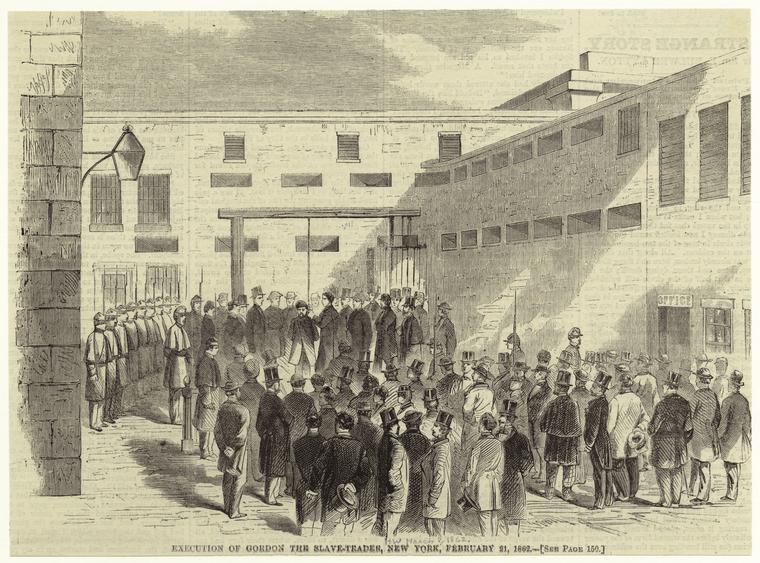
On this date in 1862, the American commercial shipper Nathaniel Gordon was hanged at the Tombs for slave trading.

Importing slaves to the U.S. had been nominally illegal for over half a century, but had never been strongly enforced. In 1820, slaving (regardless of destination) had even been defined as piracy, a capital crime.

Importation of kidnapped Africans into the United States did significantly abate during this period, and that was just fine with U.S. slaveowners ever paranoid of servile rebellion.

But a voracious demand for conscript labor persisted elsewhere whatever the legal situation. About 3 million slaves arrived to Brazil and Cuba, the principal slave shipment destinations, between 1790 and 1860 — even though the traffic was formally illicit for most of this time.

Great Britain was endeavoring to strangle the Atlantic slave trade, but the diplomatic weight she had to throw around Europe didn’t play in the U.S. Washington’s adamant refusal to permit the Royal Navy to board and search U.S.-flagged ships made the stars and stripes the banner of choice for human traffickers profitably plying the African coast. “As late as 1859 there were seven slavers regularly fitted out in New York, and many more in all the larger ports,” one history avers.

Hanging crime? No slave-runner had ever gone to the gallows as a “pirate” — not until Nathaniel Gordon.

The U.S. Navy did mount its own anti-slaving patrols, but the odd seizure of human cargo was more in the line of costs of doing business than a legal terror for merchants.

So Gordon, son of triangle trade port Portland, Maine and a veteran of several known slaving runs, didn’t necessarily think much of it on August 8, 1860, when the Mohican brought Gordon’s ship to bear 50 miles from the Congo with 897 naked Africans stuffed in the hold, bound for Havana. Half of his slaves were children.

“The stench from the hold was fearful, and the filth and dirt upon their persons indescribably offensive,” Harpers reported.

Gordon chilled in very loose confinement in the Tombs, even enjoying family leave furloughs as he readied for the customary slap on the wrist.

But with Abraham Lincoln’s election in 1860, Gordon was promoted to demonstration case.

After a hung jury in June 1861, the feds won a conviction and death sentence on those long-unused piracy laws in November 1861.

Many New Yorkers were shocked at the prospect of such draconian punishment.

Abraham Lincoln found himself besieged by appeals public and private against the unprecedented judgment. “For more than forty years the statute under which he has been convicted has been a dead letter, because the moral sense of the community revolted at the penalty of death imposed on an act when done between Africa and Cuba which the law sanctioned between Maryland and Carolina,” Gordon’s counsel Judge Gilbert Dean wrote in an open letter to the President* — an argument that could hardly be more poorly calibrated to impress in 1862.

Despite Lincoln’s famous proclivity for the humanitarian pardon, he stood absolutely firm on the precedent Gordon’s hanging would set — especially in the midst of a bloody civil war driven by the very legal sanction Dean had cited so approvingly. As Lincoln wrote on February 4, 1862,

I think I would personally prefer to let this man live in confinement and let him meditate on his deeds, yet in the name of justice and the majesty of law, there ought to be one case, at least one specific instance, of a professional slave-trader, a Northern white man, given the exact penalty of death because of the incalculable number of deaths he and his kind inflicted upon black men amid the horror of the sea-voyage from Africa.

Gordon’s hanging was the one case — the only one ever.

* New York Times, Feb. 21, 1862.

On this day..

1759: William Davis, St. Croix slave revolt suicide

On the morning of December 14, 1759, William Davis succumbed to a self-inflicted wound rather than face St. Croix’s harsh justice for an alleged slave rising plot.

They strung up his remains just the same.

St. Croix, today part of the U.S. Virgin Islands, was at the time a Danish colony.* As with other Caribbean islands, its economy catered to the lucrative new European taste for sugar — powered by human bondage.

“The establishment of the sugar industry created the demand for labor in the West Indian islands,” Eric Williams wrote. “It was a choice, from the sugar planter’s point of view, of Negro labor or no labor at all. Sugar meant slavery.”

It was, in fact, sugar which raised these insignificant tropical islands from the status of pirates’ nests to the dignity of the most precious colonies known to the Western World up to the nineteenth century …

Tremendous wealth was produced from an unstable economy based on a single crop, which combined the vices of feudalism and capitalism with the virtues of neither. Liverpool in England, Nantes in France, Rhode Island in America, prospered on the slave trade. London and Bristol, Bordeaux and Marseilles, Cadiz and Seville, Lisbon and New England, all waxed fat on the profits of the trade in the tropical produce raised by the Negro slave. … Sugar was king; without his Negro slave his kingdom would have been a desert.

For those in King Sugar’s castle this desert stuff was no mere metaphor, but life and limb itself. They trafficked fantastical wealth from the shores of tiny islets where they took their sleep surrounded by a vastly more numerous** servile population whom they controlled ever so delicately. Just let the serfs of such a manor commence a jacquerie

White planters’ vulnerability to a potential slave revolt, dramatically underscored by a 1733 revolt on neighboring St. John, bred great paranoia about imagined plots: a casual word here or there could be heard as a seditious murmuring, and then a politically motivated judicial machinery of torture, hearsay, and panicked accusations set into motion. It can be maddeningly difficult from the distance of centuries to weigh the truth value of a supposed slave plot strangled in the crib. Intrepid resistance? Or phantom from the planters’ nightmares?

Either way the slaves wound up just as dead.

We have the story of this revolt’s suppression from one of the judges, Engelbert Hasselberg, and this naturally constrains our view. Hasselberg wrote up his report, complete with an index of all the slaves punished, for eyes in Copenhagen. He’s certain that there really was an intended rising, even as he acknowledges a want of firm evidence: “many of the conspirators have refused to confess anything at all, although there has been sufficient evidence against them, insofar as it may be called evidence at all, where rogues have plotted and been the sole witnesses.” That is, a few people’s highly questionable accusations/confessions† sustained the entire affair.

But the story must have had the judges’ hearts in their throats.

Each [Negro] was if possible to slay his master or foreman; next, those whose masters’ plantations lay in the Christianstaed district, were to gather on Colleman’s plantation … and those Negroes who belonged to the West-End, were to assemble at the West-End fort, and first take possession of Fort Friderichswaern and of all the ammunition there to be found. Thereupon all those who had procured weapons were to march to Christianstaed, setting the plantation[s] on fire on the way, and killing or burning all whites who collected to put out the fires, and finally to storm [Fort] Christianstvaern.

Hasselberg’s report begins, oddly enough, by meditating that “the greater part of the slaves on colonies as recently developed as St. Croix are free-born, and have therefore just as good claim to their freedom as we have to ours. One or other fateful occurrence has brought them out of that natural equality which at birth they enjoyed with us, and made those persons our slaves who by a contrary event might have become our masters. What wonder then that such persons seek their freedom when they are provoked by the unreasonable conduct of unwise masters, and when they believe that the enterprise is not impossible.”

For Hasselberg this freely acknowledged natural inclination is not so much a systemic critique as a management challenge, and he expands on the talents required by the slaveowner to extract surplus-labor without “expos[ing] himself to resentment”, while not neglecting to request that Denmark increase its subsidy to St. Croix.

The enterprise was exposed by a few stray remarks from a quarrelsome slave.

It was in the month of December, 1759, that 2 white men, Matthias and Benjamin Bear, were molding bullets on Sr. Soren Bagge’s plantation. A Negro slave by the name of Cudjo, working at that time on Bagge’s plantation, asked Benjamin Bear to give him some of the bullets as a present, but as he was unable to give a proper account of what he was going to do with them, Bear gave him none. But Matthias, who did not think so far ahead, gave Cudjo a dozen bullets while Bear had stepped aside. Bear learned about it, and in the afternoon of the same day, he said to Cudjo, in the presence of a white man, Peter Hyde, and of a number of other Negroes, that he had heard that Matthias had given him some bullets, but he, Cudjo, had better look out, or his head might some day be found lying at his feet. To this, Cudjo replied, addressing himself to the 2 white men, Benjamin Bear and Peter Hyde, “You look out that some of your heads won’t lie at your feet pretty soon.” Peter Hyde then asked, “Whom will you then kill?” and Cudjo replied, “You shall be the first that I shall kill.”

The day before this conversation took place between Bear, Hyde and Cudjo, the Cudjo aforementioned had said concerning Mr. Bagge’s plantation house, “Maybe that house will be mine in a short time,” to which one of Bagge’s Negroes, namely Will, replied, “God damn you, you can’t keep a secret.” The same day Cudjo had asked B. Bear how long it would be until Christmas, and when Bear asked Cudjo why he wanted to know this, he answered, “I am asking about it, as I hope by that time to be a little Petit Maitre.”

Bear and Hyde reported the conversation and under questioning on December 11, Cudjo and his blood brother started revealing details of a slave rebellion in the offing — scheduled to capitalize on whites’ distracting Christmas celebrations. William Davis, a free black, was its supposed instigator.

Davis was under interrogation the very next day. The particular suspicion he was under would have instantly impressed him as placing him in the gravest peril; when induced with a plea bargain-type offer to merely suffer banishment, he “made a frank confession” and “exposed the whole dessein, and gave the names of quite a number of Negroes, some of whom have been found guilty and others acquitted.”

Hasselberg’s categorical assertion that Davis’s plea-induced statement was a “frank confession” doesn’t square comfortably either with Davis’s subsequent attempt to repudiate the “confession” or with the acknowledged denials and acquittals of most of the people he named. Perhaps this speaks well of St. Croix’s judicial restraint, but what might actually have been afoot for Christmas 1759, and how many people it might have involved, is heavily conjectural.

Not least because Davis — in remorse for naming names, perhaps, or else not trusting his captors’ assurance of humane treatment — took any subsequent remarks to an early grave.

[H]e managed to cut his throat in the morning of December 13, while in the fort. The wound was not considered dangerous by the surgeon, and he was immediately bound. He made various confessions after that time, but on the following night, he tore the bandage from his neck, cursed and scolded those who approached him, and swore that if they cut him up piece by piece, and roasted on the fire, he would nevertheless confess nothing. On the following morning, December 14, he died, and he was made an example of.

Hasselberg is not completely explicit here that the posthumous punishment occurred on that same day Davis succumbed, but he does not mince words when it comes to the example itself.

His dead body was dragged through the streets by a horse, by one leg; thereafter hanged on a gallows by a leg, and finally taken down and burned at the stake.†

By Hasselberg’s accounting, Davis was just the first of 14 people hanged, burned, broken on the wheel, or “set up in a gibbet or iron cage” to die of thirst and exposure.§

* St. Croix’s most famous denizen for posterity at this hour was a very small child named Alexander Hamilton.

** Of the British territory Nevis, one late 18th century chronicler remarked, “the present number of whites is stated not to exceed six hundred, while the negroes amount to about ten thousand; a disproportion which necessarily converts all such white men as are not exempted by age and decrepitude into a well regulated militia.” According to Hasselberg, the ratio on St. Croix was 1,690 whites to 11,807 blacks.

† The first slave to provide a corroborating account, one Qvamina, received his freedom and 50 rigsdalers in a conspicuous ceremony performed in front of other slaves.

‡ All translations are via Waldemar Westergaard in “Account of the Negro Rebellion on St. Croix, Danish West Indies, 1759” in The Journal of Negro History, January 1926.

§ William Davis was the first; the full roster of additional executions in Hasselberg’s report:

2. Franch (or French), free negro, convicted by witnesses, but confessed nothing himself.

He was broken on the wheel with an iron crowbar, laid alive on the wheel, where he survived 12 hours. The head was then set on a stake, and the hand fastened on the gallows.

3. Prince Qvakoe, belonging to his Majesty, convicted by witnesses, and has confessed being implicated.

Was executed in the same way as Franch and lived 2 hours.

4. Cudjo, belonging to Doran, is convicted by witnesses, and has himself confessed.

Was burned alive on a pyre, lived in the fire 4½ minutes.

5. Gomas, belonging to John Bradshou, is convicted and has confessed.

6. George, belonging to James Hughes, has confessed and is convicted.

Both these negroes (5 and 6) were first pinched with hot tongs, then hanged by the legs in a gallows, and a dog likewise, by the neck, between them. Gomas lived ½ an hour and was strangled; George lived 3 hours and was strangled.

7. London, belonging to Thomas Lacke, is convicted and has himself confessed.

He was first pinched with glowing tongs, then hanged up by the legs, lived 12 hours and was strangled.

8. Sam Hector, belonging to Pieter Heyliger, Senior, is convicted by witnesses, but has confessed nothing himself.

He was set up in a gibbet or iron cage and lived 42 hours.

9. Michel, belonging to Hugh O’Donnell, is convicted by witnesses, but confessed nothing.

Got the same punishment as Sam Hector, lived 91 hours.

10. Will, belonging to Soren Bagge, is convicted by witnesses, but made no confession.

Was burned alive, lived in the fire 14 minutes.

11. George, belonging to John Cookly, confessed and was convicted by witnesses.

He was pinched with glowing tongs and hanged by the neck.

12. [Name not given], belonging to Manan Rogers, is convicted by witnesses, and made a partial confession.

Was set up in a gibbet from January 18, at 3:30 p.m. to Jan. 27, 8:30 a.m.

13. Sylvester, belonging to James Conningham, has confessed and been convicted by witnesses.

He was burned alive, and lived in the fire 4½ minutes.

14. Jupiter, belonging to W. Burnet, has confessed and been convicted by witnesses.

He was burned alive, and lived in the fire for 1½ minutes.

On this day..

1797: Figaro the Elder and Jean Louis, Charleston slaves of Dominguan exiles

On this date in 1797, two French slaves were hanged in Charleston for plotting rebellion.

This plot was the product of the liberation-minded aftermath of the Haitian Revolution … although whether the product was in the minds of the slaves, or those of the paranoid slaveowners, is still up for debate.

As the great slave revolution unfolded, many of Saint Domingue’s white planters had fled abroad. Charleston, South Carolina was a major destination, one of several Atlantic cities in the U.S. that received these refugees in quantity* — lugging along as many slaves as they could. “My Fellow-Citizens know your goodness,” said one of their number in an address to the South Carolina legislature, “and anticipate the Share you are about to take in their Calamities.” The state government accordingly granted relief money to these put-upon immigrants; the British themselves are thought to have been kicking into the relief kitties in Charleston as part of 18th century covert ops to check the spread of Jacobinism.

With the Haitian Revolution and its beneficiaries aligned (for the moment) with the French Revolution,** these French exiles fit right in with pro-British federalists to a continental reactionary backlash.

Revolutionary France’s consul in Charleston (he was U.S. ambassador by the time of the events in this post) maneuvered against that city’s planter exiles (“colonial aristocrats,” as he called them†) and eyed hemispheric emancipation, according to this book.

Yet the very flight of Saint Domingue planters also brought like a contagion the idea and experience of successful revolt in the breast of those refugees’ own chattel slaves … and in the midnight terrors of those slaves’ owners. As early as August 1793, rumor gripped Charleston that a slave revolt was in the offing. Jittery Southern states began passing laws to restrict slave imports from the West Indies who might be carriers of the virulent dream of liberty.

It was in this context that Charleston authorities discovered in 1797 “a conspiracy of several French Negroes to fire the City and to act here as they formerly done at St. Domingo.”

These several Negroes denied the plot, for a while.

Eventually, and surely encouraged by what me might today dignify “enhanced” interrogation, one of them turned state’s evidence. This “Figaro the Younger” — there were two named Figaro arrested for this same plot‡ — was the property of one Jacques Delaire, one of the Dominguan community’s more belligerent aristocratic grandees. Figaro the Younger’s evidence, though only a “partial confession” was enough to doom two of his fellows.

After the condemnation of Jean Louis, he turned to the two Figaros and said, “I do not blame the whites, though I suffer, they have done right, but it is you who have brought me to this trouble.”

(A French freedman named Mercredi hanged for the same affair a week later.)

For testifying against his mates, Figaro the Younger saved his own life and was sentenced to be transported to Suriname. En route, the pressure of his leg irons caused “a swelling about the ankles which turn’d into a sore & … a mortification of the flesh ensuing his toes rotted & one of his feet drop’d of[f] entirely.”

The southern anti-slavery cause was soon crippled, too.

Especially after the 1800 Gabriel Prosser revolt, any dalliance with emancipation, republicanism, revolution, became practically unutterable, as if to speak the words would conjure up the flames of Cap-Francais. “Beyond a reasoned fear of domestic insurrection seems to have lain a desire to banish the reality of St. Domingo,” as Winthrop Jordan put it.

But the threat and the example of Haiti long stalked the imagination of those caught in the toils of the South’s peculiar institution. And more literally than that, as Robert J. Alderson notes,

Captain Joseph Vesey … was [one] of the dispensers of [refugee relief] aid, [and] many Domingan refugees made calls on him. When the Domingan planters visited, their slaves had a chance to speak with one of Captain Vesey’s slaves, Denmark Vesey.

* For example, see Gary Nash, “Reverberations of Haiti in the American North: Black Saint Dominguans in Philadelphia” in Pennsylvania History, Vol. 65 (1998). Philadelphia was at the time still the U.S. capital.

** Said alignment between revolutionary Haiti and the mother country was, of course, tenuous and not permanent.

There’s a report in the Paris archives from this period of the French consulate’s low opinion of Charleston’s Dominguans: “tricky people, at the end of their resources that vengeance towards their country and despair may lead to anything. Among the French whom we have here, there are some very good patriots who know what the hospitality of the country demands of their gratitude, but the number is small.”

‡ The Figaro plays and some of their operatic adaptations were culturally current in the 1780s and 1790s. That includes Mozart’s Marriage of Figaro but not yet Rossini’s Barber of Seville with its definitive Figaro aria … although such would be very poor excuse not to post the latter.

On this day..

1844: Gabriel de la Concepcion Valdes, “Placido”

On this date in 1844, Cuban poet Gabriel de la Concepcion Valdes was executed in Matanzas for conspiring to overthrow Spanish authority on the island.

His mother (who gave him up to an orphanage) was a Spanish dancer. His father (who adopted him back) was a “quadroon” barber. Valdes, aka Placido (Spanish link, which is true of most available online resources about him) grew up as a free mixed-race youth in a slave society.

This situated him in the privileged (relative to plantation slaves) but precarious position of the petty bourgeoisie, menaced not only by the prospect of economic reversal but by the vicissitudes of Spanish policy towards his caste — whose growth many colonial officials fretted warily.

Though Placido made his bread apprenticing as a print-maker and later making turquoise combs, he made his fame by dint of literary gift that was celebrated throughout Cuba and abroad. His “La siempreviva” won a literary competition when he was just 25, and led to an invitation to visit Spain (Placido declined it); the Cuban-born, naturalized Mexican poet Jose Maria Heredia visited Cuba in 1836 and made a point to look up Placido; and according to the out-of-print Cuba’s Romantic Poet: The Story of Placido by Frederick Stimson, the young Cuban was wildly popular with North American slavery abolitionists as well.

Placido is less well-remembered beyond his home island today, but arguably rates as Cuba’s most distinguished Romantic poet.

In the 1830s especially, when civil war in Spain put the reigning monarch on the liberal side, Placido was able to exploit the opening to write openly of Cuban political aspirations.

His La Sombra de Padilla, dedicated to Spain’s “wise and exalted Queen”, imagines one of Spain’s martyred comuneros charging him to venture his life for liberty against absolutism.

Better to fall prey to La Parca [the Grim Reaper]
Than to a despotic Monarca

But notwithstanding the war in Iberia, the exalted Queen still put Cuba under special (read: repressive) law. Placido’s prominence, having advocated for much more freedom than Cuba was slated to enjoy, subjected him to automatic Spanish suspicion as more authoritarian governance arrived in the 1840s.

The poet was arrested in the Conspiración de La Escalera (Conspiracy of the Ladder, so named for the structure its accused were tortured upon). This purported plot to raise a slave revolt may or may not (pdf) have really existed, but the crackdown it authorized sure did. Indeed, despite the “slave revolt” bogeyman, it was overwhelmingly free blacks whom the Spanish suppressed in this affair.

Gariel de la Concepcion Valdes, known as “Placido”, was shot with ten others, “miserable instruments of the most depraved machinations of immoral men, men who deserve the curse of the living and the opprobrium of generations to come,” just a week after his conviction.

The appointed lot has come upon me, mother,
The mournful ending of my years of strife,
This changing world I leave, and to another
In blood and terror goes my spirit’s life.

But thou, grief-smitten, cease thy mortal weeping
And let thy soul her wonted peace regain;
I fall for right, and thoughts of thee are sweeping
Across my lyre to wake its dying strains.

A strain of joy and gladness, free, unfailing
All glorious and holy, pure, divine,
And innocent, unconscious as the wailing
I uttered on my birth; and I resign

Even now, my life, even now descending slowly,
Faith’s mantle folds me to my slumbers holy.
Mother, farewell! God keep thee — and forever!

-Valdes, “Farewell to My Mother”

There are volumes of Placido’s poetry (in the original Spanish) freely available via public-domain Google books offerings here and here, with a short thumbnail biography here. For the nonfiction biographical exploration of Placido’s life, and detailed critical analysis of his poetry, this Vanderbilt master’s thesis (pdf) is highly recommended.

On this day..

1784: Jean Saint Malo, New Orleans Maroon

On this date in 1784,* Jean Saint Malo was hanged in the New Orleans square that’s since been christened Jackson Square, after American president Andrew Jackson.

Saint Malo, the namesake of a 19th century fishing village that formed perhaps the first Filipino settlement in the U.S., was the leader of outlaw settlements of escaped slaves who found refuge in the French colony’s bayous.

“Prior to the sugar boom,” writes Daniel Rasmussen in his well-received American Uprising, “New Orleans was a poor, multi-cultural city with very few social controls.”

The lines between slavery and freedom were not clearly drawn, and slaves frequently escaped into the swamps to form maroon colonies. There was a history of armed resistance in these areas that drew on French, Creole, and Kongolese traditions. These insurrectionary traditions shaped the lives of the slaves and represented an alternative political culture to that of the planters.

As testimony to that hazy line, Saint Malo had widespread support not only from the escaped slaves who joined him, but from those that remained on plantations. The communities were linked by blood and by trade; attempts to send creole militias out to hunt the maroons tended to founder on the draftees’ fear of retaliation by the kith and kin of their targets.

According to Gwendolyn Midlo Hall, Saint Malo’s prosecutor complained that slaves would grumble, affront their masters, leave land uncultivated … and that owners dared but few disciplinary measures lest they disappear into the swamps.

“Malheur au blanc qui passera ces bornes” (“Woe to the white who would pass this boundary”), was the declaration attributed our man, burying an ax dramatically into a tree outside his largest village, Ville Gaillarde. (The maroons lived in permanent settlements.)

It took several years, several tries, and more than several casualties for Louisiana planters to finally bring Saint Malo’s maroons to heel. And when they did — well, the dirge recorded from a fellow maroon (as related in Creole New Orleans: Race and Americanization) describes Malo’s fate.

Alas, young men, come make lament,
For poor St. Malo in distress!
They chased, they hunted him with dogs,
They fired a rifle at him.
They dragged him from the cypress swamp.
His arms they tied behind his back.
They tied his hands in front of him.
They tied him to a horse’s tail.
They dragged him up into the town.
Before those grand Cabildo men.
They charged that he had made a plot
To cut the throats of all the whites.
They asked him who his comrades were.
Poor St. Malo said not a word!
The judge his sentence read to him,
And then they raised the gallows tree.
They drew the horse — the cart moved off
And left St. Malo hanging there.
The sun was up an hour high
When on the levee he was hung.
They left his body swinging there
For carrion crows to feed upon.

* Coincidentally, June 19 would later become Juneteenth, marking the end of slavery in the United States at the conclusion of the Civil War.

On this day..

1860: John Guthrie, antislavery horse thief

On this date in 1860 in “Bleeding Kansas” — the frontier zone of dirty war by and against the Slave Power where John Brown got his start — a man named John Guthrie was hanged under scant-to-no color of law.

The site of this execution is still known as Guthrie’s Mountain or Mound … and it’s even alleged that the spot is still ill-omened by the event, and that the dying Guthrie “assailed his executioners for lynching an innocent man,” prophesying that “each of them would meet a horrible death” which curse the imminent U.S. Civil War carried into effect.

For a fuller account, see this pdf of a 1982 Kansas History article, “Guthrie Mound and the Hanging of John Guthrie”.


I know a story I think worth preserving of a Bourbon county execution without benefit of clergy, but it was not a lynching. I have had the story from a lot of people, including two eyewitnesses — not participants, of course. Away back in the later territorial days, when Bourbon county was in the ‘region beyant the law,’ a young man named Guthrie was caught up near Mapleton riding somebody else’s horse. Everybody knows that at that time in those parts, horse stealing and nigger chasing and homicide were offenses in a class by themselves. The hardheaded and hard-fisted farmers thereabouts gathered in a hurry. But there were no courts that they respected or had reason to respect. What to do?

Just across the river south of Mapleton in the Little Osage bottom is a little round hill about three hundred feet high shaped almost exactly like an overturned soup bowl. They adjourned to the top of that hill. There they elected a judge and a sheriff and a prosecuting attorney. They selected a jury and tried their man, who admitted his guilt. After the verdict and the proper sentence, the sheriff had no place to keep the man, so he executed the sentence at once by hanging him to the limb of a jack oak tree nearby. His body was buried where it was cut dawn. It is there yet.

From what I have been told I am quite satisfied that that trial was quite as regular and formal as many cases in the regular courts of that day, though not sanctioned by the law.

By the way, that hill is the same ‘pretty little hill’ where Lieut. Zebulon M. Pike ate the fried venison steak that September morning in 1806, as he notes in his journal. It is still called Guthrie mountain, and is one of the real beauty spots of old Bourbon.

C.E. Cory, 1932

The horse-thief story has different versions, in which Guthrie is either innocent of the charge or not. For what it may be worth, the 1860 New York Times also reported a “very imperfect” version of this take.


However, there’s at least one primary document suggesting that “thieving” may have been a pretext for killing the man over his anti-slavery stance.

Mapleton, K. T., Feb. 12, 1860. “MY DEAR PARENTS: … Last Sunday night about 1 o’clock a man named John R. Guthrie was hanged about a mile and a half from here on the top. of what is known as Tigret Mound. He was left suspended until Monday eve. His corpse was in plain sight from here as he hung. The proslavery’s hung him for an alleged crime of horse stealing. They arrested him without authority or shadow of law and never gave him even a mock trial, as has generally been the case. The country is again in commotion. I know not what will be the result, the probability is that unless Montgomery takes the field again it will soon blow over and give them a chance to hang the next ones that gets in their way.

Free Stater (i.e., anti-slavery) Alpheus H. Taylor

On this day..

1799: Isaac Yeshurun Sasportas, anti-slavery insurrectionist

On this date in 1799, Portuguese Jew Isaac Yeshurun Sasportas was publicly hanged in Kingston for attempting to incite a slave revolt in the British colony of Jamaica.

Here in a revolutionary age, probably no insurrection could terrify Europe’s ancien regimes like the Haitian Revolution.

History’s most successful slave revolt, the rising that seized Saint-Domingue from the French conceivably threatened — if it should spread — the entire material foundation of Europe’s colonial exploitation, and the racist intellectual superstructure that justified it.

This nightmare of crowned heads was also the dream of the epoch’s visionaries, and the subject of a struggle whose victims included Isaac Yeshurun Sasportas among many, many others.

Domingue if I do

An insurrection of Caribbean slaves against European exploiters had obvious appeal to their brethren groaning at the bottom of the Atlantic economy. In “Saint Domingue in Virginia: Ideology, Local Meanings, and Resistance to Slavery, 1790-1800” (Journal of Southern History, Aug. 1997) James Sidbury explores the (to whites) nerve-wracking arrival in that U.S. state of both news and refugees from revolutionary Saint-Domingue.

In 1793 Willis Wilson complained to Governor Lee of the “defenceless situation” of the town of Portsmouth, whose militia lacked arms and whose streets contained “many hundreds [of] French Negroes” including, Wilson had been “inform’d,” many who “belong[ed] tothe insurrection of Hispaniola.” … a commander at the state arsenal of Point of Fork — located on the James River west of Richmond and southesat of Charlottesville — reported dangerous “conversations amount the “people of colour” … “particularly since the Arrival of the French from C[ap] F[rancois],” Saint Domingue.

While these currents carried along Gabriel Prosser and a young Denmark Vesey, they also swept up men who were not slaves at all.

Isaac Sasportas, the nephew of a prominent Charleston trader (said trader’s 200-year-old home still stands there), was himself a wealthy Caribbean shipper who in the 1790s seems to have taken a nearly professional interest in revolution. After trying and failing to re-ignite a rebellion in Dutch Curacao, he started zeroing in on Haiti’s next-door neighbor, the brutal British sugar colony of Jamaica. Distinguished as it was by a running history of slave revolts, it was a natural target for the fin de siecle‘s savvy revolution-exporter.

Sasportas landed there in 1799 under cover of his gadabout-merchant act to reconnoiter British defenses and make contact with the island’s maroons.

Diplomatic L’Ouverture

The Haitian Revolution’s progress through the 1790s and into the first years of the 19th century was itself a complicated political process entailing the realest of realpolitik. Here was a colony surrounded by rival empires’ outposts, whose home country was itself engulfed in revolution. This could, and did, cut a lot of different ways.

Legendary national liberator Toussaint L’Ouverture agreed to work with the French revolutionary government in April 1793 to repel the inroads of Brits, who smelled an opportunity to swipe the lucrative colony. Alliance with the French (L’Ouverture’s black regiments served under French colors) came in exchange for the French recognizing emancipation. Win-win.

But the script had flipped by the last years of the decade.

Toussaint L’Ouverture reveals to British officer Thomas Maitland papers from the French representative d’Hedouville.

In 1798, the British were evacuating their Saint-Domingue enclaves … and L’Ouverture, now the Bonaparte figure of a somewhat autonomous polity, had to maneuver it regionally vis-a-vis its neighbors.

Fomenting slave rebellions willy-nilly was not on his agenda. Indeed, “one could even describe Louverture, in the diplomatic field, as an active impediment to the spread of emancipation.”*

So far was the former slave L’Ouverture from anti-slavery firebrand that in 1798-99 he made arrangements with the slave powers Britain and the United States, helping them oppose the French. And when the French envoy went to work on the grab-Jamaica scheme with Sasportas as an agent — Paris now being the one to smell an opportunity to steal a rival’s colony — L’Ouverture found it expedient to play along whilst quietly tipping the British to the whole plot. In effect, L’Ouverture shopped Sasportas.

Louverture could have used his newfound power to advocate independence and emancipation across the Caribbean; he decided otherwise.

Napoleon Bonaparte and other French leaders hoped that Louverture would turn Saint-Domingue into the centerpiece of a revolutionary French empire in the Americas. With an army of twenty thousand veteran black soldiers, Louverture could have threatened France’s enemies in North America, most notably British Jamaica and the United States. But Louverture declined the offer, choosing instead to sign secret treaies of nonaggression and commerce with these two countries in 1799 …

That same year, the French agent Roume drafted an ambitious plan to use part of Louverture’s army to invade British Jamaica. After the landing, Roume redicted, Jamaica’s slaves would revolt and join local maroons and Dominguian liberators on a victorious march to Kingston. Dominguian troops would become heralds of freedom, France would acquire a lucrative colony at little cost, and the expedition would deal a mortal blow to British commerce. Louverture acquiesced in public, but in private he notified British and U.S. authorities of Roume’s bellicose plans. England subsequently captured France’s secret agent in Jamaica, a French Jew named Isaac Sasportas, and the entire venture foundered. Having apparently concluded that an expedition would divert key troops and resources that were needed to secure his power base in Saint-Domingue, Louverture chose to sacrifice the Jamaiacans’ freedom on the altar of his own ambitions. Jamaican slaves would remain in bondage until 1834.

– From Haiti: The Tumultuous History — From Pearl of the Caribbean to Broken Nation

Haiti the Game

Whether one rates it as dextrous statecraft or unconscionble betrayal, L’Ouverture’s maneuvering to maintain a scope of action for himself and his fledgling nation would continue until 1802. It featured brutal continuation of Haiti’s cash crop plantation economy — now worked by cultivateurs supporting black elites, instead of slaves supporting French elites — rough suppression of labor protests, high-minded assertion of racial equality, and unsentimental diplomatic skullduggery shifting arrangents among France, Britain, and the U.S. He even bought slaves to regenerate the half-island’s labor force, decimated by years of warfare.

In the end, this Bonaparte of Haiti was undone by the Bonaparte of France** in 1802, with the full support of the British. During a lull in those nations’ hostilities, they found frank agreement that “Toussaint’s black empire” was to neither’s liking — and “We both want to destroy Jacobinism, especially that of the blacks”.† L’Ouverture played the diplomatic game very adroitly, but he had no card to match a mutual agreement of white privilege among his opposite numbers.

Toussaint L’Ouverture died of pneumonia in a French dungeon … but his countrymen rallied against the French incursion and completed the Haitian Revolution. Its independence day is January 1, 1804.‡

* Philippe R. Girard, “Black Talleyrand: Toussaint Louverture’s Diplomacy, 1798-1802,” The William and Mary Quarterly, Jan. 2009

** Napoleon’s wife Josephine was herself of Caribbean aristocratic stock: she grew up on her family’s sugar plantation in Martinique.

† Prime Minister Henry Addington, as quoted in The Slaves Who Defeated Napoleon: Toussaint Louverture and the Haitian War of Independence, 1801-1804. Thomas Jefferson, fretting “another Algiers in the seas of America,” also kinda-sorta went along with the idea, although Jefferson was at least equally concerned about a potential French resurgence keyed by its unruly Caribbean base; for America, this politicking set up the Louisiana Purchase, and that transaction was considerably facilitated by the French failure to re-establish control in Haiti after arresting L’Ouverture.

‡ In one last warped expression of colonialism — and a dreadful preview of the ruinous debt peonage more familiar to our present day — Haiti had to pay “reparations” to France for the loss to the French empire of itself, Haiti. It made these payments until 1947. France has no plans to repair the reparations.

On this day..

1823: Natty and Louie, Demerara rebels

This date in 1823 was that of the trial, conviction, and immediate execution of the first two men to suffer under color of law for the 1823 slave revolt in Demerara.

A sugar-producing colony recently ceded from the Netherlands to Britain (today, Demerara is part of Guyana), Demerara’s population was nearly 95% slaves. They would author one of the New World’s largest slave rebellions.

Ten thousand-plus are thought to have taken part in the rising — short-lived despite the numbers — starting on Aug. 18.

At the insistence of a well-regarded older slave named Quamina — nowadays honored as a Guyanese national hero — the rebels paradoxically committed themselves to nonviolence. Very few whites died; most plantation owners taken were simply tied up and held prisoner, to be rescued when government troops quelled the disturbance over the next few days.

This consideration was not reciprocated, including to Quamina himself: he was summarily executed upon capture, one of scores of rebels so treated.

But even while scattered mutineers still maintained themselves in the bush, “proper” judicial proceedings commenced on this date. (They’d been authorized just the day before. No time to stand on ceremony.)

Well … maybe a little ceremony.

Since these were the first public executions, they were carried out with great solemnity. A procession was formed to conduct the prisoners to the gallows that had been erected on the Parade Ground at Cumingsburg. First came an advance guard, followed by blacks beaing empty coffins. Then came the prisoners between guards, the garrison chaplain, and the band of the First Battalion, Demerara militia …

The procession moved slowly through the streets, the band playing a funeral march. As the procession passed up the main street of Cumingsburg, the whole of the Marine Battalion turned out and presented arms, until the procession had passed. When the prisoners were executed, a gun shot announced their deaths.

This author reports that, in contrast with the raucous scaffold support given popular “traitors” in the British homeland like Arthur Thistlewood, “in Demerara, silence and gloom surrounded the prisoners’ deaths. Those who dared to speak said they were dying for the sake of religion.”

Many would go to that silent gloom: two more the next day; four on the day after that; 47 judicially executed by the end of September. Different sources give different counts, so we’ll just say, look, it was more than a handful.

But in addition to whatever religious weight the condemned might have reckoned their sacrifice, they also died in the cause of slavery abolition. Alarmed by the scale of the uprising and not a little put off by the brutishness of its suppression, Parliament pressured on its overseas possessions to relieve the lot of the slave. Fewer beatings, a morsel of education, as a hedge against the danger of revolution. How about a bit of enlightened self-interest?

A decade after these hangings — a decade nearly to the day — London had had enough half-measures and, spurred on by yet another New World slave revolt, abolished slavery altogether.

On this day..

1851: Col. William Logan Crittenden, nephew of the Attorney General

“An American kneels only to his God, and always faces his enemy,”* declared William Logan Crittenden, refusing to kneel before his executioners in Havana this date in 1851.

This well-bred** Kentuckian veteran of the Mexican-American War ditched a New Orleans customs-house gig when Narciso Lopez formed a private filibustering expedition to try to steal Cuba from the Spanish.

Placed at the head of one of Lopez’s three battalions, Crittenden’s force was cut off and overwhelmed by the Spanish. (The detailed progress of the campaign is described here.)

He and 50 of his command captured with him were all ordered for immediate execution, six at a time, as pirates, with just a few hours’ allowance to take down official statements and scribble their hasty goodbyes. With “not the heart to write to any of my family,” Crittenden sent one to a friend giving his farewells … then, just before the end, dashed off another addressed to the Attorney General of the United States — his uncle, John J. Crittenden.†

Dear Uncle: In a few moments some fifty of us will be shot. We came with Lopez. You will do me the justice to believe that my motive was a good one. I was deceived by Lopez — he, as well as the public press,‡ assured me tat the island was in a state of prosperous revolution.

I am commanded to finish writing at once.

Your nephew,
W.L. Crittenden

I will die like a man

(Some other affecting last letters from Crittenden’s party can be perused here.)

All this scene, including a post-mortem mutilation by the enraged mob of onlookers, became a bloody banner for U.S. Southerners — since expanding the slave power was core to the entire filibustering project.

When word of the shootings reached New Orleans, a crowd sacked the Spanish consulate.

But in the international relations game, the U.S. had disavowed filibustering and its raiders enjoyed no special diplomatic protection. When a number of the later prisoners were returned in chains to Spain, the Millard Fillmore administration asked their release, but had no grounds to demand it. It was a touchy diplomatic situation … one that our late Crittenden’s uncle, as a member of cabinet, was right in the middle of.

Fillmore eventually secured the captives’ release, atoning the insult to the European power’s agents by causing the Spanish colors to be saluted in New Orleans in honor of the birth of the Infanta Isabella.

All this mincing instead of brawling struck a certain variety of hothead as distinctly unmanful.

Our flag has been wantonly insulted in the Caribbean sea … captured citizens of our country [were] sent in a slave ship to the coast of Spain, fettered, according to the custom of that inhuman traffic, and released, not as an acknowledgement of wrong on demand of our government, but as a gracious boon accorded to a friendly suit … Whilst the dying words of Crittenden yet rung in the American ear, and the heart turned sickening away from the mutilated remains of his liberty-loving followers; whilst public indignation yet swelled at the torture which had been inflicted on our captive countrymen, even then we were called upon to witness a further manifestation of the truckling spirit of the administration …

Jefferson Davis (yes, that one)

* An alternative version has Crittenden declaring that Kentuckians kneel only to their God.

** According to this public domain book (pdf; it’s also on Google books) of the Lopez expedition, William Crittenden’s cousin George Bibb Crittenden — eventually a Confederate general — was among the Texan filibusters to survive the Black Bean Lottery.

William Crittenden’s brother Thomas Theodore Crittenden fought on the Union side of the Civil War, and became Governor of Missouri in 1881. He’s noteworthy for having issued the bounty on outlaw Jesse James that led to the latter’s assassination by Robert Ford.

† Family in the president’s cabinet was just no guarantee of preferential treatment, abroad or at home; just a few years before, a son of the sitting Secretary of War had been hanged at sea for mutiny.

‡ The Spanish press likewise excoriated American yellow journalism in terms that no few present-day scribes would also deserve.

New Orleans papers, there is your work! There is the result of your diragations, of your iniquitous falsehoods, of your placards with large black letters, and your detestable extras … This blood must flow, drop by drop, upon your heads — this blood will torment you in your sleep, for they have lost their lives when you were in security in your houses.

On this day..