On this date in 1947, Hisakazu (or Hisaichi) Tanaka was shot by the Chinese Koumintang for war crimes committed during the Japanese occupation of China.
Captured in Canton at the end of the war, Tanaka was tried by the Allied occupiers for permitting the execution of a downed American airman on April 6, 1945. That unnamed airman had been tried in wartime Japan for targeting civilians during his bombing raid, a judgment that Tanaka’s tribunal vociferously disputed.
Though he drew a hanging sentence for that offense, it was not carried out: instead, the doomed general was handed over to the Chinese nationalists to answer for the depredations of his 23rd army.
No surprise, the outcome there was pretty much the same.
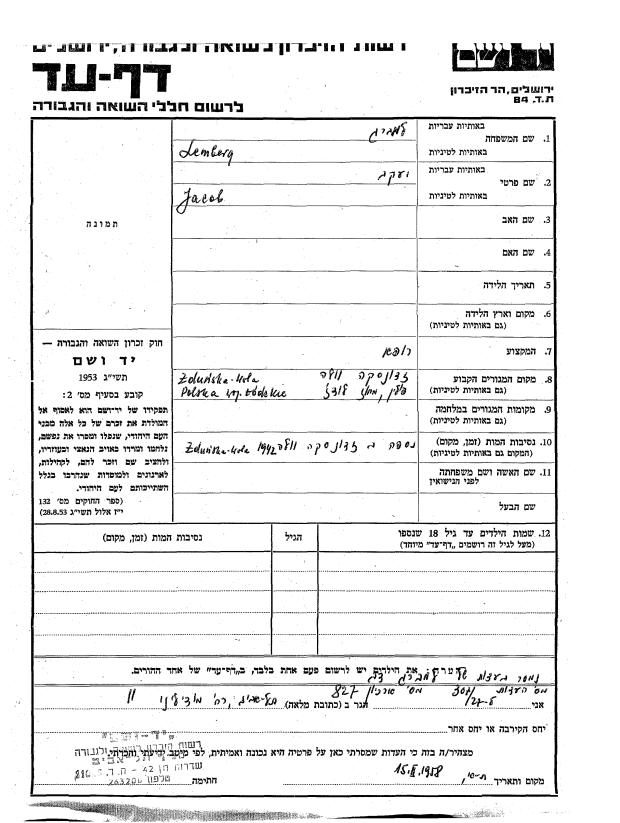
On this date in 1942, on the first day of Purim, Jakub Lemberg was executed together with his family in the Nazi ghetto in Zdunska Wola, Poland.
Lemburg, a 43-year-old internist and pediatrician, was head of the Judenrat in Zdunska Wola and thus it was his task to do the Nazis’ dirty work, such as putting together lists of his fellow-Jews for deportation.
He revealed himself to be a man of exceptional character and courage, and the circumstances of his death, as recorded in Louis Falstein’s The Martyrdom of Jewish Physicians in Poland, should not be forgotten:
The Gestapo chief ordered Dr. Lemberg to deliver ten Jews to be hanged for the ten hanged sons of Haman. Dr. Lemberg replied that he could deliver only four Jews: himself, his wife and their two children. Hans Biebow, “the Butcher of Lodz,” seized Dr. Lemberg and turned him over to the executioners, who killed him in the cemetery.
The Zdunska Wola ghetto was liquidated five months later. And in 1947, Biebow got his.
Here’s an image of Lemberg testimony (in Hebrew) from the Yad Vashem database.
When the Nazis attacked the house at 29 Kupiecka Street, rounding up all of its residents into the street, a bold young man, Izchok Malmed, whipped out a jar of acid from his pocket, hurling it in the face of a Nazi soldier, who was blinded at once. Seeking revenge, the sightless Nazi fired his revolver several times, hitting another Nazi soldier and instantly killing him. In the melee, Malmed vanished.
Commandant Friedl, after learning what had happened, ordered that one hundred men, women and children living in the area where the incident occurred be rounded up and force-marched to a nearby garden, where they were lined up against the wall of an adjacent bet hamidrash and shot with machine guns.
Afterward Nazi soldiers captured another group of Jews, forcing them to dig a large pit for the bodies of the one hundred martyrs. A thin layer of earth covered them. Some were still alive, their hands groping upward through the earth.
The Nazi soldier accidentally shot by his colleague whom Malmed had blinded was carried to the Judenrat building, and his body was placed on [Judenrat Chairman Efraim] Barasz’s desk. Friedl then proclaimed to Barasz, “See what your Jewish criminals have done. Now we shall take revenge. You shall see what we can do.” Friedl issued an ultimatum for the perpetrator of the crime to surrender within twenty-four hours. Failing that, the entire ghetto would be destroyed with everyone in it.
Barasz knew the Nazis meant what they said. He sent word to Malmed to give himself up and thereby save thousands of Jewish lives. As soon as Malmed heard, he surrendered himself to the Nazis.
Tamarof’s diary described in detail Malmed’s courage. Asked why he killed the Nazi soldier, he replied: “I hate you. I regret I only killed one. Before my eyes my parents were murdered. Ten thousand Jews in Slonim were liquidated before me. I have no regrets.” Tamarof tried to slip poison to Malmed but failed. Even the police could not get near the prisoner.
The next morning, Izchok Malmed, a hero of the ghetto, was hanged in the square where he had performed his act of courage. Despite the horrible torture to which he had been subjected, Malmed cursed the Nazi murderers. After several minutes of hanging on the gallows, the rope broke and the body fell to the earth. Instantaneously, the Nazis riddled Malmed’s corpse with bullets and re-hanged the body for another forty-eight hours.
Kupiecka Street was renamed Malmed Street after the war. Near the site of Malmed’s execution is a plaque reading, in Polish and in Hebrew, “Icchok Malmed, the hero and fighter of the Bialystok Ghetto, was killed here by the Nazi murderers on 8 February 1943. In his honor.”
* The Zchor account spells his name “Izchok” but on the memorial plaque it says “Icchok”. It’s a form of the name Isaac.
On this day in 1942, three anonymous Jewish residents of the Bialystok Ghetto in Nazi-occupied Poland were hung in the public square across the street from the Judenrat (Jewish Council) building. The three worked at the ghetto’s oil factory, and had been caught smuggling sunflower seeds.
The residents of the ghetto paid little attention to the execution, accepting it with resignation. It was hardly remarked on.
But this event was yet another small indication of dire events looming in the near future. Compared to those in other Nazi ghettos, such as those at Warsaw and Lodz, the Bialystok Jews had it pretty good. The ghetto, noted Sara Bender in her 2008 book The Jews of Bialystok During World War II and the Holocaust, was “organized, industrious, and even prosperous. Unlike other ghettos, it never experienced starvation or abject poverty.”
And it was seen as relatively safe. This day’s sort of vicious, arbitrary executions for minor rule infractions, which were so common elsewhere, were not at all frequent in Bialystok. Neither were the mass deportations that had by late 1942 decimated almost all the other ghettos.
Well, Bialystok’s turn was coming.
Unbeknownst to the Bialystokers, just as the sunflower seed smugglers were meeting their end, the powers that be in Berlin were debating the future of the ghetto. The Nazis in immediate charge of the ghetto wanted to keep it, and had logical reasons for doing so: namely, that it was a center of great industry, producing all kinds of goods for the German Army at almost no cost.
Killing off tens of thousands of hardworking slaves during wartime makes about as much sense as hanging three people over sunflower seeds, but this is what Berlin decided to do.
In early- to mid-February 1943, there was a surprise Aktion in the ghetto: 2,000 were killed and a further 10,000 deported to the Treblinka Extermination Camp. About 30,000 remained.
Once it was over, most of the surviving Bialystokers breathed a sigh of relief and hoped against hope that the worst was over — while a small underground group quietly organized an uprising for when the time came.
The rebellion, however, never really had time to get off the ground. When the final deportation occurred in August 1943, almost everyone went quietly in shock to their deaths. A cell of less than 100 fighters put up a few days’ struggle, enough to earn a footnote in history, before the last of the ghetto blew away with the ashes.
This U.S. Army photo from a few months after D-Day is filed simply thus:
“Photo taken at the instant bullets from a French firing squad hit a Frenchman who collaborated with the Germans. This execution took place in Rennes, France.” Himes, November 21, 1944.
Click to see a larger image of this stunning photo — or, take in this huge copy.
On November 1, 1943, a fourteen-year-old boy named Anatoly Kuznetsov came within seconds of execution in his hometown of Kiev in Nazi-Occupied Ukraine. As he admitted decades later, his crimes were numerous and all were worthy of the death penalty, according to the laws of the Germans. They included such grave sins as stealing beets, breaking curfew and sticking up an anti-Nazi leaflet.
By the time I reached the age of fourteen, I had committed so many crimes on this earth that I should have been shot many times over. […] Moreover, I was not a member of the Party or the Komsomol, nor a member of the underground; I was not a Jew or a gypsy; I did not keep pigeons or have a radio set; I did not commit any crimes openly; and I did not get taken as a hostage. I was in fact a most ORDINARY, unexceptional, insignificant little chap in a peaked cap.
But if the regulations drawn up by the authorities had been observed scrupulously, according to the principle of ‘If you did it you pay the penalty,’ then I had LOST THE RIGHT TO BE ALIVE twenty times over.
I persist stubbornly in remaining alive, while the number of my crimes increases in a catastrophic manner, so that I have stopped counting them. All I know is that I am a terrible criminal who has still not been caught.
The closest young Kuznetsov actually came to being killed was on November 1, 1943.
His very existence in Kiev had become a capital offense by then: all the civilians were supposed to have followed the German Army as it retreated from the city ahead of the advancing Russians, on pain of instant death.
Yet Kutznetsov stayed, hiding in abandoned buildings and bombed-out ruins, drinking rainwater, eating whatever he could find. By November 1 he had been dodging the evacuation order for over a month. And so he was called to account:
At that moment I heard a noise. I started, raised my head and saw a German soldier carrying a rifle; then I caught sight of another one on the street outside … When I thought they were not looking in my direction I dodged round the corner of the house, again cowering down rather stupidly, not looking round and averting my eyes from them in a sort of superstitious belief that they would not see me. I heard someone shout, “Hey! … Hey!” and I straightened up and stopped.
The soldier eyed me very sternly. He was a dark-haired, stocky fellow of about thirty, rather awkward in his movements, wearing old, muddy boots. His was a very ordinary, everyday type of face … In German he said:
“Come here.”
I took a few steps along the wall.
“You’ll be shot,” he said sternly, and started to raise his rifle.
It was, apparently, loaded, since he did not shoot the bolt. Another German came up, took him by the arm and said something in a very calm and indifferent tone, which sounded roughly like: “Don’t do it, there’s no point.” (That’s what I thought he said.)
The second soldier was rather older, quite an elderly man, with sunken cheeks. The dark-haired one answered him back and turned his head away for a moment. In that brief moment—I realized—I ought to have jumped up and dashed away… The dark one simply raised his rifle, turned his head for a moment, said something to the elder one, and that was the last moment of my life. […]
Right in front of my face — not in the cinema, or in a picture or in a dream — I saw the black hole at the end of the barrel, and had in my nose the unpleasant smell of gunpowder (meanwhile the elder German apparently went on saying something, but the dark one — alas! — wouldn’t listen); ages seemed to pass and there was no shot.
Then the end of the barrel dropped from my face to my chest and I realized at once in amazement that that, apparently, was how I was to be killed — shot in the chest!
Then he lowered the gun altogether. […]
He had only to squeeze his finger. I suppose on November 1st every year I ought to remember and thank that finger, the forefinger on his right hand, which let me live.
Five days later, the Red Army arrived and Kiev was liberated.
Kuznetsov would grow up to write a memoir and documentary history of his experiences during the occupation, including his aforementioned brush with death. The book, Babi Yar: A Document in the Form of a Novel, is considered a classic in the literature of World War II and the Holocaust. Parts of it have already been quoted on Executed Today.
Kutznetsov died in London in 1979. He was forty-nine years old.
On “a beautiful autumn day” this date in 1941, four dozen French leftists were executed by that country’s occupiers as punishment for the murder of a German officer.
On October 20, 1941 — sixteen months into the German occupation — a pair of Communist commandos assassinated the Feldkommandant of Nantes, Lt. Col. Karl Hotz (French link).
News of this crime went straight to Adolf Hitler himself, who personally ordered a fearful reprisal.
The list of the executed hostages as published Oct. 23 in L’oeuvre
Accordingly, the collaborationist Petain government was induced to select 50 persons from among the ranks of detained German political prisoners. Pierre Pucheu, who would later be executed himself,* intentionally selected Communist types in an effort to confine the retaliation to fellow-travelers.
On this date, those 50 — well, 48, but who’s counting?; the numbering can get dodgy in these mass-execution scenarios — were put to death at three different locations: five at Fort Mont-Valerien; sixteen at Nantes; and most notoriously, 27 internees of Choisel (French link) at Chateaubriant.**
In three different batches of nine, the 27 reds and trade unionists were fusilladed into the ranks of Gallic martyrdom. They remain among the most emblematic French martyrs of the occupation; there’s a cours des 50-Otages named for them in Nantes, and various streets that bear individual victims’ names — such as Rue Jean-Pierre Timbaud in Paris. (Timbaud was a Communist steelworker.)
Monument to the martyrs of Chateaubriant. Image (c) Renaud Camus and used with permission.
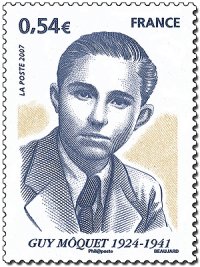
He made headlines in 2009 when current French President Nicolas Sarkozy had added to the educational curriculum the reading of Moquet’s brave-but-sad last letter to his family: the decision drew some rather mean-tempered fire because of Moquet’s political persuasion. In the end, the text bore a fairly universal reading that could play inoffensively to posterity — like its postscript injunction,
“You who remain, be worthy of the 27 of us who are going to die!”
There’s a thorough roundup of the Oct. 22 executions (including poetic tribute) here.
* Vindicating Winston Churchill’s prophecy to the Times upon receiving news that “These cold-blooded executions of inocent people will only recoil upon the savages who order and execute them.” (Oct. 25, 1941, as cited in the The Churchill War Papers, vol. 3)
** Fifty more were supposed to be executed if the assassins weren’t promptly turned in, but that second batch never took place. (There was, however, a different batch of 50 executed on October 24 in retaliation for a different political assassination. Maybe they just all ran together.)
Graf was a conscientious Catholic whose disaffinity for Naziism manifested in an early refusal to join the Hitler Youth: he did a short stint in prison in 1938 for having continued associating with a banned Catholic youth league.
This subversive fellow might have been destined for the chop regardless in the black years to come, but for a thoroughgoing radicalization, he was drafted into the army as a medic and got a front-row seat on the Holocaust and the horrors of the eastern front.
He was arrested within months and condemned on April 19, 1943 to die as a traitor — though actual execution of the sentence waited several months on the Gestapo’s vain exertions to extract from their prey actionable information on other collaborators.
A number of schools around Germany are named in Graf’s honor.
The Partisans were Tito’s Communist guerrilla movement against the Nazi occupation and while they were up against it at this early date, they would in due time wind up on the winning side and help birth the postwar government.
Their legacy remains in every European sports page as the namesake of the Belgrade sports association Partizan founded immediately after the war. It’s the umbrella entity for the frequent Serbian football and basketball champions as well as a variety of other sports. (Current world tennis no. 1 Novak Djokovic played for Partizan, for instance.)
On August 6, 1942, in the Warsaw Ghetto, Polish/Jewish hero Janusz Korczak marched with his orphans to the death trains and into legend.
The man, his activities in the ghetto, and above all his famed final walk to the Umschlagplatz, are mentioned in many books and memoirs about the ghetto.
Korczak’s real name was Henryk Goldschmidt. He took the name Janusz Korczak (pronounced “ya-nish kor-chok”) for his writing and it wound up taking over his entire life, a la Mark Twain.
Born in an observant Jewish household in Warsaw (which was then Russian Territory) in either 1878 or 1879,* he became man of the house after his father suffered a nervous breakdown in 1889 and eventually had to be hospitalized.
By thirteen, bored by school, he was writing poetry and learning foreign languages by himself. He went to medical school and served as a military doctor with the Russian Army in the Sino-Japanese War of 1905-1906. Eventually he was promoted to the rank of major.
Korczak’s true calling wasn’t in medicine, however, but in writing and in working with children. He found himself drawn to neglected and abused youngsters, and believed in treating every child with honesty and respect.
While he was in China with the military, his first book, Child of the Drawing Room, became famous in Poland. He didn’t realize he was a celebrity until he returned home.
He tried to distance himself from his writing and his fame and be an ordinary pediatrician, but people wanted to see him, to the extent that they would pretend their children were sick in order to entice him to their homes.
Korczak wrote later that one woman claimed her sons had the flu and, when he made a house call, insisted on serving him tea.
“Have you been writing anything lately?” she asked.
“Prescriptions,” he replied, and left, realizing he’d been had.
In 1910, he gave up his medical practice to start an orphanage for Jewish children age seven to fourteen. His institution was very different from most of that time and place, for Korczak had very democratic ideas: the children wrote their own newspaper and had their own parliament and court system.
If one child had a falling-out with another, the urchin could “sue” and bring a case to be decided before the orphanage court, which met once a week. (Even teachers and other staff members could be sued.) The orphanage court also held trials for children accused of violating one of the home’s rules.
Children were rewarded for good behavior, and spanked only as a last resort. Every child had a private, lockable drawer to hold their most precious belongings. Korczak carefully monitored the children’s health and also acted as a sort of informal therapist, encouraging them — most of them orphans from backgrounds of desperate poverty and abuse — to talk about their feelings. The children called him Pan (“Mister”) Doctor.
When World War I broke out, Korczak left the orphanage to serve in the Army again. He left it in good hands, however, in the care of teachers and staff he had trained himself.
“All the world is submerged in blood and fire, in tears and mourning,” he wrote sadly of his war experiences.
It was while in the trenches on the Eastern Front that he began writing a book on child development, titled For The Love of a Child. In 1918, the war finally ended, Poland became a free and independent nation, and Korczak returned to his orphans in Warsaw.
He stayed busy, setting up a second orphanage in 1919, and afterwards writing King Matt the First. The novel, a children’s story about a young boy who becomes king and puts the country’s children in charge, became a bestseller throughout the country in the wake of the calamity lately unleashed by the grown-ups. The sequel, King Matt on the Desert Island, was also a commercial success.
Korczak continued to work for his children, however; he consulted at Warsaw’s juvenile court, and in 1928 founded third orphanage, called Our Home, which had attached dormitories for teachers-in-training and was intended for Catholic children.
In 1925, Korczak wrote another book called When I Am Little Again, told from the point of view of a middle-aged teacher and meant to be read by both children and adults.
He started a children’s newspaper, the Little Review, in 1926. Saying he wanted to “defend children” in his new paper, he invited children from all over Poland to write and tell him the stories of their lives. The newspaper lasted until 1939.
He also hosted a hugely popular radio show, using the name “Old Doctor.” The program was terminated in 1937, however, after only a couple of years; Korczak’s employers with the radio station were reluctant to keep a Jew on the air. When his identity became known, the right-wing press castigated him, saying that as Jew he could never be a real Pole and shouldn’t be allowed to educate Polish children.
Like any public figure, Korczak had his critics. Anti-Semites called Our Home “a new nest of Masonry and potential Communism erected in the heart of the capital.” Communists said his institutions weren’t Communist enough; Zionists criticized him for not directing the children towards a life in Palestine; religious Jews said there wasn’t enough religion in the orphanages while assimilationist Jews said there was too much.
Yet Korczak’s methods worked.
In a follow-up study he conducted of all the former residents 21 years after the first of his institutions was opened, he found that only a few had turned to crime or prostitution as adults. The same could not be said for children who graduated from other children’s homes in Poland.
During the 1930s, many of Korczak’s friends encouraged him to move to Palestine to escape the growing problems in Poland. He actually visited a kibbutz there, but he couldn’t make up his mind whether or to go; he had trouble leaning Hebrew and wasn’t sure a man of his age could start a whole new life.
“I don’t have forty years to spend in the desert,” he wrote to a friend.
Germany’s invasion of Poland in 1939 settled the question for him; leaving the country was no longer an option. Korczak volunteered for the Army again, but was turned down due to his age.
As the Nazis tightened their strangehold around Poland and Poland’s Jews, Korczak did the best he could to shied his orphans from the chaos, suffering and bigotry around them.
He turned his pen to appeals for funds for the children. As a protest against the occupation, he walked around the city openly in his old Polish Army uniform as well as the required Star of David armband.
The uniform proved surprisingly useful: he told a friend that when he went door to door asking for money for the children, “Some people are generous, but not everyone. If they’re difficult, I just undo my coat and reveal my Polish uniform. They get so nervous about having someone in uniform in their place that they give me something just to make me leave.”
The Warsaw Ghetto opened in 1940, and the orphanage was outside its boundaries, so they had to move. (Later, the Germans reduced the size of the ghetto, and Korczak’s orphanage had to relocate again.)
The Warsaw Ghetto was a kind of hell for Jews; allotted rations of only 800 calories a day — if they could get that — people died in droves of starvation and related diseases, including typhus and tuberculosis, as well as deliberate murder by the Nazis and their collaborators.
As recorded in Betty Lifton’s biography, a gentile friend, Igor Newerly, offered to help Korczak escape this fate:
“Everyone’s worried about your going into the ghetto with the children,” Newerly told him. “Just say the word and we’ll get you false identity papers to live on our side.”
“And the children?”
“We’ll try to hide as many as we can in monasteries and private homes.”
Korczak put down his cigarette, took off his glasses in their cheap round metal frames, and began wiping them with his handkerchief as he always did when he was stalling for time.
Finally, he asked: “Do you realize how difficult it would be to hide one hundred and seventy Jewish children — that’s that’s how many we have now.”
“We’d try,” Newerlv repeated.
“But can you guarantee me that every child will be safe?”
Newerly shook his head sadly: “I’m afraid that’s impossible. We can’t guarantee anything” — he
paused — “even for ourselves.”
Korczak thanked his friend, but turned him down. He would take his chances in the ghetto. His decision was sensible for the time — the “Final Solution” had not been conceived of, and no one knew what the eventual fate of the ghetto residents would be.
Lifton records:
On the day they were scheduled to depart, November 29, the children lined up in the courtyard as rehearsed, while Korczak made a final inspection of the wagons filled with the coal and potatoes that he had so arduously procured on his daily rounds. The children waved goodbye sadly to the Polish janitor, Piotr Zalewski, who was staying behind to care for the house. His face was swollen almost beyond recognition from the beating he had received the day before when he and the laundress had applied to the Nazi police for permission to go into the ghetto with the orphans. The Germans had thrown the laundress out, but detained Zalewski for questioning. Didn’t he know that Aryans were no longer allowed to work for Jews? When the janitor replied that after twenty years of service he considered the orphanage his home, the Germans thrashed him with whips and rifle butts.
[…]
The orphans tried to sing as they marched out of the courtyard and into the street, clutching their few possessions. The green flag of King Matt, with a Jewish star on one side, flew over the little parade as it made its way through the teeming streets the short distance to 33 Chlodna Street. When they reached the place where the wall cut along Chlodna, slicing its “Aryan” half off from the ghetto, they found German and Polish police at the gate demanding identification, as if they were crossing a foreign border.
Within the ghetto, Korczak continued his activities for children’s welfare.
He tirelessly solicited aid for the orphanage to keep the children clothed and fed. He and others held benefit concerts and poetry readings, and put posters all around the ghetto saying “OUR CHILDREN MUST LIVE” and “A CHILD IS THE HOLIEST OF BEINGS.”
He took the job as director of a hopelessly underfunded shelter that housed a thousand children; in spite of his efforts, the mortality rate there was sixty percent.
Everywhere children were dying of starvation and disease on the streets or in filthy, overcrowded hovels; Korczak lobbied for the creation of a sort of hospice where they could at least breathe their last in clean, quiet surroundings.
For himself he functioned mostly on pure willpower. It was hard for him to eat when he knew the children were hungry. Five shots of pure alcohol a day, mixed with water, provided precious calories.
Yet his health was failing. His friends noticed how emaciated he had become: “ill, wasted and stooped.” He had a persistent cough and a doctor who examined him diagnosed him with pulmonary edema. Nightmares interrupted his sleep. “How hard it is to live,” he wrote, “how easy to die!”
Yet he carried on.
In the summer of 1942, it became increasingly apparent that the ghetto would be liquidated. Igor Newerly approached Korczak again and offered to help save whoever he could.
Korczak declined his offer again, but gave him his diary for safekeeping — a sign that Korczak, too, knew the end was coming. He had decided to throw his lot in with the children.
In July, the Nazis announced that there were “too many Jews” and they were sending away the children, the old, the sick and anyone else who could not work. Orphans, of course, would be at the top of the list. Resettlement meant death, and many of the ghetto residents knew it, although a substantial number clung to the hope that they would be placed in work camps and find someway of surviving a little longer.
Adam Czerniaków, the Warsaw Ghetto Chairman and Korczak’s personal friend, took his own life rather than supervise the deportations.
For the next few weeks, people were marched or dragged to the death trains, packed inside and driven off to the Treblinka Extermination Camp for gassing.
Many people tried to hide, for the most part unsuccessfully, to escape being deported. Some of the ghetto residents were so hungry that they volunteered to go, because the Nazis promised bread and marmalade to anyone who reported of their own accord.
Korczak’s orphanage’s turn came on August 6. He and the staff had made up their minds earlier: all of them would go together. And they would go quietly, in an orderly fashion, so as not to frighten the children.
Their walk to the death trains, witnessed by thousands, has passed into Holocaust legend.
Lipton records:
The Germans had taken a roll call: one hundred and ninety-two children and ten adults. Korczak was at the head of this little army, the tattered remnants of the generations of moral soldiers he had raised in his children’s republic. He held five-year-old Romcia in one arm, and perhaps Szymonek Jakubowicz…
Stefa followed a little way back with the nine- to twelve year-olds. There were Giena, with sad, dark eyes like her mother’s; Eva Mandelblatt, whose brother had been in the orphanage before her. Halinka Pinchonson, who chose to go with Korczak rather than stay behind with her mother. There were Jakub, who wrote the poem about Moses; Leon with his polished box; Mietek with his dead brother’s prayer book; and Abus, who had stayed too long on the toilet.
There were Zygmus, Sami, Hanka, and Aronek, who had signed the petition to play in the church garden; Hella, who was always restless; big Hanna, who had asthma; and little Hanna with her pale, tubercular smile; Mendelek, who had the bad dream; and the agitated boy who had not wanted to leave his dying mother. There were Abrasha, who had played Amal, with his violin; Jerzyk, the fakir. Chaimek, the doctor; Adek, the lord mayor. , and the rest of the cast of The Post Office, all following their own Pan Doctor on their way to meet the Messiah King. One of the older boys carried the green flag of King Matt, the blue Star of David set against a field of white on one side. The older children took turns carrying the flag during the course of their two-mile walk…
The young protagonist of Jerry Spinelli’s novel Milkweed described it this way:
The orphans were going by. They were marching. Their heads were high and they were singing the song I had learned. I sang along with them. Not one was dressed in rags. Everyone wore shoes. Doctor Korczak lead the way…
“The very stones of the street,” wrote Yehoshue Perle, another chronicler, “wept at the sight of the procession.”
As the group waited for the trains to leave, Korczak’s many friends were seeking out anyone with influence, desperately trying to get them out of Umschlagplatz and back to the orphanage to die another day.
It was said that a German officer, who had been a fan Korczak’s King Matt books as a child, offered him the chance to leave — without the children. Korczak refused.
His presence kept the children calm; if he left them they might panic. He knew what was coming, and he knew he could not force the children to face death alone. The fact that he was in such poor health and probably would not have survived the war in any case does not make his sacrifice any less.
Eventually the orphans and the staff boarded the train and were hauled away. There were no survivors. His name is listed on a memorial stone at the site where Treblinka once stood — the only such stone with a name on it.
Korczak’s legacy is not just in books; his name and image have been used in a lot of memorabilia over the years, and have appeared on stamps in Poland, Israel and Germany. In 1991, Polish filmmaker Andrzej Wajda made a film about Korczak and his last march. There are four statues of him in Warsaw, and a school for street children in Thailand is named after him.
From Andrzej Wajda’s Korczak.
* His year of birth is uncertain; Korczak himself may not have known it.


 By the time I reached the age of fourteen, I had committed so many crimes on this earth that I should have been shot many times over. […] Moreover, I was not a member of the Party or the Komsomol, nor a member of the underground; I was not a Jew or a gypsy; I did not keep pigeons or have a radio set; I did not commit any crimes openly; and I did not get taken as a hostage. I was in fact a most ORDINARY, unexceptional, insignificant little chap in a peaked cap.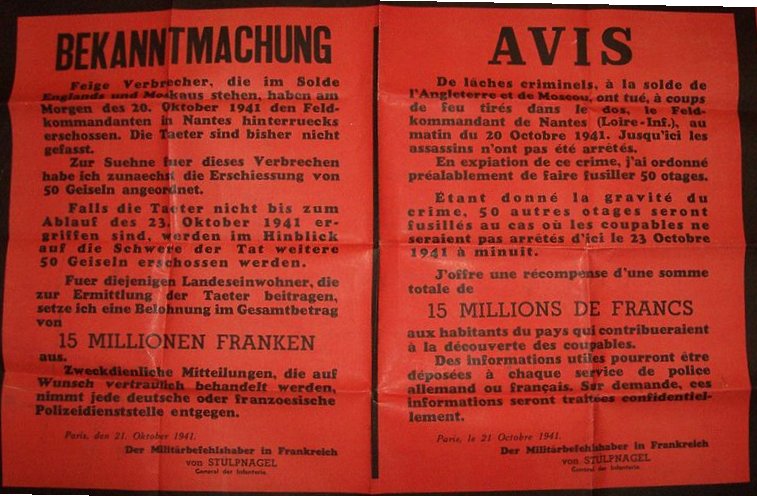


 The youngest, 17-year-old
  Graf was a conscientious Catholic whose disaffinity for Naziism manifested in an early refusal to join the


 The man, his activities in the ghetto, and above all his famed final walk to the Umschlagplatz, are mentioned in many books and memoirs about the ghetto.