1945: Albrecht Haushofer, German Resistance intellectual

On April 23, 1945, in Nazi Germany’s Berlin-Moabit prison, with the Red Army fast approaching, the SS executed Albrecht Haushofer for his part in the previous year’s July 20 plot to assassinate Adolf Hitler.

A social and political conservative and driving force behind the nascent field of “geopolitics,” which held views of the State “as a geographic organism or a spatial phenomenon” that were incorporated into the National Socialist ideology of “Lebensraum,” Haushofer was an early darling of the drive to find academic and scientific justification for Nazi beliefs and ideals — this despite his own part-Jewish parentage.

Haushofer had reservations about the intentions of the Nazi party following its rise to power in the 1930s, but he nonetheless consented to represent it in foreign affairs, having spent significant time abroad as a geopolitics student in the 1920s. Acting as chief foreign affairs adviser to Rudolf Hess, Hitler’s chief deputy, Haushofer traveled widely to promote German foreign policy. During this time, he wrote a series of historical dramas — Scipio (1934), Sulla (1938), and Augustus (1939) — containing progressively more strident symbolic criticisms of his age.

Believing that Germany must not get involved in another disastrous foreign war, Haushofer was a significant force in negotiating for peace with Britain and France. “The peoples of Europe are in a position in which they have to get on together lest they all perish,” he wrote; “and although one realises that it is not common sense but emotional urges which govern the world, one must try to control such urges.” As Hitler’s desire for war became ever more paramount, however, Haushofer lost his position with the government and returned to Germany, remaining active in secret talks to persuade the British to accept a new peace agreement.

With the outbreak of the Second World War, Haushofer remained a professor of geopolitics at the University of Berlin, but distanced himself from his Nazi past and began associating with elements of the German resistance. As the war wore on, he consistently opposed any attempt on Hitler’s life, but finally agreed to join the July plot as the only way to end the war without bringing further disaster upon Germany. With the plot’s failure, he was arrested by the Gestapo, and executed just days before the Red Army liberated Berlin.

Haushofer composed the Moabiter Sonette (pdf) while in prison, a series of poems posthumously published in 1946 regarded as among the most powerful documents of the German antiwar movement. One of his most well-known sonnets, “Schuld,” attemps to express — in sad retrospect — the weight of his moral guilt in the face of impending death:

“Schuld”

…schuldig bin ich
Anders als Ihr denkt.
Ich musste früher meine Pflicht erkennen;
Ich musste schärfer Unheil Unheil nennen;
Mein Urteil habe ich zu lang gelenkt…
Ich habe gewarnt,
Aber nicht genug, und klar;
Und heute weiß ich, was ich schuldig war.

“Guilt”

I am guilty,
But not in the way you think.
I should have earlier recognized my duty;
I should have more sharply called evil evil;
I reined in my judgment too long.
I did warn,
But not enough, and clear;
And today I know what I was guilty of.

The poem’s last line can be variously translated as “And today I know what I was guilty of” or “And today I know what my obligation had been.” Through this subtle play on words, Haushofer created a powerful poetic link between his failure to act decisively and the supposed “guilt” — “not in the way you think” — for which he had been condemned. His poems remain a testament to the power as well as the responsiblities of the individual under dictatorship, and have earned their writer a place in the annals of history as well as modern-day memorials to the German resistance movement.

On this day..

1944: Emanuel Ringelblum, historian of the Warsaw Ghetto

It was not only the destroyers of the Warsaw ghetto who left their testimony.

Emanuel Ringelblum, a Polish-Jewish historian and social worker, was among the 450,000 trapped in the ghetto.*

Ringelblum organized a monumental project to document its life — the “Oyneg Shabbos”. Ringelblum’s ring cast a network throughout the ghetto, systematically collecting its written history: public proclamations, ration cards and identity papers, and most precious of all, personal diaries and memoirs of hundreds of inhabitants, testament to the gathering madness encircling Warsaw’s Jews. Ringelblum sat up nights, sifting and categorizing a stupendous trove — over 25,000 surviving sheets — that was still never equal to his vision:

“To our great regret, however, only part of the plan was carried out … We lacked the necessary tranquillity for a plan of such scope and volume.” (Source)

Shortly before the Warsaw Ghetto Uprising, Ringelblum and his family were spirited out of the Jewish quarter and into the protection of friendly Poles. There, they outlived the ghetto by nearly a year.

But on March 7, tipped by a neighborhood teenager who would himself receive a death sentence after the war for the act, the Gestapo captured both Ringelblum’s family and that of his protectors. Around this date — just a few days after their arrest — they would be summarily shot with other fugitives in the ruins of the community he chronicled. Ringelblum reportedly spurned a rescue attempt, preferring to swallow the same draught as his wife and son.

A few years before, another writer living under another dictator scratched in his secret novel — still secret at the time of Ringelblum’s death — words that would become a signature of literary integrity in a totalitarian age:

Manuscripts don’t burn.

While Ringelblum himself fell victim at last, like most of Warsaw’s Jews, to the Holocaust, the burning — his manuscripts did not. Shortly before capture, the diligent historian had secreted them in buried coffee tins. Years after the war, many of those tins were recovered.

Their contents form the basis for Notes from the Warsaw Ghetto, one of the most moving and penetrating first-person Holocaust histories.

An interesting interview with Samuel Kassow, author of Who Will Write Our History?, is available from the New Books In History podcast.

This French-language page on an exhibition of Ringelblum’s archives covers some of its history, with a number of photographs. This site collects a number of Yiddish poems from the Ringelblum archive.

* This Time magazine article claims that Ringelblum was safe in Switzerland as of 1939, but voluntarily returned to Poland to witness and share his fellows’ fate. Noble if true, but I have been unable to find corroboration of this elsewhere.

Part of the Themed Set: The Written Word.

On this day..

1942: Avraham Stern, a strange bedfellow

On this date in 1942, Zionist freedom-fighter — or was he a terrorist? — Avraham Stern was captured by British colonial authorities and summarily executed.

Stern, as pictured on a 1978 Israeli stamp.

Born in 1907 in a part of eastern Poland then in Russian hands, Stern immigrated to British Palestine in 1925 and became an adherent of Revisionist Zionism — a maximalist strain of the fermenting Jewish homeland movement.

Various threads and factions within the Zionist movement pursued different territorial and political goals with different strategies; Stern was among the most militant foes of anything with the whiff of collaboration with the British. When the armed underground movement Irgun opted in 1940 to suspend attacks against British targets during World War II, Stern created a splinter organization with a programme of continuing anti-British violence.

The “Stern gang,” as imperial authorities knew it, had its reasons — controversial enough that some more moderate Jewish elements were happy to help the British hunt it, but reasons with their own logic, premised on the notion that London was the fundamental enemy of Jewish national interests while Berlin, for all its anti-Semitism, was not.

Between those two lay the room for wartime collaboration with Hitler against Britain with the object of establishing a Jewish state in the Levant open to unlimited immigration from a Reich eager to be rid of its Jews. In one fell swoop, it would solve Germany’s “Jewish question,”* realize Zionist state-building aspirations, and disrupt the Nazis’ wartime enemy. Stern, who had cultivated an affinity for fascism while studying in Italy and pitched a similar bargain to Mussolini, offered a pact with the devil: “the establishment of the historic Jewish state on a national and totalitarian basis, bound by a treaty with the German Reich.”

Berlin never took up the offer. Stern himself would have only a year to live, and his tiny splinter group didn’t get very far off the ground during it, carrying out a few murders and trying to raise money through crime. A high-profile bank robbery in January of 1942 that left several Brits and Jews dead brought down an intense manhunt that caught up with Stern on this day. He was handcuffed and shot on the spot.

His organization would come into its own after his death under leadership that included future Likud Prime Minister Yitzhak Shamir, carrying out a campaign of assassinations in the mid-40’s as Palestine slid towards the civil war that would give birth to Israel. In that incarnation, it valorized its creator:

He was a lion, and the cravings of the foxes were foreign to him. He was an eagle who did not know how to fly low … He was not of those who live and die, like all human beings. He was a Prometheus, one who appears but once over many generations. (Source)

That valorization has been contested but nonetheless lasting. The Knesset, just days ago as of this writing, voted laurels for Stern’s hundredth birthday. There’s almost no apolitical way to write his story, and given Israel’s persistence as a flashpoint — and its own ironic inheritance of a rebellious subject population reminiscent of pre-1948 Palestinian Jews — the radicalism of his words, deeds and persona invite debate.

Books about the Stern gang in the founding of Israel

There’s a fascinating first-person apologia from a former member of the Stern gang here.

Stern also dabbled as a poet, and wrote this anthem to the struggle with his wife:

Part of the Themed Set: Unruly Britannia.

* Germany itself was tarrying with “faraway Jewish homeland” plans at this time, specifically considering relocating European Jewry to Madagascar. The Final Solution would be implemented later, once these proved unavailing. Stern, for his part, also expected the Axis to win the war.

On this day..

1945: Nikolaus Gross, Catholic anti-Nazi labor activist

On this date in 1945, labor activist Nikolaus Gross entered the ranks of Catholic martyrs of Nazi Germany.

A miner turned newsman of the Catholic labor movement, Gross was a peripheral associate of the July 20 Plot to assassinate Adolf Hitler. He had been known and watched as a dissident and was detained shortly after the plot’s failure, but was only put to death after months of torture, along with a batch of other smaller fish in the conspiracy.

A prelate recalled a conversation he had before the dangerous venture was attempted:

I said to Nikolaus Gross on the day before the assassination attempt on Hitler of 20 July 1944: “Mr Gross, remember that you have seven children. I have no family for which I am responsible. It’s a matter of your life.” To which Gross made a really great statement to me: “If we do not risk our life today, how do we then want one day to justify ourselves before God and our people?”

Gross is notable as the first Catholic lay victim of Naziism subsequently beatified by the Church. The timing (he was beatified in 2001) is interesting to note.*

The long-running controversy over the complicated role of Catholicism writ large — if indeed such a thing could be assessed at all — during the Holocaust had surged into popular conversation with the 1999 publication of Hitler’s Pope.**

Was the Vatican’s silence during the war years complicity or powerlessness? How does one measure and weigh the behavior of the hierarchy as against individuals who risked death in resistance large and small — and they against others who collaborated for advantage, and against the vast multitude who simply went along? Can we speak of a responsibility of “the Church” for its own history of anti-Semitism, and if so, what did that mean for the live people facing real choices in the 1930s and 40s?

Bound up as they are in their respondents’ own present-day agendas, these questions seem certain to remain a point of conflict. Propagandists will always keep their own store of exemplars in either perfidy or saintliness, but let us give Nikolaus Gross no less than his due: he answered his duty unswervingly, and on this day, answered with his life.

Online accounts differ as to whether Gross was hanged or beheaded. Both methods were in use.

German-language pages on Gross are here and here. His farewell letter to his family, also in German, is here.

* Lest too grand a claim of causal relationship be inferred, note that beatification is a meandering procedure of bureaucracy rarely answering the day’s headlines; that the late Pope John Paul II elevated such legions to the choirs of heaven as to provoke complaints of debased coinage; and that in an Italian church headed by a Polish pontiff honoring a German martyr, the relationship between fascism and Catholicism was not something that, as in the English-speaking world, might have waned into forgetfulness before a timely work of popular history.

** The controversy surrounding this book, and the author’s subsequent moderation of some conclusions, is covered in a Wikipedia article. Naturally, it spawned more books — both in support of its thesis of Catholic collaboration and against.

On this day..

1944: Galeazzo Ciano and four other Italian Fascists

On this date in 1944, Benito Mussolini had his son-in-law, the politician Galeazzo Ciano, shot for treason outside the gates of Verona along with four other fascists who had abandoned Mussolini.

A glamorous playboy in public life, Ciano was the scion of a wealthy fascist founder. The youth wed Mussolini’s eldest daughter in 1930 and quickly ascended the party’s ranks, becoming Foreign Minister at the tender age of 33.

Ciano’s treachery, and that of the others seated in chairs and shot from behind on this day, was to have voted with the majority of the Fascist Grand Council for deposing Mussolini as Allied attacks thrust Italy into a desperate position. This confused affair lacked the character of a coup d’etat, but Mussolini was indeed placed under arrest the next day and a separate peace concluded with the Allies in early September.

Soon after, an audacious German glider raid freed Mussolini, who was quickly re-installed as head of a Nazi puppet state in northern Italy.

Ciano’s capture by this body set in motion a final personal drama with implications for later students of the Second World War. Edda Ciano escaped to Switzerland with her husband’s diaries — potentially damaging notes on the machinations of the Axis.

These scribblings she took hostage for the life of her husband. The blackmail was not accepted — to the grief of Edda, who never spoke to her father again.

One final quixotic rescue attempt cooked up by a female SS administrator on Ciano’s guard detail — the last of many women drawn to this charismatic man — foundered; the preordained death sentence came down on January 10th, and the men were shot the next morning.* Mussolini reportedly fretted in the small hours of the night over whether his standing in Hitler’s eyes would suffer should he intervene.

Edda had the diaries published as she threatened, and if they exposed scant novel evidence against his German and Italian compatriots, they offer a window upon diplomatic intrigue and personal relationships within the Pact of Steel.

The last entries were written from prison just three weeks before his execution, and (allowing that by that time the author had reason to lay blame for policy missteps explicitly at Mussolini’s door) the protracted effort they describe to steer the impulsive Duce towards some sane foreign policy — something that might have spared Italy the devastation of war and maintained a fascist government, as Spain managed to do — reads almost farcically in retrospect. Italy could make little material contribution to the war, and probably had as much to fear from Hitler in victory as from the Allies in defeat … but at every turn, Hitler’s inspiring star pulled the Italian dictator away from realpolitik and towards romantic catastrophe.

As the invasion of Poland approached, for instance, Ciano watched Mussolini vacillate on whether to cast his lot irrevocably with Hitler.

The Duce’s reactions are varied. At first he agrees with me [not to commit to war]. Then he says that honor compels him to march with Germany. Finally, he states that he wants his part of the booty in Croatia and Dalmatia.

Like World War II’s every nook and cranny, the Italian experience bestrode by Ciano has received eager literary coverage.

Edda and Galeazzo Ciano’s son Fabrizio also wrote a personal memoir entitled Quando il nonno fece fucilare papa (“When Grandpa had Daddy Shot”).

* Four of the five were only wounded by the initial volley, and the fifth was missed altogether; all were dispatched with a coup de grace.

On this day..

1945: Josefa Llanes Escoda

On this day in 1945, Filipina suffragist Josefa Llanes Escoda was last seen before her presumed execution by the Japanese occupying troops holding her at Manila’s Far Eastern University.

Escoda came of age with her native archipelago under American colonization. An energetic and brilliant woman, Escoda lectured in sociology at the University of the Philippines, held several civil service posts, founded the Girl Scouts of the Philippines and helped win female suffrage.

During the Japanese occupation, her efforts to aid POWs — including those on the Bataan Death March — made her the “Florence Nightingale of the Philippines”.

But she declined to do so in the capacity of Japanese collaborator and she and her husband Antonio were arrested in 1944 and executed in the weeks following MacArthur’s return and push towards Manila.

Escoda is pictured on the Philippines’ current 1000-peso bill.


Escoda is in the center of the three figures on this banknote. Jose Abad Santos, also executed by the Japanese, is in the top left.

On this day..

1941: Zoya Kosmodemyanskaya

On this date in 1941, Soviet partisan Zoya Kosmodemyanskaya was hanged by the Wehrmacht for sabotaging buildings behind German lines near Moscow.

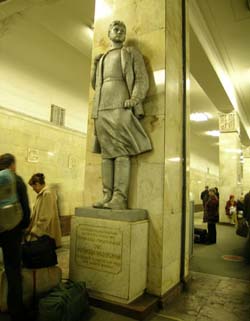
A statue of Zoya Kosmodemyanskaya stands vigil over Moscow’s World War II-era Partizanskaya metro station. Image used with permission.

One of the most famous Soviet war heroines and the first woman decorated as Hero of the Soviet Union during World War II, the 18-year-old had quit school to volunteer for a partisan unit only a few weeks before her hanging as Russia mobilized against Hitler’s race towards Moscow.

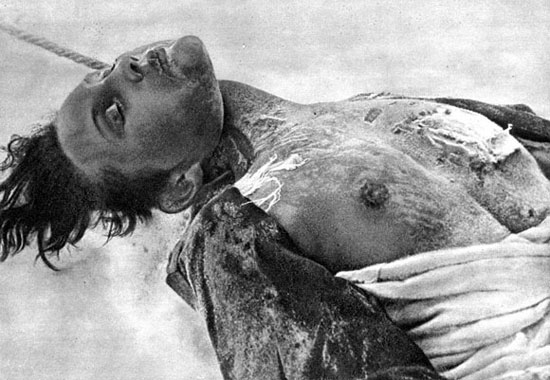
Known simply as “Tanya”, the nom de guerre which was the only information she volunteered during two days of torture, the power of the press offered her apotheosis into a propaganda coup for the Kremlin, and a symbol of courage that would long outlive Stalin. Before the public execution, the Nazis paused to photograph the scene; Kosmodemyanskaya availed the lull to harangue the Germans — “you can’t hang all 190 million of us!” — and call on the Russian villagers present to resist occupation.

Her bayoneted, mutilated body hung on the gibbet until the Red Army recaptured the village; witnesses related the tale of her dying heroism to a newsman.

It was only after the story of “Tanya” hit the press in January 1942 that her identity was established … and then promulgated widely. Anonymous and obscure in death, Zoya Kosmodemyanskaya would inspire millions and become the heroic emblem of other women partisans.


Soviet propaganda poster unabashedly modeled on the already-iconic image of Zoya Kosmodemyanskaya’s abused corpse.

Zoya, a 1944 Soviet film, was scored by Dmitri Shostakovich.

Part of the Themed Set: Women Against Fascism.

On this day..

1944: An unknown Allied airman

On this date in 1944, in the midst of a worldwide conflagration that would claim 70 million lives, one unknown crew member of an Allied bomber was shot by Nazi SS/SD troops in the woods around Enschede, Netherlands.

From late 1942, the Allies’ massive industrial capacity had sapped the vaunted Luftwaffe, bleeding down the German air force in desperate airborne combat in the Mediterranean and the Eastern front. Crippling losses in July and August 1943 lay Germany’s industrial heart open to devastating bombing and would within a year spell the end of the Luftwaffe as an effective fighting force.

The contest’s stakes were high. This hour-long compilation of contemporaneous U.S. propaganda footage celebrates the decisive effect of air supremacy in western Europe:

With hostile planes darkening Europe’s skies, the Germans called upon ruthlessness to stand in for materiel. Nazi SS chief Heinrich Himmler issued, according to Robin O’Neil, an August 1943 order to show no quarter to captured enemy pilots.

The young man shot this day suffered its effects:

The airman (estimated age 26 years), who was apparently unhurt, was taken by the SS to the cellar of the villa [serving as SS headquarters], where he was kept under guard while arrangements were made for his disposal. These arrangements consisted of the removal of his flying kit, and the substitution of a civilian light-coloured shirt, a pair of dark trousers, and a pair of socks.

In this dress he was put into a security vehicle, his hands handcuffed behind his back, and taken some distance in the grounds of the SS HQ to a spot within the compound where a grave had already been prepared. The airman was marched from the car by an escort of two SS men, one of whom dropped back and shot the airman in the back of the neck. He was buried and the grave was carefully camouflaged.

To this day, the airman’s identity has not been established. It was assumed that he was British or American, most probably American, as the trousers he was wearing were of a dark shade of khaki, and the fact that when he was informed in the car, in English, that he was to be executed, he made an indistinct reply in which the word “America” was uttered.

Countless such executions undoubtedly took place and were lost, forgotten or concealed in the charnel house of war. Thanks to the witness of Dutch prisoners who survived the war, this single act of routine brutality endured not only historically but juridically: little more than a year later, its author, Dr. Karl Eberhard Schongarth — an SS officer who participated in the Wannsee Conference and slaughtered thousands in occupied Poland and Holland — faced a war crimes prosecution for the execution of the anonymous airman.

His actions this date may have been small by the gauge of a bloodthirsty career, but since pre-war treaties explicitly regulated treatment of war prisoners, they also constituted a conveniently plain transgression of the far-from-bright line demarcating “war crimes.” For this one killing, Schongarth was himself hanged as a war criminal in Hamelin, Germany on May 16, 1946.

On this day..

1944: Richard Sorge and Hotsumi Ozaki

On the day of the USSR’s October Revolution holiday in 1944, Stalin’s greatest spies were hanged in Japan.

Renowned among espionage aficionados for supposedly forewarning Moscow of the exact date of Germany’s planned surprise attack in 1941, Richard Sorge‘s work in the pregnant years leading up to World War II produced multiple intelligence coups and could lay claim to the uncommon distinction of having materially affected the course of the war.

His signal achievement was establishing, as a foreigner in a highly xenophobic Japan, a spy ring that for years penetrated the highest levels of the Japanese government and the German embassy, giving Moscow an inside look at Axis planning.

Working under the cover of journalism in the German expat community — he had grown up in a mixed German-Russian household in Berlin and won the Iron Cross for his service in the Kaiser’s army in World War I before embracing communism — Sorge struck Hitler from half a world away. His access to the German embassy was untrammeled — indeed, he had an affair with the ambassador’s wife. His lead Japanese collaborator Hotsumi Ozaki was a major public intellectual similarly privy to sensitive information through his contacts.

The two, along with several other Japanese and foreign collaborators, produced a steady diet of top-shelf intelligence, including the (ignored) forecast of Operation Barbarossa. But the ring’s most important coup — arguably a decisive one in the history of the war as a whole — was to inform Moscow in September 1941 that Japan did not intend to attack the Russian Far East. Relieved of the nightmare prospect of a two-front war, Stalin transfered desperately needed Siberian divisions to help throw back the German advance on Moscow.

Japan by 1941 was a dangerous place to operate, however, and the nerve-rattling work — and the alcoholism to which it contributed — were taking its toll on the master spy just as the authorities were closing in. Sorge and his ring were arrested in October 1941.

Sorge’s decisive communique regarding Japanese intentions in the East had not yet borne its fruit. The war had nearly four years yet to run, and Sorge would languish in prison for most of them — long enough to leave fellow detainees with recollections of the captured operative jubilant at Red Army victories. Soviet tanks were at Germany’s doorstep by the time the two went to the gallows, one after the other, with the few minutes’ notice still customary for Japanese hangings to this day.

The spies in history who can say from their graves, the infomation I supplied to my masters, for better or worse, altered the history of our planet, can be counted on the fingers of one hand. Richard Sorge was in that group.

Spy novelist Frederick Forsythe

Sorge’s personal role in the crucible of world-shaping politics have proven a compelling topic for biographers. Among the notable works:

The Soviet government did not officially acknowledge Sorge until 1964, but the case had immediate and widespread interest in Japan. Ozaki inspired an early Kurosawa film, No Regrets for Our Youth:

The espionage ring’s operations were also the subject of a recent multilingual Japanese epic, Spy Sorge:

Part of the Themed Set: Spies.

On this day..