On this date in 1952, Irish steward George Muldowney was hanged at Pentonville Prison for the rather pathetic murder of a dashing Polish spy who had survived much greater villains.
Allowing that nobody ought to die on the floor of the Shelbourne Hotel with a sheath knife stuck in their chest, Christine Granville in particular really deserved a better exit.
Rechristened “Christine Granville” by Britain’s Special Operations Executive, she spent most of the war carrying out feats of cloak-and-dagger derring-do, with a Bond-like aplomb for extricating herself from tricky situations.
If only half the stories they tell about her are true …
Commuting between Hungary and Poland by skiing over the Tatra Mountains to gather intelligence and pull other agents out of harm’s way.
Getting herself and a fellow agent released from arrest by feigning tuberculosis by chewing her tongue until it bled.
Escaping capture at a checkpoint by pulling the pins on two grenades and daring the guards to shoot her.
Marching alone into a not-yet-liberated concentration camp to have POW’s reprieved from execution — by telling the Nazi commandante that he’d get the same treatment unless he spared them.
Snatching spymaster Francis Cammaerts from the Gestapo ahead of his execution.
Granville earned the French Croix de Guerre, the George Medal for Special Services, the Order of the British Empire and other decorations, although merely surviving so much time in the field might have been her greatest achievement … but when the war ended, she was just another unwelcome Polish refugee, scrounging for service work in a recovering economy with no welcome waiting for her in her Soviet-dominated homeland.
From here on in, the trite and the tawdry eclipse the heroic.
A stewardess gig on a cruise ship attracted the attentions of her eventual murderer; his crush unreciprocated, and her companionship with another man jealously noticed, Muldowney stalked her and — on the very eve of Granville’s departure to reunite with a wartime confederate/lover — murdered her at her Kensington hotel.
To read the London Times‘ accounting the last moments of this woman so recently outfoxing the Nazis is to behold the face of banality triumphant.
Mr. Ian Smith, for the prosecution, said that, in a written statement at Kensington police station, Muldowney …
“describes how he waited outside the hotel and saw her go in. He went in after her and asked her for some letters he had exchanged with her. She said she had burned them. He did not believe her, and then says: ‘She told me she did not want anything to do with me and was off to the Continent and would see me in two years’ time.’
He then says: ‘Then I took the knife from the sheath which I had in my hip pocket and stabbed her in the chest, and then somebody came up.'” It was a deep stab wound up to the hilt of the knife, and penetrated the heart.
Muldowney didn’t fight the charge; he’d been planning to poison himself after the murder, and tried it when he was in custody. He declined legal aid and pleaded guilty at trial, seemingly eager to expiate his sin or join his would-be lover in death. It was less than 16 weeks after the crime that he stood on the gallows.
While Muldowney moulders in well-deserved obscurity, his victim reportedly inspired her former lover to create the character of Vesper Lynd — the original femme fatale secret agent in the original James Bond novel, Casino Royale. (And the smashing cocktail named for her in the same volume.)
As dark fell on the evening of September 7, 1943, a mass execution of 186 death row prisoners — including six with unresolved clemency appeals — began at Berlin’s bomb-damaged Plotzensee Prison, continuing by candlelight until the following morning.
An Allied air raid the night of September 3-4 had struck the facility, allowing four prisoners to escape and damaging the guillotine and execution shed where sentences were normally carried out. Coincidentally, that had come hours after Hitler had (as was his wont, in common with many a politician to the present day) castigated the judiciary for the dilatory rigmarole that allowed the condemned to delay their fate with legal appeals.
That is the last thing we need, that after the air raids a few hundred condemned to death would be let loose on the population in the Reich capital. -Goebbels
Protestant pastor Harold Poelchau described (pdf) what he witnessed.
As darkness fell on September 7 the mass murders began. The night was cold. Every now and then the darkness was lit up by exploding bombs. The beams of the searchlights danced across the sky. The men were assembled in several columns one behind the other. They stood there, at first uncertain about what was going to happen to them. Then they realized. Eight men at a time were called by name and led away. Those remaining hardly moved at all. Only an occasional whisper with my Catholic colleague and myself … Once the executioners interrupted their work because bombs thundered down nearby. The five rows of eight men already lined up had to be confined to their cells again for a while. Then the murdering continued. All these men were hanged. … The executions had to be carried out by candlelight because the electric light had failed. It was only in the early morning at about eight o’clock that the exhausted executioners paused in their work, only to continue with renewed strength in the evening.
And as Poelchau intimates, the fearful harvest of September 7-8 was not the end of the massacre. Dozens more followed over the ensuing days, for a total of more than 250 executions at Plotzensee September 7-12.
Notable among the victims was 27-year-old German-Dutch concert pianist Karlrobert Kreiten, memorialized at this German page. He’d been a little too loose with his distaste for Hitler and been arrested on the eve of a concert a few months before.
On this date in 1945, according to a fringe faction of American conservatism, the first victim of the Cold War was shot by Chinese Communists at Suchow, China, near Xi’an.
John Birch, a military chaplain proselytizing in China and an agent of the CIA’s precursor entity Office of Strategic Services, had the kind of portfolio sure to rub Mao’s boys the wrong way.
Apparently it was his personality that got him into trouble.
On recon duty days after the end of World War II, he bumped into a patrol of Red Chinese. According to Time, he failed his diplomacy check.
As the scene has been reconstructed, Birch argued violently with the Communist officer who wanted to disarm him. Birch was seized and shot after his hands had been tied. The Communists then bayoneted him at least 15 times and tossed his body on a heap of junk and garbage.
“In the confusing situation,” said [Birch’s commanding officer Major Gustav] Krause last week, “my instructions were to act with diplomacy. Birch made the Communist lieutenant lose face before his own men. Militarily, John Birch brought about his own death.”
Days after World War II — how does that square with your international Communist conspiracy? The incident was not especially notable at the time, but some elements later conceived John Birch the first American casualty of Communism during the Cold War, and in this guise he became the namesake of the John Birch Society (Wikipedia entry | homepage — evidently forward-thinking enough to have grabbed their own three-letter acronym)
Here’s candy magnate and founder Robert Welch, Jr., explaining:
Despite the young lieutenant’s credentials as a martyr of evangelical anti-Communism, the oft-loopy Society’s relationship to the mainstream conservative movement and the Republican Party it took over was never completely comfortable and eventually came to a definite sundering.
The Society soldiers on, its “Get US out of the United Nations” billboards a minor fixture of Americana from Port Angeles, Washington to this one in Ypsilanti, Michigan.
On this date in 1978, a young Soviet girl’s desperate collaboration with the Wehrmacht caught up with a 55-year-old mother.
A village girl and the first in her family to go to school, young Antonina Parfenova was dubbed “Makarova” (after her father, Makar) by a teacher when the girl forgot or was too shy to say her surname. This childhood switcheroo would follow her into adulthood and ultimately buy her half a lifetime and a family to mourn her.
At 19, she had moved to Moscow when the German onslaught against the Soviet Union erupted, and like many young people in similar straits, she volunteered to help fight the Nazis. But as the front swept past her, she found herself in enemy territory, and was nabbed by the SS and persuaded to become the Germans’ executioner of Russians at Lokot, a village near the Ukrainian and Belarussian borders for which a short-lived Nazi-controlled “republic” was named.
A 2005 Pravda article (with a somewhat prurient concern over the young woman’s sexual incontinence) delves into her activities:
Usually Antonina Makarova was ordered to execute a group of 27 people, the number of partisans which a local prison could house. Death sentences were carried out on the edge of a pit half a kilometer from the prison. She never knew people whom she executed and they had no notion who the executioner was either. Antonina executed the first group of partisans being absolutely drunk and the girl could hardly realize what she was doing. She often kept clothes of those whom she killed if the things were good; she carefully washed them and heaped them in her room.
In the evenings after work Antonina loved to dress up and enjoy her time dancing with German officers together with other girls who came there as prostitutes. Antonina boasted she used to live in Moscow that is why other girls kept aloof from her.
At dawn, Antonina often came to the prison and peered into the faces of people whom she was to execute in the morning. The woman just did her job when executing people and believed that the war would write her crimes off.*
“Antonina Makarova” was implicated in some 1,500 executions, and formally charged in around 200 cases with identifiable victims. The KGB turned up scores of women of the right age with the right name, but none of them fit the bill: the real Makarova’s passport said “Parfenova.”
Not until 1976 did the case break, when a relative applying for a travel visa named her in a routine list of relatives. Now named Antonina Ginsburg — she had married a veteran and taken his name — she was living quietly in Belarus, but hardly in hiding: the pair attended parades and town functions in the honor accorded World War II survivors.
Viktor Ginsburg would be in for a bit of a shock.
Even 35 years after her spell with the Germans ended, the wounds of the Great Patriotic War were raw enough to spell her death in very quick order in Briansk, the capital of Lokot’s district. She was the last World War II traitor of any note executed in the Soviet Union, and according to this page, the only Soviet woman ever judicially executed by shooting. (I’d take that claim cautiously without more corroboration.)
The Pravda article cited above is about the only original English source readily available online; Russian speakers (or people prepared to grapple with an online translator’s inelegance) can read much more at her Russian Wikipedia page as well as here, here and here.
Update: Courtesy of Executed Today’s own Sonechka, a translation from this Russian story of Makarova’s daughter’s heartbreaking remembrance of a woman she only knew as a mother:
Pain, pain, pain … She spoiled the life of four generations … You would like to know whether I would take her back if she returned? I would. She is my mother after all… I really don’t know how to remember her — as if she’s alive or dead. According to the tacit law, women were not shot. Maybe she’s alive somewhere? And if not, tell me — I’ll finally light a candle for her soul.
(Candles in Orthodox churches are lit for “zdravie” — literally “good health, well being” — or “upokoi” — “peace of a soul.” The former is intended for living beings, the latter for dead ones.)
* This, at least, is what she told her interrogators.
Minutes after midnight this date in 1944, four senior Wehrmacht officers who had come within an ace of murdering Adolf Hitler less than 12 hours earlier were summarily shot in Berlin — the first of thousands executed for the most famous assassination attempt on the Fuhrer.
One of those rare moments where historical epochs (arguably) turn on the minutest exigencies of chance, the so-called July 20 plot had seen Col. Claus Schenk Graf von Stauffenberg insinuate a bomb into Hitler’s conference room in modern-day eastern Poland, then fly back to Berlin to mount a coup d’etat.
Blam
Stauffenberg had every reason as he left Wolfsschanze to believe the devastating blast at 12:42 p.m. must have killed the Nazi dictator. Little did he know that another officer at the table where the high command was plotting strategy for the eastern front had, in the name of legroom, shifted the deadly satchel to the other side of a heavy oak table support — shielding Hitler from the brunt of the explosion.
Four men died. Hitler had hearing loss, an injury to his right arm, and one hell of a grudge.
Stauffenberg weaseled out of the confused bunker and flew back to Berlin, expecting that his confederates were even then launching Operation Valkyrie — a contingency plan for martial law in the case of civic disturbance that the conspirators intended to use to mount a coup.
Failure to Communicate
Control and distribution of information was not the least of the many threads in the tapestry of July 20, 1944. Hitler had risen to power on his artful grasp of propaganda; today, his headquarters’ mastery of communications would overpower the putschists’ rank amateurism.
While en route, Stauffenberg had no ability to communicate to the wider world. Landing in Berlin three hours after the not-quite-deadly-enough blast at Wolfsschanze, he must have been stunned to find that Valkyrie had not been launched. Apparently, fragmentary reports from the east were unclear as to whether Hitler had survived; everyone was reluctant about committing himself.
Frantically, Stauffenberg — already deeply committed — rallied his comrades and set the treasonable gears into motion. But by this time, communications with Hitler’s headquarters had been re-established and contradictory reports of the assassination attempt’s success were flying in Berlin. Stauffenberg’s sincere but incorrect eyewitness testimony of Hitler’s death became increasingly untenable. Compounded by the sluggish and ill-coordinated action of the conspirators, officers of a more opportunist bent soon began lining up with the bad guys.
Joseph Goebbels, the senior Nazi in Berlin and Hitler’s wizard of public relations, was inexplicably left unmolested for hours — long enough to phone the radio station (also never seized) an announcement of Hitler’s survival. “To think that these revolutionaries weren’t even smart enough to cut the telephone wires! My little daughter would have thought of that.”
Conspirators’ orders to military units around Berlin went out late, piecemeal, and far too often fell on ears already deaf to the appeals. In some cases, the proclamations that should have been queued up for inundating the airwaves instantaneously were with some other officer not on the scene, and consequently were haphazardly redrafted on the fly — for telex operators who had caught the day’s drift themselves and intentionally delayed or ignored them.
From the perspective of a radio editor it was tragic. Tragic because the way in which details were handled made it obvious that this revolt had had very lithe chance of succeeding. (Source)
The coup fell apart almost as soon as it began.
Fromm Here to Eternity
Most decisively of all, timely information had prevented any participation by Gen. Friedrich Fromm, Stauffenberg’s commanding officer and the head of the Reserve Army — it was that position that allowed his aide access to Hitler’s person, and it was under his authority that the putschists were issuing their Valkyrie orders.
Fromm fell in the “opportunist” camp, and would have been ready to strike had the Fuhrer been demonstrably killed. But a telephone connection straight from the scene of the crime assured him that Hitler had survived … and that his adjutant was a wanted man.
Fromm the potential collaborator quickly turned the tables on Stauffenberg and company late on the night of the 20th.
The Schwein Abides
Before advancing to our heroes’ foreordained fate, take a moment to appreciate this newsreel rushed into production to assure the German public that everything was under control. It’s an impressive advance on statist slick-talking from Germany’s World War I clunkers (like this):
Notice Hitler greeting Mussolini — the two had been scheduled to meet that day; it would be their last encounter in this world. His maimed right arm hanging concealed beneath a greatcoat, Hitler shakes left-handed.
Fromm … had quickly made up his mind to eliminate these men and not only to cover up the traces — for though he had refused to engage actively in the plot, he had known of it for months, sheltering the assassins and not reporting their plans — but to curry favor with Hitler as the man who put down the revolt. In the world of the Nazi gangsters it was much too late for this, but Fromm did not realize it.
He … announce[d] that “in the name of the Fuehrer” he had called a session of a “court-martial” (there is no evidence that he had) and that it had pronounced death sentences on four officers: “Colonel of the Genera Staff Mertz, General Olbricht, this colonel whose name I no longer know [Stauffenberg, his aide], and this lieutenant [Haeften].”
…
In the courtyard below in the dim rays of the blackout-hooded headlights of an Army car the four officers were quickly dispatched by a firing squad. Eyewitnesses say there was much tumult and shouting, mostly by the guards, who were in a hurry because of the danger of a bombing attack — British planes had been over Berlin almost every night that summer. Stauffenberg died crying, “Long live our sacred Germany!”
The courtyard of the Bendlerblock on modern-day Stauffenbergstrasse in Berlin, where Col. Stauffenberg and three compatriots were shot. Photo by Daniel Ullrich, licensed by CC-by-sa.
Minutes after they died, the SS arrived on the scene and forbade any further executions of potential witnesses.
Fromm’s gambit didn’t work any better than Stauffenberg’s had: he was arrested right away, and was himself later shot.
What If?
While the afternoon’s theatrics may have been doomed from the moment Hitler arose unkilled from the bomb’s debris, his miraculous escape from death — “confirmation of the task imposed upon me by Providence,” he told the nation in a radio address an hour after Stauffenberg’s execution — is an inexhaustible mine for historical hypothesizing.
That the bomb could have, and would have with the least change in the principle variables, slain the dictator is widely accepted; a 2005 reconstruction of the blast scene by the Discovery Channel supports that belief in the context of the cable-documentary-friendly format* of Adolf Hitler plus slow-mo explosives. (Parts 1, 2 and 3 of this series set up the episodes excerpted here with the plot’s historical background and the crew’s investigation into the precise dimensions of the blast space — a combination of file footage, modern recreation shots, talking heads, and tromping about the forest in the modern remains of Wolfsschanze.)
But that’s the easy what-if.
More problematic — and well into the realm of bar-stool dickering — are the questions of what would have happened if the explosive had hit its target.
Stauffenberg enjoys latter-day popularity in Germany — the street where he was shot bears his name — in no small measure because of the confessedly quixotic nature of the attempted murder. Indeed, he probably died at the height of his potential popularity for history.
But it’s not for nothing that this attempt (though it did have many botched antecedents) took place in the weeks when Germany’s military position went from desperate to disastrous. Over the preceding two months, Soviet offenses had pushed the front back to the prewar Polish border, and the Normandy landing had opened a rapidly expanding western front. The assassination had a healthy dose of self-interest … and therefore was at least potentially antithetical to other interests at play in the great conflagration.
The motivation of sparing the Fatherland the ravages of war on its own soil is not ignoble of itself, of course. But given this opposition circle’s years-long failure to take effective action against Hitler while he went from successful crime to successful crime, one might ask a little more than a late-breaking suicidal gambit for unreserved historical vindication.
The German military’s deal with the devil had seen Europe’s greatest armed forces squandered by its dumbest commander. The end result would bleed the Nazi state white at unspeakable human cost … but also, arguably, towards one of the better postwar outcomes imaginable.
And would the coup even have achieved the goal of leaving Germany unoccupied? It seems impossible to think that any outcome would have been worse than Hitler, and the last year of the war was also its bloodiest … but among the spectrum of counterfactual alternatives, the appealing possibilities mostly seem to work out in spite of the plotters, rather than because of them.
1. Civil War?
Countercoups, or even outright civil war, might very likely have erupted between rivals for succession. This might have worked out as the best-case situation — fragmenting German resistance and hastening the inevitable — but it might also have given Germany a leaner, meaner fascism with a path to enduring long-term. Predicting any particular arrangement of players to emerge from this black box is a just-so story, and any of them probably leads to one of the other three alternatives; certainly the plotters weren’t banking on their own subsequent overthrow.
2. Status Quo Ante?
The coup might have utterly failed to obtain peace. German was close to defeat; the Allies were demanding unconditional surrender, and the entire point of the plot was to surrender on better terms than that. Had no quarter been offered, the putschist government might then have fought on (either by choice, or by the compulsion of internal politics) to much the same end, although quite plausibly with much less gratuitous bloodletting in the camps. Accidentally abating the Holocaust would be a very significant plus, of course, but probably not what posterity has in mind when it goes naming streets for the man.
3. World War Against Russia?
The new government might have successfully made peace with the western Allies, which was its fervent hope. Under the circumstances of the summer of 1944, that practically implied the continuation of the global war with the capitalist and fascist powers aligning against the USSR. The horrors of the eastern front up to the summer of 1944 then would likely pale in comparison to what followed. You could tell the story so that it all works out in the end, but replacing the long Cold War with an immediate hot war, especially with the United States less than a year away from its first successful A-bomb test, isn’t exactly a presumptive improvement.
4. 1918 Redux?
In the all but unimaginable case that the post-Hitler government successfully sued for peace on both its fronts (or accepted unconditional surrender), it would have had to give up to a Soviet buffer zone much of what the Soviets ultimately conquered. Millions who died fighting for it, and millions more who died in concentration camps while the fighting played out, and millions of women raped by the conquering Red Army, would have considered that arrangement an improvement; still, the peace itself could have ensconced a less crazy and therefore more durable military dictatorship in central Europe, which wouldn’t necessarily seem like an altogether positive outcome vis-a-vis the actual postwar history. More worryingly, this might have horribly recapitulated the post-World War I scenario in which the liberal politicians who accepted defeat, and not the crazed reactionaries who caused it, were blamed for the loss, fueling the subsequent rise of some unattractive revanchist successor state. Precisely because that example would have been uppermost in the officers’ own minds, it’s hard to believe this least-bloodthirsty path would have been the actual consequence of the coup.
And so on …
Second-order effects from any of these possibilities generate a novelist’s trove of alternative histories. What would the map of eastern Europe have looked like? Whither European Jewry … and therefore the postwar state of Israel … and therefore the political chessboard in the Middle East? What would an early resolution in Europe have meant for the Pacific theater, or for the Chinese revolution? How would decolonization movements have been affected had the war concluded earlier, or had it transformed into a worldwide anti-Communist war?
Postscript
Somewhere in those alternate realities, staff at the re-education camp are bantering over happy hour about what would have happened if Stauffenberg had failed.
Who knows if “internally peacable European social democracies” are a bullet point for the pie-eyed optimists, or the incorrigible pessimists?
A few of the books about Stauffenberg and Operation Valkyrie
Poor Col. Stauffenberg is due to be played by a smirking Tom Cruise in the biopic Valkyrie, a role that has drawn some slightly overheated controversy in Germany over Cruise’s adherence to Scientology.
On this date in 1947, Ding Mocun was shot for “conspiring with a foreign government to overthrow China” in Shanghai by the Kuomintang.
This former Communist turned right-wing radical may be most readily recognizable outside China as the real-life inspiration behind Ang Lee’s steamy 2007 art-house menace to undergarments Lust, Caution.
That incident was authored by Ding’s young plaything, who turned out to have a very serious side indeed. (Ding had her shot.)
While the attempt on the turncoat spy’s life really happened, there’s some dispute over whether Chang really had this particular woman strongly in mind over the twenty-plus years she composed her story. There’s more about the evolution of the fictional story here, but you’ll need Chinese skills to follow the links to Chang’s evolving text.
At any rate, Ding’s actual death would come by order of a more august character: Chiang Kai-shek.
Why so many people out to get him?
Despite his nationalist credentials, when Ding lost a party struggle in 1938, he found a gig with the collaborationist government of Japanese-occupied China running a nasty intelligence unit that made nationalists and Communists disappear. That’s the sort of resume anyone would be touching up come the mid-1940’s, and Ding went with a revision (not widely credited, though it has its advocates) that he was secretly passing information to the nationalist resistance all along. And as the nationalists and Communists turned on one another in the postwar power vacuum, it looked like his usefulness to the Kuomintang might get him off the hook after all.
It worked for a while, but Chiang — or so goes the story — caught a tabloid expose about Ding catching R&R at a lake when he’d used a medical pass to get out of prison, and impulsively ordered him shot.
Perhaps Ding’s status as official evildoer vis-a-vis a China whose messy birth many are old enough to remember helps account for the resonance of literary works that engage him as a human being. In a nonfiction vein, Konrad Lawson’s layered critique of the pro-Ding apologia linked above thoughtfully evokes the complexity of Ding’s era and the challenges it poses for historiography.
On this date in 1946, officials of Soviet-occupied Poland publicly hanged eleven convicted war criminals of the Stutthof concentration camp.
Set up immediately upon Germany’s September 1, 1939 invasion of Poland and not liberated until after official German capitulation in 1945, Stutthoff handled over 100,000 prisoners during its long service.
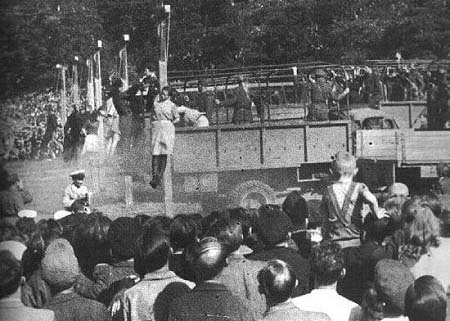
This day’s condemned — camp commandant Johann Pauls, five male kapos, and five female guards — were the product of the first of four Stutthof trials held in 1946-1947. At a hill in Gdansk known as Biskupia Gorka (Bishop Hill), upon a specially-erected row of four T-shaped double gallows centered around a pi-shaped triple gallows, and before a crowd of thousands, the doomed eleven were noosed on the back of military trucks which then drove away to leave them strangling to death with a “short drop” hanging.
The following gut-twisting images are among a number to be found here.
Above: on one end of the gallows row, the truck has just pulled away from Jenny Wanda Barkmann — a modish Hamburg lass in her mid-20’s known to Stutthof prisoners as “the Beautiful Specter” for her cruelty. Down the row, one can see that some of the prisoners are already swinging, while others have not yet been dropped.
Upon hearing her sentence, Jenny Barkmann retorted, “Life is indeed a pleasure, and pleasures are usually short.” (More about Barkmann, including trial photos, here.) In this closer view of her, just as in the first photo, she is still alive and struggling. Next to her, Ewa Paradies, another guard, is prepared for the same fate.
The central triple gallows. Commandant Johann Pauls hangs in the middle with Gerda Steinhoff — one of the senior female guards — in the foreground. The line of five male kapos recedes behind them into the enormous crowd of onlookers.
On this date in 1953, a guerrilla with the nom de guerre “Khmara” was shot in Kiev’s Lukianivka Prison for his involvement in a still-controversial resistance movement.
Dmytro Bilinchuk on the forest moon of Endor. UPA regs supposedly strictly prohibited photography; being rebels by nature, they snapped enough to fill up this page.
History is lived forward but understood backward. Therein lies the ambiguity of the Ukrainian Insurgent Army (UPA), a nationalist organization that operated in Galicia and environs after the Nazi invasion and persisted several years afterwards.
At its height, the UPA is said to have had up to 100,000 members, famously operating out of subterranean forest bunkers. This day’s victim was the captain of one of its companies; there is very little about him available online in English — principally his death date — but Ukrainian sites add the folklorish but poignant detail of his supposed adoption of an orphaned bear cub.
But about his organization, the name alone is sufficient to invite the most acrimonious debate:* were these partisans Nazi collaborators? Ukrainian patriots? Both?
Ukrainian nationalists, under the leadership of a man who had abandoned socialism for a fascist national ideology (everyone was doing it), entered the World War II era having conspicuously failed to grasp independence in a period when nationhood was being handed out like candy to small European states.
The specific kettle for Ukraine’s stewing ethnic aspirations was Galicia, the northeastern shoulder of the Carpathian mountains presently in western Ukraine. Galicia had been at the heart of both Polish and Ukrainian national movements, and they fought for it after World War I — a war won by Warsaw. (Meanwhile, Bolshevik victory in the Russian Civil War forestalled national ambtions further east.)
Brewed with the movement’s right-wing ideology, Ukrainian nationalism developed an anti-Polish, anti-Russian, anti-Communist programme, and it gazed around 1930’s Europe wondering if it couldn’t find an aggressive great power with a similar outlook that might take Ukraine under its wing.
Fast forward to the eve of World War II: by the terms of the Molotov-Ribbentrop Pact, Hitler and Stalin carved up the Ukrainians’ rival and thrust Galicia into Soviet hands, incidentally exposing its inhabitants to the pleasures of life under Stalin.
For Ukrainian nationalists, the altered situation of the Poland partition — followed shortly by Hitler’s initially successful invasion of Russia — offered an apparent opportunity to realize the dream of statehood under the patronage of a somewhat congenial Nazi government.
Though there’s a great deal of contention this author is not remotely qualified to referee about precisely which organs collaborated with or resisted the Nazis in precisely which ways, it seems fair summation to say that Ukraine’s nationalist movement was happy to treat with Berlin. Berlin being more reserved about a Slavic nationalist movement in its conquered territory, the UPA’s proposed institutional alliance with the Wehrmacht never quite came to pass as such, but that left many nationalists as freelance collaborators instead.** The hypothetical Ukrainian state in a Nazi-dominated Europe was not going to come about by sabotaging the Germans.
Instead, the UPA got busy laying the groundwork for an ethnically homogeneous Ukrainian homeland by fighting a reciprocal dirty war of ethnic cleansing against Poles in Galicia (most notoriously and emblematically, at Volhynia) — eventually developing into inter-partisan civil warfare against both Polish and Communist units (who had their own differences) with the odd brush with the Wehrmacht mixed in, and giving way to full concentration upon Soviet authorities as Red Army drove out the Germans.
The fact of having engaged German troops is a loudly bandied point in the UPA’s modern defense — the elevator pitch is that they “fought the Nazis and the Communists,” though it sure looks like they fought the one a lot harder than the other, and fought both less eagerly than they fought the Poles. There may be no cause to call UPA fighters other than sincere patriots of a nation whose aspirations were no less worthy than any other, who under beastly circumstances and for motives they believed noble committed sins no uglier than many other nationalists: even so, the thing separating that militia and its movement from, say, the Croatian Ustashi looks like opportunity rather than principle. Most perceived at the strategic plane a clear choice between Nazi victory with Ukrainian independence and Nazi defeat without, and most consciously preferred the former. No doubt the UPA would retort that its only other option was worse.
While Ukraine had a predictable exodus of anti-communist types as World War II drew to a close,† thousands of UPA guerrillas stuck around to keep up their fight (already underway) against the Soviets — including Dmytro Bilinchuk, whose biography can be enjoyed by readers of Ukrainian here.
It took a decade or more for Russia to extirpate this movement by hunting down its Bilinchuks. Buried in obscurity for the remainder of the Cold War, however, the martyrs of the OUN and UPA have pried open their tombs since Ukraine separated from the USSR in 1991 and become a contentious symbol in present-day Ukraine.
The OUN successor Congress of Ukrainian Nationalists has been part of Ukraine’s governing alliance since the Orange Revolution, and has pressed to treat its dead forebears as national heroes — renaming streets and attempting to rehabilitate UPA veterans into a class with those of the Red Army, a problematic enterprise since the two groups spent years killing one another. Old warriors may never reconcile, but the self-conscious reconstruction of the Ukrainian partisan movement in the service of shaping modern Ukrainians’ identity is a going concern:
Proving Faulkner’s old aphorism that the past isn’t dead and isn’t even past, this latter-day party and others of the Orange coalition remain electorally rooted in the UPA’s old western Ukraine stomping grounds, and tend to lean towards western Europe in outlook; eastern Ukraine remains more heavily Russian-oriented, and more inclined to the Russians’ distasteful view of the OUN and UPA.
** Late in the war, Germany would eventually form its own Galician SS Division. UPA proponents take pains to separate this German-officered formation from UPA guerrillas.
† Ironically, Ukrainians who bolted west — including the Galician SS division, which undertook a forced march to surrender in Italy rather than to the Soviets — profited greatly from having been “occupied” by Poland before the war, and from bloodily moving the border during the war. A refugee screening report (cited in Poland’s Holocaust — a source hostile to the UPA, as the title suggests) commented that Ukrainian detainees
are really having the best of both worlds. They do not qualify as Soviet citizens because their place of birth and/or habitual domicile on 1.9.39 were in Poland, and they therefore by our definition escape all punishment by the Russians for their having assisted the enemy; and they are not presumably eligible now for punishment by the Polish authorities because that part of the country from which they came is no longer part of Poland.
On this date in 1945, the last man executed for rape in England was hanged at Shepton Mallet prison — an American serviceman, hanged by the United States military.
Our story finds us in the Staffordshire town of Rugeley (for a second consecutive date), where a Mexican-American prisoner-camp guard named Aniceto Martinez raped a 75-year-old local. He should have put some thought into his alibi: he was the only American out of the camp that night, and hence easy pickings.
No, Martinez is notable only for his accidental milestones. His was the last U.S. military execution in Britain during World War II (actually coming over five weeks after Germany had capitulated). And he was the last person hanged on Albion’s soil for rape. This offense was not a hanging crime by English statute at the time, but was a capital offense in a U.S. military court … although all six of the personnel upon whom the sentence was inflicted were non-white, a pattern noticeable in stateside civilian cases as well.
The execution shed used by the U.S. military at Shepton Mallet Prison.
Martinez also, as it turned out, retired the use of Shepton Mallet as a facility for conducting executions. Dating to 1610, the prison had been out of commission during the 1930’s but taken over by the visiting American forces during the war years. (It’s remained in operation since, England’s oldest functioning prison.)
Though conducted under American law, the 16 hangings* at Shepton Mallet were actually carried out by British executioners in something of a procedural amalgam. American procedures in general governed the affair — and prolific British hangman Albert Pierrepoint, who conducted several, remarked on the (to him) oddities in his autobiography:
[A] custom which was strange to me was the practice of laying on a mighty feast before the execution. We were eating badly in this country at that time, but at an American execution you could be sure of the best running buffet and unlimited canned beer. The part of the routine which I found it hardest to acclimatise myself to was the, to me, sickening interval between my introduction to the prisoner and his death. Under British custom I was working to the sort of time where the drop fell between eight and twenty seconds after I had entered the condemned cell. Under the American system, after I had pinioned the prisoner, he had to stand on the drop for perhaps six minutes while his charge sheet was read out, sentence spelt out, he was asked if he had anything to say … and after that I was instructed to get on with the job.
One important concession to the British practice: use of the variable drop, designed to break the condemned wretch’s neck rather than a standard drop without accounting for the weight of the prisoner … which risked either slowly suffocating or outright decapitating the hanged man.
Northern Kentucky University professor J. Robert Lilly has more detail on American military executions at Shepton Mallet in this 1995 paper.
* There were also two executions by firing squad, “soldierly” executions for military offenses. A complete list of these executions is here.
On this date in 1962, the architect of the Final Solution received such justice as could be meted to him on earth at Israel’s Ramla Prison.
Adolf Eichmann, the vacuum cleaner salesman turned SS Obersturnbannfuhrer, remains the only person judicially executed in the history of modern Israel, whose intelligence services kidnapped him from Argentina where he had settled after the war.
Other Nazis had used the “only following orders” defense with little success in the Nuremberg Trials shortly after World War II. On trial years later (and at the hands a Jewish state) Eichmann — a bookish, unmenacing man who invoked Kant — posed the questions of individual responsibility and human psychology in starker terms.
To be sure, he was no anonymous functionary. Neither, however, had he dirtied his nails at the stomach-churning business end of the Holocaust: rather, he had engineered the stupendous logistical project of deporting Eastern Europe’s Jews for extermination, an (impressive) accomplishment worth exponentially more lives than any Einsatzgruppe could ever account for, yet simultaneously abstract from the upshot.
Eichmann said he did it without ill-will towards its subjects — simply to obey and to achieve.
The Banality of Evil
[I]f it was of small legal relevance, it was of great political interest to know how long it takes for an average person to overcome his innate repugnance of crime, and what exactly happens to him once he has reached that point. To this question, the case of Adolf Eichmann supplied an answer that could not have been clearer or more precise.
-Hannah Arendt
Hannah Arendt took him at his word* and saw in Eichmann the abyss gazing back into us, into his judges — not a monster but a man unsettling in his normalcy, whose job was not TPS reports or quarterly sales results but turning humans into ash.
The company man. The career man. Every man, standing in for countless thousands more who pushed the papers that drove the trains to Auschwitz.
What for Eichmann was a job, with its daily routine, its ups and downs, was for the Jews quite literally the end of the world.
Not everyone accepts her conclusions, but Arendt’s characterization of “the banality of evil” has become the man’s epigraph. And Eichmann disturbs us precisely because we seem to be able to meet him on his terms, even sympathize with him when the horror of his crimes begs for a monster like Streicher or Goebbels we could safely consign to the Other.
Arendt’s turn of phrase has a certain breezy (hackneyed, even) life in the public discourse, but her analysis of Eichmann’s careerism remains a challenging and deeply relevant one for we heirs of the world that hanged him.
The complete transcript of Eichmann’s trial is available online here. Video of his trial has been posted online here (in English) and here (original languages).
* Albeit with some reservations; others have argued that Eichmann was considerably more personally invested in his mass-murder project than his demeanor at trial admitted. Certainly he had an interest in showing the mellower Eichmann when he was on trial for his life.

 And the love affairs! Or that’s what they say — including fellow agent Ian Fleming.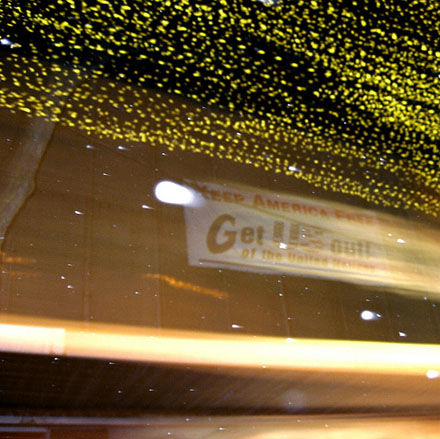
 A village girl and the first in her family to go to school, young Antonina Parfenova was dubbed “Makarova” (after her father, Makar) by a teacher when the girl forgot or was too shy to say her surname. This childhood switcheroo would follow her into adulthood and ultimately buy her half a lifetime and a family to mourn her.
 While en route, Stauffenberg had no ability to communicate to the wider world. Landing in Berlin three hours after the not-quite-deadly-enough blast at Wolfsschanze, he must have been stunned to find that Valkyrie had not been launched. Apparently, fragmentary reports from the east were unclear as to whether Hitler had survived; everyone was reluctant about committing himself.
 Based on