1917: Thirteen black soldiers of the 24th U.S. Infantry Regiment

On this date in 1917, thirteen black soldiers were secretly hanged at dawn at a military camp outside San Antonio for their parts in a Houston race riot four months earlier.

During the nadir of American race relations and just months after America’s entry into World War I, the soldiers of this historic all-black unit had been dispatched to build military facilities in Harris County, where they met animosity from whites beyond the everyday insults of Jim Crow law. Here, the service of “arrogant, strutting representatives of black soldiery” was hated and feared.

When white police arrested a black infantryman who tried to prevent their detaining a drunk black woman, then beat up and shot at a black corporal sent to inquire after him, hostility boiled over. Over one hundred soldiers marched through the city — confronting a mob of white citizens and police who had likewise armed themselves. Fifteen whites and four blacks were killed in the ensuing confrontation.

This documentary segment is from Mutiny on the Bayou:

The next day’s Houston Chronicle knew just what to do about it.

Their lenient treatment has led negro soldiers to believe that the government is in sympathy with their arrogance and impudence toward white people …

A COURT MARTIAL, A HOLLOW SQUARE AND A FIRING SQUAD WILL SETTLE THE MATTER FOR ONCE AND FOR ALL.

No white Houstonian was ever prosecuted for the day’s events, but the largest court-martial in U.S. military history tried 63 black soldiers and condemned 13 to die:

Sgt. William C. Nesbitt
Corp. Larsen J. Brown
Corp. James Wheatley
Corp. Jesse Moore
Corp. Charles W. Baltimore*
Pvt. William Brackenridge
Pvt. Thomas C. Hawkins
Pvt. Carlos Snodgrass
Pvt. Ira B. Davis
Pvt. James Divine
Pvt. Frank Johnson
Pvt. Rosley W. Young
Pvt. Pat MacWharter

The sentence was carried out without appeal, the time and place only announced after the men had already hanged but evidently witnessed by the New York Times reporter who wrote that “the negroes, dressed in their regular uniforms, displayed neither bravado nor fear. They rode to the execution singing a hymn, but the singing was as that of soldiers on the march.”

Two more mass courts-martial would follow, resulting in six more hangings the following year.

For years afterward, the incident clouded and complicated race relations, especially in the War Department.

Some blacks openly applauded the mutiny as a justified resistance against racist provocation. This inflammatory opinion piece, quoted in Mark Ellis’ Race, War and Surveillance, landed the editor who agreed to run it in federal prison:

We would rather see you shot by the highest tribunal of the United States Army because you dared to protect a Negro woman from the insult of a southern brute in the form of a policeman, than to have you forced to go to Europe to fight for a liberty you cannot enjoy. Negro women regret that you mutinied, and we are sorry that you spilt innocent blood, but we are not sorry that five southern policemen’s bones now bleech [sic] in the graves of Houston, Tex.

Meanwhile, the Army noted “the tendency of the Negro soldier, with fire arms in his possession … to become arrogant, overbearing, abusive and a menace to the community in which he happens to be stationed.” It held down its black enlistment throughout the interwar period.

Sympathizers with the policy would continue — until the raw manpower requirements of World War II trumped the discussion — to cite the Houston riots both as evidence of the dangers of arming blacks, and the disloyalty of a populace willing to register open disgust with lynch law during wartime.

* Baltimore was the soldier who had come after the missing men; his altercation with a white policeman who answered, “I don’t report to any negro” and pistol-whipped him — and, it was incorrectly rumored among the 24th Infantry that night, killed him — triggered the riot.

Baltimore’s role is developed in a fascinating study of primary documentation on the case in Edgar A. Schuler’s “The Houston Race Riot, 1917” published in The Journal of Negro History, Vol. 29, No. 3 (July, 1944). Schuler also treats the interesting tensions between the Houston black community and the black regiment, and the emergence of a white narrative of uppity, out-of-control Negroes rather than ones responding (however wrongly) to specific provocations … which conveniently turned Jim Crow law from the problem into the solution.

On this day..

1939: The 18 corpses of the rebellion

On this date in 1939, 18 junior officers of the Thai military were shot in Bangkok.

Ostensibly condemned for being part of a coup plot to depose the adolescent King Ananda Mahidol in favor of his abdicated predecessor Prajadhipok, they were in reality the casualties of a purge by the Field Marshal-turned-Prime Minister Phibun Songkhram.

It’s alternatively transliterated “Phibun Songkhram” or “Pibunsonggram”, and familiarly abbreviated to “Por”, but by any name he dominated Thai politics for a generation.

One of the military leaders of the bloodless 1932 Siamese Revolution that made the country a constitutional rather than an absolute monarchy, Phibun had in 1938 muscled his way to the Prime Ministership.

Beset by assassination attempts linked to royal revanchists to whose purposes the young turk’s programme was deeply inimical, Phibun determined to break the back of monarchism en route to a modernized, militaristic nationalism (pdf) that would be right at home in the imminent world war.*

As 1939 opens, we join the narrative of Paul Handley’s The King Never Smiles:

Phibun swept the capital and arrested 50 royals, nobles, and soldiers in the clique of his People’s Party rival Colonel Song Suradej for plotting his overthrow …

Whatever the truth behind the cabal, its quashing came to represent the final victory of the 1932 revolutionists and the constitutionalists over the monarchists. To mark it, Phibun commissioned a huge monument to the constitution, later called Democracy Monument, in the middle of the city’s main thoroughfare, Rajadamnoen (“royal progress”) Avenue.


The Democracy Monument in Bangkok.

The eighteen officers who took it in the shorts on this date were not joined by condemned VIPs like royal blood Prince Rangsit, who copped a commutation. It’s widely thought now that the “Songsuradet Rebellion” — or aptly-named “Rebellion of 18 Corpses” — was trumped-up, if not an phantasm altogether.

The Democracy Monument was not the only bulwark of Thai nationalism thrown up by Phibun in the year between the “conspirators'” January arrest and their deaths this day.**

He dropped the old absolutist name “Siam” in favor of the more nationalistic “Thailand” in June of that year; made the date of the 1932 revolution a national holiday; stripped the language of class-distinctive structures; and pressed irredentist claims against neighboring French colonies.

And if the royal house was efficiently marginalized by Phibun, it would yet develop in the latter part of the century into one of the region’s weightiest political entities† … intertwined with the Thai military Phibun helped hoist to pride of place, a formula that has left coups and unstable governments a presistent feature of the political landscape down to the present day.

* And subsequently, too. Despite aligning with the Axis powers during World War II, Phibun was a feted anti-Communist dictator as Washington started counting dominoes in Southeast Asia in the 1950’s.

** The Wikipedia page for the rebellion claims that the executions were carried out in batches of four per day. A New York Times report of December 6, 1939 said that all 18 had been executed the previous day.

† The current King Bhumibol Adulyadej, who coincidentally turns 81 today, is the world’s longest-reigning monarch as of this writing … with no shortage of concern about the conflict his passing may unstop.

On this day..

1950: James Corbitt, the hangman’s mate

On this date in 1950, famed British executioner Albert Pierrepoint carried out his most difficult assignment: hanging his friend.

Though not literally the Isles’ last hangman, Pierrepoint is the last one everyone thinks of, the man who defined the hangman’s job for the 20th century.

Discreet, orderly, and as quiet as he was efficient,* he was the brand-name executioner for stiff-upper-lip England of the waning empire, with over 400** hangings to his name from 1932 until he resigned over a fee dispute in 1956.

Despite his proper avoidance of the spotlight, Pierrepoint’s excellence at his craft would make him a celebrity — especially after the press fixated on his role hanging Nazi war criminals after World War II. The ready-made morality play upon the scaffold boards could hardly be resisted: the English grocer, meting out a dignified and precise measure of justice to the likes of the Beast of Belsen.

Hanging Around

Pierrepoint’s characteristic client wasn’t a war criminal, but a humdrum British murderer, only a handful of which attract especial remembrance today.

Still, in the immediate postwar years, the growing reach of the mass media and burgeoning public controversy over the death penalty would frequently put Pierrepoint in the middle of the era’s highest-profile hangings, including:

Tish and Tosh

Like as not, this day’s affair hit the sturdy hangman harder than any of those.

James Henry Corbitt was a regular at “Help the Poor Struggler”, the piquantly named Oldham pub Pierrepoint bought and managed after World War II. Known as “Tish” to Pierrepont’s “Tosh,” the two had sung a duet of “Danny Boy” on the night that Corbitt went out and murdered his girlfriend in a jealous rage.

Corbitt was not exceptional as a criminal, and he was indisputably guilty; we wouldn’t notice him if not for his acquaintance with the man who put him to death.

But Pierrepoint would remember this one well, as he later wrote in his his autobiography:

I thought if any man had a deterrent to murder poised before him, it was this troubadour whom I called Tish. He was not only aware of the rope, he had the man who handled it beside him singing a duet. The deterrent did not work.

Remarkably, the most prolific executioner in British history had come out against the death penalty, or so it seemed. (He later backed away from a strong anti-death penalty position, though without retracting his original reservations. The death penalty had been a decade off the books by this point, in any case.)

It is I who have faced them last, young lads and girls, working men and grandmothers.

I have been amazed to see the courage with which they walk into the unknown.

It did not deter them then and it had not deterred them when they committed what they were convicted for. All the men and women I have faced at that final moment convince me that in what I have done I have not prevented a single murder. And if death does not work to deter one person, it should not be held to deter any … capital punishment, in my view, achieved nothing except revenge.

It’s an open question how much Tish’s hanging this day really contributed to Pierrepoint’s retirement six years later or his apparent change of stance on his trade. But it provides the gut-wrenching dramatic pivot for the film Pierrepoint: The Last Hangman.

Interestingly, while the hangman saw in Corbitt’s fate a troubling indictment of the death penalty, the hanged man’s son to this day still says dad deserved to die.

More on Albert Pierrepoint

For a man so ubiquitously present in the mid-century experience of Great Britain, and who undertook such a dramatic volte-face, it’s no surprise that Pierrepoint has attracted plenty of attention — including this website, and a number of books.

Also of possible interest: Hangmen of England: History of Execution from Jack Ketch to Albert Pierrepoint (we’ve met Jack Ketch here before). More dry factual data about Pierrepoint, the father and uncle who preceded him in the post, and other recent practitioners in Britain’s colorful line of executioners is here.

* The English practice was for Pierrepoint to pinion the prisoner’s arms in the condemned cell, escort him a few steps into a hanging chamber, hood him, and execute the sentence without further ceremony. The whole process took mere seconds — a record fast seven seconds from cell door to trap door in the case of James Inglis — which Pierrepoint seems to have had a gift for dignifying in his (usual) silence with a sort of calming paternal assurance.

Pierrepoint hanged six American soldiers under the auspices of U.S. military forces deployed to England during the Second World War, and confessed to considerable discomfort with that entity’s protracted pre-hanging procedures that had him standing on the scaffold with the condemned man for several minutes.

* And perhaps well over 600 hangings; the figures are disputed.

On this day..

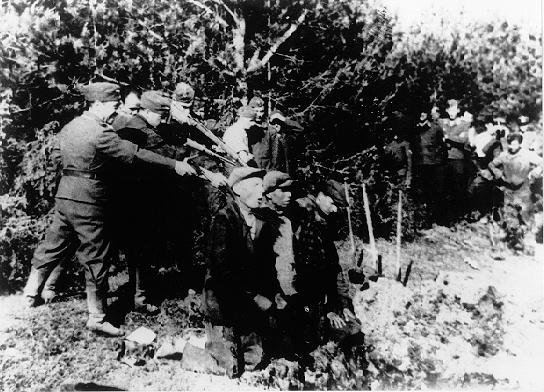
1942: Partisans by the Sonderbataillon Dirlewanger

On an uncertain date in November 1942, this photograph of an SS unit executing anti-Nazi partisans in Belarus was taken.

Behind this striking but all too typical image of brutal field executions on the eastern front lies the sordid story of one of the strangest military formations in the Nazi service.

The Dirlewanger brigade was formed under a man whose fortuitous early enrollment in the NSDAP had enabled him to pull strings to get himself out of Dachau, where he had been sent after his second molestation conviction, and where unfolding events could have easily seen him on the other end of the firing squad.

Instead, Oskar Dirlewanger formed a unit of criminals and reprobates: poachers at first, and eventually, as it grew into the SS-Sonderbatallion Dirlewanger, men culled from the camps or soldiers condemned by the army, some literally trading the likelihood of execution themselves for service under one of the most disreputable commanders in the field.

Oh, and, just incidentally — it stuck them into a lawless environment where they could probably practice and refine their pathologies unchecked. Some “rehabilitation.”

As of this relatively early date, the convict floodgates weren’t yet entirely open, and the existing German volunteers were supplemented by a goodly portion of Soviet citizens recruited in the occupied territories. From 1942 to 1944, they hung around Belarus hunting guerrillas and doing to them — well, you know. (The original notion of using poachers was to exploit their ranger-like woodsman talents for anti-partisan warfare.)

Oh, and civilians. Tens of thousands of civilians. That almost goes without saying.

Sadly for Dr. Dirlewanger, events further south were undoing all his bloody work, for it was also in the November 1942 that the Red Army decisively turned the tide of the war with its counterattack at Stalingrad — in fact, it was this very date in 1942 that it completed its encirclement, stranding a quarter-million freezing Wehrmacht regulars on the banks of the Volga, only a handful ever to see Germany again.

The Dirlewanger brigade would have its own turn being minced by the Soviet war machine, though not before it had a notorious hand in drowning the Warsaw Uprising in blood.

Dirlewanger himself was tortured to death by Polish guards a few weeks after the war ended.

Part of the Themed Set: The “Ex” Stands For “Extrajudicial”.

On this day..

1939: Nine Czech students

Today is International Students’ Day and a public holiday in the Czech Republic and in Slovakia thanks to the martyrdom of nine at the hands of the Nazi occupation forces this day in 1939.

The previous fall, Hitler had cowed the allied powers into ceding the mountainous Czechoslovakian Sudetenland to the Third Reich in order to avert war — leading to Neville Chamberlain‘s famously mistaken “peace in our time” speech.

In March 1939, Germany reneged its part of the bargain and gobbled up Bohemia and Moravia, essentially the modern Czech Republic.

That this would collapse Chamberlain’s vision of peace and set Europe’s powers on the road to war with Berlin was cold comfort to the occupied Czechs. They had their own problems.

On October 28, youth demonstrations in Prague against the occupation resulted in the shooting of Charles University medical student Jan Opletal

Two weeks later he succumbed to the injury, and his funeral turned into an anti-occupation riot forcibly quashed by German arms. According to the London Times account:

On November 17 at 3 a.m., the Gestapo entered all students’ colleges, men’s and women’s, without allowing them to dress, tied the students in groups of three, and dragged them away … Between 3 o’clock and 8 o’clock in the morning the Gestapo visited students’ homes and lodgings. Those opposing arrests and parents who withheld information were immediately shot at, and the wounded were refused attention. The Gestapo broke into high schools as well as into the university …

The prisoners were taken to the Ruzyn barracks and to the Sparta football stadium, where cold water was flung over them and were made to wait until the evening. Then, in the barrack yard, 124 students and teachers* were shot before their fellow-students, the first nine being presidents of students’ associations, including the brilliant young sociologist Dr. Matoushek [English Wikipedia entry | Czech], son of a former Minister of Commerce.

Universities in the cities were declared closed for three years; they would not in fact re-open until after the war.

The day, subsequently memorialized as den boje studentu za svobodu a demokracii (Day of the Students’ Fight for Freedom and Democracy), entered Czech history a second time a half-century later. A student protest at Opletal’s grave on this date in 1989 helped catalyze the Velvet Revolution that toppled Czechoslovakia’s Communist government.

* The larger figure was circulated in the days following by Czech sources. It is not clear to me whether that number proved unfounded, or whether subsequent memorials simply came to focus on the leading nine — whose executions are certain, and were even announced by German communique.

On this day..

1892: Jens Nielsen, the last in Denmark

On this date in 1892, serial arsonist Jens Nielsen was beheaded with an axe in the courtyard of Horsens prison — the last civil execution ever conducted in Denmark.

According to this Danish biography, Nielsen had incurred a long prison sentence for burning several farms in July 1883.

(He’d just returned from a fruitless stint in the New World, torching a warehouse in England on the return voyage.)

Apprehended immediately and sentenced to a long prison term, Jens confronted an age-old dilemma which was evidently noticeably acute among melancholy Danes: effecting state-assisted suicide on the scaffold.

These cases must have once been fairly frequent because Denmark, by an ordinance of December 18, 1767, deliberately abandoned the death penalty in cases where “melancholy and other dismal persons [committed murder] for the exclusive purpose of losing their lives.” The background for the provision was, in the words of Orste, “the thinking that was then current among the unenlightened that by murdering another person and thereby being sentenced to death, one might still attain salvation, whereas if one were to take one’s own life, one would be plunged into eternal damnation.”

The ordinance was ineffective in one case, at least, that of Jens Nielsen, who was born in 1862 and spent a most unhappy and unfortunate childhood. In 1884 he was sentenced to 16 years of hard labor for theft and arson. The following year he tried to kill a prison guard. He was tried, sentenced to death and received a commutation to life. He was then placed in solitary confinement. A year later he tried again to kill a guard, “realizing that he could not stand solitary confinement, did not have the nerve to commit suicide and wanted to force his execution.” He was again tried, sentenced to death and the sentence commuted. In 1892, having remained in solitary confinement all that time, he tried again to kill a guard. This time he got his wish, was sentenced to death and executed. (Source.)

He even managed to crack wise, “Thank you!” to the mayor who wished him God’s help on the way to the scaffold — envoy of the powers both temporal and ethereal that would finally loose his shackles.

Denmark’s death penalty law lingered into the 1930’s, but even the occasional death sentences were no longer carried out. Apart from a brief revival after World War II to punish war crimes committed during the Nazi occupation, nobody has been put to death in Denmark in — as of today — 116 years.

On this day..

1944: Hannah Szenes, who gambled on what mattered most

On this date in 1944, Hannah Szenes was shot by the Nazis in her native city of Budapest — a city she had left five years before, and to which she had returned as a British special operative.

Hannah Szenes (alternatively, “Chana Senesh” or “Hannah Senesh”) grew up in interwar Hungary.

Reaching adulthood in a period of rising anti-semitism in the late 1930’s, she became a Zionist and emigrated to British-controlled Palestine.

But with the onset of war, she signed up with the British Special Operations Executive and was parachuted behind German lines in March 1944.

Her brief: to save both Jews and downed Allied pilots. It is often described as the only military expedition to relieve European Jewry during World War II.

And it was as dangerous as it sounds.

[flv:http://www.blessedisthematch.com/BITMclip4.flv 425 344]

Hannah was nabbed crossing into Hungary on a mission that her colleagues (rightly, it seems) deemed too perilous to attempt, and withstood months of torture without divulging her codes.

By the time she went in the dock for treason, Nazi control of Hungary was collapsing and judicial administration itself was breaking down to the timpani of falling shells. Her sentencing November 4 was postponed; on November 7, an officer peremptorily informed her that she had been condemned to death. It’s believed that she was actually never formally sentenced, merely mopped up ahead of the unstoppable Red Army, which on this very day first entered Budapest’s suburbs.

A writer as well as a fighter, Szenes’ poetry survived as her monument to life — like the present-day Israeli standard “Blessed is the Match”, also the title of the documentary excerpted above; and, her “Halikha LeKesariya” (“A Walk to Caesarea”), also known as “Eli, Eli” (“My God, My God”). Here it is sung by Regina Spektor.

These lines were reportedly her last-known verses from prison:

One – two – three … eight feet long
Two strides across, the rest is dark …
Life is a fleeting question mark
One – two – three … maybe another week.
Or the next month may still find me here,
But death, I feel is very near.
I could have been 23 next July
I gambled on what mattered most, the dice were cast. I lost.

On this day..

1941: Arndt Pekurinen, conscientious objector

On this date in 1941, Finnish pacifist Arndt Pekurinen was executed at the front for refusing to fight.

Initially conscripted in the 1920’s, Pekurinen had refused to serve under arms and spent 1929-31 in prison for his troubles. He was a minor cause celebre; British MPs and big international names like Einstein and H.G. Wells pressed for his release.

A change in the Finnish conscription law — the bill was called the “Lex Pekurinen” — finally saw him freed to civilian life, but he was drafted anew to fight the Soviet Union in the “Continuation War”. When he again refused, he was shot at Suomussalmi without trial — though two men refused to do it before someone finally agreed to be the executioner.

“Kun ihmisiä ei syödä, on niitä turha teurastaa.”
(“As people are not eaten, butchering them is of no use.”)

A neglected figure during the Cold War, he’s enjoyed a latter-day rediscovery since the 1998 Erno Paasilinna book Courage: The life and execution of Arndt Pekurinen. In the decade since, Pekurinen has become a household name and a widely-admired figure. (The link is in Finnish.) A park in Helsinki was recently named for him. (Finnish again.)

Tangentially, the Nordic stock of our day’s victim and his era of militarism call to mind the hero of e.e. cummings’ “i sing of Olaf glad and big”. The allusions of this poem are American, and there’s no reason to associate it directly with Pekurinen — but it so happens that it was published in 1931, the year international pressure forced the end of Pekunin’s first prison stint:

i sing of Olaf glad and big
whose warmest heart recoiled at war:
a conscientious object-or

his wellbelovéd colonel(trig
westpointer most succinctly bred)
took erring Olaf soon in hand;
but–though an host of overjoyed
noncoms(first knocking on the head
him)do through icy waters roll
that helplessness which others stroke
with brushes recently employed
anent this muddy toiletbowl,
while kindred intellects evoke
allegiance per blunt instruments–
Olaf(being to all intents
a corpse and wanting any rag
upon what God unto him gave)
responds,without getting annoyed
“I will not kiss your fucking flag”

straightway the silver bird looked grave
(departing hurriedly to shave)

but–though all kinds of officers
(a yearning nation’s blueeyed pride)
their passive prey did kick and curse
until for wear their clarion
voices and boots were much the worse,
and egged the firstclassprivates on
his rectum wickedly to tease
by means of skilfully applied
bayonets roasted hot with heat–
Olaf(upon what were once knees)
does almost ceaselessly repeat
“there is some shit I will not eat”

our president,being of which
assertions duly notified
threw the yellowsonofabitch
into a dungeon,where he died

Christ(of His mercy infinite)
i pray to see;and Olaf,too

preponderatingly because
unless statistics lie he was
more brave than me:more blond than you.

On this day..

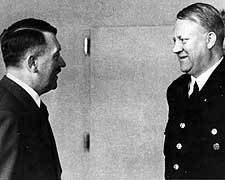
1945: Vidkun Quisling, who made his name as a traitor

On this date in 1945, eponymous Nazi collaborator Vidkun Quisling was shot at Oslo’s Akershus Fortress for high treason.

By the time of his death, the Nazi collaborator (English Wikipedia page | Norwegian) had already given his surname to English and other languages as a synonym for traitor.

Just deserts for his efforts as chief of the fascist party Nasjonal Samling to aid the Nazi conquest of his home country. Quisling interrupted a radio broadcast on April 9, 1940 to proclaim himself Prime Minister* and order cooperation with invading Germans.

Although Quisling’s lack of popular support compromised his value even as a puppet, he remained as Minister President of Norway through the war — a crucial tool in Germany’s counter-encirclement jousting with Britain, nicely explained at the outset of Frank Capra’s American propaganda flick Why We Fight:

He enjoyed public regard commensurate with his station.


A 1944 cartoon in Sweden (which remained tenuously neutral and unoccupied during the war) indicates that Quisling had already made his name a byword for treachery. The caption reads:
“I am Quisling.”
“And the name?”

Norway had abolished capital punishment in 1905, but its government-in-exile reinstated it expressly for dealing with high-level collaborators.

Though Quisling himself may have deserved this and worse, the justice and legality of so doing has been controversial ever since.


The site of Quisling’s execution. Some other shots from his trial are in this 60-year Norwegian-language retrospective.

* Thought to be the first on-air putsch in history.

On this day..

1943: 98 American civilian contractors on Wake Island

On this date in 1943, after Japanese-occupied Wake Island was subjected to a withering bombardment from the United States Navy, garrison commander Shigematsu Sakaibara ordered the summary execution of 98 American prisoners of war.

Wake Island came under Japanese attack immediately after the bombing of Pearl Harbor raised the curtain on the Pacific theater — and was overrun in two weeks.

It was strategically situated halfway between Hawaii and the Philippines. That’s why the Japanese wanted it — and that’s why the Americans wanted it back.

Caught in the middle were 1,600-plus Americans captured when Wake fell in December 1941, 1,100 of them civilian contractors of construction conglomerate Morrison Knudsen there to build a naval base. Most of these, and all military personnel, were shipped to POW camps in China early in 1941; only 700 contractors would survive their four-year sojourn in Japanese captivity.

By September 1942, only 98 Americans remained* on Wake Island — all contractors, the last remnants of the prison labor force who had been forced to lattice the island with defensive fortifications against the expected American invasion.

U.S. forces bombed Wake Island repeatedly during World War II — rare respites from the monotony of forced labor — but the most intense attack was an orchestrated naval bombardment and aerial attack beginning Oct. 5. Shigematsu Sakaibara feared it was the prelude to a long-anticipated landing attempt. And he wasn’t the only one: reporting the attack, the New York Times tried to read the tea leaves of the official pronouncements:

The fact that Wake was attacked yesterday by surface bombardment as well as aeriel bombing probably indicates that a major reduction of Wake is now intended. The atoll, which is the closest Japanese base to Pearl Harbor with the exception of a few islands in the Marshalls group, is a key stepping stone on Japan’s fastest aeriel route to her other central Pacific possessions in the Marshalls and Gilberts southwest of Hawaii.

Still,

[o]ccupation by United States forces of Wake Island, which is 1,033 miles from Midway, has been predicted for some time, but there is no indication that such an operation is probable immediately.

Sakaibara, unfortunately, didn’t have a Times subscription.

Expecting a landing, and fearing the prisoners would rise up as a “fifth column” against their captors when it came, Sakaibara had the 98 prisoners machine-gunned en masse on the beach. One of them managed to survive and escape the slaughter, but was recaptured shortly after, and is supposed to have been personally beheaded by the admiral. It’s said that unidentified man carved a (misdated) testimony to the crime on a nearby coral rock known as “98 Rock”: “98 US PW 5-10-43”.

As it turned out, the landing never did come. The U.S. Navy bypassed Wake Island, allowing it to languish under a blockade as it advanced elsewhere in the Pacific, and received Sakaibara’s peaceful surrender after the bombings of Hiroshima and Nagasaki.

Although the Japanese had hastily exhumed the murdered POWs and reburied them in a cemetery as the end of the war approached, the cover story on the “Wake Island Massacre” soon cracked. For this day’s affair, Sakaibara was convicted of war crimes by an American tribunal, and hanged in Guam on June 18, 1947.

* The identities of the 98 are known, and are listed online here as well as on a plaque at the site.

On this day..