On this date in 1942, poet Olena Teliha and her husband Mykhailo were shot by the Nazis at Babi Yar for their Ukrainian nationalist activism.
Olena Teliha (top) and her husband, Mykhailo Teliha.
Having lived in Czechoslovakia (where they met and married) and then Poland during the interwar period, the Telihas weren’t present for the worst of Soviet depredations in Ukraine. Mykhailo, a bandurist, might have been in an especially bad way, since his musical genre of choice harkened to subversive themes of Cossack insurrection, and was therefore heavily persecuted.
Instead, they moved to Kiev as the German invasion opened the prospect of returning to their ancestral homeland. There they found their affiliation with the Organization of Ukrainian Nationalists quite unwelcome to the new occupiers.
Olena kept writing for a prohibited nationalist paper, and Mykhailo gamely stuck by her.
Without a Name
Neither love, nor caprice nor adventure–
Not everything must be named.
As not always in abysmal waters
Can one find a motionless floor.
And when Your reawakened soul
Again rushes to a luminous path,
Do not question whose inspired oars
Were able to cast aside the dark shore.
Neither love, nor tenderness, nor passion,
Only heart — tumultuous eagle!
Drink then splashes, fresh, effervescent,
Of nameless, joyful sources.
(Executed Today friend Sonechka’s original translation from the Ukrainian text, found among this collection of Olena Teliha’s work)
Their execution this date is not to be confused with the mass execution of thirty thousand-plus Jews in September 1941, the atrocity with which Babi Yar is most frequently associated. This ravine continued to be used for Nazi executioners throughout the occupation of Kiev, including for more than 600 Ukrainian nationalists — who are today honored at the site with this monument:
On February 15, 1573, the brief but scintillating career of insurrectionary Matija Gubec came to a brutal end when he was publicly tortured to death in Zagreb.
You know what they say about the size of a man’s feet: Matija Gubec about to be crowned with a red-hot iron ringlet and quartered.
Although put down inside of two weeks, this revolt and its personification in Gubec have endured as potent national symbols in Croatia.
In the revolutionary 20th century, both left and right claimed Gubec’s standard as their own: a multiethnic company of Yugoslav volunteers fought under his name in the Spanish Civil War, as did multiple partisan units during World War II who took inspiration in his peasant class uprising. By contrast, the Ustasha conceived Gubec as
one man, who was not the exponent of any class, but … a reflection of an entire nation’s beliefs.*
Fascist and communist alike can jam to the rock opera Gubec Beg.**
* See Pavlakovic, Vjeran (2004) ‘Matija Gubec Goes to Spain: Symbols and Ideology in Croatia, 1936-1939’, The Journal of Slavic Military Studies, 17:4, 727 — 755.
** According to Pavlakovic, Gubec’s real given name is unknown and birth records suggest it might have been “Ambroz”. He was known as “Gubec called Beg,” using the Turkish term for a lord.
The demonstrative public hanging this day in 1944 of Poles in the remains of the Warsaw Ghetto* was little more than an everyday atrocity in Nazi-occupied Poland — although, ten days after the gauleiter responsible for previous mass executions had himself been assassinated by the Polish Home Army, it presumably had an extra bit of meaning for the city’s denizens.
Nazi terror reached new heights for the non-Jewish population of Warsaw in the winter of 1943-4. People were seized at random in the streets and executed on the spot; between October and February some 270 to 300 men and women were publicly hanged or shot each week — the kind of atrocities the French commemorate in Tulle and Oradour were, in Warsaw, a part of daily life. ‘On my way to Leszno Church today,’ Julian Kulski, a young soldier of the Home Army, recorded on 11 February 1944, ‘I saw a crowd of people standing in front of the Wall. They were gazing at something above the Wall, on the Ghetto side of it. As I got closer, I could see for myself — hanged from the upper-storey balconies of what had been an apartment house were the bodies of twenty-two of our Freedom Fighters.’ Kulski, at any rate, took them for Freedom Fighters.
This blurry photo dated to the same day and location was taken from a moving tram.
This mass execution may also be one alluded to by Jewish resistance fighter Yizhak “Antek” Zuckerman,** who survived the war in Warsaw with false papers identifying him as a Pole. His A Surplus of Memory: Chronicle of the Warsaw Ghetto Uprising remembers such an execution occurring while they lived on Leszno Street after the ghetto’s destruction — and that it greatly upset his wife, Zivia Lubetkin, because Zuckerman was so late arriving home that day.
One day the Germans hanged fifty Poles on street lamps, something they often did. This time it was on Leszno Street, in retaliation for harassing Germans. In such a case, they would take fifty Poles from their “stock” in Pawiak, publish their names, add the crime for which they were being murdered, and hang them in the city on electric poles. In this case, they also strung people up on the outside walls of the ghetto, where there was still a wall, even though there was no longer a ghetto.
* Warsaw’s Jewish ghetto had been liquidated the previous spring; at this point, it was rubble behind the still-standing wall.
On this date in 1945, and notwithstanding a partial outcry in French literary circles, fascist intellectual and Vichy collaborator Robert Brasillach was shot for treason in Montrouge.
A proper James Dean dies young, which fate was supplied courtesy of Brasillach’s editorship of the anti-semitic rag Je Suis Partout (“I Am Everywhere”) and enthusiastic support of the Vichy government.
Inasmuch as his collaboration had been in the form of ideas propagated, Brasillach’s case engaged the French polity in the challenging question of whether “intellectual crime” — and even “intellectual treason” — could exist categorically.
But then, ideas are sometimes life and death matters themselves, and nowhere is that more true than in France.
Many anti-fascist intellectuals appealed to de Gaulle for Brasillach’s life — many, but not all. Death penalty opponent Albert Camus signed the petition for clemency; Jean-Paul Sartre and Simone de Beauvoir refused.
Between fellow-feeling among the literary set, ideological enmity, and the searing experience of the occupation only just lifted lay a test for the conscience of many a French thinker — aphorized by the very words de Gaulle would use in turning aside the appeal.
On January 31, 1945, Private Edward Donald “Eddie” Slovik became a curious outlier of World War II: he was executed by firing squad by the U.S. Army for desertion. He is the only person to have been so punished for that crime since the Civil War.
Pvt Slovik was, by all accounts, quiet and helpful, by no means a coward, and more than willing to aid in the effort of World War II, traits which would have put him among a large class of that war’s veterans. Unfortunately, he was also immobilized by shelling. Equally unfortunately, he knew it, and he decided to do something about it.
Slovik and a friend, Pvt John F. Tankey, first separated from their detachment under artillery fire in late August 1944, shortly after being shipped to France. The pair hooked up with a Canadian unit and spent six weeks pitching in. Having recused themselves from the hard shelling others were experiencing on the front line, they opted to rejoin their regular U.S. unit: Slovik and Tankey sent a letter to their commanding officer explaining their absence and returned on Oct. 7.
But the front lines were not a place for Pvt Slovik.
After his assignment to the rifle unit, which would face imminent danger during shelling, Slovik asked to be placed in the rear guard, indicating he was too scared to remain in front. His request was refused. He then reportedly asked whether leaving the unit again would be considered desertion, was told it would be, and opted for the seemingly safer route of, well, deserting. One day later, Slovik was back at a U.S. camp, this time turning himself in to the camp cook. He had drafted a letter explaining his actions and indicating that he knowingly deserted, permanently recording his guilt on paper.
It’s not clear whether Pvt Slovik was acting on principles or out of an understanding of the U.S. military judicial system. He was by no means the only soldier without affinity for the conditions of war, particularly on the allied side. During the war, thousands of soldiers were tried and convicted in military courts for desertion, but up to then, all had received only time in the brig. What is clear is that Slovik was repeatedly offered opportunities to return to the line, and he equally repeatedly refused.
The case was adjudicated on Nov 11 by nine staff officers of the 28th Division, none of whom had yet been in battle. One of those judges, Benedict B. Kimmelman, wrote a stark and intriguing account of his role in the story of Pvt Slovik, capturing the scene thusly:
Five witnesses were heard. The cross-examinations were perfunctory. The defense made no closing argument. The court recessed for ten minutes, resumed, and retired almost immediately afterward. Three ballots were taken in closed court, the verdicts unanimously guilty on all counts. In open court once more, the president announced the verdict and the sentence: to be dishonorably discharged, to forfeit all pay and allowances due, and to be shot to death with musketry. The trial had begun at 10:00 A.M.; it was over at 11:40 A.M.
As with all court martial cases, Slovik’s was sent to a judge advocate for review. His criminal record, including everything from destruction of property to public intoxication to embezzlement, did not endear him to the reviewer. More importantly, though, the advocate felt Slovik could be made an example:
He has directly challenged the authority of the government, and future discipline depends upon a resolute reply to this challenge. If the death penalty is ever to be imposed for desertion, it should be imposed in this case, not as a punitive measure nor as retribution, but to maintain that discipline upon which alone an army can succeed against the enemy.
Strangely, Pvt Slovik was the only person who would be exemplified this way.
Though the military tried 21,000 desertion cases and passed down 49 death sentences for desertion during the war, it carried out only Slovik’s. And in the war’s final battles, with Germany collapsing, his execution seemed like a surreal throwback. As Kimmelman notes, hundreds if not thousands of soldiers were strictly guilty of dereliction of duty and desertion in the waning days of 1944.
They’re not shooting me for deserting the United Stated Army — thousands of guys have done that. They’re shooting me for bread I stole when I was 12 years old. (Source)
Three weeks after his conviction and three weeks before the Battle of the Bulge, Slovik’s execution order was confirmed by the 28th Division’s commander, Major General Norman “Dutch” Cota. Cota was disturbed by Slovik’s forthrightness in confessing to the desertion, and, as a front line commander who had sustained severe casualty rates in the Battle of Hurtgen Forest, had no sympathy for the crime.
After an appeal to the deaf ears of Dwight Eisenhower shortly before the sentence was to be carried out, Slovik was out of options. He was taken to the courtyard of an estate near the village of Sainte-Marie-aux-Mines and shot by 11 Army marksmen* at 10 a.m. By 10:04, as they were reloading, he was declared dead. His body was interred at a French cemetery, and after decades of lobbying the U.S. government, his remains were returned to Michigan in 1987.
Because he was dishonorably discharged, Slovik was not entitled to a pension, and his wife, Antoinette, stopped receiving payments. Curiously, though the Army managed to communicate this to her, they omitted the bit about the execution. She found out in 1953 from William Bradford Huie.
Huie was a journalist who took immediate interest in Slovik’s story, popularizing it with his book The Execution of Private Slovik, which was released in 1954. Twenty years later, the book and title were requisitioned for a well-received TV movie starring Martin Sheen.
Perhaps more interesting than this film was its never-produced predecessor, which is entitled to a place in the history of the Hollywood Blacklist. Frank Sinatra acquired rights to The Execution of Private Slovik and in 1960 announced that he would produce it as his directorial debut — with the script of this inherently political story to be written by “Hollywood Ten” blacklistee Albert Maltz. Maltz and other blackballed writers had continued working pseudonymously during the anti-Communist blacklist, but Sinatra’s openly announcing an intent to hire and credit Maltz constituted a significant crack in the wall — even though commercial and political heat eventually forced Sinatra to abandon the project. This event has treatment in a recommended episode of the magnificent cinema-history podcast You Must Remember This.
* The firing squad included 12 marksmen, but one was given a blank. Despite their skill, the 11 remaining shooters did not manage to kill him instantaneously.
One day after William Joyce became the last Briton put to death for treason, 27-year-old Theodore Schurch hanged for treachery at London’s Pentonville Prison.
Like Joyce, Schurch had enrolled in the British Union of Fascists as a teenager in the 1930’s, and it was reputedly at the party’s direction that he joined the army as a driver.
During World War II, Schurch crossed and recrossed enemy lines, delivering operational intelligence to the Italians and Germans by helping to interrogate prisoners of war, or posing as a P.O.W. himself to gain the confidences of other captured Allied soldiers.
Scurch’s army buddies seemed to think he was alright, and there was probably more than a shred of truth to the defense’s contention, paraphrased by the London Times (September 18, 1945), that the lad
was a poor, uneducated fool who was caught young [by fascist ideology] when he knew no better and jockeyed into a position from which he could not recover.
But obviously, one makes this argument when one is in no position to contest factually the capital charges against oneself, and indeed has admitted much of it. Schurch was convicted on all nine counts of treachery, plus one of desertion. Not a big fish, maybe — but just the right size to become the last man hanged in Britain for a crime other than murder.
He’s actually listed as a war casualty, which in a way he was, on the Commonwealth War Graves Commission’s Brookwood Memorial outside of London.
On this date in 1946, fascist William Joyce, famous by the nickname “Lord Haw-Haw” for his English-language Nazi propaganda broadcasts, was hanged at Wandsworth Prison for treason.
As a pugilistic young anti-Semite with the unusual credential of being a Unionist Irish Catholic, Joyce had been a moving spirit in the interwar British fascist party. (Since audio broadcasts would define Joyce’s life, it seems appropriate to refer the reader for a fuller biography to this recent Oxford biography podcast.)
But because time loves a good laugh, it had the guy haranguing his countrymen for insufficient patriotism marked out for the last treason execution in British history, and unrepentant about it by the time he got there.
The Brooklyn-born Joyce (he never lost his American citizenship) who naturalized as a German in 1940 had a rather tenuous claim on the patriotic high horse to begin with, and after the war, that meant the treason charge proceeded on legally doubtful grounds: speaking the King’s English didn’t mean he owed allegiance to the king. Prosecutors ultimately hung him with a British passport he’d obtained fraudulently, and the legal principle has never since sat well with jurists.
However limited the resources at his disposal — sparse intelligence, paltry staff, and of course, after 1942, a disastrously collapsing war effort — he had fashioned them into broadcast spin to twist the British lion’s tail in countless British homes throughout the war.
Here’s one episode, with Joyce savaging Winston Churchill, selected from archive.org’s library of Joyce broadcasts (1-7, 8-16, 17-23).
[audio:William_Joyce_Churchill.mp3]
Joyce’s star shone brightest and his invective cut deepest early in the war. Once everything at the front stopped coming up Teutons, he descended into irrelevance and self-parody, albeit without professing the slightest doubt in his fascist convictions.
This last broadcast, prepared just a few days before Germany capitulated, has our day’s principal ramblingly drunkenly from the besieged Nazi capital.
[audio:William_Joyce_final_broadcast.mp3]
Content-wise, not much had changed eight months later, but at least he managed to make his gallows statement coherently.
In death as in life, I defy the Jews who caused this last war, and I defy the power of darkness which they represent. I warn the British people against the crushing imperialism of the Soviet Union. May Britain be great once again and the hour of the greatest danger in the West may the standard be raised from the dust, crowned with the words — you have conquered nevertheless. I am proud to die for my ideals and I am sorry for the sons of Britain who have died without knowing why.
There’s a thorough, and lavishly illustrated, history of Joyce here.
* Authorities passed on prosecuting his wife Margaret, who’d also appeared on some Lord Haw-Haw broadcasts. Under the circumstances, Joyce’s daughter (by his first marriage) Heather Iandolo turned out pretty balanced.
On this date in 1948, seven “Class A” war criminals, including Japan’s wartime Prime Minister Hideki Tojo, were hanged at Sugamo Prison by the American occupation authorities.
Like other Axis heads of state, Tojo was in for a bad end: he shot himself in the chest before American troops could arrest him, but missed his heart even though a doctor had helpfully marked the spot on his chest for him.
Fail.
However inevitable Tojo’s postwar fate, however, he was not exactly of a kind with the likes of Hitler and Mussolini. Indeed, he’d been cashiered from his Prime Ministerial gig in 1944 by the real power behind the throne — the Japanese military.
Unlike the “Fuhrer” and “Il Duce,” Tojo was a reflector, not a creator, of national thought. His word was not law. It was not his command or dictate. He was one among many and not even the first among equals. He was a militarist — misguided, naive, and narrow in outlook; he regarded war as a legitimate instrument of national policy; he apparently believed what he told the court, and failed to recognize the patent contradictions between his contentions and the facts. This had been his undoing.
That’s Robert Butow in Tojo and the Coming of War. Butow argues that the titular authority in Japan (he became Prime Minister shortly before the bombing of Pearl Harbor), a dedicated, patriotic officer of adequate talents but limited vision, came much too late and controlled much too little to be seen as the equal of the European theater’s villains.
The Japan of which General Hideki Tojo became premier was operated by remote control. It was a country in which puppet politics had reached a high state of development, to the detriment of the national welfare. The ranking members of the military services were the robots of their subordinates — the so-called chuken shoko, the nucleus group, which was active “at the center” and which was composed largely of field-grade officers. They, in turn, were influenced by younger elements within the services at large and by ultranationalists outside military ranks. The civilian members of the cabinet were the robots of the military — especially of the nucleus group, working through the service ministers and the chiefs of the army and navy general staffs. The Emperor himself, through no fault of his own, was the robot of the government — of the cabinet and the supreme command, a prisoner of the circumstances into which he was born … Finally, the nation — the one hundred million dedicated souls, the sum and substance of Japan, from whom the blood and toil and tears and sweat of Churchill’s phrase were wrung — the nation was the robot of the throne.
He was the man for his time and place. He fit right in.
The former premier embraced responsibility, diligently shielding the Emperor from any intimation of guilt (some argue this was the procedure’s entire raison d’etre, from the perspective of both the prosecution and the defense), and walked a dignified and honorable last mile in the courtrooms of the victor’s justice, presenting his perspective as he knew it in the context of a wish for peace between the late antagonists.
1. I deny that Japan “declared war on civilization.”
2. To advocate a New Order was to seek freedom and respect for peoples without prejudice, and to seek a stable basis for the existence all peoples, equally, and free of threats. Thus, it was to seek true civilization and true justice for all the peoples of the world, and to view this as the destruction of personal freedom and respect is to be assailed by the hatred and emotion of war, and to make hasty judgments.
3. I would like to point out their [my accusers’] inhumane and uncivilized actions in East Asia ever since the Middle Ages.
4. In the shadow of the prosperity of Europe and America, the colored peoples of East Asia and Africa have been sacrificed and forced into a state of semi-colonization. I would point out that the cultural advance of these people has been suppressed in the past and continues to be suppressed in the present by policies designed to keep them in ignorance.
5. I would point out that Japan’s proposal at the Versailles Peace Conference on the principle of racial equality was rejected by delegates such as those from Britain and the United States.
6. Of two through five above, which is civilization? Which is international justice? Justice has nothing to do with victor nations and vanquished nations, but must be a moral standard that all the world’s peoples can agree to. To seek this and to achieve it — that is true civilization.
7. In order to understand this, all nations must hate war, forsake emotion, reflect upon their pasts, and think calmly.
The “Class A” convicts not executed along with Tojo were freed afterwards.
Tojo has enjoyed a bit of a latter-day resurgence in the public regard, product of the nationalist right’s resurgence in Japan. The hanged man’s granddaughter Yuko Tojo has waged a tireless campaign to clear him.
Further to that end, his ashes — and those of the other Class A convicts — were covertly added to the controversial Yasukuni Shrine, and remain there to this day. That public tribute to principals of Japan’s bloody foreign occupations has become a hot political football between Japan and other nations, especially China.
Japan … faced considerable military threats as well.
Japan attempted to circumvent these dangerous circumstances by diplomatic negotiation, and though Japan heaped concession upon concession, in the hope of finding a solution through mutual compromise, there was no progress because the United States would not retreat from its original position. …
Since events had progressed as they had, it became clear that to continue in this manner was to lead the nation to disaster. With options thus foreclosed, in order to protect and defend the nation and clear the obstacles that stood in its path, a decisive appeal to arms was made.
* According to John Dower’s Embracing Defeat, the suicide scenario angered some nationalists because Tojo only “belatedly summoned the will to die,” and “chose the foreigner’s way of the bullet rather than the samurai’s way of the sword, and then botched even this.”
On this date in 1943, pacifist novelist Erich Maria Remarque lost his youngest sister to the Nazi regime — beheaded because her “brother is beyond our reach.”
Actually, Elfriede Scholz was convicted (upon the denunciation of her landlady a few weeks before) by the kangaroo People’s Court for undermining the war effort. (“Wehrkraftzersetzung” — German has a word for everything.)
Like her brother, Elfriede was a staunch opponent of the Nazi government, and in 1943 that could certainly have sufficed to get her a one-way trip to Plotzensee Prison.
But Roland Freisler‘s verdict explicitly referenced (German link) her more famous brother — upon whom the Nazis would have poured out an interwar era’s worth of fury had they been able to get to him in America.
Ihr Bruder ist uns entwischt, aber Sie werden uns nicht entwischen! (Your brother is beyond our reach, but you will not escape us!
Remarque’s immortal anti-war novel All Quiet on the Western Front was banned and burned by war-glorifying Nazis (they also said Remarque was of Jewish descent, apparently without any factual basis).
Erna, Elfriede and Erich Remark — the author later restored an ancestral spelling of his name that had been Germanized in the 19th century — in happier times.
Remarque left Germany, an intellectual celebrity and man-about-town who rubbed shoulders with the likes of Marlene Dietrich (with whom he had a passionate affair) and Ernest Hemingway (with whom he did not).
The Nazis stripped his citizenship, and fumed that they couldn’t get their jackboots on him. (At one point, Goebbels invited Remarque to return. Sly.)
But Elfriede, they could get. She had stayed in her native Germany with her husband and family.
Not content with taking her head off, Berlin added a particularly vicious twist by billing the expatriate author 90 marks for the executioner’s trouble.
The author never said or wrote much about Elfriede, even his diaries. But years later, Erich Remarque dedicated his novel about life in a concentration camp, Spark of Life, to his late sister. Today, there’s a street named for Elfriede in the Remarques’ native Osnabruck.
On this date in 1945, British hangman Albert Pierrepoint executed eleven guards of the Bergen-Belsen concentration camp and two other Nazis in occupied Hameln.
Liberated only eight months before these hangings, Belsen provided the to-us-familiar store of Nazi atrocity stories. Forty-five sat in the dock at the Belsen trial under British military authority, including the notorious camp commandante Josef Kramer — better known as the Beast of Belsen — and the “Angel of Death” Irma Grese.
Those two, and nine others less distinctively nicknamed, faced the gallows. (They were hanged together with two other war criminal convicts not connected to the Belsen trial, Georg Otto Sandrock and Ludwig Schweinberger, for a total of 13.)
On December 13, 1945, Pierrepoint hanged Grese; then, Elisabeth Volkenrath; and then, Juana Bormann, each individually. Finally, the men were then dispatched in pairs.
(Other than Kramer, the most notable was Nazi doctor Fritz Klein, who gave this reading of medical ethics when queried while the camps were still operating: “My Hippocratic oath tells me to cut a gangrenous appendix out of the human body. The Jews are the gangrenous appendix of mankind. That’s why I cut them out.”)
Of all this batch, Irma Grese, the “beautiful beast”, enjoys the liveliest afterlife.
If one finds her pretty, then she was a pretty young thing — only 16 when she hitched herself to the SS; turning 22 during her fatal postwar trial.
Stalking the camp with her whip, and (rather conveniently) cited with the ravenous sexual appetite a B-movie screenwriter would give such a character, part of her siren song is plainly the fetishistic magnetism of Nazi women.
But in the numerous discussion threads about Irma Grese, any number of her advocates will emerge.
Can we leave it at the fascination that female war criminals inspire? Certainly few 22-year-old Einsatzgruppen men have the mitigatory evidence of a coming-of-age in farming and retail so lovingly emphasized, the precise measure of complicity in genocide analyzed in such detail (pdf).
Grese, perhaps, strikes as impressionable, in the youthful sense of absorbing one’s place from the world one inhabits. Her hangman wrote that “[s]he seemed as bonny a girl as one could ever wish to meet.” As a camp guard, she wins promotions; to her interrogators, she accepts responsibility equal to Himmler’s; among those condemned at the Belsen trial, she alone is defiant.
In that guise — and whether or not it is rightly attributed to her — she presents back to her interlocutor those timeless questions of personal identity and moral responsibility: where does abnormal psychology leave off into perfectly conventional psychology that just happens to occupy an abnormal world?


 Novelist, journalist and llitterateur Robert Brasillach (
 Pvt Slovik was, by all accounts, quiet and helpful, by no means a coward, and more than willing to aid in the effort of World War II, traits which would have put him among a large class of that war’s veterans. Unfortunately, he was also immobilized by shelling. Equally unfortunately, he knew it, and he decided to do something about it.
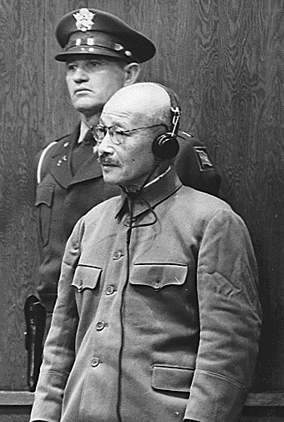 However inevitable Tojo’s postwar fate, however, he was not exactly of a kind with the likes of Hitler and Mussolini. Indeed, he’d been cashiered from his Prime Ministerial gig in 1944 by the real power behind the throne — the Japanese military.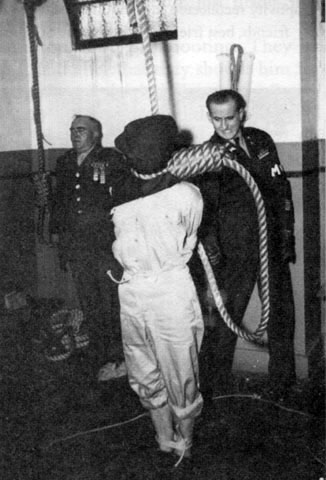
 Actually, Elfriede Scholz was convicted (upon the denunciation of her landlady a few weeks before) by the kangaroo People’s Court for undermining the war effort. (“Wehrkraftzersetzung” — German has a word for everything.)
 Of all this batch, Irma Grese, the