1997: Hostage-takers in Lima

On this date in 1997, Peruvian paramilitaries stormed the Japanese ambassador’s residence held hostage for 126 days by leftist rebels.
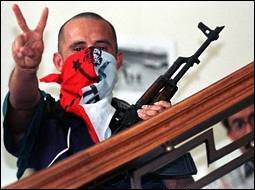
Peace out.

All 14 of the Tupac Amaru Revolutionary Movement (MRTA) were slain in the raid,* along with two of the commandos and one hostage. Officially, there were no “executions” at all.

Unofficially?

It’s pretty well-documented that some — perhaps most — of the terrorists were taken alive, and thereafter summarily executed. (pdf of Defense Intelligence Agency cable hosted by the National Security Archive)

However untoward the outcome and however unimpressive the foe, the operation was a master stroke for then-President Alberto Fujimori. Peru’s neoliberal taskmaster had introduced the world to the auto-golpe, the “self-coup”, a Cromwellian maneuver of shuttering parliament in order to rule as dictator, and he thereafter made ruthless suppression of Peru’s ruinous internal conflict the calling card of his presidency.

The DIA cable linked above claims Fujimori himself ordered the commandos to take no prisoners. He did not scruple to show himself in the middle of the bloodbath.
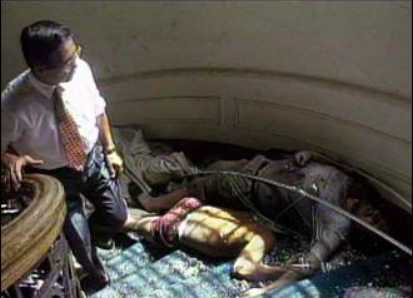

Alberto Fujimori made sure to get himself snapped standing over the bodies of the guerrillas, including MRTA leader Nestor Cerpa Cartolini.

El Presidente banked the political capital from having restored civic order, but it wasn’t the only capital he was banking. Three and a half years later, with a corruption scandal darkening his door, Fujimori absconded to Japan, faxed in his resignation, and became a fugitive.

Even there, he continued to justify his authoritarian governance.

Many Peruvians have always agreed with Fujimori’s self-assessment, even many who regret his well-publicized disregard for human rights.

But human rights researcher Michael Baney calls this day’s executions “pointless.”

“The MRTA was a spent force by the time of the embassy takeover,” said Baney. “The takeover was an act of total desperation, which is evidenced by the fact that the leader of the movement, Nestor Cerpa Cartolini, personally participated in it.”

After spending the best part of a decade in exile, Fujimori returned to the headlines by boldly returning to the hemisphere — to Chile, specifically, which arrested him and extradited him on a Peruvian warrant.

Just days ago as of this writing, Fujimori was convicted in his own former courts of authorizing death squads,** and sentenced to 25 years in prison. (Here’s some legal analysis.)

In the court of public opinion, it’s a different matter.

Fujimori’s daughter Keiko, a Peruvian congresswoman, figures to be a leading contender for the presidency in 2011, and has said she would pardon her father if given the opportunity.

“A majority of Peruvians think that Fujimori was guilty of serious human rights violations, but a majority also believe that he was a good president,” Baney observed. “And Fujimori really does believe that he single-handedly saved his country from economic and political collapse, and that Peru needs him around.”

* “Operation Chavin de Huantar”, profiled in several Spanish-language documentary videos available online. (Such as this one.)

** Not specifically related to this day’s MRTA killings, although these could be prosecuted in the future.

On this day..

1994: Rwandan Queen Dowager Rosalie Gicanda, and six attendants

When the Rwandan genocide erupted following the April 6, 1994 assassination of President Juvenal Habyarimana, the southern province of Butare went initially unscathed. Its large and powerful Tutsi population had limited the foothold of violent Hutu paramilitaries.

That calm lasted a mere fortnight, however, and was shattered this date in 1994 when the aged widow of Rwanda’s last monarch was hauled to Butare city’s national museum and shot along with several of her caregivers.

Taken in marriage in 1942 (French link) by King Mutara III, Rosalie Gicanda had stayed out of politics after he died mysteriously and Rwanda became a republic.

Being an emblematic Tutsi in April 1994, however, was all the political involvement needed to doom her. According to Human Rights Watch.

At 11 a.m. … a detachment of soldiers commanded by Lt. (jg) Pierre Bizimana, acting under the orders of Capt. Nizeyimana, invaded the modest home of Rosalie Gicanda … About eighty years old, she lived a quiet life as a devout Catholic, sharing her home with her bed-ridden mother and several women and girls who cared for them both. Because she eschewed any involvement in politics and behaved with discreet dignity, even the most anti-Tutsi politicians had left her largely undisturbed throughout the thirty years of Hutu rule…. The soldiers passed through the wooded enclosure that protected the house from the main street and entered the little house with its air of faded respectability. They seized the former queen and six others, leaving her bed-ridden mother and one girl to care for her. The soldiers passed by the ESO and then took Gicanda and the others to a place behind the national museum where they shot them. One teenaged girl, left for dead, survived to recount the murders. The soldiers returned to pillage Gicanda’s home in the afternoon and, two days later, they killed her mother. …

The news that this gracious lady and others from her household had been taken away by soldiers in the back of a pickup truck spread rapidly and alarmed Tutsi and all others who opposed the genocide. They concluded that if soldiers dared to seize even this revered person, then no one was safe.

That conclusion, of course, was well-founded. Over 200,000 Butare Tutsis are thought to have suffered Gicanda’s fate (or worse) in the ensuing months, making it the Rwandan genocide’s bloodiest province.

Pierre Bizimana was sentenced to death for Gicanda’s killing in 1998; I have been unable to document whether that sentence was ever carried out. His commanding officer, Idelphonse Nizeyimana, was arrested in October 2009.

On this day..

1997: First use of lethal injection in China

On this date in 1997, Kunming City Intermediate People’s Court debuted a brand-new execution technology for the world’s capital of capital punishment.

With a 1996 Criminal Procedural Law reform making lethal injection an option for processing the enormous ranks of China’s condemned, experimentation got underway this date on two convicts whose identities and crimes I have not seen indicated. These were not only the first lethal injections in China, but the first anywhere outside the U.S.

According to the New York Times, China began its foray without the usual accoutrement of medicalization: rather than the familiar strap-down gurney, Kunming officials simply brought the doomed prisoners to the same execution ground used for shootings and had them roll up their sleeves for the needle.

Whatever its initial inelegance, China has enjoyed many thousands of test cases since to refine the practice — as many as 15,000 per year at this time, Amnesty International has charged.*

In the 12 years since, and aided by the offices of its guinea pigs, lethal injection has gained significantly in both technical sophistication and official acceptance; it is now thought that most Chinese executions use this method, rather than the old gunshot-to-the-back-of-the-head.

To What End?

More humane? Maybe.

Easier on an executioner than discharging a bullet at point-blank range? You’d have to think so.

Cheaper? Well, maybe — if the cost of the mobile killing van is spread over enough, er, “subjects”.

But lethal injection enjoys one significant benefit of distastefully obvious utility to the state:** it facilitates tissue transplant from a recently executed prisoner.

Though Chinese officials have always stonewalled on the subject, lucrative organ harvesting from executed prisoners has long been endemic in the country.

* China’s death penalty system has been famously opaque, so this figure is far in excess of the known thousand-plus judicial executions every year (1,718 in 2008) and would include several times that number in other judicial executions not publicly reported, plus extrajudicial killings that presumably wouldn’t involve lethal injection. Even with only the official executions specifically known to the wider world, China easily accounts for the majority of the world’s executions year after year.

** The older (and still-used) method of shooting a prisoner in the head also preserves organs, of course.

On this day..

1997: Pedro Medina, en flambe

The electric chair has gotten a bad rap in recent years, and nowhere is this more evident than in the 1997 Florida execution of Cuban refugee Pedro Medina.

The improper application of an electricity-conducting sponge caused a “crown of foot-high flames” to shoot from Medina’s head, in a botched execution that caused Florida to reexamine its use of the electric chair and accelerated the trend towards lethal injection as the preferred method of execution — modern, sanitary and humane. But electrocution was once preferred for just those very reasons — well, that, and politics.

The thought of designing an apparatus to stimulate death by electrocution first came to dentist Dr. Albert Southwick in 1881, who watched an drunk man touch the terminal of an electricity generator in Buffalo, New York. Impressed at how quickly and painlessly the man died, he mentioned the incident to his friend, a state senator, who promptly brought the matter to the attention of the governor. The state legislature was then asked to consider how modern day electricity might emerge as an alternative to the often grisly process of hanging, in which incompetent executioners often inadvertently subjected prisoners to slow deaths by strangulation or decapitation.

Several years later, an inventor by the name of Harold Brown, an employee of the famous Thomas Edison, designed the first electric chair, deliberately adopting the Alternating Current (AC) form of electricity because Edison did not want his Direct Current (DC) form associated with the gruesome business of death — a sordid chapter in the history of public relations. The first execution was carried out in New York State in 1890, but the novel method was far from foolproof: it took two attempts, and the inmate was reported to have gone down in the same sort of smoke, flames, and smell of Medina’s over a hundred years later.

Still, the method caught on, and over the course of the 20th century, the electric chair became an indelible symbol of the death penalty in the nation’s consciousness.

“The chair” didn’t begin to decline until the mid-1980s, when newspaper accounts about botched executions, together with the emerging technology of lethal injection, again prompted some states to reexamine their death penalty statues.

It was around this time that Pedro Medina first came to the US from Cuba, part of the Mariel boat lift of 1980, in which Fidel Castro “permitted” some 125,000 Cuban prisoners and mentally ill to depart from the Mariel harbor for the fertile shores of America. (Medina himself had been released from a psychiatric hospital in Cuba and diagnosed with illnesses including paranoid schizophrenia and major depressive disorder with psychosis.) The boatlift polarized public sentiment in the United States.

These factors combined to lend Medina, a black man, a low status indeed in the eyes of prosecutors and jurors when, two years after his arrival on American shores, he was convicted of murdering his neighbor, Dorothy James.

Medina was executed in Albert Southwick’s brainchild 15 years later, despite pleas from James’ daughter, Lindi James, who said that she did not believe Medina had killed her mother and that her mother would not have wanted him executed regardless, and from Pope John Paul II, who also made a public call for mercy on Medina’s behalf. Medina’s lawyers also filed a petition claiming he was insane and thus incompetent to be executed, but the Florida Supreme Court ruled that, while he had mental problems, he could still be executed.

Early in the morning on March 25, 1997, Medina went out in flames.

A crown of foot-high flames shot from the headpiece during the execution, filling the execution chamber with a stench of thick smoke and gagging the two dozen official witnesses. An official then threw a switch to manually cut off the power and prematurely end the two-minute cycle of 2,000 volts. Medina’s chest continued to heave until the flames stopped and death came. (From the Death Penalty Information Center’s botched executions page.)

The source of the malfunction was not immediately apparent; prison officials claimed the fire had been caused by a corroded copper screen in the electric chair’s headpiece, but later investigation revealed that it was due to improper application of an electricity-conducting sponge to Medina’s head. Attorney General Bob Butterworth hailed the deterrent value of malfunctions: “People who wish to commit murder, they better not do it in the state of Florida, because we may have a problem with our electric chair.”

Others, including the warden conducting the execution, were not as sanguine.

The debacle of Medina’s execution caused a media sensation and led to a case by another Florida death row inmate, Thomas Provenzano, claiming that lethal injection constituted cruel and unusual punishment prohibited under the Eighth Amendment.

Provenzano lost his case, but with the release of bloody photographs of the 1999 execution of Allen Lee Davis, more states began moving against the use of the electric chair. Of the six states that today retain it (Virginia, South Carolina, Kentucky, Tennessee, Alabama and, yes, Florida), none currently use it as their only method of execution.

Rather, lethal injection has become the norm.

But for how long? There may be no AC/DC marketing gambit in the new, modern business of death, and no crown of flames. But maybe all we’ve really done by moving to the needle is render invisible ongoing Medina-like botches.

On this day..

1994: Mansour Kikhia?

Fifteen years ago, a Libyan-born dissident of American nationality was abducted from a human rights conference in Cairo.

The fate or current whereabouts of Mansour Kikhia remain unknown to this day — although one widely-suspected scenario (and the conclusion of a CIA report on the incident) is that he was spirited to Libya and secretly executed early in 1994.

While other speculation has had Kikhia being held alive, the insulin-dependent diabetic would have been in a bad way absent the sort of painstaking medical attention he would not likely have been receiving from his captors.

The former Libyan foreign minister and United Nations ambassador, who had broken with dictator Muammar al-Gaddafi in 1980, was in Egypt to participate in an Arab Organization of Human Rights conference. The date he vanished from his hotel, last seen in the company of unknown Egyptian men driving vehicles with Mukhabarat markings, was December 10, 1993 — the 45th anniversary of the seminal modern human rights document, the Universal Declaration of Human Rights.

Several distinguished Middle Eastern scholars wrote an open letter shortly after Kikhia’s disappearance imploring

Arabs, Americans with an interest in the Arab world and human rights organizations not to rest until he regains his freedom. Nothing could be worse than to let the governments concerned think he will be forgotten.

If not “forgotten” in the strictest sense — see some links of the bulletins issued over the years to keep alive his memory — the governments concerned sure seem to have paid no price for having disappeared Mansour Kikhia.

On this day..

1990: Pastor Hossein Soodmand, apostate

On this date in 1990, Hossein Soodmand, a Muslim who had converted to Christianity in the 1960’s, was hanged for apostasy under the sentence of a sharia court in Mashad, Iran — the last known apostasy execution in the Islamic Republic.

Soodmand’s post-conversion ministry in the Assembles of God church was not the sort of thing to endanger life and limb under the westward-looking Shah. But after the 1979 Iranian Revolution, there was a new sheriff in town.

Soodmand was not the last convicted or condemned for the crime — and converting to Christianity is still a crime — and his story has been back in the news of late because he may be in danger of losing his generation-long grip on the milestone.

In fact, he could lose the distinction to the next generation of his own flesh and blood.

The hanged pastor’s son, Ramtin Soodmand, was arrested in August, ostensibly for anti-government propaganda. But having followed his father’s evangelical footsteps, there was considerable fear — only slightly abated by his subsequent release on bail — that he could be put on trial for his life.

Amnesty International even put out an action alert for him during his detention, as a prisoner of conscience.

Around the same time, the Iranian legislature voted overwhelmingly for a measure to codify apostasy as a capital crime: confusingly, apostasy isn’t yet among the state’s statutes, but can be referred to sharia courts empowered to levy verdicts out of the Islamic religious tradition. (Besides Christians, Iran’s Baha’i are the other most likely defendants.)

The fact that these courts’ occasional death sentences since Soodmand have not been carried out is itself a telling indicator that the juridical disposition of apostasy cases in Iran is very sensitive to political pressure.

Small comfort to Ramtin’s sister Rashin Soodmand, who lives in London, and gave this moving interview to the Telegraph while her brother was still in a Mashad prison. In it, she describes her father spurning a bargain to abandon his illicit denomination in exchange for his life.

Of course, my father refused to give up his faith … He could not renounce his God. His belief in Christ was his life — it was his deepest conviction.

On this day..

1993: Mohamed Mustafa Tabet, serial rapist with a badge

On this date in 1993, the police chief of Casablanca was shot in Kenitra Central Prison for abuse of power.

Mohamed Mustafa Tabet (or Tabit) wasn’t exactly Captain Renault.

While Morocco still has prisoners on death row, Tabet’s was the first execution actually carried out in 11 years, and it’s the last execution in Morocco to date. He went on the rocket docket, just five months from his arrest to standing up against a wall.

To earn that rare distinction, Tabet exploited his official power to rape or sexually exploit hundreds of women. Tabet confessed to some 1,500 victims over 13 years; the minimum figure matches the 518 personal identity cards found in his apartment. (Also found: 118 video cassettes — many of them violent — and a computer list of his crimes.)

The “Tabet Affair” — actually called “Tabetgate,” proving that the United States retains the power of exporting ideas — opened a discomfiting window on gender and power in Morocco.

Webster University Prof. Don Conway-Long was in Morocco at the time researching gender and masculinity for his dissertation. His paper “Sexism and Rape Culture in Moroccan Social Discourse” (pdf) is probably the most illuminating readily-available English* document on the affair — and the many contradictory reactions it drew from contemporaries, and the pressure it put on the government to contain the fallout as “a morals case, instead of looking further into overall police corruption.”

Prof. Conway-Long was good enough to spare Executed Today a few minutes to explore power and gender in Morocco, then and now.

ET: The scale of the crime spree seems just unimaginable, that he could get away with victimizing hundreds upon hundreds of women.

DCL: And not that many came forward! It was just a couple of women. If it’s difficult to talk to rape and sexual assault survivors here [in the U.S.], it’s exponentially harder in Morocco.

You were in Morocco in the years leading up to this trial. What was the country like in terms of its gender outlook?

It’s more like our 1950’s in terms of the attitudes towards women. Some educated professors at one point were laughing at the idea that a man could be charged with raping his wife in the West. In some ways, attitudes in Morocco are maybe 20 years behind what we see in the West. We had that same conception in the 1950’s — Missouri actually finally changed that law in 1993. [See here and here -ed.]

Morocco was also probably one of the most liberal countries of the Muslim world in the sense of being more closely connected to the West. Morocco has had more openness, more tourism.

How did the Tabet case impact women’s position?

[In 1995,] about a year after I left, a battered women’s shelter was set up in Casablanca, the first one in Morocco. By comparison, our first shelters in the U.S. and U.K. were set up in 1971, 1972.

In 2004, they passed a new family law that changed a lot of the freedoms that women have — e.g., women can ask for divorce, and don’t have to obey their husbands.

But I have no idea if you can claim there’s any causal relationship between the discovery of Tabet’s crimes and these later events. At the time, some men thought he was this great sexual hero, very virile.

So what lies ahead?

The old king died in 1999; his son Mohammed VI is in there now and he’s young and more aware and one of the rising stars of the monarchs of the middle east, like the king of Jordan. His [Mohammed’s] head is on the right way, but running a country like this with so much variation — there’s 50% illiteracy, the Western Sahara conflict, a certain level of Islamist opposition, and around twenty political parties all the way out to the Communists.

So there’s no certain future, absolutely not.

As far as cases like Tabet’s — let’s hope it’s not happening still, but Morocco when I was there was a place where you pass six different kinds of uniforms walking down the street with Uzis that would be pointed at your body as you passed.

* There’s more in French and Arabic.

On this day..

1995: Kimura Shujish

On this date in 1995, Kimura Shuji was hanged in Japan.

It remains the norm in that ancient land to hale a man to the gallows with little more than an hour’s warning, having kept him in a state of unremitting apprehension of that moment for the space of decades. Given that norm, this day’s hanging was distinguished by little save an accidental, heartbreaking particular.

According to a report by the International Human Rights Federation (this page has links to .pdf versions of the report in both English and French):

when his mother and sister in law visited him on the morning of the day of execution, they were told by an officer ‘could you come again at noon since we are very busy at the end of the year?’ When they returned they were told that he had already been executed during the morning. The officer made no mention of the time of his execution. His family members said that although he had asked the detention house to inform them they had not done so. In addition, he had hurriedly written a short letter to his family during the few minutes just before his execution

On this day..

1995: Ken Saro-Wiwa and the Ogoni Nine

On this date in 1995, author Ken Saro-Wiwa and eight fellow activists of the Movement for the Survival of the Ogoni People (MOSOP) were hanged by the Nigerian military junta in Port Harcourt.

Saro-Wiwa, the author of works such as Sozaboy, was already considered among Nigeria’s greatest writers before becoming an activist for the rights of his Ogoni people in the face of Nigeria’s lucrative and ecologically destructive Niger Delta oil trade.

Few benefits of that trade returned to the politically marginalized Ogoni, whose overwhelming response to MOSOP’s organizing soon began choking off oil exploitation in Ogoniland and brought a violent response from the Nigerian dictatorship — operating hand in glove with Shell Oil, as Saro-Wiwa himself noted in his closing remarks to the sham tribunal that convicted him of inciting a murderous riot.

I repeat that we all stand before history. I and my colleagues are not the only ones on trial. Shell is here on trial and it is as well that it is represented by counsel said to be holding a watching brief. The Company has, indeed, ducked this particular trial, but its day will surely come and the lessons learnt here may prove useful to it for there is no doubt in my mind that the ecological war that the Company has waged in the Delta will be called to question sooner than later and the crimes of that war be duly punished. The crime of the Company’s dirty wars against the Ogoni people will also be punished.

In my innocence of the false charges I face here, in my utter conviction, I call upon the Ogoni people, the peoples of the Niger delta, and the oppressed ethnic minorities of Nigeria to stand up now and fight fearlessly and peacefully for their rights. History is on their side. God is on their side. For the Holy Quran says in Sura 42, verse 41: “All those that fight when oppressed incur no guilt, but Allah shall punish the oppressor.” Come the day.

Though Saro-Wiwa’s hanging helped quell Ogoniland sufficiently for Shell to resume production, it left an opposition martyr. Saro-Wiwa’s prison diary was published shortly after his hanging; his son, journalist Ken Wiwa, has written a biography; and separate UK- and Canada-based organizations exist to carry on his memory and work.

The tensions left unresolved in the Delta, meanwhile, have spawned ever more militant resistance movements.

On this day..