1789: Joseph-Francois Foulon, corrupt financier, lynched

On this date, just days after the Bastille fell, so did the head of widely-loathed ancien regime pol Joseph-Francois Foulon (or Foullon) de Doue.

“This is that same Foulon,” says Carlyle, “named ame damnee du Parlement; a man grown gray in treachery, in griping, projecting, intriguing and iniquity: who once when it was objected, to some finance-scheme of his, ‘What will the people do?’ — made answer, in the fire of discussion, ‘The people may eat grass:’ hasty words, which fly abroad irrevocable, — and will send back tidings!”

Marie Antoinette, eat your cake out.

Foulon’s grass tidings would arrive courtesy of the king‘s July 11, 1789 dismissal of Finance Minister Jacques Necker and attempt to rule through an ultra-royalist government. It was fury over this apparent reactionary coup that led to the storming of the Bastille and catalyzed the French Revolution.

Foulon, now the Controller-General of Finances — and as Carlyle puts it, “a scoundrel; but of unmeasured wealth,” who had gorged himself at the public trough while the kingdom’s finances grew thin, and who was widely suspected of having manipulated the food supply out of cruel rapacity — apprehended the danger and fled town. He even staged a lavish funeral to put about word that he had died suddenly.

But “some living domestic or dependant, for none loves Foulon,” betrayed him (Carlyle’s version) — or by whatever means, the Parisian mob sniffed him out. Then it quickly did to him what the Parisian mob would soon become famous for. “His old head, which seventy-four years have bleached, is bare; they have tied an emblematic bundle of grass on his back; a garland of nettles and thistles is round his neck: in this manner; led with ropes; goaded on with curses and menaces, must he, with his old limbs, sprawl forward; the pitiablest, most unpitied of all old men.”

Carlyle spares little but the most animal pity for Foulon, but the mob did not even muster that. Summoned to be judged at the Hotel de Ville — the Marquis de Lafayette and the new mayor of Paris, Bailly, unsuccessfully attempted to intercede for proper procedure — Foulon found himself instead subject to the revolutionary judgment of the masses.

For Dickens, in A Tale of Two Cities, this incident forms one of the mileposts of the Revolution, when the waiting sans-culottes of Saint Antoine are transfigured, and leads the fictional long-time revolutionary conspirator Defarge to sigh to his even more implacable wife, “At last it is come, my dear!”

“Does everybody here recall old Foulon, who told the famished people that they might eat grass, and who died, and went to Hell?”

“Everybody!” from all throats.

“The news is of him. He is among us!”

“Among us!” from the universal throat again. “And dead?”

“Not dead! He feared us so much—and with reason—that he caused himself to be represented as dead, and had a grand mock-funeral. But they have found him alive, hiding in the country, and have brought him in. I have seen him but now, on his way to the Hotel de Ville, a prisoner. I have said that he had reason to fear us. Say all! Had he reason?”

Wretched old sinner of more than threescore years and ten, if he had never known it yet, he would have known it in his heart of hearts if he could have heard the answering cry.

A moment of profound silence followed. Defarge and his wife looked steadfastly at one another. The Vengeance stooped, and the jar of a drum was heard as she moved it at her feet behind the counter.

“Patriots!” said Defarge, in a determined voice, “are we ready?”

Instantly Madame Defarge’s knife was in her girdle; the drum was beating in the streets, as if it and a drummer had flown together by magic; and The Vengeance, uttering terrific shrieks, and flinging her arms about her head like all the forty Furies at once, was tearing from house to house, rousing the women.

The men were terrible, in the bloody-minded anger with which they looked from windows, caught up what arms they had, and came pouring down into the streets; but, the women were a sight to chill the boldest. From such household occupations as their bare poverty yielded, from their children, from their aged and their sick crouching on the bare ground famished and naked, they ran out with streaming hair, urging one another, and themselves, to madness with the wildest cries and actions. Villain Foulon taken, my sister! Old Foulon taken, my mother! Miscreant Foulon taken, my daughter! Then, a score of others ran into the midst of these, beating their breasts, tearing their hair, and screaming, Foulon alive! Foulon who told the starving people they might eat grass! Foulon who told my old father that he might eat grass, when I had no bread to give him! Foulon who told my baby it might suck grass, when these breasts were dry with want! O mother of God, this Foulon! O Heaven our suffering! Hear me, my dead baby and my withered father: I swear on my knees, on these stones, to avenge you on Foulon! Husbands, and brothers, and young men, Give us the blood of Foulon, Give us the head of Foulon, Give us the heart of Foulon, Give us the body and soul of Foulon, Rend Foulon to pieces, and dig him into the ground, that grass may grow from him! With these cries, numbers of the women, lashed into blind frenzy, whirled about, striking and tearing at their own friends until they dropped into a passionate swoon, and were only saved by the men belonging to them from being trampled under foot.

Nevertheless, not a moment was lost; not a moment! This Foulon was at the Hotel de Ville, and might be loosed. Never, if Saint Antoine knew his own sufferings, insults, and wrongs! Armed men and women flocked out of the Quarter so fast, and drew even these last dregs after them with such a force of suction, that within a quarter of an hour there was not a human creature in Saint Antoine’s bosom but a few old crones and the wailing children.

No. They were all by that time choking the Hall of Examination where this old man, ugly and wicked, was, and overflowing into the adjacent open space and streets. The Defarges, husband and wife, The Vengeance, and Jacques Three, were in the first press, and at no great distance from him in the Hall.

“See!” cried madame, pointing with her knife. “See the old villain bound with ropes. That was well done to tie a bunch of grass upon his back. Ha, ha! That was well done. Let him eat it now!” Madame put her knife under her arm, and clapped her hands as at a play.

The people immediately behind Madame Defarge, explaining the cause of her satisfaction to those behind them, and those again explaining to others, and those to others, the neighbouring streets resounded with the clapping of hands. Similarly, during two or three hours of drawl, and the winnowing of many bushels of words, Madame Defarge’s frequent expressions of impatience were taken up, with marvellous quickness, at a distance: the more readily, because certain men who had by some wonderful exercise of agility climbed up the external architecture to look in from the windows, knew Madame Defarge well, and acted as a telegraph between her and the crowd outside the building.

At length the sun rose so high that it struck a kindly ray as of hope or protection, directly down upon the old prisoner’s head. The favour was too much to bear; in an instant the barrier of dust and chaff that had stood surprisingly long, went to the winds, and Saint Antoine had got him!

It was known directly, to the furthest confines of the crowd. Defarge had but sprung over a railing and a table, and folded the miserable wretch in a deadly embrace—Madame Defarge had but followed and turned her hand in one of the ropes with which he was tied—The Vengeance and Jacques Three were not yet up with them, and the men at the windows had not yet swooped into the Hall, like birds of prey from their high perches—when the cry seemed to go up, all over the city, “Bring him out! Bring him to the lamp!”

Down, and up, and head foremost on the steps of the building; now, on his knees; now, on his feet; now, on his back; dragged, and struck at, and stifled by the bunches of grass and straw that were thrust into his face by hundreds of hands; torn, bruised, panting, bleeding, yet always entreating and beseeching for mercy; now full of vehement agony of action, with a small clear space about him as the people drew one another back that they might see; now, a log of dead wood drawn through a forest of legs; he was hauled to the nearest street corner where one of the fatal lamps swung, and there Madame Defarge let him go—as a cat might have done to a mouse—and silently and composedly looked at him while they made ready, and while he besought her: the women passionately screeching at him all the time, and the men sternly calling out to have him killed with grass in his mouth. Once, he went aloft, and the rope broke, and they caught him shrieking; twice, he went aloft, and the rope broke, and they caught him shrieking; then, the rope was merciful, and held him, and his head was soon upon a pike, with grass enough in the mouth for all Saint Antoine to dance at the sight of.

That grass-stuffed head on a pike was there waiting when the bloody banquet’s digestif arrived later that evening in the form of Foulon’s son-in-law Louis-Jean Bertier de Sauvigny: another government official arrested that day and drug to the same place, for the same fate.


Bertier de Sauvignon, Intendant of Paris, Is Led to His Punishment (Source, specifically image 25)

On this day..

1804: Georges Cadoudal, Chouan

On this date in 1804, royalist counterrevolutionary Georges Cadoudal was guillotined in Paris with eleven of his chouan brothers-in-arms.

Cadoudal (English Wikipedia entry | the much more detailed French) was the French Revolution’s ultimate antagonist, a Breton notary (and commoner, obviously) who obstinately resisted the bloody progress of those years to the last of his strength.

His decade of royalist adventures (French) reads* like an adventure novel, a mind-bogglingly perilous series of revolts, captures, escapes, rappelling, martial exploits, diplomatic intrigue, terrorist plotting, high principles, low politics … a desperately heroic (or anti-heroic) struggle using every resource of a changing world to claw back the lost age of Bourbons.

After that dynasty’s last (up until then) king was guillotined in 1793, the intrepid Cadoudal staked his life to the 1793 Vendee rising, mounted an insurrection at Brest, and became one of the principal leaders of the anti-revolutionary Chouannerie fighting les bleus around northwest France through the 1790s.

Beaten but not bowed, Cadoudal took refuge in England when those campaigns came to grief following the royalist debacle at Quiberon, but he was never one to retire to the exile social circuit. Cadoudal remained an active schemer against the France of a rising Napoleon Bonaparte, and he was backed now by Britain’s statecraft … and her gold.

Spurning a proffered arrangement with the Corsican — who, say what one will, could recognize ability when he saw it — Cadoudal instead oversaw a dramatic 1800 assassination attempt on Napoleon that didn’t get the dictator but blew a bunch of Parisian bystanders to smithereens.

This effort having failed, our persistent intriguer slipped back into France to attempt an even bolder venture to kidnap Napoleon and elevate the Duke of Enghien — the going Bourbon candidate, who lurked on the French frontier to rush into the power vacuum.

This didn’t work either. As outlandish as the idea seems with benefit of hindsight, it was hardly a crackpot plan — as attested by the credentials of its participants.

“All Europe laughs at the conspiracy in Paris; it was, however, a well-built machine. Men, money, everything was ready. Bonaparte was to be taken alive and carried out like lightning from one post to the sea and the English fleet … I am inconsolable that it missed its mark. Those who criticize the French princes that they do not risk themselves while others fight for them, they will be the first to cry: What madness! How childish! [that d’Enghien risked himself] That is how men are made.”

Joseph de Maistre (Source)

Which is a long way of saying that it still comes down to wins and losses.

Having lost, the Bourbon pretender (he’s a pretender because he lost, of course) d’Enghien was arrested and immediately shot for his trouble; Cadoudal, taken on the streets of Paris,** was around long enough to see the hated Bonaparte take sufficient warning from the conspiracies against him to vest his governance in the imperial dignity. That was proclaimed on May 18. (The famous coronation wasn’t until December.)


Happy now, Georges? Napoleon on his Imperial throne, by Jean-Auguste-Dominique Ingres.

“We have done better than we hoped,” the doomed Cadoudal remarked caustically from his dungeon. “We intended to give France a king, and we have given her an emperor.”

He was rock-ribbed in his royalism to the very last.

He’d met Napoleon face to face years before in an abortive parley — when Cadoudal was offered, and rejected, the bribe of a lucrative Republican military commission — and now Cadoudal’s proposed victim let it be known to him that mercy was his for the asking. The indignant Breton scorned as dishonorable the very idea of supplicating Napoleon, even when the invitation was refreshed as he underwent the fatal toilette on his final day. His dozen-strong party went to their deaths this date taking heart from following the very footsteps of their martyred king.


The Execution of Georges Cadoudal, by Armand de Polignac … who portrayed several scenes of the conspirators.

A very lovely mausoleum in his native village of Kerleano preserves Cadoudal’s remains (reburied honorably there after his Bourbon Restoration finally came to pass), and his memory.

* A descendant wrote this now-public-domain book about our man.

** Reproached for orphaning a policeman’s family as he resisted capture, Cadoudal sneered, “then you should have sent a bachelor.”

On this day..

1794: Jacques Roux, the Red Priest, cheats the guillotine

On this date in 1794, French Revolution firebrand Jacques Roux committed suicide to avoid execution during the Terror.

Roux was a Catholic vicar on the eve of the Revolution, and “of the many priests who had left the church to join the Revolution none was more articulate and socially aware.”

He became a leading exponent of the radical enragés, a faction that really took the Revolution’s purported egalite to heart.

In early 1793, Roux was an official representative to the execution of Louis XVI — one can read his minimalistic report here; knowing that Roux was a priest, Louis tried to press him for some spiritual aid, and was rebuffed. “I am only here,” Roux answered icily, “to lead you to the scaffold.”

The man’s invective against the merchant classes packed considerably more heat.

Roux’s Manifesto of the Enrages minced no words:

Freedom is nothing but a vain phantom when one class of men can starve another with impunity. Equality is nothing but a vain phantom when the rich, through monopoly, exercise the right of life or death over their like. The republic is nothing but a vain phantom when the counter-revolution can operate every day through the price of commodities, which three quarters of all citizens cannot afford without shedding tears.

For the last four years the rich alone have profited from the advantages of the Revolution. The merchant aristocracy, more terrible than that of the noble and sacerdotal aristocracy, has made a cruel game of invading individual fortunes and the treasury of the republic; we still don’t know what will be the term of their exactions, for the price of merchandise rises in a frightful manner, from morning to evening.

Unfavorably contrasting the new haves with the ancien regime is the sort of thing that gets you into trouble in a bourgeois revolution.

Burdened by multiple wars, and then by poor harvests, France’s economy was a mess. Later that same year, Paris’s urban poor, the sans-culottes, invaded the Convention to force anti-hoarding and price control measures. Roux didn’t create that situation: he just had the nerve to risk his neck talking about it.

But by then, that prim ascetic Robespierre had already begun hounding Roux. He would hound him to his death.

Kropotkin‘s anarchist history, The Great French Revolution, 1789-1793, valorizes the courageous former priest. In Kropotkin’s narration, we find Roux ordered transferred out of ordinary police court to the Revolutionary Tribunal on some spurious charge of financial impropriety.*

Knowing what that meant, Roux stabbed himself in court thrice with a knife. The president of the court hastened to his assistance and displayed much friendliness towards him, even giving him the kiss of civic brotherhood, before he was removed to the Bicetre prison. In the prison infirmary Roux “tried to exhaust his strength,” as it was reported to the procurator of the Revolutionary Tribunal, Fouquier-Tinville, by opening his wounds; and finally he succeeded in stabbing himself once more, this time mortally, through the lung.

In terms of present-day iconographic potential, the French Revolution probably did not produce a more outstanding radical leftist; Roux’s direct critique of economic power clearly marks him as a forerunner of subsequent generations’ communist and anarchist movements … as well as even more contemporary voices.

And undoubtedly, Roux’s project remained (and remains) unfinished. Surveying the scene after the Terror, Roux’s onetime ally Jean-Francois Varlet remarked, “In my country there has only been a change of dress.”

There’s more of Roux’s writing on Marxists.org.

* A much more serious graft charge would likewise be deployed to topple Danton.

Longtime readers may recall that this post was briefly (and mistakenly) up on this date in 2011. Oops.

On this day..

1793: 213 or so Lyonnaise

Upon learning of the recent Republican capture of Toulon from the British and anti-revolutionary allies — a military achievement authored by a 24-year-old artillerist by the name of Napoleon Bonaparte — Joseph Fouche dispatched the following missive from the city where he his iron-fisted occupation was earning the epithet “Executioner of Lyon(s)”

Despite showing himself a ferocious Jacobin during the Terror, the Machiavellian Fouche helped author Robespierre‘s downfall and later became ennobled as the Duke of Otranto under Bonaparte. Needled by the Corsican about having voted for Louis XVI’s execution, Otranto aptly riposted, “Yes, sire; and that is the first service I had the honour of rendering your majesty!”

Joseph Fouche to Collot d’Herbois
22nd December 1793

And we likewise, my friend, have contributed to the surrender of Toulon, by spreading terror amongst the traitors who had entered the town, and by exposing to their view the dead bodies of thousands of their accomplices.

The war will be at an end if we know how to profit by this memorable victory; let us show ourselves terrible, that we may not fear becoming weak or cruel; let us annihilate in our anger, and at one single blow, every conspirator, every traitor, that we may not feel the pain, the long torture of punishing them as Kings would do.

Let us follow the example of nature in the exercise of justice. Let us be avenged as a nation, let us strike as quick as lightning, and let even the ashes of our enemies disappear from the land of liberty.

Let the perfidious and ferocious English be assailed from every quarter; let the whole republic turn into a volcano, and pour forth the devouring lava upon them: may the infamous island that produced those monsters, who no longer belong to the human species, be hurled for ever in the waves.

Farewell, my friend: tears of joy gush from my eyes, and overflow my heart. The courier is setting off. I shall write to you by the post.

FOUCHE

P.S. We have but one means of celebrating our victory. We shall this evening send 213 rebels to the place of execution: our loaded cannons are ready to salute them.

(Translation primarily as rendered in the London Times, July 18, 1815)

Whether this horrifying last bit of revolutionary braggadocio was in fact effected does not seem to be quite clear. This book claims that Fouche had 192 executed that day for the amusement of a party of Jacobins and prostitutes, which has the suspicious whiff of propaganda about it.

Hubert Cole, in Fouche: The Unprincipled Patriot reckons it “only” 67, with Fouche routinely inflating his atrocity figures a la military body counts for the benefit of ardent revolutionaries in Paris.

The use of cannon loaded with anti-personnel grapeshot — condemned tied together in pairs and then indiscriminately blasted; troops on hand to finish off survivors with bayonets — was an innovation in death-dealing technology that the National Convention did not appreciate, and Fouche was obliged to return to the more decorous methods of regular firing squads and that newfangled beheading machine.

* Not to be confused with Nazi torturer Klaus Barbie, the Butcher of Lyon. We hope the good people of Lyon will not require too many more synonymous sobriquets.

On this day..

1793: Jean-Sylvain Bailly, moonstruck

See Bailly, likewise of Paris, time-honoured Historian of Astronomy Ancient and Modern. Poor Bailly, how thy serenely beautiful Philosophising, with its soft moonshiny clearness and thinness, ends in foul thick confusion — of Presidency, Mayorship, diplomatic Officiality, rabid Triviality, and the throat of everlasting Darkness! Far was it to descend from the heavenly Galaxy to the Drapeau Rouge: beside that fatal dung-heap, on that last hell-day, thou must ‘tremble,’ though only with cold, ‘de froid.’ Speculation is not practice: to be weak is not so miserable; but to be weaker than our task. Wo the day when they mounted thee, a peaceable pedestrian, on that wild Hippogriff of a Democracy; which, spurning the firm earth, nay lashing at the very stars, no yet known Astolpho could have ridden!

Carlyle

On this date in 1793, French astronomer turned revolutionary Jean-Sylvain Bailly was guillotined during the Paris Terror.

Bailly ditched a family trade in the arts — his father was a supervisor at the Louvre — and turned his gaze skyward.

Studying astronomy under Lacaille, Bailly made a quick splash in astronomical circles with meticulous work on Halley’s Comet and the moons of Jupiter. He was inducted into the French Academy of Sciences while still in his twenties. Not quite the guy every schoolchild knows, but a significant scientist in his time. As one twentieth-century reviewer put it,*

Bailly was not a great thinker or the discoverer of new concepts; no case can be made for placing his name beside those of Newton, Leibnitz, and Laplace. But he should not be denied a niche among the numerous competent and persevering work-a-day scientists who, perhaps, in the long run make possible the achievements of a few great men. His observations and reductions, his application of a mathematical discipline to the movements of the heavenly bodies, and his detailed publications had brought him, by 1766, considerable credit among fellow scientists.

His “considerable credit” in the public sphere, enhanced by his widely-admired writing, set him up for election to the Estates-General in 1789. Indeed, Bailly was elected to head the body’s Third Estate.

On June 20th of that pregnant year, days after the Estates-General had constituted itself a National Assembly with ambitions far outstripping the limited purpose of revenue collection the king intended them for, Louis XVI locked the delegates out of their meeting-room.

Bailly, in consequence, would lead one of the pivotal actions of the embryonic French Revolution. “I do not need to tell you in what a grievous situation the Assembly finds itself,” he said to the assembly reconvened at a nearby tennis court. “I propose that we deliberate on what action to take under such tumultuous circumstances.” The result of that deliberation was the Tennis Court Oath.


Detail view (click for the full image) of Jean-Sylvain Bailly administering the Tennis Court Oath, in Jacques-Louis David‘s sketch of the event.

When the Paris provost — an archaic municipal office — was shot by the mob on Bastille Day, Bailly became the City of Light’s first mayor.

But as with other principals of the Revolution’s earliest stirrings, like Bailly’s ally Lafayette, the man was left behind by the rapid progress of events. He’d been two years retired out of public service in Nantes when he was hailed before the Revolutionary Tribunal on the preposterous charge of having conspired in Louis XVI’s attempted flight and guillotined on that basis.

A lunar crater — the largest crater visible from earth — is appropriately named after this prolific observer of the heavens.

* Edwin Burrows Smith, Transactions of the American Philosophical Society, New Series, Vol. 44, No. 4 (1954).

On this day..

1766: Thomas Arthur de Lally-Tollendal, undiplomatic

On this date in 1766, a refugee noble with more honor than sense lost his head in Paris.

Thomas Arthur, comte de Lally, baron de Tollendal — more efficiently known as Lally, or as Lally-Tollendal, though he’s not to be confused in this with his son, a French Revolution bit player — entered this world in County Galway, the child of a minor lord.

Since said lord hewed to the Jacobite party favoring restoration of the Stuarts to the English throne, the family found itself relocated with the exiled Pretender to a continental power whose spiritual and temporal interests were similarly inimical to the Hanoverian king.

Our man landed himself, like a proper retainer of his adoptive liege, a gig in the French army in which capacity he actually served at the Jacobites’ last doomed British hurrah, the 1746 Battle of Falkirk.

But his problems came from his Bourbon service much further afield — in India.

There, his expeditionary force suffered reversal after reversal at the hands of the hated Brits, even then in the process of appending India to their dominions.

Our general’s military misadventures were compounded by impolitic high-handedness towards his officers and men, and to the locals whose alliances he needed. He was, in the main, a man ill-suited to the job entrusted to him. As the Memoirs of Sanson remark, “his temper, his obstinacy, and especially his contempt for all means of action except brutal strength, were destined to lead him into mistakes in a position demanding more knowledge of politics than science of war. Sixteen years before Lally-Tollendal’s appointment, Dupleix, with scanty forces, at enmity with the Company, receiving neither help nor subsidies from the mother country, had held in check English power in the Indian peninsula by mere diplomatic proficiency. Lally knew how to conquer; but he was incapable of studying and detecting the secrets of Dupleix’s policy.”

By the time the bad news that established all this hit France, the subcontinent was pretty much Britain’s to command — just another piece of the imperial butt-kicking France suffered in the Seven Years’ War.

And Lally’s enemies were holding him personally responsible as a potential traitor. After all, he was conveniently now in English custody.

Incensed at having his honor impugned, Lally unwisely obtained English parole to return to repel these charges. He proved no more diplomatic with the barristers than he had been with the Hindus:

he was so convinced of his own innocence that he was imprudent enough to impeach the officers who had served under his orders, together with the administrators of the colony. He charged them with such violence that his death and condemnation became indispensable for their justification … When the accused appeared before his judges, he was no more able to control his temper than when he was in India … answering, fuming, retorting, stigmatising the cowardice of some, the cupidity of others, and hinting that the only guilty party was the powerless Government.

Just the sort of vindication liable to appeal more to posterity than to said government. Louis XV, another man unequal to his position, was by this autumn of his reign plumbing the nadir of his unpopularity; for the officer who had risked his life in battle under French colors throughout adulthood, Louis calculated more profit in severity (or expedience) than in clemency. Hey, it had worked for the English.

And really, for a Stuart adherent, sacrificial execution was kind of an apt fate.

We guess it worked.

“The people were pleased with all that made his punishment ignominious: the cart, the handcuffs, and the gag,” recorded aristocrat-of-letters Madame du Deffand (Source) “He was a great rascal, and besides he was very disagreeable.”

Thomas Carlyle, in his The French Revolution, spared in Lally’s defense a few sentences of delicious invective for the rotting regime that did him in.

The Parlement of Paris may count itself an unloved body; mean, not magnanimous, on the political side. Were the King weak, always (as now) has his Parlement barked, cur-like at his heels; with what popular cry there might be. Were he strong, it barked before his face; hunting for him as his alert beagle. An unjust Body; where foul influences have more than once worked shameful perversion of judgment. Does not, in these very days, the blood of murdered Lally cry aloud for vengeance? Baited, circumvented, driven mad like the snared lion, Valour had to sink extinguished under vindictive Chicane. Behold him, that hapless Lally, his wild dark soul looking through his wild dark face; trailed on the ignominious death-hurdle; the voice of his despair choked by a wooden gag! The wild fire-soul that has known only peril and toil; and, for threescore years, has buffeted against Fate’s obstruction and men’s perfidy, like genius and courage amid poltroonery, dishonesty and commonplace; faithfully enduring and endeavouring,–O Parlement of Paris, dost thou reward it with a gibbet and a gag?

There’s a public-domain 19th century lecture on our man’s adventurous career here. And there’s a monument back home near Tuam, Ireland.

On this day..

1790: Thomas de Mahy, Marquis de Favras

On this date in 1790, Thomas de Mahy, Marquis de Favras, became a penal milestone: the first French noble executed without class distinction from commoners.

At least he made history.

The scion of an ancient and penurious noble line, Favras was trying to make a different kind of history: he’d hitched onto a plot of the future Louis XVIII to reverse the still-infant French Revolution and rescue the king and queen from captivity in the Tuileries.

The royal couple were ultimately destined to escape this palatial dungeon only to the guillotine.

But in Mahy’s day, it was possible to dream of counterrevolution. And that terrifying machine of the revolution hadn’t even been invented.

For that matter, the machinery of revolutionary justice had also not been born; this was Lafayette‘s year, the revolution in its moderate phase.

It was ancien regime jurists of the Chatelet who were here appointed to judge the enemies of the nation. Having just acquitted the guy who commanded monarchist forces in Paris on Bastille Day, these establishment magistrates proceeded to throw the revolutionary left a bone by condemning Favras to the democratic capital expiration of … hanging. (Back in the good old days, he would have had the right to a beheading. Plus ça change.)

The crowd was said to be quite enthusiastic.


“Thomas de Mahy, Marquis of Favras Making Honourable Amends before Notre-Dame,” engraving by Pierre-Gabriel Berthault (French link).

Little less interested in Favras’s elimination — he was executed the day after sentence — were his fellow conspirators and other sympathetic members of the royalist party. (Future-Louis XVIII hurriedly washed his hands of the scheme.) These were quite pleased to suppress any wider exploration of

the project that this lost child of royalist enthusiasm had formed in the interest of the royal family. Among those participating in this project, but with a cowardice that is well known, were persons that an important consideration prevented from naming at the time.*

You’ve got to look forward, not back.

Despite the mob scene surrounding him as he carried his damning information to the grave, Favras had the sang-froid to remark upon being handed a copy of the order for his execution, “I see that you have made three spelling mistakes.”

“It can be said,” wrote Camille Desmoulins, “that all the aristocrats have been hung through him.”

And since they did such a metaphorically comprehensive job through this single unfortunate, it’s no wonder that Favras was the only aristocrat executed for counterrevolutionary activity during the entire first three years of the Revolution.*

* Barry Shapiro, “Revolutionary Justice in 1789-1790: The Comité des Recherches, the Châtelet, and the Fayettist Coalition,” French Historical Studies, Spring 1992.

On this day..

1793: Philippe Egalite, hoisted on his own petard

On this date in 1793, Philippe Egalite was hoisted on his own petard.

To hoist with one’s own petard actually has an older derivation, dating to siege warfare engineers whose primitive bombs, petards, were liable to detonate unexpectedly and gave their makers a “hoist.”

Still, the phrase sounds like something that ought to come right out of the French Revolution, redolent (as are petards themselves: the explosive word is from the French “to fart”) of angry mobs hoisting aristocrats, as was their wont, up on pikestaffs and lampposts and … petards. Whatever those are.

Philippe Egalite — the Duke of Orleans, as he was known for most of his life — was such an aristocrat: in fact he was royalty, the First Prince of the Blood and a cousin to Louis XVI.

And he was the member of the royal house who most vibed on the revolutionary spirit of the times, literally bankrolling the Jacobins before the Revolution. Hilary Mantel* notes that Orleans made the Palais Royal “into a sort of demagogue’s shopping centre — Paris’s most volatile public space, crammed with cafés and bookshops, a gathering place for the disaffected. In July 1789, three days of orchestrated violence began there, and culminated in the taking of the Bastille.”

Now that is a petard.

Philippe’s class-traitor politics obviously exposed him to the wrath of the monarchists — a particular irony since the man’s son Louis-Philippe, was France’s last king from 1830 to 1848 — but as usual in Paris during the Terror, it was the the Revolution devouring its children that did him in.

Despite taking up during the Revolution the very Republican name Egalite by which we know him, and despite Egalite‘s vote in the Convention in favor of guillotining Louis XVI (this is sometimes described with more melodrama than accuracy as the “decisive” vote), and despite his many years’ prior revolutionary sympathy, the Duke of Orleans was rounded up with the rest of the available Bourbons when the French General Dumouriez‘s spring 1793 defection prompted a panicky revolutionary purge in Paris. Philippe’s own son, the future king, had gone over with Dumouriez to the Austrians.

Rosebud

The Duc d’Orleans employed Choderlos de Laclos, author of the notoriously delicious Dangerous Liaisons.

As an individual citizen turned politician turned guillotinee, Egalite doesn’t much stand out in those perilous years: one more vulnerable Convention delegate outmaneuvered by Robespierre et al.

As the Daddy Warbucks of the Rights of Man, however, Egalite was a titanic figure for his contemporaries. Not many held him in high personal esteem, but movements need moneybags, and the Prince of the Blood bankrolled his from the bottomless revenues he earned on estates that would dwarf entire departements.

The Duke of Orleans and those around him, according to George Armstrong Kelly in “The Machine of the Duc D’Orléans and the New Politics” (The Journal of Modern History, Dec. 1979)

invented something novel in the history of French politics: the massive use of wealth, research, and propaganda** for the purpose of forming public opinion and swaying public policy. No doubt there are analogues among the Romans and the eighteenth-century English; but here we are almost reminded of the Rockefellers and Kennedys.

Orleans was accused of generating all this mayhem to make his own bid for the throne; those accusations may even hold a bit of truth. Such machinations remain for the conspiratorial among posterity a shadow-play upon the wall; one is left to guess at their potential dimensions from shreds of evidence and the vying vituperations of various contemporary revolutionary factions.

But if extant, such schemes were fatally compromised by the mediocrity of the figurehead who lost his head this day. Though a revolutionary in his philosophy, he was still a doughy Bourbon scion in his soul, and heir to the many shortcomings that characterized that dynasty in its decadence.

Dissolute in the enjoyment of privilege; irresolute in the conquest of power; blithely rearing wolves to his own destruction. That was some petard.


Philippe Egalite and his onetime lover Grace Elliott are the titular characters of the 2001 Eric Rohmer movie The Lady and the Duke.

* Hilary Mantel is the same author who penned the acclaimed historical novel Wolf Hall, about Thomas Cromwell.

** Kelly claims that Egalite funded Marat.

On this day..

1793: Adam Philippe, Comte de Custine

The best defense would have been a good offense for French General Adam Philippe, Comte de Custine — guillotined in Paris this date in 1793 for inadequacy in command of the French revolutionary armies fighting continental monarchist armies.

You must be this tall to go on the General Moustache* ride, and poor results in the field at this time could leave you shorter. Losing to the enemy looked an awful lot like conspiring with the enemy, especially when there was a “Comte” in your name.

Custine spent the winter of 1792-1793 coughing up French conquests across the Rhine. (In his defense, several of them were things that he’d previously conquered himself.)

Recalled once to Paris to justify himself, the bewhiskered general was defended by no less than Robespierre, and thereafter returned to the field. Given this background, it was not wise of him to resume the losing streak — but he did.*

The resultant second recall saw the moustache — and its associated head — permanently shaved for treacherously throwing battles like the 1919 White Sox. This met with the great approval** of Hebert‘s Pere Duchesne :

“Epitaph on General Custine”

Here lies an headless General—(I’ll say dead)
As many living Generals want an head.

You have just done something worthy of me by denouncing Custine. You have brought into broad daylight his plots and his treason. If we had waited a few more days to recall him freedom would have been fucked. This infamous rascal, after having had the French in Frankfurt massacred, after having abandoned Mainz, after having allowed Valenciennes to be encircled, after having delivered Condé, only awaited the right moment to lead his army into a slaughter and to deliver the coup de grace to the republic by sacrificing its last resources. Fortunately, the bugger has been put to the side. His crimes have been proved, let his head promptly fall under the national razor, but let his not be the only one! Let all the scoundrels who compose his headquarters also be shortened. Pursue, denounce without rest the infamous Tourville, who was the right arm of Lameth, and who will deliver Maubeuge if we leave him in command. Make known the swindler Lapallière, and especially the ci-devant marquis de Verigni, known in all the gaming houses under the name of Debrulis. Tell the Sans Culottes in the army that this rat has emigrated twice. Don’t forget Leveneur, the intimate friend of Lafayette, and the henchman of Custine. Don’t allow these bandits a moments rest until they’ve been chased and punished as traitors.

Custine’s son also got the chop for defending his old man.

Surviving the purge: Adam Philippe’s then-three-year-old grandson, Astolphe Custine. Custine would become famous as “the de Tocqueville of Russia,” and for his aphoristic and still-current travelogue La Russie en 1839.

* Actual nickname.

** And characteristically profane. Pere Duchesne would not have had a lot of patience for coy little cunnilingus references where a salty sans-culotte f-bomb would do instead.

On this day..

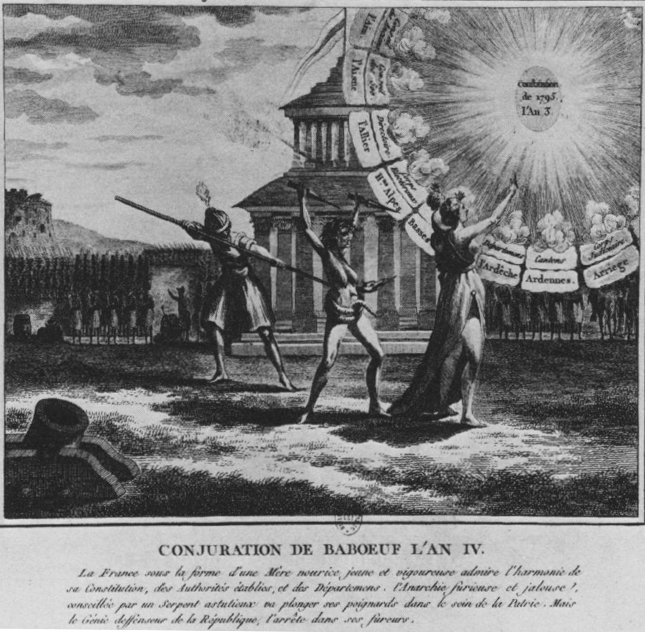
1797: Gracchus Babeuf, for the Conspiracy of Equals

If the “revolutionary extremist” exists at all as an identifiable type, he exists in purest incarnation in Gracchus Babeuf. No revolutionary better fits the description “narrowminded to the point of genius”; few have defined their heaven more clearly or crusaded so fanatically, ascetically, so religiously to bring it to earth.

Gracchus Babeuf: The First Revolutionary Communist

On this date in 1797, Francois-Noel Babeuf lost his head for the Conspiracy of Equals — the last Jacobin upheaval of the French Revolution, or the first Communist upheaval of post-Revolution modernity.

Francois-Noel — he styled himself “Gracchus” after the populist Roman tribunes — was a young man of Desmoulins‘ generation but from a considerably more hardscrabble background. Like the starry-eyed Dantonist scribbler, Babeuf discovered himself a brilliant journalist and pamphleteer with the onset of the Revolution; he did several prison stints during various revolutionary phases of the early 1790s for his too-radical-for-school opinions.

He did another in 1795 under the French Directory for his firebreathing rag Le Tribun du Peuple, which was particularly unfashionable stuff during the post-Robespierre Thermidorian regime.

Nothing daunted, Babeuf emerged from prison the leading apostle of the Parisian proletariat which had by then been decisively separated from power.

The order of the day was class consolidation with the spoils of the aristocracy apportioned among a new oligarchy of wealth. As France rushed headlong towards Bonaparte and Bourbon restoration, Babeuf was the man left to rally “the party which desires the reign of pure equality.”

The French Revolution was nothing but a precursor of another revolution, one that will be bigger, more solemn, and which will be the last.

The people marched over the bodies of kings and priests who were in league against it: it will do the same to the new tyrants, the new political Tartuffes seated in the place of the old.

Manifesto of the Equals, 1796

One can see why later revolutionaries — Marx included; Babeuf makes a cameo in the Communist Manifesto — would adopt this sort of thing as a harbinger of the next century’s revolutions.

And if the Directory had known who Nicholas II would be, it would have had no intention of going the way of his family.

Instead, it shut him down in February, 1796: Napoleon Bonaparte personally carried out the operation, just days before he wed Josephine.


The Babeuf Conspiracy. Anonymous French print.

Babeuf’s party comes down to us as a “conspiracy,” under which word the state would charge him and which his follower Philippe Buonarroti would later rebrand the “Conspiracy of Equals”. It was not so much a grassy-knoll type of conspiracy as it was an underground organization.

When its adherents placarded Paris with the seditious “Analysis of the Doctrine of Babeuf” as the city endured a potentially dangerous economic crisis in April 1796, the government was put to a test of its strength.

It passed.

Having infiltrated Babeuf’s network, it arrested the principals on the eve of the Conspiracy’s intended insurrection. They were hailed out of Paris (a safeguard against sympathetic risings) to the commune of Vendome and there put on trial.* Babeuf and his associate Augustin Alexandre Darthe were condemned to death on May 26th and guillotined the very next day.

The last gasp of the French Revolution dropped with their heads into the basket.

Revolutionary Babeuvism, however, had scarcely just begun.

I don’t know what will become of the republicans, their families, and even the babies still at their mothers’ breasts, in the midst of the royalist fury that the counter-revolution will bring. O my friends! How heart-rending these thoughts are in my final moments! … To die for the fatherland, to leave a family, children, a beloved wife, all would be bearable if at the end of this I didn’t see liberty lost and all that belongs to sincere republicans wrapped in a horrible proscription.

-Babeuf’s last letter to his family

* The trial of Babeuf was itself a jurisprudential milestone: it was the first French trial to be transcribed verbatim.

What might look today like a nifty little advance for efficient judicature was bitterly controversial in 1797. The French Revolution had overturned an ancien regime practice of professional magistrates accepting legal testimony by written deposition and deciding matters behind closed doors. The liberte, egalite, fraternite way would instead demand that testimony be given live in the courtroom where citizen jurors could weigh its credibility.

Babeuf’s lawyer, Pierre-Francois Real, protested against the court stenographers, arguing that “The law insists that the system of written depositions not be restored in any way. That system will undoubtedly return if any means are used to save testimony given orally.”

There’s a fascinating disquisition on the curious and contradictory development of this issue and the way it “violates … common assumptions about the advance of textuality in the West” during the French Revolution in Laura Mason, “The ‘Bosom of Proof’: Criminal Justice and the Renewal of Oral Culture during the French Revolution” The Journal of Modern History, March 2004.

On this day..