On this date in 1864, the Union army in the American Civil War hanged a black deserter outside Petersburg, Va., for — in the delicate words of the army dispatch — “an attempt to outrage the person of a young lady at the New-Kent Court-house.”
The Union army was just taking up position for the coming monthslong siege of the Confederate capital, Richmond. Johnson, who confessed to deserting another unit, offered savvy blue commanders a win-hearts-and-minds opportunity: a public reassurance that the Old Dominion’s dim view of Negro outrages upon young ladies would be honored by its soon-to-be occupiers.
Not bad in theory. The execution left something to be desired.
The field of public relations being very much in its infancy, the upshot of this salutary demonstration seems not to have been conveyed to its target audience; so, when a defending Confederate battery caught sight of the gallows being thrown up in brazen view of its own lines, it jumped to the not-unreasonable conclusion that the Yanks were about to make an example of a southern spy. Rebel guns promptly made the Union detachment their “target audience.” An artillery shot struck one Sgt. Maj. G. F. Polley (or Polly) and “tore him all to pieces” before
[a] flag of truce was sent out to inform the enemy that a negro was to be hung who had insulted a white woman the day before; they stopped firing. We then marched back and saw the negro hung.
The return on investment for the souls of Johnson and the misfortunate NCO was altogether unsatisfactory:
The incident was cleverly turned to advantage by the Confederates, who had been losing hundreds of Negro laborers by desertion. The Rebels marched Negroes past the spot, pointing out to them the perils of fleeing their lines, saying that the Yankees hanged all ‘Contrabands.’ For weeks nocturnal escapes of Negroes ceased on that front. (Source)
It wasn’t a total loss, however. The Library of Congress ended up with some striking archival photos.
(There’s a better touch-up of this last photograph of Johnson’s body being cut down here.)
On this date in 1953, Julius and Ethel Rosenberg were put to death in Sing Sing’s electric chair as Soviet spies.
Divisive since it was handed down — or more precisely, since a famous article in London’s Guardian challenged the verdict and helped elevate it into a latter-day Dreyfus case — the Rosenbergs‘ sentence has inspired so much acrimony over several generations that merely to observe the date is to invite a debate capable of eminently more heat than light.
Where to begin with a case so towering in the recent cultural milieu?
A textbook might say that Julius and Ethel were convicted of passing atomic secrets to the Russians, that they maintained their innocence and their defenders carried that flame years after their deaths, and that intelligence files opened after the Cold War — notably the Venona project — apparently confirmed that Julius was a spy after all, though Ethel seems to have been little more than an approving bystander and Julius, come to think of it, never had anything so worthwhile as atomic secrets to share with Moscow. This information (which does have its own skeptics, albeit a small minority) undermines the maximal “absolute innocence” position that this day’s victims always asserted, but it’s a curious leap to take it as vindicating the legal outcome.
“My husband and I must be vindicated by history; we are the first victims of American fascism.”
Half a century on, juridical guilt or innocence seems distinctly secondary in the lasting importance of the Rosenberg trial, the two-year battle to save them, and their potent symbolic afterlives.
The Rosenbergs are the only stateside judicial executions for espionage since the Civil War.* That is a remarkable distinction, after all; so, how comes it that it is held by — to state the case against them in its strongest imaginable terms — two enthusiastic but bush-league players, and not by the likes of Aldrich Ames? How was it that a judge with a largely center-liberal career on the bench would read them a sentence of death hysterically accusing these Lower East Siders of causing the Korean War?
[Y]our conduct in putting into the hands of the Russians the A-bomb years before our best scientists predicted Russia would perfect the bomb has already caused, in my opinion, the Communist aggression in Korea, with the resultant casualties exceeding 50,000 and who knows but that millions more of innocent people may pay the price of your treason.
…
I feel that I must pass such sentence upon the principals in this diabolical conspiracy to destroy a God-fearing nation, which will demonstrate with finality that this nation’s security must remain inviolate; that traffic in military secrets, whether promoted by slavish devotion to a foreign ideology or by a desire for monetary gains must cease.
It is here in the age of McCarthyism, in the shadow of the USSR’s balance-altering A-bomb test in 1949, that the Rosenbergs stand in sharpest relief — not because of “guilt” or “innocence”, but as the ne plus ultra of that era’s range of social discipline.
A few years before, the United States and the Soviet Union had made common cause against Hitler in World War II, the United States pumping war materiel to Russians bearing the brunt of the fighting.
No longer operative.
The Communist Party USA enjoyed membership rolls pushing six figures; other socialist parties and movements had found niches in American life in the interwar years.
As the Great War gave way to the Cold War, the great powers remained nominal allies (that’s the reason the Rosenbergs weren’t tried for treason), but shifted rapidly into conflict. The American polity organized to expel the red menace by rendering it foreign and criminal — ideological rigging for the forty years’ imperial contest ahead. Loyalty oaths, blacklists, the House Un-American Activities Committee … in the whole of the self-conscious construction of communism as “contagion”, the power and willingness of the state to kill Julius and Ethel Rosenberg formed the tip of the spear, and an ugly contrast to that same state’s solicitous handling of Nazi scientists then developing the vehicles to deliver atomic technology to Moscow in mushroom cloud form.
Though different in many particulars, the thrust will be familiar to any sentient denizen of post-9/11 America: the extreme penalty enforces a wall between the suspect and abject (but tolerated) loyal liberal and the enemy left. Depend upon Ann Coulter for the most brutal articulation:
We need to execute people like John Walker [the American-born soldier captured fighting for the Taliban in 2001] in order to physically intimidate liberals, by making them realize that they can be killed, too. Otherwise, they will turn out to be outright traitors.
Like most symbols, the Rosenbergs came by their exaltation by accident; at the strictly personal level, their deaths are nearly operatic performances of human stubbornness and bureaucratic inertia. Investigators rolling up a spy ring** were looking for confessions and names to keep the indictments coming.
Julius refused to provide either, so his wife was arrested for leverage against him on the reasoning that he would confess to protect her. The gambit failed: both prisoner and hostage remained obstinate. The government’s bluff had been called, and it ruthlessly executed its threat.
Had the two really been responsible for starting a war, execution would hardly begin to cover the bill — yet to the very foot of the chair, the condemned, and Julius especially for the sake of his wife, were pressed with offers of mercy for confessing and “naming names”.
Abjure or expire: show trial logic.
[audio:Julius_and_Ethel_Rosenberg.mp3]
An Execution in the Family
Given names to name, the personal mystery of their silence — the ultimate heroism or folly or tragedy or transcendence — only deepens the resonance of their fate both for contemporaries and posterity, the poignance of their orphaned children’s subsequent path, the contrast with Ethel’s brother David Greenglass who has since admitted to perjuring testimony against Ethel in order to shield his own wife. (Greenglass says the Rosenbergs died from the “stupidity” of not copping a deal of their own.)
Even before Julius and Ethel went to the chair this date,† they had become the emblem of a paranoid age. In the days following, Sartre savaged the United States for trying “to stop scientific progress by a human sacrifice”:
Your country is sick with fear. You’re afraid of everything: the Russians, the Chinese, the Europeans. You’re afraid of each other. You’re afraid of the shadow of your own bomb.
Decades later, the shadows haven’t faded altogether. In playwright Tony Kushner’s imagination, the spirit of Ethel stalks her real-life prosecutor, closeted McCarthy henchman Roy Cohn, as he succumbs to AIDS in the 1980’s.‡
Rosenberg resources — and vitriol — are in plentiful supply online and off. A good starting point on the case is this page at the University of Missouri – Kansas City. Be sure to check the tale of a last-ditch legal maneuver that almost succeeded.
* There is one partial exception in the unusual case of six German saboteurs electrocuted in Washington, D.C., during World War II on a charge sheet that included espionage. The hearing was held by a military commission and only one of the six was an American citizen, so it was far from the regular judicial process — if one can call it that — the Rosenbergs faced.
** Originating in the investigation of Klaus Fuchs, the man who actually did what Julius and Ethel Rosenberg were accused of doing — passing atomic secrets to Moscow — although with debatable ultimate effect for the Soviets’ research. Fuchs served nine-plus years in a British prison and was released to East Germany; more than a few were galled at the difference between his sentence and the Rosenbergs’.
Stateside, George Koval was another spy far more valuable to Moscow in the nuclear race than were the Rosenbergs. Koval got away clean and died in Moscow in 2006.
† Julius first, then Ethel. Her execution was botched; repeated shocks were required to kill her.
‡ Cohn’s posthumous autobiography did acknowledge illegally rigging the Rosenberg trial, as his Kushner character does.
On this date in 1975, a Saudi prince knelt in the public square before Riyadh’s Great Mosque, and 10,000 onlookers watched a golden-hilted sword took off his head for regicide.
It is little enough to say that, twelve weeks before, Faisal ibn Musa’id (transliterated several different ways — ibn or bin; Musa’id, Musaid, Musaed, or Musad) had approached his uncle King Faisal and shot him three times at point-blank range.
The reason(s) why a prince of the realm should do such an extraordinary thing are the real issue. They were murky then, and remain so to this day.
Certainly, when the monarch of the world’s leading oil producer is slain shortly after denying his product to the world’s leading oil consumer … well, speculation is bound to happen, even if the oil embargo was wrapped up a year before the murder. The assassin had studied (lackadaisically) in the United States a few years before, fueling hypotheses of a CIA hit, but there’s not even much of a satisfying just-so story to go with that, to say nothing of supporting evidence.
Whatever reasons there were seem to have been internal — a personal vendetta arising ultimately from the kingdom’s uneven confrontation with modernity so sensitively treated in Abdelrahman Munif’s Cities of Salt novels.*
The prince’s brother Khalid (or Khaled) had been slain by Saudi Arabia’s security forces in 1965 after demonstrating against television’s entry into the kingdom, an innovation authorized by King Faisal to the chagrin of strict Wahhabists. Khalid remains a martyr figure to Islamic fundamentalists to this day, and the conventional supposition is that Prince Faisal shot King Faisal in vengeance served 10 years cold; some accounts have him announcing as much at the moment of the murder.
(The conspiratorial palace intrigue version suspects Prince Fahd (or Faud) of using the aggrieved young man as his instrument in a coup; a defector from the Saudi diplomatic corps also inculpated Fahd along these lines. King Faisal’s death made Fahd the de facto ruler of Saudi Arabia upon the accession of a politically disinterested brother; Fahd ascended the throne officially when that brother died in 1982 — the succession was passing brother-to-brother, rather than father-to-son — and had steered the ship of state for 30 years by the time of his own death in 2005.)
The official inquiry concluded, as such things do, that Faisal killed Faisal alone, and though early reports had the shooter mentally unbalanced, authorities eventually figured him sane enough for trial and the full measure of the law’s majesty.
Faisal ibn Musa’id remains the only royal prince judicially executed by the House of Saud.
* An assassination inspired by Faisal’s shows up in the second novel of the cycle, Trench.
(Thanks to Laura James of CLEWS, one of the best crime blogs going, for this guest post — published first at True Crime Magazine; some links have been updated.)
Gallows Love
When Oscar Wilde allegedly gestured at the garish wallpaper in his cheap Parisian hotel room and announced with his dying breath, “Either it goes or I go,” he was exhibiting something beyond an irrepressibly brilliant wit. Freud, you see, wasn’t whistling “Edelweiss” when he wrote that gallows humor is indicative of “a greatness of soul.” The quips of the condemned prisoner or dying patient tower dramatically above, say, sallies on TV sitcoms by reason of their gloriously inappropriate refusal, even at life’s most acute moment, to surrender to despair.
–Tom Robbins, “In Defiance of Gravity”
The Ordinary’s Accounts are some of the earliest true crime stories written in English. Their popularity came at the same time the masses learned to read, and some think there was a cause-and-effect relationship there — Englishmen learned their letters when there were some bloody good murder stories that made the exercise worthwhile.
The Accounts were, in essence, press releases issued by the Newgate prison in London after each execution to give lessons to posterity and to stimulate respect for the criminal laws. Those from the 1740s-1750s are online here.
The authors of these accounts were required to speak to the condemned every day for the weeks between the conviction and execution. They chronicled the confessions and behavior of men and women doomed to die, focusing largely on the personal history of each criminal, their crimes, and questions of faith.
In 1747, an Ordinary recorded the extraordinary story of a shoplifter named Mary Allen and a highwayman named Henry Simms, whose love was born in gaol and lasted to the gallows.
Mary Allen was 26 years old and through shoplifting had “gathered together a large Quantity of Goods of various Kinds, very near sufficient to have furnished a Shop, which it seems was her Intent; which Goods were found in a Room in Park-street.”
The Ordinary did not like Mary. She didn’t want to talk to him because she would have no speeches made about her when she was dead. He thought she was surly, obstinate. She also said it was grief enough to her parents that she was being executed, and she didn’t want to add to their afflictions with her dying quotes. The Ordinary thought it a pity she didn’t think of her parents before she embarked on her criminal career.
Since she wouldn’t speak to him, the Ordinary was forced to record his observations of her. He noted that she was of
[A] turbulent Spirit, and frequently quarrelled with her Fellow-Prisoners, and being the weaker Vessel, frequently came off damaged. When she was tried she had two black Eyes, which she got in a Quarrel; and when she went to the Place of Execution, she had a black Eye, received but a few Days before in another Skirmish. During her Confinement she contracted a great Fondness for Gentleman Harry.
Henry “Gentleman Harry” Simms, aged 30, was an orphan turned highwayman and pimp, known for his large Cutlass and his dandy clothes, and in the Ordinary’s words he was
[As] famous a Thief as ever yet adorn’d the Gallows. The Money he gain’d by Robbing he generally spent among the Whores about Covent-Garden, and as he generally wear very genteely dress’d, they gave him the Title of Gentleman Harry.
While under Sentence of Death, his fertile Brain was continually contriving Schemes in hopes to save his Life. He wrote several Letters to the Secretaries of State, and even to his Majesty himself.
…
While under Sentence he … still seemed found of the gay Part of Life, having a Number of Ladies coming frequently to see him, and did not appear so much concerned as one in his Circumstances should be.
What occupied Gentleman Harry in his last days was his fellow sufferer Mary Allen. They fell in love and spent their last days in intimacy (though the Ordinary also noted that “they sometimes fell out, when Simms generally beat her.”)
And on the final day, Mary Allen and Gentleman Harry indulged in hugs and kisses and hand-holding until their last moments on earth and met death with a defiant embrace.
THE ORDINARY of NEWGATE’S ACCOUNT of the Behaviour, Confession, & Dying Words of […] MALEFACTORS Who were executed at TYBURN On Wednesday the 17th of JUNE, 1747.
At the PLACE of EXECUTION.
THE Morning of their Execution, after going up to Chappel, where they all behaved very devoutly, they were brought down into the Press-Yard, had their Fetters knock’d off, and was then convey’d to Tyburn … Simms was cleanly dress’d in a White Fustian Frock, White Stockings, and White Drawers; and just as he got into the Cart at Newgate, threw off his Shoes. Being arrived at the Place of Execution, some Time was spent in Devotion, in which they all most heartily joined.
SIMMS … owned the Robbery of Mr. Smith in the Borough.
ALLEN Wept a good deal, and own’d the Robbery for which she died.
…
And they all went off the Stage calling to the Lord to have Mercy on their Souls.
Just before they were turn’d off, Simms and Allen saluted each other; and then joyning Hands, went off, taking hold of each other.
This is all the Account given by me, JOHN TAYLOR , Ordinary of Newgate.
Fifty years ago today, the onetime Hungarian Prime Minister and three others associated with the country’s shattered 1956 revolution were hanged in Budapest for treason by the Soviet-backed Hungarian government.
A moderate Communist, Imre Nagy assumed leadership of Hungary from 1953 to 1955, a period of ideological thawing after the death of Joseph Stalin.
Nagy charted a “new course” towards Austrian-style neutrality or Yugoslavian-style “national Communism” not yoked to Moscow, opposed domestically by his predecessor and rival Matyas Rakosi, who eventually ousted the reform-minded minister.
But Nagy’s anti-Soviet credentials saw him elevated back to the office by popular acclamation during the 1956 Hungarian Revolution — an interval of the nation’s history still deeply cherished in Hungary today. Here’s a recollection by newsreel montage to the strains of Beethoven’s salute to the national martyrs of another time and place.
Nagy held the office for only ten days before Soviet intervention crushed the revolution. He issued this radio appeal to the world (in Hungarian, followed by the English version at about 0:34) on November 4, 1956:
[audio:Imre_Nagy_broadcast.mp3]
It was an appeal against all geopolitical realities; Hungary was the Soviet Union’s sphere, and western counter-intervention could have precipitated World War III. Verbal outrage abounded, of course:
But Khrushchev gibed that the United States had “supported” the revolution “in the nature of the support that the rope gives to a hanged man.”
For all that, the abortive revolution has won the benediction of history: still venerated in Hungary, and arguably a turning point in the postwar world when the Soviet Union set itself unmistakably and, eventually, fatally against the legitimate aspirations of its subjects.
Nagy’s statue in Budapest’s Martyrs’ Square. Creative Commons photo by Martin Ujlaki.
Less the leader of this stirring movement than carried along by it, Nagy nevertheless embraced the revolution fully.
His government hardly had the opportunity to implement any sort of programme, but it gestured towards multiparty parliamentary democracy. Nagy attempted to withdraw Hungary from the Warsaw Pact. And to the fame of his memory, he refused Soviet blandishments after his capture to recant and accede publicly to the new Hungarian government.
For these principles, Nagy, his defense minister Pal Maleter, and revolutionary officials Miklos Gimes and Jozsef Szilagyi underwent a weeklong trial June 9 to 15, culminating in execution on this date — all strictly hush-hush, and not announced until the bodies were cold.
Though secret, the trial was tape-recorded in its entirety. This past week, to coincide with the anniversary of the affair, the full 52 hours of audio were publicly aired for the first time — over the same June 9-15 span, and at the location of the original trial. The recordings are held by the Open Society Archives, which maintains a wealth of information on the 1956 revolution (such as, topically, this ‘death circular’ issued by anti-Soviet Hungarians). Formerly held under lock and key, the audio files are not yet published for public distribution at this point, but one would expect that it’s only a matter of time.
Nagy and his companions were officially rehabilitated and, on this date in 1989, reburied with honors; tens of thousands turned out to pay respects that had been officially prohibited for 33 years. In this chaotic period as Soviet domination of eastern Europe crumbled, their fellow-traveler Bela Kiraly (who gives a fascinating account from the inside of the Revolution in this 1996 interview) returned from exile for the reinternment ceremony and found that he was technically still under the sentence of death he had received in absentia at Nagy’s trial.
On this date in 1945, the last man executed for rape in England was hanged at Shepton Mallet prison — an American serviceman, hanged by the United States military.
Our story finds us in the Staffordshire town of Rugeley (for a second consecutive date), where a Mexican-American prisoner-camp guard named Aniceto Martinez raped a 75-year-old local. He should have put some thought into his alibi: he was the only American out of the camp that night, and hence easy pickings.
No, Martinez is notable only for his accidental milestones. His was the last U.S. military execution in Britain during World War II (actually coming over five weeks after Germany had capitulated). And he was the last person hanged on Albion’s soil for rape. This offense was not a hanging crime by English statute at the time, but was a capital offense in a U.S. military court … although all six of the personnel upon whom the sentence was inflicted were non-white, a pattern noticeable in stateside civilian cases as well.
The execution shed used by the U.S. military at Shepton Mallet Prison.
Martinez also, as it turned out, retired the use of Shepton Mallet as a facility for conducting executions. Dating to 1610, the prison had been out of commission during the 1930’s but taken over by the visiting American forces during the war years. (It’s remained in operation since, England’s oldest functioning prison.)
Though conducted under American law, the 16 hangings* at Shepton Mallet were actually carried out by British executioners in something of a procedural amalgam. American procedures in general governed the affair — and prolific British hangman Albert Pierrepoint, who conducted several, remarked on the (to him) oddities in his autobiography:
[A] custom which was strange to me was the practice of laying on a mighty feast before the execution. We were eating badly in this country at that time, but at an American execution you could be sure of the best running buffet and unlimited canned beer. The part of the routine which I found it hardest to acclimatise myself to was the, to me, sickening interval between my introduction to the prisoner and his death. Under British custom I was working to the sort of time where the drop fell between eight and twenty seconds after I had entered the condemned cell. Under the American system, after I had pinioned the prisoner, he had to stand on the drop for perhaps six minutes while his charge sheet was read out, sentence spelt out, he was asked if he had anything to say … and after that I was instructed to get on with the job.
One important concession to the British practice: use of the variable drop, designed to break the condemned wretch’s neck rather than a standard drop without accounting for the weight of the prisoner … which risked either slowly suffocating or outright decapitating the hanged man.
Northern Kentucky University professor J. Robert Lilly has more detail on American military executions at Shepton Mallet in this 1995 paper.
* There were also two executions by firing squad, “soldierly” executions for military offenses. A complete list of these executions is here.
On this date in 1856, the Victorian poisoner William Palmer stepped on the scaffold at Stafford prison, eyed the trap suspiciously, and asked, “are you sure it’s safe?”
It wasn’t.
One of the more notorious characters of 19th century crime, Palmer hanged for poisoning a gambling buddy with strychnine, but he was widely thought to have left many more bodies in the ground. The philandering physician certainly had a knack for having people turn up suddenly dead around him:
The last four of his five legitimate children;
His illegitimate child;
Two people to whom he owed money;
His mother-in-law;
His wife (after Palmer took out insurance on her);
His brother (ditto);
And John Parsons Cook, whom Palmer was finally convicted of killing.
Evidence against Palmer was completely circumstantial, the public mood was completely prejudicial, and the case was completely sensational. It didn’t help Palmer’s cause that future Lord Chief Justice Sir Alexander Cockburn was on the case, inflicting a withering cross on the defendant. Neither did it help his cause as much as one might think having the victim’s body come up negative for any lethal dose of poison. Robert Graves wrote a book about the case, and reckoned it a likely frame-up. Most other popular recollections — like Madame Tussaud’s, where Palmer stood until 1979 — have figured him for the same cold-blooded poisoner his public thought him. Gambling debts on the verge of burying him afforded him very plausible motivation (Cook was supposedly killed because Palmer had fraudulently borrowed a few hundred pounds against his name and was about to be found out).
How quickly “crimes of the decade” fade away. Palmer was the O.J. Simpson of the 1850’s, although his spell in the public eye was only a few months. Parliament had to intervene to move his case from Staffordshire to London for want of an unprejudiced jury; 35,000 people crammed the streets overnight in the rain to watch him swing; and time was you could get yourself the Unabridged Edition of The Times‘ minute-by-minute report on the Palmer trial or bone up on the case in the 19th century’s legal tomes, to say nothing of the requisite (and in this case, poetic) broadsheet and enough cultural ejecta to stock a museum exhibit.
Palmer earned a passing name check in Sherlock Holmes — “When a doctor does go wrong he is the first of criminals. He has nerve and he has knowledge.” His case is supposed to be the source of the pub idiom “what’s your poison?”
Legend — scurrilous, of course — has it that his hometown of Rugeley even petitioned the government to change its name for fear of never escaping its association, but that the change would only be permitted if the town named itself after the Prime Minister: Lord Palmerston. Rugeley it remains.
* Notably, Palmer was convicted of poisoning in the face of exculpatory toxicology evidence. He denied the poisoning to the end.
On this date in 1798, the Greek revolutionary Rigas Feraios and five co-conspirators were strangled by their Ottoman captors on the Danube River en route to Constantinople to prevent their rescue.
A Vlach by blood, Feraios was a hero — and ultimately a martyr — of Greek independence years before the revolution against Ottoman rule that would deliver it.
A Renaissance man for the Greek Enlightenment, Feraios had a variegated youthful career knocking about the Ottomans’ Balkan possessions and absorbing the revolutionary Zeitgeist abroad in Europe.
Settling in Vienna in his mid-thirties, he brandished his pen in the service of an imagined pan-Balkan, pan-Hellenic uprising to shake off the Turkish yoke. He edited the first Greek newspaper, published a map* and constitution for the imagined realm of the “Inhabitants of Rumeli, Asia Minor, the Islands of the Aegean, and the principalities of Moldavia and Wallachia”, and churned out blood-stirring poetry in Demotic, the vernacular tongue — most memorably, the Thourio, i.e., “War Hymn”.
… and a little taste of the gist, in English:
How long, my heroes, shall we live in bondage,
alone,like lions on ridges, on peaks?
Living in caves, seeing our children turned
from the land to bitter enslavement?
Losing our land, brothers, and parents,
our friends, our children, and all our relations?
Better an hour of life that is free
than forty years in slavery.
This sort of fire-breather is not the sort of man the Ottomans were keen on seeing involve himself with Bonaparte, most especially now that the French kingpin had started outfitting Oriental adventures. The Turks’ Austrian allies nabbed Feraios in Trieste en route to confer with Napoleon’s Italian subalterns about interfering in the Balkans.
Shipped to the governor of Belgrade, Feraios was to be sent to Constantinople for adjudication by Sultan Selim III. A Turkish buddy of the poet’s, however, happened to be blocking the way with a sizable force of his own who’d been administering a rebel statelet carved out of Ottoman territory. Tipped that this gentleman was keen to liberate the Turks’ unwelcome prisoners if they tried to pass, the local authorities had them summarily strangled and their bodies dumped in the Danube.
A Rigas Feraois monument in Belgrade. (Author’s photograph, in terrible light.)
* Including Constantinople. The dream of “Greater Greece” would persist long, and die hard.
Early this date in 1937,* Soviet Marshal Mikhail Tukhachevsky was executed by a gunshot to the head for allegedly plotting a coup d’etat against Stalin.
One of the most infamous trials** of the Soviet Union’s Great Purge, which would strip the Red Army of much of its officer corps on the eve of its existential test against the Wehrmacht, the Case of the Trotskyist Anti-Soviet Military Organization has always offered fodder for debating the whys and wherefores.
The bare facts are that nine extremely high-ranking members of the military brass were suddenly arrested and within a few weeks (except the one who committed suicide first) shot on the staggering charge of counterrevolutionary conspiracy. Foremost among the victims was Marshal of the Soviet Union Mikhail Tukhachevsky, notable in the annals of military history for pioneering (along with several other Soviet officers, notably Triandafillov) the military doctrine of “deep battle” or “deep operations”.
Deep Battle
Reflecting on the grinding, indecisive struggles of attrition that characterized World War I and the Russian Civil War (both conflicts Tukhachevsky served in), he sought a theory of offensive warfare for modern armies fighting in large and complex engagements — the operational art. In an early (1923) formulation, Tukhachevsky noted
the impossibility in the presence of modern wide fronts to destroy an enemy army by a single blow compels us to achieve this by a series of successive operations … A series of annihilating operations, introduced successively and combined by continuous pursuit, can replace the annihilating engagement, which in former armies was a better type of combat. (Cited here.)
Deep operations would require sophisticated application of technology to strike an opposing army’s entire support structure behind its lines in coordinated operations, rather than the unproductive World War I tactic of throwing waves of cannon fodder across No Man’s Land in the hope of achieving a breakthrough by sheer mass alone. It ripened into official Red Army doctrine in the 1930’s, decreeing
[s]imultaneous assault on enemy defenses by aviation and artillery to the depths of the defense, penetration of the tactical zone of the defense by attacking units with widespread use of tank forces and violent development of tactical success into operational success with the aim of the complete encirclement and destruction of the enemy. The main role is performed by the infantry, and the mutual support of all types of forces are organized in its interests. (Cited here.)
What Happened?
The mystery has always been exactly why Stalin should shoot Tukhachevsky, even if any question beginning “why should Stalin shoot …” nearly answers itself.
Explanations particular to Tukhachevsky range from rivalries within the army (early blocs of officers appointed by Trotsky and Stalin formed professional rivalries; Trotsky had given Tukhachevsky his first Soviet command) to purely personal enmity between the two men. Many have speculated that a genuine “plot” of some sort — whether a coup or assassination, or more mundane political scheming — was indeed afoot against the Soviet dictator. Tukhachevsky’s (officially sanctioned) links with a German military then developing its own similar operational concepts have told against him in some readings.
Author Robert Conquest put about the theory that Heinrich Himmler’s intelligence operatives had contrived to pass the Soviets forged documents pointing to Tukhachevsky’s German collaboration, the better to weaken the Bolshevik defenses. Conversely — and in his diary, Goebbels attributed this riff on the Dolchstosslegende to Hitler himself — a contrarian take has long defended at least this particular purge as a judicious one by Uncle Joe, insuring that wartime Russia would not be hamstrung by “defeatist” elements or other players who might develop both the means and motive for ending the war on German terms.
Inquiries along these lines, of course, expand beyond the particular case into the larger questions of why Stalin purged the army as a whole, and what ultimate effect that purge had on the Soviets’ military readiness in 1941.
Legacy
With Tukhachevsky’s fall, accompanied by other military reformers, the “deep operations” school acquired sufficient taint to abjure the company of the judicious officer. Nevertheless, Tukhachevsky’s influence would play its part in the Great War: his onetime associate Georgy Zhukov, who may have only accidentally avoided being purged himself, deployed Tukhachevskian mobile tactics to crush Japan’s Siberian aspirations at the Battle of Khalkhin-Gol in 1939; duly elevated for this victory to the precarious post of Marshal of the Soviet Union, Zhukov was a crucial commander in the defeat of Nazi Germany.
Tukhachevsky, along with all those shot this day, was rehabilitated during the Khrushchev era.
Sorry about shooting you in the head. Here’s a commemorative stamp.
* The condemned received their death sentence at 23:35 on June 11, the sentence to be carried out “immediately” — it seems likely but not completely certain that it had become the 12th by the time the executions actually took place, and different sources report different different dates of death. According to the contemporaneous New York Times report, Soviet authorities announced that the executions had taken place on the 12th. (As an interesting side note, the Times that day also blurbed exiled Stalin rival Leon Trotsky reading in the tea leaves of Tukhachevsky’s death “the beginning of the end for the Stalinist dictatorship.”)
** Not, however, a show trial — Tukhachevsky et al were tried in secret.
At 7:14 a.m. on this date in 2001, Oklahoma City bomber Timothy McVeigh was executed at the federal penitentiary in Terre Haute, Ind.
More ink has been spilled about the 33-year-old Gulf War veteran and his infamous crime than this space can possibly hope to summarize. Books can be — and have been — written debating whence McVeigh sprang and whether he was rightly convicted.
McVeigh tended to keep coy about his version of his activities on April 19, 1995,* but he was never less than frank about his philosophy.
Though his avowed motive, the Waco slaughter that occurred two years to the day before Oklahoma City, has never exactly been secret, the way he’s connected those events has also never been particularly welcome. And McVeigh would say that the fact that he suffered execution while the only parties punished in the Waco siege were the survivors makes his point.
For all its moral monstrosity, the Gulf War veteran’s critique of his violent actions vis-a-vis those the state claims legitimacy for makes discomfiting reading, and is not always so easy to answer. From our distance of time, knowing that three months after McVeigh’s execution another terrorist act to beggar Oklahoma City would propel the United States back into Iraq, it strikes eerily prescient notes.
In a 1998 essay, McVeigh savaged the government for its hypocritical posture towards the country he had once fought, Iraq:
The administration has said that Iraq has no right to stockpile chemical or biological weapons (“weapons of mass destruction”) — mainly because they have used them in the past.
Well, if that’s the standard by which these matters are decided, then the U.S. is the nation that set the precedent. The U.S. has stockpiled these same weapons (and more) for over 40 years. The U.S. claims that this was done for deterrent purposes during the “Cold War” with the Soviet Union. Why, then is it invalid for Iraq to claim the same reason (deterrence) — with respect to Iraq’s (real) war with, and the continued threat of, its neighbor Iran?
…
If Saddam is such a demon, and people are calling for war crimes charges and trials against him and his nation, why do we not hear the same cry for blood directed at those responsible for even greater amounts of “mass destruction” — like those responsible and involved in dropping bombs on [Dresden, Hanoi, Tripoli, Baghdad, Hiroshima and Nagasaki]?
…
The truth is, the use of a truck, a plane, or a missile for the delivery of a weapon of mass destruction does not alter the nature of the act itself.
These are weapons of mass destruction — and the method of delivery matters little to those on the receiving end of such weapons.
Whether you wish to admit it or not, when you approve, morally, of the bombing of foreign targets by the U.S. military, you are approving of acts morally equivalent to the bombing in Oklahoma City. The only difference is that this nation is not going to see any foreign casualties appear on the cover of Newsweek magazine.
It seems ironic and hypocritical that an act viciously condemned in Oklahoma City is now a “justified” response to a problem in a foreign land.
[T]his bombing was also meant as a pre-emptive (or pro-active) strike against those forces and their command and control centers within the federal building. When an aggressor force continually launches attacks from a particular base of operations, it is sound military strategy to take the fight to the enemy. Additionally, borrowing a page from U.S. foreign policy, I decided to send a message to a government that was becoming increasingly hostile, by bombing a government building and the government employees within that building who represent that government. Bombing the Murrah Federal Building was morally and strategically equivalent to the U.S. hitting a government building in Serbia, Iraq, or other nations. Based on observations of the policies of my own government, I viewed this action as an acceptable option. From this perspective what occurred in Oklahoma City was no different than what Americans rain on the heads of others all the time, and, subsequently, my mindset was and is one of clinical detachment.
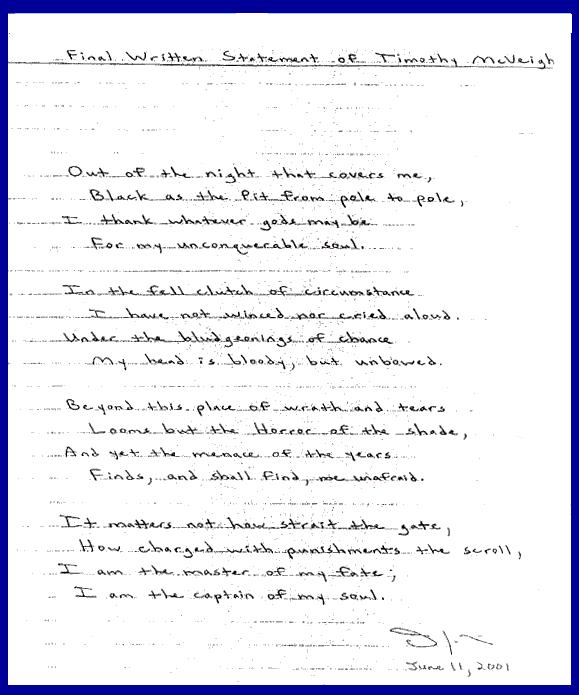
He broadcast clinical detachment in the execution itself — the first conducted by the federal government since 1963, technically imposed for the eight federal employees among his 168 victims — from his waiver of appeals to his unnervingly unblinking death mask to the stoic 19th century poem “Invictus” that formed his written (and only) final statement.
* Also — coincidentally or not — the execution date of Richard Snell in Arkansas, a militia man (and white supremacist, which McVeigh was not) who had once tried to blow up the Murrah building himself.




 It wasn’t.
 A Vlach by blood,

 Though his avowed motive, the