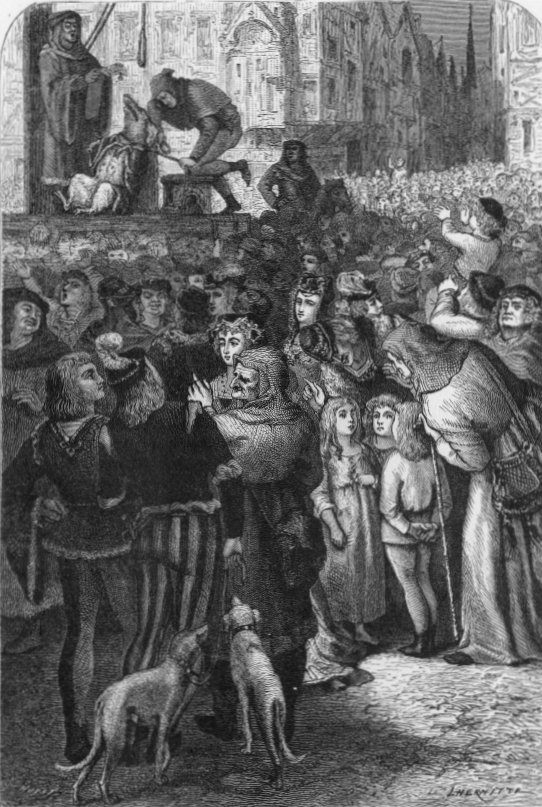
1400: Sir Thomas Blount, “bowels burning before him”

On this date in 1400, Sir Thomas Blount was drawn and quartered at Oxford.

He was a loyalist of the latterly deposed (and soon to be murdered) Richard II. Blount took part in the Epiphany Rising plot against the usurper Henry IV.

The chronicles supply an unusually graphic and detailed description (pdf) of this horrible manner of death. (Paragraph breaks have been added for readability.)

The King [Henry IV] commanded his chamberlain, Sir Thomas Erpingham, to have justice executed upon the lords who were taken prisoners, and to put them all to death, except a young knight whom he had dubbed the Saturday before his coronation, whom the King pardoned for rising in arms against him, on account of his youth and noble lineage.

Sir Thomas Blount and Sir Benet [Shelley] were drawn from Oxford unto the place of execution, a long league or more, and there they were hung; they then cut them down and made them speak, and placed them before a long fire. Then came the executioner with a razor in his hand, and kneeling down before Sir Thomas Blount, who had his hands tied, begged his foregiveness [sic] for putting him to death, for he was obliged to perform his office.

‘Are you he,’ said Sir Thomas, ‘who will deliver me from this world?’

The executioner replied, ‘Yes, my lord; I beg you to pardon me.’

The lord then kissed him and forgave him.

The executioner had with him a small basin and a razor, and kneeling between the fire and the lords, unbuttoned Sir Thomas Blount, and ripped open his stomach and tied the bowels with a piece of whipcord that the breath of the heart might not escape, and cast the bowels into the fire.

As Sir Thomas was thus seated before the fire, his bowels burning before him, Sir Thomas Erpingham said, ‘Now go and seek a master who will cure you.’

Sir Thomas Blount placed his hands together, saying, ‘Te Deum laudamus! Blessed be the hour when I was born, and blessed be this day, for I die this day in the service of my sovereign lord King Richard.’

After he had thus spoken, Sir Thomas Erpingham asked him, ‘Who are the lords, knights, and esquires who are of your accord, and treason?’

To which the good knight replied, suffering as he was, ‘Art thou the traitor Erpingham? Thou art more false than I am or ever was; and thou liest, false knight as thou art; for, by the death which I must suffer, I never spake ill of any knight, lord, or esquire, nor of anybody in the world; but thou utteredst thy false spleen like a false and disloyal traitor; for by thee, and by the false traitor the Earl of Rutland [who ratted out the conspiracy], the noble knighthood of England is destroyed.

‘Cursed be the hour when thou and he were born! I pray to God to pardon my sins: and thou traitor Rutland, and thou false Erpingham, I call you both to answer before the face of Jesus Christ for the great treason that you two have committed against our sovereign lord noble King Richard, and against his noble knighthood.’

The executioner then asked him if he would drink.

‘No,’ he replied, ‘you have taken away wherein to put it, thank God’! and then he begged the executioner to deliver him from this world, for it did him harm to see the traitors.

The executioner kneeled down, and, Sir Thomas having kissed him, the executioner cut off his head and quartered him; and he did the same to the other lords, and parboiled the quarters. And in Oxford castle many other knights and esquires were beheaded.

Thomas Erpingham doesn’t exactly exude charm in this account, going out of his way to bust on a guy having his entrails ripped out. But good guys and bad guys are a matter of perspective: Erpingham’s loyal service to the new dynasty got him a complimentary bit part in Shakespeare’s Henry V (Erpingham fought at Agincourt). Shakespeare’s young King Harry calls him his “Good old Knight”.

On this day..

1951: Harley LaMarr, dutiful son

On February 12, 1950, Buffalo socialite Marion Little Frisbee* was discovered in a frozen ditch in a suburb 12 miles outside the city, a .32-20 rifle bullet through her left temple.

Within 24 hours, a 19-year-old Native American** youth named Harley LaMarr had been caught at a boarding-house and copped to the crime.

While the coroner did report an “attempt at criminal assault,” the motive for Frisbee’s abduction/murder had been robbery. Harley LaMarr needed money because his mother, Amelia Palwodzinski, had had a fight with her second husband the month before. In the course of that fight, she planted a butcher’s knife in the man’s chest.

As Amelia went off to serve a 30-year stretch for manslaughter, she made her boy Harley promise to give the victim a decent burial. Harley had no money: he did have a .32-20. He took it to a tony part of town and waited for an opportunity.

Marion Frisbee’s purse netted him about $6. He didn’t bother taking her diamond ring because, he said, he just wanted cash for the funeral. Harley insisted the gun went off by accident: the jury in a four-day trial that April didn’t buy it.

The day before Harley LaMarr’s electrocution at Sing Sing on January 11, 1951, the Empire State’s prison officers brought his mother from Bedford Hills a few miles down the road to death row for one last goodbye with her tragically dutiful son.

The youth met with his mother for 20 minutes after authorities brought her from Bedford Hills.

They spoke together in low tones. The woman took a long last look at her son and walked away from the visiting cage dry-eyed.

“Thank you for coming, ma,” the youth called after her. (Source (pdf))

* No relation to the flying-disc fortune; that “Frisbee” was only trademarked in 1958. Marion Frisbee was just the wife of a local salesman with the Queen City Pure Water Company.

** Amelia was white; Harley’s father was Native American.

On this day..

1879: Benjamin Hunter, in the Hunter-Armstrong Tragedy

(Thanks for the guest post to Robert Wilhelm of the Murder By Gaslight historic crime blog, and author of the book Murder And Mayhem in Essex County. Executed Today readers are sure to enjoy Wilhelm’s detailed investigations into long-lost historic crime. This post, reprinted with permission, first appeared last February on Murder By Gaslight. -ed.)
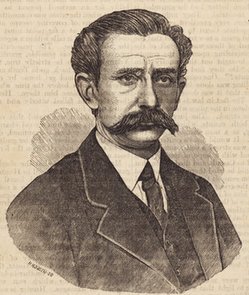
John Armstrong

The night of January 23, 1878, a man was found on the ground with a serious head wound, not far from the home of Ford W. Davis in Camden, New Jersey. Near the wounded man, a hammer and a hatchet were found, each marked with the initials F. W. D. The man was identified as Philadelphia music publisher, John M. Armstrong and when it was learned that he owed Ford W. Davis a sizeable amount of money, Davis was arrested. But Armstrong also owed $12,000 to Benjamin F. Hunter who had insured Armstrong’s life for more than double that amount.

Date: January 23, 1878

Location: Camden, New Jersey

Victim: John M. Armstrong

Cause of Death: Blows from a hammer and an axe

Accused: Benjamin F. Hunter

Synopsis:

Benjamin Hunter

Armstrong was taken to his home in Philadelphia, across the Delaware River from Camden, to be treated for head wounds. As a friend of the Armstrongs, Benjamin Hunter was among the first sent for by the stricken family. In the guise of helping, Hunter suspiciously rearranged the bandages on Armstrong’s head, reopening the wound. But when Armstrong died, Ford Davis was charged with his murder.

Some days later a young man named Thomas Graham was drowning his sorrows in a Philadelphia saloon. Laden with guilt, Graham made statements about the Armstrong murder that were incriminating enough to have him arrested. In jail, Graham made a full confession. Graham was an employee at Benjamin Hunter’s hardware concern and Hunter had offered him $500 to kill John Armstrong. Graham was in need of money and readily agreed.

They made a plan and set a date for the murder and Hunter made arrangements to be in Virginia that day. But Hunter returned to find Armstrong still alive — Graham’s nerve had failed him. Undaunted, Hunter came up with a more detailed plan to murder Armstrong. He gave Graham a hammer which bore the initials F. W. D. then had Graham mail a postcard to Armstrong, purporting to be from Ford Davis, asking Armstrong to meet him in Camden. Graham was to kill Armstrong with the hammer then leave it behind to frame Davis. Graham lost his nerve again but this time lied and said Armstrong never showed up.

Thomas Graham

Hunter decided not to leave anything to chance and met Armstrong, face to face, and persuaded Armstrong to accompany him on the ferry from Philadelphia to Camden. Graham, armed with the hammer and a hatchet that Hunter had given him, also initialed F.W.D., followed after them, riding in a different section of the boat. In Camden they took a streetcar and Graham followed on foot. They got off the car on Vine Street and Hunter left Armstrong and went back to give Graham the signal.

Graham hit Armstrong once with the hammer, but lost heart before he was able to finish the job. He threw the hatchet away and ran back to the ferry. Hunter grabbed the hatchet and attacked Armstrong, striking him on the head. He left Armstrong severely wounded, with a fractured skull.

After Graham’s confession, Ford Davis was released and Benjamin Hunter was arrested for murder.

Trial: June 10, 1878

Benjamin Hunter pled not guilty to the murder of John Armstrong. The defense asserted that there was no evidence that Hunter was in Camden that night. They also provided numerous witnesses that testified to Hunter’s good character. And they challenged the indictment on the grounds that since Armstrong died in Philadelphia, the murder could not be prosecuted in New Jersey.

It came out in court that Hunter had loaned Armstrong a total of $12,000 and to insure his loan Hunter had persuaded Armstrong to agree to a life insurance policy with Hunter as beneficiary. The amount of the policy was $26,000.

Thomas Graham had turned state’s evidence and it was his eye-witness testimony which tightened the noose around Hunter’s neck. The trial lasted 23 days and at the end the jury, with almost no deliberation, found Hunter guilty.

Verdict: Guilty of first degree murder

Aftermath:

Hunter’s attorneys appealed the verdict on the grounds that since Armstrong died in Philadelphia, Hunter could not be convicted of murder in Camden, New Jersey. The appeal was denied and Hunter was sentenced to hang on January 10, 1879.

With all hope gone, Benjamin Hunter confessed. The amount of money he had loaned Armstrong had been so large that he had been losing sleep worrying about it. Armstrong appeared to be using the money to maintain a lavish lifestyle rather than improving his failing business. Hunter’s only hope of retrieving his money was Armstrong’s death.

A week before the execution, Hunter attempted suicide, trying to spare his family and himself the indignity of a hanging. He was not allowed a knife or fork when eating, but he was able to tear away the top of a tin cup and used sharp edge to cut into his leg. Under a blanket he was able to cut an artery without the knowledge of the jailers on his deathwatch, and he had lost a pint and a half of blood before passing out and alerting them. He was saved from death and the execution went on as scheduled.

It was reported that Hunter, due to weakness from the loss of blood, and fear of death had to be carried to the gallows; though some claimed he had been given brandy and was dead drunk when carried in.

The hanging was to be done using a method adopted by the state of New Jersey — used in the case of Antoine La Blanc, among others — in which, rather than falling through a trap, the condemned man is pulled upward when a counterweight is dropped. Hunter’s execution was horribly botched as this eye-witness account attests:

“There was no scaffold. He was hanged in the corridor of the Court House, with a rope reaching up into the Court House over a pulley and to a weight in the cellar below. He was hanged at a cross-like arrangement, made by two corridors populated by men from some of whom the Sheriff demanded ten dollars apiece, and Eli Morgan, Deputy Sheriff to Sheriff Daubman, was to cut a little rope that held a stronger rope that controlled a three-hundred pound weight that was intended to hoist up the murderer into the air. The narrator was within two feet of Hunter when he was hanged. The rope was so long that it failed of its purpose and stretched, and the man went up in the air for but a few feet then tumbled down like a bunch of wet rags. Then Eli Morgan grabbed the rope and hauled him up hand over hand and held him there until he was throttled to death.”

It took Hunter at least fourteen minutes to die of strangulation.

Benjamin Hunter’s brother tried to collect on the life insurance policy and agreed to give the money to the Armstrong family. The insurance company refused to pay and Armstrong’s wife and administratrix of his estate, sued the company. The court sided with the insurance company saying they did not need to pay. The case was appealed all the way to the U.S. Supreme Court who overturned the verdict and called for a new trial. If the insurance company could prove that the policy had been taken out by Hunter as part of the crime of murder, then policy need not be paid, if there was no fraud, then the money must be paid.

The false accusation and imprisonment of Ford Davis had completely prostrated him. Shortly afterwards, partly out of consideration for his innocent sufferings, Davis was appointed crier of the Camden Courts, and he held that position for many years.

Resources:
Books:

Hunter, Benjamin F., and Thomas Graham. Hunter-Armstrong tragedy the great trial : conviction of Benj. F. Hunter for the murder of John M. Armstrong. Philadelphia: Barclay, 1878.

Lawson, John Davison. American state trials: a collection of the important and interesting criminal trials which have taken place in the United States from the beginning of our government to the present day. St. Louis: Thomas Law Books, 1921.

Seen & heard by Megargee, Volume 4, Part 1. Philadelphia: Louis N. Megarcee, 1904.

The Medico-legal journal … New York: Medico legal journal, 1886.

On this day..

1386: The Sow of Falaise, seeing justice done

There exists a receipt for January 9, 1386, in which the executioner of Falaise, France, acknowledges payment of ten sous and ten deniers

for his efforts and salary for having dragged and then hanged at the [place of] Justice in Falaise a sow of approximately three years of age who had eaten the face of the child of Jonnet le Macon, who was in his crib & who was approximately three months old, in such a way that the said infant died from [the injuries], and [an additional] ten s. tournoise for a new glove when the Hangman performed the said execution: this receipt is given to Regnaud Rigaut, Vicomte de Falaise; the Hangman declares that he is well satisfied with this sum and that he makes no further claims on the King our Sire and the said Vicomte.

From this tiny kernel of primary documentation — the only primary source that exists — an impressive legend has grown up around the “Sow of Falaise”. It’s been alleged by subsequent interlocuters that the condemned sow was dressed up as a person for execution, that other pigs were made to attend in order to take warning by their swinish sister’s fate, and even that the incident became so famous as to merit depiction in a church fresco.


The supposed fresco has been whitewashed, but Arthur Mangin’s L’Homme et la Bete (1872) took a stab at reconstructing it.

This bizarre scenario can’t help but raise the question for we later observers — just what was the objective in trying and “executing” a farm animal? Did the human supporting cast to this scene not feel itself ridiculous?


Scene from The Hour of the Pig.

Book CoverAccording to Paul Friedland‘s research for his fascinating recent survey of public executions, Seeing Justice Done: The Age of Spectacular Capital Punishment in France, the subsequent embroideries around the Sow of Falaise have no basis in fact. They were simply made up … or rather, they were interpolations of authors who were baffled as we to see a sow hoisted on a gibbet.

“Punishment may be about many things, but in the last instance, we citizens of the modern world have an almost visceral need to believe that it is primarily about one thing: deterrence,” Friedland opines.

“The punishment of a pig for murder violates our modern understanding of the essential purpose of punishment because it punishes an animal, which we ordinarily do not believe to be capable of criminal intent, and because it does not lend itself very well to the principle of exemplary deterrence.” The tale’s evolution in later centuries “allowed an incomprehensible anecdote from the past to fit neatly into the modern paradigm of penal deterrence.”

Well, the past is a foreign country. They do things differently there.

Seeing Justice Done situates that murderous pig within an unfolding saga of penal theory and practice stretching from the Roman Empire to the 20th century. And while Friedland’s study focuses on France in particular, the historical threads he teases out will look familiar much further afield.

We had the pleasure of interviewing Dr. Friedland about his book recently, and we’re pleased to present it here not in our customary Q&A form, but as Executed Today‘s debut podcast. The mediocre sound quality is on me, but Dr. Friedland’s insights are more than worth it. (Unlike your host, Friedland is a podcasting natural; catch him in a July 2012 episode of the New Books In Human Rights podcast.)


Trouble seeing the podcast player? Access the interview on podbean.

Other executions referenced in this podcast: Christ | the brutal 1757 execution of Damiens | Louis XVI and Marie Antoinette | the filmed 1939 execution of Eugen Weidmann | the last execution in France ever | Saddam Hussein‘s filmed hanging

(n.b. the intro/outtro music is Blind Lemon Jefferson‘s “‘Lectric Chair Blues”, a 1928 recording now in the public domain.)

On this day..

1813: The Yorkshire Luddites, for murdering William Horsfall

This is the bicentennial of the hanging of three Luddites for the murder of manufacturer William Horsfall.

“Luddite” has come to refer imprecisely to a wide range of anti-mechanization machine-wrecking in early 19th century Britain; however, it’s most properly applied to a specific 1811-1816 movement.

While often understood casually as a sort of mindless technophobia, wreckers — Luddites and otherwise — actually had material labor grievances. New more efficient power looms reduced skilled workers to the ranks of unskilled subsistence labor, or to those of the superfluous unemployed.

With trade unionism illegal (and severely repressed), their means of resistance were of a desperate character. Lord Byron, almost alone in Parliament, rose to defend them: “These men were willing to dig, but the spade was in other hands; they were not ashamed to beg, but there was none to relieve them. Their own means of subsistence were cut off; all other employments pre-occupied; and their excesses, however to be deplored and condemned, can hardly be the subject of surprise.”

Hence, Byron sarcastically remarked, “new capital punishments must be devised, new snares of death must be spread, for the wretched mechanic who is famished into guilt.” Parliament did indeed extend its capital statutes to the protection of these new looms.

“Wrecking,” in the analysis of the late Eric Hobsbawm, “was simply a technique of trade unionism in the period before, and during the early phases of, the industrial revolution.”

Hobsbawm quotes a Nottingham town clerk describing the way textile manufacturers “acquire entire control of their workmen” by putting them to work on the owners’ power looms rather than hiring out workers who use their own looms. “Perhaps the most effectual manner in which the combination [read: proto-union] could coerce them was their former manner of carrying on war by destroying their frames.”

And the descriptor “war” was not far off.

The Luddites — so named for legendary loom-smasher Ned Ludd — proliferated in 1811-1812. Beginning in Nottingham with a protest against falling wages signed by General Ned Ludd and the Army of Redressers, they tapped a wellspring of discontent.

It was a time of war, of economic crisis, of spiking wheat prices whose rise to an 1812 record peak further immiserated those who scraped to earn a living by the sweat of their brow. A generation after the French Revolution, with Napoleon rampant on the continent, English elites had reason to fear their own legitimacy stood on unstable ground.* In 1811, the king even went mad.

And they thrive well who from the poor
Have snatched the bread of penury,
And heap the houseless wanderer’s store
On the rank pile of luxury.

-Percy Bysshe Shelly, “The Devil’s Walk” (1812)

From their birthplace in Nottingham, Luddite societies spread out through textile country, conspiring by moonlight to break into factories and smash up frames or commit other acts of industrial sabotage. (There’s a pdf timeline here) Byron, the Luddites’ defender, owned that the night before he departed a recent visit to Nottingham, “forty frames had been broken the preceding evening as usual, without resistance and without detection.”

Terrified manufacturers — some were known to have armored their establishments with what amount to siege fortifications; others, to outfit homes with early panic rooms as bolt-holes in the event of a Luddite attack — met this mob action violently. Westminster put 12,000 troops into Luddite country to fight the wreckers.

And the wreckers fought back.

William Horsfall, owner of a Marsden wool mill with 400 employees, had vowed to “ride up to his saddle in Luddite blood” … which promise gave a poetic twist to his actual fate: while riding on Huddersfield‘s Crosland Moor** in April 1812, a group of Luddites lying in wait opened fire on him and shot Horsfall through the groin.

“As soon as he fell after being wounded the inhuman populace surrounding him reproached him with having been the oppressor of the poor — they did not offer assistance,” an officer later reported. “Nor did any one attempt to pursue or secure the assassins who were seen to retire to an adjoining wood.” A fellow-manufacturer helped Horsfall to an inn, where he expired painfully 38 hours later.

It was several months before the powers that be were able to crack it.

Eventually, the energetic Huddersfield magistrate Joseph Radcliffe† was able to exploit the threat of hanging to force a Luddite cropper‡ into impeaching his confederates in the plot. This investigation is covered in marvelous detail at the Luddite Bicentenary blog, an outstanding resource on the period in general, but for our purposes we’ll sum up to say that the hunt for Horsfall’s killers wound up zeroing in on George Mellor, Thomas Smith, and William Thorpe.

They were tried over 11 hours on a single day, January 6, 1813 (summary: 1, 2, 3, 4).

That was a Wednesday.

That Friday, the three hanged in their manacles behind York Castle under heavy military guard to forestall any possible rescue, having never admitted any part in the murder. The authorities judiciously eschewed a more demonstrative (and potentially riot-inducing) execution at the scene of the crime.

“The number of people assembled was much greater than is usual in York, on those melancholy occasions; but not the slightest indication of tumult prevailed, and the greatest silence reigned during the whole of this solemn and painful scene,” the Leeds Mercury reported§ — and darkly explicated the intended lesson of the scene for other machine-wreckers.

all those who may have been so far infatuated as to become members of such societies should, from this moment, and by one common consent, desist from taking another step in furtherance of their objects. They must now see that they have stood on the brink of a frightful precipice, and that another step might have plunged them into that gulph which has overwhelmed their less fortunate associates.

The mailed fist deployed against wreckers in 1812-1813 did indeed smash the movement. Still, sporadic Luddite attacks would continue as late as 1816, and Luddite veterans went at the fore of the 1817 Pentrich Rising … just outside the place it all began, Nottingham.

* It was in just this period — in fact, only a few days after William Horsfall’s murder — that Prime Minister Spencer Perceval was assassinated. Given the conditions abroad in the land, many an elite feared upon first notice of this event a revolutionary rising … although Perceval’s killer turned out to be a deranged merchant whose confused private grievance had nothing to do with Britain’s social tensions.

** Not far from the spot of Horsfall’s murder — and a standard stop on every present-day Luddite commemorative walk — you’ll still find William Horsfall Street.

† Radcliffe’s exertions in the war against the Luddites secured for his family a still-extant baronetcy.

‡ Benjamin Walker, the Luddite informer who sent Mellor, Smith, and Thorpe to the gallows, was denied the advertised £2000 reward and wound up a beggar in London.

§ Leeds Mercury report via a reprint in the London Times of Jan. 12, 1813. (Also see this excerpt.)

On this day..

1889: Alfred Schaeffer, diabolical dynamiter, lynched near Seattle

From the Chicago Daily Inter Ocean, January 8, 1889 (paragraph breaks added for readability: the original had none at all):

A DIABOLICAL DYNAMITER.


After Killing Three Persons and Wounding Others He Is Barbarously Lynched

SEATTLE, Wash. T., Jan. 7. — Alfred Shaffer [sic], a Bohemian, fired a heavy charge of giant powder under the house of George Bodala, at Gilman,* thirty miles east of Seattle, at 4:30 o’clock this morning, instantly killing John and Michael Scherrick, and Anna, the 9-year-old child of Bodala, and badly wounding Bodala, his wife, and little son and daughter.

Last spring Bodala caused the arrest of Schaeffer on the charge of criminal assault upon his wife. Schaeffer was sentenced to a short term of imprisonment, and when he was released he made such serious threats against the life of Bodala that he was again arrested, and incarcerated in jail nine days.

When he was released he returned to Gilman, and since then he lost no opportunity attempting to injury Bodala, and this morning put his threats into execution. The two Scherricks and the little girl were instantly killed.

Bodala was brought to the Providence Hospital to-day, and is in a very bad condition. The other three will probably recover. Schaeffer was found by the people of Gilman at his own house. He was placed under arrest, and later in the afternoon, upon the arrival of the sheriff, turned over to that officer.

This afternoon while the Sheriff was at dinner a crowd of 100 broke open the door of the house where Schaeffer was confined, took him to a tree opposite the railroad depot, and strung him up, first trying to make him confess.

He refused, and was hanged.

After thirty seconds he was cut down again and given another chance to confess, still declining he was again elevated and cut down for a second time after forty-five seconds.

He was then very weak, and, efforts to make him confess failing, he was again pulled up, and left hanging until death ensued.

* Present-day Issaquah.

On this day..

1836: Abraham Prescott, homicidal somnabulist

(Thanks to Meaghan Good of the Charley Project for the guest post. -ed.)

On this day in 1836, Abraham Prescott was hanged in Hopkinton, New Hampshire.

His crime was sensational at the time; the trial record can be viewed here. The slaying was horrifying in and of itself, and there was the added element of betrayal: Prescott had turned on the people who had treated him like kin.

A gentleman farmer, Chauncey Cochran, had taken Abraham Prescott in during his mid-teens and given him a place to stay on his farm in Pembroke, New Hampshire. In return, Prescott worked for Cochran on the farm.

This relationship continued amicably for three years, and Abraham grew very close to Chauncey and his wife, Sally. They trusted him and treated him like a son.

Our story begins on January 6, 1833, three years to the day before Prescott swung. During the early morning hours, Prescott took an ax and struck Chauncey and Sally in the head as they slept. Either he didn’t mean to kill them or he didn’t know how to aim, because he delivered glancing blows that merely caused considerable bruising and bleeding.

Abraham told them he’d been sleepwalking, and he hadn’t even realized he’d attacked his master and mistress until he saw Chauncey rising up from the bed, covered in blood. He wasn’t the first person on these pages to use the sleepwalking defense, but Abraham’s wild story actually worked — that time, anyway.

Perhaps the Cochrans were blinded by their affection for their employee. Perhaps they simply had no common sense. In any case, they accepted Prescott’s explanation and didn’t summon the police or even dismiss him. After he axed them both in bed. Most bosses would probably consider that a one-strike offense.

A report of this “unhappy and and almost unheard-of occurrence of somnambulism” was actually published in the New Hampshire Patriot several days later. Even after subsequent events cast the incident in a very sinister light, Chauncey still referred to it as “the accident.”

Several months passed and Prescott behaved normally, diligently working on the farm and causing no trouble. Then, on June 23, Sally asked him to go with her on a berry-picking expedition.

They set off together, and several hours later he came home alone and visibly agitated.

When asked what was wrong, Abraham said he’d been bothered by a toothache and lay down against a tree to rest. He evidently fell asleep, and when he woke up Sally was lying prone. Abraham had been sleepwalking again, and had clubbed her with a three-foot wooden stake, and he thought he’d killed her.

This time Chauncey didn’t give Prescott the benefit of doubt. The eighteen-year-old found himself jailed and charged with capital murder.

Abraham Prescott’s lawyer went for the insanity defense, focusing on his culpability rather than his actions. Prescott was not terribly bright and may have actually been developmentally disabled. Various witnesses testified that there was mental illness in his family. Abraham’s mother said he’d had hydrocephalus as an infant and had sleepwalked frequently during his childhood. Several doctors testified about somnambulism and insanity, and how the defendant could be a good example of both, although they were all speaking theoretically as none of them had examined him.

(Fun fact: one of the expert witnesses was George Parkman, who was himself the victim of a homicide sixteen years later and is featured elsewhere on these pages.)

The prosecution had a much easier time of it: they had a very good case that Prescott had murdered his mistress deliberately. His attempt to conceal her body suggested he knew the wrongfulness of his actions. He was under the impression that he stood to inherit everything if the Cochrans died (since they said he was “like family”).

Vis-à-vis the sleepwalking, Abraham’s own statements contradicted each other. When questioned right after his arrest, he had provided a much more straightforward account of what happened, one that didn’t involve somnambulism: Abraham said that while he and Sally were picking berries, he had done or said something “improper” to her and she threatened to tell her husband. He killed her because he was afraid he would be sent to prison if Chauncey found out about it.

(Prescott subsequently retracted that statement and went back to the sleepwalking story.)

Even after conviction, however, questions remained. Several reprieves were issued while the state tried to figure out whether or not he was crazy and, if so, how crazy. He copped a retrial because the first jury that convicted him had been improperly exposed to the popular belief in Prescott’s guilt by virtue of being barracked at a local pub. The sentencing judge at his last trial remarked on the court’s meticulous solicitation of “the most experienced witnesses, in our own and neighboring States, to throw upon the secret operations and sudden derangements of the mind, and all the evidence which the highest records of the history of man could furnish.”

Prescott spent in all two years awaiting execution, a very long time in those days. In the end, however, the law decided that Prescott knew what he was doing that day in the strawberry patch, and he had to die.

We will never know for sure why he killed Sally Cochran. The only thing that can be said with certainty is that Abraham Prescott was a very troubled young man.

A large crowd braved a snowstorm to watch him die.

On this day..

1655: Jane Hopkins, Bermuda’s last known witch execution

The last known witchcraft execution in Bermuda history occurred on this date in 1655.

The isolated English colony was at this period laboring under social crisis, or a set of crises. It had been declared in rebellion by Cromwell‘s parliament for taking too-vigorous umbrage at King Charles‘s execution. Its official C of E ministers were being challenged by breakaway independents of various stripes of Puritanism. The tobacco crop blew away one year. And it may have had a perilous gender imbalance (too many women, too few men: Bermuda definitely did have this problem in the 18th century). (Source for this whole paragraph) Perhaps it’s no surprise that its Puritan governor* would oversee a spasm of witch persecutions from 1651 to 1655.

Jane Hopkins and another woman named Elizabeth Page were both stuck in the dock on this occasion. They’d recently arrived on the Mayflower** and the captain “did vehemently suspect them to be witches,” seemingly on account of their traveling sans male.

Page bewitched the ship’s helm according to a witness who beheld her run “her finger over the compas, And yt ran round from North to South, And turned backe againe.” That’s pretty impressively infernal, but here in the 17th century they knew to look for some hard forensic evidence … so a group of matrons in Bermuda was empaneled to feel Elizabeth Page up in search of a witch’s teat. Much to the woman’s good fortune, she possessed “not any marke or spotts or signes … only something more than ordinary (in a certain place).” She was accordingly acquitted.

Jane Hopkins’ body was not so ordinary.

The eyewitness testimony against her was a fellow-passenger to whom Hopkins sighed that she wished God would send some sign clearing up all these suspicions of devilry. A rat — ubiquitous in seafaring life, mind you — promptly appeared. To add to this damning divine indictment, a peeping tom on the ship watching her dress had noticed some sort of mark on her shoulder.

Sure enough, Hopkins’s gropers discerned “in her mouth a suspicitious marke and under her arme she hath a dugge or Teat, And upon her shoulder a wart, and upon her necke another wart … all these were insensible when they were prickt.” With this sort of slam-dunk evidence, the jurymen could hardly do otherwise than agree that Hopkins “hath felonously and wickedly consulted and covenanted with the Devil & him hath suckled and fedd contrary to nature & the law of God and man, as doth appeare by markes & signes upon her body.” (The full trial records can be perused here)

It’s not absolutely certain that Jane Hopkins was the last person executed in Bermuda for witchcraft. There were several additional witch prosecutions to follow in the 17th century: some ended in acquittal, others in conviction. There was even at least one more death sentence, but that hanging was stayed and the final disposition of the case is unknown.

* Governor Josiah Forster’s legacy for the isles — other than hanging witches — was the “Forster Chair” made in his honor.

** Not the same ship as the Mayflower of Plymouth Colony fame.

On this day..

1897: The Bicol martyrs of Philippines independence

On this date in 1897, eleven pro-independence Filipinos were shot at Manila’s Bagumbayan execution grounds.

These eleven,* together with one who was tortured to death on a prison brig and three others who died exiled to prisons elsewhere in the Spanish empire, comprise the Fifteen Bicol (or Bikol) Martyrs.

Spanish suppression of the unfolding Philippine Revolution was in full martyr-making; just days before, the same site had seen the execution of Dr. Jose Rizal. (A few days after this, it made still another batch of martyrs.)

“They died bravely,” a Filipino newspaper reported. “They died like those who are sustained by a sacred ideal.”

They were.

This date’s victims had been rounded up on September 16 at Naga City in the Bicol Region. It was the aftermath of Spain’s discovery of the anti-colonial Katipunan secret society, and mass arrests followed by torture-aided interrogation were the order of the day.

These would not, in the end, avail.

As a result, the “Quince Martires” are still commemorated in independent Philippines every January 4, which is a public holiday in Naga City … and commemorated throughout the year at that city’s Plaza Quince Martires, and its monument.


(c) image courtesy of Wally Ocampo.

* Rev. Fr. Gabriel Prieto; Gabriel’s brother, Thomas Prieto; Rev. P. Severino Diaz; Rev. P. Inocencio Herrera; Manuel P. Abella; Manuel’s son, Domingo I. Abella; Camilo Jacob; Florencio Lerma; Macario Valentin; Cornelio Mercado; and Mariano Melgarejo.

On this day..

1661: The effigy and books of Giuseppe Francesco Borri

Alchemist, prophet, and dashing Italian rogue, the Jesuit-educated Giuseppe Francesco Borri (English | Italian) was burned on this date in 1661.

Luckily, he was hundreds of kilometers away.

A Milanese noble by birth, Borri was studying in Rome when he experienced a vision and started expounding a mystical theology decidedly not acceptable to Catholic orthodoxy.

That Mary’s mother was conceived of the Holy Spirit, and therefore that the Madonna was a goddess. That, with the limitless proceeds of the philosopher’s stone, he’d bankroll a spiritual army under the wings of the archangel St. Michael.

The charismatic young prophet began attracting quite a following — including the eccentric Swedish Queen Christina, then hanging around Rome after her abdication and indulging her own taste for alchemy — and was soon obliged to flee Rome for Milan, and then Milan for Switzerland, with the Inquisition at his heels. (He’s supposed to have left behind the occult markings that adorn the Porta Alchemica.)

While the heresiarch was safe abroard, the Roman Inquisition went ahead with its business without him. It was ruled that Borri was

to be punished as a heretic for his errors, that he had incurred both the ‘general’ and ‘particular’ censures, that he was deprived of all honour and prerogative in the Church, of whose mercy he had proved himself unworthy, that he was expelled from her communion, and that his effigy should be handed over to the Cardinal Legate for the execution of the punishment he had deserved.

Nothing daunted, the “executed” Borri set up as a doctor, scientist, astrologer, and alchemist in northern Europe — Strasbourg, Amsterdam, and Copenhagen. Throughout the 1660s his alchemical arts attracted the patronage of royalty as well as an endless stream of ailing patients and curious hangers-on. Borri even claimed to have accomplished the feat of transmuting a base metal into gold, which magical product can still be seen at a Danish museum.


Borri’s alchemy gold.

In a way, he did: the guy became fabulously wealthy. And he never stopped promulgating his cabalistic spiritual theorems.

Unfortunately his Danish patron died in 1670, and while en route to his next gig in Turkey he was arrested in Hapsburg territory and handed over the papacy. Borri was not put to death bodily, but spent the remainder of his life imprisoned in Rome, finally dying in the Castel Sant’Angelo in 1695.

On this day..