1793: Jean-Jacques Ampère, father of a savant, for Joseph Chalier

(Thanks to Amelia Fedo, a graduate student in French literature, for the guest post.)

He didn’t know it yet, but on this date in 1793, a brilliant adolescent named André-Marie Ampère lost his father to the guillotine. If the name sounds familiar, it’s because it would eventually become the SI unit of electrical current.

Andre-Marie Ampere, one of the founding pioneers of electromagnetism (Ampere called the new field “electrodynamics”) lost his father to the French Revolution’s guillotines.

The father in question was Jean-Jacques Ampère, an intelligent and levelheaded man whose sense of duty outweighed his instincts of self-preservation.

He was determined to do every job he had to the best of his ability — whether the task was educating a son or discharging the office of justice of the peace — and this diligence cost him his life.

A bourgeois silk merchant (a quintessentially Lyonnais occupation), he lived with his wife and son in a tiny village outside of Lyon called Poleymieux-au-Mont-d’Or. It was there that he and his wife, who were one of only five bourgeois families in a primarily peasant population, raised the boy who would grow up to be the father of electrodynamics.

In 1782, he retired and devoted himself full-time to his children’s upbringing — particularly that of his son, whom he soon realized was not an ordinary child. Born partly of necessity (Poleymieux lacked a school) and partly of choice (Jean-Jacques had, after all, opted to move to Poleymieux, and some speculate that he wished to give his son an upbringing like the one advocated by Rousseau in Émile), André-Marie’s unorthodox education resembled what today’s DIY pedagogues might call “unschooling”: he was encouraged to take charge of his own learning, given access to his father’s library, and taught a variety of eclectic subjects according to what most held his interest at the moment.

For most children, this technique is questionable; but when your kid happens to be a genius and a polymath, it works just fine. André-Marie was an audodidact and proactive in his learning, which would be a force for good in his life: as we’ll see, it was what pulled him out of his depression after his father’s death.

When the Bastille fell in 1789, not much changed at first. Jean-Jacques embraced the ideals of the Revolution and even wrote a play called Artaxerxe ou le Roi constitutionnel [Artaxerxe or the constitutional king], which James Hofmann, author of André-Marie Ampère: Enlightenment and Electrodynamics, sees as a parable containing Revolutionary themes.

A month after the fall of the Bastille, he lost his job as local aristocrat Guillin Dumontet’s procureur fiscal (a “judicial and administrative position,” according to Hofmann). Then, in the fall of 1791, he took another bureaucratic job: justice of the peace and “presiding legal functionary for the police tribunal” in Lyon. He may have done it voluntarily, out of sincere political fervor; but he may also have done it to protect his family, since his former boss, Guillin Dumontet, had been beheaded and partially cannibalized by his peasants a few months prior. If he had indeed taken this post for the good of his family, his plan backfired horribly…

As has been detailed in the post on Joseph Chalier, 1793 was not a good year for the Lyonnais.

The Revolution ran counter to the grain of Lyonnais culture for a number of historical reasons (the strong Catholic tradition and the silk trade being two of them). More immediately, famine and taxes had not disposed the people of Lyon towards the local Revolutionary government — particularly the far-left Jacobin faction, which continuously struggled for control of the city.

When the Jacobins seized power in March 1793, they provoked opposition from Girondins and royalists alike, and on May 29 important members of the Jacobin leadership were arrested. Among those apprehended was Joseph Chalier, head of a major Jacobin club known as the “Central Club.” Someone had to open the case against Chalier, and that someone was Jean-Jacques Ampère.

In spite of the Convention’s attempts at negotiation (which quickly turned to threats), Chalier was sentenced to death on July 16 and guillotined the next day. It was not Jean-Jacques who condemned Chalier to death — that does not appear to have been part of his job — but it was he who sent out the warrant for his arrest, and this was more than enough to get him sentenced to death when the political tides turned. (If the judges who actually sentenced Chalier to death — Cozon, Pourret, Régnier, and Maret — were ever punished, I haven’t found any evidence for it.)

Paris responded by placing Lyon under siege on August 9, and two months later, the city surrendered to the Convention. Rather than flee, Jean-Jacques remained in the city, resolved to see his duty through to the bitter end. Throughout the siege, he instructed his wife not to tell their children of the danger he was in. When Lyon was taken, he was immediately arrested, and in the six weeks he spent in prison, he had little doubt about his fate.

Trial and execution

Much of his trial is preserved in court documents. They refer to Lyon as “Ville-Affranchie” — “Liberated City,” the name Bertrand Barère gave to the town before declaring, “Lyon has made war against liberty; Lyon is no more” — so you know they mean business.

During his interrogation, Ampère père was accused not only of having issued the warrant for Chalier’s arrest, but also of having sentenced male and female Jacobin club members to public humiliation and having their eyebrows shaved off, respectively — as well as just generally having been a jerk to Jacobin detainees during interrogations.

The responses he gives show a man resolved to keep both his pride and his honor in the face of certain death, a functionary convinced that he had committed no wrong. Ampère admits to having had Chalier arrested but vehemently denies the other charges. He was also asked if he had left his post and/or sent a revocation to Paris, and responded that he had kept his post and had “no revocation to make.” This probably sealed his fate.

Here’s the full text of his interrogation, from Histoire des tribunaux révolutionnaires de Lyon (take my translations of legalese with a grain of salt; I don’t speak it in any language):

Frimaire 2, Year 2 (November 22)

Interrogation of Jean-Jacques Ampère, 61 years of age, justice of the peace of the canton of Halle-aux-Blés, residing in Lyon, Quai Saint-Antoine, Number 44. — Responses he gave.

I was in Lyon during the siege.

I never had any correspondence with the so-called constituent authorities in Lyon.

Question: You are accused of having filed the whole procedure against the patriots, of having been president of the correctional police during the whole time of the counter-Revolution, and of having judged those who had committed no crime other than belonging to the [Jacobin] club, sentencing the men to be tied to the post [this refers to a punishment formally known as “exhibition,” which was sort of like the pillory] and the women to having their eyebrows cut off; of having condemned, among others, Cadet Rufard, member of the [Jacobin] club, to six months of imprisonment for having sought bread for his brother, put in chains on May 29. You are reproached with having said to all of those whom you interrogated, “You are scoundrels, you people with your clubs; you had agents all the way out in the country, and your plot was the destruction of honest people.” In a word, you are accused of the assassination of the virtuous Chalier, since it was you who filed the first procedure, and it’s thanks to your arrest warrant that he mounted the scaffold.

Response: I never had any part in the judgments against patriots, men or women, which pronounced the sentence of pillory against the men and shaved eyebrows against the women; I admit to having filed the procedure against Citizen Chalier, on the declaration that had been made to me on May 27 by the public prosecutor who had the right to provoke my ministry; I also made several investigations against certain municipal officers after May 29, and in ruling on these procedures, I followed the law in sending back the accused in the presence of the director of the jury, the indictment alone regulating the jurisdiction. I conformed to the investigation of the functions of police officers who are uniformly employed to gather the vestiges of crimes and send the judgment back to the courts who should be informed of them. The circumstances were such that prudence joined with my sense of duty in making me carry out the measure indicated by the law. Before ruling on the procedure against the municipal officers, I had also ruled on the fate of a municipal named Sautemouche. I let him out under an oath to return, and soon after his release, the unfortunate Sautemouche succumbed to the blows of malicious persons. He was murdered, and most of the sections shouted for my arrest, because I had obeyed my conscience and my opinion by delivering an innocent man.

Question: Did you leave Lyon and did you send your revocation to the Committee of Public Safety, according to the law?

Response: I have no revocation to make.

Question: Did you continue your functions during the siege in a city in revolt?

Response: Yes, from May 27 until the beginning of August.

Question: Did you issue the warrant for Chalier’s arrest?

Response: Yes, on June 7.

On November 22, the same day as his trial (other sources give the date as November 23, 24 or 25, but I’m going by the date of execution given in legal documents), he was guillotined in Place Bellecour along with three men who appear not to have been involved in the affair: Étienne Chazottier, a lawyer and the president and secretary of the “permanent section” (a local political office), for “offenses against patriots”; Pierre-Elisabeth Chaponnay, an aristocrat, for “giving considerable sums to, and favoring the plans of, counterrevolutionaries”; and Jean Freidière, a geometer and secretary of the “surveillance committee” — no crime given. Ampère was 61 years old.

Shortly before his execution, he was allowed to write a final letter to his wife. Here’s the most complete version I can find, taken from Portraits Littéraires by Charles-Augustin Sainte-Beuve:

My dear angel, I have received your comforting letter; it was a life-giving balm to the emotional wounds that had been inflicted on my soul by my regret at being misunderstood by my fellow-citizens, who have denied me, through the most cruel separation, a homeland that I have cherished so much and whose prosperity is so close to my heart. I wish for my death to be the seal of a general reconciliation between our fellow-men. I pardon those who rejoice in it, those who caused it, and those who ordered it. I have reason to believe that the national vengeance, of which I am one of the most innocent victims, will not extend to the few possessions that have been sustaining us, thanks to your wise money-saving and our frugality, which was your favorite virtue … After my trust in the Eternal, to whose breast I hope will be taken that which remains of me, my sweetest consolation is that you will cherish my memory as much as I cherished you. That much is owed me. If from my home in Eternity, where our dear daughter has preceded me, I am able to attend to things on earth, you and my dear children will be the object of my care and concern. May they enjoy a better fate than their father and always have before their eyes the fear of God, that salutary fear that makes innocence and justice act on our hearts in spite of the fragility of our nature! … Do not speak to Josephine [André-Marie’s younger sister, then about eight years old] of her father’s misfortune — make sure she does not know about it; as for my son, there is nothing I do not expect of him. As long as you have them, and they have you, embrace each other in my memory: I leave you all my heart.

The author then explains that “There follow a few pieces of advice concerning the household economy, notes about paying off debts, and meticulous scruples regarding antique probity, signed with these words: J.-J. Ampère, husband, father, friend, and forever-faithful citizen.”

He continues with a sentiment shared by most nineteenth-century commentators on this affair: “Thus died, with resignation, with grandeur, and expressing himself almost as Jean-Jacques [Rousseau] would have been able to, this simple man, this reclusive merchant, this justice of the peace from Lyon. He died like so many members of the National Assembly, like so many Girondins, sons of [the spirit of] ’89 and ’91, children of the Revolution, devoured by it, but pious to the end, and not cursing it!”

We are also treated to some of Ampère’s actual notes (it would have been nice if Sainte-Beuve had just reprinted them in their entirety instead of only snatches): “It is impossible, my dear friend, for me to leave you rich, or even moderately comfortable; you cannot attribute this to my bad conduct nor to any spendthrift behavior. My greatest expense was the purchase of books and geometrical instruments which our son could not do without; but that expense was itself a bargain, because he never had any tutor except for himself.”

The Jacobins greatly spun the proceedings against Ampère; in a November 25 letter to the Convention, Collot d’Herbois and Fouché claimed that: “It was liberty that they wanted to assassinate in killing Chalier; his executioners have confessed it; before coming under the blade of justice, they were heard to say that they were dying for the king, that they had wanted to give him a successor.” It goes without saying that there is no reason to believe that Ampère said any such thing on the scaffold—he lived and died a Republican.

Aftermath

To say the execution was a shock to the eighteen-year-old André-Marie would be an understatement.

He never truly recovered from the death of his father, which was neither the first nor the last personal tragedy that would befall him; his older sister Antoinette had died a year earlier, and he would also lose his first wife after only four years of marriage. James Hofmann points out in Enlightenment and Electrodynamics that Jean-Jacques was André-Marie’s only link to the world outside Poleymieux, where he was socially isolated in addition to being intellectually stimulated (his undersocialization did indeed have a permanent effect; he was extremely awkward all his life).

Although André-Marie made a “return to normalcy” through study, he was scarred for life; Hofmann asserts that the event “contributed to the permanently melancholy cast of his adult temperament.”

After hearing the news, André-Marie became catatonic for a year; according to his friend and fellow-scientist François Arago, “The blow was too hard; it was beyond the strength of a young man of eighteen: Ampère was shattered. His intellectual faculties, so active, so intense, so developed, suddenly gave way to a veritable idiocy. He spent his days mechanically contemplating the earth and sky, or making little heaps of sand.”

Yikes. Arago claims that André-Marie was able to snap out of it with the help of Rousseau’s writings on, of all things, botany: “This lethargy of all moral and intellectual feeling had lasted for more than a year, when the letters of J.-J. Rousseau, on botany, came into Ampère’s hands. The limpid and harmonious language of this work entered the soul of the sick young man and partially gave him his nerves back, as the rays of the rising sun pierce the thick fogs of morning and bring life to the heart of plants stiff from the night’s chill.” With that, Ampère’s intellectual life reawakened; he began to study, and eventually became more or less functional — although, according to Hofmann, direct discussion of the event remained a taboo subject.

Indirect references are another matter; he named his son Jean-Jacques, in memory of his father and also, some speculate, as an homage to Jean-Jacques Rousseau.

On this day..

1797: Figaro the Elder and Jean Louis, Charleston slaves of Dominguan exiles

On this date in 1797, two French slaves were hanged in Charleston for plotting rebellion.

This plot was the product of the liberation-minded aftermath of the Haitian Revolution … although whether the product was in the minds of the slaves, or those of the paranoid slaveowners, is still up for debate.

As the great slave revolution unfolded, many of Saint Domingue’s white planters had fled abroad. Charleston, South Carolina was a major destination, one of several Atlantic cities in the U.S. that received these refugees in quantity* — lugging along as many slaves as they could. “My Fellow-Citizens know your goodness,” said one of their number in an address to the South Carolina legislature, “and anticipate the Share you are about to take in their Calamities.” The state government accordingly granted relief money to these put-upon immigrants; the British themselves are thought to have been kicking into the relief kitties in Charleston as part of 18th century covert ops to check the spread of Jacobinism.

With the Haitian Revolution and its beneficiaries aligned (for the moment) with the French Revolution,** these French exiles fit right in with pro-British federalists to a continental reactionary backlash.

Revolutionary France’s consul in Charleston (he was U.S. ambassador by the time of the events in this post) maneuvered against that city’s planter exiles (“colonial aristocrats,” as he called them†) and eyed hemispheric emancipation, according to this book.

Yet the very flight of Saint Domingue planters also brought like a contagion the idea and experience of successful revolt in the breast of those refugees’ own chattel slaves … and in the midnight terrors of those slaves’ owners. As early as August 1793, rumor gripped Charleston that a slave revolt was in the offing. Jittery Southern states began passing laws to restrict slave imports from the West Indies who might be carriers of the virulent dream of liberty.

It was in this context that Charleston authorities discovered in 1797 “a conspiracy of several French Negroes to fire the City and to act here as they formerly done at St. Domingo.”

These several Negroes denied the plot, for a while.

Eventually, and surely encouraged by what me might today dignify “enhanced” interrogation, one of them turned state’s evidence. This “Figaro the Younger” — there were two named Figaro arrested for this same plot‡ — was the property of one Jacques Delaire, one of the Dominguan community’s more belligerent aristocratic grandees. Figaro the Younger’s evidence, though only a “partial confession” was enough to doom two of his fellows.

After the condemnation of Jean Louis, he turned to the two Figaros and said, “I do not blame the whites, though I suffer, they have done right, but it is you who have brought me to this trouble.”

(A French freedman named Mercredi hanged for the same affair a week later.)

For testifying against his mates, Figaro the Younger saved his own life and was sentenced to be transported to Suriname. En route, the pressure of his leg irons caused “a swelling about the ankles which turn’d into a sore & … a mortification of the flesh ensuing his toes rotted & one of his feet drop’d of[f] entirely.”

The southern anti-slavery cause was soon crippled, too.

Especially after the 1800 Gabriel Prosser revolt, any dalliance with emancipation, republicanism, revolution, became practically unutterable, as if to speak the words would conjure up the flames of Cap-Francais. “Beyond a reasoned fear of domestic insurrection seems to have lain a desire to banish the reality of St. Domingo,” as Winthrop Jordan put it.

But the threat and the example of Haiti long stalked the imagination of those caught in the toils of the South’s peculiar institution. And more literally than that, as Robert J. Alderson notes,

Captain Joseph Vesey … was [one] of the dispensers of [refugee relief] aid, [and] many Domingan refugees made calls on him. When the Domingan planters visited, their slaves had a chance to speak with one of Captain Vesey’s slaves, Denmark Vesey.

* For example, see Gary Nash, “Reverberations of Haiti in the American North: Black Saint Dominguans in Philadelphia” in Pennsylvania History, Vol. 65 (1998). Philadelphia was at the time still the U.S. capital.

** Said alignment between revolutionary Haiti and the mother country was, of course, tenuous and not permanent.

There’s a report in the Paris archives from this period of the French consulate’s low opinion of Charleston’s Dominguans: “tricky people, at the end of their resources that vengeance towards their country and despair may lead to anything. Among the French whom we have here, there are some very good patriots who know what the hospitality of the country demands of their gratitude, but the number is small.”

‡ The Figaro plays and some of their operatic adaptations were culturally current in the 1780s and 1790s. That includes Mozart’s Marriage of Figaro but not yet Rossini’s Barber of Seville with its definitive Figaro aria … although such would be very poor excuse not to post the latter.

On this day..

1903: Peter Mortensen, divinely accused

On this date in 1903, Peter Mortensen was shot over a lumber bill.

The evidence against Peter Mortensen was circumstantial: a moonlight witness, some unexplained cash, and a perceived insufficiency of vigor in insisting upon his innocence when suspicion fell upon him.
Though this much sounds pretty speculative, Mortensen’s very direct pecuniary interest in Hay’s death was harder to wave away. Mortensen, a Salt Lake contractor, owed money to George Ernest Romney’s* Pacific Lumber company. On the evening of December 16, 1901, he summoned Romney’s employee James R. Hay — who was also Mortensen’s friend, neighbor, and fellow-teacher at a Mormon Sunday school — to pay up.

Hay never made it home.

The next day, Mortensen had a receipt for the payment in Hay’s hand, and Hay had a cashless grave and a bullet hole in his head. Rarely have means, motive, and opportunity converged so exactly.

Public sentiment against Mortensen was so overwhelming** that selecting an impartial-ish jury proceeded at a weeks-long crawl as Mortensen’s attorney met prospect after prospect by bluntly asking whether they had formed an opinion as to his man’s guilt. Prospect after prospect confirmed that they had done. By the end, the court had been reduced to issuing “open venires” bypassing the regular jury summons process and authorizing anyone handy to be inducted into the jury pool. Deputies scoured Salt Lake City like press gangs, hunting for possible jurymen.

In all, the court dismissed some 600 prospective jurors for bias (which was quite a lot for the time), and ran through $4,500 in that process alone (likewise).

Those finally seated had to weigh, along with the more conventional indicia of guilt, the inflammatory witness testimony of James Hay’s father … who said he didn’t just have a pretty strong suspicion about the defendant, but that he actually knew Mortensen did it. “God revealed it to me,” the elder Hay said with “tears streaming down his cheeks” according to a report in the Idaho Daily Statesman of June 6, 1902.

He appeared to me by the Holy Ghost and put the words of His Spirit into my mouth. I had to utter them, for I knew they were true. I cannot and will not deny it here, neither will I deny it when I meet my God on the last day.

This is not the only manifestation I received. On Tuesday noon I saw the trail of blood leading from the railroad tracks to where my son-in-law was buried. I saw it in a vision just as plainly as when I afterwards visited the spot.

Again, this is judicial testimony in an American courtroom in the 20th century.

The fact that it appeared — and that the trial court refused a defense demand to instruct the jury not to consider supernatural visions in the light of real evidence — formed the central argument of Mortensen’s appeal. In the end, Utah’s Supreme Court refused to vacate the sentence. Still, the weird appearance of “divine revelation evidence” in a Utah courtroom led the Mormon patriarch Joseph F. Smith to issue a finding distancing the Church of Jesus Christ of Latter-Day Saints from any embarrassing mummery:

[N]o member of the Church of Jesus Christ of Latter-day Saints should, for one moment, regard such testimony as admissible in a court of law, and to make the case perfectly clear it may be further stated that such evidence would not be permissible even in a Church court, where rules of evidence, though not so technical, are founded largely upon the same principles that govern the rules of evidence in a court of law. Any attempt, therefore, to make it appear that such evidence is in keeping with the tenets of the “Mormon” faith is wholly unjustified

About six weeks before Mortensen’s execution, a prison break took place at the penitentiary. It’s been given out latterly that the arrogant Mortensen was so unpopular even with his fellow-prisoners that they intentionally left him stuck in his cell. 1903 press accounts appear to indicate otherwise — that he was not the only convict left stuck in his cell, and that Mortensen’s particular rum luck wasn’t a social lack but a digital one: somebody dropped the necessary set of keys. Either way, there was no way out, and neither when Utah’s governor interviewed Mortensen personally to see about his mercy application. Never mind his popularity with prisoners; Mortensen’s continued insistence on innocence while pleading for his life was the real diplomatic failure.

Mortensen selected shooting rather than hanging as his method of death, and went to it “firm as a rock.” He left only a last statement repeating his vociferous and widely disbelieved denial of Hay’s murder.

To the world I want to say and swear by the heavens above, by the earth beneath, and by all I hold near and dear to me on this earth, that I am not guilty of that cowardly murder of my dearest friend. I ask therefore no man’s pardon for aught that I may have done in life. I am confident that my life is an example to most people. I lay no claim — please strike out the last two words — I do not say that I am better or more worthy of respect of the world than the average man, but I have done my duty to my father and mother, my brothers and sister, and to other near relatives. I have done my absolute duty toward my wife and my five little babies. May God keep and care for those sweet darlings.


Salt Lake Telegram, Nov. 20, 1903.

* Yes, those Romneys. George Ernest Romney‘s significantly younger first cousin George Wilcken Romney became Governor of Michigan, and was in turn the father of the 2012 Republican Presidential nominee Mitt Romney. The mutual grandfather of George E. and George W. designed the St. George Tabernacle.

** Even Mortensen’s wife thought him guilty, for he had gone out that fatal evening of the 16th with Hay, and returned an hour later “deathly pale.” However, while God’s hearsay to Mr. Hay was available in open court, Mrs. Mortensen’s evidence was not: Utah law prohibited wives testifying against their husbands.

On this day..

1720: Edward Hunt, the first counterfeiter executed in colonial Pennsylvania

On November 19, 1720, Edward Hunt was hanged in Philadelphia. He was the only Pennsylvanian executed for treason prior to the American Revolution — that treason being not the betrayal of the state (in the sense we might think of it today), but counterfeiting.

In the bitterness of his scaffold speech, which disdains the customary acknowledge-my-guilt, pray-for-my-soul form of the genre to complain about his case, Hunt made plain that he was not reconciled to the justice men had rendered him.

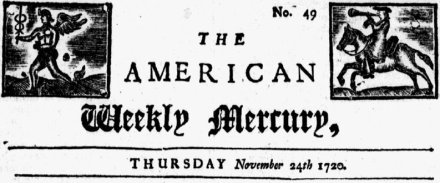
The American Weekly Mercury of Thursday, November 24 published “this extraordinary Piece” only with a preface complaining that “it is evident, that the following Speech was intended to misrepresent the Administration and Justice of this Government, as well as to infuse both ill Principles and Practices into the Minds of the People.”

The Dying Speech of Edward Hunt, formerly taken in Rebellion at Preston, and transported a bound Servant to the Island of Antigua, before his Execution upon the 19th Instant, at Philadelphia, where he had been legally convicted of High Treason, and most justly condemn’d for his Counterfeiting Spanish Silver Coin, made current* by Act of Parliament within all his Majesties Colonies in America.

It may be expected, that I should say some thing now concerning my Life and Conversation, which i must with Sorrow own to God and the Word has not been according to the Precepts and Principles of the Church, in which I was bred and educated: But with a sincere repentance and hearty Sorrow I do lament all the Errors of my past Life, firmly believing in my Saviour Jesus Christ, in whose Merits and ever flowing Mercy I do only trust for Salvation and Pardon, who has promised Eternal Life on no other Terms to the most Righteous upon Earth.

As to the Crime that now I suffer for in particular, I must own it is an Offence against the Laws, which I hope God will pardon me since he knows that I did not do it with any Design to cheat or defraud any one, or to make a Practice of Coining; but being ignorant of the Breach of any Laws of God or Man, I thought I might cut those Impressions as innocently as any other, or the Stamps that the Gentlemen of this place imploy’d me about, to make Farthings.** I am an English Subject, and desired to have the Privilege of the Laws of England, but it was not granted in any Point, except in Condemning me.

I am the first unhappy Instance of this kind that ever suffered in the King’s Dominions, pray God it may be a Warning to all, not to offend wilfully in the same that I did through Ignorance: For if I had known it, I would not have taken all the World to have done it. God give me a patient Resignation to submit to his blessed Will, in whatsoever he please.

I do heartily ask Forgiveness of all that I have offended in any manner of way, and do sincerely forgive all that have injured or offended me; particularly Mr. John Moore and Morris Birchfield, and the Evidence that swore against me in that Tryal. I do solemnly declare, That I know not any thing, or have been guilty of any one thing laid to my Charge in that Matter, or any of the other things laid to my Charge, by John Butler, either in England or Ireland.

I did petition the Honourable Governor for a Reprieve, until the King’s Pleasure was known concerning me, being I could not be tried by the Laws of England in all Points, as a Church of England Man ought to be: But it was a Privilege too great for me to obtain. Pray God to forgive them all, and every one that has a hand in taking away my Life any manner of way, and that my Blood be not required at their Hands, for they know not what they do. I am on Earth judged and condemned to die for the Breach of a Law of Man that was not duly published, which for that Reason I transgress’d it ignorantly, though the first that suffers for the Transgression of unknown Laws, or that was sentenced according to the Laws of England, without the Privilege of a Subject, which I desired of the Judge, which I know was not qualified by the same Laws to try me.

I do not know what Advantage there can be to any in my Death, and that I could not appeal to my King, neither before nor after my Tryal. I do not speak this because I am not in Charity with all the World, I do, from the Bottom of my Heart, forgive all in Obedience to my Saviour’s Command and Example, who suffered more for me, being innocent, and had not only done no Harm, but Good, and pray’d even for is cruel Persecutors and Murderers, and promised, That those that follow his Examples in this World by patiently enduring the Cross, shall reign with him to all Eternity: To Him therefore I commit all, an my poor Wife, beseeching him to help her, and be her Support and Comfort, and preserve her poor Soul free from the Polutions [sic] of the World, that through his precious Merits we may meet where we shall be both happy to all Eternity, in the merciful Arms of our dear Lord and Saviour Jesus, who I do beseech to receive my poor Soul.

According to Kenneth Scott’s Counterfeiting in Colonial America, Edward Hunt’s wife, Martha, got a £500 fine and a lifetime prison sentence for misprision of treason. (If that book is up your alley, Scott has an even more specific Counterfeiting in Colonial Pennsylvania.)

* Early colonial American commerce was severely hampered by a shortage of English/British currency. As a result, coins minted in Spain’s lucrative southern territories served as the colonies’ primary currency in the 17th and 18th centuries, particularly the iconic eight-real silver “pieces of eight”.

This is the reason why the currency of the present-day U.S. isn’t an “American pound sterling” but the almighty dollar: Dutch colonists had brought a coin called the leeuwendaalder to their former New Amsterdam (New York) province, the name deriving from the German thaler. As the pieces of eight corresponded to the thaler/daalder, it inherited the same name. Indeed, the “Spanish Dollar” remained legal tender in the post-colonial United States until 1857.

This is also the reason for reckoning of the eight constituent bits that comprised the dollar, and hence of the American colloquialism “two bits” to denote $0.25 … and, later, the adjective “two-bit” to man something cheap, mean, or small-time.

** They may have been Spain’s coins, but it’s wildly implausible that any Englishman could think he could counterfeit “innocently.”

On this day..

1427: Johann Bantzkow, Mayor of Wismar

On this date in 1427, the merchant-mayor of Wismar was beheaded — the incidental casualty of a Baltic trade war.

The Hanseatic League, that vast trading cartel stretching from Europe’s Low Countries in the west to Novgorod in the east, was in its glory at the start of the 15th century. The Hanse dominated Baltic trade.

Its major rival was Denmark, which had brought most of Scandinavia together in the Kalmar Union.


Map of the Hanseatic League at its apex, circa 1400. (Via Wikipedia)

Come the 1420s, the Danish monarch was Eric of Pomerania, a handsome and headstrong king. He would come to blows with Hanse cities over the Duchy of Schleswig.

Schleswig is the “neck” of Denmark’s Jutland peninsula. In the present day, the German-Danish border splits Schleswig horizontally: north Schleswig is Danish soil; south Schleswig, German.

To summarize a complicated history, the historical Duchy of Schleswig was long a bone of contention between the pre-modern precursors of those current states. Since Germany was very far from a unitary entity where we lay our scene in the 15th century, Denmark’s immediate rival for Schleswig was that territory’s southern neighbor, Holstein. Eric had fought intermittently in the 1410s and 1420s against the counts of Holstein over who controlled what and upon what terms in south Jutland.

After securing a legal ruling favorable to his claims from the Holy Roman Emperor, Eric in 1426 began enforcing his rights by force.

Holstein in turn sought aid from Hanseatic towns many of whom — wary of Denmark as a rival to its Baltic trading stranglehold — did indeed enter the fray on the side of Holstein. Hanseatic ships began raiding southern Denmark in the spring of 1427.

Wismar, a Hanse wool-trading port just a few kilometers outside of Holstein, was one of these cities. Johann Bantzkow (German link), its merchant ruler, supplied some 200 sail for the Hanseatic flotilla.

Unfortunately for the Hanse, and for Bantzkow, the Danes proved to have naval superiority and dealt a crushing defeat to the Hanseatic fleet on July 11, 1427 — then once again on July 25. A number of Wismar ships were captured in the process.

Public anger in Wismar was intense. That city had seen its own social conflicts in the generations preceding between the town’s patricians and its guilds; now popular anger over the souls lost at sea caused Bantzkow’s fellow-mayor Hinrik van Haren to be slain by the mob. Bantzkow himself was condemned judicially, and his influential family could not manage any better succor than a death by the sword instead of the horrible prospect of the breaking-wheel. Claus Jesup (German link), a leader of guilds, made himself mayor of a rearranged political order.

The prospective realignment was itself reversed in 1430, and the re-established magnates put up a Bantzkowsche Sühnekapelle (German again), or Bantzkow Penance Chapel, to atone for the unjust beheading. Regrettably, the chapel was demolished in the 19th century.

Given setbacks at sea, Holstein and its remaining Hanseatic allies focused on actual conquest in Schleswig, and with much better success. Eric was eventually forced after great expense to sue for a costly stalemate,* an affair which helped to undermine Eric’s own hold on power until he was finally deposed in 1440.

However, Eric’s success on the seas — and his urgent need for funds — led to his establishing Denmark’s Sound Dues on 1429, collecting lucrative tolls from all foreign ships sailing between the Baltic Sea and the Kattegat.** This tax would remain a pillar of the Danish state well into the 19th century, at times providing up to two-thirds of the government’s operating income.

A new Hanse was re-founded in 1980 as a cultural exchange network among the historic cities of the federation.

* Control of Schleswig-Holstein never was definitively resolved, and it re-emerged as a famously devilish diplomatic problem in the 19th century — prompting Lord Palmerston to remark that “only three people … have ever really understood the Schleswig-Holstein business — the Prince Consort, who is dead — a German professor, who has gone mad — and I, who have forgotten all about it.”

** It’s thanks to Sound Dues that Elsinore, the main tolling point, got big and rich enough for Shakespeare to set Hamlet there.

On this day..

1922: Taffy Long, Herbert Hull, and David Lewis, Rand rebels

RAND MINING RECOVERY.

LOWER WORKING COSTS.

(From our correspondent.)

JOHANNESBURG, Oct. 28. The Rand Daily Mail, in an article dealing with the economic situation of the Union, gives striking figures illustrating the steady advance of the gold industry on the march towards prosperity.

Profits for the July-September quarter show an increase of £1,136,000 over the previous quarter. This has been accomplihed not only by lowering wages, but by all-round improvement in efficiency per unit, mining costs having fallen from 25s. 8d. in 1921 to 20s. 5d. in September, 1922 …

[T]he Rand Daily Mail says that these facts “represent unmistakable omens of coming prosperity which should steel the downhearted farmer to greater effort and encourage the suffering industrialist throughout the Union, and transform the pessimism of the merchant into healthy confident and hope.” (London Times, Oct. 30, 1922)


THREE RAND EXECUTIONS.

ANTI-GOVERNMENT RIOT.

(From our correspondent.)

JOHANNESBURG, Nov. 17. The bitterest feeling prevails among the workers over the refusal to reprieve the three men, Long, Hull, and Lewis, who were condemned to death for murder in connexion with the Rand revolt, and were executed at Pretoria to-day.

Appeals for mercy poured in till almost the last moment, and an open-air mass meeting was held, in which prominent Communists took part. At this meeting angry and threatening speeches were made; the names of General Smuts and Sir Lionel Phillips were boohed, and the crowd attempted to break into the Town Hall, severely injured a detective, and was finally dispersed by armed police. The public generally approves the Government’s firmness. The condemned men sang the Red Flag on the scaffold. (London Times, Nov. 18, 1922)


“Come dungeons dark or gallows grim the sun will be our parting hymn.”

FUNERAL OF RAND MURDERERS.

COMMUNIST APPEAL TO CHILDREN.

(From our correspondent.)

JOHANNESBURG, Nov. 19. Remarkable scenes recalling the funeral of the victims of the great strike of 1913 were witnessed at the burial of the remains of Long, Lewis, and Hull, who were executed on Friday. The coffins, in separate hearses, were followed by thousands of workers, with banners and regalia, representing every trade union. “The Red Flag” was sung at the graveside and addresses were delivered, in which members of Parliament, of the Provincial Council, and Town Councils participated.

The latest development of Communist propaganda in Johannesburg is the distribution broadcast among children and students as they are leaving their schools and colleges of a pamphlet denouncing as “legalized murder and a blot on history” the execution of the men convicted of murder at special treason courts. (London Times, Nov. 20, 1922)

On this day..

1688: Goodwife Ann Glover, Salem trial run

On this date in 1688, colonial Boston hanged its last witch … or, its first Catholic martyr.

Goodwife Ann Glover was an Irishwoman who had been among some 50,000 Catholics deported to Barbados* by Oliver Cromwell during the 1650s.

1688 finds her with a daughter, desperately poor, as housekeepers in Boston to one John Goodwin and his family.

After one of Goodwin’s daughters accused the Glovers of stealing some linen, the daughter got cussed out and — per Cotton Mather’s credulous account of the washerwoman’s devilry — “visited with strange Fits, beyond those that attend an Epilepsy or a Catalepsy, or those that they call The Diseases of Astonishment.” In fact, four Goodwin children began suffering these symptoms, and would do so for weeks on end, only abating enough for meals and a good night’s sleep. (They would finally be cured, weeks after their supernatural tormenter’s hanging, by having to fast for a couple of days.)

The family doctor diagnosed “an hellish Witchcraft.” Mather has an extensive description of their thrashings, but his contemporary, Boston merchant Robert Calef, charged in his anti-Mather tract More Wonders of the Invisible World that Mather himself did not shy from “taking home one of the children, and managing such intrigues with that child, and printing such an account of the whole … as conduced much to the kindling of those flames, that in sir William‘s time threatened the destruction of this country.”

This Glover case is Cotton Mather’s underreported debut on the witchcraft scene. With the moderating hand of his father away, the ambitious 25-year-old divine took on a starring role in the drama. He would boast of it in published material in the years following, and as Thomas Hutchinson later observed,

The printed account was published with a preface by Mr. Baxter, who says, ‘the evidence is so convincing, that he must be a very obdurate Sadducee who will not believe.’ It obtained credit sufficient, together with other preparatives, to dispose the whole country to be easily imposed upon by the more extensive and more tragical scene, which was presently after acted at Salem … these books were in New-England, and the conformity between the behavior of Goodwin’s children and most of the supposed bewitched at Salem, and the behavior of those in England, is so exact, as to leave no room to doubt the stories had been read by the New England persons themselves, or had been told to them by others who had read them. Indeed, this conformity, instead of giving suspicion, was urged in confirmation of the truth of both.

Years later, when the public turned against Mather’s appalling leading role in the Salem Witch Trials, one of the Goodwin children was among the parishioners whom Mather detailed to come to his defense. “[Mather] never gave me the least advice, neither face to face nor by way of epistles, neither directly nor indirectly,” insisted Nathaniel Goodwin, later to become the executor of his estate. “[H]e never advised me to anything concerning the law, or trial of the accused person.”**

Eventually persuaded by the children’s mysterious or staged illnesses, the town magistrates hauled Goody Glover in for questioning and set upon her poor command of the King’s English. Glover was a native speaker of Gaelic; she had lived in Boston for only a few years, and it’s likely that whatever degree of English she picked up in her indenture in Barbados was heavily creolized by that island’s enormous mid-17th century influx of African slaves for the sugar plantations.

Whatever she said sounded like it came straight from perdition to the ears of Cotton Mather.

she being sent for by the Justices, gave such a wretched Account of her self, that they saw cause to commit her unto the Gaolers Custody. Goodwin had no proof that could have done her any Hurt; but the Hag had not power to deny her interest in the Enchantment of the Children; and I when she was asked, Whether she believed there was a God? her Answer was too blasphemous and horrible for any Pen of mine to mention. An Experiment was made, Whether she could recite the Lords Prayer; and it was found, that tho clause after clause was most carefully repeated unto her, yet when she said it after them that prompted her, she could not Possibly avoid making Nonsense of it, with some ridiculous Depravations. …

It was not long before the Witch thus in the Trap, was brought upon her Tryal; at which, thro’ the Efficacy of a Charm, I suppose, used upon her, by one or some of her Cruel the Court could receive Answers from her in one but the Irish, which was her Native Language; altho she under-stood the English very well, and had accustomed her whole Family to none but that Language in her former Conversation; and therefore the Communication between the Bench and the Bar,’ was now cheefly convey’d by two honest and faithful men that were interpreters.

Just imagine how apoplectic this guy would be if he ever heard “para Espanol o prima dos.”

One can readily picture confusion and malice multiplying one upon the other as it passes not only between two different tongues but also between two different cosmologies. We don’t know very much about Ann Glover; even her name is a slave name. But she was Catholic, and so had a religious world of saints and symbols that her persecutors could readily equate with demons. (Querying her in the condemned cell at one point, Mather is told that “saints” forbid her cooperating with his Protestant exhortations, but he understands it as “spirits” — apparently the Gaelic word is one and the same — and he presses her for the identities of these infernal agents.) She probably did not remotely share her prim persecutors’ regard for temperance and submission. She was of course poor and uneducated, ready prey for the entrapment of a well-schooled prig who could scarcely conceive the lives she had already led in Ireland and Barbados. If one likes, one might take her as the luckless victim of a conservative clergy’s backlash against the slow fade of its authority.

Glover’s broken speech and wrong religion surely made it easy to “other” her. Even so, at least in Mather’s construction, Goodwife Glover’s condemnation reads as if it proceeded with at least the partial participation of the accused.

Several rag dolls were recovered from Glover’s home, and Mather says that Glover agreed that these were “her way to torment the Objects of her malice … by wetting of her Finger with her Spittle, and streaking of those little Images.” Even if this matter is just as her foe depicts it, Glover wouldn’t exactly by the only person in history to be irritated by her employer, nor to satisfy her vengeance on some fetish of an untouchable enemy.

Glover might herself have believed in the folk magic whose practice was only slowly ebbing away at this time; Mather even says that Glover obligingly healed a boy whom she had bewitched when his mother testified at her trial.

Or she might have defiantly embraced the sorcery accusations against her as a last rebuke to the Puritans who had torn her from hearth and home all those years before and now despised her as an idolatrous papist. Her contemporary defender Robert Calef just thought she was a bit out of her gourd; “the generality of her answers were nonsense, and her behaviour like that of one distracted,” giving “crazy answers to some ensaring questions.” The court actually explored this possibility as well by empaneling a group of medical men to explore Glover’s competency. They found her compos mentis.

It’s too bad that we don’t have Goodwife Glover’s own account of herself. Instead we read her through axe-grinding interlocutors.

Mather wearied his victim with demands to convert, along with an interpreter since “she entertained me [in her cell] with nothing but Irish.” (He didn’t mean whiskey.) It was only “against her will” that Mather prayed with her — or maybe more like “at her” — although he also claimed to have extracted an admission that other witches were operating who would continue to afflict the Goodwin children.

She was drawn on this date to the gallows at Boston Neck — coincidentally almost the very spot where Boston’s Catholic Cathedral of the Holy Cross stands today.

There’s a precious alleged† first-person account of her execution:

There was a great concourse of people to see if the Papist would relent … Her one cat was there, fearsome to see. They would to destroy the cat, but Mr. Calef would not [permit the cat to be killed]. Before her execution she was bold and impudent, making to forgive her accusers and those who put her off … She predicted that her death would not relieve the children, saying it was not she afflicted them.

November 16 is now, by a 1988 tricentennial resolution of Boston’s considerably more Catholic-friendly city council, Goody Glover Day in that city. What better spot to celebrate than at Goody Glover’s Irish pub?

* Such deportees were said to be “Barbadosed”.

** This is not the only link between those Massachusetts witch-hunts; Rebecca Nurse, one of the women hanged at Salem, might have visited Ann Glover in jail.

† So far as I have been able to determine this widely-reproduced quote sources entirely to a 1905 Journal of the American Irish Historical Society piece. This was itself reproduced from a strongly partisan article titled “A Forgotten Heroine” and published in a devotional Catholic magazine, The Ave Maria. It was written by Harold Dijon, an instructor at a Baltimore Catholic school, without primary footnotes — only a general citation that it has “been gleaned from Cotton Mather, Upham, Drake, Moore, Owens, Calef, Cartrie, and papers of the Massachusetts Historical Society.” I have not been able to locate the document Dijon quotes here.

On this day..

2011: Reginald Brooks, flipping the bird

(Thanks to Meaghan Good of the Charley Project for the guest post. -ed.)

On this day in 2011, multi-filicide Reginald Brooks was executed in the Southern Ohio Correctional Facility in Lucasville, Ohio.* He was the fifth man executed that year and, at 66, the oldest since 1999.


Brooks (top) and the children he murdered.

Although his guilt was never in question, he had spent close to thirty years on death row while his appeals wound their way through the system.

On March 6, 1982, just days after his wife filed for divorce, Brooks shot their three sleeping sons: Reginald Jr., 17, Vaughn, 15, and Niarchos, 11. He then bought a bus ticket to Las Vegas, taking the gun with him in his suitcase, as well as his birth certificate and high school diploma. The police caught up with him in Utah.

Brooks had some history of domestic violence, but his only prior arrest had been for grand theft. His aunt, when asking the appeals board for clemency, said he had a normal, loving relationship with his children. Before shooting them all in their sleep, that is.

His attorneys argued that his crimes were motivated by mental illness, namely paranoid schizophrenia. Brooks had a normal childhood and young adulthood, but started to fall apart in the years prior to the murders. He quit his job in the 1970s because he thought his coworkers were trying to poison him. (He never worked again and his wife had to support their family.)

Beginning around 1980, he began isolating himself from friends and family, and accused his wife of committing incest with Reginald Jr. The family tried to get psychiatric help for him, to no avail.

In spite of overwhelming evidence, Brooks never admitted to his crime and suggested various bizarre theories as to what had really happened. A psychiatrist who evaluated him in 2010 and 2011 believed Brooks genuinely could not remember shooting his sons.

There was, however, clear evidence of premeditation: Brooks had purchased the murder weapon nine days before the murders, lying on his application form where it asked if he’d ever been convicted of a felony. He also turned on the stereo in his apartment and left the music blaring loudly, presumably to drown out the sound of the gunshots. Then, after the murders, Brooks immediately left town, taking documents he would need to start a new life — clearly suggesting cognizance of guilt.

The prosecution conceded Brooks did have schizophrenia, but argued that his illness was not so severe as to make him incompetent or legally insane, and that he was lying when he said he couldn’t remember committing the murders. Attorneys for the state suggested he murdered his children to spite his wife, “through a twisted sense of jealousy, hatred, or despair.”

Brooks’s ex-wife, Beverly, witnessed his execution. He had no last words, but he did give a message: glaring at the glass behind which the witnesses were standing, he stuck out the middle fingers of both hands. And as he slowly lost consciousness and breathed his last, his middle fingers still stood erect.

* The Texas of the North when it comes to capital punishment.

On this day..

1888: William Showers, “pathetic soul”

(Thanks to Meaghan Good of the Charley Project for the guest post. -ed.)

On this date in 1888, after a hearty breakfast of beefsteak, eggs, sweet potatoes and coffee, William Showers became the eighth man judicially hanged in Lebanon County, Pennsylvania.

He had been condemned for the murder of his grandson, William “Willie” Kahler. An account of his trial and death, assembled by the Lebanon County Historical Society, describes the condemned man as he appeared on the day of his execution: “The aged Bill Showers [he was sixty-two] looked like what he was, a pathetic soul. He was only five feet two inches in height and weighed less than one hundred twenty-five pounds.”

Showers had been dealt a hard hand in life, and he didn’t have a good reputation among his neighbors in the village of Annville. Much to the shame of the family, his only daughter Sara had borne six children out of wedlock. Sara died young in 1886, and her father was left in charge of two of her children: six-year-old Willie Kahler and his brother, Samuel “Sammy” Speraw, age four. (What happened to the other four children has not been recorded.)

Bill Showers was a widower by then. For about six months, with the help of his son and his daughter-in-law, Showers did the best he could to provide a home for his grandsons.

But in April 1887, Showers’s son and his wife stopped helping him care for Willie and Sammy. Bill had never wanted the boys in the first place, and he couldn’t afford to feed them on his own.

For about a month the three of them lived alone and Bill tried to get someone to take the children off his hands. He tried a few different foster homes, but he couldn’t afford to pay the foster parents for the boys’ keep. He took them to an orphanage, but they were refused admission. The county almshouse rejected them also.

Bitter and desperate, Bill complained to a friend, “If no one will take them, I have one place to put them. I won’t be a damned fool and raise other people’s children.”

In mid-May, however, Showers’s normally sulky and reclusive attitude suddenly changed and he went to the neighbors and cheerfully announced that he had finally found another home for the children. Two brothers in Schuylkill County were willing to adopt them and take them to Texas to start a new life, and they would be out of Bill’s hair forever. Showers asked his daughter-in-law to mend the boys’ clothing in preparation for their journey.

Then, on May 17, he borrowed the local minister’s buggy and set off over the mountains to Sammy and Willie’s new adoptive home. A few of the neighbors noticed Showers riding out of town that morning. They also noticed that he was alone.

By May 30, the good citizens of Annville were suspicious enough to go to the local constable, Joseph Fegan. When Fegan questioned Showers as to the whereabouts of his grandchildren, Bill told them a most extraordinary story: on the way to Schuykill County, he said, he’d encountered two black men and asked them for directions.

He then stopped to water his horses, letting the children out of the buggy as he did so. When he returned to the wagon, Willie and Sammy were gone. He believed they’d been abducted by the two black men. But he never reported their disappearances, he said, because he was “too upset.”

No one believed this wild story, and the people of Annville organized search parties to look for the two children, whom they were sure had been murdered. They found their tiny, nearly naked bodies that very same day, in a ditch only about 70 yards from Showers’s house. They had both been beaten and strangled to death.

Showers was arrested, charged with murder and lodged in the county jail. Which was just as well for him, because his neighbors were inclined to lynch him. His son hired a very able local attorney, Frank Seltzer, to defend him. Seltzer selected Frank Lanz, a former state senator, as co-counsel.

The Commonwealth of Pennsylvania charged the defendant only with the murder of Willie. The idea was that if they lost that case, they could go forward and try Showers for the murder of Sammy.

The trial date was in mid-June, and the first thing Showers’s attorneys did was move that it be delayed. As the Lebanon County Historial Society puts it:

Seltzer…had a different view of the situation. He rose and objected to the call of the case with a voice that could be heard in the county jail one-half block away. Promptly and resignedly, his tone of voice changed. As if explaining a baptismal font to a heathen, he told the judges that he and Senator Lantz had been retained for less than a week. Their request for a continuance was not made :in the spirit of vexatious delay” but rather for lack of time to prepare the case for trial and, of prime importance, the inability to have a fair trial in the county at the time in light of the prevailing rumors. Adverse pretrial publicity, pleaded Seltzer, rendered a fair trial impossible at this time.

[The prosecutor] Ehrgood replied to Seltzer that he had been given prompt notice he was going to press for immediate trial and Seltzer would have ample time to prepare, since it was only Monday and he would not be ready for trial until the following Thursday. This was a concession which Seltzer and Lantz hardly appreciated.

The judge agreed with the defense, and set a new trial date for September. This would give time for his lawyers to prepare, and maybe for the rumor mill to stop spinning. These were some of the stories floating around:

  • Seltzer murdered his wife in 1886.
  • He also killed his daughter Sara, Willie and Sammy’s mother.
  • He was in love with a local seamstress, Elizabeth Sargent, and killed his family members to get them out of the way so he could marry her.

The press didn’t help matters.

Headlines in the local papers included shockers like “Annville the Scene of a Murder Most Foul!” and “William Showers Dyes His Hands with His Grandchildren’s Blood!”

During the summer of 1887, Showers’s attorney, Seltzer, fell ill and was confined to bed, unable to assist with the defense. It seemed unlikely that the trial would really take place in September. Perhaps Showers couldn’t stand the suspense anymore, for on September 23 he summoned his sons Stephen and William Jr. to the jail, along with the lawyer Luther F. Houck.

Showers made an oral confession to all of them, speaking in his native German, and Houck wrote it down and translated it into English.

The substance of Showers’s confession was that Elizabeth Sargent had agreed to marry him on the condition that he got rid of the boys, and they had agreed to kill them. Elizabeth, he said, helped him strangle Willie and Sammy and dump their bodies in a pre-dug grave.

In court later that day, Showers pleaded guilty to both murders, and his confession was read out for everyone to hear. Elizabeth Sargent was in the audience and she leaped up and shouted, “That’s a lie!” The judge had her removed from the courtroom. The next day she and her parents took a train out of town. Because Showers had implicated her and the police weren’t sure as to whether she was involved in the children’s deaths, the court issued a bench warrant for her arrest.

The townspeople, however, didn’t believe Showers’s second story any more than they had his first one. They were convinced of Elizabeth’s innocence. She subsequently reappeared and presented an alibi, proving she had not been with Showers on the dates he specified in his statement.

When he heard the news about his client, Selzer rose from his sickbed and rushed to court to try to undo the damage. He begged the judge not to accept the guilty plea. In private, Showers told his attorney the confession was completely untrue and he made up the story because he’d been sick and weak, and people who visited him in jail told him he would be hanged if he didn’t own up to what he did.

Selzer’s argument persuaded the judge: Showers’s guilty plea was withdrawn. He finally went to trial on December 15, 1887.

He testified on his own behalf and gave yet another bizarre story, this time implicating a local man named George Matterness and his dead daughter Sara’s husband, a man named Huffnagle. He said Matterness and Hufnagle, along with two other men in blackface, had visited Showers’s home on the night of May 17 and lead Willie and Sammy out of the house. Matterness, Showers said, had later told him the children were buried in the ditch. Showers had told no one about this before because Hufnagle had repeatedly threatened his life.

The prosecution immediately called George Matterness as a rebuttal witness. Matterness, a teacher, freely admitted he knew Showers slightly, but said the whole story was a lie and he was baffled as to why the old man would have implicated him.

Given the circumstances, it’s surprising the jury actually deliberated till midnight and then on to 8:00 a.m. the next morning before pronouncing Showers guilty.

He told Seltzer, “I’m glad they didn’t find me innocent so they can’t go ahead and try me on the indictment for the murder of Sammy.” He expressed hope that he would prevail on appeal, but the Pennsylvania Supreme Court denied him and the governor quickly issued a death warrant.

Three hundred people were allowed into the prison courtyard to witness the execution. Thousands more clogged the streets around the jail into a “solid mass of morbid minded humanity bent on seeing Bill Showers tripped into endless time.”

The morbid mass got its wish. The small, slight man fell only three feet, and his neck was not broken. He strangled slowly for seventeen minutes.

As Showers’s sons all refused to take custody of the body, he was buried on the grounds of the county almshouse. This was the same institution that had refused to accept his grandsons, an act that would have saved their lives.

On this day..

2010: Farid Baghlani, womanslayer

On this date in 2010, Farid Baghlani was hanged in Ahvaz for a 2004-2008 serial murder spree that claimed the lives of six women.

At trial, Baghlani openly attributed his crimes to his hatred for women, probably not a defense calculated to maximize his prospects of acquittal. Those who lost loved ones to Baghlani returned the sentiment, and celebrated his execution by handing out sweets.

On this day..