1917: Lation Scott lynched

(Thanks to Meaghan Good of the Charley Project for the guest post. -ed.)

On this date in 1917, 24-year-old black farmhand Lation (or Ligon) Scott died a horrible death in Dyersburg, Tennessee.

For the two years prior to his extrajudicial “execution” by a lynch mob, Scott had worked as a farmhand for a white family, doing the farm chores while the husband worked at his job in Dyersburg.

He got on well with the family and was fond of the two children. He seemed like an ordinary enough man and a good worker, according to the NAACP journal The Crisis:

Accounts as to his intelligence vary widely. One report asserts that he was almost half-witted. Others attribute to him the intelligence of the average country Negro… He had the reputation of being a splendid hand at doing general housework, or “spring-cleaning,” and…had done this sort of work for a prominent woman of Dyersburg. She states that she was alone in the house with him for two days.

No trouble resulted.

In addition to farming and the doing of odd jobs, he was a preacher. On November 22, 1917, however, he allegedly raped the farmer’s wife while her husband was at work. He threatened to kill her if she reported what he had done. He then fled, leaving his victim bound and gagged inside the farmhouse.

The woman was able to free herself and identify her attacker, and the community took swift action, searching extensively for Scott and offering a $200 reward for his apprehension. Scott was able to elude capture for ten days, though, making his way fifty miles to Madison County. There, a railroad worker recognized him and he was arrested.

The sheriff’s deputy for Dyer County, along with some other men (including, presciently, an undertaker), picked up the accused man and started off back to Dyersburg by car in the wee hours of the morning. They didn’t bother taking an indirect route for the purpose of their journey.

Hundreds, perhaps thousands, of people gathered along the road and waited for their quarry.

And when he appeared, they forced the car off the road and made the officers turn over their prisoner.

These people were not typical of the average lynch mob: rather than stringing him up on the spot, they drew up a list of twelve “jurors” and, at noon, after church let out, drove Scott to the county courthouse for a “trial.”

Scott was ordered to stand up and asked, “Are you guilty or not guilty?”

Scott admitted he was guilty, and the “jury” voted for conviction.

Although one “prominent citizen” asked the people not to be barbaric, because it was Sunday and because “the reputation of the county was at stake,” both the rape victim and her husband wanted Scott to be burned alive rather than merely hanged.

The Crisis‘s description of what happened is not for the faint-hearted.

The Negro was seated on the ground and a buggy-axle driven into the ground between his legs. His feet were chained together, with logging chains, and he was tied with wire. A fire was built. Pokers and flat-irons were procured and heated in the fire… Reports of the torturing, which have been generally accepted and have not been contradicted, are that the Negro’s clothes and skin were ripped from his body simultaneously with a knife. His self-appointed executioners burned his eye-balls with red-hot irons. When he opened his mouth to cry for mercy a red-hot poker was rammed down his gullet. In the same subtle way he was robbed of his sexual organs. Red-hot irons were placed on his feet, back and body, until a hideous stench of burning flesh filled the Sabbath air of Dyersburg, Tenn.

Thousands of people witnessed this scene. They had to be pushed back from the stake to which the Negro was chained. Roof-tops, second-story windows, and porch-tops were filled with spectators. Children were lifted to shoulders, that they might behold the agony of the victim.

It took three and a half hours for the man to die.

Margaret Vandiver wrote in Lethal Punishment: Lynchings and Legal Executions in the South, “The lynching of Lation Scott was the most ghastly of all those I researched.”

This spectacle of horror took place in broad daylight, and no one in the mob wore masks.

Nevertheless, no one was ever prosecuted.

According to The Crisis,

Public opinion in Dyersburg and Dyer County seems to be divided into two groups. One group considers that the Negro got what he deserved. The other group feels that he should have had a “decent lynching.”

A “decent lynching” was defined as “a quick, quiet hanging, with no display or torturing.”

One local citizen remarked that he thought the people who tortured and killed Lation Scott were no better than the rapist himself. Another simply commented, “It was the biggest thing since the Ringling Brothers’ Circus came to town.”

Lation Scott’s was the last lynching in Dyer County history.


Wire report in the Salt Lake Telegram, Dec. 3, 1917.

On this day..

1865: The Jacksonville Mutineers

On this date in 1865, six African-American infantrymen were shot in Fernandina, Florida, for the Jacksonville Mutiny.

Formed in 1863, the 3rd Infantry Regiment, United States Colored Troops served in the trenchworks around Fort Wagner — the grinding siege in the summer of 1863 that followed the bloody attempt to storm the fort immortalized in the 1989 film Glory.

The Third was subsequently transferred to Union-occupied Jacksonville, Florida for duty garrisoning a conquered town of the Confederacy whose white citizens chafed doubly at their presence. But the unit had weathered both the boredom of the garrison and the hostility of white Floridians, and was set to muster out and return home on Halloween of 1865.

All U.S. Colored Troop regiments were officered by white men, putting an inevitable racial tinge on the inherent potential tension between enlistees and their commanders — the triggering event in our story. Heading the Third was a fellow named John L. Brower, Lieutenant Colonel by rank courtesy of his political connections but of nearly no actual military experience.

Ohio National Guard Judge Advocate General Kevin Bennett, in his 1992 article about the mutiny,* calls Brower a “martinet”; elevated to command of the Third on September 12 for what should have been a mostly ceremonial interim, Brower delighted in enforcing stringent wartime discipline months after Appomattox. While no man welcomes the taste of the lash when he’s one foot out the door back to civilian life, excess discipline meted out by cruel white overseers was particularly bad form for Colored Troop regiments.

From the standpoint of black Americans, the war had been all about destroying slavery; they had practically had to force this objective, and their own presence,** into the conflict. Being strung up by the thumbs for petty theft — Brower’s decreed punishment for one of his charges on October 29 — was far too evocative of the hated Slave Power.

“Inexperienced officers often assumed that because these men had been slaves before enlistment, they would bear to be treated as such afterwards,” one white Colored Troop commander later remembered. “Experience proved to the contrary. Any punishment resembling that meted out by the overseers caused irreparable damage.”†


The inclination of black troops to reject servile treatment and the anxiety that this provoked among their officers and the larger white community must surely be read in view of the perplexing new conditions following the Civil War.

Even among whites who supported it in principle, slavery abolition meant an unsettling and uncertain rearrangement of civilization — or at least, it potentially meant that. Would the economy continue to function without slavery? Would the daily conventions and assumptions that had sustained whites north and south have to be entirely renegotiated?

“Once let the black man get upon his person the brass letter, U.S., let him get an eagle on his button, and a musket on his shoulder and bullets in his pocket, there is no power on earth that can deny that he has earned the right to citizenship,” Frederick Douglass had proclaimed. Now that the war had finished, what else did those musket-toting sable fellows think they had earned the right to?

Press reports over the course of 1865 show a continuing theme of “Negro mutinies”: it is for wiser studies than this post to determine whether the trend such stories represent is disturbances among the black soldiery, or an exaggerated preoccupation among their white countrymen. In either event, Jacksonville was very far from unique even if the punishments were exemplary.


From the June 16, 1865 Cleveland Plain Dealer, concerning black soldiers on a steamer bound for Texas calling at Fort Monroe who, chagrined at the assignment, refused to permit the steamer’s resuming its journey.


From the June 19, 1865 Philadelphia Inquirer, concerning a company refusing to embark for Texas. “Certain evil disposed persons put it into the heads of these credulous colored soldiers that they were to be sent to Texas as servants for the white troops,” runs the report. “Doubtless some secret enemies of the Government instilled similar subtle falsehoods into the simple minds of the blacks who were disarmed at Fortress Monroe a few days ago.”


From the September 30, 1865 Daily National Intelligencer (Washington, D.C.), concerning a mutiny reported near Hilton, N.C.


From the Oct. 1, 1865 Daily Constitutionalist (Augusta, Ga.), reporting a disturbance begun when a black regiment demonstrated against a court-martial for one of their comrades accused (and acquitted) of stealing a hat.

In the midst of all of this — right about the time of the incident in this post, in fact — bulletins reached American shores of the Morant Bay Rebellion, a bloody rebellion of black laborers in British-controlled Jamaica. Slavery had been abolished on that Caribbean island more than 30 years prior: what did that uprising augur for the races in these United States?


Subtext becomes text: the Norwich (Conn.) Aurora, December 23, 1865. “The African released from restraint, and the passion of the savage provoked, will realize the scenes formerly witnessed in Hayti.” (The full article (pdf))

For our case, the name of the man punished like a slave is lost, but we do know what he did: steal some molasses from the kitchen. That’s how six of his comrades ultimately wound up looking down the barrels of their executioners.

A Lt. Greybill caught the greedy nosher and decreed a rough summary punishment, which the arriving Brower arrived helped to enforce on the resisting prisoner. “Tying up by the thumbs” was a brutal and humiliating treatment that lifted the man by those digits (often dislocated in the process) until only his toes remained on the ground, barely supporting his weight, and left him there for hours. In the film 12 Years a Slave, we see a man subjected to this sort of tiptoeing, but with a rope about the neck instead of about the thumbs.

Other enlisted men gathered around this pitiful scene, complaining about what they saw. A Private Jacob Plowden, who will eventually number among our day’s six executees, cried out that “it was a damn shame for a man to be tied up like that, white soldiers were not tied up that way nor other colored soldiers, only in our regiment.”

Plowden announced that “there was not going to be any more of it, that he would die on the spot but he would be damned if he wasn’t the man to cut him down.” Another private, Jonathan Miller, joined the incitement — “Let’s take him down, we are not going to have any more of tying men up by the thumbs.” A number of the black soldiers, 25 to 35 or so, began advancing on Brower and the hanging molasses-thief. Brower drew his sidearm and fired into them, wounding a man and sending the soldiers scurrying — some dispersing, but other dashing off to tents to arm themselves.

Several non-lethal fights now occurred in various spots around the camp between soldiers and officers, and eventually between the disaffected soldiers and arriving brethren from Company K, who had been summoned to calm the situation.

Lt. Col. Brower exchanged shots with several of the men who armed themselves, and in a bit of symmetry with the distasteful punishment that had started the whole mess, he had his thumb shot off in the process. One of the privates who had been heard complaining of the thumb-hanging, now playing peacemaker, grabbed the injured officer and escorted him to a safe building, warning some men who tried to pursue them to “stop their damn foolishness.”

Elsewhere, a Lt. Fenno sabered a protestor, and got bashed over the head with a fence-post in response. Neither injury was life-threatening to its recipient. Some shots were exchanged elsewhere in camp and/or fired demonstratively into the air, again to no fatal effect. And a Private James Thomas cut down the post where the source of all the disturbance, the fellow who just wanted an extra ration of molasses, was hanging.

This was the whole of the commotion, which Company K reinforcements soon quelled.

In a speedy series of court-martials lasting from Oct. 31 to Nov. 3, thirteen men were convicted of mutiny in this affair, and a fourteenth of conduct prejudicial to good order (his offense: not during the mutiny but after all was over, saying of Brower, “the God-damned son of a bitch, he shot my cousin. Where is he? Let me see him.”) A fifteenth man was acquitted. All 15 accused mounted their own defense, without counsel or aid — generally endeavoring to show that they had either not armed themselves or (and this was the decisive factor for the six whose conviction carried a death sentence) not fired their weapon.

The trial itself posed interesting procedural dilemmas, which Bennett explores at length in his article: first, because it was a mutiny case, the white officers of the Third who comprised the jurors were also, awkwardly, the brother-officers of the witnesses who testified against the mutineers.

And second, although the Civil War was over, Florida still technically remained in a state of rebellion, and this enabled the unit to convene a general court-martial, issue death sentences, and even carry them out without allowing any appeal to Washington. General John Foster gave the final approval to the sentences and transmitted case files to Washington after the fact; that was all the six condemned had by way of legal or executive review.

On December 10, he received a telegraph ordering him to suspend one of the death sentences in response to an inquiry raised by U.S. Senator Edgar Cowan: Cowan had been contacted by one of his constituents, who represented that Private David Craig, whom the constituent had raised from childhood, had written him complaining of his wrongful conviction. According to Sen. Cowan, the allegation was that Craig had been directed to collect arms from the mutineers as the disturbance came to an end, but was thereafter arrested in the confusion for being armed with the weapons he collected. But December 10 was nine days too late, and the late Private Craig’s case file disturbingly seems to have been lost from the National Archives.

The other five shot by musketry this date were:

  • Joseph Green
  • James Allen
  • Jacob Plowden
  • Joseph Nathaniel
  • Thomas Howard

Lt. Col. Brower only testified at one of the courts-martial, and was sent home almost immediately afterwards. He’d lost his thumb for his adventure as an officer and a gentleman, but between the original provocative punishment that he helped enforce, and then inflaming a tense situation by shooting at his soldiers, the brass was probably just as pleased to see him go as were his subordinates.

The non-executed mutineers who received prison terms (up to 15 years) had their sentences commuted following a review in 1866. The rest of the regiment mustered out as scheduled at the end of October, two days after the Jacksonville Mutiny.

* B. Kevin Bennett, “The Jacksonville Mutiny”, Civil War History, Volume 38, Number 1, March 1992. Bennett’s article is the source of all of the quotes in this post not otherwise cited.

** See I Freed Myself, or this podcast interview with its author, David Williams.

† See here for a fascinating instance of this at sea in June 1865, by the author of Becoming American under Fire: Irish Americans, African Americans, and the Politics of Citizenship during the Civil War Era

On this day..

Feast Day of St. Andrew

Now after that John was put in prison, Jesus came into Galilee, preaching the gospel of the kingdom of God, and saying, The time is fulfilled, and the kingdom of God is at hand: repent ye, and believe the gospel.

Now as he walked by the sea of Galilee, he saw Simon and Andrew his brother casting a net into the sea: for they were fishers. And Jesus said unto them, Come ye after me, and I will make you to become fishers of men. And straightway they forsook their nets, and followed him.

Mark 1:14-18

“Walks on the Water” by the Russian band Nautilus Pompilius
Translation from friend of the blog Sonechka; alternate version here

Apostle Andrew was fishing from a wharf.
While the Savior was walking on the water.
Andrew was pulling fishes from the sea,
While the Savior – fallen men.

Andrew cried out: “I will leave the wharf,
If you reveal the secret to me.”
And the Savior answered: “Be calm, Andrew.
There is no secret here.

“You see, yonder, on the mountain
Towers a cross,
Underneath are a dozen soldiers.
Hang on it for a while.
And when you get bored,
Return back here
To walk on the water with me.”

“But, Master, the helmets are adorned with glistening horns,
A black raven circles the cross.
Explain to me now, take pity on the fool,
And leave the crucifixion for later.”

The Messiah gasped and with ire
Stamped his foot on the smoothness of water.
“You are indeed a fool.” — And Andrew in tears
Shuffled off home with his fishes.

November 30 is the feast date of St. Andrew the Apostle, Christ‘s very first disciple along with his brother St. Peter.

Andrew gets pretty short shrift in the New Testament compared to his brother, even though the Gospel of John actually credits our man with being the first of the two boys to cotton to the Nazarene’s preaching.

Despite playing such a minor role in the sacred texts, he has a cultural footprint far in excess of fellow apostolic extras like Saint Bartholomew.

After the master’s crucifixion, Andrew is supposed to have preached in Turkey and Greece. Romanian and Kievan Rus’ traditions posit that he wandered even further north to make the first Christian inroads among their pagan forebears; as a consequence, Romania, Russia, and Ukraine are all among the countries that count Andrew as a patron saint, along with the place of his martyrdom, Greece.

The most recognizable such patronage, of course, is Scotland.

The story has it that a legendary Roman monk in the fourth century brought three fingers, an arm bone, a kneecap, and a tooth formerly comprising the saint from Patras, where Andrew died, to a monastery on the coast of Fife. The subsequent settlement has been known as St Andrews for over 800 years, so if you like that might make Andrew the patron saint of golf, too.**

Scotland’s flag, the ☓-shaped heraldic saltire pictured above, evokes Saint Andrew’s distinctive execution device, the aptly-named (and kink-friendly) St. Andrew’s Cross.

Like his brother’s physiologically improbable upside-down execution, this is supposed to have represented the disciple’s own unworthiness to die the same death as the Savior, and Roman executioners’ surprising accommodation of such scruples.

St. Andrew’s Day is an official holiday in Scotland. In many other countries of central and Eastern Europe, the vigil preceding St. Andrew’s Day has long been associated with folk magic for divining the identity of an unmarried maid’s future husband.


Detail view (click for the full image) of Henryk Siemiradzki’s 1867 painting Siemiradzki Noc-Andrzeja.

Andre, Andrei, or Andreas are equivalents; it’s thanks to a November 30 christening that San Andreas Lake got its name, and in turn conferred same on the associated continental fault that keeps Californians employed making disaster movies about their own selves going the way of Atlantis.

* There is also an apocryphal Acts of Andrew, whose original text has been lost but is known in summation indirectly through other authors. It is thought to date to the third century.

** It was Archbishop James Hamilton — later executed — who gave the residents of St Andrews standing access to golf’s Holiest of Holies, the Old Course at St Andrews.

On this day..

1793: Antoine Barnave, constitutional monarchist

I want a hero: an uncommon want,
When every year and month sends forth a new one,
Till, after cloying the gazettes with cant,
The age discovers he is not the true one

Barnave, Brissot, Condorcet, Mirabeau,
Petion, Clootz, Danton, Marat, La Fayette
Were French, and famous people, as we know;
And there were others, scarce forgotten yet,
Joubert, Hoche Marceau, Lannes, Desaix, Moreau,
With many of the military set,
Exceedingly remarkable at times,
But not at all adapted to my rhymes.

-Lord Byron, Don Juan

On this date, French Revolution orator Antoine Barnave — a founder of the short-lived Feuillants faction — became short-lived himself courtesy of the Paris Terror.

Just one of the side courses when the Revolution devoured its own children, Barnave (English Wikipedia entry | French) was a smart young avocat in the 1780s who distinguished himself at the Parlement of Grenoble.

Avant-garde ideas like political power redistributed to reflect “the new distribution of wealth” were just the sort of revolution that a wealthy lawyer could get behind.

Duly elected at the ripe old age of 27 to France’s watershed (and last) Estates-General of 1789, Barnave was a very early member of the Jacobin Club. You know, before it was cool.

Barnave’s genteel vision of the Revolution transferring the estates of the ancien regime into the mercantile hands of his friends in the bourgeoisie fell spectacularly to pieces in 1791.

That April, Mirabeau died. He was Barnave’s great debating rival in the Jacobin Club, but both men actually represented the same fundamental persuasion: constitutional monarchy. Needless to say, this Revolution was not built to halt at that particular milepost.

Within mere weeks, almost as if the players had been awaiting the literal death of Mirabeau’s moderation, events hurtled past Barnave’s sensibilities. The desperate royal family made its ill-chosen flight to Varennes in June, and the well-regarded Barnave was one of the Constituent Assembly delegates sent to escort Louis XVI back to a Paris now boiling with republican sentiment. Did not the sovereign’s literally attempting to desert from his patrimony entail an abandonment of his station?

In perhaps the pinnacle of Barnave’s rich career in political oratory, he delivered to the National Assembly on July 15 a thundering no to that proposition, challenging his fellow delegates to choose “between attachment to the Constitution and resentment against a man.”

I ask to-day of him among you who may have conceived every kind of prepossession and the deepest and most violent resentment against the executive power — I ask him to tell us whether his anger with that power is greater than his attachment to the law of his country.

Those who would thus sacrifice the Constitution to their resentment against one man seem to me far too liable to sacrifice liberty in their enthusiasm for another; and since they love a republic, now is the time to say to them: How can you wish for a republic in a nation where you hope that the action, easily pardoned after all, of an individual who has much to plead in his justification, that the action of an individual, who though certain qualities of his are now condemned, long possessed the people’s affection — when, I say, you hoped that the deed he has done might change our Government, how was it that you were not afraid that this same variableness of the people, if once they were moved by enthusiasm for a great man, by gratitude for great deeds — because the French nation, you know it, can love much better than it can hate — would overthrow your absurd republic in one day? (Source)

Barnave, to his grief, was entirely clear on what he desired in July of 1791: “all change is fatal now; all prolongation of the Revolution is disastrous now; the real question to my thinking is this, and the national interest is bound up with it; are we going to end the Revolution, or are we going to begin it again?”

His speech carried the motion on July 15th: Louis remained king. Still, the Revolution did not exit into past tense on Barnave’s say-so, and certainly not on so insubstantial a basis as “a resolve to be peaceful, a common resolve, a drawing together.”

He had the applause of the Assembly, which printed his speech for national distribution. But tempestuous debates broke out in Jacobin clubs and other radical circles, and amid intemperate accusations of treasonable conduct by the all-change-is-fatal-now crowd there were oaths sworn never to recognize the kingship of Louis XVI.

On July 17, a huge crowd led by Georges Danton filled the Champs de Mars to petition Louis’s removal. And in response to the Jacobin Club’s announced intention to support this demonstration — which turned into a galvanizing massacre when the Marquis de Lafayette had his national guardsmen fire on the protesters — Barnave with his friends and political allies Adrien Duport and Alexandre Lameth dramatically abandoned the Jacobins and split off the rival Feuillants.

In their day, this so-called “triumvirate” had been the Jacbins’ left wing. By now, they were the the revolution’s conservatives: the monarchists against the republicans, and the guys who liked the Revolution’s existing changes just fine.

“If the Revolution takes one more step, it cannot do so without danger,” Barnave intoned in that July 15 address of his. (Source) “If it is in the direction of liberty, the first act to follow could be the destruction of royalty; if it is in the direction of equality, the first act to follow could be the violation of property … is there still to be destroyed an aristocracy other than that of property?”**

Not everyone found those one-more-steps quite so terrible to contemplate as did the the silver-tongued Grenoble barrister.


Political cartoon of the Janus-faced Barnave — the man of the people in 1789, turned the man of the royal court in 1791.

If we have the luxury from posterity to smile at the notion of the Revolution’s peacably halting itself in 1791, the Feuillants had cause in their moment to think they could pull the trick.

Their move at first dramatically weakened the Jacobins, as the ranks of moderates flocked to Barnave’s prestige and eloquence. The Paris Jacobin Club lost three-quarters of its membership almost overnight, and most of its Assembly deputies. Public sentiment, at least so well as its contemporaries could discern, veered towards Barnave as well, and he was able to finalize the long-awaited Constitution of September 1791 preserving a number of important executive powers for the king’s own person.

The period of governance under that constitution opened with an address by the king that Barnave had written for him; its first few months are the “Feuillant Ministry”. Barnave was the beleaguered royal family’s chief advisor in this period.

But the Feuillant Ministry was crumbling almost from its inception. Its supporting club was founded on abhorrence for the popular politics whose force was still being uncovered in the Revolution; Barnave wanted nothing so much as the end of such societies altogether. So while the monarchists had secretaries exchanging delegated backslaps at private confabs, the reduced Jacobins — now the most passionate rump, helpfully purged of their milquetoast liberals — redoubled themselves under the sway of men like Marat and Robespierre. Barnave’s apparent alignment with the now-constitutional monarch gave legs to the “royalist” charge that was more and more laid at his feet, and Jacobin Clubs soon began receiving as prodigals former members who had found their dalliances with the Feuillants unsatisfactory.

Barnave and his faction came under relentless siege by pamphleteers, journalists, and radical democrats. One wonders if, in the end, Barnave took some cold comfort in having seen an implacable antagonist like Brissot precede him to the guillotine when his own Girondin faction, formerly the fire-eaters, tipped over the Revolution’s starboard bulwarks.

Meanwhile, the impolitic demand emanating from Marie Antoinette’s brother, the Holy Roman Emperor that the French royal family be safeguarded put France on its way to war with Austria, an outcome entirely contrary to not taking one more revolutionary step.

The hounded Barnave retired to Grenoble in January 1792 by which time the constitution he had so diligently promulgated had already virtually ceased to function, and he himself lost influence with both the king and the Assembly. In the months to follow the war tocsin undid his fellow-constitutionalists remaining in Paris. Consigned to the sidelines, their faction was arrested as royalists after the August 10, 1792 overthrow of the Bourbons.

Barnave’s papers were inventoried for hints of treasonable correspondence with the fallen king and queen, but as the curtain had not yet raised on the Terror — and Barnave had not been deported to the prisons of the capital in time for the September Massacres — he had an uncommonly lengthy period of political imprisonment. Barnave exercised this time composing his De la Révolution et de la Constitution (later published as Introduction à la révolution française), an economic history arguing that the rise of industry and manufacturing had transferred the leading role from France’s aristocrats to her bourgeoisie.

With the onset of the Terror, he was shipped to Paris to face treason charges owing to correspondence with Marie Antoinette, where his famous oratory took its last public turn for an audience that had stopped up its ears.

Finally, citizens, I recall this to you; I might have left France in all safety. Perhaps those who still love me will have reason to lament that I did not do what was so easy for me; but, whatever happens, I shall not have to reproach myself with having challenged the judges of my country, with having cast doubts on their integrity, their justice. I shall be sacrificed perhaps, but I had rather owe my ruin to human error than have pronounced my own condemnation. I shall carry to the scaffold the same calmness which you have seen me show in the debate, and to the last moment I shall pray for the welfare of my country. (Source)

He was beheaded with four other people at the Place de la Revolution on the morning of the very next day.

French speakers might enjoy this public domain book by Jules Gabriel Janin. This post has also quoted several times from Eliza Dorothy Bradby’s 1915 English biography of the man.

* It later emerged that Mirabeau was being paid by the royalist party.

** One of the steps towards equality so troubling to Barnave had been a push among Jacobin radicals to resolve upon the emancipation of black slaves in the colonies. Fretting the loss of, e.g., the lucrative sugar revenues of Saint-Domingue (Haiti), Barnave staunchly opposed this; he was one of the leading lights of the pro-slavery Massiac Club. (French link)

On this day..

2006: Sanjaya Rowan Kumara, with “signs of life”

Sri Lankan national Sanjaya Rowan Kumara was hanged on this date in 2006 at Kuwait’s Central Prison for murdering a woman while robbing her house.

He was pronounced dead and cut down within eight minutes. But …

medics who transported his body to a morgue said they noticed he was still moving, Al-Qabas daily reported.

Forensic experts were immediately called to examine the body and they confirmed that “there was some weak pulse in his heart,” the daily said.

The examination was repeated several times and each time “the dead body showed some signs of life,” Al-Qabas quoted unnamed medical sources as saying.

“They eventually pronounced him completely dead at 1400 hours local time,” five hours after his hanging, the sources said.

The justice ministry refused to comment on the report but head of the criminal execution department, Najeeb al-Mulla, who supervised the hanging, told Al-Watan newspaper the report was “baseless.”

On this day..

1802: Captain William Codlin, maritime insurance scammer

From A Peep Into the Past: Brighton in the Olden Time, with Glances at the Present, by John George Bishop:

In 1802 an event, at which “all the world wondered,” took place off Hove. This was the supposed foundering of the good ship Adventure, Captain William Codlin, commander.

The morning of Sunday, August 8th, 1802, was bright and beautiful; towards noon, however, there was a dense fog, which lasted the whole afternoon. There was little or no wind; the sea was calm; and in the evening, as the fog cleared, a brig, evidently abandoned by her crew, was seen coming heavily, as if water-laden, westward.

Just as she reached opposite the bottom of Hove-street, the water was up to her bulwarks, when down she sank, and was wholly lost to view.

Strong suspicion of foul play was excited, as there appeared to be nothing to account for such a disaster. This suspicion proved to be true — the object of the Captain evidently being to obtain the insurance money. All was apparently well-planned; but

The best laid schemes o’ mice and men,
Gang aft a gley.

As the tide receded, the top of one of the brig’s masts appeared above water, indicating her whereabouts; and Mr. S. Stepney, of Brighton, was employed to raise her.

A day or two after the occurrence Dr. Hargraves was on “the Bank,” at the bottom of West-street, Brighton, and Captain Codlin happened to be standing near him. The Doctor said, “Don’t you think, Captain, they’ll get her up?”

“I’ll swallow hell fire, if they do,” replied Codlin.

The four fishing-boats engaged by Mr. Stepney, however, did their work successfully; and when the Adventure was towed ashore, a hole was discovered in the ship’s bottom; and the auger with which it was bored was lying near it!

Codlin, anticipating this discovery, had previously taken the coach to London, going thence to Dover, where he got on board a vessel, with the vie of getting across the Channel.

But justice was on his track. Another vessel was dispatched, which overtook the former, and he was brought back to London — a prisoner.

Codlin was subsequently tried for the offence, found guilty, and, as was then the custom, hung for his crime at Execution Dock, Woolwich. The raising of the Adventure cost Mr. Stepney £30, for which he was never reimbursed one farthing! His sole memento of the transaction was a dirk, found on board the ship; and this is still in the possession of a member of his family.


From the Morning Post and Gazetteer (London, England), November 29, 1802.

As early as six o’clock on Saturday morning [Saturday, November 27, 1802], a croud began to assemble opposite Newgate, to see Codlin go into the cart, and proceed to the place of execution, pursuant to his sentence for sinking the brig Adventure.

About eight, the spectators had increased prodigiously, so much so, that the multitude extended from Ludgate hill to Newgate-street. All the windows were crouded, and the tops of the houses were covered with people.

At ten minutes before nine, the unhappy man was brought out at the felons’ door. When he appeared, he was perfectly composed, and indeed cheerful.

He was a very personable man, as it is called, of the age of 36, and a ruddy complexion; and was well dressed in a blue coat, white waistcoat, mixture small clothes, and white stocking.

He ascended into the cart, which was covered with black, with a firm step and steady countenance, attended by the two executioners, Jack Ketch and his deputy, and another person appointed to read prayers to him on the road.

His arms were tied back with ropes, and the rope was round his neck. The cart went towards Newgate-street, preceded by the City Marshal on horseback, and the whole phalanx of peace officers, mustering nearly 100.

The Under Sheriffs, as usual, attended in their carriages, in one of which went the Chaplain.

In this order the procession proceeded slowly through Newgate-street, Cheapside, Cornhill, Leadenhall street, to Whitechapel.

During the journey, the prisoner looked up only once, and that was when the cavalcade got to the Royal Exchange. At Whitechapel they turned down the New Road, and arrived at Execution Dock soon after ten o’clock; the procession, preceded by the Deputy Marshal of the Admiralty on horseback, with his silver car.

At the sight of the gibbet (which had been previously erected at low water mark), the unhappy man started back with an apparent horror in his countenance at the vie of his approaching fate; that was the only symptom of fear which he betrayed on the occasion.

The obstructions by the different turnings in the way, and by the concourse of people filling every passage, did not seem to disturb the settled firmness of his mind.

As the procession drew near to the scene of execution, the difficulties of the passage became continually greater, so that it was hardly possible for the peace officers to clear the way.

At the entrance towards the dock, it became necessary that the criminal should be removed out of the cart, to walk to the scaffold, which was yet at some distance. He descended from the cart with the assistance of those who were beside him. After coming down, he stood as erect as the confinement of his shoulders and arms would allow. His looks wore still an air of unchanged firmness. He walked on with a steady step, and was even observed, by some gentlemen, to chuse the least dirty paths, so as to avoid bemiring his legs, while he went on.

He ascended the ladder to the scaffold, without betraying any new emotions of terror.

On the scaffold he joined in prayers with the clergyman, who was there in attendance, for two or three minutes. He shook the clergyman’s hand in taking farewell, with somewhat of a convulsive grasp.

He turned up his eyes and looked for a moment earnestly at the shipping opposite. A cap was put on his head; he drew it with his own hand, over his eyes. The board, upon a signal from the Sheriff, who sat in an opposite window, was soon after dropped from under his feet. In to or three minutes he appeared to expire without a struggle.

After hanging the usual time, the body was cut down and put into a coffin, covered with a cloth, then into a boat, and attended by the executioners, Mr. Gale, the undertaker, and two peace officers, the boat, a four-oared one, proceeded up the river, nearly to Blackfriars-bridge, where the coffin was landed. The body was conveyed to the house of Mr. Gale, in the Old bailey, here it remained yesterday for interment.

The concourse of people was as great as ever remembered. Many seafaring men were of course present. An immense concourse of people attended his progress from the gaol to the place of execution; it continually augmented while he proceeded.

When he reached the scaffold, the whole neighbourhood, to a considerable distance, was filled with one throng; all the decks of the ships round the dock, and a multitude of boats on the river, were equally crowded with spectators. The solemnity of the occasion seemed to make a due impression on the mob.

It was not until the night of Thursday that the unhappy man ceased to entertain hopes of a reprieve; he was very cheerful until his brother visited him on that evening, and bade him prepare for death, for that every hope was lost.

The prisoner as then much affected; but his brother, by his repeated assurances that he would be a friend to his wife, and a father to his child, made him more easy and collected. His wife was with him until twelve o’clock on the night preceding his execution.

Codlin was a native of Scarborough. We are assured by those who knew him, that a better seaman was not in the North coast trade, in which he had long sailed between Sunderland and London.

He had two or three years since begun to drink occasionally too much. He was not in employment, and his wife and children were in distress, at the time he entered into the fatal engagement.

On this day..

1948: Hans Karl Möser, for rocketry

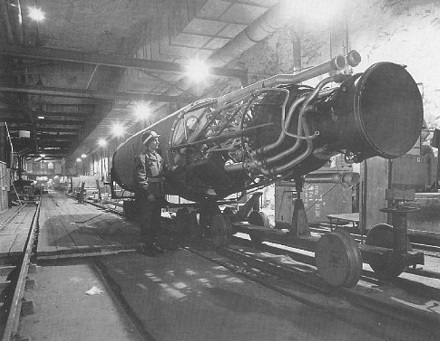
In 1943, punishing Allied bombing had chased Germany’s brilliant rocket scientist Wernher von Braun and his team away from the Baltic port of Peenemünde where their pioneering work on the V-2 rocket had taken such a heavy toll on London.

Casting about the Third Reich for a suitable spot to base the missile team, the rocketeers settled on the Kohnstein, a hill in Thuringia already hollowed out by gypsum mines. This tunnel network was readily adapted into a subterranean munitions factory called Mittelwerk — difficult for the Allies to find, and once they found it, difficult to bomb.


A U.S. Army soldier poses with a half-assembled V-2, one of about 250 such rockets found in the Mittelwerk labyrinth when the facility was captured.

With the facilities and the big brains in place, only one thing was missing: millions of man-hours of labor.

Nazi Germany had that in plentiful supply.

Beginning in late 1943, concentration camp inmates at Buchenwald began to be funneled out to a new facility, Mittelbau-Dora. Initially just a Buchenwald sub-camp, Dora grew over the course of 1944 into an immense facility holding 50,000 prisoners — a handful of German undesirables, but mostly captured foreign nationals: French, Dutch, Polish, Czech, and Russian. Short of food, sleep, and clothing for the 1944-1945 German winter, they were systematically worked to death in the Mittelwerk shafts to build a better bomb.

Our day’s principal, Hans Möser/Moeser (English Wikipedia entry | German) was an SS-Obersturmführer who made a living throughout the war years pulling guard detail in a number of concentration camps.

On May 1, 1944, Möser was transferred from Auschwitz to Mittelbau-Dora. It was the last job he would ever hold, but were Möser on the market today his C.V. would laud his team-player orientation and project management skills on a high-priority initiative. No doubt he was just the sort of reliable agent who understands how things are done that the world’s mad bombers need at their back.

“Ninety percent of the prisoners lived and worked in the tunnel of the mine,” testified one German who worked at Dora as a secretary and doctor’s aide.

As a result of the uninterrupted work in the mines and the absence of any installation for forced draft and ventilation, there prevailed a stuffy cold atmosphere, which made breathing difficult. The prisoners also slept in the subterranean tunnel in big chambers hewed out of the rocks, in five beds on top of each other. Already in 1944 3,500 prisoners used to sleep in such a room. In the tunnel of the mine there was no ater, the prisoners got absolutely insufficient quantities of tea for drinking purposes. But for weeks they were not able to wash themselves. As a result of the heavy work in the mines and of the bad food numerous prisoners died from exhaustion during their work.

According to that same testimony, the camp received a frightful order on Good Friday, which fell on March 30 in 1945: drive every last prisoner into those tunnels and bring down the caves around them. “No prisoner should be allowed to fall into Allied hands alive.”

The speedy arrival of the American 3rd Armored Division and 104th Infantry Division just days later prevented that order from taking effect.

The facilities themselves, too, were to be destroyed as part of Hitler’s scorched-earth “Nero Decree” intended to deny the benefit of German industry and infrastructure to the arriving conquerors. But Hitler’s War Production Minister Albert Speer was intentionally ignoring that order, a decision that might well have helped him avoid hanging at the Nuremberg trials.

Mittelwerk was a valuable capture indeed for the Allies. The Americans who first occupied it, and then the Russians who took it over a few months later, ransacked it for parts and technical specifications. The V-2 was the first man-made object to reach space, blasting at the speed of sound to the edge of orbit before plummeting back with its payload into the heart of London or wherever. It’s the ancestor of the long-range, intercontinental ballistic missiles that would come later, as well as the space programs of the countries who could build such missiles.

And of course, it wasn’t just the parts.

Wernher von Braun himself was the top prize of all — the young genius (he was just 33 when World War II ended) with the weapons of the future in his skull. As Germany collapsed in 1945, von Braun and his team of engineers had resolved to surrender themselves to the Americans rather than the Russians, but they too were subject to an order given the SS to execute the scientists if their capture appeared imminent. The Fuhrerbunker knew as well as the Allies how valuable this asset was.

In the event, von Braun managed to give himself up to a surprised American private. He disappeared into American custody, the crown jewel of “Operation Paperclip” that grabbed some 1,500 scientists from Germany and helpfully whitewashed their past misdeeds — misdeeds like Nazi party affiliation, and participating in slave labor camps.

Firing guided rockets into space was one thing. Unfortunately for our man Möser, his own skill set of bullying subordinates was not in short supply for either of the Cold War antagonists.

Möser was the one defendant (among 15) condemned to death at the resulting trial of Dora camp personnel. Rocket scientists, naturally, were not present for the occasion; Wernher von Braun and his team were hard at work at this time at Fort Bliss, Texas adapting the V-2 to the American Hermes program.

But at Dora, it had been Möser’s job to oversee camp discipline and labor strength for the slaves doing the grunt work manufacturing von Braun’s brainchild. Testimony convinced the court that the SS man had done this far too brutally, and perhaps with sadistic pleasure.

Several witnesses testified Möser frequently beat prisoners and participated in executions, often shooting at the men who were hanged for camp infractions — while they were hanging, or after they were taken off the gallows. (And of the latter, some already dead and some still alive.) “The accused told the twelfth witness that it was a pleasure to give the mercy shots, like shooting a deer.”

Möser for his part countered that he took no joy himself in the beatings and killings that he had to conduct as part of his job — and that the camp commandant had early on reprimanded him for leniency, threatening that “in view of the importance of the V-weapons operation, this could be interpreted as sabotage because it reduced the work efficiency.” How’s that for a hostile work environment?

(There’s a large .pdf of the entire trial summary here. Möser’s section begins on page 36 of the pdf (page 68 per the numbering in the scanned book pages).)

His presence on this here site betrays the outcome. On this date in 1948, Hans Möser was hanged at Landsberg Prison along with several other (unrelated) convicted war criminals.

On this day..

1730: Patrona Halil, Ottoman rebel

On this date in 1730, Patrona Halil, the virtual ruler of the Ottoman capital at the head of a popular rabble, was lured to Istanbul’s Topkapi Palace on the pretext of receiving an imperial honorific — and there seized by the sultan’s guards and put to summary death.

An Albanian shopkeep and Janissary, Halil (English Wikipedia entry | Turkish) had been at the fore of an extraordinarily successful rebellion that bears his name in Turkish histories.

Very recently the mortal terror of Europe, the Ottoman Empire was into its midlife crisis by the early 18th century — a long transition, as it would transpire, into its terminal “sick man of Europe” stage.

Incensed at the splendor of the grandees during the so-called “Tulip Period” — elites’ 1720s fad for that flower, which accompanied years of decadent, and perhaps impious, openness towards Europe — struggling* Istanbul artisan guilds revolted in 1730 over taxes imposed to pay for war with Persia.

Not for the last time, the impositions of the taxman only served to catalyze wider grievances that had already been mounting. Janissaries cast a gimlet eye on the sultan’s dalliances with European military innovations — which those feudal infantrymen rightly perceived as an existential threat. Everyday Turks and the ulama alike resented the cultural inroads of the West. In the paroxysm of 1730, these factions combined with the petite bourgeois guilds to shake the Porte far more deeply than some riot ought.

There had been many rebellions in Istanbul before, but this was the first to show a syndrome that was thereafter often repeated: an effort to Westernize military and administrative organization propounded by a section of the official elite, accompanied by some aping of Western manners, and used by another interest group to mobilize the masses against Westernization.*


Jean-Baptiste van Mour, a Flemish painter residing in Istanbul at the time. He’s notable for numerous paintings of the Tulip Era Ottoman Empire, including that of the sword-brandishing Patrona Halil further up this post.

The rebellion forced the execution of the grand vizier, and the abdication of Sultan Ahmed III in favor of his nephew Mahmud. Rioters sacked the estates of the wealthy and put a definitive end to the Tulip Period by trashing the delicate gardens emblematic of their sybaritic lords.

For nearly two months, the impertinent Halil was virtually the master of the capital. He rode with the new sultan to the ceremony investing him with Osman’s sword; he dictated appointments for his rude associates, like a Greek butcher named Yanaki who was to become Hospodar of Moldavia. At Halil’s whim, Mahmud was forced to order mansions put to the torch and (of course) that hated war tax rescinded.

Halil probably ought to have been better on his guard against the maneuver the sultan executed this date — and was always likely to attempt in some form. Then again, what he had already achieved, however briefly, was outlandish, and pointed to weaknesses in the Ottoman state far more durable than Halil himself. By slaying the insurgent chief, Mahmud got himself some breathing space: popular dissatisfaction, however, was too widely rooted to be destroyed at a single stroke, and would resume again with intermittent disturbances and purges well into 1731, with a successor revolt in 1740.†

And over a still longer arc, the parties of the Halil revolt would guard their prerogatives so jealously and effectively over the generations to come as to fatally compromise the capacity of the sultanate to compel the modernization that the Empire required. Patrona Halil’s revenge was two centuries in coming … but it was worth the wait.

* According to Robert W. Olson’s “The Esnaf and the Patrona Halil Rebellion of 1730: A Realignment in Ottoman Politics?”, Journal of the Economic and Social History of the Orient, September 1974, the major beefs of the esnaf (guilds) were a spiral of inflation brought by the devaluing Ottoman currency, the influx of immigrants to the capital, and taxes.

** Serif Mardin, “Center-Periphery Relations: A Key to Turkish Politics?”, Daedalus, Winter 1973.

† See Olson, “Jews, Janissaries, Esnaf and the Revolt of 1740 in Istanbul: Social Upheaval and Political Realignment in the Ottoman Empire”, Journal of the Economic and Social History of the Orient, May 1977.

On this day..

1964: Glen Sabre Valance, the last hanged in South Australia

On this date in 1964, Glen Sabre Valance became the last person hanged in South Australia.

Born Paul Fraser, he jazzed up the handle by cribbing the surname of the title outlaw from the 1962 John Ford Western The Man Who Shot Liberty Valance.

Like that Lee Marvin cutthroat, “Glen Valance” was destined to live a brutal life with a violent end.

In the early morning of 16 June 1964, the 21-year-old Valance broke into the home of his former employer, Richard Strang. He had a standing dispute with the Bordertown farmer over wages but his real grudge ran deeper than that. Strang had bemusedly read the sensitive youth’s diary to other farmhands weeks before, resulting in an altercation — and, after Valance drove off with some of his effects, a police report and an arrest.

Valance nursed “bad thoughts” against his tormenter, he muttered to his family. They turned out worse than anyone could have expected: bad enough to justify his adopted alias.

As Strang and his wife dozed in bed, Valance leveled his rifle at the hated ex-boss, and leveled the score. Then he seized the waking Suzanne Strang and raped her there in the bed sodden with the gore of her husband’s warm corpse.

As Valance hightailed it out of Kooroon Station, Suzanne Strang phoned police — and the resulting roadblocks snared the murderer that very day, with the murder weapon right there in the passenger seat … actually riding shotgun. Valance mounted an unsuccessful insanity defense.

In 2011, Lillian Clavell — ten years old at the time of her half-brother’s execution — published a book, A Tormented Soul: The Tragic Life of Glen Sabre Valance, the Last Man to be Hanged in South Australia.

In it, a Clavell still affectionate for her big brother points to their savagely abusive mother as the root cause of the adult Paul/Glen’s horrific crime. (Lillian says that her father shielded her from the worst of any domestic violence, but Paul had no father in his life and no such protection.)

I know she burnt his hands on the stove. I know she put his face through a window. Once she held a knife to his throat and said she’d kill him if he ever stole anything from the cupboard again. I believe that (abuse) led very much to his crime.

Valance was hanged in an unused guard tower (the “Hanging Tower”) of Adelaide Gaol. The facility is unused today, but the date November 24, 1964 and the letters GSV still remain printed on the brick wall.

On this day..

Feast of St. Clement

Today is St. Clement’s Day, the feast day of the first century Pope Clement I — who, tradition has it, was martyred by the Romans under Trajan at the ancient Crimean city of Chersonesus by being pitched into the Black Sea weighted down with an anchor.*


The Martyrdom of St. Clement, by Bernardino Fungai.

The documentary trail for leadership of the Christian community in these embryonic years is a little thin but officially, the Vatican rates Clement the fourth Pope following St. Peter, Linus, and Cletus; Tertullian says he was ordained by Peter’s very own hand.
He’s the earliest of these successors of the Apostle who can still speak to posterity. The First Epistle of Clement,** which might very well be from the pope’s own hand, is among the oldest extant Christian texts outside of the books actually gathered in the New Testament. Clement wrote it to recall the Corinthian congregation to obedience after “no small sedition” challenged its presbyters; by way of a voluminous review of authority both scriptural and natural,† the Bishop of Rome unsurprisingly concludes that folk ought submit to the constituted ecclesiastical authorities.

Forasmuch then as these things are manifest beforehand, and we have searched into the depths of the Divine knowledge, we ought to do all things in order, as many as the Master hath commanded us to perform at their appointed seasons. Now the offerings and ministrations He commanded to be performed with care, and not to be done rashly or in disorder, but at fixed times and seasons.

And where and by whom He would have them performed, He Himself fixed by His supreme will: that all things being done with piety according to His good pleasure might be acceptable to His will.

They therefore that make their offerings at the appointed seasons are acceptable and blessed: for while they follow the institutions of the Master they cannot go wrong.

For unto the high priest his proper services have been assigned, and to the priests their proper office is appointed, and upon the levites their proper ministrations are laid. The layman is bound by the layman’s ordinances.

Let each of you, brethren, in his own order give thanks unto God, maintaining a good conscience and not transgressing the appointed rule of his service, but acting with all seemliness.

Not in every place, brethren, are the continual daily sacrifices offered, or the freewill offerings, or the sin offerings and the trespass offerings, but in Jerusalem alone. And even there the offering is not made in every place, but before the sanctuary in the court of the altar; and this too through the high priest and the afore said ministers, after that the victim to be offered hath been inspected for blemishes.

They therefore who do any thing contrary to the seemly ordinance of His will receive death as the penalty.

-1 Clem 40:1 – 41:3 (via)

Presumably in consequence of the device used to sink the pope into the Euxine, St. Clement is honored as the patron of smiths and metalworkers; little-observed now, St. Clement’s Day once saw clanging processions of cloaked, and tanked, blacksmiths answering to Old Clem and belting out tunes at every tavern they passed. Pyromaniacs and Warner Brothers cartoon characters might also wish to honor St. Clement with a good old-fashioned anvil firing.

* Chersonesus, which is the city where the prince Vladimir the Great was baptized en route to Christianizing all of Russia, has gorgeous ruins that can be seen adjacent to present-day Sevastopol. St. Cyril, missionary to the Slavs and fountainhead of the Cyrillic alphabet(s), is supposed to have dug up Clement’s relics during his sojourn and hauled them, anchor and all, back to Rome.

** There’s a Second Epistle of Clement, too, but it is not thought to be a genuine product of Clement.

† And unnatural! Viz. “There is a bird, which is named the phoenix. This, being the only one of its kind, liveth for five hundred years; and when it hath now reached the time of its dissolution that it should die, it maketh for itself a coffin of frankincense and myrrh and the other spices, into the which in the fullness of time it entereth, and so it dieth.” The phoenix is supposed to be evidence and/or metaphor for the Resurrection and the afterlife.

On this day..