1945: The children of Bullenhuser Damm

On this date in 1945, as Adolf Hitler celebrated his 56th birthday within a Red Army cordon, one of the Second World War’s more tear-jerking little crimes against humanity happened in Hamburg.

Bullenhuser Damm — still to be found today — was a former Hamburg school which fell out of use as World War II progressed, owing to the devastation Allied bombings wrought on the surrounding area.

The school itself sustained little damage, however, which eventually facilitated its appropriation as a satellite building for the nearby Neuengamme concentration camp.

Over at Neuengamme, the SS doctor Kurt Heissmeyer had been conducting a litany of horror medical experiments on 20 Jewish children — mostly from Poland — culled from the concentration camps, seeking medical evidence for Nazi racial theories further to a cushy professorship. But as April 1945 was obviously endgame for the Third Reich, thoughts naturally turned to disposing of evidence of indictable offenses.


Photos of the eventual Bullenhuser Damm victims showing their surgical scars after Heissmeyer injected them with tuberculosis.

Bullenhuser Damm was just the place for disposal.

On April 20, the 20 kids were loaded up on trucks with their four adult caretakers — two French, two Dutch — plus six Soviet prisoners of war.

At Bullenhuser Damm, the kids were parked in a room and hung out, blissfully ignorant of their danger. “They had all their things with them — some food, some toys they had made themselves, etc,” physician Alfred Trzebinski later recalled at his own trial. “They sat on the benches and were happy that they had gotten out. They didn’t suspect a thing.”

In the next room, the 10 adults were being hanged.

According to Admitting the Holocaust, Trzebinski was impressed with his own compassionate use of this bit of down time: he generously gave the children morphine shots to sedate them before their own executions. Or rather, their murders … since the doctor could not but agree that “you cannot execute children, you can only murder them.”

I must say that in general the children’s condition was very good, except for one twelve-year-old boy who was in bad shape; he therefore fell asleep very quickly. Six or eight of the children were still awake — the others were already sleeping … Frahm [an orderly] lifted the twelve-year-old boy and said to the others that he was taking him to bed. He took him to a room that was maybe six or eight yards away, and there I saw a rope already attached to a hook. Frahm put the sleeping boy into the noose and with all his weight pulled down on the body of the boy so that the noose would tighten. (Trzebinski, again)

The other 19 children were disposed of in like manner, and then all 30 corpses cremated overnight … just in time for what must have been a much-needed 5 a.m. coffee.

After the war, the facility went back to use as an actual (creepy!) school, but it was eventually renamed Janusz Korczak School, for a Polish-Jewish educator gassed with his young charges at Treblinka. There’s a permanent exhibition (German) at the site, as well as a memorial rose garden with a variety of plaques commemorating the victims of Bullenhuser Damm.

Trzebinski’s take on his conduct this horrible night might have been good enough for his conscience, but it didn’t pass muster with his judges: he was hanged on a war crimes rap prominently including Bullenhuser Damm on October 8, 1946. Kurt Heissmeyer, however, avoided detection until 1959 and only received a long prison sentence in 1966, shortly before his death.

On this day..

1928: Charles Birger, bootlegger

On this date in 1928, colorful gangster Charles Birger was hanged in Benton, Illinois.

A sort of social bandit for the Prohibition era, Birger was born Shachna Itzik Birger to a Russian Jewish family that immigrated to the U.S.

Birger was a young saloon-keeper on the make when the U.S. decided to make a go of its first foolish drug war, Prohibition. And in the immortal tradition of drug wars, it made the enterprising purveyor a whole lot richer, and a whole lot violent-er.

While Al Capone‘s Tommy Guns were tearing up Chicago, Birger set up shop in southern Illinois. A literal shop: from his famous speakeasy Shady Rest, he did three-way battle with the (pro-Prohibition) Ku Klux Klan and the rival Shelton Brothers Gang.

This cinematic affair of armored car shootouts, aerial bombings, and gangland assassinations comes off with verve in A Knight of Another Sort: Prohibition Days and Charlie Birger. The bon vivant Birger, bursting with charisma, entertains at his gin joint, aids the misfortunate, corrupts the police, and merrily mobs up Williamson County.

That story reached its conclusion when Birger was arrested for ordering the murder of Joe Adams, mayor of a nearby town who had taken the Shelton Gang’s armored “tank” car in for repairs.

Birger said he hadn’t actually done that, but he went to the gallows grinning, and humorously chatted up reporters before the big show — cementing his myth with that legend-quality indifference to death.

“I’ve played the game and lost, but I’ll lose like a man,” Birger philosophized. “I’m convicted of a crime I didn’t commit, but I’ve committed a lot of crimes. So I guess things are even. We got too strong against the law, and the law broke it all up.” (From the Chicago Tribune, April 20, 1928.)


Birger shakes hands with so-called “humanitarian hangman”
Phil Hanna.


Birger insisted on hanging in a black, not a white, hood — owing to his hatred of the Ku Klux Klan.

Birger is still a legend in southern Illinois, and a live one at that: he’s been in the news lately due to a weird custody fight over the rope used to hang him.

This macabre historical memento also happens to be the last rope ever used for any public execution in Illinois.

On this day..

1567: Wilhelm von Grumbach, Landfrieden-breaker

On this date in 1567, Wilhelm von Grumbach was dismembered along with two of his followers in the marketplace of Gotha.

Grumbach (English Wikipedia entry | German) was the cantankerous German instigator of the aptly-named Grumbachsche Handel, a messy clash of rights and prerogatives at the hinge of the old feudal order and centralized princely authority.

Grumbach was a knight who’s invariably described as an “adventurer”. As a young man he fought in the Peasants War, but as he headed into middle age he became your basic penniless minor nobleman chafing at the failures and obstructed opportunities life threw at him.

The thing he could not abide losing was the disappearing right of the nobility to enter into a feud or vendetta. This scans to the modern like rank anarchy, but feuds were part of the tapestry of medieval German society, long codified in law — an obvious descendant of clan and tribal obligations out of which the muddle of feudal vassalage had formed. “The passion for liberty and rights,” says this volume, “ran amok in Germany. Churchmen, princes, burghers, and peasants all wanted their independence and readily resorted to declarations of feud to secure and defend their rights.”

The standing right for miscellaneous minor lords to start miscellaneous private wars was quite naturally one that princes were ever keen to restrict. After centuries of two-steps-forward, one-step-back efforts to deal with the feud, the 1495 Imperial Diet formally codified a ban on feuding known as the Ewiger Landfriede, or “perpetual peace”. In Poli Sci 101 terms, this is the state finally monopolizing legitimate violence.

As with dueling, however, official proscription did not end the practice. It was, indeed, Grumbach’s defeat and execution that would eventually be remembered as the decisive nail in the coffin for knightly feuds.

And so in Franconia where we lay our scene will civil blood make civil hands unclean …

Grumbach’s liege was Melchior Zobel von Giebelstadt, the Prince-Bishop of Wurzburg. (Still another confusing dimension of the political map, some princes of Germany’s many statelets were simultaneously ecclesiastical authorities. For purposes of this post, the “-Bishop” part doesn’t enter into it.)

Knights’ basic problem — the reason they were vulnerable to losing their wacky old-time rights — was poverty, and it was in money that Grumbach’s feud was rooted. Grumbach’s personal twist on this was being the sort of irascible coot who could carry a grudge so far as to get himself sawed into pieces over it.

Immediately upon assuming the Prince-Bishopric in 1544, Melchior Zobel von Giebelstadt forced Grumbach to return an unauthorized cash gift his predecessor had paid to the knight, and then stiffed said knight out of six villages whose revenues Grumbach sought by way of compensation.

He had to deal with Grumbach’s feud for the remainder of his term, which was also the remainder of his life … right up until Grumbach murdered him.

The disaffected knight hooked up with the margrave* Albert Alcibiades and started making a right mess in the middle of Europe with a 1552-54 mini-war. When Albert got thumped, Grumbach had to evacuate to France, and his holdings outside Wurzburg were plundered and/or destroyed by his foes.

So now the guy was even more aggrieved, and even more pfennigless.

He was downright vengeful about his feud at this point, although it’s noteworthy relative to that monopolization-of-violence trend that he was still the only one: in days of yore, intra-elite wars might have spawned multiple self-reproducing vendettas.

The grumpy Grumbach now gravitated to another patron,** the deposed elector of Saxony Johann Friedrich II — another dude who felt hard done by in the Holy Roman Empire.

Grumbach evened his score with Melchior von Zobel by having the Prince-Bishop killed in Wurzburg in April 1558. (In present-day Wurzburg, three Zobelsaulen markers commemorate the Prince-Bishop’s assassination, one on the very spot of the murder.)

But that still left the money, and we know Grumbach wasn’t the type to write off a debt. In 1563, he successfully invaded Wurzburg with 1,300 soldiers and at swordpoint forced from the city a concession restoring his property.

For Grumbach, it was to prove a Pyrrhic victory.

In principle, he had achieved a great vindication of the ancient right of the feud, and for the hard-pressed nobility against the realms’ many princes. If others of his station had rallied to that banner, what a whirlwind Germany would have reaped.

According to Hillay Zmora’s State and Nobility in Early Modern Germany: The Knightly Feud in Franconia, 1440-1567, however, Grumbach’s fellow-knights looked into this particular abyss and said “nein, danke.”

Grumbach was in fact hatching an extravagant scheme† to liberate the entire German nobility … from the yoke of the princes. It was a radical aristocratic utopia … nobles were not only to be protected by the [Holy Roman] emperor from the princes, but to help him subdue them once and for all and to establish an hereditary monarchy in Germany. But despite Grumbach’s best efforts to incite the Franconian nobility, they did not line up behind him. Guidied by the captain of the Franconian Circle (Kreis), Georg Ludwig von Seinsheim, who denounced Grumbach’s undertaking as ‘against God, law and the emperor’, they formally turned away from him in 1564. In the view of the majority of them, the Knighthood was to maintain its autonomy by respecting the equilibrium between emperor and princes, not by irresponsibly challenging the latter. And it was this view, reassuringly transmitted to the princes, which carried the day.

Grumbach was outlawed by the empire and in 1566-67 was overcome with his protector Johann Friedrich at Gotha. Both men spent he remainder of their lives as imperial prisoners, with the notable difference that Johann Friedrich had the pull to live out his natural ration of days while Grumbach went straight to the dungeon for torture and thence to the scaffold in the town that had lately been his last redoubt. There, Grumbach was ripped apart — his dying eyes beheld the executioner wrench the heart out of his very chest and taunt him: “Behold, Grumbach, thy false heart!” The late knight’s rotting quartered remains got nailed up around town to broadcast the unmistakable message:

The noble right to feud was dead.

* Hereditary military commander.

** Among their other capers, Grumbach and his patron Johann Friedrich conspired with Torben Oxe‘s nephew Peder Oxe to depose the Danish king Frederick II in favor of the king’s grand-niece, Christina. (Christina will be known to Tudor-philes as the young woman who scuttled Henry VIII’s post-Anne Boleyn suit with the sharp remark, “If I had two heads, one should be at the King of England’s disposal.”) Nothing came of the plot. (Source)

† Christian Wieland writes that Grumbach deployed — unsuccessfully but still impressively — a 16th century multimedia propaganda campaign to state his case to the “common nobleman”: woodblock-illustrated printed leaflets, songs valorizing the attack on Wurzburg (sample verse: “Violence may be averted by violence / According to natural law”).

On this day..

1680: John Marketman, jealous chirurgeon

On this date in 1680, an unusual public execution took place in West Ham.

John Marketman (Manchetman) was a ship’s surgeon, which he spelled “chirurgeon” because it was olden days. Being away at sea gave him a lots of time to picture how his wife Mary Snerlin back home might be cuckolding him, and when he arrived back one time to apparent corroborating information, he went a little nutso.

According to the trial record from the spring 1680 Chelmsford Assizes,

the circumstances of the bloody Deed was sworn to as followeth, the Prisoner being newly come on Shore, having been at Sea for a considerable time, was informed that she had been over lavish of her Favours to a Neighbour of hers, being by profession a Shoemaker; he being newly come from Sea and coming home as it is said surprized her too familiar with the said Shoemaker, whereupon he in a Rage threatned [sic] her, yet notwithstanding the Rage of Jealousie, he seemed reconciled, but to the contrary retaining an inward hatred, which she perceiving, fled to a neighbours house, thinking to stay whilst his Anger was overpast, yet he with a seem’d Reconciliation, came to invite her home, and came up to her as if he would imbrace her, but with his bloody hands he stab’d her with a Knife under her Right Breast, about four inches deep,* of which Wound she in a little time died, only confessing her innocence, at his Trial he did not deny the Fact, and after his being convicted did confess his Rashness in proceeding on such Cruelty, without the least remorse, after he was found Guilty of wilful Murder and received Sentence of Death, he seemed exceeding Penitent, and did bewail his cruel Crime, shedding many Tears, that he had given himself over to the suggestions of the Prince of darkness, and so continued to the utmost.

There are somewhat different twists on the underlying facts of the case from different sources — like the profession of the alleged lover, and the question of whether Marketman caught them in flagrante delicto or merely heard town gossip, and the matter of whether he took revenge with cold calculation or in more of a drunken fury. Fill it out however you like; in outline we have one of the stock classics of homicide.

But at receiving his sentence, Marketman did something remarkable: he asked the judge to alter the sentence and be hung not at the usual execution spot in Chelmsford, but in West Ham — “the town where he did perpetrate the wicked act.”

Marketman, you could say, really went all-out from that very first moment to put on a full-dress, no-holds-barred scaffold performance par excellence. He should have been in the business of scripting deaths.

Besides hanging in West Ham, Marketman had his mother (“poor Soul drowned in Sorrow,” in the words of a pamphlet titled “True Narrative of the Execution of John Marketman”**) lead him personally to the gallows. There a minister preached on 2 Corinthians 7:9, “I rejoice, not because you were grieved, but because you were grieved into repenting” — demonstratively comforting Marketman that his imminent strangulation would stand “a monument to divine justice … in and thorow you, God sheweth the consequences of a sinful and wicked life.”

This was the evolving principle of executions as exemplary deterrence, and Marketman was ready to play the part in his final turn. He spoke for a long time, with the swooning mother right there as evidence, on how he

had been very disobedient to his too indulgent parents, and that he had spent his youthful days in profanation of the Sabbath and licentious evils of debaucheries beyond expression, and that he had been over penurious in his narrow observance of his wive’s ways, desirous that all should pray to the Eternal God for his everlasting welfare, and with many pious expressions ended this mortal life.

In focusing on the theatrical aspects of Marketman’s execution, we don’t mean to suggest that the sea-chirurgeon’s encounter with his death was in any way insincere: present-day executions too comprise a ritualized performance in which a good many dying prisoners are very willing to participate. (Modern American executions behind prison walls don’t map to the take-warning-from-my-fate discourse, but it’s quite common for those on the gurney to offer victims’ witnesses the “closure” shibboleth.)

The early-modern condemned were widely expected to give a pedagogical account of themselves before execution, and widely complied with the expectation. Marketman simply underscores the surprising extent to which a fellow will not only comply but actively assert his part in his own death. Marketman wanted his hanging to embody redemption, instruction, and the majesty of the law that hanged him. Maybe in his heart of hearts he even wanted that before he knifed poor Mary Snerlin.

The chirurgeon went so far as to write a prison letter to his supposed rival: “As for the injury you have done me, I freely from my heart forgive you, begging God to give you grace that you may unfeignedly repent of all your sins, that God may have mercy on your soul.”

See J.A. Sharpe, “Last Dying Speeches: Religion, Ideology and Public Execution in Seventeenth-Century England,” Past & Present, May 1985.

* Say what you will about chirurgeons, they know about killing.

** This source also says his wife was pregnant, which must have added some vinegar to Marketman’s cuckoldry suspicions.

On this day..

1942: Vasily Klubkov, Zoya Kosmodemyanskaya’s betrayer

We’ve touched in these pages — one of our earliest posts, in fact — on Soviet war heroine Zoya Kosmodemyanskaya, a teenager executed by the advancing German army in November 1941 for conducting partisan attacks behind enemy lines.

Zoya’s story became known after the Red Army recaptured village of Petrishchevo, where she was hanged. A January 27, 1942 Pravda article recounted the gallows defiance of the young guerrilla, whom villagers knew only by her nom de guerre, “Tanya”. She had withstood German torture, refused to give them any information, and at her hanging incited her countrymen and -women to resist the invaders. She’s still to this day a beloved national martyr in Russia, which is why she’s also an Ace in our execution playing cards.

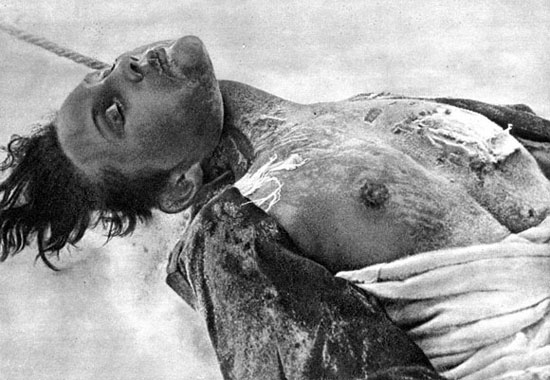
The young woman on the gallows, and in the ghastly post-mortem pictures with her left breast mutilated swiftly became propaganda grist for Moscow.

Zoya’s instant Joan of Arc-like legend invited investigation of the precise circumstances of her capture and death … and this in turn meant extremely dangerous scrutiny for any Soviet citizen in her environs whose behavior in those last days could be held to be in any way sub-heroic.

This brings us to today’s unfortunate entry, Vasily Klubkov, a humble mail-sorter before the war whose picture belongs in the dictionary next to “poor luckless sod.” Just him, Zoya, and everyone else on the terrible Eastern Front.

It was on this date* in 1942 that Klubkov paid the penalty for Zoya’s sacrifice.

Vasily Klubkov and Boris Krainov were other partisans who had been detailed along with Zoya Kosmodemyanskaya to torch some enemy assets on the same mission around Petrishchevo. Practically children all, they each acted independently from the others; long story short, Zoya and Vasily Klubkov were both captured.

Zoya fiercely endured every torture the Germans could throw at her, but Klubkov was made of softer stuff. When an officer pointed a gun at his head and demanded some answers, Klubkov started talking.

“I was a coward,” he later admitted. “I was scared I would be shot.”

Now, this admission very much against his own safety was made to the NKVD in March 1942, and since we already know that Vasily Klubkov was the sort to fold under torture, we can well imagine that the NKVD also got whatever it wanted out of the misfortunate young man. Considering the politicized quality of the trial and the circumstances of the “confession,” it has to be treated with caveats.

Under NKVD pressure, Klubkov signed off on a version of events that just so happened to mesh beautifully with the iconography already forming around the hanged “Tanya”: namely, that he was brought face-to-face with his fellow-prisoner and confirmed her identity, whereas she refused to breathe a word to her captors; that he saw her stripped naked and bashed with truncheons for hours and still summon the fortitude to refuse her interrogators the least satisfaction. Pavel Klubkov gave posterity firsthand evidence of Zoya Kosmodemyanskaya’s heroism in captivity.

“Klubkov may have been telling the truth, since it’s easy to imagine a terrified teenager on his first mission agreeing to his German captors’ demands,” notes Andrew Nagorski in The Greatest Battle: Stalin, Hitler, and the Desperate Struggle for Moscow That Changed the Course of World War II. “But there’s no way of knowing for sure how he really behaved, since he surely was just as terrified when he was interrogated by the NKVD. Or how much of what he said about Zoya was accurate, since the NKVD may already have been preparing the transcript with the idea of her elevation to mythic status.”

Heck, the reason the NKVD even had Klubkov to interrogate was that he escaped German custody, another big character red flag as far as the Soviets were concerned. That he escaped from the same custody that martyred Zoya Kosmodemyanskaya probably sealed his fate before he received his first pistol-whipping. NKVD records paint a kid who has already given up.

Well he might have. The verdict of the court was surely ordained from the start, but it was formally delivered on April 3: “Execution by shooting, without confiscation of property due to its absence.”

* Though there are some cites for April 3 out there, it appears that April 3 was the date of his conviction by a military tribunal and April 16 his execution date. This is a bit of a protracted delay by wartime Soviet tribunal standards, but then, Klubkov would have been a person of relevance to the state itself. The highest-ranking official who thought he could approve Klubkov’s execution without asking anyone else might have been a little further up the food chain than for your run-of-the-mill deserter.

On this day..

Themed Set: Alaska


(cc) image from blmiers2.

Vast and sparsely-populated Alaska doesn’t have many executions in its history and hasn’t had the death penalty on the books since 1957.

True to its weird reputation, though, the few in its register include some offbeat selections — like our next two days’.

On this day..

1749: Richard Coleman, solemnly declaring

On this date in 1749, five men were hanged at Kennington Common.

We wish well the restive shades of Patrick Rena, Thomas Dobbings, Thomas Walker, and Arthur Gibbons; the former two died for a violent robbery upon the roads, and the latter two for a violent robbery upon the Thames.

But our attention for this date is to the fifth man. Richard Coleman also drew the attention of those present, both for the monstrous crime he was accused of, and for his steady assertion of innocence. The minister assigned to salvage these wrongdoers’ souls, which was also a not entirely reputable marketing business in selling scaffold exclusives, knew a lead story when he saw one.

Coleman was executed for being part of a gang of three men who raped to death a woman named Sarah Green on the night of July 23, 1748. He was in no way implicated in this horrific crime for well over a month, a time when the victim lay precariously in hospital.

But by the next April, well … he was the man as far as the law was concerned. Coleman protested his innocence in vain, via Rev. Wilson; the latter’s hanging-day chapbook made Coleman the distinct feature attraction.

The following Paper was delivered to me at the Place of Execution, by Richard Coleman, which he earnestly desired I would publish.

To all Christian People.

The dreadful Sentence passed upon me, I shall meet with Cheerfulness, being in no Degree conscious of the least Guilt of that most inhuman and most unnatural Crime that I have been found guilty of.

I am very sensible that it is not in my Power to make the incredulous World believe me innocent. I leave the following Account with the Rev. Mr. Wilson, who I am very greatly obliged to, and return him my hearty Thanks, for the comfortable Relief I have received from him in a Preparation for a future State of Bliss, and I hope he will cause it to be published for m Satisfaction, that it may pass the impartial Examination of all Persons.

Here Coleman proceeds to give a detailed, almost hour-by-hour account of his activities on the night of the murder … and the activities of those around him.

Coleman was at pains to do this not only to assert his own innocence, but to decry a particular witness who ought to have supported his alibi but instead made it known “that if he was subpoenaed he should do me more Harm than Good … The Occasion of expressing himself in that severe Manner, I suppose, was owing to his being unluckily found by me with Mrs. B—t in very indecent Actions soon after her Husband’s Death; and having been often detected by me in the same Manner, it has caused ill Blood between us.”

Whether this man’s testimony would have made the difference one can only guess. At any rate, Coleman insisted,

On Monday the 25th of July I heard that a Woman had been used very ill by three of our Men, but no-body was taken up for it till a Quarrel happened between me and one [Daniel] T[rotma]n, at the Queen’s Arms Alehouse in Bandy-Leg Walk, which was as follows:

— On the 27th of August last … I was very much in Liquor; we had a Pint of Bumbo in the publick Room; and as I was stirring it with a Spoon, Trotman, an entire Stranger to me, very abruptly asked me what was done with the Pig, (meaning a Pig that our Men had taken and killed belonging to a Neighbour, and had been in Custody for it.) … I said to Trotman, Damn the Pig, what is it to me. He damn’d me, and I him; we gave each other very bad Language, and because it had been reported that three or four of our Men committed the Cruelty on Sarah Green, he made use of the following aggravating Words, namely (says he) Don’t you know Kennington Lane. I reply’d yes, I do, damn you, what of that? He said again don’t you know the Woman that was so cruelly treated, Yes, said I, Damn you what of that? Said he, was not you one of the Persons concerned in doing it; I reply’d if I was, you Dog what then, and immediately threw the Spoon at him. He returned it in the same Manner at me, and had it not been for the Persons present we should have fought.

…

The Morning after the Quarrel happened I called at the Queen’s Arms Alehouse; and Mr. C—t, who keeps the House, said to me Mr. Coleman you was silly last Night … and he repeated the Discourse aforesaid, and told me I did not consider what Advantage bad People might make of such unguarded Expressions. I reply’d that I was much in Liquor, and did not remember what I said.

But as prophesied, the offended Daniel Trotman and a woman in the pub who witnessed the exchange did indeed proceed on the basis of this “admission” to swear out an oath against Coleman who

was carried to the poor Woman in St. Thomas’s Hospital, to see if she knew any Thing of me; and when I came before her I was particularly pointed out by Mr. C— P—e, who laid his Hand on me, and said, is this one of the Men; which was not fair, for she should [not] have fixed upon me without being dictated. Upon that she said I believe he is one. I said to her consider well what you say, for my Life is at Stake. Will you swear I am one of the Persons. She reply’d, No I won’t, and likewise said if I was one of them we walked a good Way, and talk’d of indifferent Things, and you behav’d much like a Gentleman; but when she was assaulted, I ran away, which was not behaving like a Man.

Coleman’s story was that he wasn’t with Sarah Green as friend or foe at all that night. The justice of the peace clearly thought little enough of Green’s sketchy witness guesstimate that Coleman was released on his own word to return for more questioning.

The next scene at Sarah Green’s bedside begins with Coleman outside the room, and the victim asked

what sort of a Man Mr. Coleman was. She reply’d that he wore his Hair, and had a Carroty Beard. As to having my own Hair she was mistaken, for I have not wore it these 14 Years.

His Worship asked the Deceased if she could swear that I aided or assisted in the Assault. She said No, I cannot, for it was dark.

I was called in, and she made the following Information.

This Informant on her Oath says, that on Saturday Night the 23rd of July last between the Hours of 11 and 12 o’Clock, as she was going thro’ Newington Church-Yard to her Lodging in Bandy-Leg-Walk, she was assaulted and cruelly beaten by two Men to her unknown, and that R. Coleman was present in her Company at the Time she was assaulted and cruelly treated.

Coleman would say in his last publication that he believed Sarah Green was coached. Being conscious of innocence — we’ll come to that — the evidence aligning against him must have struck the young man as the product of an evil hand. Maybe it was just a lot of circumstantial stuff and half-mistaken witnesses falling into a terrible pattern.

The next mischance to befall the accused was that his victim/accuser succumbed to her injuries prior to the formal September 19 hearing.

This made the charge against him murder. Well, rape was already a capital crime, so no real change for Coleman … except that he had now lost the chance to confront openly a witness whose testimony sounds from the hospital interviews like it was eminently impeachable. Now, Green’s last affidavit was going to her final word on the matter.*

Coleman fled the warrant consequently taken out for him, which was read as evidence of guilt by neighbors who had the luxury of not reckoning their own survival odds upon a jury-box. Coleman says he tried to place an advertisement which a lily-livered editor rejected, reading

I, Richard Coleman, seeing myself advertised in the Gazette as absconding on Account of the Murder of Sarah Green, knowing my self not any ways culpable, do assert, that I have not absconded from Justice, but will readily and willingly appear at the Assizes, knowing my Innocence will acquit me.

Ha.

From some combination of partiality, malice, and groupthink, some additional eyewitness testimony — people who think they might have seen him that night, people who swear they talked to Coleman and Green together but never thought to bring it up to the authorities until he was arrested, and alibi witnesses of his own whom jurors disbelieved — Coleman was judged guilty and doomed to the noose.

Basically, the evidence against him was that he’d popped off to Daniel Trotman while in his cups, Sarah Green (mostly) ID’d him, and some people thought he’d been seen with her in the dark that night while some of Coleman’s own friends and relatives claimed otherwise. There isn’t exactly going to be crime lab evidence here, nor was there an explicit threshold for jurors to require near-certainty to convict. It probably looked to the court like a pretty darn good case.

Coleman had no recourse but to commit his futile self-vindication to posterity.

I do also most solemnly protest, that I am not in any Manner of Degree guilty of that most inhuman Murder of Sarah Green, neither was I at Newington, or in Kennington-Lane that Night that the cruel Fact was committed on Sarah Green.

This I declare as a dying Man, and I sincerely believe (as the Rev. Mr. Wilson told me several Times) if I was either directly or indirectly guilty of that Murder, and should go out of the World with denying it, that eternal Damnation would be my Portion.

… I have the Satisfaction to declare myself to the World (as I have often done to the Rev. Mr. Wilson) that I never was so serene in Mind, or so easy in my Conscience in my Life, as I am at this Time, and I heartily wish that every wicked Sinner may have the Opportunity of so good a Divine as the Rev. Mr. Wilson has been unto me, which must be a great Means to the Enjoyment of eternal Bliss.

It is an inexpressible Pleasure to me, that I am soon to leave this very wicked World; and I hope that GOD Almight of his infinite Mercy and Goodness, will, through the Merits and Intercession of my blessed Redeemer, his only Son our Saviour Jesus Christ, pardon all my Sins, and receive my Soul into eternal Happiness …

There is nothing that gives me so much Concern as the Distress that I leave my poor Wife and two Infants in. She has been very good to me under my unhappy Misfortune and so have my poor afflicted Brothers. I hope that the Almighty will be the Guardian of my Wife and Children.

Oops

We’ve been speaking of Coleman as categorically innocent but presented only conflicting and doubtful witnesses.

The resolution of the matter did not come until two full years after Coleman serenely strangled to death. The rest of the story was incautiously blabbed by a gentleman named James Welch to a companion as they walked the road to Newington Butts.

“Their conversation,” says the Newgate Calendar, “happened to turn on the subject of those who had been executed without being guilty; and Welch said: ‘Among whom was Coleman. Nichols, Jones and I were the persons who committed the murder for which he was hanged.'”

Maybe he should have chatted about the weather.

In the course of conversation Welch owned that, having been at a public-house called Sot’s Hole, they had drunk plentifully, and on their return through Kennington Lane they met with a woman, with whom they went as far as the Parsonage Walk, near the churchyard of Newington where she was so horridly abused by Nichols and Jones that Welch declined offering her any further insult.

Welch’s companion informed on him, but upon arrest there was no better evidence against Welch, Nichols, and Jones than there had been against Coleman. Actually, this later case was much weaker: one guy’s alleged hearsay statement.

In a classic prisoner’s-dilemma scenario, John Nichols was finally persuaded to turn crown’s evidence on the other two before they turned on him, and his testimony to the vile end of Sarah Green got his former mates hanged.

“The poor woman was treated in a manner too shocking to be described,” our correspondent relates. And “it appeared that at the time of the perpetration of the fact the murderers wore white aprons, and that Jones and Welch called Nichols by the name of Coleman — circumstances that evidently led to the conviction of the unfortunate man of that name.”

Mistakes Happen…

The hangings in the case of Sarah Green — both the right ones and the wrong one — occurred at the acme of Britain’s “Bloody Code” days.

It’s instructive to note that the reality of wrongful executions seems to have been widely accepted. In the case at hand, the Newgate Calendar does not mince words in describing Richard Coleman as innocent.

And while doubt about individual defendants’ guilt often led jurors to acquittals or the ad hoc “pious perjury” downgrading of potentially capital charges, the existence of this or that wrongful execution in no way imperiled the capital statutes as a whole. It was merely another risk in a brutal world all too full of them.

Just a few months after Welch and Jones went to the gallows, another woman controversially on trial for her life received from one of her correspondents a lament that “We see nothing more frequent than Persons confessing the Crimes that others had suffer’d for before.”

* Although Green’s case was a bit different since she actually had time to swear a statement, the legal footing of “dying declarations” vis-a-vis the usual right of a defendant to confront an accuser has long remained a jurisprudential sticky wicket.

On this day..

1944: Joseph Epstein, Polish Communist French Resistance hero

On this date in 1944, Joseph Epstein* was shot with 18 others at Mont-Valerien outside Paris for their parts in the World War II French Resistance.

Joseph — “Jurek”, really — was born in Poland, but his communist politics got him harried out of Poland and Czechoslovakia and onward to France in the early 1930s.

There he completed his law studies, but was unable practice since he wasn’t a Frenchman.

But he was a perfect recruit for the international republican brigades of the imminent Spanish Civil War (he commanded an artillery battery named in honor of Tudor Vladimirescu).

War would drive Joseph Epstein hither and yon for his remaining years. After a spell in a French POW camp for Spanish Civil War refugees, Epstein signed up for the Foreign Legion, got captured and sent to a German POW camp, escaped to Switzerland, and returned to France.

There as “Colonel Gilles” of the communist resistance organization Francs-Tireurs et Partisans, he became the commissionaire of military operations for the capital and pioneered a shift in tactics towards guerrilla strikes using larger teams. Resistance fighter (and later, historian of the Resistance) Henri Nogueres explained:

Most of the comrades adopted the three comrades system. But in Paris there were policemen and German soldiers everywhere: Joseph Epstein preferred to engage fifteen to twenty fighters per operation … [because] if in Paris during daylight, three persons only had to attack a military unit, there will always be a danger to be arrested that could lead to a partial or complete failure. By contrast, with a larger group, it was possible to gain a superiority if adopting a discrete strategy. The operations in Paris conducted in 1943 were placed under Colonel Gilles’ authority.

Epstein was arrested in the autumn of 1943 at a meeting with Missak Manouchian, and withstood months of brutal torture without so much as revealing his real name or national origin.

While this is a standard accomplishment in a Resistance martyrology, the proof of it in this case was that the ensuing “Manouchian Group” show trial, and the resulting famed “Affiche Rouge” poster, took great pains to depict Resistance members as foreigners and criminals.

As a Polish Jew who regularly ordered assassinations, Epstein would have made a fine exhibit … if the Nazis had known who he was. Instead, he’s conspicuous only by his absence.

The ironic consequence, according to another Resistance veteran, was that “The man who, by far, was the greatest officer in all of France, the greatest tactician of the People’s War, is unknown to the general public. Of all military leaders, he was the most audacious, the most capable, the one who gave the French Resistance its originality compared to other European countries.”

* Not to be confused with the writer of the same name.

On this day..

1934: Georges-Alexandre Sarrejani, vitriolic

On this date in 1934, Georges-Alexandre Sarrejani (alias Sarret) became the last person guillotined at Aix-en-Provence

This charmer — most of the links today are in French — ticked one off the bucket list by seducing a pair of sisters, Catherine and Philomene Schmidt.

These he used as partners in a simple insurance scam way back in 1920: get them to marry a couple of men at death’s door, produce bogus medical exams declaring them to be in robust health, and pocket the proceeds when they kick the bucket. Sarrejani got the lion’s share because he threatened to denounce the Bavarian sisters as World War I spies. Insurers had their suspicions but couldn’t prove anything.

In 1925, a defrocked priest and said priest’s mistress threatened to turn in the scam artists.

Sarrejani, again with the full complicity of his women, horrifyingly disposed of the threat.

After shooting both dead, he ducked off to Marseilles to pick up a bathtub and 100 liters of vitriol (aka sulfuric acid). With this, Sarrejani and his mistresses marinated their victims until they had dissolved into a foul brackish puddle, which was nonchalantly poured out into the garden.

It’s this stomach-turning crime that Sarrejani is most famous for, and got the “trio infernale” immortalized on the silver screen in a gruesome 1974 film.

However, this murder was unknown for six years and might have gone permanently undetected had not the infernales attempted an even more primitive insurance scam in 1931. How many victims, one wonders, have been successfully acid-bathed by murderers restrained enough to get away with it.

At any rate, in 1931 Catherine Schmidt insured herself and faked her own death, substituting a tuberculotic corpse. She had the carelessness to show herself in Marseilles where someone recognized her as a “dead” woman … and in the ensuing interrogation, she turned the denunciation game right around on Serrejani. I’ll show you a Bavarian spy, mister.

The result was France’s most headline-grabbing trial since the bluebeard Henri Landru, pictures of which can be gawked at this French forum thread. Sarrejani had some legal training, enabling him to drag out the melodrama even further to the great delight of the nation’s editors.

When all was said and done, Sarrejani was set to lose his head; the Schmidts got just 10 years in prison. Call it the dividend on that insurance-fraud money he’d muscled out of them.

The whole ghastly affair had one last horror when Sarrejani met the blade this morning just outside the prison walls: the blade stuck halfway down, leaving embarrassed executioners to do 10 minutes of live troubleshooting while their patient below (justifiably) fulminated against their incompetence.

On this day..

1912: Tom Miles lynched

From the Montgomery Advertiser (April 10, 1912)

Lynched After Acquittal

SHREVEPORT, La., Apr. 9 — Tom Miles, a negro, aged 29, was hanged to a tree here and his body filled with bullets early today. He had been tried in police court yesterday on a charge of writing insulting notes to a white girl, employed in a department store, but was acquitted for lack of proof.

On this day..