1151: Konrad von Freistritz, ruined

On this date in 1151, Konrad von Freistritz, the nobleman who built Henneburg castle, was beheaded for treason along with his brother Adalram.

The few Germanic sources for this event do not appear to preserve the particulars of his misbehavior, although his situation as a descendant of the recently diminished Aribonen dynasty suggests a probability.

Ruins of his former fortress persist in Styria (present-day Austria), not to be confused with the far more picturesque Bavarian Henneburg castle, adjacent to Stadtprozelten — nor with the Henneberg ruin in Thüringen.

As with its builder’s biography, not a whole hell of a lot of the castle remains, but some photos of mossy rubble can be perused here.

On this day..

1941: Louis Berrier, messenger pigeoner

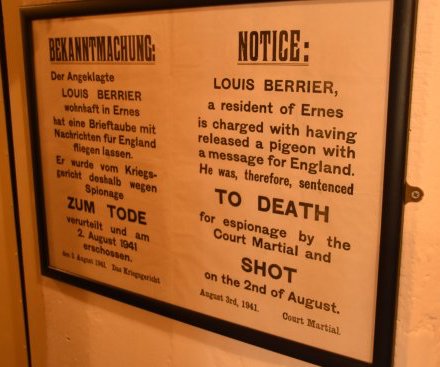
Notice: Louis Berrier, a resident of Ernes is charged with having released a pigeon with a message for England. He was, therefore, sentenced to death for espionage by the court martial and shot on the 2nd of August.
From the Channel Island Military Museum on the Channel island of Jersey; image courtesy of Trip Advisor.

On this day..

1630: Guglielmo Piazza and Giangiacomo Mora, colonna d’infamia

On this date in 1630, a ludicrous disease panic sent two innocent men to the scaffold in Milan.

Terrified as their family and neighbors dropped dead around them of a raging bubonic plague outbreak, the surviving Milanese sprouted buboes on their brains.


1630 illustration of the plague-wracked Milanese doing the bring-out-your-dead thing.

Just days before the executions marked in this post, a city official named Guglielmo Piazza was noticed by some busybodies “strolling down the street writing from an ink-horn at his belt and wiping his ink-stained fingers on the walls of a house.” They promptly reported him not for misdemeanor property damage but for spreading plague poison, whatever that would be.

Investigators to their shame gave this accusation enough credence to interrogate Piazza under torture, a decision which obviously was tantamount to the execution itself. He broke he sealed his own fate when he broke and confessed, and sealed same for a misfortunate barber named Giangiacomo Mora whom Piazza was made to accuse.

Milan was proud enough of this obvious injustice to stand up an colonna d’infamia (“column of infamy”) denouncing both “poisoners” until a storm finally knocked the lying marble down in 1788. It read,

Here, where this plot of ground extends, formerly stood the shop of the barber Giangiacomo Mora, who had conspired with Guglielmo Piazza, Commissary of the Public Health, and with others, while a frightful plague exercised its ravages, by means of deadly ointments spread on all sides, to hurl many citizens to a cruel death. For this, the Senate, having declared them both to be enemies of their country, decreed that, placed on an elevated car, their flesh should be torn with red-hot pincers, their right hands be cut off, and their bones be broken; that they should be extended on the wheel, and at the end of six hours be put to death, and burnt. Then, and that there might remain no trace of these guilty men, their possessions should be sold at public sale, their ashes thrown into the river, and to perpetuate the memory of their deed the Senate wills that the house in which the crime was projected shall be razed to the ground, shall never be rebuilt, and that in its place a column shall be erected which shall be called Infamous. Keep afar off, then, afar off, good citizens, lest this accursed ground should pollute you with its infamy.

August, 1630.

Prior to the column’s overturning, the Milanese Enlightenment intellectual Pietro Verri wrote a meditation upon it titled Sulla tortura e singolarmente sugli effetti che produsse all’occasione delle unzioni malefiche, alle quale si attribui la pestilenza che devasto Milano l’anno 1630. Italian speakers can enjoy it here.

On this day..

1849: Maximilian Dortu, republican martyr

Maximilian Dortu was shot on this date in 1849 for his part in that era’s failed revolutions, but posterity will always remember his dunk on the future German emperor Kaiser Wilhelm.

A plaque commemorating Herr Dortu in Potsdam. (cc) image from Doris Antony.

A kid fresh out of university when the intoxicating fires of revolution broke out in Europe in 1848, Dortu (the cursory English Wikipedia entry | the detailed German upon hearing that Wilhelm — Prince of Prussia at the time — had deployed artillery in the suppressions roasted him publicly as Kartätschenprinz — the Prince of Grapeshot. It’s a name the Prussian autocrat has never fully lived down.

That got him detained for several months but nothing daunted he emerged after release late in 1848 as a rabble-rousing orator in Potsdam, then took part in the May-July 1849 Palatine uprising — a secondary revolt that occurred after Prince Grapeshot annulled the constitution that the preceding months had nominally secured.

“An idealistic soul, fierce in battle, stormy and ardent on the rostrum, bursting with patriotic fervor at every moment,” a compatriot judged him.

All Dortu’s passion was no match for the grapeshot; the militia that he led dissolved as 19,000 crack Prussian soldiers under General Moritz von Hirschfeld poured in to smash the rebellion.

Dortu was captured in Freiburg and condemned as a rebel, pridefully refusing to petition for mercy. “Who has the courage to confess a conviction and fight for it, must also have the courage to die for it,” he wrote to his parents.

This romantic hero, “the first martyr of the Prussian court martial,” (there were two more shot in August) became for many years a democratic icon, of sufficient weight that Wilhelm, as King of Prussia in the 1860s, forbade Potsdam from accepting a memorial donative from Dortu’s widow. But the disdain of the Hohenzollern never sufficed to snuff out his memory; since 2004, he’s been honored annually by a commemorative ceremony at his tomb on the anniversary of his death.

On this day..

1819: Robert Watkins, Hang Day Fayre

Today is the bicentennial of the day in the national limelight for the Wiltshire village of Purton Stoke: the July 30, 1819 execution of Robert Watkins for an infamous robbery-murder.

Watkins, an impecunious bare-knuckle pugilist, murdered coal merchant Stephen Rodway to steal his boodle only to find that the diligent bourgeois had marked his banknotes as a failsafe making it possible to trace their subsequent circulation back to Watkins’s red hands.

So notorious was the crime in its day that ten to fifteen thousand people crowded into the small settlement to see the man pay his penalty, and on minimal notice: it occurred only two sleeps after Watkins’s conviction.

At an early hour of the morning, and at the time of the execution, the number of persons in the road and neighbouring fields was immense. That which was not seen in the prisoner, was evident in most of them — a fearful and breathless anxiety, a solemn stillness, and a deep expression of melancholy thought. There was in him a composure and resignation worthy of a better cause; and were not the proofs of his guilt striking, almost beyond example, his firmness of soul must have extorted compassion in all, and a conviction of his innocence. He was earnestly and feelingly entreated by the chaplain, and by some who were deemed likely to make an impression on him, to disburden his soul of part of its guilt by confession; but he was decisive in his denials of any participation in the deed, and only allowed that he was close to the spot where the murder was committed; in every other respect than that of confession, his behaviour was proper and becoming. Near to the fatal spot, the cart passed his wretched mother; he looked steadfastly at her for some moments, and with a gentle inclination of head and great expression of feature, seemed to take an external farewell of her; but soon after, on the cart stopping from some obstruction, she came up again, and he shook hands with her without losing any of his composure. On the scaffold he joined in earnest prayer with the same unsubdued firmness, and at his own desire, read aloud the 108th Psalm, “O God, my heart is ready;” and afterwards said to the crowd. — “God bless you all.” On the hangman’s adjusting the rope, he observed, that it could only “kill the body;” the action of his lips and hands showed that he was absorbed in prayer till the moment of his death. He was launched into eternity exactly at a quarter past 2 o’clock, and he died without a struggle. Almost at that instant of time, and before the last convulsions were over, a loud clap of thunder burst over the spot where the innumerable multitude had collected, and for half an hour afterwards, redoubled peals reverberated awfully through the heavens. The crowd, who behaved throughout with great propriety, then quietly dispersed.

London Times, Aug. 1, 1819

From the lordly vantage of some idiot execution blogger, this all seems like a pretty mundane crime two centuries later. But it’s still a lively enough memory in Purton Stoke, where the former site of the gallows is still known as Watkins Corner, that the town held a commemorative Hang Day Fayre in 2007, complete with a Watkins execution re-enactment.

On this day..

1948: Ruth Closius-Neudeck

A notoriously brutal guard at the Ravensbrück women’s concentration camp named Ruth Closius-Neudeck was hanged on this date in 1948.

With impeccable timing she exited a life of proletarian obscurity by applying for a gig as a camp warden in July 1944, right when the Third Reich’s prospects for surviving the war went terminal.

That left her scant few months to stack up fodder for the eventual war crimes tribunals but Neudeck had a knack for making hay in the twilight.

Almost immediately earning promotion to barracks overseer, she earned a reputation as one of the cruelest guards at the camp that once cultivated Irma Grese. (They didn’t overlap.) One prisoner would later describe seeing her “cut the throat of an inmate with the sharp edge of her shovel.”

She was subsequently detailed to the nearby Uckermark satellite camp, smaller and more lethal — as it was converted for the Third Reich’s final weeks into a killing center for inmates whose bodies had been broken at slave labor in Ravensbrück or elsewhere. She acknowledged sending 3,000 women to the gas chambers as Uckermark Aufseherin.

She was one of five camp guards charged in the Uckermark trial (also known as the Third Ravensbrück trial) in 1948, and the only one of those five executed.

On this day..

1819: Antonia Santos, Bolivarian revolutionary

Today is the bicentennial of the July 28, 1819 execution by firing squad of Bolivarian independence heroine Maria Antonia Santos Plata.

Monument to Antonia Santos in Socorro, Colombia.

This New Grenada peasant (English Wikipedia entry | the more extensive Spanish) led Bolivar-aligned guerrillas resisting the Spanish reconquest in her home Province of Socorro.

She was captured during the last months of Spanish hegemony, but even as she awaited execution of her sentence her comrades in arms continuing in the field played a part in the crucial Bolivarian victory at the Battle of Pantano de Vargas.

She was shot at 10:30 in the morning on the main square of Socorro, along with Pascual Becerra and Isidro Bravo.

A battalion of the Colombian army’s Seventh Brigade is named for Antonia Santos.

On this day..

2019: Ali Hakim al-Arab and Ahmad al-Mullali, Bahrain opposition

The Gulf state Bahrain shot three men this morning, including two young Shia activists whose condemnation became a worldwide cause celebre. (The third man was an unnamed individual convicted of killing an imam.)


Left: Ali Hakim al-Arab, right: Ahmad al-Mullali

The majority-Shia island, home to American and British military bases, has been ruled by the Sunni House of Khalifa since 1783. In those two-plus centuries, this dynasty has achieved Croesus-like wealth for itself and disproportionately directed the country’s vast oil revenues to a class of predominantly Sunni elites.

This simmering grievance exploded during the Arab Spring era in the form of a 2011 uprising; though these protests were violently squelched by troops requisitioned from Bahrain’s allied Gulf petrokingdoms Saudi Arabia and the United Arab Emirates, protests and opposition have continued ever since.

Many of the political prisoners arrested in this crackdown or subsequently were housed in Jau (or Jaw) Prison, notorious for overcrowding and torture. This prison in turn has become the target of numerous actual and attempted jailbreaks in the 2010s, with outside supporters trying to help imprisoned Shia dissidents escape.

The most daring and deadly of these was the January 1, 2017 raid by armed regime opponents that (temporarily) freed ten prisoners. The gunmen, who reportedly prepped for the operation by scouting the prison and environs with drones, slew a police officer during the escape.

Throughout the 2010s Bahrain has met every exertion of its opposition by heightened repression. Just weeks after this jailbreak, it extended military tribunals to civilian cases, a chilling threat to every dissident. And it made a massive example of the people who were allegedly involved in the Jau Prison outrage, both the escapees and the outside activists — all bracketed together under the expansive rubric of “terrorism”. (Bahrain judges have ruled that mere “moral pressure” can supply the violence necessary to qualify an act as terrorism.)

The result was a mass trial of 60 alleged jailbreak participants. There were two acquittals and 56 sub-capital sentences; Ali Hakim al-Arab and Ahmad al-Mullali earned the headlines with death sentences for killing an off-duty officer (not the one shot during the jailbreak). Most of those convicted also had their citizenship stripped into the bargain.

Both men submitted “confessions” under heavy torture, including beatings, electric shocks, having nails ripped out, and possibly even moral persuasion.

Human rights organizations around the world raised alarms yesterday with the ominous news that the men’s families had been summoned to visit their doomed relations at Jau Prison; in London, an activist scaled the Bahrain embassy to unveil a banner demanding clemency.

“One of Bahrain’s darkest days,” said Bahrain Institute for Rights and Democracy director Sayed Ahmed Alwadaei in a statement. “It appears that the Bahraini government planned this meticulously, timing the executions to coincide with US, EU and UK legislative recesses in order to avoid international scrutiny. These crimes only happened because of the unconditional support lent to dictator Hamad by Washington and London.”

On this day..

1955: Frederick Arthur Cross, “not a bit sorry for myself”

“I made up my mind to do away with myself and bought a tin of rat poison, but hadn’t the courage to do it. When I saw the man in the public house I got the idea that if I killed him I would be hanged. I’m not a bit sorry for myself, but I am sorry for him and I wish I’d known before this that he was married.”

Frederick Arthur Cross, depressed after his wife left him, insisting to his judge on pleading guilty to the capital murder of a stranger in a ‘suicide by executioner’ case. Cross was hanged on July 26, 1955.

On this day..

1971: Kariye Partici, the last woman hanged in Turkey

The last of 15 women executed in Turkey, Kariye Partici, hanged on this date in 1971.

Partici (German Wikipedia link, but most all of the few other sources available online are in Turkish) with her brother forced a woman named Aysel Malseven to swallow the insecticide Folidol in order to rob her of some jewelry.

Turkey had not conducted executions for seven years prior to the March 1971 military coup. The new regime’s ready resort to the rope for mundane civilian murders foreshadowed its readiness to employ the same methods to crush political resistance.

On this day..