1943: Thirteen Red Orchestra members

Thirteen anti-fascist resistance members of the “Red Orchestra” ring(s) were efficiently beheaded by the Plötzensee Prison fallbeil on this date in 1943.


Let no one say that I wept and trembled and clung to life. I want to end my life laughing, laughing the way I loved and still love life.

Erika von Brockdorff

They were:

German Wikipedia’s list of executions in the Reich has only the above 11 listed for this day; via … @KrasnojKapelle on Twitter and this Bundesarchiv page, the others were

* A psychoanalyst, Rittmeister contributed through his correspondence the whimsical/ominous title of a volume about the history of his field — “Here Life Goes on in a Most Peculiar Way”: Psychoanalysis before and after 1933.

On this day..

1974: Leyla Qasim, Bride of Kurdistan

On this date in 1974, Kurdish activist Leyla Qasim was hanged by the Ba’ath regime in Baghdad.

A middle daughter among four brothers from the heavily Kurdish Khanaqin district, Qasim joined the Kurdish Student Union as a student at Baghdad University in the early 1970s.

The Iraqi government had fought a running war against Kurdish rebels throughout the 1960s, resolved only by a tenuous truce; by the spring of 1974 armed conflict began again.

Visible Kurdish activists living right in the capital became a natural target.

Qasim and four male companions were arrested in late April, accused of plotting against Iraq (various accounts have this down to a hijacking scheme or cogitating the murder of Saddam Hussein). They were tortured, condemned in a televised trial, and executed together.

She purportedly gave her family the last words of a proper martyr: “I am going to be [the] Bride of Kurdistan and embrace it.”

She’s still regarded as a Kurdish heroine and many families confer her name on their daughters.

On this day..

1916: Thomas Kent

On this date in 1916, Thomas Kent was shot in Cork, Ireland — the only person executed that May for the Easter Rising outside of Dublin.*

The Kents were were prominent nationalists of several generations’ standing in County Cork and were all set to join the Easter Rising until the last-minute countermanding order went out.

When the Rising happened anyway in Dublin — a day later and numerically much smaller than originally intended — the constabulary was preventively dispatched throughout the island to arrest known fellow-travelers … like the Kents.

The constabulary’s attempted raid on the Kent property May 2 met armed resistance that became an hours-long siege; Constable William Rowe was shot dead, as was Richard Kent.

The surviving Kent brothers, William and David,** along with our man Thomas, were all tried for affair: William was acquitted, David condemned but the sentenced commuted, and only Thomas actually executed.

Cork’s main railway station was in 1966 re-christened Kent Station in his honor.

* In August of that year, Roger Casement hanged in London for treason in connection with the Easter Rising. Casement had not taken any direct part in the fighting, but had worked to arrange the (attempted) support of Britain’s wartime enemy, Germany.

** Both David and William Kent later sat in the Irish parliament.

On this day..

1916: Eamonn Ceannt, Michael Mallin, Con Colbert, and Sean Heuston

On this date in 1916 — following a Sunday respite — executions in the aftermath of the Irish Republican Easter Rising against British power resumed with four more shootings at Dublin’s Kilmainham Gaol.

Eamonn Ceannt was an Irish Republican Brotherhood leader and was the fifth of the seven men who signed the Proclamation of the Irish Republic to be executed. (The remaining two, James Connolly and Sean Mac Diarmada, were shot on May 12th.) On the night before his execution, he wrote a ferocious although arguably counterproductive summons to future Irish revolutionaries

never to treat with the enemy, never to surrender at his mercy but to fight to a finish. I see nothing gained but grave disaster caused by the surrender which has marked the end of the Irish Insurrection of 1916 — so far at least as Dublin is concerned. The enemy has not cherished one generous thought for those who, with little hope, with poor equipment, and weak in numbers, withstood his forces for one glorious week. Ireland has shown she is a nation. This generation can claim to have raised sons as brave as any that went before. And in the years to come, Ireland will honour those who risked all for her honour at Easter in 1916 …

I wish to record the magnificent gallantry and fearless, calm determination of the men who fought with me. All, all, were simply splendid. Even I knew no fear, nor panic ,nor shrank fron no risk [sic], even as I shrink not now from the death which faces me at daybreak. I hope to see God’s face even for a moment in the morning. His will be done.

His firing squad failed to kill him cleanly, necessitating a gory coup de grace.

Michael Mallin was the co-founder with the pacifistic Francis Sheey-Skeffington of the Socialist Party of Ireland, and the second-in-command for the aforementioned James Connolly of the socialist union militia Irish Citizen Army. In the latter capacity Mallin led the detachment which seized St. Stephen’s Green during the Easter Rising.

A devout Catholic as well as a revolutionary militant, Mallin’s last letter to his family urged two of his children to take up holy orders. They indeed did so, and his youngest son, Father Joseph Mallin SJ, died only days ago as of this writing at the age of 104.

Con Colbert was another deeply religious rebel; an Irish Republic Brotherhood officer, he commanded rebels at several locations including the Jameson’s whiskey distillery at Marrowbone Lane.

The youngest of the group — who were, like all the Easter Rising rebels, shot sequentially rather than en masse — was 25-year-old Sean Heuston, also known as Jack or J.J. James Connolly had dispatched him to hold the Mendicity Institution for a few hours to delay the British advance; Heuston’s garrison of 26 ended up defending it for two days against several hundred enemy troops until, food and ammunition exhausted, they surrendered at British discretion.

His confessor cast the young patriot in a positively beatific light at the end:

A soldier directed Seán and myself to a corner of the yard, a short distance from the outer wall of the prison. Here there was a box (seemingly a soap box) and Sean was told to sit down upon it. He was perfectly calm, and said with me for the last time: ‘My Jesus, mercy.’ I scarcely had moved away a few yards when a volley went off, and this noble soldier of Irish Freedom fell dead. I rushed over to anoint him; his whole face seemed transformed and lit up with a grandeur and brightness that I had never before noticed

Never did I realise that men could fight so bravely, and die so beautifully, and so fearlessly as did the Heroes of Easter Week. On the morning of Sean Heuston’s death I would have given the world to have been in his place, he died in such a noble and sacred cause, and went forth to meet his Divine Saviour with such grand Christian sentiments of trust, confidence and love

On this day..

1916: Not Constance Markievicz, “I do wish your lot had the decency to shoot me”

On this date in 1916, the British field court meting out death sentences to Irish Easter Rising rebels announced eighteen commutations — most notably including Countess Constance Markievicz.

Markievicz has long been one of the most remarkable and compelling personalities of the Irish independence struggle. As her biographer noted, many other women of that cause are best-known “mainly because of their connection with more famous men.” Markievicz, notably, “stood alone, self-driven and self-confident. She was more than a muse or an enabler or a facilitator, the preferred roles for women to play.”

She was the privileged daughter of a baronet turned polar explorer who came to her distinctive name by marrying a Polish nobleman.** In her girlhood, she’d been presented at court to Queen Victoria.

She trained as a painter and her material circumstances put within her reach that charmed state of comfortable avant-garde consciousness. The Countess gave that up, for Ireland. The abhorrence of the daughter of the Provost of Trinity College Dublin is perhaps her most definitive epitaph: “the one woman amongst them [Irish republicans] of high birth and therefore the most depraved … she took to politics and left our class.”

By the late 1900s and into the 1910s she was a mainstay of hydra-headed radicalism: nationalist, suffragist, socialist. (She was a close friend and comrade of James Connolly.) In those years she could have spent in a pleasant Left Bank garret, she walked picket lines, burned flags, faced arrest, and sold jewelry to fund the soup kitchen she worked in.†

Markievicz co-founded the Fianna Eireann youth organization as a response to Baden-Powell‘s imperial scouting project. It would become an essential feeder for the republican organs (like the Irish Volunteers); Fianna itself was also well-represented among the Easter Rising fighters, and contributed that conflagration’s youngest martyr.

Bust of Constance Markievicz on St. Stephen’s Green, where she served in the Easter Rising.

But for her sex Markievicz would probably have been among the martyrs herself for her role on the St. Stephen’s Green barricade, and perhaps she wished it were so; she greeted the news of her May 6 commutation with the retort, “I do wish your lot had the decency to shoot me.” She’s been slated with having personally shot a constable during the Rising, although her defenders consider this a baseless smear.

While again in prison — she’d been amnestied from the Easter Rising stuff, but was arrested anew for anti-war activism — Markievicz successfully stood for election to Parliament, and in fact has the distinction of being the first woman elected a British M.P. … although she complied with Sinn Fein policy and refused to take the seat. She was also a member of the First Dail (parliament) of the revolutionary Irish Republic and was the first Irish female cabinet minister (Ministry of Labour).

Constance Markievicz died in 1927 at the age of 59, penniless in a public ward having disbursed the entirety of her wealth. A quarter-million of her fellow peoples of the Irish Free State thronged the streets of Dublin for her funeral.

* The other commutations (with their associated non-capital sentences) as published by the London Times of May 8, 1916:

Penal servitude for life. — Henry O’Hanrahan.

Ten years’ penal servitude. — Count George Plunkett, John Plunkett (his son).

Five years’ penal servitude. — Philip B. Cosgrave.

Three years’ penal servitude. — R. Kelly, W. Wilson, J. Clarke, J. Marks, J. Brennan, P. Wilson, W. Mechan, F. Brooks, R. Coleman, T. Peppard, J. Norton, J. Byrne, T. O’Kelly.

** It turned out that although Casimir Markievicz went by “Count Markievicz” there wasn’t actually any such title. But “Count” and “Countess” stuck nevertheless.

† She does perhaps forfeit some wokeness points for complaining of her post-Easter Rising imprisonment at Aylesbury that she was lodged with “the dregs of the population … no one to speak to except prostitutes who have been convicted for murder or violence. The atmosphere is the conversation of the brothel.”

On this day..

1916: John MacBride

Major John MacBride was shot on this date in 1916 for his improvised role in the Easter Rising.

A doctor by training and a republican by heart, MacBride earned his officer’s commission when, as an emigre to South Africa, he raised the Irish Transvaal Brigade to fight against the British during the Second Boer War. (The Boer nationalist cause was wildly popular among Irish nationalists: they had the same enemy.)

The British during that conflict were aggressive about treating as “rebels” even guerrillas whose nationality was in question, so the fact that the Irishman MacBride accepted citizenship from the Transvaal Republic and went to war against the Crown made him a right traitor in London’s eyes. After the war, he laid low in Paris and married Maud Gonne to the annoyance of the lovestruck poet W.B. Yeats who had unsuccessfully wooed Gonne.*

Back in Ireland once gone from Gonne, MacBride’s Boer War bona fides made him such an obvious locus of sedition that the Easter Rising conspirators kept him entirely away from their plot for fear of inviting the attention of whomever was watching MacBride. Instead, he walked into events accidentally, finding the rising occurring while he was in town to meet his brother.

A proper Irish patriot with military experience that the revolutionaries sorely needed,** MacBride recognized what was happening and presented himself to Thomas MacDonagh — who gave him a snap appointment to the command team occupying Jacob’s Biscuit Factory.

After events had run their course, MacBride embraced his martyrdom with such equanimity that some wondered whether he hadn’t tired of life. More likely, he was just being realistic: as he halloed to another prisoner who hailed him, “Nothing will save me, Sean. This is the end. Remember this is the second time I have sinned against them.” His dignified and fatalistic final address to the court that condemned him concluded,

I thank the officers of the court for the fair trial I have had, and the Crown counsel for the way he met every application I made. I have looked down the muzzles of too many guns in the South African War to fear death, and now please carry out your sentence.

* The two married in 1903 and divorced in 1905. Yeats alleged in private correspondence that MacBride had molested Gonne’s daughter, Iseult. (Repeatedly rebuffed by Maud Gonne, Yeats later also proposed to Iseult, who was 30 years his junior. There’s a lot going on here.) This allegation has blackened MacBride’s name down the years although its credibility remains in question since the jealous Yeats was an extremely hostile observer.

After the Easter Rising was crushed, Yeats spared some verse in his poem “Easter, 1916” to throw some (qualified) shade at his dead rival, which drew him a rebuke from Maud.

This other man I had dreamed
A drunken, vainglorious lout.
He had done most bitter wrong
To some who are near my heart,
Yet I number him in the song;
He, too, has resigned his part
In the casual comedy;
He, too, has been changed in his turn,
Transformed utterly:
A terrible beauty is born.

** General Charles Blackader, who suppressed the Easter Rising and presided over the ensuing courts-martial, reportedly admired “the most soldierly” MacBride: “He on entering the court stood to attention, facing us. In his eyes, I could read: ‘You are soldiers, so am I. You have won. I have lost. Do your worst.'” (From Secret Court Martial Records of the Easter Rising)

On this day..

1916: Edward Daly, Michael O’Hanrahan, Willie Pearse, and Joseph Plunkett

On this date in 1916, four Easter Rising rebels were shot in Kilmainham Gaol’s Stonebreakers Yard — an almost novelistic selection of thematic successors to the three men who had been executed there the day before.

Journalist/novelist Michael O’Hanrahan was the close friend and aide-de-camp of one of those May 3 executees, Tom MacDonagh — the two of them directing the rebel occupation of the Jacob’s Biscuit Factory during the week of April 24.

Edward Daly was the brother-in-law of Fenian ultra Tom Clarke, another man who had been shot on May 3.

Daly, at least, was a battalion commander during the Easter Rising and a part of the rising’s leadership; sculptor Willie Pearse was a mere run-of-the-mill rebel of the type that the British were not executing … save for that surname which he shared with his brother Patrick, the third Republican ringleader shot on May 3. Having seemingly absorbed an extra ration of fury intended for his brother, Willie Pearse’s execution was keenly felt as an injustice from the first.

But perhaps none of the Easter Rising executions tugged the heartstrings quite like that of Joseph Plunkett, a poet and Esperantist who was also one of the signatories of the seditious Proclamation of the Irish Republic. Plunkett had been one of the conspiracy’s secret emissaries to Germany, arranging shipments of arms that the British ultimately intercepted.

At midnight, due to be shot in a few hours with the day’s first light, Plunkett was married by a prison chaplain to his sweetheart, artist and Sinn Fein activist Grace Gifford. This tragic union made Grace Gifford and her sister Muriel double widows, for Muriel’s husband was Tom MacDonagh — the aforementioned already-executed associate of Michael O’Hanrahan.

There are roads, railway stations, football clubs, and the like named for all four of these men at various places in Ireland.

On this day..

1916: Thomas MacDonagh, Patrick Pearse, and Thomas Clarke

Thomas MacDonagh, Padraig (Patrick) Pearse, and Thomas Clarke — three of the principal Irish Republican leaders of the Easter Rising against British domination that had been crushed just days before — were shot in Dublin’s Kilmainham Gaol on this date in 1916.


Illustration from the New York Times, May 7, 1916.
“To a Poet Captain”
by Thomas MacDonagh

His songs were a little phrase
Of eternal song,
Drowned in the harping of lays
More loud and long.

His deeds were a single word,
Called out alone
In a night when no echo stirred to laughter,
To laughter or moan.

But his songs new souls shall thrill,
The loud harps dumb,
And his deeds the echoes fill
When the dawn is come.

MacDonagh and Pearse were contemporaries of one another: poets, progressive educators, Gaelic revivalists; men who girded for battle “with a revolver in one hand and a copy of Sophocles in the other.” Each dreamer commanded a unit of Irish Volunteers during the week of April 24-30, MacDonagh occupying Jacobs Factory and Pearse the iconic General Post Office, in which post it was Pearse’s sorrow to issue the surrender order by the end of the quixotic week.

Clarke, cut from another cloth, was a Fenian revolutionist of an older vintage, who had disappeared into British prison after trying to bomb London Bridge in the 1880s, then emigrated for a time to the United States. Drawn to a reviving nationalist movement, Clarke had the honor of affixing his name first upon the Rising’s Proclamation of the Irish Republic. Pearse and MacDonagh signed it too: a fatal endorsement for they three and for each of the other four men to lend it their signatures.

“My comrades and I believe we have struck the first successful blow for freedom,” Clarke said via a statement given out by his impressive wife Kathleen. “And so sure as we are going out this morning so sure will freedom come as a direct result of our action … In this belief, we die happy.”


This traditional Irish song was updated with patriotic verse by Patrick Pearse.

On this day..

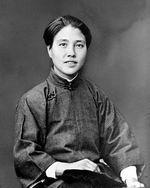
1928: Xiang Jingyu, Communist

The Chinese Communist Xiang Jingyu was martyred on May Day of 1928.

The preeminent female cadre of her time, Xiang was the 16-year-old daughter of a merchant when imperial China fell in 1911. She came of age, and radicalized, in the tumultuous aftermath, becoming an early advocate for women’s liberation as an essential objective of the revolution. She also became the wife of Mao crony Cai Hesen.

Xiang made her mark with a seminal 1920 essay, published while studying in France, “A discussion of women’s emancipation and remoulding.” In it, “Xiang called upon women who had realized consciousness to form four organizations: a study and propaganda society, a free choice in marriage league, a student loan society, and public nurseries.” (Andrea McElderry, “Woman Revolutionary: Xiang Jingyu,” The China Quarterly, March 1986)

Returning to China the following year, she became one of the Communist Party‘s leading voices in the women’s section, where she dunked on bourgeois feminism (“The result of their efforts will be that the whole bunch of them will enter the pigsties of the capital and the provinces where together with the male pigs, they can preside over the nation’s calamities and the people’s misforturtunes”) and gained only halting traction campaigning for girls’ education and mobilizing female factory workers. Her dour and driven demeanor earned her the nickname “Old Grandma”.

Arrested by French soldiers in Hankou‘s French Concession, Old Grandma had no time for the captors who would betray her to the Kuomintang, and her own death. “I am Xiang Jingyu, a member of the Chinese Communist Party. You can kill me and cut me to pieces. I myself have no hope, but tens of thousands of Xiang Jingyus will rise up in my place.”

The present-day Communist Party esteems her a hero.

On this day..

1916: Francis Sheehy-Skeffington, Patrick McIntyre and Thomas Dickson, by Captain Bowen-Colthurst

On the morning of this date in 1916, British Captain John Bowen-Colthurst ordered the summary execution of three Irish journalists in his custody: part of a still-notorious murderous rampage through Dublin amid the Easter Rising.

Bowen-Colthurst’s subsequent “insanity” skate has been a sore subject in the century since its predictable enactment.

The product of landed Anglo-Irish elites — his childhood manor, Dripsey Castle, still stands — had trotted the globe in service of the empire: the Boer Wars, India, Tibet, and the western front.

It’s the sort of background that should have made Bowen-Colthurst a calm hand in a tight spot.* Instead, the Easter Rising panicked him. Atrocities against Irish nationalists are not exactly surprising in the abstract here, but Bowen-Colthurst’s behavior in these hours was so erratic and violent that his men would remark that he had lost his head … although they strikingly never disobeyed his patently illegal orders.

At Portobello Barracks in Dublin, which in this week swarmed chaotically with off-duty leave soldiers reporting themselves for duty in the face of the armed insurrection, the Third Royal Irish Rifles’ commander was absent on sick leave and evidently took command discipline with him. “Captain Colthurst, although not the equal in rank of Major Rosborough, was the senior office in point of service and, according to all the evidence, considered himself at liberty to ignore his brother-officers,” Francis Sheehy-Skeffington’s widow explained.

Sheehy-Skeffington — a gentle pacifist affectionately known among antiwar socialists and the women’s movement as “Skeffy” — had been arrested on sight on April 25th, while out and about trying to dissuade looters. Bowen-Colthurst marched him out overnight as a human shield for a random patrol, and did not mind murdering before his eyes a passing young man caught out after curfew.

Proceeding along, Bowen-Colthurst grenades a tobacconist’s shop, mistakenly thinking that its owner, named Kelly, was Sinn Fein man Tom Kelly. In fact, the tobacconist Kelly was a loyalist, as were the two publishers that Bowen-Colthurst arrested at his place: Patrick McIntyre and Thomas Dickson.

Ignoring their protests, our unstable captain brought all three men back to the barracks. By morning’s light, he had decided on no authority but his own to have them executed.

“I am taking these prisoners out and I am going to shoot them because I think it is the right thing to do” was all the justification that he submitted. Later, he would say that he feared the prisoners would escape; that, believing that Germans were landing and revolutionaries were gunning down Black and Tans throughout Dublin, “I took the gloomiest view of the situation and felt that only desperate measures would save the situation.” So he shot the one guy who didn’t want to fight and two guys who were on his own team. According to later testimony, he would even order Skeffy to be re-shot upon being informed that the man was still moving several minutes after execution.

Still, the tilting captain had enough self-possession to openly worry to a brother-officer that he might have committed a hanging offense … and to actively conceal the evidence of it. Had events not been exposed by a courageous whistleblower, Sir Francis Vane, everything surely would have been obfuscated into the soupy fog of war. Embarrassingly compelled by Vane’s tattling to court-martial Bowen-Colthurst only to pass him off to an asylum (and later, to Canada), the brass took it out on Vane by terminating his career a few months later: “this officer was relegated to unemployment owing to his action in the Skeffington murder case in the Sinn Fein rebellion.”

Uproar at the Bowen-Colthurst affair had some interesting knock-on effects: for one thing, the naked impunity available to an officer at a time when enlisted men in France were being shot at dawn for minor disciplinary lapses might have contributed to the British command’s decision later in 1916 to permit the execution of a shellshocked lieutenant. And, an associate of the loyalist British commander in Ireland during the Easter Rising claimed that Sheehy-Skeffington blowback subsequently led to the execution reprieve granted to Eamon de Valera: that future president of independent Ireland just so happened to have his name “first on the list” when the matter came to a head.

Today, a visitor center at the former Portobello Barracks (now called Cathal Brugha Barracks) memorializes the three men executed there on April 26, 1916.

* We don’t mean to be cavalier about the psychological strains inflicted by violence. Bowen-Colthurst seemed to exhibit signs of shell shock in the trenches, whether due to the shells themselves or to having lost his younger brother in the war.

On this day..