1941: Harry Gleeson, posthumously exonerated

On this date in 1941, Harry Gleeson hanged for murder in Ireland — wrongly, the government admitted in 2015.

Gleeson was the nephew and farmhand of a man called John Caesar, whose County Tipperary property abutted a cottage inhabited by a local prostitute called Moll McCarthy. On November 21, 1940, Gleeson found Moll McCarthy dead on a farm field. Her face had been destroyed by a gunshot; her murder orphaned seven children, many of them the illegitimate progeny of local married men.

Nine days later, Irish police arrested a surprised Gleeson for the murder. He hotly denied their theory that he had availed himself of the victim’s services, and then slain her to prevent his uncle finding out about it.

It was, the Irish Times says in a review of one of the several books about the case, “a definitively Irish murder case: the prosecution claimed that ‘Gleeson was meeting Moll at the field pump, away from prying eyes, and arranging to give her potatoes in exchange for sex.'”

As a criminal case, it involved that brew of tunnel vision preoccupation with the wrong guy and outright cheating to nail him that frequently characterizes errant convictions. But there may have been a political undercurrent besides.

Gleeson was defended by former Irish Republican Army chief of staff Sean MacBride,* and it’s been hypothesized that the barrister’s political affiliations critically unbalanced the case for at least a couple of important reasons:

  • A prejudicial court and jury perhaps gave their verdict as much against MacBride as against Gleeson. (The jury issued its conviction alongside an unsuccessful application for clemency.)
  • MacBride himself might have pulled some punches from the defense bar in view of the possibility — as charged by Kieran Fagan in The Framing of Harry Gleeson — that McCarthy was actually murdered for informing on IRA men.

A few books about Mary MacCarthy and Harry Gleeson

* MacBride’s father John “Foxy Jack” MacBride hanged in 1916 for his role in the Easter Rising.

On this day..

1922: Cemal Azmi, the butcher of Trabzon

On this date in 1922, a Turkish official implicated in the Armenian genocide had a death sentence enforced upon him … by an assassin’s bullet.

Cemal Azmi, wartime governor of the Black Sea littoral of Trabzon,* was the point person in his region for the murder of some 50,000 Armenians. One distinctive twist in Trabzon (though by no means confined to that locality) was the prevalent use of drowning for cost-effective wholesale murder.

The Italian consul in Trabzon, Giacomo Gorrini — a veteran diplomat who hereafter would become consumed by the Armenian community’s travails until his death in 1940 — gave a heartbreaking account. His accounts of systematic mass drownings were corroborated by many other witnesses, including Turkey’s wartime German allies.

The passing of the gangs of Armenian exiles beneath the windows and before the door of the Consulate; their prayers for help, when neither I nor any other could do anything to answer them; the city in a state of siege, guarded at every point by 15,000 troops in complete war equipment, by thousands of police agents, by bands of volunteers and by the members of the “Committee of Union and Progress”; the lamentations, the tears, the abandonments, the imprecations, the many suicides, the instantaneous deaths from sheer terror, the sudden unhingeing of men’s reason, the conflagrations, the shooting of victims in the city, the ruthless searches through the houses and in the countryside; the hundreds of corpses found every day along the exile road; the young women converted by force to Islam or exiled like the rest; the children torn away from their families or from the Christian schools, and handed over by force to Moslem families, or else placed by hundreds on board ship in nothing but their shirts, and then capsized and drowned in the Black Sea and the River Deyirmen Dere — these are my last ineffaceable memories of Trebizond, memories which still, at a month’s distance, torment my soul and almost drive me frantic.

According to the tribunal that tried him in absentia in 1919, Governor Azmi personally ordered many such mass drownings. He also used the Red Crescent hospital to lodge young Armenian girls for his use as sex slaves, only to have them killed late in the war to tie up loose ends. To complete his cycle of deadly sins, Azmi also took liberal advantage of the looting opportunity afforded by the speedy vanishing of Armenian subjects.

Azmi absconded rather than face postwar prosecution but his symbolic death sentence gained bodily force via Armenian revolutionaries’ Operation Nemesis: a campaign to assassinate the chief authors of the genocide.

Nemesis’s most famous targets were the “Three Pashas” who ruled the Ottoman Empire during World War I. (They successfully murdered two of the three.) But Azmi was on the list as well, and on April 17, 1922, a pair of Armenian hit men gunned him down on the Berlin’s Uhlandstrasse along with another genocidaire, Behaeddin Shakir. The assassins weren’t even arrested.

* Centuries before, Trabzon’s Byzantine precursor, Trebizond, had been the last redoubt of the vanishing Roman Empire.

** Vahakn Dadrian, “Children as Victims of Genocide: The Armenian Case,” Journal of Genocide Research, 2003, 5(3). The same author has written widely on the Armenian genocide, including but not limited to Azmi’s conduct in Trabzon; also see his “The Turkish Military Tribunal’s Prosecution of the Authors of the Armenian Genocide: Four Major Court-Martial Series” (Holocaust & Genocide Studies, 1997 11(28) and “The Armenian Genocide as a Dual Problem of National and International Law” (University of St. Thomas Journal of Law and Public Policy, 2010, 4(2)).

On this day..

1995: Nicholas Ingram

British-American Nicholas Ingram was electrocuted in the U.S. state of Georgia on this date in 1995.*

Born in England to a British mother and an American father, Ingram at age 19 had invaded the Cobb County home of J.C. and Mary Sawyer. The Sawyers complied with the armed intruder’s demands for money ($60) and the keys to their pickup truck, but Ingram still marched them to a nearby woods and executed them. J.C. Sawyer was killed; Mary Sawyer feigned death and survived to give evidence against their tormenter.

Thanks to his nationality and his legal representation (British lawyer Clive Stafford Smith, who would later found the anti-death penalty NGO Reprieve), Ingram’s prospective execution because a cause celebre in Old Blighty. British MPs and the Archbishop of Canterbury issued appeals for mercy, although Tory Prime Minister John Major gave a chilly refusal when solicited for intervention by Ingram’s family:

I found your letter very moving and I can imagine the profound distress you must be feeling. But I have concluded, with deepest regret, that there are no proper grounds for the British Government to intervene with the State of Georgia.

The Georgia prison commissioner who conducted this execution, Allen Ault, later turned against capital punishment.

On this day..

1902: Clinton Dotson, bad son


Headline from the Salt Lake (Utah) Telegram, April 4, 1902

On this date in 1902, Montana hanged Clinton Dotson.

Dotson was already in prison for the murder-robbery of miner Eugene Cullinane* when he conceived what the Anaconda Standard (April 4, 1902) called “one of the most shocking murders that the world has ever known.” Permitting the newsman a pass for this slight exaggeration, it was indeed a real triumph in mustache-twirling villainy: the assassination of Dotson’s own father as part of a Rube Goldberg scheme to get himself out of jail.

Briefly, the scheme was that James Fleming, alias James McArthur, cellmate of Clinton Dotson, upon his release during the first part of January, 1901, should go to the cabin of Captain [Oliver] Dotson and extract from him by threat or otherwise a confession that it was he, Captain Dotson, who slew Cullinane. If Captain Dotson refused to make such a confession, McArthur was to kill the old man and arrange the body and the furniture of the house in such a way as to leave the impression that the old man had died by his own hand. A confession exonerating Dotson [and his confederates] from responsibility of Cullinane’s murder was then to be forged.
With a devil’s cunning, Fleming carried out this diabolical scheme. So cleverly was it done that, but for the prior knowledge possessed by the prison officers, the theory of suicide would probably have been accepted. Close investigation, however, showed that the suicide theory was impossible, that the deed had been done by one hidden in an adjoining room … [and Fleming] took no steps to conceal his tracks.

Fleming had already been executed in September, on the same gallows that claimed his parricidal sponsor.

* Dotson had also served time for homicide in Wyoming.

On this day..

1951: William Watkins, one man’s life and death

On this date in 1951, William Watkins hanged for drowning his eleventh child.

An execution that was barely noticed in its time and would be nigh-forgotten today, it’s revived in all its messy humanity in a book titled Execution: One Man’s Life and Death. John Mervy Pugh, the son of one of Watkins’s prosecuting barristers, watched Watkins’s two-day trial as a young man and was still so troubled by it many years later that once “it all came tumbling back into my mind” he decided that he “could not let it rest.” Pugh’s empathetic book plumbs the trial and police records, supplemented by interviews with Watkins’s surviving family and even Watkins’s executioner, the ubiquitous Albert Pierrepoint.

“This was one case I never expected would have taken place,” Pierrepoint told Pugh. “In my opinion many men have been reprieved for a lot worse crime than this.” According to Pugh, many others involved the case, from prison warders to court officials, were equally shaken by the unexpected denial of clemency. Watkins’s guards, who had a good feel for how these things played out, had confidently reassured the convict that he would surely never hang.

Forty-nine years old at his death, which was barely ten weeks after the death of the infant for which he was condemned, Watkins was a factory worker who scrabbled an honest if impecunious living with his second family. Once he was charming and gregarious, but an advancing congenital deafness and the strains of Britain’s hard years through Depression and war had left him taciturn and “prematurely old; his once black hair was now steel grey and his face permanently looked as though he needed a shave.” (His vanishing hearing also robbed him of his longtime driving profession.) He’d had nine children with his first wife but had left her for their former boarder whom Pugh anonymizes as “Maisie”. Though never married, the two lived as man and wife in a run-down home at the back of 79 Clifford Lane in Birmingham. They had a four-year-old son together. Then Maisie got pregnant again.

By both parents’ own admissions it was a child that they did not want and could not afford. (Bill still continued dutiful maintenance payments to the family he had deserted; the last one arrived after his arrest.) Maisie gave birth at home — she’d had no medical attention at all during her pregnancy — on the night of January 20, 1951. Minutes after she delivered, the baby was drowned, and Watkins’s fate was sealed.

Bill and Maisie lived cheek by jowl with their neighbors and Maisie’s condition had been obvious; it was no more than a couple of days before their observable comings and goings (specifically, Maisie’s not coming and going) had generated the inference of a birth … and Bill’s evasiveness generated rumors that demanded investigation.

When men arrived bearing papers and sharp questions, Bill’s answers were not very coherent or consistent. His excuses for that — panic in the moment, and the weariness of repeated police questioning later on — did not quite seem equal to the gravity of a dead infant, which he made no effort to hide when pressed. Minutes after the birth, the father said, he was washing the bloody newborn off and “it fell in the bowl.” So … scoop it out? He didn’t, and even said he couldn’t, for no satisfactory reason: alternately because his wife was shouting or, as he once allowed, “I suppose I panicked and we did not want the child.” It’s a disordered story for what in that moment seems for all the world a disordered soul. Quite disturbingly, the child was also found stuffed head-first in a pillow slip; was this because Bill had socked away the corpse in a vain attempt at concealment, or was it because he had callously stuffed the still-living creature inside the sack before “bathing,” intending all along to asphyxiate it?

This last interpretation surely carries an outrage beyond “mere” infanticide, perhaps the very margin by which Watkins swung. In notes before he recommended Home Secretary Chuter Ede against a reprieve (in effect, this recommendation was the decision) Permanent Under-Secretary of State Frank Newsam recorded the view that “this is a shocking case of the massacre of an unwanted infant by drowning as if the infant were a kitten.”

To Pugh’s eye, it seemed Watkins barely helped his own attorneys at all; he remarks that in revisiting the transcripts years later it is obvious how fragmentary was Watkins’s understanding of events, so hard of hearing was he. His near-deafness led others to take him for vacant and stupid; he’s repeatedly referred to as simple-minded by figures who encounter him, even his own barrister, although he was nothing of the sort. Yet Pugh also wonders whether the “prematurely old” Watkins had not indeed simply given up, somewhere along the line. The hangman Pierrepoint shared the same impression when he first spied the prisoner, as he later told Pugh: “he looked so dejected and slightly stooped, as though he couldn’t care less; suddenly I felt sorry seeing a man looking so sad and just waiting to die.”

At 8.00 a.m. the Chaplain arrived and gave Bill communion. Together they said the Lord’s Prayer and in the name of the Christ he served, the Chaplain forgave Bill for what he had done. The two prison officers found themselves affected by the scene and wished that time would not linger; the last hour always seemed the longest.

At 8.40 a.m. Mr Blenkinsop (the Undersheriff) arrived, and was quickly taken to the Governor’s office. Dr John Humphrey (the Prison Doctor) was already there. At 8.55 a.m., Pierrepoint and his assistant stood outside the door of the condemned cell and were joined within a minute by the Governor, the doctor and the Chief Prison Officer.

Within the cell Watkins was now seated with his back to the door, and seconds before the door opened, looked up, sobbing, and said to the Chaplain, “I have never met so many kind people in my life as I have met since I have been here. Why did I have to come to prison before people are so kind?” The Chaplain had to turn away for fear of showing his own emotion. Already the Under-Sheriff had given the signal: it was 30 seconds past 8.59 a.m. The door opened; Pierrepoint was behind Watkins: “Come on, old fellow,” he said in his soft northern voice. He pinioned his arms, and with an officer either side, Bill was escorted through the now opened doors to the scaffold and Pierrepoint remembers that he walked steadily into the chamber. The assistant was down on his knees pinioning his legs, Pierrepoint put a hand under his drooping chin, placed a white hood over his head and then the noose, stepped back and pulled the lever. Since Pierrepoint had entered the room, twelve seconds had passed: William Arthur Watkins was dead.

On this day..

1901: George Parker, drunk marine

From John Sadden’s Portsmouth Book of Days (via):

Elizabeth Rowland, of Prince Albert Street, Eastney, Portsmouth, received this letter [on January 19, 1901] from 22-year-old George Hill [George Parker], whom she had been seeing while her soldier husband was serving in India.

Hill was a marine at Eastney Barracks until he was convicted of stealing there.

He was later arrested for murdering a man on a train during an armed robbery.

Dearest Lizzie,

It makes my heart bleed, as I am writing these few lines, to think I shall never see you again, and that you will be alone and miserable now … I always loved you dearly … I am truly sorry and penitent for having, in an evil moment, allowed myself to be carried away into committing murder.

I went and purchased a revolver so that when I came down to Portsmouth I could end both our lives if I had not been successful in obtaining money from my father.

I know you were not happy at home, nor I either, for I have been very unhappy of late, mostly on account of the false charges brought against me at the barracks.

I shall get hung now. I believe I was mad; I know I was drunk.

God help me!

My days are numbered, but I will bear it unflinchingly.

Your broken-hearted sweetheart,

Geo H Hill

Hill was hanged at Wandsworth Prison on March 19, 1901

On this day..

1915: Wenseslao Moguel, “El Fusilado”, survives the firing squad

On this date in 1915, Wenseslao Moguel, a soldier of Pancho Villa during the Mexican Revolution, was captured and immediately stood in front of a firing squad.

Miraculously, Moguel survived their volley, and even survived the coup de grace shot to the head afterwards delivered by the squad’s commander.

Although badly disfigured, he managed to crawl away from the execution grounds and went on to live a full life with the nickname El Fusilado (“the executed one”). He died around 1975.


In 1937, Wenseslao Moguel appeared on the Ripley’s Believe It Or Not! radio program.

On this day..

1964: Jack Ruby condemned

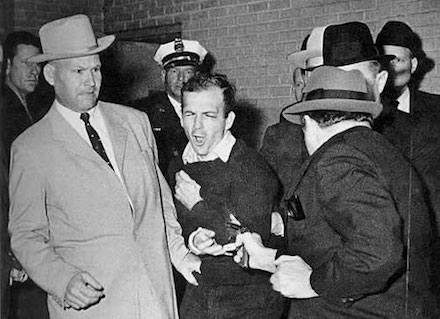
On this date in 1964, Dallas nightclub owner Jacob Rubenstein — notorious to history as Jack Ruby — was condemned to the electric chair for the dramatic live-televised murder of accused John F. Kennedy assassin Lee Harvey Oswald, captured by snapping shutters in one of the 20th century’s indelible images.

Ruby would never sit on that mercy seat.

For one thing, his punishment arrived as the American death penalty lulled into hibernation. Had he lived his sentence eventually would have been vacated by the 1972 Furman v. Georgia ruling. But instead of seeing that juridical landmark, the enigmatic Ruby died in prison inside of three years, awaiting retrial after an appeal.

On this day..

1931: Alfred Arthur Rouse, Blazing Car Murderer

On this date in 1931, Alfred Arthur Rouse hanged at Bedford Gaol for the murder of … someone.

A traveling salesman, Rouse tomcatted around old Albion leaving several illegitimate children and at least three bigamous marriages in his wake.

The weight of these strata of deceptions (and financial obligations) eventually drove Rouse to start thinking about how he could “start afresh” (his words) and darned if he wasn’t undone by the added decency of wanting to be sure that his legal wife and son would be looked-after once he walked out on them. And they say romance is dead.

The answer to his dilemma was a life insurance policy plus “a down-and-out” case that Rouse met at a pub who tellingly remarked over pints that “nobody in the world cares whether I live of die.”

Dangling the prospect of a job, Rouse convinced this man to accompany him to the Midlands on Guy Fawkes night of 1930 — a night when “a fire would not be noticed so much.” Before the night was over, Rouse’s Morris Minor made just such a fire, with a charred corpse of Rouse’s age and build behind the wheel.

The Headsman is fully prepared to believe that the Edmond Dantes-like corpse switcheroo has been executed by a few clever folk in history. Rouse, however, seems not to have thought through the endgame for he returned home — just briefly, but long enough for his wife to get a cockamamie story from him about his car being stolen — and then proceeded to Walea and the arms of one of those mistresses on whom he was allegedly trying to get a fresh start. Suspicious of him because he scrammed when she showed him the newspaper article reporting his possible roadside murder, she rang the police.*

Rouse’s claims that he’d picked up a hitchhiker who accidentally set himself ablaze in the car while refilling the gas tank while Rouse took a piss didn’t get much traction in view of the obvious motive presented by Rouse’s misbehavior. (And the fact that he’d previously told his wife and mistress the different story about his car being stolen.) Furthermore, crown forensic witnesses were able to show that whoever burned to death in that car was alive but unconscious when the fire killed him — perhaps incapacitated by a blow from a wooden mallet also found in the Morris Minor.

Rouse professed innocence of murder deep into his appeals but as hope disappeared he wrote a confessional to the Daily Sketch from which the quotes herein have been derived.

In it, he said that he never asked his passenger’s name. It’s a name that has not been established in the intervening decades, and not for want of trying; there have been several DNA misses on leads brought by families of men who disappeared in 1930. We may one day discover it; for now, the mysterious last word belongs to the Times of March 21, 1931.

At dawn yesterday the funeral of the unknown man murdered by Alfred Arthur Rouse in his motor-car took place in secret at Hardingstone parish church.

On Thursday night the remains of the body were removed from Northampton Hospital to the mortuary. Early yesterday morning the coffin was placed in a police tender and taken to Hardingstone.

The vicar officiated at a brief service. Six police officers carried the coffin to the grave by the side of the path behind the church. The plate on the coffin bore the inscription, “Man unknown. Died November 6, 1930.” A wreath was placed on the coffin by Superintendent Brumby, and was inscribed: “With deepest sympathy from the officers and constables of the Northampton and Daventry Division.”

* Rouse would claim that he intended to disappear to some new life but, having been observed by passersby down the road from the blazing car, he feared that he would not after all be taken for the victim.

On this day..

2000: Hu Changqing, Jiangxi deputy governor

On this date in 2000, the former deputy governor of China’s southeastern Jiangxi province was executed for corruption. The day before, the Supreme People’s Court had denied his appeal.

The ambitious Hu Changqing (or Chongqing) had steered his way up the ranks of the Communist party and into his political position by the 1990s, where he was nailed for taking some $600,000 in payola.

“Over the decades, I became lazy about studying, and all the diplomas I got illegally were just to pave the way for my political promotion,” he said shortly before his execution, sounding more social critic than struggle session. “I have no idea what makes a Communist Party member, except for paying monthly dues.”

China as a whole has been grappling with this same question since the post-Mao turn towards state capitalism with a heavy dollop of corruption undeterred by regular executions chastising same. The rewards available are so very asymmetric, as Hu himself allegedly remarked: “Now I may cost you a little money, but when I become a big official, all I’ll have to do is write a note or make a call and you’ll be raking in tens of millions.”

He wasn’t even wrong, and had some reason to believe he might have already ascended into a zone of de facto impunity — for he was the highest-ranking official executed for corruption in China in several decades.

As it turned out, he was actually only big enough for trophy hunting. His execution occurred while China’s parliament sat in session considering anti-corruption measures, and it led The People’s Daily to editorialize that “For such a flagrant criminal, only the death penalty is sufficient to safeguard national law, satisfy popular indignation, rectify the party work style and fight against corruption.”

On this day..