1920: James Daly, Connaught Rangers mutineer

The British Empire administered its last execution for mutiny on this date in 1920 — that of Irish Private James Daly of the Connaught Rangers.

A Dublin cemetery preserves a monument to Daly and his comrades.

You can take the Irishman out of Ireland, but not Ireland out of the Irishman. Something like that.

Daly was shot in Dagshai prison, India, but the reason for his death was that old familiar of his homeland’s history: nationalism.

Half a world away, London was playing the bad guys in the Irish War of Independence.

It was a conflict uniquely suited for dividing comrades; little wonder that it also divided comrades in arms.

Having lately bled for His Majesty in the War to End All Wars, plenty of Irish enlistees were nonplussed to see troops deployed to their own neighborhoods, Black and Tans shooting up their friends and family.*

From June 1920, a number of Irish Connaught Rangers “grounded arms” for their brethren in Eire, refusing to serve Britain while British troops occupied Ireland. One thing led to another, and a group (led by Daly, and his brother William) ended up trying to rush an armory to recover its weapons, opposed by other Rangers who remained loyal to the crown.

Fourteen death sentences were handed down for this show of indiscipline, but Daly’s was the only one actually carried out. The Rangers were disbanded two years later with the formation of the Irish Free State. And everyone lived happily ever after.

* Connaught Rangers had been used (without incident) to suppress the Easter Rising in 1916.

On this day..

1943: Six POWs, inscribed on a ouija board

Here lie the remains of 3529270 Pte T Jackson Manch Reg. CQMS C Anderson FMSVF, A S H Justice USS Houston. 33271– Pte Mar- … here the letters had been eaten away. At the bottom of the board there were several more words which it was not possible to decipher but still discernible were the words

Executed 1/11/43

The WW2 People’s War is an online archive of wartime memories contributed by members of the public and gathered by the BBC. The archive can be found at bbc.co.uk/ww2peopleswar.

This date’s execution — contributed to WW2 People’s War by Chris Comer of Stockport Libraries on behalf of Arthur Lane — concerns six Commonwealth POWs who were shot for attempting to escape at Thambazayat, a prison camp in Burma.

They’re remembered by a fellow-prisoner from their time at the Thailand prison camp Chungkai, where the prisoners pulled off a memorable caper with a ouija board and some of their guards.


Chungkai War Cemetery, on the site of camp’s POW burials. (From Australian War Memorial)

These executions did not reshape history. But this story of a few men under the shadow of a senseless death has the spark of humanity that animates these pages. Read it in its entirety here: part 1 | part 2.

On this day..

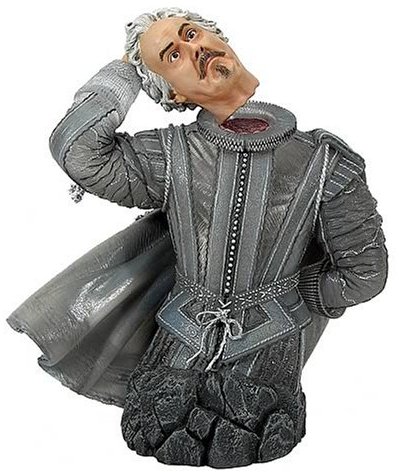
1492: Sir Nicholas de Mimsy-Porpington, Nearly Headless Nick

(Thanks to Elizabeth M. Hull for the guest post. -ed.)

Post-mortem resident of Gryffindor House, Hogwarts School of Witchcraft and Wizardry, Hogsmeade, U.K.

A minor character in J.K. Rowling’s Harry Potter saga, Nearly Headless Nick remains one of the most memorable. Executed — badly — on Halloween of 1492, Sir Nicholas de Mimsy-Porpington became the ghost of Gryffindor House. The school has about 20 resident ghosts: the Grey Lady (Helena Ravenclaw) and the Bloody Baron of Slytherin House died violently as well, in a murder-suicide.

Rowling says that her editor suggested that she cut a ballad Mimsy-Porpington wrote about himself from The Chamber of Secrets. In the song, the ghost claimed to have been executed for “a mistake any wizard could make,” a “piffling error,” a case of wizardry gone wrong. Asked by Lady Grieve (otherwise unknown) to straighten her teeth, Mimsy-Porpington seems to have given her a tusk. “They” imprisoned the piffler immediately, though he cried all night that he could fix his mistake, and his beheading followed the next morning.

Unfortunately for Mimsy-Porpington, his was not the only incompetence: “they’d mislaid the rock/Where they usually sharpened the axe”! The “cack-handed twit” of a headsman said “this may sting a bit” to the gibbering wizard, and swung the axe in the air. Alas, unable to sharpen the blade, the executioner was reduced to bestowing numerous blows: “But oh the blunt blade! No difference it made,” the ghost sang,

My head was still definitely there.
The axeman he hacked and he whacked and he thwacked,
“Won’t be too long,” he assured me,
But quick it was not, and the bone-headed clot
Took forty-five goes ’til he floored me.

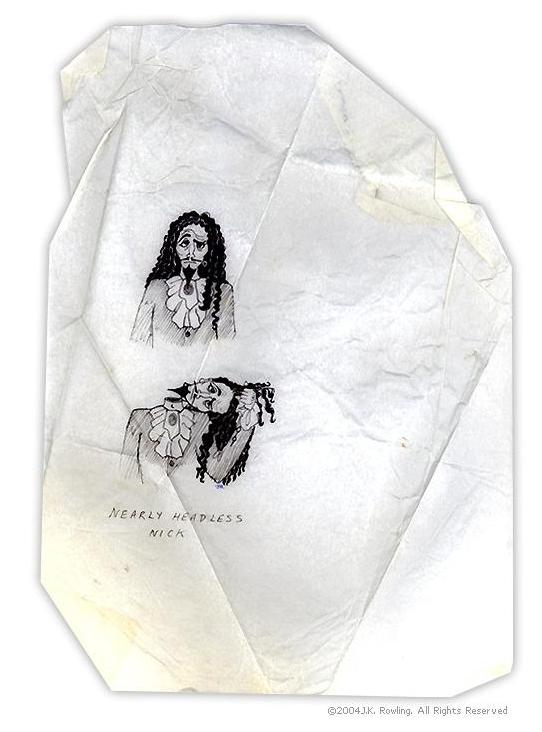
(The full ballad is here and here; the original handwritten version can be seen here.)

After repeated strokes of the edgeless axe, Mimsy-Porpington finally expired. On festival occasions, he re-enacts his near-beheading, a show quite popular with the Hogwarts student body (Prisoner of Azkaban, p. 159).

However, the bone-headed, cloddish headsman was unable to completely behead the wizard. As Ron Weasly notes, the ghost is merely nearly headless.


Nick, as played in the Harry Potter films by John Cleese. Rowling’s own original sketch of Nearly Headless Nick is here.

While he gets a great deal of pleasure from entertaining Hogwarts residents by swinging “his whole head . . . off his neck and . . . onto his shoulder as if it was on a hinge” (Sorceror’s Stone, p. 124), his condition limits his access to the dizziest heights of post-mortem society. Beheading was an aristocratic execution, meant to bring a swift death to the privileged, those able to hunt legally in their lifetime. In the afterlife, the beheaded aristocrats have established a “Headless Hunt” Club, and have blackballed Mimsy-Porpington, who misses their entrance requirements by that much: “‘half an inch of skin and sinew holding my neck on.'” Unable to participate in Club sports like “Horseback Head-Juggling and Head Polo,” Mimsy-Porpington is denied admission into the elite society (Chamber of Secrets, p. 124).

Sadly, their scorn for his crippling condition is not limited to exclusion from their company.

Mimsy-Porpington’s five hundredth Deathday anniversary party, held on Halloween 1992, welcomes hundreds of ghosts from as far away as Kent to a feast of rotten fish, putrid, “maggoty haggis,” and a tombstone cake with grey icing, while an orchestra of 30 musical saws plays waltzes. The Deathday Boy’s speech is interrupted by the members of the Headless Hunt: “Sir Properly Decapitated-Podmore” begins a game of Head Hockey, sending his own head sailing past the humiliated Mimsy-Porpington as he tries to address his guests (Chamber of Secrets, p. 132-7).

Somehow the courageous Gryffindor ghost overcomes this diabolical heads-up-manship and several months as a petrified cloud to live a useful afterlife, helping Harry many times. Most significantly, in the final pages of The Order of the Phoenix, a traumatized and grieving Harry turns to Mimsy-Porpington, hoping to discover a way to keep his dead friend and guardian Sirius Black alive. “‘You’re dead,'” Harry says, “‘But you’re still here, aren’t you? … People can come back, right? As ghosts. They don’t have to disappear completely.'” Mimsy-Porpington gently tells Harry that he can only “‘walk palely'” where his living self once trod, “‘neither here nor there,'” hovering between life and death for fear of the unknown. However, Black risked his life joyously and died laughing; he will not linger between death and life. Harry must live on without him.

There may be historical precedent for Mimsy-Porpington’s death in the botched execution of James Scott, Duke of Monmouth (1685), when the notorious Jack Ketch took five blows to kill the rebel, and finally had to use a knife to sever the last “skin and sinew” connecting the head to the corpse. Monmouth’s hairstyle in portraits from the late 1600s resembles that drawn by Rowling in her sketch of Nearly Headless Nick, although that sketch shows a beard style from the early 1600s, nearly 70 years earlier. Moreover, the ghost enters Harry Potter’s life wearing an Elizabethan neck ruff and says that he has not eaten in nearly 400 years, implying a death in the late 1500s.

In spite of this wibbly-wobbly timeline, Mimsy-Porpington’s deathdate establishes the firm chronology of Rowling’s series: the five hundredth anniversary of his death in 1492 would fall in 1992; therefore the events of Chamber of Secrets (published in 1997) must occur in 1992. The dating of the series is confirmed five books later by the tombstones of Harry’s parents, who died on Halloween Day, 1981 (Deathly Hallows, p. 328). For J.K. Rowling, death, the last enemy — not life — marks the measure of this world’s time.

On this day..

2008: Greg Wright, still fighting for exoneration

Two years on from his execution in Texas this date in 2008, the website FreeGregWright.com still bears its namesake’s now-hopeless case for exoneration.


Wright’s wife Connie (the woman on the right) and their friend Bente Hjortshøj released this photo of Greg Wright 15 minutes after execution “to show the world the cruel and unusual punishment and its horrible consequences.”

Wright and another homeless man, John Adams, were taken in by a generous 52-year-old widow named Donna Vick. Vick paid for her charity with her life … but who was the killer?

Adams fingered Wright, but Wright always insisted that Adams killed her. Late-arriving DNA evidence appeared to back Wright. So did too-late-to-matter confessions by Adams. (Adams, for his part, was also convicted for capital murder; each man was separately tried on the theory that he was the murderer and the other the bystander.)

The disputed facts of this case are a muddier affair that don’t readily admit a slam-dunk exoneration. An episode of the Dallas DNA television series looked at Wright’s case and disappointed Wright’s supporters with its unfavorable view of the subject’s case.

Wright, nevertheless, maintained his innocence from the execution gurney.

John Adams lied. He went to the police and told them a story. He made deals and sold stuff to keep from going to prison. I left the house, and I left him there. My only act or involvement was not telling on him. John Adams is the one that killed Donna Vick. I took a polygraph and passed. John Adams never volunteered to take one. … I was in the bathroom when [Adams] attacked [Vick]. I am deaf in one ear and I thought the T.V. was up too loud. I ran in to the bedroom. By the time I came in, when I tried to help her, with first aid, it was too late. The veins were cut on her throat. He stabbed her in her heart, and that’s what killed her. I told John Adams, “turn yourself in or hit the high road.” I owed him a favor because he pulled someone off my back. I was in a fight downtown. Two or three days later he turned on me. I have done everything to prove my innocence. Before you is an innocent man.

The victim’s son — for whom little ice was cut by Wright’s admitted failure to summon medical help for the victim, or to turn in the alleged killer Adams — complained that the statement was “the same thing we’ve got since day one, each of them blaming it on the other one.”

Former congresswoman Cynthia McKinney witnessed the execution, taking a break from her Green Party presidential bid.

One of the crime scene investigators in this case, Eric George Rosenstrom, is now himself wanted for murder.

On this day..

1268: Conradin of Swabia

On this date in 1268, 16-year-old boy-king Conradin was beheaded in Naples with his best friend.

This short-lived son of German king Conrad IV inherited his call on the purple at the age of 26. 26 months.

While the infant king worked on his ABC’s in Swabia, different regents tried to keep his Sicily and Jerusalem thrones warm in the far-flung empire.

Knowing an opportunity when he saw it, Conradin’s uncle and “regent” Manfred usurped him in Sicily, tipping over the first domino in a peninsular political chain that would fell both relatives. With Manfred’s accession, the rival power of the papacy now faced an active military strongman at its doorstep — and it, in turn, sponsored French noble Charles of Anjou to oppose, and eventually overthrow, Manfred.

By the time all this played out, Conradin was, if not exactly a seasoned man of the world, at least old enough to hear his voice cracking and start noticing girls. By the standards of medieval Europe, that was plenty old enough to press his injured rights in battle.

Accordingly, Conradin — Corradino, to the Italians — led Hohenstaufen boots down the boot to reclaim Sicily. No dice.

His captor’s attitude was summed up in the sentiment, Conradi vita, Caroli mors — “Conrad’s life is Charles’s death,” somewhat doubtfully ascribed to the counsel of Pope Clement IV — so when you think about it, it was no more than self-defense to cut short that vita. And his buddy’s, too, since the scaffold was already hired for the day.


Conradin of Swabia and Frederick of Baden Being Informed of Their Execution in Prison in Naples, by Goethe buddy Johann Heinrich Wilhelm Tischbein. Did either try the Sicilian Defence?

He turns to clasp with longing arms his friend,
And turning, sees the fatal blow descend,
Then presses with his lips the severed head,
Last greeting of the dying to the dead.
One quivering flash, a shock that is not pain,
And those he parted death unites again.
So perished Conradin, but legends tell
That as the trenchant blade descending fell,
An eagle, that, unseen by human eyes,
Had poised aloft, down swooping from the skies,
For one short instant hovered o’er the slain,
And dyed his pinions with a crimson stain,
Then wildly shrieked, and upward soaring sped
To witness for the blood unjustly shed.

-Tribute in purple poetry by William John Rous (Here’s a more prose-y review of Conradin’s campaign and demise)

This upward-soaring, crimson-pinioned raptor saw off the Hohenstaufen dynasty of the Holy Roman Empire.

In the unstable years that followed, as rival princes and factions jockeyed for influence, there’d be some serious nostalgia for the bygone Hohenstaufens. But there is opportunity as well as peril in change, and though it may be that this fractious realm was neither Holy, nor Roman, nor an Empire, it emerged from its interregnum with its first Habsburg ruler — of many.

What’s left of Corradino di Svevia (and Frederick of Baden) lies entombed at a Neapolitan church, watched over by a monumental 19th century marble sculpture of the youth.

On this day..

1941: Twenty Red Army officers


Top to bottom: Proskurov, Rychagov, Shtern, and Smushkevich.

“Quantity has a quality all its own.”

-Stalin

The aphoristic Uncle Joe doomed Soviet officers in both quantity and quality on this date in 1941, shooting 20 Soviet officers at the very moment when Mother Russia could have used them most.

This wouldn’t seem like the ideal time for a purge, but old habits are hard to break.

As the Wehrmacht closed in on Moscow, these prisoners had been evacuated to the Volga city of Kuybyshev (today, Samara). In this, they were already treated more courteously than some.

But any semblance of consideration for these fallen brass — to say nothing of bourgeois indulgences like due process — went out the window when an order arrived from Lavrenty Beria:

“Investigation to be stopped, all to be executed by firing squad without delay.”

They were.

Those “all” included:

Many of this day’s victims were rehabilitated after Stalin fell.

Cold comfort, perhaps, but for their survivors there was bloodier satisfaction: the personal order Beria gave to execute them was in turn used against Beria when he was purged.

It’s a bit tangential, but here‘s an interesting interview with one of their contemporaries in Soviet combat aviation, who managed to survive those terrible years (despite being “taken out to be shot on three occasions” while a POW in Spain). There are some pictures of the planes these men would have used in this thread of a Spanish-language military forum.

On this day..

1659: The first two Boston Martyrs

October 27 is International Religious Freedom Day, dating to the execution this date in 1659 of Quakers Marmaduke Stephenson and William Robinson on Boston Commons. They were two of the four Boston Martyrs, Quakers whose necks were stretched in Massachusetts for failing to either keep quiet or stay out of town.

(Fellow Quaker Mary Dyer, perhaps the more famous martyr, was led out to execution with Stephenson and Robinson but reprieved at the last moment. Her time was still some months away.)

As Puritans had fled C-of-E persecution earlier in the 17th century, Quakers migrated to the New World with Cromwell‘s Puritan ascendancy.

And in the Massachusetts Bay Colony, the old dissidence had become the new orthodoxy — as described by the (obviously partisan) Horatio Rogers. (Via)

In June, 1659, William Robinson, a merchant of London, and Marmaduke Stephenson, a countryman of the east pan of Yorkshire, “were moved by the Lord,” in Quaker phrase, to go from Rhode Island to Massachusetts to bear witness against the persecuting spirit existing there; and with them went Nicholas Davis of Plymouth Colony, and Patience Scott of Providence, Rhode Island, a girl of about eleven years of age … During their incarceration Mary Dyer was moved of the Lord to go from Rhode Island to visit the prisoners, and she too was arrested and imprisoned. On September 12, 1659, the Court banished the four adults from Massachusetts upon pain of death

… On October 8, within thirty days of her banishment, Mary Dyer with other Rhode Island Quakers went to Boston, …where she was again arrested and held for the action of the authorities. Five days later William Robinson and Marmaduke Stephenson, who had been travelling about spreading their doctrines through Massachusetts and Rhode Island since their release from prison, also went to Boston to look the bloody laws in the face, in the words of the Quaker chronicler; and they too were arrested and cast into prison. …

The issue was now clearly made between Quaker and Puritan. The Quaker defied the unjust Puritan laws, and dared martyrdom. Dare the Puritan authorities inflict it?

On October 19 the three prisoners were brought before Governor Endicott and the Assistants, and demand having been made of them — Why they came again into that jurisdiction after having been banished from it upon pain of death if they returned? — they severally declared that the cause of their coming was of the Lord and in obedience to him. The next day they were again brought before the magistrates, when the Governor called to the keeper of the prison to pull off their hats, which having been done, he addressed them substantially as follows: “We have made many laws and endeavored in several ways to keep you from among us, but neither whipping nor imprisonment, nor cutting off ears, nor banishment upon pain of death, will keep you from among us. We desire not your death.” Notwithstanding which, he immediately added: “Hearken now to your sentence of death.” … When the Governor ceased speaking, however, Stephenson lifted up his voice in this wise: “Give ear, ye magistrates, and all who are guilty, for this the Lord hath said concerning you, who will perform this promise upon you, that the same day that you put his servants to death shall the day of your visitation pass over your heads, and you shall be cursed forevermore, the Lord of Hosts hath spoken it; therefore in love to you all take warning before it be too late, that so the curse might be removed; for assuredly if you put us to death, you will bring innocent blood upon your own heads, and swift destruction will come upon you.” …

Great influence was brought to bear to prevent the execution of the sentences. Governor Winthrop of Connecticut appeared before the Massachusetts authorities, urging that the condemned be not put to death. He said that he would beg it of them on his bare knees that they would not do it. … Governor Endicott, the Rev. John Wilson, and the whole pack of persecutors, however, seemed to thirst for blood; and it was determined that somebody must die.

The 27th of October, 1659, was fixed for the triple execution and elaborate preparations, for those days, were made for it. Popular excitement ran high, and the people resorted to the prison windows to hold communication with the condemned, so male prisoners were put in irons, and a force was detailed, in words of the order, “to watch with great care the towne, especially the prison.”…

The eventful day having arrived, Captain Oliver and his military guard attended to receive the prisoners. The marshal and the jailer brought them forth, the men from the jail, and Mary Dyer from the House of Correction. They parted from their friends at the prison full of joy, thanking the Lord that he accounted them worthy to suffer for his name and had kept them faithful to the end. The condemned came forth hand in hand, Mary Dyer between the other two, and when the marshal asked, “Whether she was not ashamed to walk hand in hand between two young men,” for her companions were much younger than she, she replied, “It is an hour of the greatest joy I can enjoy in this world. No eye can see, no ear can hear, no tongue can speak, no heart can understand, the sweet incomes and refreshings of the spirit of the Lord which now I enjoy.” The concourse of people was immense, the guard was strong and strict, and when the prisoners sought to speak the drums were caused to be beaten.

The method of execution was extremely simple in those days. A great elm upon Boston Common constituted the gallows. The halter having been adjusted round the prisoner’s neck, he was forced to ascend a ladder affording an approach to the limb to be used for the fatal purpose, to which limb the other end of the halter was attached. Then the ladder was pulled away, and the execution, though rude, was complete.

The prisoners took a tender leave of one another, and William Robinson, who was the first to suffer, said, as he was about to be turned off by the executioner, ‘I suffer for Christ, in whom I lived, and for whom I will die.” Marmaduke Stephenson came next, and, being on the ladder, he said to the people, “Be it known unto all this day, that we suffer not as evil-doers, but for conscience sake.”

Next came Mary Dyer’s turn. Expecting immediate death, she had been forced to wait at the foot of the fatal tree, with a rope about her neck, and witness the violent taking off of her friends. With their lifeless bodies hanging before her, she was made ready to be suspended beside them. Her arms and legs were bound, and her skirts secured about her feet; her face was covered with a handkerchief which the Rev. Mr. Wilson, who had been her pastor when she lived in Boston, had loaned the hangman. And there, made ready for death, with the halter round her neck, she stood upon the fatal ladder in calm serenity, expecting to die….

Just then an order for a reprieve, upon the petition of her son all unknown to her, arrives. The halter is loosed from her neck and she is unbound and told to come down the ladder. She neither answered nor moved. In the words of the Quaker chronicler, “she was waiting on the Lord to know his pleasure in so sudden a change, having given herself up to dye.” The people cried, “Pull her down.” So earnest were they that she tried to prevail upon them to wait a little whilst she might consider and know of the Lord what to do. The people were pulling her and the ladder down together, when they were stopped, and the marshal took her down in his arms, and she was carried back to prison. . .

It was a mere prearranged scheme, for before she set forth from the prison it had been determined that she was not to be executed, as shown by the reprieve itself, which reads as follows: “Whereas Mary Dyer is condemned by the Generall Court to be executed for hir offences, on the petition of William Dier, hir sonne, it is ordered that the sajd Mary Dyer shall have liberty for forty-eight howers after this day to depart out of this jurisdiction, after which time, being found therein, she is forthwith to be executed, and in the meane time that she be kept a close prisoner till hir sonne or some other be ready to carry hir away within the aforesajd tyme; and it is further ordered, that she shall he carrjed to the place of execution, and there to stand upon the gallowes, with a rope about her necke, till the rest be executed, and then to returne to the prison and remajne as aforesaid.“

Mary Dyer once again returned from exile the following year, and was hanged in June 1660.

The hours were numbered, however, for New England Puritans in their most cartoonishly obnoxious form. Upon the restoration of the monarchy in the mother country, an edict forbidding the death penalty for Quakerism closed the doors to the Boston Martyrs club.

An Account of the Sufferings of Marmaduke Stephenson is available free on Google books.

On this day..

1978: Seventeen officers in Somalia

Seventeen army officers were shot this day on the outskirts of Mogadishu for attempting to overthrow Somali dictator Siad Barre.

“The executions were carried out by by a firing squad formed of soldiers of the armed forces and were witnessed by thousands of people from all areas of Mogadishu,” said Mogadishu radio.

The abortive April 9 coup attempt seems to have been precipitated by Somalia’s ill-fated intervention in neighboring Ethiopia’s Ogaden region, a bloody little Cold War sideshow that saw both the U.S. (from Ethiopia, to Somalia) and Soviet Union (from Somalia, to Ethiopia) switch sides. Some of the officers concerned feared that Siad would come a-purgin’ after the last Somali forces slunk home on March 15, 1978.

The condemned (per this source) were:

  • Col Mohamed Sheikh Osman “Cirro”
  • Maj Siad Mohamed Jama
  • Maj Ibrahim Mohamed Hersi
  • Maj Siad Jama Nur
  • Capt Mohamed Ahmed Yusuf Aganeh
  • Capt Abdisalan Elmi Warsame
  • Capt Bashir Abshir Isa
  • Capt Abdillahi Hasan Nur
  • Lt Abdi Osman Ugas
  • Lt Abdirahman Maalin Bashir
  • Lt Adan Warsame Abdillahi
  • Lt Abdillahi Mahamud Guled
  • Lt Mohamed Abdullahi Husein (Gorod)
  • Lt Abdulwahab Ahmed Hashim
  • Lt Abdulqadir Gelle Omar
  • Sgt Farah Mohamed Halwo
  • Director Abdulqafar Warsame Abdilleh

But they’re perhaps most memorable for a coup participant not among their number, Abdullahi Yusuf Ahmed, who fled to Kenya and founded from exile the Somali Salvation Democratic Front, eventually one of the principal entities resisting the Barre regime. Ahmed served as President of Somalia from 2004 to 2008, but his government was unable to gain control of the notoriously fractious state or to end Somalia’s ongoing civil war.

On this day..

1769: Nicolas de Lafreniere and four others for the Louisiana Rebellion

On this date in 1769, five French Creoles were shot in New Orleans for a revolt the previous year against a Spanish takeover.

This date’s story begins with the French King Louis XV getting his French clock cleaned in the French and Indian War. This conflict blew an ill wind all over Francophone North America, much of which was taken by the British. Result: a quarter-millennium later, this blog is in English.

Even what France kept, she did not keep. In a secret pact, France ceded to wartime ally Spain “the country known as Louisiana, as well as New Orleans and the island in which the city is situated.”

This projection onto New World colonists of Old World diplomatic horse-trading was rife with potential hostility among the traded horses. In this instance, Louisianans were widely dismayed when they were finally informed that they’d become Spaniards.

When they did get the memo — and Louis XV declined to reconsider — they launched the Louisiana Rebellion of 1768, expelling the new Spanish govenror Antonio de Ulloa.*

These weren’t mere rabble who showed Ulloa “insubordination … a sense of liberty and independence,” but elites of French New Orleans. Nicolas de Lafreniere was the attorney general.

“The name of Lafreniere deserves rank with those of foremost American patriots,” Americans later reckoned. O’Reilly’s reputation did not fare as well in the patriotic literature, but he perhaps had the best of the law.

Between a rock and a hard place, the leftover French adjutant Charles-Philippe Aubry refused to support the rebels, but also refused to fire on fellow Frenchmen. Meanwhile, Ulloa refused to provide his credentials to the uppity colonists. Louis XV refused to receive the delegations sent to implore him to keep Louisiana.

All these refuseniks found the matter adjudicated by immigrant Irish officer Alejandro O’Reilly, plucked out of Cuba to replace Ulloa and lay down the law. He spoke softly when he landed, but the amnesty he offered was followed a few months later by the surprise arrest of the chief rebels.

Lafreniere, Joseph Milhet, Jean-Baptiste Noyan, Pierre Caresse, and Pierre Marquis were ordered hanged on this date. Noyan, nephew of the city’s founder and a young man just married, was offered his pardon, but melodramatically refused.

It was found that there was no hangman in the colony, so the condemned prisoners were ordered to be shot. When the day of execution came, hundreds of people left the city. Those who could not leave went into their houses, closed the doors and windows and waited in an agony of sickening dread to hear the fatal shots. Only the tramping of soldiers broke the deathlike stillness which brooded over the crushed and helpless city. At three o’clock on a perfect October afternoon in 1769, the condemned men were led to the Spanish barracks. Lafreniere, it is said, gave the order to fire. A volley of muskets broke out on the still air, and five patriots went to their death, — the first Louisianians to give their blood for the cause of freedom.

–A History of Louisiana

The details and historiography of this event are the subject of this 146-page master’s thesis. (pdf)

Whether or not all that stuff about Louisiana planters as freedom-loving patriots trod down by the barbarous Spanish has any real merit to it, that’s the way they’ve been memorialized.

Lafreniere Park in Metairie, La. — home of anti-death penalty VIP Sister Helen Prejean — is named for Nick Lafreniere.

When next visiting the Louisiana State House, keep an eye out for this day’s victims on the frieze to the right of the main entrance. And when next visiting New Orleans, keep an ear out for the ghost of the priest that buried them.

* Ulloa was also a scientist and gave his name to the Ulloa Halo, a “physical illusion consisting of a white luminous ring or arch that can sometimes be seen in mountainous regions, typically in foggy weather, while facing an area opposite the Sun.”

On this day..

1943: Leonard Siffleet, beach beheading

On this date in 1943, Australian World War II commando Leonard Siffleet was beheaded on Aitape Beach in Papua New Guinea, along with two Ambonese, H. Pattiwal and M. Reharing

A photograph of the Japanese soldier Yasuno Chikao an instant before he strikes off Siffleet’s head was taken from the body of a Japanese casualty later in the war. Published in Life magazine, it became one of the war’s most iconic photos.

On this day..