1669: Susanna One-Ear

On this date in 1669, a slave of the Dutch East India Company named Susanna was sewn into a rock-weighted sack and tossed into Table Bay as punishment for infanticide in the Cape Colony (present-day South Africa).

The spare narration of the company’s journal describes Susanna’s speedy progress from the (not further explained) strangulation of her “half-caste” infant girl — reported on December 11, tried on December 12, and executed on December 13.

December 11th. — In the evening meeting the Fiscal [Cornelis de Cretzer] reported that a female slave of the Company, named Susanna of Bengal, lying stiff and stinking of the small-pox in the slave house, had not hesitated to strangle her infant, a half-caste girl; he likewise submitted the sworn declaration of the surgeon, which mentioned that the poor innocent child had died in consequence. The Council having considered this serious affair at once, ordered that the murderous pig should be placed in confinement in order to be punished according to her deserts.

December 12th. — This evening the Council decreed that the female slave, above mentioned, should be tied up in a bag and thrown into the sea. The minister [Adrianus de Voogd] and sick comforter [Joannes à Bolte(n)] were accordingly sent to her, to admonish her to repentence [sic] of what she had done, so that she might in a Christian manner prepare herself for death to-morrow afternoon.

December 13th. — About 11 o’clock the sentence was read here on the square in presence of the murderess and the public, and afterwards carried out on the roadstead in the presence of all the slaves. For the maintenance of justice it was executed with death [by drowning?].

Unsurprisingly we know little else about Susanna … but we do know something.

A documentation project on the first decades of the Cape Colony features a series called “Uprooted Lives”, by Mansell Upham focusing on the lives of slaves and aboriginals affected by the settlement has a fantastic article (pdf) on “Susanna van Bengale” or “Susanna Een Oor” (Susanna One-Ear). It’s a highly recommended read, not only illuminating the judicial perspectives on infanticide that would have informed her judges, but tracing other, fleeting glimpses of Susanna supplied by the documentary record and illuminating the context of her case in view of two other important trials of mothers that preceded it.

It’s worth the click to read it here.

On this day..

2011: Amina bint Abdul Halim bin Salem Nasser

Per the BBC’s report of a Saudi Interior Ministry statement, a woman named Amina bint Abdul Halim bin Salem Nasser was beheaded for sorcery in the northern province of Jawf on this date in 2011.

The London-based newspaper, al-Hayat, quoted a member of the religious police as saying that she was in her 60s and had tricked people into giving her money, claiming that she could cure their illnesses.

Our correspondent said she was arrested in April 2009.

But the human rights group Amnesty International, which has campaigned for Saudis previously sentenced to death on sorcery charges, said it had never heard of her case until now, he adds.

Amnesty says that Saudi Arabia does not actually define sorcery as a capital offence. However, some of its conservative clerics have urged the strongest possible punishments against fortune-tellers and faith healers as a threat to Islam.

On this day..

1994: Raymond Carl Kinnamon, filibusterer

On this date in 1994 — the ten-year anniversary of the robbery-murder that earned him his death sentence — Raymond Carl Kinnamon died to lethal injection despite his loquacity.

A career criminal with 17 felony convictions and three prison stints previously to his name, Kinnamon robbed a Houston bar at gunpoint on December 11, 1984. The crime escalated to murder when one of the patrons, Raymond Charles Longmire, smacked the gunman’s hand away from his pocket.

On this unusual Sunday-morning execution, the death warrant specified the execution be completed before dawn. Kinnamon received a last-minute stay that was subsequently overturned by an appellate court, but the legal chicanery ate up most of the window. Seeing an angle, Kinnamon delivered a rambling, 30-minute last statement looking to run out the clock on his executioners. According to the Associated Press (here via the Paris News of Dec. 12, 1994), prison officials eventually forced the start of the lethal drugs while the prisoner was still mid-filibuster, to the complaints of Kinnamon’s family.

“I’ve got a few things to say,” Kinnamon said as witnesses filed into the death chamber about 5:15 a.m. CST.

Thirty minutes later, after thanking dozens of people, criticizing capital punishment, expressing love for his family and getting a drink of water from the prison warden, he was still talking.

“I can see no reason for my death,” he said, then began squirming, lifting his head and shoulders and tried sliding his right arm from a leather strap.

Warden Morris Jones and a prison chaplain, Alex Taylor, both stationed a few feet away at opposite corners of the gurney, stepped in to control the inmate and executioners behind a one-way mirror in an adjacent room began the lethal dose.

Kinnamon’s niece, standing with her mother and a friend behind a clear plastic shielded window, began sobbing loudly.

“They didn’t let him finish,” Natasha Fremin cried out. “I didn’t get to say goodbye.”

The dispatch notes that “it was not clear what would have happened if Kinnamon had continued to speak past sunrise.”

On this day..

1940: Carl Heinrich Meier and Jose Waldberg, the first hanged under the Treachery Act

I went into this with both my eyes open, telling myself that a man who has an ideal must be willing to sacrifice everything for it or else the ideal isn’t an ideal at all, or the man isn’t a man at all, but a humble creature who deserves only pity.

-Carl Heinrich Meier, last letter to his fiancee (Source)

On this date in 1940, Great Britain carried out the first two executions under its brand-new-for-wartime Treachery Act of 1940.

Raced into the books in May of 1940 amid Nazi Germany’s onslaught on France, the Treachery Act made it a capital crime if, “with intent to help the enemy, any person does, or attempts or conspires with any other person to do any act which is designed or likely to give assistance to the naval, military or air operations of the enemy, to impede such operations of His Majesty’s forces, or to endanger life.” Naturally the realm had centuries of treason statutes to fall back on; the intent in creating this new capital crime of treachery was to target spies and saboteurs who might not themselves be British citizens — and therefore evade “treason” charges on grounds of not owing loyalty to the British Crown. Instead, the Treachery Act explicitly governed “any person in the United Kingdom, or in any British ship or aircraft.”

Carl/Karl Heinrich Meier and Jose Waldberg were textbook cases. They had rowed ashore at Dungeness on September 3 intending to pose as Dutch refugees while reconnoitering ahead of a potential German cross-channel invasion. With them were two other Abwehr agents with the same intent, Charles Albert van der Kieboom and Sjoerd Pons.

While his comrades were noticed by routine coastal patrols and picked up near the beach, Meier picturesquely showed up that morning at a public house in Lydd where his clumsy command of contextual slang and etiquette led the proprietress to turn him in.

They were tried in camera weeks later, by which time the Luftwaffe was systematically bombing the jurors; despite this radically prejudicial context, Sjoerd Pons was actually acquitted — successfully persuading the court that he’d been forced into the mission on pain of a concentration camp sentence for smuggling. (Pons was detained as an enemy alien despite the acquittal.)

The other three men were not so fortunate. Perhaps most to be pitied was “Waldberg” who was really a Belgian named Henri Lassudry: although he had not presented Pons’s same defense to the court it appeared that he also had been coerced into the operation, in his case by Gestapo threats against his family. But none of the three death sentences was to be abated. A week after Meier and Waldberg/Lassudry hanged at Pentonville Prison, van der Kieboom followed them to the gallows.


“Jose Waldberg” aka Henri Lassudry.

The Treachery Act would be used against German agents repeatedly through the war years and in time had the distinction of noosing the last person hanged in Britain for a crime other than murder.

On this day..

1920: Joseph Usefof

(Thanks to Robert Elder of Last Words of the Executed — the blog, and the book — for the guest post. This post originally appeared on the Last Words blog. Fans of this here site are highly likely to enjoy following Elder’s own pithy, almanac-style collection of last words on the scaffold. -ed.)

“You see an innocent man dying tonight. Thank you, warden. You have been a kind man.”

— Joseph Usefof, convicted of murder, electric chair, New York. Executed December 9, 1920.

Usefof was executed along with three other men for the 1918 murder of subway ticket agent Otto Fialo in the Bronx. Joseph Milano, one of Usefof’s co-defendants, exonerated Usefof in a written confession, which he later retracted. Usefof maintained his innocence; he was the first of his group to be executed because he was considered the most likely to suffer a breakdown.

[Executed with Usefof and Milano were James Cassidy and Charles McLaughlin, along with a fifth man electrocuted for an unrelated murder, Howard Baker. -ed.]

On this day..

1452: Antonio Rizzo, cannonaded

From Charles Stanton in Medieval Maritime Warfare:


In the months preceding the final fall of Constantinople in 1453, the great Ottoman sultan Mehmed (II), the Conqueror, caused to be constructed in less than twenty weeks on the European bank of the Bosporus just north of the city a colossal castle which he called Bas-kesen, meaning ‘Decapitator’ or ‘Throat-cutter’. Later called Rumeli Hisar (‘Castle of the Roman Lands’), it stood opposite the Anadolu Hisar (‘Castle of Anatolia’), built in 1394 by his great-grandfather Bayezit I at the narrowest part of the strait (less than 1km across). It consisted of three main towers and fourteen smaller ones connected by inner and outer curtain walls, covering an area of 31,250 sq. m (almost 7.75 acres). The fortress still stands to this day, glowering down upon passing maritime traffic much as it did when it was completed on 31 August 1452.


The view from the still-standing fortress shows its commanding view over the narrow strait. (cc) image from Olga Petrovska.

The main tower in the middle was 22m (72ft) high and 23.3m (76ft 5 in) in diameter, with 6.5m (21ft 4in) thick walls. Named the Halil Pasha after the sultan’s vizier who built it, it stood closest to the shoreline. On it, Mehmed had positioned what were described as ‘bronze tubes capable of discharging balls weighing over six hundred pounds’. He then gave the citadel’s commander, one Firuz Aga, the following explicit instructions:

Do not allow ships sailing from the Hellespont [Dardanelles] to the Black Sea or from the Black Sea to the Hellespont, no matter under whose flag they may be sailing — Genoese, Venetian, Constantinopolitan, Kaffatinian, Trapezundian, Amisinian, Sinopean, or even under my own flag, and no matter what class they are — triremes, biremes, barques, or skiffs — to sail through without first lowering their sails and paying the customs duties; only after they have done so will you permit them to proceed on their way. Use the cannon to sink the ship that does not comply and submit.

Early the following November two Venetian ships destined for the Dardanelles ignored the injunction and passed through the Bosporus without stopping as ordered. Luckily, they survived the consequent cannonade. A third, carrying grain for Constantinople a short time later, was not so fortunate. The earlier experience had evidently served to provide Firuz Aga’s gunners with the proper range. A single stone from one of the cannon ‘shattered the ship’. The crew of thirty, including the captain, a certain Antonio Rizzo, were subsequently captured and taken to the sultan in Didymoteichos (in Thrace, about 37km or 23 miles south of Adrianople — modern Edirne). ‘He gave orders to behead them all except the captain whose life was to be taken by a stake through the anus,’ recorded a fifteenth-century chronicler known only as ‘Doukas’, who claimed he himself saw Rizzo’s rotting corpse only ‘a few days later’. The impact on maritime warfare was just as dramatic. The advent of a true ship-killing weapon spelled the end of one age and the beginning of another.

In his watershed study Gunpowder and Galleys, early modern military historian John Francis Guilmartin concluded that the one technological innovation most responsible for ushering in a new age of warfare was ‘the use of effective heavy cannon’. It was, therefore, fitting that Mehmed II employed perhaps the largest cannon ever built up to that point to vanquish the first great naval power of the passing medieval period. In his campaign to conquer Constantinople, the Ottoman sultan engaged a Hungarian engineer named Orban to produce a sort of supergun which could smash the several-feet thick Theodosian Walls that had protected the capital of the Eastern Roman Empire for a millennium. ‘In three months’ time a terrifying and extraordinary monster was forged,’ testified Doukas. Mehmed’s Greek biographer, Michael Kritovoulos, provided precise dimensions: the barrel was cast in bronze some 20cm (8in) thick; it measured about 8m (26ft 8in) long, with a bore at the muzzle of 76m (30in) in diameter. In a test, the cannon discharged a 544kg (1,200-pound) stone ball which burrowed itself almost 2m (6ft) into the ground over 1.6km (1m) away. Doukas said that thirty wagons pulled by sixty oxen and 200 men were required to haul it from Adrianople to Constantinople where it was positioned to batter the walls south of the Blachernae Palace.

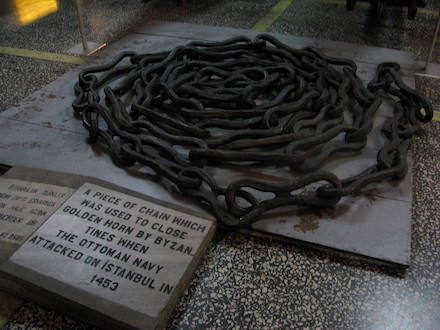
Not content with this ostentatious display of military power, Mehmed then brought to bear the full force of his powerful new fleet. The Byzantines had barred the entrance to the Golden Horn with a giant iron chain suspended on wooden pontoons between two fortified towers, one on each side. (This chain currently resides in the Turkish Naval Museum of Istanbul.)


(cc) image from Henri Bergius.

A squadron of ten Greek warships was stationed outside it, while another sixteen from Genoa, Venice and other western maritime cities guarded it from inside. Previous Ottoman assaults on this defensive cordon had failed, so the sultan circumvented it by building a road of greased wooden logs across Galata Hill behind the Genoese colony of Pera on the side of the Golden Horn opposite the city. He then, on 22 April, had seventy to eighty ‘biremes on wheeled cradles’ hauled over said byway and into the harbour behind the chain. The manoeuvre demoralized the defenders and enabled Mehmed’s naval forces to attack the city’s sea walls from the Golden Horn at the same time that his army assaulted the land walls. Inevitably, Constantinople fell on 29 May 1453. Vanquished were the last vestiges of Byzantine imperial power and its maritime thalassocracy remained only as a distant memory.

On this day..

1900: A day in the death penalty around the world

… courtesy of the Foreign News dispatch in the pages of the Boston (U.S.) Daily Advertiser, Dec. 8, 1900:

On this day..

1816: Marci Zöld, Hungarian outlaw

Legendary Hungarian outlaw Marci Zöld was executed on this date in 1816.

Zöld — Hungarian link, as are most in this post; we’ve inverted the Hungarian surname-first naming convention for ease — followed his father’s footsteps into outlawry; his heyday comprised the months following a Christmas 1815 escape from a previous imprisonment after which he and a confederate “kidnapped and plundered for several months in Sárrét, and in Bihar, Szabolcs, Heves and Szolnok counties.” (Heves was his native soil, so he’s also known as Marci Hevesen.)

By summer he had teamed up with another bandit named Pista Palatinszky and formed a gang that raided promiscuously throughout Transdanubia, escaping justice until he didn’t.

The allure of the road — moreso than any evident virtue distinguishing the brigand’s actual conduct — qualified him to be taken up by poets of the emerging Romantic age, like Sandor Petofi‘s poem which inaccurately portrays Marci doing Robin Hood wealth redistribution. Mor Jokai, Jozsef Gaal, and Lajos Kormendi are among the many other authors who have paid him tribute.

To some extent, his defiance of the Austro-Hungarian empire expressed an inchoate longing for rebellion, like the Balkan hajduks. Even moreso, it was a matter of good timing — for the 18th-19th century pivot was a peak era for romanticizing highwaymen, now that the species was disappearing into the crucible of modernity. This is the same period for the likes of Schinderhannes and Diego Corrientes Mateos; equally, it’s the moment when artists of various nationalities elevated into the cultural canon decades-dead outlaws like Dick Turpin (England) or Juraj Janosik (Slovakia).

On this day..

1805: Gabriel Aguilar and Manuel Ubalde, abortive Peruvian rebels

On this date in 1805, Cusco‘s Plaza Mayor hosted the hangings of two colonial Peruvian creoles who had aspired to revive the Incan resistance to Spain.

The devastating Tupac Amaru rebellion lay just 25 years in the background here, but these men were not themselves indigenes. They were, however, New World-born, and thus heirs to a resentment at colonial control from half a world’s distance that would within the coming generation separate Peru from Spain.

“Denizens of the lower strata of creole society,” as D.A. Brading writes, the lawyer Jose Manuel Ubalde and the mining entrepreneur Gabriel Aguilar — close friends from a previous association in Lina —

inhabited a world in which Catholic piety, patriotic fervour and personal ambition were fuelled by visions and dreams. For Aguilar obtained Ubalde’s support for proclaiming him Inca emperor of Peru by informing him of a childhood vision in which he had been assured of a great role in his country’s history. Both men agreed that Spanish rule was oppressive and that St Thomas Aquinas had recognised the right to rebel against tyranny. When they conferred with like-minded priests, one cleric cited the prediction of Raynal,* the 1771 representation of the Mexico City Council,** and the example of the ‘Americans of Boston’. But the current of religious emotion that underlay these arguments surfaced when another cleric fell into an ecstasy in Aguilar’s presence, and claimed later to have seen the pretender crowned in the cathedral of Cuzco.

Unfortunately, the path to such a coronation ran through the actions of sympathetic military men — and one of the officers that these conspirators reached out to shopped the plotters before they could set anything in motion.

After their arrest, Ubalde was reminded of the traditional doctrine that, since the Catholic king was God’s image on earth, any challenge to his authority was an attack on God. By way of reply, he insisted on the right of rebellion against tyranny and argued that natural law did not prescribe loyalty to any particular dynasty. After all, the Papacy had just recognised Napoleon as emperor of the French, despite the claims of the Bourbon dynasty to that throne. He went to his execution convinced that Aguilar had been chosen by providence as a creole Maccabee, called to liberate Peru from Spanish rule.

* French Enlightenment figure Guillaume Thomas Francois Raynal anticipated a rebellion that would destroy colonial slave empires from below: “Your slaves stand in no need either of your generosity or your counsels, in order to break the sacrilegious yoke of their oppression … they will rush on with more impetuosity than torrents; they will leave behind them, in all parts, indelible traces of their just resentment. Spaniards, Portuguese, English, French, Dutch, all their tyrants will become the victims of fire and sword.”

** Mexico submitted a notable May 2, 1771 petition to King Carlos III calling for most of the imperial positions in the New World to be staffed by people from the New World rather than home country cronies — and warning that to do otherwise was to invite “not only the loss of this America, but the ruin of the State.” (Source)

On this day..

1917: Private Joseph Bateman, shot at dawn

On this date in 1917, Black Country volunteer Joseph Bateman was shot for desertion.

The 2nd Battalion South Staffordshire Regiment private was among the earliest wave of young Britons to sign up, in late 1914 — but his three years of service were marked by intermittent AWOL episodes, including when the unit was on home soil, far from the front lines. It’s not clear the reason for this eventually fatal pattern.

For ninety years, Bateman was, like most “shot at dawn” soldiers, persona non grata for official war commemorations. His name was finally added to Wordsley‘s Great War cenotaph in 2007, thanks to the tireless campaigning of an interested teacher/historian named Graham Hodgson.*

Press reporting on Hodgson’s campaign subsequently turned up Bateman’s relations, including a grateful granddaughter whose only photo of Joseph Bateman was “marked by lipstick where her grandmother kissed it after learning of his death.” (BBC)

He’s buried at Rocquigny-Equancourt British Cemetery in the Somme.

* Unfortunately, Mr. Hodgson was killed in a car accident on Cyprus shortly afterwards. At the time he apparently had a historical novel about Private Bateman in progress, but I can find no indication that it’s been posthumously published; however, Bateman does figure in To War with God: The Army Chaplain who Lost his Faith by Peter Fiennes. Fiennes’s grandfather, the titular army chaplain, stayed up all night consoling Joseph Bateman in the hours ahead of his execution.

On this day..