1716: Lords Kenmure and Derwentwater but not Lord Nithsdale

This date in 1716 saw the beheading of two Jacobite lords, but it was more famous for the third who ducked the executioner in one of the Tower of London’s greatest escapes.

Lord Nithsdale, Escape from the Tower by Emily Mary Osborn(e)

Three were doomed to the block this date:

They were the fruit of Parliament’s impeachment of Jacobite leaders. Six of these fellows threw themselves upon the mercy of the Commons, and were rewarded with a death sentence by William Cowper. Only half managed to wrangle mercy from the crown.

On the eve of this date’s execution, Lord Nithsdale received a visitation of his wife, Winifred … who helped him swap clothes with one of her maids, in which garb he audaciously marched out the Tower gates in the train of his spouse.

The king whom Nithsdale had purposed to dethrone was a good sport about it. “It was the best thing a man in his condition could have done,” he declared.

The fugitives managed to cross the channel — that required another bit of dress-up, in the livery of the Venetian ambassador — and absconded to Rome. William Maxwell, Lord Nithsdale, outlived his appointment with the headsman by 28 years.

They are gone — who shall follow? — their ship’s on the brine,
And they sail unpursued to a far friendly shore,
Where love and content at their hearth may entwine,
And the warfare of kingdoms divide them no more.

–“The Dream of Lord Nithsdale”

A letter detailing the escape from the pen of the intrepid Lady Nithsdale herself is well worth the read.

Her reputation as a romantic heroine (only enhanced by the romantic futility of the Jacobite struggle itself) has lent itself to all manner of literary expropriation, like this 19th century historical novel.

All very well for these two lovebirds. But the remaining 67% of the day’s scaffold carrion did not escape the Tower in women’s clothing, or men’s, and paid with their heads as scheduled.

Derwentwater went out with a peevish scaffold a ballad, “Lord Derwentwater” (or “Lord Allenwater”, or several similar variants), and another aptly titled “Derwentwater’s Farewell”.

His partner at the chop, Lord Kenmure,** also made the folk playlist in “O Kenmure’s On And Awa, Willie”, one of the ditties gathered by Robert Burns.

Having beheld all these various exemplars, Derwentwater’s brother and fellow Stuart supporter Charles Radclyffe decided to emulate them all.

Later that same year, Charles Radclyffe also made a successful prison break and got to the continent.

As a result, he was still around to participate in the 1745 Jacobite rising … and finally get executed for that.

(All part of God’s mystical plan for Radclyffe: look sharp and you’ll find him succeeding Isaac Newton as CEO of the legendary Holy Grail-keeping secret society Priory of Sion in Holy Blood, Holy Grail and its pulp novel knockoff The Da Vinci Code.)

* It’s impossible not to notice that this cross-dressing escape foreshadows that of Bonnie Prince Charlie when the Jacobite cause flamed out for good thirty years later.

** And like Lord Nithsdale, he was also blessed with a perspicacious wife — albeit one who wasn’t able to extricate him from the Tower.

On this day..

1629: John Dean, boy arsonist

(Thanks to Meaghan Good of the Charley Project for the guest post. -ed.)

On or about this day in 1629, one John Dean, described in court documents as “an infant between eight and nine years,” was hanged in Abingdon, England for setting fire to two barns in the nearby town of Windsor.

According to Historia placitorum corone: The history of the pleas of the crown, Volume 1 by William Axton Stokes and Edward Ingersoll, this juvenile felon was indicted, arraigned and found guilty all on the same day, February 23, “and was hanged accordingly.” The actual date of his execution is not known, but it can’t have been long afterward. The wheels of British justice ground very quickly in those days, though not so fine.

The age of criminal responsibility in England at the time was seven years old. (It was later raised to eight, and in 1963 to ten, where it remains; there have been calls to raise it again.) Accordingly, anyone seven years or older could be charged with a crime and face the same penalties as someone seventeen or forty-seven — including the death sentence.

This does not mean that vast numbers of children were executed, however; quite the contrary. As Capital Punishment U.K. notes, “Death sentences were certainly routinely passed on 7 -13 year olds but equally routinely commuted. Girls were only typically hanged for the most serious crimes whereas teenage boys were executed for a wide range of felonies.”

The same source notes that little John Dean was probably the youngest child ever executed in England.

For reasons lost to history, he was not given the usual commutation: although there is no mention that anyone was hurt or killed in the fires, the judge found that John had “malice, revenge, craft and cunning,” and refused to recommend a reprieve. Perhaps the boy had a prior criminal record.

Thus did John Dean secure a footnote in history; were it not for his death no one would remember him today. Somehow, I doubt he would have thought it was worth it.

On this day..

1799: Heshen forced to commit suicide

It was on this date that notoriously corrupt Chinese minister of state Heshen or Ho-Shen was forced to commit suicide in lieu of execution.

The able child of a Manchu military officer, Heshen came of age in the long reign of the emperor Qianlong.

That Heshen rose above his modest station with this monarch’s favor was the source of no small resentment. Rumors circulated that the attractive young former bodyguard reminded the emperor of a lost, beloved concubine — with all that implies.

“Elegant in looks, sprucely handsome in a dandified way that suggested a lack of virtue,” a Korean diplomat described Heshen.

Whatever there might have been to the homosexuality angle, Heshen exploited the imperial protection to gorge himself on the state’s revenues; he’s reported to have filled the bureaucracy with clients who saw to it that Heshen got a yuan out of every tael that passed through state business in the last quarter of the 18th century. He even dynastically married his own son to one of Qianlong’s daughters.

It was the peak of the Qing dynasty’s glory, and the dawn of its imperial stagnation. Heshen — resplendent, omnipotent, and sunk in vice* — remains to this day its persona par excellence.

As long as the emperor lived, Heshen had a virtual free hand.

But as soon as the emperor died — on February 7, 1799, at the age of 87 — the successor** Jiaqing destroyed him.

Citing Heshen’s inability to suppress the nettlesome White Lotus and Miao rebellions, Jiaqing arrested and tortured the former retainer into copping to all manner of offenses both mortal and venial.

My thoughts dwell ever on the Confucian precept: ‘For three years after a parent’s death none of his former surroundings should be changed.’ …

But as regards Ho Shen, his crimes are too grave to admit of possible pardon … Ho Shen is a deep-dyed traitor, lost to all moral sense, who has betrayed his Sovereign and jeopardised the State. As self-constituted dictator he has usurped supreme authority.

Seeing the man’s abrupt change of fortunes, Heshen’s people in the bureaucracy fell over each other to denounce him.

He was condemned to the horrific expiation of “slow slicing”; however, given “the undesirability of executing the chief Minister of State like a common felon in the public square,” Jiaqing “allowed him the privilege of committing suicide, as a mark of high favour and out of regard to the dignity of the nation.”

A principal accomplice was made to witness Heshen ceremonially hanging himself; then the accomplice was reprieved of his own death sentence and sent into exile.

The new sovereign found his nation’s dignity sufficiently upheld by the doomed man’s melancholy inventory of loot destined (of course) for the re-appropriation of the Qing … and sufficiently outraged that, upon discovering weeks after the some artifact Heshen had failed to enumerate,

Had these facts come to Our knowledge before the 18th day of the 1st Moon [i.e., February 22], we should assuredly have decreed Ho Shen’s decapitation, even if We had spared him the lingering death and dismemberment.

However, he has already been permitted to commit suicide, and thus luckily escaped the extreme penalty of public execution. We do not, therefore, insist on his corpse being hacked to pieces.

Jiaqing had better to worry about his own now-declining state, which was about to be hacked to pieces by encroaching European powers.

Having made an example of Heshen and a handful of his most visible allies, he was still saddled with the endemic structural corruption Heshen had fostered in the institutions of Qing governance.

“Historians have tended to see Jiaqing’s failure of nerve in purging the bureaucracy of all tainted officials as something of an original sin whose commission predetermined the dynasty’s steady decline,” writes William T. Rowe of this turning point. “But given the need for at least some continuity in routine administration, it is not at all clear that he could have acted otherwise.”

(Hey, at least he did make the few examples. Not everyone even does that much.)

And so Jiaqing struggled in vain to maintain China’s fading prestige; his reign would witness economic erosion and a burgeoning opium trade that eventually led it to war with the British and humiliating western domination.

Since a sclerotic bureaucracy at once crushing in its expanse, helpless in its effect, and riven with self-dealers, is a timeless theme (especially in China), Heshen persists as a lively emblem of corruption.

Heshen’s luxurious mansion — which was also among Jiaqing’s indictments — still stands; today, it’s a museum.

* It bears remembering that it is principally by the testimony of Heshen’s enemies that we know him.

** Technically, Jiaqing had been ruling since Qianlong symbolically “abdicated” in 1796; in reality, Qianlong continued to run the realm until his death.

On this day..

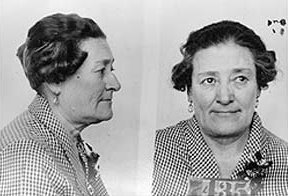
1930: Eva Dugan, her head jerked clean off

On this date in 1930, Eva Dugan was badly hanged.

A former Alaskan cabaret performer, Dugan relocated to warmer climes, took a job keeping house for a to New York.

A mysterious teenage accessory, “Jack”, was never found. Eva was picked up and extradited after the missing rancher’s remains turned up in a shallow grave.

The grizzled former frontierswoman — she followed the Klondike gold rush in her youth — took her fate nonchalantly.

“Wal, I’ll die with my boots on, an’ in full health,” she scolded her jurors. “An’ that’s more’n most of you old coots’ll be able to boast on.”

Eva Dugan’s health may have been full — though she bid unsuccessfully for clemency claiming mental illness — but her body was halved.

At 5 a.m. this date, wearing a homemade silk shroud, a composed Dugan mounted the gallows at the state prison in Florence.

Her death was instantaneous, for the rope, when it snapped at the end of the drop, severed her head from her body.

Five witnesses, two women, fainted. Altogether there were five women in the chamber at the time of the execution. It was the first time in the history of Arizona that an execution was witnessed by women.

Thanks in part to this ghastly scene, Arizona in 1934 replaced the gallows with the western states’ hot new killing technology, the gas chamber … leaving Dugan the last female client of that state’s hangman.

(Another woman, Ruth Judd, narrowly missed swiping Dugan’s distinction; Judd’s hanging sentence was commuted for insanity just days short of her scheduled 1933 hanging.)

On this day..

1570: Hegumen Kornily of the Pskov-Pechery Monastery

Though the primary sources are shaky, at least one chronicle avers that it was on this date in 1570 that the Russian tsar Ivan the Terrible had Hegumen Kornily [Cornelius] of the Pskov-Pechery Monastery put to death.

An icon of the sainted Cornelius marks the spot of his martyrdom at his Pskovo-Pechery monastery. From (cc) image by Usama.

This was the coda to Ivan’s bloody sack of Novgorod, part of the violent state consolidation carried out in Ivan’s terrible police state.

Having left Novgorod prostrate, Ivan marched westwards towards the edge of Livonia (what is now the Russian-Estonian frontier) to put Pskov in its place.

If Ivan’s depredations here were less extensive than in Novgorod — and they were less extensive — it might be due in no small measure to this date’s victim.

Over a period of four decades, Kornily had overseen the golden age of his priory — agglomerating lands, riches, and brethren. He had also charted a somewhat independent, contra-Moscow political course, and apparently harbored anti-Ivan refugee Andrei Kurbsky.*

[Ivan] came [to Pskov] in great wrath, roaring like a lion, for he wished to torture innocent people and to spill much blood. But the Lord God, all-bountiful and all-merciful lover of mankind … took pity on the human race … when the Grand Duke came before Pskov, he halted near the town and rested at the monastery of St Nicholas. And … when the Grand Duke heard all the bells ringing, his heart was softened and he came to himself, and ordered all his soldiers to blunt their swords with stones and forbade them to commit murder in the town … he was met by the Abbot of the Pechery monastery, Kornily, with all the clergy … and they went into the cathedral church of the Holy Trinity and heard mass.**


Ivan the Terrible begs Kornily for admission to the monastery, by Klavdy Lebedev. (Detail view; click for the full canvas.)

This all sounds friendly enough.

What we may have in the passage foregoing is a conflation of legends about the monk, who is unambiguously attested a martyr to Ivan at the gates of the monastery even as he’s credited with sparing the city as a whole from the tsar’s full fury. (This particular execution — or murder — date is cited in this popular history of Ivan; “February” sometime is generally agreed.)

So maybe it was one of the tyrant’s famous piques of rage — or maybe Kornily didn’t really charm him into altering his plans at all.

Although the particulars are half-obscured in legend, one can still visit at this gorgeous monastery the “Path of Blood”: the route from the gates to the cathedral along which the remorseful tsar allegedly carried his victim’s body. Ivan also made several gifts to the monastery.†

Kornily himself is still venerated on these sacred grounds, thanks not only to his holy martyrdom but to his worldly machinations. A decade after the abbott laid down his life, the walls he had raised around the monastery proved fortification enough to repel the Polish king Stephen Bathory‡ — helping cement Kornily’s reputation as the celestial defender of Pskov.

* See the title of the next footnote? Vassian Muromtsev was a protege of Kornily’s in the Pskov-Pechery monastery; Kurbsky actually had a running correspondence with Muromtsev.

Muromtsev “was put to death together with [Kornily],” reports Kurbsky, although his authority for this claim is doubtful. “They say that they were both crushed together on the same day by some kind of instrument of torture; and their holy martyred corpses were buried together.”

** Quoted in Nikolai Andreyev, “Kurbsky’s Letters to Vas’yan Muromtsev,” The Slavonic and East European Review, June 1955.

† Andreyev, “The Pskov-Pechery Monastery in the 16th Century,” The Slavonic and East European Review, June 1954.

‡ We’ve met Stephen Bathory’s infamous niece in these pages.

On this day..

1790: Thomas de Mahy, Marquis de Favras

On this date in 1790, Thomas de Mahy, Marquis de Favras, became a penal milestone: the first French noble executed without class distinction from commoners.

At least he made history.

The scion of an ancient and penurious noble line, Favras was trying to make a different kind of history: he’d hitched onto a plot of the future Louis XVIII to reverse the still-infant French Revolution and rescue the king and queen from captivity in the Tuileries.

The royal couple were ultimately destined to escape this palatial dungeon only to the guillotine.

But in Mahy’s day, it was possible to dream of counterrevolution. And that terrifying machine of the revolution hadn’t even been invented.

For that matter, the machinery of revolutionary justice had also not been born; this was Lafayette‘s year, the revolution in its moderate phase.

It was ancien regime jurists of the Chatelet who were here appointed to judge the enemies of the nation. Having just acquitted the guy who commanded monarchist forces in Paris on Bastille Day, these establishment magistrates proceeded to throw the revolutionary left a bone by condemning Favras to the democratic capital expiration of … hanging. (Back in the good old days, he would have had the right to a beheading. Plus ça change.)

The crowd was said to be quite enthusiastic.


“Thomas de Mahy, Marquis of Favras Making Honourable Amends before Notre-Dame,” engraving by Pierre-Gabriel Berthault (French link).

Little less interested in Favras’s elimination — he was executed the day after sentence — were his fellow conspirators and other sympathetic members of the royalist party. (Future-Louis XVIII hurriedly washed his hands of the scheme.) These were quite pleased to suppress any wider exploration of

the project that this lost child of royalist enthusiasm had formed in the interest of the royal family. Among those participating in this project, but with a cowardice that is well known, were persons that an important consideration prevented from naming at the time.*

You’ve got to look forward, not back.

Despite the mob scene surrounding him as he carried his damning information to the grave, Favras had the sang-froid to remark upon being handed a copy of the order for his execution, “I see that you have made three spelling mistakes.”

“It can be said,” wrote Camille Desmoulins, “that all the aristocrats have been hung through him.”

And since they did such a metaphorically comprehensive job through this single unfortunate, it’s no wonder that Favras was the only aristocrat executed for counterrevolutionary activity during the entire first three years of the Revolution.*

* Barry Shapiro, “Revolutionary Justice in 1789-1790: The ComitĂ© des Recherches, the ChĂ¢telet, and the Fayettist Coalition,” French Historical Studies, Spring 1992.

On this day..

1957: Walter James Bolton, the last hanged in New Zealand

New Zealand got itself permanently out of the execution business after hanging Walter Bolton this date in 1957 for the murder of his wife.

The 68-year-old farmer was condemned after his wife finally succumbed to a year-long bout with some mysterious recurring ailment — and the post-mortem revealed long-term arsenic poisoning. Since Bolton turned out to have been having an affair with his wife’s sister, the pieces just fell right into place.

Jurors found these circumstances credible enough to stretch Bolton’s neck, but there’s the small problem that Walter Bolton himself also tested for arsenic poisoning.

The defense argued that the farm’s wells must have soaked up the poison from sheep dip.

But if you like your wrongful executions more sinister than dunderheaded, you might turn a wary eye to that adulterous sister-in-law, Florence Doherty, who committed suicide a year after Bolton hanged. This 2001 Investigate magazine argues (beginning on p. 24 of the pdf) that Doherty may have been a serial arsenic poisoner.

(Bolton’s hanging was also botched, to complete the official dog’s breakfast.)

Whether or not Bolton was rightly accused, nothing along the lines of a public scandal over the case triggered death penalty abolition in New Zealand.

It was rather the First World’s collctive mid-20th century move away from capital punishment. Various abolition efforts building in the 1950’s finally led to a 1961 free vote on the matter, in which ten members of the conservative National Party broke party ranks to eliminate the death penalty for all ordinary crimes. (Decades later, a Labour government also eliminated the death penalty for treason; New Zealand has only ever hanged one person for that crime.)

On this day..

1944: Jean Cavailles, philosopher-mathematician

“A philosopher-mathematician loaded with explosives, lucid and reckless, resolute without optimism. If that’s not a hero, what is a hero?”

–Georges Canguilhem

On this date in 1944, French intellectual Jean Cavaillès was shot at Arras for his role in the French Resistance.
The university lecturer had been called up as France mobilized against Germany, and captured in the ensuing German blitz.

Escaping, he started a subversive newspaper, was appointed to the Sorbonne, got captured again, escaped again, made it to London, and returned to occupied France to direct a sabotage campaign.

This “intellectual who loved explosives” was finally captured for good in the summer of 1943 along with his handler (and future French Foreign Minister) Christian Pineau.

On this day..

1939: The only triple execution in Manitoba

On this date in 1939, the Canadian province of Manitoba carried out at Headingley Gaol the only triple execution in its history.

Peter Korzenowski and William Kanuka hanged side by side just after midnight that February 16, while their accomplice Dan Prytula waited 14 minutes for his turn on the gallows.

Less than a year before, drunk on moonshine, the trio beat and kicked 81-year-old Anna Cottick to death on her Dauphin-area farm in an attempt to plunder the place of a rumored $1,000. In fact, they only found twenty-three bucks.

According to an article that appeared on the regrettably extinct Manitoba’s Buried History site,

The process of finding enough corroborating evidence to obtain murder convictions was the stuff of modern crime dramas.

As soon as the Royal Canadian Mounted Police arrived at the Cottick farm, members noticed fresh tire tracks entering and leaving the yard. They were tracked three miles west to within 150 yards of Kanuka’s residence, and from there to the Gilbert Plains home of Prytula’s sister. The tire marks were a perfect match to the treads on Prytula’s 1929 Ford. It was confiscated and, while casts were taken of its treads, Prytula was arrested and his blood-stained clothes, boots and three .32 calibre bullets were seized and sent to the RCMP crime lab for testing.

As one group of police officers were arresting Prytula and Korzenowski, another searched the Cottick residence for additional evidence. Almost immediately they noticed what appeared to be fingerprints on the glass smashed by the assailants. Fragments were sent to experts in Winnipeg, along with a window frame and piece of wall where the bullets fired by Korzenowski and Prytula lodged.

The RCMP also searched the residence and yard of Korzenowski, located a few hundred yards from where Kanuka had been staying. There they found the revolvers used in the break-ins, hidden in a pile of stones. Korzenowski was promptly arrested, and three days later he and his two friends were part of an identification line-up paraded in front of the hospital beds of the Cotticks.*

To top all that off, they bugged the men’s jail cell with a dictograph and snared them in several incriminating conversations. Representative remark: the lawyers are so expensive, “No wonder one has to go robbing.”

* Anna’s 91-year-old husband survived the home invasion.

On this day..

1688: Philip Standsfield

Oh Gentlemen, see, see dead Henrys wounds,
Open their congeal’d mouthes, and bleed afresh.
Blush, blush, thou lumpe of fowle Deformitie:
For ’tis thy presence that exhales this blood
From cold and empty Veines where no blood dwels.
Thy Deeds inhumane and unnaturall,
Provokes this Deluge most unnaturall.

–Lady Anne Neville in Shakespeare’s Richard III

There long persisted superstition* of ancient vintage that the wounds of a murder victim will bleed in the presence of the murderer.**

This date in 1688 saw the execution in Edinburgh of one Philip Standsfield (sometimes Stansfield or even Standfield) for parricide, his conviction being secured in part by the supposed accusation of his father’s corpse.

The prodigal firstborn of James Standsfield was an incorrigible scoundrel, and the state had a considerable circumstantial case to the effect that said scoundrel finally popped the old man to prevent disinheritance. (It also appeared that he’d tried to do it other times over the years.)

Circumstantial evidence is nice.

But how about some forensic evidence to really cinch a conviction? No DNA evidence here in the 17th century, so maybe something a little more … supernatural?


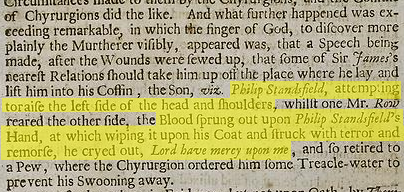
From A True Relation of a Barbarous Bloody Murther etc., available here.

The King’s Advocate insisted — over the objections of a defense attorney that “it was a superstitious observation, founded neither upon law nor reason” — that the corpse’s having bled on Philip Standsfield but none of the others in his party simultaneously attempting to move it “he must ascribe … to the wonderful Providence of God, who in this manner discovers murder.”

Divine forensics. That’s even better than the arson evidence Texas used to kill Cameron Willingham.

And it had the same result, to wit,

the said Philip Standsfield to be taken upon Wednesday next, being the 15th of February instant, to the Market-cross of Edinbrugh, and there, betwixt two and four o’clock in the afternoon, to be hanged on a gibbet till he be dead, and his tongue to be cut out and burnt upon a scaffold, and his right hand to be cut off and affixed to the east port of Haddingtoun, and his body to be carried to the Gallowlie betwixt Leith and Edinburgh, and there to be hanged up in chains; and ordains his name, fame, memory, and honours to be extinct, his arms to be riven forth and delete out of the books of arms …†

Well, you get the idea. Executed Today would like to apologize to the dempster of Edinburgh for keeping Philip Standsfield’s name, fame, and memory alive.

In our defense, we are hardly the only ones: this is thought to be the last time that Scottish law employed the bleeding-corpse “test”.

* Some other instances of purported “bleeding at the touch” may be perused here.

** In a 1927 piece in the Journal of the American Institute of Criminal Law and Criminology, Canadian jurist William Renwick Riddell says this folk belief “was wide spread and is not dead yet” and offers in a footnote (perhaps by way of explaining his interest) that “when at the Bar, I was once offered such evidence by my client; but I declined to use it.”

† The execution was botched, and the gibbeted body illicitly pulled down and tossed in a ditch — which is where the elder Standsfield’s had been discovered.

On this day..