1855: Emmanuel Barthelemy, duelist

The winner of England’s last fatal duel was hanged at Newgate on this date in 1855 … but not for the duel.

Both participants in that duel, Emmanuel Bart(h)elemy and Frederic Cournet, were French emigres* who had commanded Parisian barricades during the 1848 revolution.

On its surface the duel was one of those trivial affairs of honor: Barthelemy heard that Cournet (otherwise unknown to him) had repeated some defamatory rumors about Barthelemy already abroad in France, and challenged Cournet on that basis; Cournet at first dissociated himself from any such smears, but upon better consideration thought he considered Barthelemy’s notice a little on the ultimatum side and took exception to that.

The consequent set-to was delayed some time by negotiations over every element of its ceremony. When at last it was arranged, it unfolded thus:**

it should commence with pistols, the combatants, being 40 paces apart, advancing 10 paces before firing if they chose, and having two shots each, miss-fires not counting; that the choice of position, the choice of pistols, and the signal for firing should be determined by tossing up; that if the pistols proved ineffectual swords should be resorted to to terminate the affair.

Cournet won the toss and got to choose his position and take the first shot. Barthelemy had to stand stock-still as Cournet

advanced his 10 paces and fired, but though on 14 similar occasions he had never failed to hit his opponent this time he missed. Barthelemy then told him that he had his life in his hands, but would surrender his right to fire if Cournet would agree to terminate the duel with swords. [Barthelemy had wanted swords to be the dueling weapon in the first place -ed.] Cournet declined to do so, saying that he would stand his adversary’s fire and take his second shot. Barthelemy then levelled his pistol, but … it snapped. He put a fresh cap on and it snapped a second time,† and it was then agreed that he should use Cournet’s pistol, which was loaded and handed to him. Before discharging it, however, he again offered ineffectually to terminate the contest with swords. He then fired, and with fatal precision.

Barthelemy himself and all four of the seconds involved (both Barthelemy’s and Cournet’s) were arraigned in this case, but the jury returned only a manslaughter verdict. Barthelemy served a few months; he would have to exercise fatal precision once again to find a different route to the scaffold.

In his non-duelling life, Barthelemy was a mechanical engineer, and it was in this capacity that a soda-water manufacturer named George Moore employed him to repair his machinery at 73 Warren Street, just off Fitzroy Square.

Late the night of Friday, December 8, Barthelemy showed up with a veiled woman at the place and asked for Moore. Minutes later, the servant-girl saw all three emerge struggling violently together from their private meeting. As she raced to the door to scream for help she saw the Frenchman raise a pistol and fire …

“Murder!”

Her screams started attracting the neighbors as Barthelemy burst past her, but an iron gate in front of the house obstructed him. Before more people could assemble he fled back into the house and locked it shut behind him.

Moore’s neighbor, a former East India Company man named Charles Collard, thought quickly to his own grief. Collard raced around the back side of the house where a garden opened onto another street, and arrived just in time to catch Barthelemy vaulting over the garden wall. Collard pounced on him, and in the ensuing melee Barthelemy shot him, too.

This was all too late for Barthelemy, for the delay had brought an onrushing of neighbors and passersby who quickly subdued the gunman. Somehow — nobody quite knew how — his companion was nowhere to be found. She had vanished from the house leaving only her veil, and as she had surely not escaped by the front gate it was thought that she must have found some way to slip out the back casually amid the commotion and made a nonchalant escape. She was never seen again.

Moore was found quite dead in his home: he’d been shot through the head, and the marks on his body indicated that the fatal wound had been preceded by some whacks with a cane. Collard lingered on many hours in agony — long enough for his captured murderer to be brought before him and Collard to deliver a signed j’accuse identifying Barthelemy as the villain.

Barthelemy must have had a way with jurors because even in convicting him for murder on this occasion, the panel still recommended mercy. There seems to have been some thought that the mysterious dispute in the house might have been a spontaneous affair qualifying as manslaughter, while the murder of Collard might have passed (since Collard grabbed Barthelemy) as self-defense. The crown unsurprisingly did not share this exceptionally generous view of a man who had already been in the dock for homicide in the past and declined to extend mercy.

Barthelemy disdained the religious entreaties of his captors, scandalizing the right-thinking with bon mots like “it is no use to pray to God, as God will not break the rope.” Indeed, He did not.

* It was perhaps fitting that Frenchmen, a people with an abiding enthusiasm for the duel, who transacted this milestone encounter. En garde!

** Per the London Times of Oct. 28, 1852, summarizing evidence presented in court.

† Upon post-duel examination it emerged that Barthelemy’s pistol had failed to discharge because of a bit of linen rag stuck in the breach. This eyebrow-raising fact gave rise to the suspicion of foul play, though on whose part and to what end is less distinct. Both guys ended up with a shot at one another with the exact same pistol. Cournet just missed his.

On this day..

2013: Alireza Mafiha and Mohammad Ali Sorouri, viral video stars

A 37-second security camera clip of a Tehran being mugged by machete-wielding assailants went viral to great outrage in Iran in December 2012, and resulted in the very speedy execution on January 20, 2013, of the culprits.

Alireza Mafiha and Mohammad Ali Sorouri were publicly hanged at a still-dark 6:30 a.m. before a crowd of about 300 people for Moharebeh (waging war against God)

There’s a photo series of the execution here.

Two other accomplices (the video captures four assailants in all) received 10 years in prison and 74 lashes.

On this day..

1891: James Eubanks

(Thanks to Meaghan Good of the Charley Project for the guest post. -ed.)

On this date in 1891, middle-aged widower James M. Eubanks was hanged in the yard of the county jail in San Jose, California. He’d killed his oldest daughter, Ada, thirteen months before.

Ada was fifteen years old at the time of her death, and worked as a waitress at a restaurant called Heath House in Los Gatos. Her relationship with her father was troubled and James was often abusive towards her. Once, the girl’s uncle had to intervene when he saw James chasing after Ada brandishing a stick.

James, a father of six, played the part of the beleaguered single parent with an out-of-control child: he said Ada was a habitual runaway, was “running around at night too much,” and that he he had “heard a great many reports that she was of loose character.”

There were hints of something more than typical inter-generational tension and teenage rebellion in the Eubanks family, however. Ada confided to a female relative that her father had committed “improper actions” that caused a great deal of trouble for her, and there were rumors that she had been pregnant by her own father.

Three days before Christmas in 1889, Ada was at work at Heath House and her father was loitering at the saloon next door.

He’d taken a position at the upstairs window, which afforded him a view of the Heath House kitchen, and was sullenly eyeballing his daughter.

Between nine and ten in the morning, James left his surveillance point carrying a double barreled shotgun. He came into the restaurant through the kitchen door and called for Ada.

When she came to the door, he took aim and fired, hitting her in the chest and killing her instantly. James then fired a shot at his own head, but missed.

He calmly walked back into the saloon, ordered a drink of whiskey, consumed it and went back upstairs. There he tried to cut his throat with a razor, but inflicted only a minor wound before the constable came and arrested him.

Admitting to the slaying, the “drunken, worthless wretch” said he’d been angry because Ada refused to turn over her earnings from her job.

At his trial, Eubanks’s lawyer presented a defense of diminished capacity: he admitted he’d fatally shot his daughter, but said that “from the long and excessive use of intoxicating liquors … he was, at the time of the homicide, and for a long time prior thereto, of a weak and enfeebled mind” and therefore incapable of forming the malice aforethought necessary for a first-degree murder conviction.

His attorney argued for a conviction of second-degree murder, or at least a recommendation of mercy.

The jury would have none of it, and James Eubanks didn’t seem to care. “I am a nuisance to the world,” he wrote in a memorandum confessing to the killing, “so I leave it in disgust.”

He found religion on death row, like so many others of his kind, and said he believed God had forgiven him and he would go to Heaven.

According to one newspaper report, the day before James was hanged, 2,000 men, women and children were permitted to traipse through the jailyard to have a look at the gallows. James Eubanks himself traversed it speedily; he died a speedy six minutes after the drop, having delivered himself of the trite last words, “I hope this will be a warning to others.”

Sheriff Giles E. McDougall‘s duty required him to preside over the hanging, and he was sickened by the experience. He lobbied for a change in California law — going so far as to write to every county sheriff in the state to solicit support — so that executions would fall within the confines of the state prison system and would no longer be the responsibility of individual counties. McDougall got his new law within a year.

On this day..

2000: Spencer Corey Goodman

On this date in 2000, music producer Bill Ham — noted as the manager of ZZ Top — settled into the witness booth at Huntsville to watch Spencer Corey Goodman suffer lethal injection for the murder of Ham’s wife.

“Minutes before the execution, a witness turned to” Ham, one paper reported, “and asked how he was doing. ‘Great,’ Ham replied.”

Ham’s wife Cecile, 48, left her Houston residence on July 2, 1991, and never returned. Five weeks later, her red Cadillac led Eagle County, Colo. deputies on a 32-mile high-speed chase until it plunged over a cliff. The driver survived: he was Spencer Goodman, a repeat felon who had just been paroled.

According to the statement he gave in custody — a statement that helpfully ticks every box a state’s attorney would need for a capital conviction — he’d been very busy during his brief liberty.

On July 1, 1991, I was released from the old Bexar County Jail … I was given a bus ride back to Houston, Texas by Wackenhut [a private prison company -ed.] and dropped off on the east side of town at 9:30 a.m. I was given my papers to report to Texas House at 5:30 p.m. that night. Instead of going to the halfway house I started walking west. I walked most of the night. … During the day on Tuesday, July 2, 1991, I started walking out Memorial Drive. During the mid-afternoon it started raining. I walked up into a Walgreens parking lot maybe about 4:00 p.m. and just hung around the parking lot for about 20 to 30 minutes. I saw a white female drive up in a 1991 red Cadillac. She pulled up in the firelane along the blind side of the parking lot and then went into the Walgreens store. At that time I was not really watching her, but I don’t think that she stayed inside the drug store very long. When the lady came out of the store she opened the driver’s door and started getting into the car. I decided at that point that I wanted to take her car from her. I had been walking for a long time and my feet hurt and I wanted some transportation. I ran up behind her while the driver’s door was still open. She was sitting behind the wheel, and I shoved her over with one hand and punched her just under the left ear, to knock her out. She fell over to the passenger’s side and was knocked unconscious. I got into the driver’s seat. I think that I may have hit her in the back of the neck to make sure that she was unconscious. I think that the keys to the car were in her hand because they fell to the floor. I picked them up and started the car and then looked around to see if anyone had seen what happened. It was raining, and there was nobody around the parking lot. I first pulled out of the parking lot and turned right on Memorial going west, but there was a subdivision down that way, so I turned around and went to the Dairy Ashford for a ways and then turned off towards the west. I know that I was near a high school off of Dairy Ashford. I pulled off the main road and parked on a side road off behind this little building. I then used martial arts and broke the lady’s neck. I don’t know why I did it, but I know that I was lost. I then put her in the trunk of the car. I did not have on a shirt because my shirt was wet from the rain. I was also wearing jogging pants. After I put her in the trunk, I drove down this road. I was right by this high school when I saw this guy in a truck. I then asked him how to get to I-10. . . . I followed the guy’s direction. As I was driving I went through the lady’s purse and got out her wallet. I found about $20.00 and some change in her purse and some credit cards. I saw an Exxon gas station at HWY 6 and Westheimer so I stopped and filled up with gas. I used the Exxon gas card and signed the name on the card. I then got on I-10 and headed west. . . . . . . I knew that she was dead when I put her in the trunk because I felt on her pulse.

The killer’s niece, Megan Goodman, posted a sad memorial to a man who became in his last months “like my older brother”. Though the original host site appears to be several years gone, archive.org preserves it here.

On this day..

1973: Lim Seng, under Philippines martial law

On this date in 1973,* under the then-new martial law regime of Philippines strongman Ferdinand Marcos, a 52-year-old Chinese businessman was shot at Fort Bonifacio.**

Lim Seng was a struggling restauranteur in the 1960s when he dove into the heroin business.

He wasn’t struggling much longer.

He quickly became the Walter White of Manila heroin production, exploiting ties to criminal syndicates in the Golden Triangle to churn out (by the early 1970s) 1.2 tons of smack. Ninety percent of it was exported to the United States. (.pdf source on Lim Seng’s criminal career)

The other 10% helped feed a burgeoning heroin addiction among Manila students, leading to a seminal 1972 anti-drug law under which Lim Seng was arrested days after martial law came down that September. He faced a military, rather than a civilian trial.

Naturally quite wealthy from his enterprise, he evidently believed up until the last moments that he could buy his way out of execution. Little did he understand that he had been ticketed to demonstrate the incipient dictatorship’s iron fist: thousands of civilian spectators crowded the ropeline of the rifle range to glimpse the garishly publicized ceremony, while others took in the radio broadcast or news footage.

Lim Seng was the first person executed by the Marcos regime for drug trafficking.

* Lim Seng was tried in December 1972, and some sources report this as his execution date. Contemporary newspaper accounts unambiguously confirm that the execution took place on January 15, 1973.

** Fort Andres Bonifacio, formerly a base of the U.S. occupation called Fort McKinley, was christened for an executed Filipino patriot.

On this day..

1730: Neither James Prouse nor James Mitchel, much to their surprise

January 14, 1730, was the date appointed for the public hanging in Philadelphia of James Prouse and James Mitchel for burglary.

Prouse, for his part, admitted the crime but insisted that James Mitchel had nothing to do with it — and Mitchel insisted the same. This ultimately generated considerable support for clemency which the authorities did not seem inclined to act upon.

Naturally the young newspaperman Benjamin Franklin — just turning 24 in January 1730 — was keen to publish this affecting story in his Philadelphia Gazette. Through the magic of public domain, he’s generously allowed us to republish his account from the January 20, 1730 Gazette as our guest post today.

Hyperlinks are, as one may surmise, Executed Today‘s own annotations.


We think our Readers will not be displeased to have the following remarkable Transaction related to them in this particular Manner.

Wednesday the 14th Instant, being the Day appointed for the Execution of James Prouse and James Mitchel for Burglary, suitable Preparations were accordingly made. The tender Youth of one of them (who was but about 19) and the supposed Innocence of the other as to the Fact for which they were condemned, had induced the Judges (upon the Application of some compassionate People) to recommend them to His Honour‘s known Clemency: But several Malefactors having been already pardoned, and every Body being sensible, that, considering the great Increase of Vagrants and idle Persons, by the late large Importation of such from several Parts of Europe, it was become necessary for the common Good to make some Examples, there was but little Reason to hope that either, and less that both of them might escape the Punishment justly due to Crimes of that enormous Nature. About 11 o’Clock the Bell began to Toll, and a numerous Croud of People was gathered near the Prison, to see these unhappy young Men brought forth to suffer. While their Irons were taken off, and their Arms were binding, Prouse cry’d immoderately; but Mitchel (who had himself all along behaved with unusual Fortitude) endeavoured in a friendly tender Manner to comfort him: Do not cry, Jemmy; (says he) In an Hour or two it will be over with us, and we shall both be easy. They were then placed in a Cart, together with a Coffin for each of them, and led thro’ the Town to the Place of Execution: Prouse appear’d extreamly dejected, but Mitchel seemed to support himself with a becoming manly Constancy: When they arriv’d at the fatal Tree, they were told that it was expected they should make some Confession of their Crimes, and say something by Way of Exhortation to the People. Prouse was at length with some Difficulty prevailed on to speak; he said, his Confession had been taken in Writing the Evening before; he acknowledged the Fact for which he was to die, but said, That Greyer who had sworn against him was the Person that persuaded him to it; and declared that he had never wronged any Man beside Mr. Sheed, and his Master. Mitchel being desired to speak, reply’d with a sober compos’d Countenance, What would you have me to say? I am innocent of the Fact. He was then told, that it did not appear well in him to persist in asserting his Innocence; that he had had a fair Trial, and was found guilty by twelve honest and good Men. He only answer’d, I am innocent; and it will appear so before God; and sat down. Then they were both bid to stand up, and the Ropes were order’d to be thrown over the Beam; when the Sheriff took a Paper out of his Pocket and began to read. The poor Wretches, whose Souls were at that Time fill’d with the immediate Terrors of approaching Death, having nothing else before their Eyes, and being without the least Apprehension or Hope of a Reprieve, took but little Notice of what was read; or it seems imagined it to be some previous Matter of Form, as a Warrant for their Execution or the like, ’till they heard the Words PITY and MERCY [And whereas the said James Prouse and James Mitchel have been recommended to me as proper Objects of Pity and Mercy.] Immediately Mitchel fell into the most violent Agony; and having only said, God bless the Governor, he swooned away in the Cart. Suitable Means were used to recover him; and when he came a little to himself, he added; I have been a great Sinner; I have been guilty of almost every Crime; Sabbath-breaking in particular, which led me into ill Company; but Theft I never was guilty of. God bless the Governor; and God Almighty’s Name be praised; and then swooned again. Prouse likewise seemed to be overwhelmed with Joy, but did not swoon. All the Way back to the Prison, Mitchel lean’d on his Coffin, being unable to support himself, and shed Tears in abundance. He who went out to die with a large Share of Resolution and Fortitude, returned in the most dispirited Manner imaginable; being utterly over-power’d by the Force of that sudden Turn of excessive Joy, for which he had been no Way prepared. The Concern that appeared in every Face while these Criminals were leading to Execution, and the Joy that diffused it self thro’ the whole Multitude, so visible in their Countenances upon the mention of a Reprieve, seems to be a pleasing Instance, and no small Argument of the general laudable Humanity even of our common People, who were unanimous in their loud Acclamations of God bless the Governor for his Mercy.

The following are Copies of the Papers delivered out by Prouse and Mitchel the Evening before, with little or no Alteration from their own Words.

I James Prouse was born in the Town of Brentford in Middlesex County in Old England, of honest Parents, who gave me but little Education. My Father was a Corporal in the late Lord Oxford’s Regiment of Horse, (then named the said Lord’s Blues) and I was for some Time in the Care of an Uncle who lived at Eling near Brentford aforesaid, and who would have given me good Learning; but I being young would not take his good Counsel, and in the 12th Year of my Age came into Philadelphia, where I was recommended to one of the best of Masters, who never let me want for any Thing: But I minding the evil Insinuations of wicked People, more than the good Dictates of my Master, and having not the Fear of God before my Eyes, am deservedly brought to this wretched and shameful End. I acknowledge I justly merit Death for the Fact which condemns me; but I never had the least Design or Thought of the like, until often press’d, and at length seduced to it by John Greyer, who was the only Person that ruined me. He often solicited me to be guilty of other Crimes of the like Nature, but I never was guilty of any such, neither with him or any one else; neither did I ever wrong any Man before, save my too indulgent Master; from whom I now and then pilfer’d a Yard or the like of Cloth, in order to make Money to spend with the said Greyer. As for James Mitchel who dies for the same Fact with me, as I hope to receive Mercy at the great Tribunal, he the said James Mitchel is intirely innocent, (*) and knew nothing of the Fact until apprehended and taken. I am about Nineteen Years of Age and die a Protestant.

JAMES PROUSE.

(*) N. B. He declared the same Thing at the Bar just before he received Sentence.

The Speech or Declaration of James Mitchel written with his own Hand.

I James Mitchel, was born, at Antrim in the Kingdom of Ireland, of good and honest Parents, and brought up with them until the Age of 13 Years, and had a suitable Education given me, such as being taught to read and write English, with some Latin; and might have been further instructed, but at my earnest Request was bound Apprentice to a Book-binder, and served 4 Years to that Trade; after which I left the Kingdom and went for England in order to be further improved in my Business; but there had the Misfortune to be press’d on board the Berwick Man of War, commanded by the Honorable George Gordon, and having been at several Parts abroad, returned to England in Octob. 1728. where I was by Sickness reduced to a very sad Condition, through which I came over to this Country a Servant; here I was it seems unfortunately led into bad Company, and one Evening by James Prouse was raised out of my Bed to go and drink with him and one Greyer, the which Greyer after parting gave to the said James Prouse Six-pence, which was all the Money I saw that Night and till next Morning, and then James Prouse took out of his Pocket a 15 Shilling Bill, and desired me to get it changed for him, in order to spend some of it; but coming unto Town I was apprehended for the robbing of Mr. George Sheed, and now am to die for the same. I die a Protestant.

JAMES MITCHEL.

On this day..

1869: William German, surprising Klan lynch victim

(Thanks to Meaghan Good of the Charley Project for the guest post. -ed.)

On this date in 1869, a man named William German was lynched by the newly formed Ku Klux Klan.

German, a white man, had been hanged for killing a black man, Bill Cullum.

Yes, you read that right.

Bill Cullum was a former slave; William German, a former soldier in the Confederate Army. German was living on a farm he’d rented from a white plantation owner, Alvin Cullum, who had been Bill’s owner.

German was ordered to clear off the land so the ex-slave could live there instead. Furious, German put on KKK robes and, with another man, tracked down Bill Cullum and shot him several times. The dying man was able to crawl to a nearby house and name his attacker before he expired.

The local KKK chapter was outraged. William German had committed his act wearing their garb, but without their authorization and against their rules.

What happened next was recounted in the Memphis Daily Appeal (now called The Commercial Appeal):

The Union and American of Saturday says: “By a private letter from a trustworthy gentleman residing at Cookville in Putnam County, we give some further information in regard to the recent execution near Livingston, in Overton County, by a body of supposed Ku-Klux, of the young man Wm. German, an account of which we published Thursday morning. “He says that a few days before the execution, German shot and badly wounded, and supposed he had killed, a Negro man living in his neighborhood. The shooting took place in a public road, and the Negro managed to crawl to the house of his employer, where he told who had shot him. The Negro had the character of being a quiet, peaceable man, and as there had been no previous trouble between him and German, it was supposed the crime was perpetrated in pure wantonness.

It is thought that the persons by whom German was killed were members of a secret organization, to which he belonged — but whether Ku-Klux or not, nobody in the neighborhood appears to know. The body of men concerned in the execution numbered about 200, and none of them were identified by citizens who witnessed their appearance and departure. Accounts reported Bill German was found hanged in a nearby barn; a sign posted there declared: Hung for shooting a Negro, Bill Cullum, and violating the laws of Ku Klux.”

These days, this story has been used by the KKK as evidence that they are a peaceable organization and not at all racist, honest, pinky-swear.

An aside: executions ran in the German family. William German’s brother, Columbus C. “Lum” German, had also served in the Confederate Army and also met his death at the end of a rope, in 1866.

On this day..

1864: Samuel Wright, by contrast

Samuel Wright and George Townley both murdered romantic partners late in 1863. Both were tried, convicted, and condemned to hang in very short order and both the subjects of intense pressure for a crown commutation of sentence.

Only one of those men hanged. It was 150 years ago today.

George Townley

Townley lived near Manchester and was courting a young woman named Bessie Goodwin from Derbyshire. Described as a man from a respectable upper middle class family with “refined manners,” and an intelligent linguist* to boot, Townley was nevertheless a rung or two below Miss Goodwin on the wealth and status ladder.

He was, accordingly, frustrated of his designs when the young lady accepted a clergyman’s proposal and broke off her previous engagement to Townley. Despite being disinvited by ex-fiancee, Townley took a train to her village and pressed his company on her. The two went for a walk that evening, and Townley stabbed her in the throat — a fact which he confessed on the scene to the first person who responded to the commotion and found Miss Goodwin staggering towards her home with a fatal gash in her neck.

In the great tradition of weird stalkers everywhere, Townley then helped the Good Samaritan carry the dying woman home, and kissed her tenderly, all the while bemoaning to arriving gawkers his guilt. “She has deceived me, and the woman who deceives me must die,” he responded chillingly to the inquiries of his would-be father-in-law. “I told her I would kill her. She knew my temper.”

This is all a very bad hand to deal a defense barrister.

Having little to work with, his superstar attorney — remember, the family had money — went with an insanity defense, aided by the lunacy diagnosis of prominent psychiatrist Forbes Winslow.** There was some history of insanity in his family, and everyone seemed agreed on the point that Townley didn’t set out with the intent to commit murder, but impulsively — madly? — took that course as he realized during his interview that he would surely not be putting a ring on that.

The legal standard of the time gave no purchase to this sort of thing. Townley’s judge instructed the jury to find insanity only if he “was under delusions … [and] supposed a state of things to exist which did not exist, and whose diseased mind was in such a condition that he acted upon an imaginary existence of things as if those things were real.” This is the M’Naghten rule, a historically pivotal and also highly restrictive insanity definition dating to 1843.

On December 12, 1863 Townley was sentenced to death for the murder, with the hanging scheduled for the approaching New Year’s Day. According to the London Times report the next week (Dec. 18), the sentence “has not made the slightest alteration in his demeanour. He partakes of his meals heartily, sleeps well, and repeatedly asserts that he was perfectly justified in taking away his victim’s life, and that he feels no remorse for the deed.”

Nevertheless, Townley’s well-off family and friends had enough pull to pry open a previously little-known legal escape hatch.

Upon the judge’s own request, the crown empaneled a committee to adjudicate Townley’s sanity for his mercy petition. But a sloppily written law actually allowed any two doctors plus any two magistrates to issue a formal certification of madness which would compel the prisoner’s removal to the asylum. Townley’s own solicitor simply assembled himself a quartet so minded and presented their finding to the Home Secretary, forcing his hand — to a great deal of public outrage once the obscure mechanism became known.

“Good friends and abundant means may give a convicted criminal unexpected advantages over an ordinary offender,” the Times complained in an editorial. (Jan. 27, 1864) Plus ça change.

Samuel Wright

Samuel Wright was not a man of means or linguistic gifts, but a bricklayer who lived in a Waterloo Road public house in Surrey, on London’s southern outskirts.

On December 13, 1863, he slashed the throat of his live-in lover Maria Green after they’d both been on a drinking bout. On December 16, mere three days later, Wright voluntarily pleaded guilty and received a death sentence.

A hue and cry for Wright’s sentence to be abated soon arose among London’s working classes, especially in the wake of Townley’s commutation. Wright had a good reputation, while Green was known for her violent temper. Wright intimated that she had menaced him with a knife during a quarrel.

Was this not a case like George Townley’s, only more so?

The contrast in the fates between the two murderers did not flatter. The crimes were analogous even to the mode of slaying.† If anything, the rich man’s suggested a more egregious context: Townley’s victim appeared more sympathetic, and Townley had gone out of his way to track her down in order to kill. Why was Townley’s heat of passion “insanity” but Wright’s was motive and deliberation?

The Home Secretary offered his sympathy but not his mercy. After all, Wright himself agreed that he intentionally killed Green. “To commute the sentence on the grounds on which it has been pressed would, in fact, be to lay down a rule of law as to the distinction between murder and manslaughter contrary to that which is well established,” wrote a Home Office spokesman on Jan. 7 in response to three separate petitions submitted on Wright’s behalf. Maybe they thought the same thing about Townley … but that decision was out of their hands.

In one of the period’s characteristic hanging broadsides, the balladeer has Wright lament,

Friends, for me have persevered,
To save me from the gallows high;
Alas! for me there is no mercy,
Every boon they did deny,
While others who was tried for murder,
And doomed to die upon a tree,
Through friends and money has been pardon’d
who deserved to die as well as me.

But, oh! my friends, you must acknowledge
what I say has oft been said before.
Some laws are made to suit two classes,
One for the rich, one for the poor;
So it is with me and Townley,
A reprieve they quickly granted he,
He was rich, and I was poor, —
And I must face the fatal tree.

The mood of the populace for the hanging at Horsemonger Lane Gaol this date in 1864‡ was decidedly ugly. On the night of the 11th, when it became clear that the many last-ditch bids for commutation — directed not only at the Home Secretary but even to Queen Victoria and even to the Prince of Wales appealing for a boon on the occasion of his first son‘s January 8 birth§ — a handbill circulated in the prison’s neighborhood entreating its denizens to protest the execution by shuttering all windows. “Let Calcraft and Co. do their work this time with none but the eye of Heaven to look upon their crime.”

Indeed this summons was widely obeyed.

A small crowd only turned out for the occasion, and shouted their disgust for the proceedings: “Shame!” and “Judicial murder!” and “Where’s Townley?” Even many months later, at the controversial August 10 hanging of Richard Thomas Parker, the crowd chanted Townley’s name, now the emblem of the unequal justice of the law.

One diarist’s entry for the day recalled that “[t]he blinds were down in all the neighbouring streets and the military were called out in case of an attempted rescue. When the unfortunate man appeared on the scaffold, loud cries of ‘Take him, take him down’ were heard in every direction, to which the unhappy man responded by repeated bows to the multitude, he still continued bowing and was actually bowing when the drop fell.”

Postscript

The language of the law that permitted Townley his backdoor commutation was revised by Parliament within weeks.

As to Townley himself, another panel appointed by the Home Office found him fully cogent, which meant that officially, he had become insane after his death sentence and the insanity abated thereafter. While this finding theoretically reinstated the death penalty, actually hanging him after these circumstances was thought to be inhumane, and he was reprieved. One supposes there must have been some thought for the potential disturbance Townley’s hanging would have occasioned.

On February 12, 1865 — a year and change after escaping the noose that claimed Samuel Wright — George Townley hurled himself headlong off a high staircase onto a stone floor in Pentonville Prison, where he had been transferred as an ordinary inmate. He died on the spot.

* Of course, he could never hope to match the linguistic’s fields most famous English murderer.

** You might recognize this distinctive name from our Winslow’s son, L. Forbes Winslow, a figure in the Jack the Ripper investigation.

† An additional unflatterering comparison point to Derbyshire contemporaries: a proletarian named Richard Thorley had been hanged in Derby in 1862 for a very similar crime: he slashed his girlfriend’s throat when she tried to break up with him.

‡ Among the very last public hangings at Horsemonger Lane Gaol. All UK hangings were conducted behind prison walls by 1868.

§ This infant, Prince Albert Victor, is the royal eventually identified with Jack the Ripper by a particularly inventive hypothesis.

On this day..

1909: The Pollet gang, breaking the French moratorium

Warning: Graphic severed head pictures await at the bottom of this post.

On this date in 1909, the guillotine returned France after an absence of more than three years.

The sitting president was a staunch death penalty opponent and had blocked all executions since his term began in 1906. That was about the same span of time that the Pollet gang had, in the words of a New York Times wire report,* “infested the Belgian-French frontier, robbing churches, houses, and inns, holding up stage coaches and belated travelers, and torturing and slaying their victims according to the old piratical adage that dead men tell no tales.”

Abel Pollet had been a smuggler who put his native gift for leadership to good use organizing his fellow traffickers into a more lucratively violent line of work. Thanks, presumably, to the syndicate’s pre-existing professional aptitude for evasion, it persisted for years and authored a quantity of robberies and murders that authorities could only guess at. (The official homicide estimation ran north of 50.) It was a spree so atrocious that it helped force the end of the whole death penalty moratorium since sentiment was so strong against the Hazebrouck gang .

Incited by the many depredations and perhaps starved from years without the bloody spectacle of public execution, a vast concourse of 30,000 mobbed the guillotine at Bethune.

“At midnight there were 2,000 watchers in the square,” one report ran. “The main street of the town was crowded as on the eve of a fete. Soon after midnight men brought ladders and benches to the square and mounted them to obtain an uninterrupted view. Others climbed into the branches of trees, where their presence was revealed by the glow of cigarettes and pipes in the dark among the branches.”

Undeterred by the steady winter’s drizzle, they would wait all the night through, their numbers continually augmented as road-trippers arrived by train.

At four in the morning the dread traveling executioner Anton Diebler, who had already plied this trade for a generation and more and would continue in the role for another 30 years, arrived with four assistants to set up the guillotine. It was only with difficulty that police restrained the pawing mob.

By half-past five the public prosecutor officially informed the condemned men what they surely already knew — that there would be no mercy. The crowd on the square would have its prey.

As the first robber, Theophile Deroo, emerged at 7:25 a.m., “there was a painful silence, and then an outbreak of hoots and curses from the crowd.” A wilting Deroo had to be hustled to the board amid the jeers. “A mort! A mort!” came the howls.

Three times in the next eight minutes the executioners furiously scrubbed the apparatus clean while guards (per the Times) “held the crowd back with main force.”

Canut Vromant followed coolly; Auguste Pollet was third, fighting and shouting. His brother, the leader Abel Pollet, went under a rain of curses that he answered with the words “Down with the priests! Long live the Republic!”

People are ghoulish. Far be it from us to deny them.


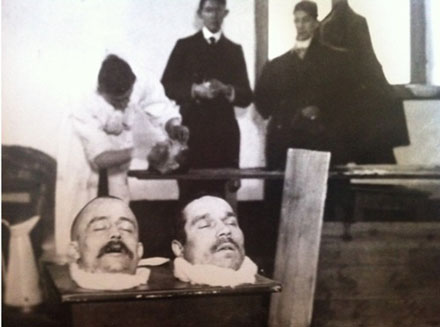
Top: the heads of the Pollet brothers. Middle: The heads of their two accomplices. Bottom: Canut Vromant’s headless trunk awaits autopsy. All images from the invaluable Bois de Justice, via this goregrish forum.


After the quadruple executions, the heads are cleaned up. (Source)

Perhaps, dear reader, you find the public exhibition of these severed heads objectionable. If so, you have an ally in the French state that did the severing.

For years, French elites had been fretting the indecorous behavior of the crowd at what was supposed to be a solemn occasion. The advent of photography only made matters worse, for now the discomfiting head-chopping exercise could be shared with those indisposed to sitting up all night smoking pipes in trees.

But as the moratorium gave way, the rising media form of cinema promised even more debased exhibitions. Enterprising cinematographers were already staging execution re-creations; now there was the prospect for film audiences to be incited to countless bloodlust frenzies by on-the-scene deathporn footage of hated criminals going under the blade. It was in response to just this fear that France a bit later in 1909 promulgated (French link) its first film censorship rules — forbidding in this case the public display of film liable to disturb the public tranquility.

* Jan. 16, 1909 … under the excited headline “THIRST FOR BLOOD AMONG THE FRENCH”,

On this day..

2013: Zhang Yongming, cannibal corpse

(Thanks to Meaghan Good of the Charley Project for the guest post. -ed.)

One year ago today, 57-year-old Zhang Yongming was executed in China, just six months after a court in the province of Yunnan convicted him of murder. Zhang, a farmer, was modern China’s answer to Fritz Haarmann: authorities believe he killed young men and boys, cannibalized parts of their bodies and sold the leftover flesh at the village market.

Convicted of eleven murders, he’s suspected of six more.

When young people started disappearing in the neighborhood, the police initially assumed they’d been kidnapped and sold for slave labor, a sad situation that’s all too common in present-day China.

From TruTV:

Witnesses reported that Yongming began selling meat at the local market, which he had never done before, after 1997. The meat, which he sold as ostrich meat, was cured and dried.

When police finally searched Yongming’s house, they found strips of human flesh that were hung up to dry around his house. He kept dozens of human eyeballs preserved in alcohol in bottles, which police said looked like “snake wine.” Investigators said Yongming likely fed human remains to his dogs. In a nearby vegetable garden, police found bones believed to be human.

This wasn’t the first time Zhang had faced the death penalty, either: in 1979, he was convicted of murder and sentenced to death, but the sentence was reduced and he was released from prison in 1997. The government even helped him get back on his feet by giving him a bit of land and a monthly allowance.

But Zhang simply couldn’t stay on the straight and narrow: by the spring of 2008, he’d started killing again, and the murders didn’t stop until his arrest four years later.

Following his conviction in July 2012, he confessed to his crimes and didn’t bother to file any appeals. He reportedly showed no remorse and didn’t offer any apologies for his victims’ families or any explanation for his conduct.


Zhang’s victims.

On this day..