1284: Alice Bowe and her friends

(Thanks to Meaghan Good of the Charley Project for the guest post. -ed.)

At some unspecified day in November 1284, in Edward I’s England, Alice Bowe or Alice at the Bowe (not the garden designer of the same name) was burned at the stake for murder, and seven of the men who took part in her same crime were hanged.

Alice and sixteen others had lynched a guy who’d attacked their friend.

Alfred Marks’s 1908 book Tyburn Tree: Its History and Annals, available for free here, tells the story:

In the year 1284, the 13th of Edward I., Laurence Ducket, goldsmith, having grievously wounded one Ralph Crepin in Westcheape, fled into Bow church, to the which, in the night time, entered certain evil persons, friends unto the said Ralph, and slew the said Laurence, lying in the steeple, and then hanged him up, placing him so by the window as if he had hanged himself, and so was it found by inquisition: for the which fact Laurence Ducket, being drawn by the feet, was buried in a ditch without the City: but shortly after, by relation of a boy, who lay with the said Laurence at the time of his death, and had hid himself there for fear, the truth of the matter was disclosed.

Wherefore a certain woman, Alice atte Bowe, the mistress of Crepin, a clerk, the chief causer of the said mischief, and with her sixteen men, were imprisoned, and later, Alice was burnt, and seven were drawn and hanged, to wit, Reginald de Lanfar, Robert Pinnot, Paul de Stybbenheth, Thomas Corouner, John de Tholosane, Thomas Russel, and Robert Scott. Ralph Crepin, Jordan Godchep, Gilbert le Clerk and Geoffrey le Clerk were attainted of the felony and remained prisoners in the Tower.

The church was placed under an interdict by the archbishop: the doors and windows stopped up with thorns. But the body of Laurence was taken from the place where it lay, and given burial by the clergy in the churchyard. After a while, the bishop of Rochester, by command of the archbishop, removed the interdict.

On this day..

1933: Thomas Thurmond and John Holmes lynched in St. James Park


This still-notorious lynching — America’s seminal lynching for the broadcast media era — has been portrayed several times on the silver screen.

On this day..

1881: Four Black Friday hangings

November 25, 1881, was the day after Thanksgiving. And that date was a true “Black Friday” on the American gallows: four distinct murderers, all African-American men, were hanged in four different cities on this date in 1881.

We’re cadging entirely from the New York Herald of Nov. 26, and all quotes (as well as the pictured headline) source to that journal.

Richard James (South Carolina)

Richard James hanged in Marion, South Carolina for the previous year’s murder of a local shopkeep, David M. Harrell.

James insisted on his innocence, and even “turned upon the preacher with indignation” at in his cell on his last day when importuned to unburden himself of his sin. He “swore by all that was holy that he knew nothing of the crime, and was ready to face his Maker with this oath on his lips.”

James, “a light colored negro about thirty two years old” who “looked capable of committing any crime” and had a bad reputation in town, had been tried with his two brothers, Benjamin and Lewis for having waylaid the Harrell on his way home from closing the store.

A mixed-race jury (nine whites, three blacks) convicted the first two but acquitted Lewis. Benjamin had already been executed some weeks previously.

Henry Johnson (South Carolina)

Shortly afternoon that same day, Henry Johnson hanged in the jail in Sumter while “the housetops and fences near the jailyard were crowded with negroes, who heightened the scene by melancholy exclamations.”

Johnson, who converted to Catholicism the week before his death, occupied his last morning writing to a sweetheart in Port Royal, S.C. (He sent her some wooden buttons to remember him by, and demanded that she never marry.)

While he went mildly, his crime was “one of the most cold-blooded and unparalleled murders ever known in South Carolina.” (Of course, newspapers say this about every crime.)

John Davis, a good and hard working colored man was going through Hope Swamp on his way to the forest, where he was employed to cut cross ties for the railroad [but] he was followed by one Henry Johnson, also colored, who shrouded himself from view by the thick undergrowth. Thus, Indian like, he thirsted for his victim’s blood, and followed David step for step with the greed of a hungry panther until they arrived at a point where the depth and loneliness of the swamp was best suited for the tragedy that was enacted. The desired spot having been reached, Johnson, without uttering a word, raised his gun and fired, shooting John Davis in the middle of the back. Davis dropped dead in his tracks instantly. Johnson then caught him by his heels and dragged him to a hollow log, in which he placed Davis and then covered the log all over with … straw and leaves.

And then Johnson went to Davis’s house, where he knew he would get a good reception since Davis’s wife fancied him.

Explaining that Davis had had to go into town on business and would not be back for a day or three, Johnson made himself “not only lord of Davis’ house, but his much beloved wife.” He tried to lay the blame on a local fellow named Orange Isaacs whom Johnson by all appearances sincerely believed to be a sorcerer.

Joseph Harris (Tennesee)

In Rogersville, Tenn., Joseph Harris hanged for slaying two men in November 1880 in a crime that aroused so much local hatred that he was stashed away in Nashville until two days prior to the execution to prevent the appearance of lynch law.

Unlike the South Carolina condemned, Harris’s hanging was fully public, and a fair concourse of onlookers braved freezing temperatures to satisfy themselves with the course of justice.

Harris had targeted the outgoing proprietor of a country farm called Marble Hall. John Brown, having sold the estate, had sent his family on to their next lodgings in Bristol while he remained at Marble Hall with a 17-year-old stable hand named Heck to sell off the remaining livestock and close up affairs.

Those affairs were closed for good on November 23, when the room that Brown and Heck occupied was discovered on fire, its inhabitants having had their brains bashed in. $500 Brown had recently pocketed from the sale of his hogs was missing.

Sang Armor (Georgia)

Sang Armor not only had the most unusual name of November 25’s grim harvest, but was distinguished as the first-ever public execution (or execution of any kind) in Taliaferro county, Georgia. Taliaferro is currently (circa 2010 census) the least populous county east of the Mississippi with a population of just 1,717.

Armor was egged on by the crowd at his gallows to give up the names of accomplices whom he had previously implied had aided him in the murder of an elderly white man, but he remained “sullenly silent on the subject and talked only on religious matters.” The scaffold was erected in Ellington meadow, on the land of his victim, Amos Ellington.

“The feeling against Armor was very strong,” concludes the report, “especially among the colored men, several of whom he tried to implicate in the crime.”

Not Squire Clark (South Carolina)

It wasn’t all doom and gloom. Squire Clark, who was supposed to hang in Lexington, S.C., was respited until December 23.

Clark, sentenced to be die in a strange case where a body was found on a railroad tracks, mutilated by passing trains, had been convicted circumstantially for having killed the fellow before dumping his remains on the tracks. Convicted, overturned on appeal, convicted again, and ultimately commuted to a penal sentence, Clark never made it into the executioners annals.

The estate of his victim later sued the railroad for negligence in having run over the remains of W.S. Hook no fewer than three times.

On this day..

1903: Peter Mortensen, divinely accused

On this date in 1903, Peter Mortensen was shot over a lumber bill.

The evidence against Peter Mortensen was circumstantial: a moonlight witness, some unexplained cash, and a perceived insufficiency of vigor in insisting upon his innocence when suspicion fell upon him.

Though this much sounds pretty speculative, Mortensen’s very direct pecuniary interest in Hay’s death was harder to wave away. Mortensen, a Salt Lake contractor, owed money to George Ernest Romney’s* Pacific Lumber company. On the evening of December 16, 1901, he summoned Romney’s employee James R. Hay — who was also Mortensen’s friend, neighbor, and fellow-teacher at a Mormon Sunday school — to pay up.

Hay never made it home.

The next day, Mortensen had a receipt for the payment in Hay’s hand, and Hay had a cashless grave and a bullet hole in his head. Rarely have means, motive, and opportunity converged so exactly.

Public sentiment against Mortensen was so overwhelming** that selecting an impartial-ish jury proceeded at a weeks-long crawl as Mortensen’s attorney met prospect after prospect by bluntly asking whether they had formed an opinion as to his man’s guilt. Prospect after prospect confirmed that they had done. By the end, the court had been reduced to issuing “open venires” bypassing the regular jury summons process and authorizing anyone handy to be inducted into the jury pool. Deputies scoured Salt Lake City like press gangs, hunting for possible jurymen.

In all, the court dismissed some 600 prospective jurors for bias (which was quite a lot for the time), and ran through $4,500 in that process alone (likewise).

Those finally seated had to weigh, along with the more conventional indicia of guilt, the inflammatory witness testimony of James Hay’s father … who said he didn’t just have a pretty strong suspicion about the defendant, but that he actually knew Mortensen did it. “God revealed it to me,” the elder Hay said with “tears streaming down his cheeks” according to a report in the Idaho Daily Statesman of June 6, 1902.

He appeared to me by the Holy Ghost and put the words of His Spirit into my mouth. I had to utter them, for I knew they were true. I cannot and will not deny it here, neither will I deny it when I meet my God on the last day.

This is not the only manifestation I received. On Tuesday noon I saw the trail of blood leading from the railroad tracks to where my son-in-law was buried. I saw it in a vision just as plainly as when I afterwards visited the spot.

Again, this is judicial testimony in an American courtroom in the 20th century.

The fact that it appeared — and that the trial court refused a defense demand to instruct the jury not to consider supernatural visions in the light of real evidence — formed the central argument of Mortensen’s appeal. In the end, Utah’s Supreme Court refused to vacate the sentence. Still, the weird appearance of “divine revelation evidence” in a Utah courtroom led the Mormon patriarch Joseph F. Smith to issue a finding distancing the Church of Jesus Christ of Latter-Day Saints from any embarrassing mummery:

[N]o member of the Church of Jesus Christ of Latter-day Saints should, for one moment, regard such testimony as admissible in a court of law, and to make the case perfectly clear it may be further stated that such evidence would not be permissible even in a Church court, where rules of evidence, though not so technical, are founded largely upon the same principles that govern the rules of evidence in a court of law. Any attempt, therefore, to make it appear that such evidence is in keeping with the tenets of the “Mormon” faith is wholly unjustified

About six weeks before Mortensen’s execution, a prison break took place at the penitentiary. It’s been given out latterly that the arrogant Mortensen was so unpopular even with his fellow-prisoners that they intentionally left him stuck in his cell. 1903 press accounts appear to indicate otherwise — that he was not the only convict left stuck in his cell, and that Mortensen’s particular rum luck wasn’t a social lack but a digital one: somebody dropped the necessary set of keys. Either way, there was no way out, and neither when Utah’s governor interviewed Mortensen personally to see about his mercy application. Never mind his popularity with prisoners; Mortensen’s continued insistence on innocence while pleading for his life was the real diplomatic failure.

Mortensen selected shooting rather than hanging as his method of death, and went to it “firm as a rock.” He left only a last statement repeating his vociferous and widely disbelieved denial of Hay’s murder.

To the world I want to say and swear by the heavens above, by the earth beneath, and by all I hold near and dear to me on this earth, that I am not guilty of that cowardly murder of my dearest friend. I ask therefore no man’s pardon for aught that I may have done in life. I am confident that my life is an example to most people. I lay no claim — please strike out the last two words — I do not say that I am better or more worthy of respect of the world than the average man, but I have done my duty to my father and mother, my brothers and sister, and to other near relatives. I have done my absolute duty toward my wife and my five little babies. May God keep and care for those sweet darlings.


Salt Lake Telegram, Nov. 20, 1903.

* Yes, those Romneys. George Ernest Romney‘s significantly younger first cousin George Wilcken Romney became Governor of Michigan, and was in turn the father of the 2012 Republican Presidential nominee Mitt Romney. The mutual grandfather of George E. and George W. designed the St. George Tabernacle.

** Even Mortensen’s wife thought him guilty, for he had gone out that fatal evening of the 16th with Hay, and returned an hour later “deathly pale.” However, while God’s hearsay to Mr. Hay was available in open court, Mrs. Mortensen’s evidence was not: Utah law prohibited wives testifying against their husbands.

On this day..

1720: Edward Hunt, the first counterfeiter executed in colonial Pennsylvania

On November 19, 1720, Edward Hunt was hanged in Philadelphia. He was the only Pennsylvanian executed for treason prior to the American Revolution — that treason being not the betrayal of the state (in the sense we might think of it today), but counterfeiting.

In the bitterness of his scaffold speech, which disdains the customary acknowledge-my-guilt, pray-for-my-soul form of the genre to complain about his case, Hunt made plain that he was not reconciled to the justice men had rendered him.

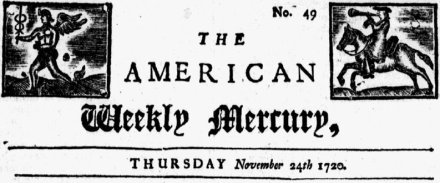
The American Weekly Mercury of Thursday, November 24 published “this extraordinary Piece” only with a preface complaining that “it is evident, that the following Speech was intended to misrepresent the Administration and Justice of this Government, as well as to infuse both ill Principles and Practices into the Minds of the People.”

The Dying Speech of Edward Hunt, formerly taken in Rebellion at Preston, and transported a bound Servant to the Island of Antigua, before his Execution upon the 19th Instant, at Philadelphia, where he had been legally convicted of High Treason, and most justly condemn’d for his Counterfeiting Spanish Silver Coin, made current* by Act of Parliament within all his Majesties Colonies in America.

It may be expected, that I should say some thing now concerning my Life and Conversation, which i must with Sorrow own to God and the Word has not been according to the Precepts and Principles of the Church, in which I was bred and educated: But with a sincere repentance and hearty Sorrow I do lament all the Errors of my past Life, firmly believing in my Saviour Jesus Christ, in whose Merits and ever flowing Mercy I do only trust for Salvation and Pardon, who has promised Eternal Life on no other Terms to the most Righteous upon Earth.

As to the Crime that now I suffer for in particular, I must own it is an Offence against the Laws, which I hope God will pardon me since he knows that I did not do it with any Design to cheat or defraud any one, or to make a Practice of Coining; but being ignorant of the Breach of any Laws of God or Man, I thought I might cut those Impressions as innocently as any other, or the Stamps that the Gentlemen of this place imploy’d me about, to make Farthings.** I am an English Subject, and desired to have the Privilege of the Laws of England, but it was not granted in any Point, except in Condemning me.

I am the first unhappy Instance of this kind that ever suffered in the King’s Dominions, pray God it may be a Warning to all, not to offend wilfully in the same that I did through Ignorance: For if I had known it, I would not have taken all the World to have done it. God give me a patient Resignation to submit to his blessed Will, in whatsoever he please.

I do heartily ask Forgiveness of all that I have offended in any manner of way, and do sincerely forgive all that have injured or offended me; particularly Mr. John Moore and Morris Birchfield, and the Evidence that swore against me in that Tryal. I do solemnly declare, That I know not any thing, or have been guilty of any one thing laid to my Charge in that Matter, or any of the other things laid to my Charge, by John Butler, either in England or Ireland.

I did petition the Honourable Governor for a Reprieve, until the King’s Pleasure was known concerning me, being I could not be tried by the Laws of England in all Points, as a Church of England Man ought to be: But it was a Privilege too great for me to obtain. Pray God to forgive them all, and every one that has a hand in taking away my Life any manner of way, and that my Blood be not required at their Hands, for they know not what they do. I am on Earth judged and condemned to die for the Breach of a Law of Man that was not duly published, which for that Reason I transgress’d it ignorantly, though the first that suffers for the Transgression of unknown Laws, or that was sentenced according to the Laws of England, without the Privilege of a Subject, which I desired of the Judge, which I know was not qualified by the same Laws to try me.

I do not know what Advantage there can be to any in my Death, and that I could not appeal to my King, neither before nor after my Tryal. I do not speak this because I am not in Charity with all the World, I do, from the Bottom of my Heart, forgive all in Obedience to my Saviour’s Command and Example, who suffered more for me, being innocent, and had not only done no Harm, but Good, and pray’d even for is cruel Persecutors and Murderers, and promised, That those that follow his Examples in this World by patiently enduring the Cross, shall reign with him to all Eternity: To Him therefore I commit all, an my poor Wife, beseeching him to help her, and be her Support and Comfort, and preserve her poor Soul free from the Polutions [sic] of the World, that through his precious Merits we may meet where we shall be both happy to all Eternity, in the merciful Arms of our dear Lord and Saviour Jesus, who I do beseech to receive my poor Soul.

According to Kenneth Scott’s Counterfeiting in Colonial America, Edward Hunt’s wife, Martha, got a £500 fine and a lifetime prison sentence for misprision of treason. (If that book is up your alley, Scott has an even more specific Counterfeiting in Colonial Pennsylvania.)

* Early colonial American commerce was severely hampered by a shortage of English/British currency. As a result, coins minted in Spain’s lucrative southern territories served as the colonies’ primary currency in the 17th and 18th centuries, particularly the iconic eight-real silver “pieces of eight”.

This is the reason why the currency of the present-day U.S. isn’t an “American pound sterling” but the almighty dollar: Dutch colonists had brought a coin called the leeuwendaalder to their former New Amsterdam (New York) province, the name deriving from the German thaler. As the pieces of eight corresponded to the thaler/daalder, it inherited the same name. Indeed, the “Spanish Dollar” remained legal tender in the post-colonial United States until 1857.

This is also the reason for reckoning of the eight constituent bits that comprised the dollar, and hence of the American colloquialism “two bits” to denote $0.25 … and, later, the adjective “two-bit” to man something cheap, mean, or small-time.

** They may have been Spain’s coins, but it’s wildly implausible that any Englishman could think he could counterfeit “innocently.”

On this day..

2011: Reginald Brooks, flipping the bird

(Thanks to Meaghan Good of the Charley Project for the guest post. -ed.)

On this day in 2011, multi-filicide Reginald Brooks was executed in the Southern Ohio Correctional Facility in Lucasville, Ohio.* He was the fifth man executed that year and, at 66, the oldest since 1999.


Brooks (top) and the children he murdered.

Although his guilt was never in question, he had spent close to thirty years on death row while his appeals wound their way through the system.

On March 6, 1982, just days after his wife filed for divorce, Brooks shot their three sleeping sons: Reginald Jr., 17, Vaughn, 15, and Niarchos, 11. He then bought a bus ticket to Las Vegas, taking the gun with him in his suitcase, as well as his birth certificate and high school diploma. The police caught up with him in Utah.

Brooks had some history of domestic violence, but his only prior arrest had been for grand theft. His aunt, when asking the appeals board for clemency, said he had a normal, loving relationship with his children. Before shooting them all in their sleep, that is.

His attorneys argued that his crimes were motivated by mental illness, namely paranoid schizophrenia. Brooks had a normal childhood and young adulthood, but started to fall apart in the years prior to the murders. He quit his job in the 1970s because he thought his coworkers were trying to poison him. (He never worked again and his wife had to support their family.)

Beginning around 1980, he began isolating himself from friends and family, and accused his wife of committing incest with Reginald Jr. The family tried to get psychiatric help for him, to no avail.

In spite of overwhelming evidence, Brooks never admitted to his crime and suggested various bizarre theories as to what had really happened. A psychiatrist who evaluated him in 2010 and 2011 believed Brooks genuinely could not remember shooting his sons.

There was, however, clear evidence of premeditation: Brooks had purchased the murder weapon nine days before the murders, lying on his application form where it asked if he’d ever been convicted of a felony. He also turned on the stereo in his apartment and left the music blaring loudly, presumably to drown out the sound of the gunshots. Then, after the murders, Brooks immediately left town, taking documents he would need to start a new life — clearly suggesting cognizance of guilt.

The prosecution conceded Brooks did have schizophrenia, but argued that his illness was not so severe as to make him incompetent or legally insane, and that he was lying when he said he couldn’t remember committing the murders. Attorneys for the state suggested he murdered his children to spite his wife, “through a twisted sense of jealousy, hatred, or despair.”

Brooks’s ex-wife, Beverly, witnessed his execution. He had no last words, but he did give a message: glaring at the glass behind which the witnesses were standing, he stuck out the middle fingers of both hands. And as he slowly lost consciousness and breathed his last, his middle fingers still stood erect.

* The Texas of the North when it comes to capital punishment.

On this day..

1888: William Showers, “pathetic soul”

(Thanks to Meaghan Good of the Charley Project for the guest post. -ed.)

On this date in 1888, after a hearty breakfast of beefsteak, eggs, sweet potatoes and coffee, William Showers became the eighth man judicially hanged in Lebanon County, Pennsylvania.

He had been condemned for the murder of his grandson, William “Willie” Kahler. An account of his trial and death, assembled by the Lebanon County Historical Society, describes the condemned man as he appeared on the day of his execution: “The aged Bill Showers [he was sixty-two] looked like what he was, a pathetic soul. He was only five feet two inches in height and weighed less than one hundred twenty-five pounds.”

Showers had been dealt a hard hand in life, and he didn’t have a good reputation among his neighbors in the village of Annville. Much to the shame of the family, his only daughter Sara had borne six children out of wedlock. Sara died young in 1886, and her father was left in charge of two of her children: six-year-old Willie Kahler and his brother, Samuel “Sammy” Speraw, age four. (What happened to the other four children has not been recorded.)

Bill Showers was a widower by then. For about six months, with the help of his son and his daughter-in-law, Showers did the best he could to provide a home for his grandsons.

But in April 1887, Showers’s son and his wife stopped helping him care for Willie and Sammy. Bill had never wanted the boys in the first place, and he couldn’t afford to feed them on his own.

For about a month the three of them lived alone and Bill tried to get someone to take the children off his hands. He tried a few different foster homes, but he couldn’t afford to pay the foster parents for the boys’ keep. He took them to an orphanage, but they were refused admission. The county almshouse rejected them also.

Bitter and desperate, Bill complained to a friend, “If no one will take them, I have one place to put them. I won’t be a damned fool and raise other people’s children.”

In mid-May, however, Showers’s normally sulky and reclusive attitude suddenly changed and he went to the neighbors and cheerfully announced that he had finally found another home for the children. Two brothers in Schuylkill County were willing to adopt them and take them to Texas to start a new life, and they would be out of Bill’s hair forever. Showers asked his daughter-in-law to mend the boys’ clothing in preparation for their journey.

Then, on May 17, he borrowed the local minister’s buggy and set off over the mountains to Sammy and Willie’s new adoptive home. A few of the neighbors noticed Showers riding out of town that morning. They also noticed that he was alone.

By May 30, the good citizens of Annville were suspicious enough to go to the local constable, Joseph Fegan. When Fegan questioned Showers as to the whereabouts of his grandchildren, Bill told them a most extraordinary story: on the way to Schuykill County, he said, he’d encountered two black men and asked them for directions.

He then stopped to water his horses, letting the children out of the buggy as he did so. When he returned to the wagon, Willie and Sammy were gone. He believed they’d been abducted by the two black men. But he never reported their disappearances, he said, because he was “too upset.”

No one believed this wild story, and the people of Annville organized search parties to look for the two children, whom they were sure had been murdered. They found their tiny, nearly naked bodies that very same day, in a ditch only about 70 yards from Showers’s house. They had both been beaten and strangled to death.

Showers was arrested, charged with murder and lodged in the county jail. Which was just as well for him, because his neighbors were inclined to lynch him. His son hired a very able local attorney, Frank Seltzer, to defend him. Seltzer selected Frank Lanz, a former state senator, as co-counsel.

The Commonwealth of Pennsylvania charged the defendant only with the murder of Willie. The idea was that if they lost that case, they could go forward and try Showers for the murder of Sammy.

The trial date was in mid-June, and the first thing Showers’s attorneys did was move that it be delayed. As the Lebanon County Historial Society puts it:

Seltzer…had a different view of the situation. He rose and objected to the call of the case with a voice that could be heard in the county jail one-half block away. Promptly and resignedly, his tone of voice changed. As if explaining a baptismal font to a heathen, he told the judges that he and Senator Lantz had been retained for less than a week. Their request for a continuance was not made :in the spirit of vexatious delay” but rather for lack of time to prepare the case for trial and, of prime importance, the inability to have a fair trial in the county at the time in light of the prevailing rumors. Adverse pretrial publicity, pleaded Seltzer, rendered a fair trial impossible at this time.

[The prosecutor] Ehrgood replied to Seltzer that he had been given prompt notice he was going to press for immediate trial and Seltzer would have ample time to prepare, since it was only Monday and he would not be ready for trial until the following Thursday. This was a concession which Seltzer and Lantz hardly appreciated.

The judge agreed with the defense, and set a new trial date for September. This would give time for his lawyers to prepare, and maybe for the rumor mill to stop spinning. These were some of the stories floating around:

  • Seltzer murdered his wife in 1886.
  • He also killed his daughter Sara, Willie and Sammy’s mother.
  • He was in love with a local seamstress, Elizabeth Sargent, and killed his family members to get them out of the way so he could marry her.

The press didn’t help matters.

Headlines in the local papers included shockers like “Annville the Scene of a Murder Most Foul!” and “William Showers Dyes His Hands with His Grandchildren’s Blood!”

During the summer of 1887, Showers’s attorney, Seltzer, fell ill and was confined to bed, unable to assist with the defense. It seemed unlikely that the trial would really take place in September. Perhaps Showers couldn’t stand the suspense anymore, for on September 23 he summoned his sons Stephen and William Jr. to the jail, along with the lawyer Luther F. Houck.

Showers made an oral confession to all of them, speaking in his native German, and Houck wrote it down and translated it into English.

The substance of Showers’s confession was that Elizabeth Sargent had agreed to marry him on the condition that he got rid of the boys, and they had agreed to kill them. Elizabeth, he said, helped him strangle Willie and Sammy and dump their bodies in a pre-dug grave.

In court later that day, Showers pleaded guilty to both murders, and his confession was read out for everyone to hear. Elizabeth Sargent was in the audience and she leaped up and shouted, “That’s a lie!” The judge had her removed from the courtroom. The next day she and her parents took a train out of town. Because Showers had implicated her and the police weren’t sure as to whether she was involved in the children’s deaths, the court issued a bench warrant for her arrest.

The townspeople, however, didn’t believe Showers’s second story any more than they had his first one. They were convinced of Elizabeth’s innocence. She subsequently reappeared and presented an alibi, proving she had not been with Showers on the dates he specified in his statement.

When he heard the news about his client, Selzer rose from his sickbed and rushed to court to try to undo the damage. He begged the judge not to accept the guilty plea. In private, Showers told his attorney the confession was completely untrue and he made up the story because he’d been sick and weak, and people who visited him in jail told him he would be hanged if he didn’t own up to what he did.

Selzer’s argument persuaded the judge: Showers’s guilty plea was withdrawn. He finally went to trial on December 15, 1887.

He testified on his own behalf and gave yet another bizarre story, this time implicating a local man named George Matterness and his dead daughter Sara’s husband, a man named Huffnagle. He said Matterness and Hufnagle, along with two other men in blackface, had visited Showers’s home on the night of May 17 and lead Willie and Sammy out of the house. Matterness, Showers said, had later told him the children were buried in the ditch. Showers had told no one about this before because Hufnagle had repeatedly threatened his life.

The prosecution immediately called George Matterness as a rebuttal witness. Matterness, a teacher, freely admitted he knew Showers slightly, but said the whole story was a lie and he was baffled as to why the old man would have implicated him.

Given the circumstances, it’s surprising the jury actually deliberated till midnight and then on to 8:00 a.m. the next morning before pronouncing Showers guilty.

He told Seltzer, “I’m glad they didn’t find me innocent so they can’t go ahead and try me on the indictment for the murder of Sammy.” He expressed hope that he would prevail on appeal, but the Pennsylvania Supreme Court denied him and the governor quickly issued a death warrant.

Three hundred people were allowed into the prison courtyard to witness the execution. Thousands more clogged the streets around the jail into a “solid mass of morbid minded humanity bent on seeing Bill Showers tripped into endless time.”

The morbid mass got its wish. The small, slight man fell only three feet, and his neck was not broken. He strangled slowly for seventeen minutes.

As Showers’s sons all refused to take custody of the body, he was buried on the grounds of the county almshouse. This was the same institution that had refused to accept his grandsons, an act that would have saved their lives.

On this day..

2010: Farid Baghlani, womanslayer

On this date in 2010, Farid Baghlani was hanged in Ahvaz for a 2004-2008 serial murder spree that claimed the lives of six women.

At trial, Baghlani openly attributed his crimes to his hatred for women, probably not a defense calculated to maximize his prospects of acquittal. Those who lost loved ones to Baghlani returned the sentiment, and celebrated his execution by handing out sweets.

On this day..

1942: Eddie Leonski, the Brownout Strangler

(Thanks to Meaghan Good of the Charley Project for the guest post. -ed.)

On this date in 1942, a boyishly handsome G.I. named Edward Joseph “Eddie” Leonski was hanged at Pentridge Prison in Melbourne, Australia.

Although his crimes were committed in Australia and were not war-related, he was court-martialed and sentenced to die under American military law.

This was the first and last time a foreign national who committed crimes in Australia was tried and sentenced under the laws of their own country. Eddie was only the second U.S. serviceman to be executed in World War II. (The first, James Rowe, had been convicted of murdering another soldier and was hanged in Arizona just three weeks earlier.)

Known as the “Brownout Strangler” due to his penchant for attacking women at night on Melbourne’s dimly lit streets, Leonski killed three people and assaulted several others of the course of just over two weeks, from May 3 to May 18, 1942. He said he was fascinated by women’s singing and killed his victims to “get at their voices.”

Leonski was born in New Jersey in 1917, the sixth child of Polish/Russian immigrant parents, and grew up in New York City. Crime historian Harold Schechter notes he had the kind of unstable childhood, dysfunctional family background and mommy issues typical of serial killers:

Both [parents were] confirmed alcoholics. He was seven when his father abandoned the family. Not long afterward, his mother, Amelia, took up with another drunkard. She herself suffered at least two mental breakdowns, severe enough to land her in Bellevue, where she was diagnosed with both manic-depression and incipient schizophrenia. From an early age, three of his brothers were chronic troublemakers, eventually racking up lengthy rap sheets. One of them ended up in a state institution, where he lived out his life.

According to all accounts, Eddie was the apple of his unstable mother’s eye. He, in turn, had the kind of deeply disturbing attachment to her found in other homicidal mama’s boys.

On the surface Eddie seemed to have risen above his origins. He began weight-lifting in adolescence and eventually developed an impressive physique. Following high school he took a three-year stenography course and graduated in the top ten percent of his class. He was a promising employee at a Manhattan supermarket chain before he was drafted into the Army in 1941.

Leonski didn’t do nearly so well in the military: although he was reliable and charming when sober, he drank heavily and was unstable and aggressive when under the influence. As a result, he was always in some minor trouble or another.

But there was a war on and the United States was not in a position to be picky about who would serve. Eddie was sent to Australia in early 1942.

Only weeks after his arrival, he began attacking women and trying to choke them. The first few times, he was interrupted and had to flee before he could accomplish his purpose. Then his crime spree was interrupted in the last week of March after he went AWOL on a six-day bender and was thrown into the brig for a month. As soon as he got out he began stalking women again.

At 2:00 a.m. on May 3, an extremely intoxicated Leonski encountered 40-year-old Ivy Violet McLeod waiting for a streetcar near a dry cleaner’s. He strangled her to death and ripped off her clothing, but was scared away when he heard footsteps.

McLeod’s body was found several hours later: “legs wide apart and feet tucked under her thighs, with genitals exposed.” Her killer had not had time to rape her.

A week later, Eddie was in a restaurant when he struck up a conversation with 31-year-old Pauline Buchan Thompson, a policeman’s wife and mother of two. They went to a bar after dinner and spent several hours talking and drinking.

Close to midnight, Eddie offered to escort her home. On the way, Mrs. Thompson started drunkenly singing.

“She had a nice voice,” he said in his confession. He got angry when she stopped: “I got mad and then tore at her, I tore her apart.”

A few hours later a night watchman found her body on the very steps of her boardinghouse. Like Mrs. McLeod, she was nearly nude with her legs splayed, but had not been raped.

Hours later, a hung-over Eddie Leonski was nursing the hair of the dog that bit him when he told a fellow soldier what he’d done. He made more statements about the two murders over the next few days, but his friend didn’t believe him and told no one what Leonski was saying — time during which Leonski made three more unsuccessful assaults on women.

Eddie’s friend finally took him seriously on the morning of May 19, after the body of 41-year-old Gladys Lillian Hosking was found sprawled in a patch of yellow mud outside Camp Pell, where the American soldiers were stationed.

The previous night, Eddie had come in after midnight, slathered head to toe in the same yellow mud. Too drunk to clean himself up (he’d consumed an incredible thirty beers and seven whiskeys that day), he just shed his soiled clothes and collapsed into bed.

Leonski’s friend finally went to the cops.

When he was arrested, Eddie made no pretense of innocence: he quickly confessed, and various witnesses to his aborted attacks identified him. (That said, Ivan Chapman’s out-of-print book on Leonski makes the point that the evidence against him might not really have held up without those confessions: 1940s forensics techniques would not have yielded a positive match to a victim from his bloodstained trousers, and the yellow mud could easily have been picked up innocently by any drunken G.I. who stumbled traversing the trench.)

Fredric Wertham, a noted forensic psychiatrist who never met Leonski, believed he was insane and the murders were prompted by his twisted relationship with his mother:

That his three victims were all women considerably older than he was is psychiatrically most significant. He unconsciously linked their voices with his mother. The whole psychological explosion occurred in a period of deprivation when he was away from home and separated from his mother — but not from her dominating image. The deeds constituted symbolic matricide.

Very Norman Batesian.

Army psychiatrists, however, believed that while Eddie Leonski was certainly a psychopath, he was not psychotic and was fully aware of the wrongfulness of his acts. Douglas MacArthur personally signed the death warrant.

Eddie maintained a positive, chipper attitude awaiting execution. He spent his time memorizing Oscar Wilde’s Ballad of Reading Gaol, and converted to Catholicism, and went to the gallows singing a popular song that was called, ironically, “It’s a Lovely Day Tomorrow.”

His remains were moved several times before finally finding a permanent grave in a military cemetery in Hawaii. The Australian modernist artist Albert Tucker made a painting titled “Memory of Leonski.” The film Death of a Soldier is based on his crimes.

On this day..

1752: James of the Glen

On this date in 1752, the Scotsman Seamus a’ Ghlinne mounted a gallows above the narrows at Ballaculish with the reproach of Psalm 35 for his persecutors:

False witnesses rose; to my charge things I not knew they laid.
They, to the spoiling of my soul, me ill for good repaid.

Seamus a’Ghlinne — James of the Glen, or just James Stewart — had come there that day to die for the ambush murder of Colin Roy Campbell.

The victim was stock of Clan Campbell, one of the largest Highland clans and one whose loyalties to England’s Hanoverian kings were being richly rewarded.

The Stewarts, who had backed the recent ill-fated Jacobite rebellion in favor of the exiled pretender Bonnie Prince Charlie, were in the opposite predicament.

Colin Campbell was said on that fatal May 14 to be en route to expel the Stewarts from the village of Duror so that Campbells could move in. But even Campbell’s everyday job of extracting resentful rents from estates repossessed from Jacobite sympathizers would have turned many a murderous eye his way.

Someone that day shot Colin Campbell in the back from wooded cover, then vanished, murderous eye and trigger finger and all, never to be never apprehended. So they got James Stewart to answer for it instead.

This wasn’t a tragic case of well-intentioned police developing tunnel vision on the wrong suspect so much as repaying tit for tat in a family feud. The trial was held at the Campbells’ Inverary Castle. Its presiding judge was the Campbell alpha male, the Duke of Argyll. Eleven more Campbells sat on Stewart’s jury. But then, from the Campbells’ side, or London’s for that matter, what was to say that this one murder might not be the germ of a new rebellion if not ruthlessly answered?

Still, there was “not a shred of evidence,” says present-day Glasgow barrister John Macauley, who is pushing for an official reversal of the verdict. “The whole thing from start to finish was a farce.” (Judge for yourself here.)

James Stewart was, however, the foster father of a man who actually was suspected of firing the shot, Allan Breck Stewart, a former Jacobite fighter who had returned from exile in France to collect rents for the Stewarts. Known to have threatened the Campbells previously, Allan was also tried and condemned to death — but only in absentia, since he suspiciously fled to France immediately after the so-called Appin Murder.

Many years later, Robert Louis Stevenson would use this dramatic crime, and Al(l)an Breck’s flight to safety, in Kidnapped. “I swear upon the Holy Iron I had neither art nor part, act nor thought in it,” Stevenson’s Alan says to the fictional protagonist in the novel, just after both have witnessed the murder.

And in reality, Alan too is thought by those who know the case to be clear of guilt in the matter. The Stewart family reputedly knew all along which of their number was Campbell’s real killer, but refused to give him up and kept the family secret for generations. It’s even said that that man had to be forcibly held down on execution day to prevent him giving himself up.

To judge by the most recent research, that man was likely Donald Stewart, the son of Stewart of Ballachulish and the best shot among a group of several young hotheads who resolved together to slay the Campbells’ hated Factor. The conspiracy also goes as the reason — or at least excuse — for keeping Donald silent, since in giving himself up he might see all four of them to the gallows. The late Lee Holcombe makes a comprehensive case for Donald Stewart as the gunman in the 2004 book Ancient Animosity: The Appin Murder and the End of Scottish Rebellion; Donald Stewart was also fingered publicly in 2001 by a matriarch of the Stewarts of Appin, though others of her family have not publicly confirmed that that’s the secret name.

James Stewart’s decaying corpse remained gibbeted on the spot of his execution for 18 months after, a rotting warning to the Stewarts or any late Jacobites. In 1754, a local halfwit called “Daft Macphee” finally tore down the gallows and threw it into Loch Linnhe … but its former position overlooking the modern Ballachulish Bridge is still marked by a mossy stone monument to James of the Glen, “executed on this spot Nov. 8th 1752 for a crime of which he was not guilty.”

A Few Books About the Appin Murder

On this day..