1913: John Williams, the Case of the Hooded Man

One hundred years ago today, John Williams was hanged at Lewes Gaol for murdering a police officer.


Not this John Williams.

Williams was supposed to be the mysterious prowler spotted lurking outside a Hungarian countess’ Eastbourne home on October 9, 1912. The prowler was treed on the portico of the house by a responding police officer, but shot that cop dead and made good his escape.

The ensuing “Case of the Hooded Man” — the branding is not quite Sherlock Holmes, but it suits this blog — concerned the legal contest over whether John Williams was that prowler/shooter.

Circumstantial though it was, quite a lot of evidence supported that conclusion.

The day after the murder, Williams was informed upon by a young friend, Edgar Power, who knew him by his real name of George McKay. Williams/MacKay had passed Power a note on the night the policeman died reading, “If you would save my life come here at once to 4 Tideswell Road. Ask for Seymour [the name of Williams’s girlfriend]. Bring some cash with you. Very Urgent.”

Power set up a meeting with Williams where the police could nab him. (Power would later testify at trial that his friend had bragged specifically about his “good shot” that hit the policeman.)

Not yet done, our busybody stool pigeon then called on Williams’s girlfriend and persuaded her to move the murder weapon she had hidden with her beau … enabling police to grab that piece of evidence, too.

That gun made its mark in the emerging science of forensic ballistics. Seminal ballistics expert Robert Churchill was able to conclusively link this firearm to the portico murder by means of an early application of a now-familiar technique.

Churchill fitted a new hammer and springs and then test-fired [the gun]. Those test bullets had the same rifling pattern as the bullet used to kill Inspector Walls, and Churchill had no doubt about his conclusions that it was a gun of that very same make which had fired the fatal bullet.

In order to demonstrate the technicalities of Churchill’s evidence, Sergeant William McBride, one of the very first police photographers at Scotland Yard, used close-range photography to illustrate the pattern of the grooves on the bullets. He also collaborated with Churchill in placing dentist’s wax inside the gun barrel, then withdrawing it when it had cooled and set hard. This enabled him to photograph the pattern in the wax, caused by the grooves of the inside of the gun barrel, showing the same profile that would match a lead bullet fired through that gun barrel.

A nationwide petition for Williams’s pardon would circulate after his conviction upon the production of some dubious evidence throwing suspicion upon another (phantasmal, so far as anyone could determine) party. The Home Secretary replied to those appeals in the House of Commons a week before the execution:

The house will understand that there is no part of the Home Secretary’s duty which throws greater responsibility upon him or is indeed more painful, then that which has to be exercised in connection with the prerogative of mercy. Of course, any man would be only too glad to find a scintilla of evidence or reason, or I might say to invent a reason, which would enable him to save a human life. But my duty, as I understand it, is to act in accordance with the law and the traditions of my office … the whole story [of a man’s alleged twin brother committing the crime] is an invention because [the man], having known John Williams in the past, he did not like to think of his being hanged.

Thought-of or no, hanged John Williams was.

Part of the Daily Double: Century-Old English Legal Novelties.

On this day..

1913: Edward Hopwood, clumsy suicide

On this date in 1913, Edward Hopwood was hanged for the murder of his girlfriend, Florence Silles.

Silles was an actress and music hall songstress who had broken off her relationship with the 45-year-old manager when she found out that, contrary to his representations, Hopwood was (a) still married; and (b) not wealthy.

Hopwood contrived to track his ex down in a hotel bar, and after an evening’s drinking and talking, the two got into a cab together. There, Hopwood shot her point-blank through the head.

It sounds — and was — pretty open-and-shut, but Hopwood’s bootless defense took the case through a brief detour of an odd cul-de-sac of English jurisprudence. Hopwood claimed that he’d been trying to commit suicide, and that Silles caught her bullet accidentally as she attempted to stop him killing himself.

While it’s clear that nobody else in the court believed this, it’s also the case that suicide is a felony by law. And up until 1957, it was legal doctrine that anyone who, in the course of commission of this felony, managed to kill another person, could be held liable for homicide. (Source)

Accordingly, as the London Times reported on Dec. 10, 1912, that with respect to the attempted-suicide claim, “even if the prisoner’s story were true, the prosecution submitted that in law his crime would be at least manslaughter, and in all probability murder.” Hopwood attempted to appeal his conviction on the basis of botched suicide, and an appellate ruling wrote this very doctrine into precedent.

Part of the Daily Double: Century-Old English Legal Novelties.

On this day..

1656: Joris Fonteyn, anatomized and painted

“On January 28th 1656, there was punished Joris Fonteyn [or Fonteijn] of Diest, who by the worshipful lords of the law court was granted to us an anatomical specimen. On the 29th Dr. Joan Deyman made his first demonstration on him in the Anatomy Theatre, three lessons altogether”.”

-Records of the Amsterdam Anatomy Theatre (cited in this pdf)

Dr. Joan Deyman had succeeded Dr. Nicolaes Tulp in the redoubtable position of the guild’s Praelector Anatomiae — the physician entrusted with the guild’s once-per-year public anatomical reading over the dissection of an executed criminal. In his day, Tulp and his dissection had been painted by Rembrandt.

With the new praelector in the wealthy city came its guild’s need for fresh art to keep up with the Joneszes.

New subject, new work … but the same artist. A mere sapling when he rendered Dr. Tulp, Rembrandt was a fully mature painter of 50 when he put this scene to canvas.

Sadly, this painting was damaged in a 1731 fire, destroying most of its figures, including the titular one.


Braaaaaaaaaaaaaiiiiinnnnnssssssssss! Dr. Deyman’s hands are all that remain of him. The cadaverous Joris Fonteyn, however, belongs to the ages.

Since it was part of the anatomization law for the unfortunate subjects to be given a decent burial, Fonteyn’s exit from the annals of history is another entry (pdf) in the surgeon’s guilds records:

Wednesday, February 2, at 9 o’clock in the evening the body was interred with fitting dignity in the South Churchyard.

On this day..

1909: Remy Danvers

On this date in 1909, French double-murderer Remy Danvers was guillotined in Carpentras.


From Le Matin, January 27, 1909.

Danvers, already a career criminal, signed on as a farmhand at age 22 in 1907 — a period when capital punishment in France was in abeyance owing to the presidency of a death penalty opponent who systematically blocked executions.

On February 1, 1908, he shot that farmer dead to steal some money he learned was available in the house … and for good measure shot his wife too, as she begged him on her knees for her life. He got caught trying to dump the burlap-sacked corpses in the Rhone. (Here’s a French-language summary, from the original Le Figaro report.)

Because of the de facto death penalty moratorium, Danvers didn’t sweat his death sentence too much. However, the outrages of the Pollet gang finally restored the guillotine to the French criminal justice scene earlier in January of 1909. Danvers turned out to be the very next victim in its path.

Shortly before the sentence was carried out, the public prosecutor appeared in Danvers’ cell to advise the doomed man of his appeal’s rejection, and the consequent imminent removal of his head. Fortified by rum, a visibly upset Danvers managed to get through it, but execution-starved French folk crowded a scene that authorities attempted to restrict. Someone snapped this photo:

The unruly public, the New York Times opined, “undoubtedly will hasten Parliamentary action toward making future executions private.”

That date was still some years away, but a France increasingly discomfited by its history of public executions did institute laws forbidding attendees from filming or photographing executions. (Those laws didn’t work, but there they were just the same.)

There’s more about Remy Danvers in this guillotine.cultureforum.net thread (French).

On this day..

1846: Elizabeth Van Valkenburgh, in her rocking chair

On this date in 1846, a 46-year-old woman lamed from a fall got noosed in her rocking chair in Fulton, N.Y.

Elizabeth Van Valkenburgh had been widowed at 34 with four children, when her first husband died of dyspepsia and exposure. “There is no foundation,” the prisoner explained, “for the report that I had in any way hastened his death, nor did such a thing ever enter my mind.”

She remarried shortly thereafter to John Van Valkenburgh, apparently a violent drunk, whose depredations eventually led Elizabeth to get rid of him by spiking his tea with arsenic. “To this act I was prompted by no living soul,” she said in her confession. “I consulted with no one on the subject, nor was any individual privy to it.” She may have been keen to clear any public suspicion from her oldest children — they were old enough to try to get mom to move out of the house with them and offer to help take care of the younger kids. She suffered a fall from a barn’s hayloft as she was hiding out, which crippled her leg.

The key original documents from her trial, including the death sentence and the rejection of clemency (a petition to which 10 of Valkenburgh’s 12 jurors subscribed) are preserved here.

Oh, and one other thing. On the eve of her hanging, the condemned murderess produced a germane revision to her aforementioned confession, recalling that there may actually have been some foundation for the report that she also hastened her first husband’s death.

With respect to my first husband I should have stated that about a year before his death I mixed arsenic, which I purchased several months previously at Mr. Saddler’s in Johnstown, with some rum which he had in a jug, of which he drunk once, and by which he was made very sick and vomited, but it did not prevent his going to work the next day and continuing to work afterwards, until the next June. His feet and the lower part of his legs became numb after drinking this, which continued until his death, and his digestion was also impaired.

I always had a very ungovernable temper, and was so provoked by his going to Mr. Terrill’s bar where he had determined to go and I had threatened that if he did go he should never go to another bar, and as he did go nothwithstanding this, I put in the arsenic as I have said.

Right.

Because of the her impaired mobility, the condemned poisoner was carried in her rocking chair to the gallows, and stayed right in it for the whole procedure. They noosed her up sitting in the rocker, and dropped the platform to hang her as she rocked away in it.

On this day..

1912: Four blacks lynched in Hamilton, Georgia

By dint of the grueling publishing schedule, this site is rarely equipped to follow as deeply into the wilderness as one might like the trailheads uncovered day by day.

Today is 101 years since a lynching in Hamilton, Georgia that made national news and is just pregnant with curious little details that seem like they ought to attract an enterprising researcher.

The four, whose names are conflictingly reported, were tenant farmers of Norman Hadley, described as “a well-to-do unmarried farmer.” Some days before, Hadley was killed with a few .32 and .38 caliber gunshots through a window while sitting home alone.

Why were these four promptly arrested? What was known or believed about their probable grievance against Hadley — especially given the inclusion of a woman? We know that some topics of race relations were taboo at this period, and the bare facts seem suggestive of a much richer background where the nearby Columbus Enquirer-Sun only murmurs that “it was known that he [Hadley] had had some trouble with these negroes.”

Professing himself ignorant of any stirring popular violence — even though the superior court had only just announced a hurried special sitting so that it could try the case with speed lest vigilantes do what they ultimately did — the local sheriff blithely absented himself from town on the night of the 22nd. Would he have done that were he not Norman Hadley’s uncle? Late that evening,

[The crowd] advanced on the jail and throwing [the jailer] to one side broke the doors down. The terrified negroes were hustled out at the point of guns and marched outside the town. There they were quickly strung up. Immediately their writhing bdies became silhouetted against the sky, revolvers and rifles blazed forth and fully 300 shots were fired before the mob dispersed and left its prey to the winds.

The “prey” — all four of the prey — protested innocence every step of the way.

Whatever was abroad in the town, the wire stories that carried this lynching into press runs around the country found “no motive for the killing of Hadley” that “can be advanced by people here.” But they were absolutely certain: the sheriff had said during the preceding week that the accused were all trying to put the blame on one another, but that “it is not known why the negroes, or whoever killed him did so.” (Columbus Ledger, Jan. 18, 1912) So the interrogation never got around to why?

Whatever skeletons were in Harris County closets, the story’s national import was helped along by the near-simultaneous release of a study indicating that the state of Georgia had contributed a quarter (19 out of 71) of the previous year’s lynchings. It fit the narrative, as they say.

The African-American Savannah Tribune, as one might imagine, editorialized indignantly (Jan. 27, 1912):

The lynching of the four Negroes, one woman and three men, at Hamilton, Ga., on Monday night to avenge the death of a prominent white farmer, which was supposedly committed by the victims, was one of the most brutal and wanton crimes ever perpetrated in this state. There was not even the usual confessions of the unfortunate victims given out, in fact they professed their innocence to the end, but the mob was bent on taking their lives and therefore carried out their murderous intentions. The case was as follows: On last Sunday afternoon the man, who was murdered, was sitting in his home alone, a shot was fired through he window and he fell dead. That afternoon four Negro tenants were arrested charged with the murder and the next night they were taken out and lynched. The sheriff, who was uncle of the dead man feared no lynching and took a trip to Columbus, Ga., and in the mean time the Negroes were seized and put to death. Even circumstancial evidence against the Negroes was slight but they had to die to appease the wrath of the mob. Surely such crimes cannot much longer continue without some effort being put forth on the part of the law abiding citizens to stop them. Such dastardly crimes as this are indicative of the low value which is placed upon human life, especially if the life be that of a Negro.

The tone of moral outrage contrasts rather markedly with the Columbus Ledger‘s “let the law take its course” demand for a more orderly hanging scene.

The Hamilton Lynching

Law abiding citizens of Harris county have doubtless been made to blush with shame at the result of last night’s lynching, which cannot but be condemned by all lovers of good government.

Residents of that county were justly wrought-up over the killing of one of their prominent young citizens and punishment for the guilty party or parties could not have been too severe. But the law should have been allowed to take its course.

Judge Gilbert of the Chattahoochee circuit had, upon urgent request of the citizens of Harris, called a special term of the superior court of that county to investigate the case and give the four negroes a speedy trial, that justice might be meted out witout delay, and it appears that everything possible had been done to bring about the apprehension and speedy punishment of the blacks who murdered young Hadley.

Therefore, it seems to the Ledger that there was absolutely no excuse for the acts of last night.

These men may have put to death the guilty parties, or they may have lynched several innocent blacks. They doubtless feel confident that they got the right negro, but have they assurance of this fact?

Law-abiding citizens cannot endorse the acts of this mob, and we must condemn the incident, or any other which tends to disregard law and disrupt government.

Less sentimental still — the heartless progressivism of economy — was the Ledger‘s reasoning on Jan. 26.

Lynching and Business

Lynching has a business side. Most of us have considered more or less the other aspects of it — the breaking of law, creation and increase of a spirit of lawlessness, the turning back of civilization and the taking of human life, without warrant or justification, which is plain murder.

But, lynching has a business side, which is worth consideration at this time.

In other sections the South is regarded by literally hundreds of thousands of otherwise well-informed people as a country of miasma, fever, laziness and lynching …

Day after day, wee after week and year after year, Southern newspapers and other influences that are devoted to the best interests of the South hammer away at this misinformation about our section in efforts to dissipate it. bout the time they seem to be making some headway along comes a lynching or a massacre, like that in Harris county, and the people of other sections believe that their first opinions and ideas were right and have been confirmed. And most assuredly they hae a reason for thinking so.

Just now the South has opportunities that it has never had before. For many years the tide of home-seekers and the trend of capital seeking investment has been westward … [but they are now] turning to the South — and it should be remembered that there are more homeseekers and investors in this country than ever before.

But mob rule, lawlessness, ruffianism and murder will not attract them. Even the leader of a mob would hardly want to move to a lawless section of some other part of the [coun]try. No man who has sense enough to make money to invest would buy property in a section in which the law is so disregarded, for robbery is a lesser crime than murder.

If Harris county alone should suffer for the massacre that has been permitted in the shadow of its courthouse, the balance of us would have little to say. But Harris county will not be the only one to suffer. Muscogee will suffer and so will every county in Georgia and so will the whole South.

It is about time for people in this part of the country to look the matter squarely in the face from a business view point.

On this day..

1894: Albert F. Bomberger, for the Kreider family murders

(Thanks to Meaghan Good of the Charley Project for the guest post. -ed.)

On this day in 1894, Albert F. Bomberger was hanged in the four-year-old state of North Dakota for the gruesome mass murder he’d committed the year before. His execution within sight of the Kreider home where he’d slaughtered six people (and raped a seventh) went off smoothly, but it almost didn’t: when the trap was sprung, his feet were only six inches above the ground.

Born in Pennsylvania in 1871, Bomberger left home as a teenager and worked his way west. At some undetermined point, he was hired to work on the Kreider on a farm southeast of Cando, North Dakota, a job that came with his own room within the farmers’ home. Bomberger was apparently a relative of some sort, and hailed from the same part of Pennsylvania the Kreiders were originally from.

The Kreider family was a large one. Besides Daniel S. Kreider* and his wife Barbara, there were eight children: sons Aaron, 12, David, 7, and Henry, 3, and daughters Annie, 15, Bernice, 13, Murby, 11, Mary, 9, and Eva, 5.**

Bomberger became infatuated with the eldest daughter Annie and would not be put off by her rebuffs. After midnight on July 6, 1893, he sneaked into her bedroom, which was next to his own; Annie kicked him out and threatened to tell her parents if he didn’t quit bothering her. Bomberger slunk back to his bed, furious and humiliated, and plotted revenge.

On the morning of July 7, Bomberger found Daniel Kreider asleep in bed and shot him with a double-barreled shotgun.

Then he went down to the kitchen where Mrs. Kreider was fixing breakfast and shot her to death as well.

And last, he penned up Annie, Aaron, Eve and Henry in his bedroom.

With those kids locked up, Bomberger tracked down Murby, Mary and David, and blasted them with a single load of buckshot each.

13-year-old Bernice attempted escape by jumping out a second-floor window and running for help. Bomberger caught her, and she cried and begged to be allowed to see her family again. He obligingly took her inside, showed her each of the dead bodies (Mary turned out to be still alive, so Bomberger slit her throat), then then shot Bernice dead at close range while she cowered in the corner with her hands over her face.

While Bomberger was thus occupied, Aaron, Eva and Henry escaped his room and hid elsewhere in the farm. The murderer wasn’t interested in them anyway; he turned his attentions to Annie. He raped her in her bedroom, took her to the barn, raped her again and then forced her to make his breakfast, give him $50, and pack his lunch.

Bomberger then tied Annie up, put her in the barn’s loft, saddled up and rode straight for the nearby Canadian border on one of the children’s horses.

He did make it to Manitoba, but that didn’t stop Cando’s sheriff from hopping the 49th parallel himself to arrest the murderer. Bomberger had little to say for himself. He seemed indifferent to his fate and, when asked to explain why he’d committed such a horrific crime, blamed booze.

He even pleaded guilty: the entire court procedure lasted fifteen minutes.

Almost 120 years later, amateur historian R. Michael Wilson would say that, of all the criminals he’d written about in his extensive studies of crime in the western United States, Albert Bomberger stood out as one of the most horrible.

The dead Kreiders were buried together in one grave at a Mennonite cemetery in their home state of Pennsylvania. Some 15,000 people attended their funeral. The murder farm was sold at auction; the house where the murders took place burned down in 1917.

As for the surviving children, they stayed in Pennsylvania after the murders. Annie married, had at least two children and lived a long life: she died in 1960, age 82.


Um …

* The brother of future Pennsylvania Congressman Aaron Kreider (R).

** Various sources give them different ages; these are the best estimations I could make. It’s also worth noting that Murby’s name is occasionally given as “Merby” or “Melby” and Bernice may be called “Beatrice”. I’m going with the names as they were listed in the cemetery records, but those could well be wrong.

On this day..

1907: Three “terrorists” in an Odessa public garden

Chicago Daily Tribune Jan 18, 1907

Hang Terrorists in Public Gardens.

ODESSA, Jan. 17. — The public gardens was the scene of a triple execution today. Three terrorists were hanged in a row after having been condemned to death for the armed robbery of a shop. Their trial took place before a drumhead court martial.


New York Times Jan 18, 1907

ODESSA, Jan. 17. — The public gardens here to-day were the scene of a triple execution. Three Terrorists condemned to death for the armed robbery of a shop were hanged in a row. They obtained only $3.50 from the store they robbed.


This atrocity (derogated as “Field Courts Martial which endeavor to confuse ordinary civil offenses with revolutionary acts leading to the almost daily execution of offenders, who in civilized lands would receive only the most trivial sentences.”) appeared in a petition for the U.S. Congress to condemn the Russian crackdown against agitators in the waning 1905 revolution.

Mark Twain was among the worthies* who lent their name to the appeal:

We, the undersigned, believe that it is time for civilized nations to protest against the atrocities practiced by the Russian Government in its prolonged warfare against its own people.

The subject is one which interests all nations, as a matter of common humanity. On more than one occasion governments have taken action for the amelioration of termination of abhorrent conditions existing in foreign countries. Many instances might be cited, but we content ourselves, as sufficient for our present purposes in citing the case of the Bulgarian atrocities in 1877, when Russia, in taking advantage of the general horror excited by the inhumanities of the Turkish forces within the dominions of the Sultan, intervened in the name of humanity, to rescue the inhabitants of Bulgaria from their deplorable condition. Fifty years before, various European powers, of whom Russia was one, intervened to redeem the Greek inhabitants of the Sultan’s dominions from barbarities and oppression. In seeking now some entirely pacific means of inducing the Russian Government to ameliorate the condition of its subjects, we are asking for nothing which the Russian Government has not itself in times past afforded a good precedent.

This petition and protest rest solely and entirely upon the instances wherein the Russian Government is disregardful of the usual customs of civilized nations; and wherein it is guilty within its borders of flagrant violation of the terms of agreement of the Geneva Treaty of 1864 and 1868 between the Nations, and also the Second Convention of the Peace Conference at the Hague in 1902.

One notices that among the behaviors viewed by this petition’s congressional sponsors as “disregardful of the usual customs of civilized nations” when conducted by tsarist Russia were acts that in other times members of that august body would rise to defend: “Tortures are applied to prisoners within fortresses and prisons to elicit information.”

* Signers also included: New York judge Samuel Greenbaum; “Battle Hymn of the Republic” author Julia Ward Howe; explorer George Kennan (cousin of the famous American diplomat of that name); future Supreme Court Justice Louis Brandeis; and others.

On this day..

1864: Five Virginia City road agents

The frontier town of Virginia City, Montana, saw a quintuple hanging on this date in 1864, authored by the local vigilance committee.


(cc) image from Rich Luhr of the hanged men’s gravestones at Virginia City’s Boot Hill. (It’s one of several American West cemeteries known as “Boot Hill”)

A miners’ boom town since prospectors struck gold nearby the previous year, Virginia City was even, briefly, the capital of the Montana Territory.

For order, it depended upon a Vigilance Committee of local grandees … and that committee had just days before carried out the hanging of Henry Plummer, the sheriff of the nearby mining town of Bannack and a reputed outlaw gang boss.

Plummer’s supposed “road agents” did the wilderness-trail robbery act familiar of the western milieu, but on a nearly industrial scale: it was suspected that “horses, men and coaches” traveling around Bannack and Virginia City were systematically “marked in some understood manner, to designate them as fit objects for plunder.”

The next act in the Vigilance Committee’s confrontation with these highwaymen and bywaymen was to bust up the Plummer network by seizing and hanging five supposed road agents on this date.

The evidentiary basis for these conclusions was varied, and in most cases less than what you’d call ironclad; the club-footed cobbler George Lane was thought to be marking stages for outlaws to hit, but the crippled rancher Frank Parish? Or Jack Gallagher, who wasn’t even on the list of wanted road agents the vigilantes were working from?

(The Vigilance Committee’s Parish Pfouts would record in his diary “that every man executed by the Vigilance Committee at that time was proved to be a murderer or highway robber.” The unsavory whiff of lynch law notwithstanding, those vigilantes have not wanted for latter-day defenders.)

This text summarizes all the accused men’s backgrounds, including the colorful Boone Helm.

Upon the Vigilance men’s summary and predetermined judgment, the quintet was marched down the street to a then-unfinished log structure and strung up on an inside beam.

That log store can still be seen in Virginia City, where it’s kitschily advertised as the Hangman’s Building.

On this day..

1979: Pin Peungyard, Gasem Singhara, and (twice) Ginggaew Lorsoungnern

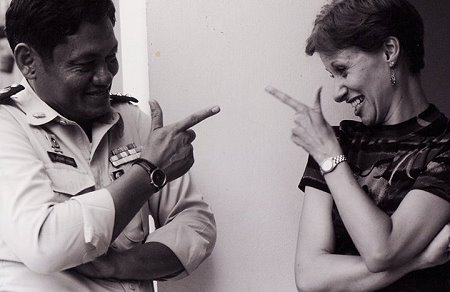
For this date’s entry we turn to The Last Executioner — the memoirs of Chavoret Jaruboon, who was the last prison executioner in Thailand.


Bang. The late (he died in 2012) Chavoret Jaruboon, on the left.

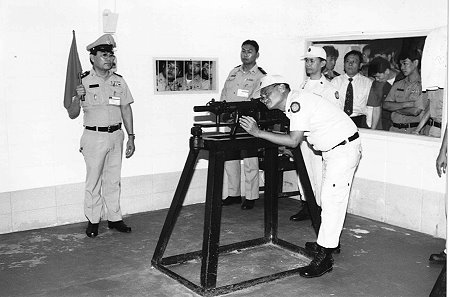
Thailand uses lethal injection today, but our narrator here was the last to conduct executions by that country’s previous execution method, a unique shooting arrangement that prevailed through 2002.*

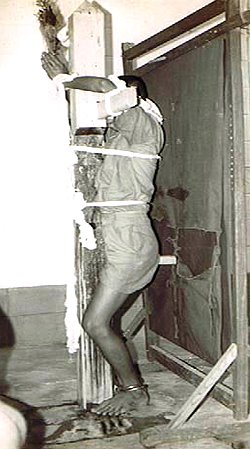
The prisoner to be executed was tied to a wooden cross, hands pinned in a prayerful position (wai), and facing a wall; behind him (or occasionally, as in today’s post, her), a screen; behind the screen, Chavoret Jaruboon with a mounted automatic rifle that would discharge a burst of up to 15 bullets into the vicinity of the heart, generally terminating life immediately.

The clientele this date were three members of a kidnap gang. Ginggaew Lorsoungnern, a former domestic for a Pathumwan, Bangkok family, had picked up from school the six-year-old child who was her former charge and delivered her to a bunch of toughs. When the ransom delivery went awry — the parents were supposed to toss the money out of a moving train at the spot of a flag, but missed the flag owing to darkness — the enraged kidnappers stabbed the little boy to death. Ginggaew allegedly flung herself over the child in a vain effort to protect him.

Inasmuch as her inside position was the lynchpin for the whole operation, however, these hystrionics would not save her from reprisal. (It wasn’t quite judicial reprisal since the execution was carried out by executive decree: not uncommon in dictatorial 1970s Thailand.) It probably didn’t help that coroners discovered soil in the victim’s lungs … meaning that when they’d dumped his body into its grave, he wasn’t yet dead.

The case was a media sensation. The late executioner’s 21st century book (copyright date: 2006) says that he was even then still “constantly asked about Ginggaew.” For what it’s worth, he thought the sentence was too harsh for her part in the crime. But executioners don’t get to make these decisions.

Ginggaew was the first woman shot in Thailand since 1942, and the first that Chavoret Jaruboon ever saw executed. In his time, he shot three women; Ginggaew is not among their number because in 1979, he was only a member of the execution team, not the man with his finger on the trigger. He was an “escort”, part of the team that brought the doomed from their cell to the execution chamber and then removed the corpse.

Escort duty was “one of the most emotional roles in the whole process of execution,” he writes. “Even the executioner does not have to see the body after he has done his job.”

And on January 13, 1979, the day Ginggaew died followed by two of her collaborators, the escorts had especially unpleasant duty.

While the men died stoic, Ginggaew was frantic, and fainted repeatedly over the hours before execution. “I didn’t do it, I didn’t kill the boy,” she pleaded. “Please don’t kill me, I didn’t kill him.”

Worse was to come.

At 5pm Ginggaew was selected to be brought to the execution room first. The escorts helped her to her feet but she immediately crumpled to the ground. She sobbed that she felt too weak to stand … As she approached the room she had to be revived from another faint.

I found this very difficult to deal with. Between us [escorts on the execution team] we finally got the stricken woman to the cross. She cried while they bound her at the waist, shoulders, and elbows. Her arms were brought up over the beam in a position of prayer. Still, she struggled and tried vainly to break free. The escorts pulled across the screen and fixed it so that the white square indicated where her heart was. Then they stepped out of range. I walked to the gun to load it and aim it at the target on the screen. I was aware that Ginggaew was still struggling. Normally once the prisoner was fixed to the cross they gave up fighting, but this was not the case with her. I secured the gun over her stifled sobs, locking it into position. When I was satisfied, I nodded at Prathom to take over. He took his position and at 5.40pm exactly he released ten bullets into Ginggaew’s body.

Doctor Porngul went up to her and checked for the pulse and retina response. As expected, he confirmed her dead. The escorts quickly untied her body, which was bleeding profusely from the chest, and laid her face down on the floor. She jerked and twitched a little. This wasn’t out of the ordinary but was distressing to witness. Her chest burst open and the blood looked like it would never stop flowing. They carried her into the morgue, the tiny room that we used just off the execution hall. I followed them just to make sure everything was alright. They placed her gently on the bed and we went out to prepare for the next one. What happened then will never leave me.

As the second prisoner, Gasem, was brought into the execution room, there was a sound from the morgue. I could see everything from where I was standing as the door was wide open — Ginggaew was trying to get up. The shocked escorts and I ran back to her. There was blood everywhere. One of the escorts rolled her over and pressed down on her back to accelerate the bleeding and help her die. Another escort, a real hard man, tried to strangle her to finish her off but I swept his arms away in disgust. We stood there watching her gasp for breath for I don’t know how long, but it could only have been a minute or two. I was filled with pity for her. I couldn’t help thinking that she was dying the way that little boy had died — except suffocating from blood instead of earth.

Meanwhile, Gasem had been shot. He died instantly from ten bullets. He had not resisted his death in any way, and spoke to nobody on the way to the cross. After the doctor confirmed that Gasem was definitely dead he checked on Ginggaew. Amazingly she was still breathing. It was a horrible, horrible situation. He told the escorts to put her back on the cross. The men complied, somewhat relieved to be able to just follow orders. It was a grim, nauseating job and they were covered in her blood when they turned to pull the screen across. This time the full quota of 15 bullets were used, and finally, she was dead.

You might wonder why we didn’t just shoot her where she lay, but it would have been against the regulations. Also, I don’t know that any of us could have stood so close to the young girl and pulled the trigger. As it was, the escorts moved as quickly as possible, each of us was concerned that her suffering should not be prolonged.

Pin had had to wait outside for ten minutes until Ginggaew was carried to the morgue for the second time. He was then brought in and tied to the cross. At 6.05pm Prathom pulled the trigger, sending 13 bullets into his back. The doctor went to check on him and discovered that he too was still alive, only just, but still breathing all the same. I loaded the gun again and Prathom shot a further ten bullets, this time killing him instantly. We were all in need of more than one stiff drink that evening.

There are a couple of reasons why Ginggaew had such a terrible death. Firstly her heart wasn’t on the left side as with most people. She most probably had Kartagener’s Syndrome, which is when a person is born with their heart on the right-hand side instead of the left. And even if it was she wasn’t secured firmly enough to the cross so she was able to move around, therefore the bullets would miss their target. It showed the importance of binding the prisoner as tightly as possible, for their own sake. I had my doubts when she was first pronounced dead. I thought I could detect some strain in her neck, and maybe that’s why I followed the escorts to the morgue. The head should normally flop backwards with the cross being the only support for the limp body.


Ginggaew, Gasem, Pin, and all others who were executed by shooting entered the execution building through this red door … now disused and overgrown since Thailand scrapped shooting. Pic from this Norwegian Amnesty International page.

After Thailand switched to lethal injection, Chavoret Jaruboon retired to a monastery. His books show no disquiet about his career. He explicitly supported the death penalty.

“What I do is empty this story (the executions) from my mind. If I don’t do that I don’t know what (the executions) will do to me.”

-Chavoret Jaruboon

* We’ve previously written about a 2001 execution by gunfire in Thailand.

On this day..