1857: George Sharpe and John Johnson, Edwardsville murderers

From the Alton Weekly Courier, June 25, 1857, under a June 20 dateline.

Yesterday being the day appointed for the execution of the murderers of Jacob Barth, we dispatched one of our Assistants to Edwardsville, in order that from personal observation we might be able to correctly report the proceedings of this melancholy occasion at the earliest moment. The following is as full and concise a sketch as could be prepared after his return late yesterday evening, and contains, we believe, all the particulars in which our readers would likely feel an interest.

The Day and The Crowd

The weather was very favorable, the day being mild and pleasant. The sun shone clear and warm, but not oppressively so; the recent rains had settled the dust, but had not made any mud, and the roads were consequently in good traveling condition. The rarity of capital executions in this part of the country, together with the recent and very exciting history of this case, conspired to draw out a tremendous crowd of people to witness this the last and severest penalty of the law. It was estimated that there were between seven and eight thousand persons present, some of whom had come from a distance of fifty miles. They were of all ages, sexes, conditions and complexions. A large portion of them were Germans* — friends, relatives and countrymen of the murdered man. Very much to our surprise, mortification and sorrow, we observed a large number of females among the spectators — we say “females,” for we scarcely feel at liberty to designate them as either women or ladies, for we have always thought, and had good reason to think, that every feeling and attribute of a true woman’s nature would generate in her bosom an unconquerable repugnance to voluntarily witnessing any such revolting scenes under any circumstances in the world. Many of the females who were at the place of execution yesterday, and who witnessed the infliction of the dreadful death penalty with the same coolness and indifference as the men generally manifested, were young, and would have been pretty anywhere else and under ordinary circumstances. Why they attended, or what could have induced them to be present at all, we cannot possibly conceive; and in recording the fact that they were there, we feel that their loving, and noble, and gentle sex is by that fact disgraced.

The Prisoners

It is already known to our readers that Robert Sharpe, the younger of the two brothers condemned, has been sent to the State’s Prison for life, under commutation of sentence by Gov. Bissell. The other two – George W. Sharpe, tried and condemned under the name of George Gibson, and John Johnson, who, until after his trial bore the false name of Edward Barber — have been closely attended by Rev. E. M. West and other clergymen, and have appeared to be truly penitent for their crimes. For several days before their execution, they both seemed fully resigned to their fate, and prepared to meet and try the dread realities of eternity; but yesterday morning Sharpe yielded to despondent and despairing feelings, and seemed to suffer dreadfully with fear and terror during the last few hours of his life. The prisoners were both young, heavy set, and rather good-looking men. They evidently had been possessed of healthy and vigorous frames, capable of performing much labor. In preparation for the last scene of their lives. Sheriff Job had arrayed the unfortunate men in very neat suits of clothing, of the ordinary style and fashion, and of perfect snowy whiteness in every particular; they were also cleanly shaved and looked extremely well. Sharpe had two sisters and two brothers, including the one now in the Penitentiary; Johnson had four sisters and four brothers; the parents of both are all living yet; but no relative or even acquaintance who knew them before they committed the murder was beside them in their last trying hour.

The Procession

At half past one o’clock the Sheriff placed the prisoners in a neat and comfortable hack which had been provided, and in which they were conveyed at a slow pace to the place of execution. The carriage was escorted by a portion of the Madison Guards, under command of Captain J. Sloss, fully armed and equipped. A large concourse of spectators followed, but observed good order and decorum. The procession passed along the main street of the town, through its entire length. The prisoners occupied themselves in singing and prayer all the time after they left the prison.

The Scaffold

The spot chosen for the execution was in a ravine east of town, and on the County Poor House Grounds. The scaffold was a neat and substantial structure, as perfectly adapted to its use as anything could be. It was surrounded by rising ground in every direction, so that every person in the vast assemblage could obtain a perfect and near view of the awful tragedy. An area had been laid off by a temporary enclosure, which was guarded by a detachment of the Madison Guards, under command of Lieut. J. G. Robinson, no one being allowed to enter without the permission of the Sheriff.

The Scene at the Scaffold

After those whose duty or privilege it was had ascended to the platform of the scaffold, Sheriff Jon briefly addressed the assembled multitude. He said he was there in his official capacity to perform an unpleasant duty, in executing upon two of his fellow men the severest penalty provided by our laws for the violation of its enactments. Exceedingly unpleasant as was this duty, it was yet a duty, and should be faithfully performed. The example thus set ought not to be lost upon those who had come to witness it. The persons — and specially the youth — of that vast assemblage should take warning from the terrible fate of the two young men so soon to be hurried to the dread presence of an offended God, and avoid the crimes that so justly and so certainly lead to this terrible end. Rev. E. M. West then spoke at some length in explanation of the manner in which and the reasons why the commutation of the sentence of Robert Sharpe had been petitioned for and granted. We cannot possibly give even a skeleton of his remarks in this issue; perhaps we may do so tomorrow. Mr. West then closed with a brief and earnest admonitory exhortation suited to the occasion. The Sheriff then extended a permission — even an invitation — to the prisoners to address the audience, of which Johnson immediately availed himself. He said he stood before his hearers a cold-blooded murderer, of which crime he had been found guilty, and for which he was soon to be so terribly yet so justly punished. In a few minutes, he and one of his companions in guilt would be suddenly launched into eternity, and sent into the presence of the great God whose laws they had violated, with the blood of their victim yet red upon their hands. But he had a humble hope that he had made his peace with God, and that although his crime had been great, his salvation was sure. His soul was at peace; he had no malice in his heart, and he was ready and willing to meet the Judge of all the earth. His punishment although terrible was just, and he was prepared to meet it. If he had remained at home during his early youth and obeyed the pious instructions of his mother, he would not now have been on the scaffold a condemned murderer. He hoped all the youth who heard him would take warning by his example, he influenced by the counsels of their good and pious mothers, keep out of bad company and bad habits and thus avoid the terrible fate that had so soon overtaken him Johnson spoke with much feeling and earnestness and manifested deep emotion while speaking. His remarks were very appropriate to the occasion, and were listened to with respectful attention. Sharpe seemed to desire to speak but was so overcome with the horrors of his situation he was unable to do so. Rev. J. B. Corrington then addressed to the audience a few very appropriate remarks. He had once thought that a saving repentance in view of the certainty of death was almost if not quite an impossibility, but in the two interviews he had had with the condemned in prison, he had received grounds for hope that their repentance was thorough and sincere, and of course acceptable. He hoped, however, none of his hearers would trust their salvation to a death-pending repentance. We have positive evidence of the efficacy of but one such; and God had placed this one case on record in His Holy Word that none might despair, and but the one that none should presume. Mr. Corrington closed with a brief but earnest and heart stirring prayer, in which the prisoners, standing and with clasped hands, joined audibly.

The Execution

The prisoners then shook hands with and took an affectionate leave of each other, the Sheriff and his deputies and the attending clergymen. Johnson seemed perfectly composed and met his fate without exhibiting the least symptom of fear or even regret. He stood erect and without trembling, retained the ruddy natural glow of health in his face, and as much firmness and calmness of mind as in an ordinary business transaction. Often he would clasp his hands, and a smile of apparently perfect happiness would overspread his features. He seemed perfectly willing — even anxious, for his last moment to come. When the Sheriff told them to step on the drop, he turned to his companion and said, “George, which side would you rather stand on?” Sharpe was terribly affected, and was really a pitiable object to behold. His eyes seemed to have almost lost all expression, and exhibited nothing but a glassy, death-like stare; his face was ashy pale, and showed no color save a livid purple hue; his hands were alternately and convulsively clasped and raised in supplication, and he constantly gave utterance to heart-rending moans or incoherent prayers. When requested to step forward upon the drop, he obeyed, exclaiming, “O Lord! have mercy on me! I dare not die! I’m afraid I’m not prepared!” The ropes were adjusted round their necks, their arms were pinioned together across their backs, their hands tied, white muslin caps were drawn over their heads, and when all was ready, at a single stroke, Sheriff Jon severed the cord which held the supporters of the drop, and in an instant the unfortunate murderers were suspended in mid air in the agonies of death. They both struggled very much for more than a minute. In about two minutes after, they fell, Johnson ceased to manifest any signs of life. Sharpe continued to struggle, though less and less, for full five minutes. The knot of the noose had slipped round to the back of his head, and the fall had failed to break his neck; he therefore lived until he was literally choked to death. They both fell about five feet, and if the knot had remained in the right position, his neck would have been instantly broken, of course. After having hung full thirty minutes, the bodies were taken down, placed in handsome walnut coffins, and decently buried. Too much praise cannot be awarded to Sheriff Jon for the kind and considerate, yet firm and prompt manner in which he discharged the unpleasant duty that devolved upon him. The independent, manly and conscientious course he has pursued during the exciting and trying scenes that have occurred at our county seat during the past few weeks has won for him a still greater share of the popular favor of his constituents of which he before enjoyed so much.

* The victim was German; the young men, deep in their cups, murdered him because they took umbrage at Barth’s refusing them a ride. According to the New York Daily Tribune (May 29, 1857), a mob of some 400 lynch-minded Germans assembled in Edwardsville when the accused were granted a change of venue to a more “American” county — and even went so far as to throw up a gibbet before the Sheriff Job who eventually conducted the legal execution dissuaded his immigrant neighbors from effecting an extrajudicial one.

** Bissell was the first Republican governor of Illinois: in fact, one of the first Republican elected officials anywhere. He had previously distinguished a term in Congress (he was elected as a Democrat, before the 1854 founding of the GOP) with his naked contempt for the South’s delegates. For having the temerity to rebut exaggerated claims of Mississippian valor in the Mexican-American War, Bissell at one point prompted the future Confederate president Jefferson Davis to challenge him to a duel: surprisingly (to Davis) Bissell accepted, but word of the affair circulated in Washington and the sectional hotheads were made to cancel their rendezvous.

Here’s an 1858 letter to Bissell by Abraham Lincoln seeking (successfully) the pardon of two Logan County men convicted of stealing a few hogs.

On this day..

1899: John Headrick and Carroll Rice, Missourians

On this date in 1899, young John Headrick was hanged outside Cape Girardeau‘s courthouse for murdering James Lail.

The 19-year-old Headrick was an embittered ex-farmhand of his victim, James Lail — who fired the youth for stealing a buggy.

In July of 1898, he turned up on the farm and found Lail in the barn. Lail’s wife and daughter both saw young Headrick arrive; they would testify that within half a minute of him entering the barn, they heard gunshots.

At trial, Headrick would claim that he shot in self-defense when Lail menaced him with a deadly currycomb (a brush used for horses), offering the prosecutor the opportunity for a bit of sport on the cross-ex:

Q: “You want the jury to understand that you are afraid of your life when a man assaults you with a curry comb?”

A: “Yes, sir, when I am in a place where I can’t get away.”

Q: “Especially if you are armed?”

A: “If I wasn’t armed I would have been killed.”

Q: “He aimed to curry you? He didn’t strike you with the curry comb?”

A: “No, sir, he did not. He struck at me mighty hard.”

Jokes aside, Lail’s surviving family had a terrifying ordeal still to come. As Headrick blasted away at his fallen boss, Lail’s wife Vernie arrived and threw herself over her husband protectively.

The young assailant shot her, too, then began beating her. By now, 19-year-old Jessie Lail was on the scene too. “John Headrick, what do you mean!” she shrieked. “You have wrecked my life forever! You have killed Papa, now you are killing Mother!”

In the ensuing chaos, Vernie Lail tried to make a run for it only for Headrick to chase her down and stab her — to death, or so he thought. Then the young assailant marched Jessie Lail off at gunpoint. Somehow, Vernie Lail survived a slashed throat, a shot through the back, and numerous other injuries to rise yet again and make it a quarter of a mile down the road to her mother-in-law’s house.

“By God, the old woman is gone, you can’t kill her, can you?” Headrick exclaimed to the daughter when they re-crossed the spot where mom’s body should have been. Headrick at this point wisely abandoned the scene of his carnage after trying and failing to extract a pledge from his hostage not to give evidence against him. A posse found him shortly afterwards, hiding in a barn.

The sturdy and surprisingly low-to-the-ground tree on which Headrick was hanged just outside the Cape Girardeau courthouse still stands, or did as of 2010 when it was endangered by a proposed traffic roundabout. Have a gander at the old gallows-tree in this post by Cape Girardeau journalist Ken Steinhoff, here.


Headrick’s hanging took place behind jail walls, but on the same date in Alton, Carroll Rice was hanged before a reported crowd of 5,000 for the murder of his wife.

“Just before the black cap was adjusted, and while his legs were being pinioned, the condemned man broke away form the sheriff and attempted to escape,” press reports ran.

It was worth a try.

On this day..

1873: A day in the death penalty around the U.S., courtesy of the New York Herald

Dispatches to the New York Herald from 1873 give us today’s post: a little portrait of public hangings in Reconstruction Dixie.

Isham Belton O’Neill, 32 at his death, hanged in Atlanta on this date in 1873; the Herald reported it in the next day’s edition.

O’Neill grew up on a farm outside Atlanta but was taken to the city by service in the Confederate army.

Postwar, he started a short-lived painting business with a fellow veteran, John Little: short-lived, because within a few months the courts were sorting out the partnership’s dissolution. Little, evidently, felt hard done by their rulings and “met O’Neill on the street several times after the snit, and even visited him at his shop, always urging him to let him have a sash, which he claimed to be his own property.”

On September 5th, 1871, they bumped into each other again by accident and after a few pleasantriles, Little started in on the sash again. “You got it be swearing a damned lie,” he insisted.

The testimony is that O’Neill then struck him in the face, and [Little] seized O’Neill first by the collar and then by his hands, which he endeavored to hold firmly; but O’Neill, by turning and exerting himself, wrenched his right hand from Little’s grasp, put it behind him and drew from under his coat a large Bowie Knife and quickly stabbed Little in the abdomen, the knife penetrating six inches deep, making a surface cut of two inches long, the sides of which were jagged, as if the sharp, two-edged knife, after having been plunged in, had been twisted round and drawn out.

Enough about the sash, okay?

O’Neill was a respectable fellow in the community (apart from the unpleasantness), and he stuck to a shaky “self-defense” story long enough that he might have started to believe it himself. So even though Little gurgled his last that night with five feet of bowel hanging out of the jagged fissure O’Neill had carved, the killer felt inordinately confident of an executive reprieve.

O’Neill even eschewed the opportunity to escape during a general jailbreak in February 1872, obediently remaining in his spot even with the cell door popped wide open in front of him. Several fellow prisoners successfully absconded on this occasion and avoided recapture.

O’Neill only received word of the governor’s final rejection of his petition at 1 in the morning on the date of his hanging, when “he was awakened out of a sound sleep to receive it.”

Up to that moment he had been confident in the belief that his life would be spared by the Governor, and had refused to listen to the advice of his counsel and spiritual advisers to prepare for death. When he was told that the last hope was gone he felt very bad and was convinced. For the first time he seemed to realize the awful situation, broke down and gave way to piercing cries and lamentations — “Oh! is it all over with me? My God! it is terrible. Does the Governor refuse even a respite? O merciful God, is there no other chance!” and he ended with long heartrending, choking sobs.

We turn now to the Herald‘s June 17 report of a public execution from Lebanon, Virginia.

A steady, sharp stroke of a hatchet, a rope is cut, the crash of a falling drop follows, another rope is stretched to its utmost tension, there is a rebound and the body of Archie Johnson, a negro, is swinging in the air, a solemn warning to an immense multitude of spectators that “he that sheddeth man’s blood by man shall his blood be shed.”

Archie Johnson, “a copper-colored negro, about twenty-eight years of age” with a countenance “regular and well cut for a negro” was the former slave of a local Russell County gentleman.

Upon liberation, the correspondent charges, he “began a career of dissipation and vice,” driving away a wife with his wantonness before he “totally abandoned himself to all that was degraded, vicious and criminal.” At last, he murdered a man named Hunt.

This story is particularly intriguing for the writer’s detailed — often editorializing — reportage of the hanging details.

Not only all Russell county were on the grounds, but from Washington, Scott and other surrounding counties many thousands came to behold the death struggles of a condemned felon. The number of females in the vast throng was somewhat astonishing, and their complexions were as varied as the costumes they wore. Some were as black as a traditional ace of spaces, others as fair as the whitest lily, while the intermediate embraced every imaginable shade between the two. A large number of these came on horseback, their long, dark riding skirts forming a happy contrast with the innumerable bright and gaudy colors worn by the pedestrians. As to horses, all the available racks, trees and fences in town were thickly lined with them, and then it seemed that the surrounding woods were densely picketed with them. The prevailing costumes of the men were blue and gray jeans. The valleys, the knobs, the peaks and plains, the huts and houses, seemed to have poured themselves out to-day, all actuated by the same common, morbid curiosity, and it can safely be said that scarcely a score of them were solemnly impressed by the terrible scene they witnessed. The number present was estimated at six thousand people.

Turning from sociology to engineering, our observer sketches the construction of the lethal apparatus:

THE SCAFFOLD

was a very ordinary, rude affair, consisting of the usual two main uprights, a narrow platform in the rear, in front of which was the drop, supported by a rope. This ran through the crossbeam near the centre, and was secured to a peg driven in one of the uprights, about four feet from the ground. It allowed of a fall of six feet, and was in all respects as thorough and effective as a majority of the clumsy, murderous machines* generally used in such instances in the South. The structure was situated in the old field to the north of the town and about half a mile distant from the jail.

As for Johnson himself, he signed off on a written confession blaming for his downfall those usual suspects: liquor, cards, loose women. Then he puffed a nonchalant cigar as he rode on his coffin to the gallows, “neatly and tastefully attired in a suit of entire black cloth, black cap, with gloves and gaiters”; he sat on a chair beside his noose for two different sermons (Methodist and Baptist), then a hymn which Johnson “joined with great spirit and religious zeal,” asked one last cigar which he puffed happily for ten minutes in which “his coolness just at this time excited the wonder of many and the admiration of more,” and finally at 2:24 p.m. — 48 minutes after he arrived at the gallows — submitted to his fate.


There was a third U.S. hanging on June 13, 1873: Joseph Duncan, in a public execution at Paris, Ky., for murder. All I have been able to learn in particular of Duncan’s hanging was that his first rope broke, necessitating the ol’ do-over.

* Presumably the Yankee’s judgment of the gallows here is informed by New York’s having “progressed” to upward-jerking hangings.

On this day..

1886: Tabby Banks and Tom Honesty, for election rejection

This date in 1886 gives us the double execution of two men named Banks and Honesty — words we don’t hear in the same sentence every day, amirite?


Baltimore Sun, June 5, 1886: the source of all newspaper quotes in this post.

That’s Tabby Banks and Tom Honesty, to be exact, “two full-grown and powerful negroes” who to nobody’s satisfaction denied all the way to the gallows that they had murdered a white 18-year-old, Joseph McFaul, outside the (still-extant) Taylor Hotel on November 14, 1884. The sources I have located do not explicate any beef specifically known to have existed between these individuals; they do, however, situate the conflict squarely within America’s political environment in that electoral year. It is not only in passing that we have noted the parties’ racial identities.

Days before McFaul died, former hangman Grover Cleveland was elected President — the first Democrat to win the office since before the Civil War.

It might be better to say that Cleveland was the first Democrat to hold the office. The tossup 1876 presidential election was more-or-less won by New York Democrat Samuel Tilden, but he was bilked of the prize in an electoral college bargain that exchanged another Republican presidency for the end of Reconstruction.

In the 1870s and 1880s, northern whites were steadily coming around towards Southern whites’ distaste for the ongoing rigor necessary to enforce the putative equality of ex-slaves with their former masters.

Recognizing that such lethargy among white elites in effect amounted to abandoning the field to the violent reassertion of white supremacy, blacks were deeply apprehensive about 1884. Some even feared that chattel slavery might be restored outright. For all the growing indifference of the Republicans, the potential election of the Democrat Cleveland, T. Thomas Fortune wrote during the campaign, “would be a cold afternoon for this country and especially for the Negro and the laboring classes.” (Via)

This is presumably why McFaul, a Democrat taking part in a celebratory parade for Cleveland’s election, would have been hateful to Banks and Honesty. According to the Baltimore Sun, those latter two had previously “traversed the [march] route, threatening to kill some democrat.” Later, McFaul chanced to nominate himself their target by stepping into an alley, where the two churls “immediately attacked him.” Some passing Samaritan saw what was happening and managed to pull McFaul out of the alley and onto the street; still, his assailants did not disdain to press the assault in public view and clobbered the young man with a rock.

Everyone parted and went their separate ways, but young McFaul was a dead man walking. His skull fractured by the stone, he died that night in his sleep.

President Cleveland, of course, did not restore slavery. He took little interest in the situation of black Americans and did nothing to check the onset of Jim Crow, but in this he was not so different from his Republican contemporaries. Nobody among the nation’s white elite had a belly for the fight any longer.

Frederick Douglass had to concede in a Washington, D.C. speech of 1886 that “as far as the colored people of the country are concerned, their condition seems no better and not much worse than under previous administrations.”

Lynch law, violence, and murder have gone on about the same as formerly, and without the least show of Federal interference or popular rebuke. The Constitution has been openly violated with the usual impunity, and the colored vote has been as completely nullified, suppressed, and scouted as if the fifteenth amendment formed no part of the Constitution, and as if every colored citizen of the South had been struck dead by lightning or blown to atoms by dynamite. There have also been the usual number of outrages committed against the civil rights of colored citizens on highways and by-ways, by land and by water, and the courts of the country, under the decision of the Supreme Court of the United States, have shown the same disposition to punish the innocent and shield the guilty, as during the presidency of Mr. Arthur.

On this day..

1691: William Fielding, scammer

Four men and four women stretched their necks at Tyburn on this date in 1691.

Among them we find one William Fielding, condemned for robbing three houses by using a 17th century variant of the Nigerian prince email scam:

The Prisoners came to all the Prosecutors and pretended that there was a Lady Dead who had left them Legacys, and Wheedled them to go to look after it, and the whilest Robbed their Houses; which was lookt upon as a very wicked Invention.

Proving that even confidence men are vulnerable to their own trick, however, the Ordinary of Newgate‘s dispatch from the foot of the gallows reports that Fielding

said, That he was afraid that if he might be spared that he should be tempted to Rob again, because of his extream poverty: Therefore he now submitted to dye willingly, that he might not add sin to sin, and so encrease his future punishment.

Well might he fear hellfire if he took the judiciary for his example. In a time when property was far dearer than life, Fielding himself and all but one of the other seven to hang with him (the one was an infanticidal mother) died for felony thefts of various types — ranging from the pathetic (“stealing from Charles Thurston, on the 4th of this Instant May, one Linnen Bag, value 1 d. and 20 l. in Mony”) to the ludicrous (“Robbing Daniel Leery, on the 12th Instant, in the Street, as he was going along, in St. James’s Parish, snatching his Hat and Perrywig off his Head, in the Night”).

On this day..

1806: Polly Barclay, accessory in the murder of her husband

On May 30, 1806, Polly Barclay of Wilkes County, Georgia was “taken by a proper officer to a gallows previously to be erected in or near the town of Washington, and then and there on the day aforesaid, between the hours of ten o’clock in the forenoon and two o’clock in the afternoon … hung by the neck until you are dead.”

And may God have mercy on her soul.

The purported triggerman, Polly’s brother, had been acquitted of murdering Polly’s husband; then, said assassin turned right around and testified against his sister — who was duly condemned for hiring him. (They do say that Justice is blind.)

But don’t take Executed Today‘s word for it. For this sordid all-in-the-family homicide, we’re pleased to recommend a visit to the annals of Washington, Ga., we gladly defer to genealogist and historian Stephanie Lincecum‘s Peachy Past post.

On this day..

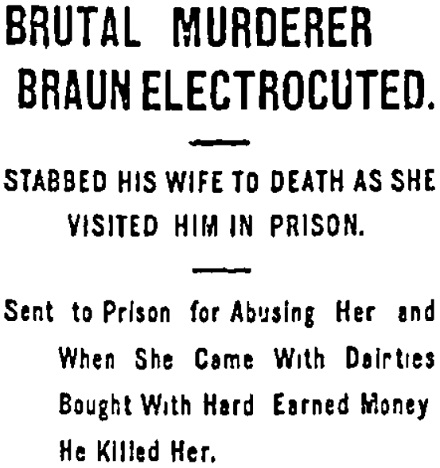
1899: Adrian Braun, who murdered his wife in Sing Sing


Wilkes-Barre Times, May 29, 1899.

On this date in 1899, Adrian Braun was electrcuted at Sing Sing.

Braun was a hulking German cigar-maker with a reputation for habitually thrashing his wife. Authorities got involved when he bashed a neighbor who intervened in a beating so hard that it fractured the man’s skull.

In August 1897, Braun caught a two-year sentence for assault. With her batterer put away, Kate Braun now had to shift for herself; struggling to make ends meet as a washer-woman, she had to give up two of her five children to the St. Joseph’s Roman Catholic Orphan Asylum. Still, she scraped together enough money to buy her incarcerated husband some sweets on a prison visit.

Mr. Braun was at work peeling potatoes in the prison kitchen when he was summoned for the arrival of his spouse in March 1898. After using up their visiting time on a conversation that appeared entirely mutually affectionate, the two were about to part when Adrian Braun suddenly whipped out the potato-knife he had recently been employing and daggered the poor woman’s throat — with lethal effect.

Braun never explained his shocking crime and pursued only a half-hearted insanity defense at his ensuing trial.

“No man was ever executed at the prison who had less sympathy than was felt for Braun,” the Wilkes-Barre Times reported on the day of the man’s execution.

On this day..

1987: Pawel Tuchlin, the Scorpion

Pawel Tuchlin, whose eight-year serial murder spree earned him the nickname “the Scorpion”, was hanged on this date in 1987 — the second-last execution in Poland’s history.

The classic quiet-neighbor-we-never-saw-it-coming type, farmer Tuchlin authored 20 sex attacks on young women in the vicinity of Gdansk from 1975 to 1983. Eleven of the victims survived their ordeals, but a bloodied hammer recovered from Tuchlin’s farm testified to the horror of the nine deaths to his name.

After confessing the crimes, Tuchlin attempted to retract the admission — and upon sentencing in 1985 he anticipated O.J. Simpson by a decade with his vow, “If I am released, I will search for the murderer to the end of my life.”

On this day..

2014: Mahafarid Amir Khosravi, billionaire

Businessman Mahafarid Amir Khosravi, once the wealthiest man in Iran, was hanged one year ago today for embezzling $2.6 billion.

Khosravi rocketed up the world’s rich lists — Forbes estimated that he would slot in around no. 219 in 2012 — during the late 2000s, when he launched the Aria Investment Development Company. This firm sprouted up from a strapling of 50 million rial (just a couple thousand US dollars) to 20 billion rial in just three years — thanks, as investigations ultimately revealed, to a series of bank loans obtained by means of forged documents that bank managers were tricked or bribed into accepting, then using those loans to purchase state-owned companies like Khuouzestan Steel at sweetheart rates.

According to the Associated Press, “Khosravi’s business empire included more than 35 companies from mineral water production to a football club and meat imports from Brazil.” His fall was a gigantic scandal, generally reckoned the largest financial scam in the history of the Islamic Republic.

The condemnation of a top business magnate on the nuclear “corrupt on earth” charge could hardly fail to raise uncomfortable questions about top government officials. In this case allegations of untoward connections were alleged by to go all the way to then-president Mahmoud Ahmadinejad, as a political football to discredit the more liberal elements in Ahmadinejad’s Cabinet.

On this day..

1912: Rev. Clarence Richeson, minister, madman, and murderer

Minutes after midnight this date in 1912, a desexed preacher’s troubled concupiscence was at last abated by the Massachusetts mercy seat.

Some demon ruled Clarence Virgil Thompson Richeson‘s wayward footsteps through this life, and ere its last immolation saw Richeson alternate a serial pattern of abstinent betrothals with bouts of increasingly severe mental instability.

“Clarence had become deranged,” wrote one of the several theological seminaries he attended to his father, explaining why he couldn’t be kept.

Derangement for Clarence Richeson ranged from the merely embarrassing (wet dreams, three or four times a week) to the positively poltergeistian (bouts of raving, delirious lunacy). These foibles proved no obstacle to the charismatic Richeson’s repeated engagement — six or more young women by my count succumbed to his court — although he would later confess that these relationships, never consummated in matrimony, were almost never consummated in bed either. Richeson claimed to have remained a virgin until age 28, and then for most of the succeeding six years as well, even though a book of that period describes him as a “tall, handsome giant with the classic face of a Gibson hero.” On at least one occasion he besought a doctor to castrate him as he feared he could not keep his self-control around women.

Richeson’s strange proclivities kept interrupting the cursus honorum of Baptist pastorships that comprised his professional life: he had to resign from a church in Kansas City in 1904 after proposing to three different women, and a gig in El Paso was cut short when he fell into a spell of paranoid delusion.

1908 finds him a minister once again, now in Hyannis, Mass., and celebrating the birthday of 17-year-old Avis Linnell with an engagement ring. His “spells” or “fits” of madness were continuing as well, and numerous associates would later produce affidavits testifying to his violent outbursts. A doctor (who only quelled Rev. Richeson this night by morphine) recalled one incident:

I was called to see him at the residence of Mrs. Hallet, with whom he was boarding, and when I arrived I found there were with him two or three men whom I knew to be members of his church; he was acting violently and they were trying to control and quiet him both by words and by attempting to restrain him by physical force. He appeared at times to be partly conscious; then he would go into a state whereby he lost consciousness and was practically unconscious, apparently had no knowledge of what he was doing or saying. During this period of time he talked irrationally, raved incoherently, and physically manifested an abnormal degree of strength.

Parishioners decent enough to stand with their preacher would eventually find these private afflictions played out in lurid public detail. That was after Avis Linnell turned up dead at the Boston YWCA where she boarded while studing at the New England Conservatory of Music. It was 17 days before her scheduled Halloween, 1911 marriage to Clarence Richeson, and Miss Linnell was pregnant.

At first ruled a suicide, the case caught the eye of the Boston Post, whose swarm of reporters soon found a pharmacist who had sold Richeson cyanide days before the death of his betrothed. Richeson’s clemency petitions would eventually focus on his unbalanced mental state, but poison, of course, suggests the calculation of the pastor and not the outbursts of the madman within. (We’re getting ahead of ourselves, but doctors arguing for mercy also viewed Richeson as a prime research subject, whose maintenance behind bars could help to avert dangerous mental illnesses in others in the future.)

Matters went very quickly from this point.

Richeson resigned from his pastorship and, while lying in jail under indictment, slashed himself with a sharp piece of tin. Not his wrists, but his manhood — an attempted emasculation that was near enough successful that the physician responding to his shrieks was obliged to complete it in order to close up the wound. Richeson would later insist that he “shall think to my dying day that two men came in and did it” — apparitions of his mind’s creation.

The dying day was quick in coming. Two weeks after his self-mutilation, on January 5, 1912, Richeson withdrew his pretrial not guilty plea and simply copped to the murder. The death sentence was mandatory, but the plea also prevented any opportunity for a jury to rule on whether the killer’s instability lessened his criminal culpability. It was the opinion of some psychiatrists and not a few laymen that it was not simply a matter of Richeson’s state slipping between lucidity and delirium, but that his deterioration over the years had delivered him into a state of permanent derangement. Even Avis Linnell’s mother forgave her daughter’s killer “this dreadful thing” because “it is my belief he went to the electric chair an insane man and that he has been mentally irresponsible for some time past.”

On Sunday, May 19, a day and a half before he became the 14th client of the Massachusetts electric chair, Rev. Richeson conducted his last service — not in the prison chapel (against regulations) but from his own cell. “This is Sunday my last on earth,” he reflected. “If I had lived a righteous life I should today be delivering a sermon from the pulpit of my church in Cambridge instead of being caged here awaiting a felon’s death.”

It had not been so long ago in those environs that any execution would be a prayerful service, condemned together with the congregation. Matters by now were disposed of behind prison bars, but the electrocution of a clergyman was far too rich a theme not to fill New England’s actual pulpits that same day with topical exhortations; indeed, since the Richeson case made national headlines, these were preached all over. (The Olympia, Wash., Daily Recorder of May 20 notes a Presbyterian baccalaureate address that Sunday touching on Richeson as a cautionary example; the Grand Rapids, Mich. Evening Press of May 27 had a preacher at the Calvary Baptist Church declaiming against Richeson’s execution as an instance of anti-clerical prejudice.)

With the witnesses all gathered in the death chamber and just as the last straps were being adjusted the Rev. Herbert S. Johnson stepped forward and asked Richeson the following questions which he answered in a clear voice:

“Would you like to confess Christ as your Savior before these witnesses?”

“I do confess Christ as my Savior.”

“Have you the peace of God in your heart in this hour?”

“I have the peace of God in this hour.”

“Does Christ give you the strength you need in this hour?”

“Christ gives me the strength I need.”

“Do you repent of your sins?”

“I do.”

“Have you the peace of God in your heart?”

“God will take care of my soul and I pray for all.”

“Are you willing to die for Jesus’ sake?”

“I am willing to die.”

Just as he uttered the word “die,” Warden Bridges tapped the stone floor with his gold headed black cane which had been used so many times as a signal to the executioner who switched on the electric current and at 12:17 Drs. McLaughlin, McGrath and Butler pronounced Richeson legally dead. The penalty exacted by the laws of Massachusetts had been paid and all hope of studying this abnormal man for the purpose of aborting criminal tendencies in others of his kind was wiped out in a few seconds.

On this day..