1680: William Howard, Viscount Stafford

(Thanks to Scottish Enlightenment titan David Hume for the guest post on William Howard, 1st Viscount Stafford — a Catholic peer who fell victim to the hysteria of Titus Oates‘s “Popish Plot”. It takes some time to build into the execution itself, since Hume in his History of England narratively locates it in the proto-Whig party’s frustrated parliamentary efforts to exclude from the succession the king’s Roman Catholic brother, the eventual King James II who at this time was the Duke of York. -ed.)

Besides friendship for his brother, and a regard to the right of succession, there were many strong reasons which had determined Charles to persevere in opposing the exclusion. All the royalists and the devotees to the church, that party by which alone monarchy was supported, regarded the right of succession as inviolable; and if abandoned by the king in so capital an article, it was to be feared that they would, in their turn, desert his cause, and deliver him over to the pretensions and usurpations of the country party. The country party, or the whigs, as they were called, if they did not still retain some propensity towards a republic, were at least affected with a violent jealousy of regal power; and it was equally to be dreaded that, being enraged with past opposition, and animated by present success, they would, if they prevailed in this pretension, be willing, as well as able, to reduce the prerogative within very narrow limits.

All menaces, therefore, all promises were again employed against the king’s resolution: he never would be prevailed on to desert his friends, and put himself into the hands of his enemies. And having voluntarily made such important concessions, and tendered, over and over again, such strong limitations, he was well pleased to find them rejected by the obstinacy of the Commons; and hoped that, after the spirit of opposition had spent itself in fruitless violence, the time would come, when he might safely appeal against his Parliament to his people.

So much were the popular leaders determined to carry matters to extremities, that in less than a week after the commencement of the session, a motion was made for bringing in an exclusion bill, and a committee was appointed for that purpose. This bill differed in nothing from the former, but in two articles, which showed still an increase of zeal in the Commons: the bill was to be read to the people twice a year in all the churches of the kingdom, and every one who should support the duke’s title was rendered incapable of receiving a pardon but by act of Parliament.

The debates were carried on with great violence on both sides. The bill was defended by Sir William Jones, who had now resigned his office of attorney-general, by Lord Russel, by Sir Francis Winnington, Sir Harry Capel, Sir William Pulteney, by Colonel Titus, Treby, Hambden, Montague. It was opposed by Sir Leoline Jenkins, secretary of state, Sir John Ernley, chancellor of the exchequer, by Hyde, Seymour, Temple. The arguments transmitted to us may be reduced to the following topics.

In every government, said the exclusionists, there is somewhere an authority absolute and supreme; nor can any determination, how unusual soever, which receives the sanction of the legislature, admit afterwards of dispute or control. The liberty of a constitution, so far from diminishing this absolute power, seems rather to add force to it, and to give it greater influence over the people. The more members of the state concur in any legislative decision, and the more free their voice, the less likelihood is there that any opposition will be made to those measures which receive the final sanction of their authority. In England, the legislative power is lodged in King, Lords, and Commons, which comprehend every order of the community: and there is no pretext for exempting any circumstance of government, not even the succession of the crown, from so full and decisive a jurisdiction. Even express declarations have, in this particular, been made of parliamentary authority: instances have occurred where it has been exerted: and though prudential reasons may justly be alleged why such innovations should not be attempted but on extraordinary occasions, the power and right are for ever vested in the community. But if any occasion can be deemed extraordinary, if any emergence can require unusual expedients, it is the present; when the heir to the crown has renounced the religion of the state, and has zealously embraced a faith totally hostile and incompatible. A prince of that communion can never put trust in a people so prejudiced against him: the people must be equally diffident of such a prince: foreign and destructive alliances will seem to one the only protection of his throne: perpetual jealousy, opposition, faction, even insurrections will be employed by the other as the sole securities for their liberty and religion. Though theological principles, when set in opposition to passions, have often small influence on mankind in general, still less on princes; yet when they become symbols of faction, and marks of party distinctions, they concur with one of the strongest passions in the human frame, and are then capable of carrying men to the greatest extremities. Notwithstanding the better judgment and milder disposition of the king, how much has the influence of the duke already disturbed the tenor of government? how often engaged the nation into meaures totally destructive of their foreign interests and honour, of their domestic repose and tranquillity? The more the absurdity and incredibility of the popish plot are insisted on, the stronger reason it affords for the exclusion of the duke; since the universal belief of it discovers the extreme antipathy of the nation to his religion, and the utter impossibility of ever bringing them to acquiesce peaceably under the dominion of such a sovereign. The prince, finding himself in so perilous a situation, must seek for security by desperate remedies, and by totally subduing the privileges of a nation which had betrayed such hostile dispositions towards himself, and towards every thing which he deems the most sacred. It is in vain to propose limitations and expedients. Whatever share of authority is left in the duke’s hands, will be employed to the destruction of the nation; and even the additional restraints, by discovering the public diffidence and aversion, will serve him as incitements to put himself in a condition entirely superior and independent. And as the laws of England still make resistance treason, and neither do nor can admit of any positive exceptions; what folly to leave the kingdom in so perilous and absurd a situation, where the greatest virtue will be exposed to the most severe proscription, and where the laws can only be saved by expedients, which these same laws have declared the highest crime and enormity.

The court party reasoned in an opposite manner. An authority, they said, wholly absolute and uncontrollable is a mere chimera, and is nowhere to be found in any human institutions. All government is founded on opinion and a sense of duty; and wherever the supreme magistrate, by any law or positive prescription, shocks an opinion regarded as fundamental, and established with a firmness equal to that of his own authority, he subverts the principle by which he himself is established, and can no longer hope for obedience. In European monarchies, the right of succession is justly esteemed a fundamental; and even though the whole legislature be vested in a single person, it would never be permitted him, by an edict, to disinherit his lawful heir, and call a stranger or more distant relation to the throne. Abuses in other parts of government are capable of redress, from more dispassionate inquiry or better information of the sovereign, and till then ought patiently to be endured: but violations of the right of succession draw such terrible consequences after them as are not to be paralleled by any other grievance or inconvenience. Vainly is it pleaded that England is a mixed monarchy; and that a law assented to by King, Lords, and Commons, is enacted by the concurrence of every part of the state: it is plain that there remains a very powerful party, who may indeed be outvoted, but who never will deem a law, subversive of hereditary right, any wise valid or obligatory. Limitations, such as are proposed by the king, give no shock to the constitution, which, in many particulars, is already limited; and they may be so calculated as to serve every purpose sought for by an exclusion. If the ancient barriers against regal authority have been able, during so many ages, to remain impregnable; how much more those additional ones, which, by depriving the monarch of power, tend so far to their own security? The same jealousy too of religion, which has engaged the people to lay these restraints upon the successor, will extremely lessen the number of his partisans, and make it utterly impracticable for him, either by force or artifice, to break the fetters imposed upon him. The king’s age and vigorous state of health promise him a long life: and can it be prudent to tear in pieces the whole state, in order to provide against a contingency which, it is very likely, may never happen? No human schemes can secure the public in all possible imaginable events; and the bill of exclusion itself, however accurately framed, leaves room for obvious and natural suppositions, to which it pretends not to provide any remedy. Should the duke have a son, after the king’s death, must that son, without any default of his own, forfeit his title? or must the Princess of Orange descend from the throne, in order to give place to the lawful successor? But were all these reasons false, it still remains to be considered that, in public deliberations, we seek not the expedient which is best in itself, but the best of such as are practicable. The king willingly consents to limitations, and has already offered some which are of the utmost importance: but he is determined to endure any extremity rather than allow the right of succession to be invaded. Let us beware of that factious violence, which leads to demand more than will be granted; lest we lose the advantage of those beneficial concessions, and leave the nation, on the king’s demise, at the mercy of a zealous prince, irritated with the ill usage which he imagines he has already met with.

In the House of Commons, the reasoning of the exclusionists appeared the more convincing; and the bill passed by a great majority. It was in the House of Peers that the king expected to oppose it with success. The court party was there so prevalent, that it was carried only by a majority of two, to pay so much regard to the bill as even to commit it. When it came to be debated the contest was violent. Shaftesbury, Sunderland, and Essex argued for it; Halifax chiefly conducted the debate against it, and displayed an extent of capacity, and a force of eloquence, which had never been surpassed in that assembly. He was animated, as well by the greatness of the occasion, as by a rivalship with his uncle Shaftesbury; whom, during that day’s debate, he seemed in the judgment of all to have totally eclipsed. The king was present during the whole debate, which was prolonged till eleven at night. The bill was thrown out by a considerable majority. All the bishops, except three, voted against it. Besides the influence of the court over them; the church of England, they imagined, or pretended, was in greater danger from the prevalence of presbyterianism than of popery, which, though favoured by the duke, and even by the king, was extremely repugnant to the genius of the nation.

The Commons discovered much ill humour upon this disappointment. They immediately voted an address for the removal of Halifax from the king’s councils and presence for ever. Though the pretended cause was his advising the late frequent prorogations of Parliament, the real reason was apparently his vigorous opposition to the exclusion bill. When the king applied for money to enable him to maintain Tangiers, which he declared his present revenues totally unable to defend; instead of complying, they voted such an address as was in reality a remonstrance, and one little less violent than that famous remonstrance, which ushered in the civil wars.

All the abuses of government, from the beginning almost of the reign, are there insisted on; the Dutch war, the alliance with France, the prorogations and dissolutions of Parliament; and as all these measures, as well as the damnable and hellish plot, are there ascribed to the machinations of Papists, it was plainly insinuated that the king had, all along, lain under the influence of that party, and was in reality the chief conspirator against the religion and liberties of his people.

Portait of William Howard as a young man by Anthony van Dyck, ~1638-1640. Howard was born in 1614, and beheaded at the age of 66.

The Commons, though they conducted the great business of the exclusion with extreme violence and even imprudence, had yet much reason for the jealousy which gave rise to it: but their vehement prosecution of the popish plot, even after so long an interval, discovers such a spirit, either of credulity or injustice, as admits of no apology. The impeachment of the Catholic lords in the Tower was revived; and as Viscount Stafford, from his age, infirmities, and narrow capacity, was deemed the least capable of defending himself, it was determined to make him the first victim, that his condemnation might pave the way for a sentence against the rest. The chancellor, now created Earl of Nottingham, was appointed high steward for conducting the trial.

Three witnesses were produced against the prisoner; [Titus] Oates [conjurer of the Popish Plot panic -ed.], [Stephen] Dugdale, and [Edward] Turberville.* Oates swore, that he saw Fenwick, the Jesuit, deliver to Stafford a commission signed by De Oliva, general of the Jesuits, appointing him paymaster to the papal army, which was to be levied for the subduing of England: for this ridiculous imposture still maintained its credit with the Commons. Dugdale gave testimony, that the prisoner at Tixal, a seat of Lord Aston‘s, had endeavoured to engage him in the design of murdering the king; and had promised him, besides the honour of being sainted by the church, a reward of five hundred pounds for that service. Turberville deposed, that the prisoner, in his own house at Paris, had made him a like proposal. To offer money for murdering a king, without laying down any scheme by which the assassin may ensure some probability or possibility of escape, is so incredible in itself, and may so easily be maintained by any prostitute evidence, that an accusation of that nature, not accompanied with circumstances, ought very little to be attended to by any court of judicature. But notwithstanding the small hold which the witnesses afforded, the prisoner was able, in many material particulars, to discredit their testimony. It was sworn by Dugdale, that Stafford had assisted in a great consult of the Catholics held at Tixal; but Stafford proved, by undoubted testimony, that at the time assigned he was in Bath, and in that neighbourhood. Turberville had served a noviciate among the Dominicans; but, having deserted the convent, he had enlisted as a trooper in the French army; and being dismissed that service, he now lived in London, abandoned by all his relations, and exposed to great poverty. Stafford proved, by the evidence of his gentleman and his page, that Turberville had never, either at Paris or at London, been seen in his company; and it might justly appear strange that a person, who had so important a secret in his keeping, was so long entirely neglected by him.

The clamour and outrage of the populace during the trial were extreme: great abilities and eloquence were displayed by the managers, Sir William Jones, Sir Francis Winnington, and Serjeant Maynard. Yet did the prisoner, under all these disadvantages, make a better defence than was expected, either by his friends or his enemies: the unequal contest in which he was engaged was a plentiful source of compassion to every mind seasoned with humanity. He represented, that during a course of forty years, from the very commencement of the civil wars, he had, through many dangers, difficulties, and losses, still maintained his loyalty: and was it credible that now, in his old age, easy in his circumstances, but dispirited by infirmities, he would belie the whole course of his life, and engage against his royal master, from whom he had ever received kind treatment, in the most desperate and most bloody of all conspiracies: He remarked the infamy of the witnesses; the contradictions and absurdities of their testimony; the extreme indigence in which they had lived, though engaged, as they pretended, in a conspiracy with kings, princes, and nobles; the credit and opulence to which they were at present raised. With a simplicity and tenderness more persuasive than the greatest oratory, he still made protestations of his innocence, and could not forbear, every moment, expressing the most lively surprise and indignation at the audacious impudence of the witnesses.

It will appear astonishing to us, as it did to Stafford himself, that the Peers, after a solemn trial of six days, should, by a majority of twenty-four voices, give sentence against him. He received, however, with resignation the fatal verdict. God’s holy name be praised! was the only exclamation which he uttered. When the high steward told him, that the Peers would intercede with the king for remitting the more cruel and ignominious parts of the sentence, hanging and quartering, he burst into tears: but he told the Lords that he was moved to this weakness by a sense of their goodness, not by any terror of that fate which he was doomed to suffer.

It is remarkable that, after Charles, as is usual in such cases, had remitted to Stafford the hanging and quartering, the two sheriffs, Bethel and Cornish, indulging their own republican humour, and complying with the prevalent spirit of their party, ever jealous of monarchy, started a doubt with regard to the king’s power of exercising even this small degree of lenity. “Since he cannot pardon the whole,” said they, “how can he have power to remit any part of the sentence?” They proposed the doubt to both Houses: the Peers pronounced it superfluous; and even the Commons, apprehensive lest a question of this nature might make way for Stafford’s escape, gave this singular answer: “This House is content that the sheriffs do execute William, late Viscount Stafford, by severing his head from his body only.” Nothing can be a stronger proof of the fury of the times than that Lord Russel, notwithstanding the virtue and humanity of his character, seconded in the House this barbarous scruple of the sheriffs.

In the interval between the sentence and execution, many efforts were made to shake the resolution of the infirm and aged prisoner, and to bring him to some confession of the treason for which he was condemned. It was even rumoured that he had confessed; and the zealous party-men, who, no doubt, had secretly, notwithstanding their credulity, entertained some doubts with regard to the reality of the popish conspiracy, expressed great triumph on the occasion. But Stafford, when again called before the House of Peers, discovered many schemes, which had been laid by himself and others for procuring a toleration to the Catholics, at least a mitigation of the penal laws enacted against them: and he protested that this was the sole treason of which he had ever been guilty.

Stafford now prepared himself for death with the intrepidity which became his birth and station, and which was the natural result of the innocence and integrity which, during the course of a long life, he had ever maintained: his mind seemed even to collect new force from the violence and oppression under which he laboured.

When going to execution, he called for a cloak to defend him against the rigour of the season: “Perhaps,” said he, “I may shake with cold; but I trust in God, not for fear.” On the scaffold he continued, with reiterated and earnest asseverations, to make protestations of his innocence: all his fervour was exercised on that point: when he mentioned the witnesses, whose perjuries had bereaved him of life, his expressions were full of mildness and of charity. He solemnly disavowed all those immoral principles, which over-zealous Protestants had ascribed, without distinction, to the church of Rome: and he hoped, he said, that the time was now approaching, when the present delusion would be dissipated; and when the force of truth, though late, would engage the whole world to make reparation to his injured honour.

The populace, who had exulted at Stafford’s trial and condemnation, were now melted into tears at the sight of that tender fortitude which shone forth in each feature, and motion, and accent of this aged noble. Their profound silence was only interrupted by sighs and groans. With difficulty they found speech to assent to those protestations of innocence which he frequently repeated: “We believe you, my lord! God bless you, my lord!” These expressions, with a faltering accent, flowed from them. The executioner himself was touched with sympathy. Twice he lifted up the axe, with an intent to strike the fatal blow; and as often felt his resolution to fail him. A deep sigh was heard to accompany his last effort, which laid Stafford for ever at rest. All the spectators seemed to feel the blow. And when the head was held up to them with the usual cry, This is the head of a traitor! no clamour of assent was uttered. Pity, remorse, and astonishment, had taken possession of every heart, and displayed itself in every countenance.
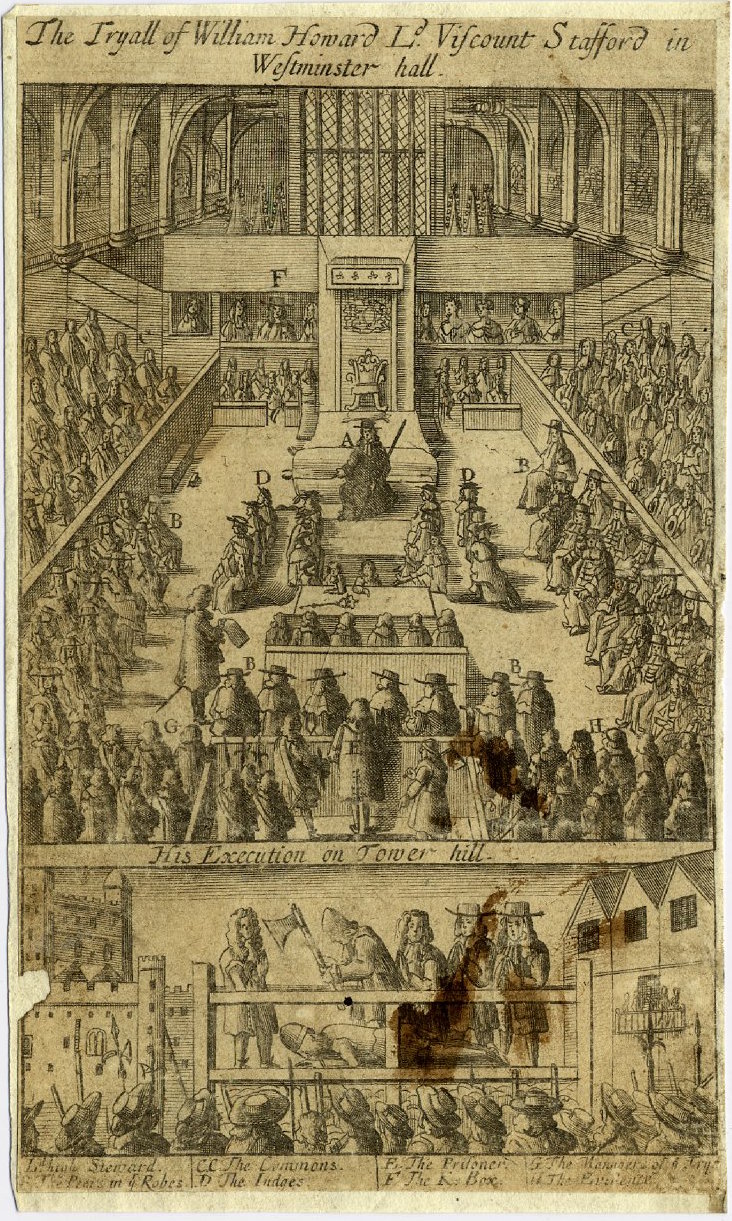

Detail view (click for the full image) of an engraving of the trial and execution of Viscount Stafford. (via the British Museum).

This is the last blood which was shed on account of the popish plot: an incident which, for the credit of the nation, it were better to bury in eternal oblivion; but which it is necessary to perpetuate, as well to maintain the truth of history, as to warn, if possible, their posterity and all mankind ever again to fall into so shameful, so barbarous a delusion.

The execution of Stafford gratified the prejudices of the country party; but it contributed nothing to their power and security: on the contrary, by exciting commiseration, it tended still farther to increase that disbelief of the whole plot, which began now to prevail.

* Channeling Jacques de Molay, Stafford prophesied that Turberville, the perjured witness against him, would not outlive him by so much as a year. Turberville obligingly dropped dead of smallpox late in 1681, after falling out with his former Popish Plot conspirator Titus Oates.

On this day..

1763: John Brannon, Joseph Jervis, Charles Riley, and Mary Robinson

On this date in 1763, four thieves hanged at Tyburn to great public indifference.

They were of such scanty account that one is hard-pressed to find a newspaper report of the executions; even the Ordinary of Newgate didn’t bother to publish on them until weeks later, when he could combine them with a pair of February hangings. (Perhaps because, as he notes in his account, three of the four were Catholic and so gave the Anglican minister short shrift on the confessional front.)

Two of the men — and also one prosecutor, the victim Peter Manchester, who was robbed of his prize money — appear to have been recently from royal service in the just-concluded Seven Years’ War: early avatars of the crime wave that would engulf London as demobilized soldiers and seamen swamped its labor market.

six persons were capitally convicted and received sentence of death, for the several crimes in their indictments set forth, viz.

John Brannon, John Edinburgh, Joseph Jervis, Charles Reiley [Riley -ed.], Mary Robinson, and Mary Williams.

And on or about Friday the 16th of December the report of the said malefactors being made to his Majesty, by Mr. Recorder, two of them were respited, namely, John Edinburgh, for horse-stealing; and Mary Williams, for being concerned with Charles Reily and Mary Robinson in the robbery of Peter Manchester; and the remaining four ordered for execution on Wednesday December the 28th, and were accordingly executed.

1. John Brannon was indicted, for that he, on the King’s highway, on Thomas Worley did make an assault, putting him in corporal fear and danger of his life, and stealing from his person one pair of silver shoe-buckles, value 10s. his property; and Jane Blake, otherwise Buckley, spinster, for receiving the same, well knowing them to have been stolen, October 17.

The prisoner Brannon was one of five in a desperate gang, who attacked the prosecutor Worley, and another, John Paget, in Church-lane, White-chapel, about 12 at night. Having searched them and found no money on them, they took a pair of silver buckles from each, and a handkerchief from Paget: Mean time Esq. Gore’s chariot passing by, they fired two pistols at it, because the coachman would not stop. Brannon was positively sworn to, as one of the two first that came up to the prosecutor, and held a pistol to him while he was robbed. He was detected and taken the next day by means of Jane Blake offering the buckles to a pawn-broker, Mr. Samuel Spencer, who stopped them, secured her, and sent constables to search her lodgings, where they took Brannon, found the other pair of buckles and the handkerchief before mentioned, and also a pair of horse pistols loaded.

His behaviour after sentence was in general such as became his unhappy condition; but being under the influence and direction of the church of Rome, he gave no account to me of his accomplices, or any other fact: Nor did he pretend to deny this, either at his trial or afterwards, as indeed there was no room for it. He appeared to be about thirty years of age, was born in Dublin, was by trade a Carver, and had served six years in the Royal Navy.

2. Joseph Jervis was indicted, for that he, on the 14th day of November, about the hour of two in the night, on the same day, the dwelling house of Joseph Hill did break and enter, and steal one silver spoon, value 1s. the property of the said Joseph in his dwelling.

This convict lived in King-street, Spitalfields; but how he supported himself there, whether by any honest labour, doth not appear either by his own confession, or the evidence of several witnesses for him, who gave only a negative character, that they never heard any ill of him. And supposing he had practised this wicked scheme of breaking into houses, and plundering them in the hour of deep sleep undiscovered for a time, ’tis hard to imagine how they could hear any ill of him, however criminal. As to the present fact, he had prowled away as far as Kingsland, a mile or two, at midnight, to perpetrate it. But here, luckily for the publick safety, he was mistaken in his mark, and fell upon a house well inhabited by a master Carpenter and his workmen: The former, awakened by the noise of wrenching open the frame of a cellar window, alarmed two or three of his men, who came upon him, and with some difficulty seized and secured him; in effecting of which, by means of his resisting and endeavouring to escape in the dark, he had received two unlucky strokes, one with a pistol and another with a hanger, both on the head; by which he was wounded, and made more deaf and stupid than he was before, for he laboured under both those defects during the time between sentence and execution. After he was apprehended, he was found to be furnished with a tinder-box, a dark-lantern, a candle, and an iron bar flatted at one end. A silver spoon was also found upon him, the property of Mr. Hill, the prosecutor.

He had the artifice to plead on his trial, that he was non compos, out of his mind, and knew not what he did. But being reminded by the Court that his situation was very serious, and no proof of this assertion being offered, it was urged no farther. After conviction and sentence passed, he still appeared to be very hard of hearing and dull of apprehension; so that it was a difficult task to instruct and prepare him, whether this was real or partly affected. He said he was born at Hertford, where he learned to read and write, and then was brought up to the trade of dressing flour, which he afterwards followed for several years in London, in or near Houndsditch; he was now about forty-five years of age.

After he had been daily visited, assisted with prayers, and the plainest instructions, he was now and then questioned what progress he had made in his preparation for an awful change; but could give very little satisfaction in that matter, only said, he would trust to Providence; meaning, that he would give no farther account of his past life, nor confess any other facts; tho’ he did not pretend to deny he was guilty of any other.

When he found himself included in the Death-warrant, it did not much affect him, as he seemed to expect it. Endeavours were renewed to prepare him for the holy communion; but with no better success; he pleaded he had lost his memory, as well as his apprehension; and that what he read or heard made little impression, and was quickly gone from him; so that he seemed incapable of celebrating that sacred act of remembrance. However, there seemed to be a greater want of disposition than capacity. To arouse and quicken him, therefore, to a sense of his duty in this respect, he was permitted to be present, and very near, at the administration of the communion in the chapel, the day before he suffered; so as that he could hear and see all that was spoken, or done, without admitting him to partake of it. Several intelligent good neighbours were present now, and on other occasions, who took opportunities to speak familiarly to him before and after service, in order to bring him to a better disposition. But neither did these means kindle in him that desire, which we hoped. He still continued in a languid indifference. As he could still read, and as his last evening was now come, a brief but excellent little tract on spiritual communion was put into his hands, to assist and raise his thoughts this last night of his life. He returned it to me the next morning, and said he had read it. Being asked whether he understood it, and applied it to himself? he replied, he did, as well as God gave him leave; his usual answer to such questions.

3, 4. Charles Reiley, labourer, and Mary Robinson, and Mary Williams, spinsters, were indicted for that they, in the dwelling house of Francis Talbot, near the King’s high-way, on the body of Peter Manchester did make an assault, putting him in corporal fear and danger of his life, and stealing from his person four guineas and one half-guinea, his property, against his will, October 18.

The prosecutor, Peter Manchester, was a sailor, come to town about a week, and had received five guineas prize money the very day of this robbery. Passing along Salt-petre Bank, he was forced into this house by Williams and Robinson, shut in, and his purse violently taken from him by these two women, assisted by Charles Reiley. He was also beaten by the women, while Reily threatened to cut off his hand, if he did not let go the purse to him; by which means Reily got it, containing four guineas and a half, and he and Robinson ran off with it. The prosecutor pursued, but missed them; he then applied to two of his shipmates and a constable to assist him. By help of these, and others, the two women were found out, and apprehended the same night. Robinson being searched, had two guineas and a quarter found concealed upon her. The two guineas she confessed before the Justice next day to be the property of the prosecutor, and that they were given to her by Charles Reily, one for herself, and one for Mary Williams, to reward them for their trouble; and that he kept two guineas and a half, the remainder of the money. But luckily for Williams she had not fingered the guinea; which circumstance, together with her not being able to follow Reily, to get her share from him, seem to be the distinguishing considerations, which might turn the scale for a respite to one of these three, rather in her favour. As for Reily he was caught in the very trap for such creatures of prey. The prosecutor being at Hicks’s-hall next day, to prefer a bill of indictment against them, had intelligence that Reily was then drinking at Newgate, only as a voluntary visiter, went directly and found him there; and tho’ he fled, and had a long run for it, from thence to St. Dunstan’s church, he was there taken, detained in the cage at St. John’s, Wapping, examined, and committed, having confessed the fact, but said it was the first.

Being all three convicted the 10th of December, they came up to chapel the 11th, being Sunday morning, tho’ they professed all to be of the church of Rome. Yet Reily, to my surprize, joined in the service, made his responses, read his part in the Psalms and the Liturgy very distinct and intelligible, as if well acquainted with it. On questioning him, after divine service, he let me know, that he was brought up in an hospital for children on a Protestant foundation in a great city, where he received a common share of good learning and the principles of Christianity, but was now determined to die in the faith of the church of Rome; for which he could give no better reason, than that his father died in that persuasion. Endeavours were used to reason him out of this very groundless and weak resolution, and proper books put into his hands for that purpose, particularly a Protestant Catechism and a New Testament, both which he soon after returned, without suffering them to make any good impression upon him. As to the fact for which he was convicted, he said, he was not in the house when the fray began but, having his lodging there, came in, in the midst of it, and so was drawn in.

He was bred up to the sea from a lad, served his time in the Merchants service, in the New York trade; and between six and seven years since, entered into the King’s service, a volunteer, at Cork, in which he has continued ever since, till discharged about six months before from the Orford of 70 guns, in which he had been at the taking of the Havanna, from whence he came home in her; and had also a share in two Spanish prizes, the St. Jago and St. Charles, taken by the Orford in company with the Temeraire and the Alarm, a little before the peace extended thither. After he was a prisoner in Newgate, he was told that a dividend of 3l. 17s. a man was paid the 26th of October, which he did not receive, and believed he had much more due to him. In the same ship, he said, he was at the taking of Cape Breton and Quebeck, for both which he received some prize money. — He was about 30 years of age.

4. Mary Robinson was much about the same age of thirty, and had passed thro’ various scenes, in her way, which was none of the best. She had been at the cities of Bath and Bristol for five years, to which she came from Dublin, where she was born. She had left her husband there, having sold his goods and quitted him, because, as she said, he had used her ill. While she was under sentence, she owned she had been a wicked sinner in all respects, except the crime of Murder.

The Morning of EXECUTION, Dec. 28.

OF the four convicts, there being only Jervis who adhered to the church of England, he went up and attended to the duties of the chapel, as well as his imperfect state of sensibility and attention would permit. He was sincere and sensible enough to acknowledge the justice of his sentence; and also owned expressly that this was not his first offence of this nature; but would give no particulars of time, place, or persons. For, either he could not be convinced it was his duty, or else he could not be persuaded to comply with it; still persisting to say, that his memory was so bad he could not recollect any fact, or he did not see what use or satisfaction it could give the world, or any injured person, to confess it. To set this in a strong light before him, a plain case was put; Suppose you had been robbed, would it not give you satisfaction to know who did it? And what is become of him? Whether living or dead? Whether hardened and going on still in his wickedness, or penitent and reformed, at least past the power of offending any more. Would it not be a great ease and benefit to you to put an end to your doubts and suspicions? Would it not be the same to innocent persons, who might be suspected, to be cleared of those doubts and suspicions? Surely it might, to the saving of their character, their liberty, and their livelihood. Reason and justice, no less than our rational religion and our excellent church, join in requiring this mark of sincere repentance from dying criminals: And let those who teach, or think, or act otherwise, see to it.

There is the more reason to speak thus freely, because this duty is too often made a stumbling-block to several unhappy persons under sentence, whose preparation is obstructed, and rendered more difficult, by the contrary poisonous principles sown in the prison by some disguised enemy; tho’ it must be owned there is no need of this, while the native pride and corruption of the human heart, unmortified, are sufficient to harden it against this duty, and every act of self-abasement.

In a word, I could form no apology in my own mind for this criminal not complying with this duty, but his defect of apprehension and memory before-mentioned.

We used the Litany, and other proper acts of devotion in the chapel, in which he joined tolerably well for the most part. After which he was directed to meditate on proper subjects, or read in the way to the place. When he went down from the chapel, which was about twenty minutes before nine, he was asked, Are you resigned? He answered in the affirmative. Do you find peace and hope in your breast, on a sure foundation? He replied faintly in the same manner.

The other three convicts of the church of Rome, were kept ready in their cells, not in the Press-Yard, or Little hall, as usual, for what reason, as I did not enquire, so I did not learn. But all were detained about an hour later than usual, till after ten, on account, as it was said, of some necessary part of the apparatus not being provided in time.

After the Sheriff was set off in his chariot, preceded by proper officers on horseback, then followed the first cart with Charles Reily and Mary Robinson; and in the second were John Brannon and Joseph Jervis. In a little more than an hour they arrived at the place, where they read and repeated their prayers very earnestly, with an audible voice; the last offices of prayer were performed for Jervis, while the others were exercised in their own devotions. They were all greatly affected, the woman wept and bewailed herself much, till the cart being driven away, they all resigned their lives.

On this day..

2017: Fifteen Sinai Islamic militants

Egypt today hanged 15 Islamic militants convicted of a 2013 attack on an army checkpoint that killed nine.

Hanged in simultaneous mass executions at Borj al-Arab and Wadi al-Natroun prisons, the accused ISIS/ISIL fighters might have been selected to ornament Cairo’s public present-day crackdown on the Islamist movement and the restive Sinai, on the heels of a Bir al-Abed mosque attack last month that claimed more than 300 lives.

An attorney representing the hanged men claims that the execution was irregularly expedited a mere six days after the death warrants were approved, instead of the mandatory 15; if true, according to a statement today by the British human rights organization Reprieve, that would not far differ from the process that landed them in the executioner’s path to begin with.

These death sentences and executions are a flagrant breach of international law. Trials in Egypt routinely fail to meet basic fair trial standards, and this is especially so in mass trials and military tribunals — as in this case. Egypt has executed at least 55 people and sentenced thousands to death since Sisi took power — a massive increase on pre-2014 figures.

The international community, particularly Egypt’s allies, must condemn these killings. The European Commission and member states must urgently review their assistance to Egypt’s judiciary, which is responsible for these atrocities.

These executions also appear to break a yearlong lull in executions in Egypt; a Cornell University project had Egypt credited with only a single previous execution in 2017 after hanging 44 in 2016.

On this day..

1969: Equatorial Guinea’s Christmas Eve executions

A story from the 1970s Equatorial Guinea dictatorship of eventual Executed Today client Francisco Macias Nguema, via Suzanne Cronjé’s out-of-print 1976 volume Equatorial Guinea, the forgotten dictatorship: forced labour and political murder in central Africa.

a first batch of murderers were unskilfully hanged at Bata on the mainland early in December while another group met their end in Fernando Po [the island also known as Bioko, home to Equatorial Guinea’s capital city Malabo -ed.] on Christmas Eve. After a kind of public trial before most of the Cabinet in which assembled population was asked to endorse the verdict, they were shot or hanged to the strains of Mary Hopkin singing ‘Those were the days’ over the loudspeaker system.

The Headsman must admit to being flummoxed at the slipperiness of dependable primary sourcing for this extraordinarily picturesque event: as Cronje’s source notes, “the government probably only gets away with them because so little ever gets out about its doings.”

Many sites around this Internet situate the event on Christmas Eve of 1975. This appears to me unambiguously mistaken; Cronje’s narrative quotes its information from a February 1970 Financial Times report, and the Mary Hopkin detail also better fits the earlier date. (Her song was a hit in 1968.) However, it’s possible that distinct seasonal events were conflated between the years, for the 1970s were years of terrifying purges in Equatorial Guinea that claimed tens of thousands of lives.

Christmas Eve 1969 is also the date reported by Randall Fegley in Equatorial Guinea: An African Tragedy (1989) although in Fegley’s telling the nostalgic soundtrack accompanied that ugly early December execution, not the one on Christmas eve. Wikipedia’s entry for Macias Nguema asserts as of this writing that the shootings were carried out by executioners dressed as Santa Claus; the only hint of textual authority I have located for this outlandish detail points to a 1981 Human Rights Quarterly article by Fegley which I cannot access. (Update: In fact, Fegley’s article makes no claim about Saint Nick getup. Thanks to cz for the comment.)

On this day..

1856: Three Italian seamen in Hampshire

On this date in 1856, Neapolitan sailors Giuseppe Lagava, Giovanni Barbaolo and Matteo Pettrici* were hanged at Hampshire for a murderous mutiny aboard the British barque Globe.

In an incident to thrill the Euroskeptic, the Alloa-based barley hauler had become a Bosphorus donnybrook one Monday in July when five Italian soldiers (our Neapolitans, along with a Venetian and a Triestine) turned against the English half of the crew (comprising the master, the mate, two sailors, and a ship’s boy). Alerted by the sound of the Italians murdering the two sailors, the boy and the two senior officers were able to barricade themselves in the master’s cabin.

After a tense negotiation, the sailors contented themselves with the two lives they had already taken as well as all the valuables they could load into a skiff, and lowered into the sea intending to disappear into the Turkish coast. But the Globe was able to limp into harbor with her surviving crew, and a quick scrambling of British and Turkish pursuit forces captured three of the five rebels.**

Hauled to England and condemned on foreign soil, the Italians kept mum about the event until hours before the execution when Lagava broke down and confessed, claiming to have dragooned his confederates into the task “trascinarsi per i capelli” (by the hair of their heads).

We tap the hanging report from the London Reynolds’s Newspaper of Dec. 28, 1856.

The drop had been erected over the entrance gateway of the gaol on the previous day, and all the preparations having been completed at five minutes to eight o’clock, Mr. Hasfield, under sheriff, acting for Mr. E. R. Bradshaw, of Fairoak-park, high sheriff of the county of Hants, formally demanded the bodies of the culprits for execution. They were then brought out of the cells in which they had been separately confined, and marshalled in the procession appointed to convey them to the gallows. The governor led the way, followed by the Rev. Mr. Rogers, and then came Peetrisi [sic], resting one arm upon Signor Ferretti and another upon the officer of the gaol. Lagava came next — supported by two officers and accompanied by Dr. Faa and Mr. Stone; and was in turn followed by Barbaolo, who was led by two turnkeys and attended by Bishop Grant and Dr. Baldassoni. A more painful sight than was presented by this procession as it crossed the court-yard lying between the prison and the entrance gateway cannot possibly be imagined. There was nothing of bravado in the manner of any of the culprits — though all of them walked without assistance.

Arrived at the entrance-gateway, the culprits were conducted by a narrow stone staircase to an apartment about forty feet above the basement floor, where the process of pinioning was gone through. Previously to this the unhappy men were permitted to embrace each other, which they did with great apparent affection, and also bade farewell to the chaplain and governor, and the priests, Lagava and Barbaalo, requesting the latter to accompany them to the scaffold. Resigning themselves into the hands of Calcraft they were now severally pinioned. During the whole time this was going on, Lagava and Barbaalo repeated aloud the “Kyrie Eleison,” and other prayers.

At one period Lagava directed the attention of Pietrici to the priest, but the latter replied, “The priest did not die for me; Christ died for me.” Pietrici was the first to be led on to the scaffold. As soon as Calcraft had placed him under the fatal beam, the most painful excitement was occasioned among the crowd assembled in front of the gaol by the culprits exclaiming in a loud shrill voice, which resounded across the valley overlooked by the prison, “Gesu Cristo, piglia l’anima mia!” (Christ have mercy upon my soul!) and other phrases of a similar character, which, not being understood by the multitude, were believed to be cries of distress and protestations of innocence. Lagava was brought up next, and no sooner had he been placed near his fellow-culprit than his voice was raised in protestations to the Virgin Mary, and all the saints of the calendar. Terrible as was the scene up to this point, it was infinitely more painful where Barbaalo appeared on the drop. This wretched youth was greatly excited, and could not be induced to submit himself quietly to the executioner. He appealed to the priests, and these reverend men, in their anxiety to give the dying man consolation, placed themselves in positions which obliged Calcraft to call upon them to remove, or it would be impossible for him to perform his office. This as done in a tone loud enough to be heard by the crowd below, from whom a murmur of “Shame” arose, probably as much from the length of time already occupied in affixing the nooses and splicing the ropes round the cross-beam — a clumsy operation, which, with the improved example of the metropolitan prison in Newgate open to them, is a disgrace to all the country justices who tolerate it — as from any other cause. At length, after thirteen minutes had elapsed from the period of Pietrici appearing on the scaffold, during the whole of which time the culprits were exclaiming in Italian at the top of their voices, and in tones which created the most painful excitement among all who heard them, the drop fell, and in a few moments the bodies of the wretched men were hanging lifeless.

There were very few spectators present; probably at no period more than a thousand, and as soon as the drop fell most of them dispersed.

The bodies were cut down after hanging an hour, and before noon they were buried in one of the court-yards of the gaol.

The visiting justices, with Lord Henry Cholmondely in the chair, had a meeting at ten o’clock on Tuesday morning. It is understood that one of the subjects under discussion was the great inhumanity of requesting a culprit about to be executed to descend between seventy and eighty steps, which is the number from the basement of the entrance gateway to the drop at Winchester.

It may be interesting to add that Pietrici was a Dalmatian, and has been in England before, having sailed in a vessel which traded between the Levant and Liverpool. Lagava and Barbaalo were both Sicilians. The former sailed in both French and English transports during the late war, and was flogged while in the English service. Lagava it should be stated, is an assumed name; his real name is Francisco Libresti, but having deserted from the Sicilian service, he changed his name to avoid detection. Barbaalo was of better birth than his comrades, being the son of a law agent; he was brought up in the Marine School of Naples, and carried certificates of good seamanship.

* Also given in various reports as Pietrici or Pettrich. Barbaolo is also alternately given as Barbalalo or Barbalano.

** Summary via Lloyd’s Illustrated Newspaper, July 27, 1856.

On this day..

1865: Francis Johnson (Francis Harper), lynch survivor

From the Chicago Republican, Dec. 23, 1865:

Special Despatch to the Chicago Republican.

WATSEKA, Iroquois Co., Ill. Dec. 22.

Francis Johnson, alias Francis Harper, was executed at Watseka, Iroquois county, Ill., on Dec. 22, for the murder of Dr. W. Nelson, of Muncie.

THE MURDER.

The murder was committed on the night of Nov. 2, about half a mile south of Gilman station, on the Illinois Central railroad. Harper and Nelson got off the passenger train at Gilman, and started on foot for Onarga. When about half a mile south of the station Harper drew a pistol and shot Nelson through the head but not so as to cause instant death. When he saw the pistol-shot did not kill Nelson, Harper sprang upon him and choked him to death; then robbed the boy of a few dollars in postal currency, and took the murdered man’s clothes, with the marks of blood upon them; also his valise, watch, and ring — all of which were marked with the owner’s name. Harper went to Onarga; had a tailor mend the torn and bloody coat, took the cars for Chicago, and was arrested on the train, through the agency of a telegraphic message to the conductor, who found the property in his possession. Harper was taken back to Gilman, and hung three times by a mob, but was cut down by Sheriff Martin before quite dead. At last the Sheriff got him away, and he was taken to Kankakee. He was brought from there and tried at the last term of the Circuit Court, convicted, and sentenced to be hanged on the 22d inst.

HIS TRIAL AND CONVICTION.

The evidence upon which Harper was convicted of the murder of Nelson was purely circumstantial, but conclusive. It was proven that he had hired a revolver in Kankakee, and furthermore that he had accompanied the murdered man on the cars of the Illinois Central railroad to Gilman, at which station they left the train together. It was also substantiated on the trial that he had been boarding with him at the Murray House at Kankakee, nearly a week prior to the time; and when Nelson expressed the determination to go to Gilman, Harper immediately announced his intention of accompanying him. After getting off from the train there, Harper asked Nelson to accompany him to the house of a friend, which invitation was accepted, and the two proceeded down the track together. This invitation on the part of Harper was merely a ruse to decoy his victim into some lonely spot; and, when they had proceeded about one hundred rods, Harper, stepping behind Wilson, drew his revolver, and shot him, as detailed above.

All these details were fully substantiated upon the trial; but in addition to them, Harper, when he was arrested, had upon his person Nelson’s coat, torn and covered with blood; the knife, watch, clothing, satchel and box of the deceased; and upon the latter were Nelson’s initials. After the case was given to the jury, they were out but a short time, when they returned a verdict of “guilty.”

EFFORTS AT COMMUTATION.

Harper was not without relatives, and, upon the announcement to them that he had been sentenced to death, they addressed themselves assiduously to the work of endeavoring to secure for him a reprieve, or commutation of the sentence to imprisonment for life. Gov. Oglesby, however, refused to grant their request; and since neither Judge Starr, who presided at the trial, nor the District Attorney, could be induced to add their signatures to a petition in his behalf, it became evident that the murderer must pay the full penalty of his crime.

WANT OF SYMPATHY.

To say that not a particle of sympathy was manifested by the people of Iroquois county in behalf of Harper, would be no more than speaking the honest truth. We have already stated that so outraged were the people against him at the time he was held in custody at Gilman that he was taken from the officers and hanged by the summary process of Lynch law, but after a desperate effort by the sheriff and his officers, was rescued from the hands of the mob and lodged in jail at Kankakee. Throughout his confinement, during his trial, and after his sentence, there was scarce an individual to be found who expressed a regret at the terrible fate which awaited him, or who entertained a doubt of his guilt.

DENIES HIS GUILT.

The prisoner, throughout the time that intervened between his sentence and Friday of last week, strenuously denied his guilt. No persuasion or entreaty could move him, and no assertion on the part of those who visited him in his cell, that they believed him to be the murderer of Nelson, seemed to move him in the least. To every interrogatory he gave the stereotyped response that he was innocent and knew nothing about the murder, though at times he seemed very humble, and shed tears when conversing with visitors upon the subject of the murder and his approaching doom. To those who were familiar with him he seemed to be borne up by some hope of reprieve, faint though it was, and an escape from the death to which the law had condemned him.

HIS CONFESSION.

One week ago today, Harper confessed his guilt. It was not, however, until assured that all hope of escape from death upon the gallows was out of the question and that all, including his own counsel, believed him to be guilty, that he unburdened his soul of the great secret it bore and escaped the additional sin of going before his Maker with a lie upon his lips. He had been visited in the morning by Dr. Thayer, who earnestly urged him to reflect upon the perilous position he occupied and besought him to make a full confession of his guilt. Bursting into tears, he confessed that he did shoot Nelson on the night of Nov. 2, between Gilman and Onarga. He also confessed that he hired a revolver in Kankakee for that purpose, and that he intended to kill him when they left that place together. He said that the shot did not kill Nelson; that he had a hand-to-hand struggle with him, and that he was not dead when he left him. He further said that he got his own coat bloody, and that he would have given his own life if he could have called Nelson back to life after he had done the fatal deed. He further confessed that he changed his name from Harper to Johnson, and he deserted from the army. The prisoner also said that he had felt for some time a desire to unburden his heart and acknowledge his guilt to his fellow-men, before his God, and seek his pardon. He said that he did not commit the murder for money and reward, but because he was in an unhappy state of mind, which drove him to desperation.

NOT GUILTY OF OTHER CRIMES.

The prisoner denied having participated in or committed other crimes. When asked if he knew anything about the mysterious disappearance of De Los Carrier, he replied that as God was his witness he knew nothing about him; that Nelson was the only man he ever murdered. In this statement the prisoner evinced much candor and honesty, and many believed he was speaking the truth.

THE EXECUTION.

The sentence of the law was carried into effect today, and Harper was executed. Since his sentence he has been confined in the jail at Kankakee, from whence he was brought to this place last evening. During the past few days he has exhibited signs of sincere penitence, and expressed the hope that God had pardoned his terrible sin. In the transit from Kankakee to this place he was far more cheerful than it was expected he would be, and conversed freely with those in attendance upon him.

PREPARATION FOR THE EXECUTION.

Sheriff Martin had made all possible preparation for the execution of the condemned, and, notwithstanding the oft-repeated threats on the part of the people in this locality that the execution should be a public one, it was conducted in a strictly private manner. He called to his assistance a guard of fifteen veteran soldiers, who were stationed around the enclosure in which the execution took place, and effectually guarded the execution from any interruption. The arrangements of this officer were made in a most judicious manner, and the result proved them to be every way successful.

THE GALLOWS.

The arrangement of the instrument of death was different from that ordinarily used, in that the culprit was suddenly jerked up instead of being dropped through a trap, as is ordinarily the custom. A heavy weight attached to a rope passing over a pully, was held by a cord in such a manner that, when this cord was cut, the weight dropped six feet, jerking the unfortunate man suddenly from his standing place into the air. The drop was frequently tested, and found to work smoothly prior to the execution.

HIS LAST NIGHT ON EARTH.

Harper passed his last evening upon earth in devotional exercises. He manifested little nervousness, but read his Bible and said his prayers calmly and quietly, and with hardly the air of one who knew he was to die upon the morrow. He also conversed freely with his spiritual advisers, and sometimes alluded to his approaching end calmly and seemingly without fear. At a late hour prayer was offered in his behalf by those in attendance, in which he joined, and soon after he retired to rest, and during the greater portion apparently slept soundly and quietly.

THIS MORNING

He arose very early, and when asked how he had passed the night, replied that he had rested well. Breakfast was brought him, of which he partook with a good relish, and afterward engaged in conversation with Dr. Thayer, who had so often visited him during his confinement. In this interview he talked freely and again expressed the hope that his sins had been forgiven. The sacrament was administered to him by clergymen who were in attendance at ten minutes before eleven o’clock, and at its conclusion he was directed to prepare himself to proceed to the place of execution. He signified his readiness to accompany the officers, and with them walked forth to die.

AT THE GALLOWS.

Arriving within the enclosure, within which the scaffold had been erected, he was permitted to warm himself for the day was bitter cold, and upon being asked if he had anything to say, replied in the affirmative. In a few words, earnestly spoken, he urged the spectators to take warning by his fate, and entreated them to beware of bad company, which he said had taught him habits which led him to the commission of the terrible crime for which he was about to die. He again acknowledged his guilt and the justice of his punishment, and at the conclusion of his remarks was conducted to the scaffold.

Harper stepped upon the gallows at 11:05 , and was immediately dressed in the shroud prepared for him. He then sang one verse of a hymn in a clear voice, the noose was adjusted around his neck, and the cap was drawn over his face and fastened. At 11:15 the drop fell, and Francis Harper had paid the penalty of his earthly crimes.

He was jerked up six feet, but fell back two feet. The neck was not broken. A few contortions, and he was pronounced dead at 11:19 by the attending physicians. At 11:30 the body was taken down, and will be forwarded to his father at Effingham, Ill. Everything passed off quietly; and thus died one who acknowledged his guilt and admitted the justice of his punishment.

HIS EARLY LIFE.

Harper was twenty-two years of age, and was born in Morgan county, Ind. He had no Christian education, except the good counsels of his mother, which were disregarded. In 1864 he joined the 70th Indiana regiment, but soon after deserted. Since that time he has led a career of crime in this State, which yesterday terminated upon the gallows.

On this day..

1782: Patrick Dougherty, robber

(Thanks to Meaghan Good of the Charley Project for the guest post. -ed.)

On this day in 1782, wine porter Patrick Dougherty was hanged at St. Stephen’s Green in Dublin, Ireland for the robbery of Thomas Moran. In August, Dougherty and an accomplice, George Coffey, had attacked Moran and relieved him of his watch, his shoes, a seal, a key, a pen-knife, and a pair of silver shoe buckles. All told, the items were worth a princely £15.

In addition, Dougherty was suspected of being the leader of a large criminal gang that committed many armed robberies.

Brian Henry, in his book Dublin Hanged: Crime, Law Enforcement and Punishment in Late Eighteenth-Century Dublin, records the events surrounding the robber’s execution:

At the hanging, the Dublin Volunteers turned out in force to prevent a threatened outbreak of violence. They managed to keep the crowds back until after the hanging, when Dougherty’s family and friends broke through a wall of men to rescue the body, which they defiantly carried to the house of his prosecutor [and victim], Moran.

In hot pursuit, a detachment of Volunteers rushed to Lower Ormond Quay, snatched the body back from the crowd, ran with it to the front gate of Trinity College and offered it to the professors of anatomy for dissection. In the end, the porters slammed the front door of the college in their faces. Afterwards, the family and friends of Dougherty recovered his body, whereby it was “taken for burial.”

Although they did not succeed in their plan, the Volunteers’ response to the mob’s action illustrates the pervasive attitude of the propertied classes towards the common people. It also illustrates how science and medicine had become linked to the propertied classes and the punishment of hanging. Surgeons were regarded with suspicion as their dissections prevented families and friends of deceased felons from waking their bodies.

Although George Coffey was tried alongside Dougherty, no report of his fate exists. Dougherty’s was the last hanging at St. Stephen’s Green; after this, the gallows was moved to the front of Newgate Prison.

On this day..

1717: Five at Tyburn

The Ordinary of Newgate His Account of The Behaviour, Confessions, and Last Speeches of the Malefactors that were Executed at Tyburn on Friday the 20th of December, 1717.

The melancholy Papers relating to the Criminals executed in this County, having, the Session before this, receiv’d a happy Interruption, through an extraordinary Accident, which then happen’d, and is well known to the Publick; They now come out again, to give an Account of such of the Malefactors, lately condemn’d, as are the sad Subject of them.

At the general Sessions held at Justice-hall in the Old-bailey, on Wednesday, Thursday, Friday, and Saturday, the 4th, 5th, 6th, and 7th days of December, 1717; Eleven Persons, viz. Nine Men, and Two Women, that were Try’d for, and Convicted of, several Capital Crimes, receiv’d Sentence of Death: But the Two Women’s Judgment being respited for their Pregnancy, and Four of the Men repriev’d by His Majesty‘s most gracious Mercy (which I hope they will take due Care to improve) Five of them only are now order’d for Execution.

While they lay under this deplorable State of Condemnation, I constantly visited them, and had them, twice every day, brought up to the Chapel in Newgate; where I pray’d with them, read, and expounded the Word of God to them, and instructed them in those Points of Religion, which were most proper for them both to know and to practise; endeavouring to make them sensible, and to repent, of their past Sins and Follies, and to pray for that Grace, by the Divine Power whereof they might be happily rescued from under the Slavery of Sin and Satan, and admitted into the Glorious Liberty of the Children of GOD. This was the Drift and Purpose of my daily Admonitions to them, both in publick and private. And,

On the Lord’s Day, the 8th instant, I preach’d to those Condemn’d Persons, and many others there present, both in the Forenoon and Afternoon, upon Luke 21. 27. being part of the Gospel appointed for that Day, and the Words these: And then shall they see the Son of Man coming in a Cloud, with Power and great Glory.

From this Text and Context, first explain’d in general, and illustrated by parallel Places, I shew’d in particular,

  1. The Certainty of Christ’s Coming to Judge the World. And,
  2. The Uncertainty of the Time when He shall come.

    To which I added,

  3. ult. The weighty Consideration of the nearer or more visibly approaching Judgment, which is privately pass’d on the Soul of every Man at his Death, and will be publickly confirm’d (and extended to his Body also) at the Last Day, when Christ shall come, attended with Myriads of Angels, to raise the Dead.

Again, on the last Lord’s Day, the 15th instant, I preach’d likewise to the Condemn’d, &c. and my Text was Numb. 35. 31. Moreover ye shall not take Satisfaction for the Life of a Murderer, which is guilty of Death: But he shall be surely put to Death.

After a general Explanation of these Words, I shew’d from them in particular,

  1. The heinous Nature of the Crime of Murder; the irreparable Evil of it, and what has a near Relation to it, and may well be comprehended under it.
  2. The Severe Punishment due to it.
  3. & lastly, The great Necessity of that Man’s sincere and hearty Repentance, who is Guilty of this, or of any other Sin whatsoever, according to the Degree thereof.

Having enlarg’d upon all those Points, I concluded every Sermon I then preach’d to the Condemn’d with proper Admonitions to them: And here shew’d them particularly, That any wicked Act wilfully committed, whereof the Consequence might be the shedding of Blood, was Murder in the Sight of God; and that (according to the Apostle’s Conclusion) Whosoever hateth his Brother is a Murderer; adding these peremptory Words, Ye know, that no Murderer has Eternal Life abiding in him, 1 Joh. 3. 15.

From which Consideration, I endeavour’d to make them sensible of the absolute Necessity there was for them (and accordingly exhorted them) to search their own Heart to the bottom, that they might find out their Sins (the Cause of their Troubles and Fears) and so truly repent of all they had done amiss, and of whatever Mischief their Crimes might have further been attended with, in this World; as to prevent their dismal and dreadful Effects in the World to come.

To these Exhortations they seem’d very attentive; and in my private Examinations of them, they gave me the respective Accounts following.

1. Thomas Bingley, convicted upon 3 Indictments, for assaulting, wounding and robbing, on the King’s Highway near Acton, these 3 Persons, viz. 1st, Silvester Proud; 2dly, Jonathan Chapman; and, 3dly, John Blackwell, on the 11th of November last: On which Day, at the very same Time and Place all these Facts were committed by him, with the Assistance of two others hereafter nam’d. He said, he was 25 Years of age, born at Doncaster in Yorkshire: That while he liv’d with his Father (a Malster and Distiller ) he serv’d him in his Business: But upon a Difference happening between his said Father and him, about a Twelvemonth ago, he then came up to London, where he had not been long, before he was listed in the first Regiment of Guards, under the Command of Colonel Townshend. He freely confest the Facts he now stood condemn’d for; but said he had done no such things before, and that those (which were his first) would be also his last, were he to live never so long. When I told him of his Barbarity to the Person of Mr. Proud, whom he violently assaulted, being not contented only to rob him, but using him most cruelly, even to his endeavouring the taking away of his Life: He answer’d, That in his Heat and Haste (being under Fear) he knew not well what he did, but now considering what he had done, he was very sorry, and begg’d his Pardon for it, thanking God, that the Wounds he had given him, proved not Mortal. Here he said, That though he never was a Robber before, yet he had been otherwise a very bad Young-man, he having liv’d a loose Life, and been very extravagant, a great Spendthrift, and withal a most undutiful Son, who had given his Father a great deal of trouble: All which he now was very much griev’d at, being sensible of the Evil and Misery his Follies had justly brought upon him in this World, and of the greater Punishment he deserv’d to undergo in the next: And therefore earnestly pray’d to God for Mercy, and his Father, and all others he had offended, for Pardon; and wish’d all Young-men might take Warning by him, and be more dutiful to God and their Parents, than himself had been; and so avoid such a sad and untimely End, as this he was now come to. When Yesterday the Death-Warrant was come down, and he found by it, that there was no hope at all for him to live much longer in this World, he then (upon my exhorting him to make a full Confession of his Sins, and clear his Conscience) own’d (though he had deny’d it before) that within these 4 or 5 Months he had committed several (but no great) Robberies on the Highway, sometimes about Paddington, and at other times in and about Whitechappel, as also in other Places further from London; and, That once he had begg’d a Furlow of his Officer, under pretence of seeing his Friends in the Country for a few Days; but it was upon no such occasion; his only Design being then to have more Time and Opportunity to do Mischief (as he did) to honest Men: Which wicked Course of Life is now a great trouble to his Soul, who heartily wish’d he had not been so wicked. He implor’d again and again God’s Mercy and their Pardon whom he had any ways injur’d: And that was all the Satisfaction he could make.

2. Joseph Sherrier, condemn’d with the ‘foresaid Tho. Bingley, for being concern’d with him in the 3 Facts above specified, He said, he was 22 Years of age, born at Alresford in the County of Suffolk, and a Lock-Smith by Trade: That since his coming up to London, which was in May last, he work’d with a Smith near Drury-lane, when he had time to work, he being in the same Service, and in the same Regiment and Company with Bingley, who (he said) was the Man that put him upon these Facts, which he would never have thought to commit, had he not been enticed thereto; adding, That when he saw the said Bingley had so barbarously (as he had) cut the poor Man’s Head in diverse places, he cry’d to him, Why have you done that? And he further told me, he was very sorry to
See original Click to see original

see it, and if he could, would have prevented it; but standing then at some distance, he could not. At first he said, this was the only time he ever engag’d in such wicked Facts as these were, which the said Bingley induced him to, and that were he to live never so long in this World, he would not be guilty of the like, or any other Crimes; but afterwards he confess’d, That about June or July last, Bingley perswaded him to go upon the Highway; and, That within that time he had committed several small Robberies with him, for which (to his great Grief) he could now make no Satisfaction, but thank’d God he had never shed Blood. He seem’d to be very Sensible and Penitent.

3. Edward Motte, alias Popham (the former being his right Name) condemn’d with the two former, viz. Thomas Bingley and Joseph Sherrier, for being an Assistant to them in the Facts before mention’d. He said, he was 21 Years of age, born at Boxted in Suffolk: That he was a Blacksmith by Trade, and wrought at it ever since he came up to London, when his Service in His Majesty’s Foot-Guards (in which, and in the same Company, he was with Bingley and Sherrier) permitted it. He own’d his Guilt of the Facts he stood condemn’d for, and said, That Bingley had brought him into the commission of them; and, that he had no hand in the Personal Hurt that Mr. Proud receiv’d, and wish’d he could have hinder’d Bingley from doing a thing of that nature; for himself abhorr’d such Cruelties: Neither would he, of his own accord, have gone in this manner upon the Highway; but the said Bingloy forced him to it. He acknowledg’d his Crime was great, in complying with that wicked Man’s Solicitations; and said, this was the first time he had offended the Law; but when the Death-Warrant was come, he acknowledg’d, That within these five months past he had been engag’d with the said Bingley and Sherrier in some Robberies on the Highway, he could not tell how many; yet hoped, that tho’ he was to suffer by it in this World, yet he should find Mercy in the next, for he heartily repented.

4. James Dickenson, alias Robinson (the former his right Name) condemn’d for breaking open the House of Mr. Thomas Bevis, and stealing thence Linnen to the value of 30 s. on the 31st of October last. He said, he was about 26 Years of age, born in Goodmans-Fields, in the Parish of St. Mary White-Chapel, and by his Occupation a Packthread-Spinner, by which he could maintain himself and Family well enough; but not being contented with that honest way of living, he fell into that which prov’d at last his Shame and Ruin. At first (indeed) he stifly deny’d the Fact he stood condemn’d for; alledging this common and worn-out Excuse, That the stoln Goods found on him, were given him by an unknown Hand, to carry to a certain Place: But at last he confess’d himself Guilty. And he also acknowledg’d (upon my putting him in mind of it) That he had formerly committed other ill Facts, and was once burnt in the Hand, and sent to the Bridewell in Clerkenwell, there to be kept at hard Labour for a Twelve-month; and yet (as it prov’d) this Correction did not cure him of his Thievish Distemper; who own’d, That he had committed several ill Facts, which were never found out, and which he cannot now to any purpose discover, nor make any Satisfaction for. He was a poor ignorant Person, who knew nothing of Religion, could not read at all, nor so much as say the Lord’s Prayer.

5. John Monstieurs, condemn’d for the Murder of John Henrick Rule, on the 17th of October last. He said, he was 27 Years of age, of good Parentage, and born at Enwegen in Gelder-land: That he had been brought up in the Business of Merchandizing ; and the chief Commodities he commonly dealt in, were Wines and Brandy, which he bought in the Low-Countries, and imported into England. The Religion he profess’d was that he call’d the Roman Catholick . As to the Fact he was Try’d and Condemn’d for, he at first stifly deny’d it, and would fain have perswaded me, that he was perfectly ignorant and innocent of it; and that he was a Person of a good Life and good Reputation in his own Country. Upon which, I told him, That tho’ I could not charge him with other Crimes (as having no knowledge of him before) yet this, for which he now stood condemn’d, was so evident, and so fully prov’d upon him, that I wonder’d he durst deny it; considering (too) that such a Denial could not clear him before God, nor before Men, neither would be of any the least avail to him as to his present State in this World, but should greatly aggravate his Sins and Condemnation in the Sight of God, and make him infinitely the worse as to his future State in the other World. Being inform’d that some time ago he intended to have marry’d a Dutch-woman, a Protestant; and that one of the Conditions of the Contract to be made between them, was; That he should leave the Church of Rome, and embrace the Protestant Religion; I ask’d him, Whether it was so: To which he reply’d, It was. Then asking him further, Whether he was still in the same mind; that is, Whether he would now (as to this Change) do for the good of his Soul what he promis’d to perform for his Love’s sake, and would be a Protestant whether he liv’d or died? He answer’d at first, That he would; but sometime after this, said, That as he suppos’d both Religions were good, and he was to die so soon that now he had neither time, nor indeed any proper or free Disposition of mind (under his present distraction and disquietude) to attend to any Instruction relating to those Points or Principles, wherein they differ’d the one from the other, and considering also that he was born in the Roman Communion: So he thought it not fit to renounce it, and embrace another; which (for ought he knew) he might have done, were he to have liv’d longer in this World; for he was inclinable enough, from the Instructions he had receiv’d of me, since his Confinement in Newgate (both before and after his Condemnation) to believe, That of the two, the Protestant Religion was the better. He so far agreed with me, that he profess’d, He rely’d on the alone Merits of Jesus Christ for the Pardon of his Sins; and, that he look’d upon Him as the only Mediator between God and Man, and hoped to be sav’d by Him. Here (after some further Instructions to set him forward in the right way) I press’d him to a free Confession, as of all his Sins in general, so particularly of this enormous Crime of Murder, which had brought him to this shameful and untimely Death. Whereupon he (tho’ he had positively deny’d it before) now own’d, that He was Guilty of it; but said, That the Deceased having first began a Quarrel with him, they both (by consent) went out together, to decide the Difference by dnt of Sword: This he alledging for his Pretence as a legal (or at least allowable) Way, to ask and receive Satisfaction for Affronts and Injuries given; was presently shewn his great Mistake herein, and his indispensable Duty and Interest to repent. Besides, I old him, That if that was a Duel, I greatly suspected him to be the Aggressor; but indeed could not think other, but that this Murder was by him committed without Provocation, and with all the Aggravation of Baseness and Barbarity imaginable. To which he said little or nothing but this, I am now to satisfie the Law for it, and pray God to have Mercy on my Soul. Then I went on, exhorting him to Repentance; and such a Repentance too, as might be proportionable to his high Crime, crying with David, Ps. 51. 12. Deliver me from Blood-guiltiness, O God! &c. Before I parted at that time, when I had a long private Conference with him (which was the next day after I had preach’d (chiefly) against Murder) and I found he was something mov’d, and seem’d to relent, I desir’d him for God’s sake, and for his Soul’s sake, to tell me what Crimes of that nature, or what other heinous Sins, he had committed before, either in his own Country or any where else. To which he reply’d, that he had formerly fought several Duels with Officers and other Gentlemen, wounding some of ’em, but never kill’d any; and that, as to other Matters, he had liv’d like other young Gentlemen, not so well (he must needs confess) as he should have done; for which he implor’d God’s Mercy and Pardon. Being not fully satisfied with his Confession, I further desir’d him to declare freely and ingenuously, what was the true Cause of his committing that Murder. To which he giving no Answer, his Silence put me upon asking him this plain Question, which I press’d him to answer positively one way or other, viz. Whether he did not kill the Deceased with an intent of having his Money and other his Goods? Whereto he made this only Reply, Sure enough; and would say no more, nor express that Sorrow he should have had for the great Evil he had done, and the Guilt he thus had contracted by his Commission of such an inhumane and bloody Fact. I endeavour’d all I could to make him throughly sensible of his Sin and Misery. How affected he was with what I said, and what were his inward Thoughts, I know not: But his outward Appearance discover’d his not being much concern’d. And this hard Temper I was afraid would continue with him to the time of his Death; but thro’ God’s great Mercy it did not; for at the nearer approach of that King of Terrors I found that what had been laid before him to bring him to Repentance, began to make some impression on, and mollify, his obdurate Heart. Then he exprest his Grief for all his Sins, and particularly the heinous Crime that had brought this severe (but condign) Punishment upon him; and he fully confest, That he was Guilty of wilful Murther: That the Person he kill’d had not in the least provok’d nor challeng’d him to it; and, That out of a covetous, malicious, and cruel Heart he did it; thinking to find with the Deceased a great deal of Gold, Money, &c. but he was disappointed therein, for he found but little of that about him. The manner of his committing that barbarous Murther (which he said none but himself knew any thing of, or was concern’d in) was by a Hammer he carry’d in his Pocket for that wicked Purpose, and with which he struck him in divers places on the Head, and other Parts. When he had made an end of this his Confession, I represented to him the horrible nature of that Fact, and the greatness of his Guilt; earnestly exhorting him duly to consider it, and take it to Heart, to the end he might so repent of it, as to obtain God’s Pardon for it; without which he must be eternally miserable.

With such Exhortations as I thought most proper to move him, I endeavour’d to reclaim him out of his dangerous State. And this I did till he was carry’d to the Tree; where I attended him, and the rest of the Dying Criminals, for the last time; and after the usual Performance of my Ministerial Office to their Souls, I left them. When I was withdrawn from them, and they had desir’d the Standers-by to take Warning by them, and pray for their departing Souls, they apply’d themselves to their private Devotion, for which they had some Time allotted them: Then the Cart drew away; and they were turn’d off; while each of them was earnestly calling upon God for the Pardon of his Sins, and the Salvation of his Soul, in these and the like Ejaculations: Lord! have Mercy upon me! Lord, save me! Lord Jesus, receive my Spirit!

This is all the Account here to be given of these Malefactors, by me,

PAUL LORRAIN, Ordinary.
London, Friday, Dec. 20. 1717.

On this day..

2009: Gerald Dube, from Cell 10

Eight years ago today, Botswana hanged a Zimbabwean man for slaying four.

Employed by his cousin Patricia Majoko as a filing clerk at her law firm — and also living with Majoko — Gerald Dube went wild when he was fired from the job in 2001 and slew his benefactress, her two children, and also the maid. Whether he was literally legally insane was the last and decisive argument around his case.

A month before his hanging Dube favored the larger public with a letter providing a firsthand account of life with four other condemned men in “Cell 10”, Botswana’s death row. Unfortunately I have not been able to locate this text in its entirety, but it is summarized in this article, which also quotes some excerpts.

Concerning the night of an execution (the doomed are removed from Cell 10 only 24 hours prior to hanging, which is also the extent of their advance notice of imminent death):

A few hours after nightfall, when the last prison lights have gone out and the only sound is the rustle of corrugated iron roofing and the chirping of night insects, the terror that envelopes Cell 10 seems closer and more palpable. Between the time prison officers come to take condemned inmate away, usually around 6 am, until the execution at 6 am the following morning, the inmates of Cell 10 listen in on every sound. Somewhere at the back of your mind you know that your brother is being executed next door.

Every movement from the slaughter house can be heard very clearly in Cell 10. At night, prison warders sit through a night vigil, singing hymns the whole night. Just before 0600 am, there will be complete silence. And the hanging starts. You can imagine the emotional torture that comes with the whole process.

Death row’s more routine torments:

Our day starts at 0500 am, that is when Radio Botswana switches on, and so do the prison lights. 0600 hours, the cell is opened and the only movement we can do is shuffling around the courtyard. Between 0700 and 0730 we have our breakfast. Lunch is served between 12 00 Hrs and 1300 Hrs and supper between 15 00hrs and 1545hrs. At 17 00 hrs we are locked back into the cell. The routine continues until the day the hangman arrives … In between 17 00hrs and 0500hours we do not have access to the toilet. The only toilet available to us is in the courtyard. Once we are locked in our cell we can not access this toilet. When we need to relief ourselves, that is when we need to pee or worse, the only thing at our disposal is a bucket that can only be emptied the following morning. Remember there are five of us using a bucket for whatever relief and this has been going on for years. We are tired of raising this with prison officers who have all been turning a deaf ear.

When we complain, all we get from the officers is verbal abuse. We are reminded that we are on death row and have been condemned to death. We are reminded that we are condemned prisoners and that the Prison Department cannot waste government resources on condemned prisoners. The question we are asking ourselves is whether we forfeited our constitutional rights when we were sentenced to death?

On this day..

1950: Shooting on Seoul’s Execution Hill

On this date in 1950, South Korean police shot more than 100 alleged Communists on a hill outside Seoul. It was just one day amid a weeklong bloodbath that claimed a reported 800 or more, although December 15 was the one that helped to thrust the horrors into public consciousness in the West.

These mass executions occurred in the paroxysm after the North Korean capital of Pyongyang — briefly captured by the United Nations offensive earlier in 1950 — was retaken by Chinese-supported Communist forces in early December.

These were themselves only the most recent installment of numerous indiscriminate mass murders that had scarred the South Korean rear once Chinese intervention in the summer of 1950 turned the tide of the war. A South Korean Truth and Reconciliation Commission investigation from the 2000s estimated that the collective death toll of countless such executions could “conservatively” run to 100,000-plus: “the worst tragedy of 20th century South Korea,” as one commission member provocatively characterized it.

In a Kafkaesque bureaucratic twist, many of those rounded up for execution were culled from the rolls of the “National Guidance League”, an organ set up by the Seoul government to re-educate former leftists. Enlistment to the League was incentivized by extra rations pushed by local officials with signup quotas to make, and that was just great for everyone until that same state decided to turn it into an expedient roster of fifth columnists.

“The authorities pressed us to join the league,” one aged survivor said at a 2009 news conference. “We had no idea that we were joining a death row.”

American officials directing the South Korean army downplayed all this as it was occurring. Even when the Korean War ended in 1953, South Korea remained under the dictatorial administration of its wartime president Syngman Rhee, whose commitment to strangling leftist dissent extended so far as hanging the presidential candidate of the Progressive Party. For many years the wartime massacres could be no more than murmured at.

The chaos of war helped bring the executions to momentary prominence in December 1950, however, when western conscripts bivouacked down adjacent to the capital’s “execution hill” and were aghast to witness what was happening there.

“A wave of disgust and anger swept through American and British troops who either have witnessed or heard the firing squads in action in the Seoul area during the last two days,” reported the United Press on December 17, 1950. (via the Trenton (N.J.) Evening Times of the same date) On Friday, December 15, those soldiers “were horrified upon seeing truckloads of old men, women, youths and several children lined up before open graves and shot down by South Korean military police with rifles and machineguns.

“One American captain George Graff reported he kicked aside the dirt lightly covering one of the bodies and found it still twitching.”

Deeply shocked, one British soldier wrote to the government “wondering which side was right in Korea.”

Revulsion among these forces and their newspaper-reading publics threatened to badly erode support for the mission — a point made forcefully by the Archbishop of York in a letter to the London Times (December 20, 1950):

Sir, —

I hope that our Government will convey to the South Korean Government the horror and detestation with which the people of this country have read the accounts of the wholesale execution of suspected Communist sympathizers. Your Correspondent says it is reported that some of the murdered women “carried babies on their backs.” If these barbarous executions continue, all sympathy with South Korea will vanish, and instead there will be a general demand that the forces of the United Nations should no longer be used to protect a Government responsible for these atrocities. I am glad to see that British soldiers on the spot already have shown their anger at these killings.

Yours faithfully,
Cyril Ebor
Bishopthorpe, York, Dec. 18

Christian ministers in Korea likewise raised alarm over these atrocities with both United Nations and South Korean authorities. Due regard for humanity and/or public opinion led the United Nations on December 17th to exhume the execution grounds looking for evidence of child executions. But the very same day, according to the U.P. (via the Cleveland Plain Delaer, Dec. 18, 1950),

South Koreans hauled another batch of prisoners to snow-covered “Execution Hill” this afternoon and shot them.

Evidently to escape the eyes of angry American G.I.s and British Tommies, the prisoners apparently were forced to lie down in trenches where they were killed.

The new executions occurred only two hours after U.N. observers had supervised an exhumation of bodies lying in four trench-like graves on the hill and after 29th Brigade Commander Tom Brodie had told his officers he was not prepared to tolerate further executions in his area.

As layer after layer of bodies were disinterred from the mountain graveyard, Fusillier Capt. Bill Ellery, tall, moustached British officer, said coldly and precisely what all watching British and American troops were thinking.

“We don’t do this sort of thing in my country.”

A South Korean apologized. The prisons were so crowded with Communists sentenced to death that Execution Hill was the only solution.

“There are so many to execute,” he said.

An abatement of visible-to-western-press executions and the cosmetic expedient of a small Christmas amnesty appears to have stanched the immediate threat to homefront support for the war — which would continue for another two and a half years.

On this day..