It is thought that on this date in 1461, weeks after the bloodiest battle on English soil, the Lancastrian noble James Butler was beheaded at Newcastle.
Surviving the Battle of Towton, where some 1% of the era’s English population is thought to have perished in a savage fight, was trick enough for Butler, the Earl of Ormonde (or simply Ormond) and Earl of Wiltshire, and Lord-Lieutenant of Ireland.
Since both sides’ battlefield policy that day was to grant no quarter, the prisoner rolls were not extensive.
A bit of someone’s personal correspondence from the time indicates that, at least in this instance, it was a no more desirable fate:
[T]he Erle of Wylchir is hed is sette on London Brigge. (Source)
Like many a noble who rates little but a face in the crowd for us today, Butler linked a chain of some illustriousness. The Ormonde estate’s ancestry reached back to the family of Edward II; its succession fell to James’ younger brother Thomas, who was great-grandfather to Anne Boleyn. (Anne’s father Thomas Boleyn was the 8th Earl of Ormonde.)
On this date in 1818, on the authority of a military tribunal of doubtful legality, a general who would become a president hanged two British citizens for aiding America’s Indian enemies.
You don’t get to be the $20 bill guy without knocking a few heads.
The First Seminole War saw the ambitious General Andrew Jackson appropriate for himself authority considerably beyond that authorized by Washington to escalate border conflicts around Spanish Florida into an outright invasion.
Though both Spanish and British interests had a foothold on the peninsula, neither was ever formally drawn into war; the conflict pitted Jackson’s armies against Seminole Indians who were also known to take in escaped slaves from over the border. Regardless the immediate casus belli, the war’s eventual effect was to force the Spanish to cede Florida, fitting it unmistakably into America’s evolving pattern of imperial conquests. But Europeans proved not to be exempt from Jackson’s fury.
The elderly Scottish trader Alexander Arbuthnot and the young British ex-marine Robert Ambrister were swept up as Jackson pillaged through Florida. Both had friendly relations with the natives, and somewhere amid personal pique, deliberate provocation, and squelching their knowledge of white Americans’ provocations against the Seminoles lay sufficient reason to string them up.
Due process
Jackson, who would win the White House himself on a populist platform in a decade’s time, has had many advocates in history; few of them would deny the man’s authoritarian streak.
A decidedly unsympathetic — arguably corrective — study of Jackson’s conduct in the Southeast during this period unravels Jackson’s reasoning as to how British citizens in Spanish territory were capitally liable in the eyes of a third country that neither state was at war with:
As soon as [Jackson] reached St. Marks, he set into motion the wheels of his personal justice system to punish Alexander Arbuthnot and Robert Ambrister for crimes against the United States.
Jackson appointed a military court of twelve voting officers, Edmund Pendleton Gaines presiding, to hear charges that Arbuthnot and Ambrister had aided and abetted the enemy of the United States in the Seminole War. Of the panel, five were Volunteer officers whom Jackson had personally recruited for the campaign. Even though partially stacking the board and conducting the proceeding as a court-martial in the Florida wilderness obviated the need for precise legal punctilio, Old Hickory ruminated over just how to go about the business. His original idea of charging his two prisoners with piracy had appeal because it allowed him to take action against these subjects of a neutral power for aiding one nation against another nation. Yet the similarities of such a circumstance to that of the Marquis de Lafayette’s Revolutionary War service nagged at Jackson as an embarrassing comparison. By the time he convened the court-martial, Jackson had hit upon the solution. “The laws of war did not apply to conflicts with savages,” he solemnly intoned, and thus was he able to dispense with not only the laws of war, but virtually all laws altogether. The court would charge Arbuthnot and Ambrister with assisting and encouraging the Seminoles. In Jackson’s legal universe, these were capital offenses.
The specific charges accused Arbuthnot of inciting the Creeks to make war on the United States, of spying for the Seminoles, and of inciting the Seminoles to kidnap, torture, and kill William Hambly and Edmund Doyle. Charges against Ambrister stated that he had aided and abetted Seminoles and had led Seminoles against the United States.
Arbuthnot requested counsel, and the court obliged him by appointing one, but he apparently managed most of his own defense. Some describe his efforts as eloquent, but both he and Ambrister must have realized that their part in this show was already scripted to its conclusion. Ambrister, in fact, finally abandoned all pretense of due process simply to throw himself on the mercy of the court.
(The original minutes of the trial are available from Google books here.)
Jackson’s justification of himself, essentially placing the condemned men outside the law by stripping them of their whiteness, will not much flatter his latter-day partisans:
These individuals were tried under my orders by a special court of select officers, legally convicted as exciters of this savage and negro war, legally condemned, and most justly punished for their iniquities … I hope the execution of these two unprincipled villains will prove an awful example to the world … that certain, though slow retribution awaits those unchristian wretches who, by false promises, delude and excite an Indian tribe to all the horrid deeds of savage war.
… although a further point takes a tack the modern reader may find more familiar:
The moment the American army retires from Florida the war hatchet will be again raised, and the same scenes of indiscriminate massacre, with which our frontier settlers have been visited, will be repeated, so long as the Indians within the territory of Spain are exposed to the delusion of false prophets and poison of foreign intrigue; so long as they can receive ammunition, munitions of war, from pretended traders and Spanish commandants, it will be impossible to restrain their outrages. … The savages, therefore, must be made dependent on us, and cannot be kept at peace without being persuaded of the certainty of chastisement being inflicted on the commission of the first offence.
Even at the end of his life, this day’s hanging was still flung against Jackson: “By the Eternal! You old Hags! If I get hold of you, I’ll hang you all up under the 7th section as I did Arbuthnot and Ambrister!” (click to see the entire cartoon)
(The letter is as read by a friendly congressman here.)
Jackson’s own popularity essentially carried the day against a measure of Congressional censure, but the affair caused him ongoing political annoyance; for Jackson’s enemies, it would forever impugn the man’s motives and behavior. (See the cartoon, which dates to the incipience of a later generation’s own imperial war.) The success that sufficed to exonerate him to his peers might seem rather less compelling to posterity.
* A 2004 Congressional Research Service report (pdf) on military tribunals also touches the Arbuthnot and Ambrister affair and hints, in its neutral way, at the Napoleonic direction Jackson’s legal reasoning would mark out:
Experts in military law have differed on the legitimacy of Jackson’s action. William Winthrop, writing toward the end of the nineteenth century, noted that if any officer ordered an execution in the manner of Jackson he “would now be indictable for murder.” To William Birkhimer, in his 1904 treatise, Jackson had asked the special court only for its opinion, both as to guilt and punishment, and the delivery of that opinion could not divest Jackson of the authority he possessed from the beginning: to proceed summarily against Arbuthnot and Ambrister and order their execution. Birkhimer’s analysis would allow generals to execute civilians without trial or to dispense with the fact-finding and judgment that results from trial proceedings.
It bears remembering that this incident was in fact only three years removed from Bonaparte’s last hurrah, and some few of Jackson’s countrymen saw such a figure in Old Hickory.
On this date in 1733, English highwayman William Gordon was hanged at Tyburn (along with three thieves unconnected to him) for stealing a hat, wig, watch and ring while “in a state of intoxication.”
Gordon is hardly notable as a criminal at a time and place hangings were ubiquitous. But the Newgate Calendar relates that he came within a whisker’s breadth of making himself very notable indeed in the history of hangings; indeed, since punching a hole in one’s own neck is far less desperate than the straits of a man expecting the rope, it’s a bit surprising that this relatively favorable experiment didn’t find more imitators.
Mr. Chovot, a surgeon, having, by frequent experiments on dogs, discovered, that opening the windpipe, would prevent the fatal consequences of being hanged by the neck, communicated it to Gordon, who consented to the experiment being made on him. Accordingly, pretending to take his last leave of him, the surgeon secretly made an incision in his windpipe; and the effect this produced on the malefactor was, that when he stopt his mouth, nostrils, and ears, air sufficient to prolong life, issued from the cavity. When he was hanged, he was observed to retain life, after the others executed with him were dead. His body, after hanging three quarters of an hour, was cut down, and carried to a house in Edgware road., where Chovot was in attendance, who immediately opened a vein, which bled freely, and soon after the culprit opened his mouth and groaned. He, however, died; but it was the opinion of those present at the experiment, that had he been cut down only five minutes sooner, life would have returned.
On this date in 1763, a young woman shuffled off this mortal coil and into Quebecois folklore.
She’d made the mistake of outliving two husbands, and was convicted (with her father) of having been the instrument of their demise. Gibbeted after her death — a punishment not used in France, but Quebec had been captured by the English in the French and Indian War — her corpse became a figure of ghost stories and popular superstition, haunting passersby and playing poltergeist.
But why take it from me? Here’s the unhappy fate of Madame Corriveau, in puppet theater.
Or a stylish graphic novel-style cartoon.
Devotees of the written word can get their fill in two 19th century texts available free from Google Books: a passage in Maple Leaves, and a historical novel in which she figures as a character, The Golden Dog. Her French Wikipedia page is here.
On this date in 1857, ten days before the scheduled date for his execution, Mangal Pandey was hanged at Barrackpore, India, for mutiny against his British officers — a death sentence at the intersection of technology, faith and empire that would prefigure India’s first large-scale rebellion against English authority.
For a man of whom much is written and ponderous historical weight is imputed, Mangal Pandey is a mysterious character. Little is known of his life save the very end of it; its significance, as is so often the case, derives from the larger history that preceded and followed it on the subcontinent.
The march of industry was driving better and better ways to kill people, and to this end the British were upgrading old smoothbore firearms with more accurate rifled weapons. Early in 1857, Indian forces got the Pattern 1853 Enfield.
Soldiers of the day loaded their guns by biting open a paper cartridge, which Indian troops had been doing for years. But the Enfield cartridge, coated with a waterproofing grease, smelled or tasted different to many — and rumors spread that it was manufactured with pork lard (which would be an affront to Muslims) or beef tallow (which would be an affront to Hindus).
Controversially, this book says Pandey “is part of that imagination of historians. He had no notion of patriotism or even of India.”
The British didn’t take seriously the potential implications of this postulate among a population already resentful of aggressive Christian proselytizing. When a general petitioned for the expediency of switching back to the old cartridge paper, he got a characteristic response:
“Concessions made to the murmurs and threats of an ignorant race only increase their perversity and folly.”
On March 29, Pandey — possibly high — went on a protracted rampage on the parade grounds. The Indian soldiery resisted orders to restrain him, although it also did not answer Pandey’s incitement to mutiny, leaving the sepoy to a solitary performance in which he fought off in melee two British officers. Only the arrival of a general — the one who had wanted to replace the cartridges — mastered the situation.
The verdict was a foregone conclusion, but the criminality of Pandey’s outburst from the standpoint of the British military is a much easier matter to establish than the chain of events elevating him into national hero. Pandey lived his life forward, but his noteworthiness derives from retrospection.
A month after he hanged, the Indian Rebellion of 1857broke out, an event (debatably) construed as an Indian War of Independence, dramatically recontextualizing the Barrackpore hanging. His exhortations about the cartridges, about “our religion”, suggest him as a like-minded martyr, but there is almost nothing to firmly establish why he did what he did. He even declined to defend himself at trial.
None of this undermines his place in India’s national pantheon, and perhaps Pandey’s own blank backstory facilitate his mythological adoption. A 2005 Indian film, Mangal Pandey: The Rising, recently placed it on the silver screen, drawing criticism both for naive Indian nationalism and for insufficient reverence for the title character.
Its rendition of Pandey’s conviction and hanging are here:
On this date in 1582, the Jesuit priest John Payne suffered drawing and quartering at Chelmsford for his forbidden faith.
This blog tips its cap to any fellow who prefers that awful punishment to a timely change of doctrine. Payne (or Paine) is accordingly one of the Forty Martyrs of England and Wales recognized by the Catholic church.
We pause instead to take note of a small continuity between Payne and Campion, a secondary character whose shadow we observe but fleetingly, but whose presence suggests the condition of a community under siege — and whose character seems not unknown to our time.
Campion was apprehended by a police informant named George Eliot (“Judas Eliot”, Protestants as well as Catholics would call him).* A Catholic himself, Eliot took to collecting bounties on fugitive priests — to relieve himself, the Catholics said, of a murder charge pending against him. Eliot attended Campion’s last service, excused himself, and returned with a posse.
“If I had thought that you would have had to suffer aught but imprisonment through my accusing of you, I would never have done it,” [Eliot] said, “however I might have lost by it.”
“If that is the case,” replied Campion, “I beseech you, in God’s name, to do penance, and confess your crime, to God’s glory and your own salvation.”
But it was fear for his life rather than for his soul that had brought the informer to the Tower; ever since the journey from Lyford,** when the people had called him “Judas,” he had been haunted by the specter of Catholic reprisal.
“You are much deceived,” said Campion, “if you think the Catholics push their detestation and wrath as far as revenge; yet to make you quite safe, I will, if you please, recommend you to a Catholic duke in Germany, where you may live in perfect security.”
But it was another man who was saved by the offer. Eliot went back to his trade of spy; Delahays, Campion’s jailer, who was present at the interview, was so moved by Campion’s generosity that he became a Catholic.
The said priest Payne went about once to persuade me to kill (Jesus preserve her) the Queen’s Majesty, and said that there were divers matters from the Pope published against her, that it was lawful to kill her Highness without any offence to Godward … the Pope would yield as much allowance of money as would fully furnish fifty men, to every man a good horse, an arming sword, a privy coat, and a pocket-dagge.
Which Payne answered:
For Eliot I forgive his monstrous wickedness and defy his malicious inventions; wishing that his former behaviour towards others being well known, as hereafter it will, were not a sufficient reproof of these devised slanders.
Reviled to posterity — to the extent he is not utterly obscure — Eliot enjoyed the material rewards of his labors. The Catholic source we have been citing reports that “he had been made a yeoman of her Majesty’s guard, and had come flaunting into court with his red coat.”
On this date, when John Payne was hanged, drawn and quartered still professing his innocence of treason and adherence to the Roman church, Eliot pocketed £4 for his service.
* The informants themselves became public figures who not only had to defend their integrity from the impeachments of their victims but contend with one another for pride of place. Eliot and fellow-informant Anthony Munday, later to make himself a name less blackened as a minor playwright, wrote competing pamphlets each asserting (and justifying) their own contributions to Campion’s arrest. (Source)
** Eliot arrested Campion at Lyford; on the journey to prison, Catholic tradition has it that Campion was supported by the crowd and Eliot openly jeered.
On this date in 1720, Charles Vane’s resilient pirate career finally came to the end of a noose.
Like his onetime lieutenant Calico Jack Rackham, Vane plundered the American coast and the Caribbean during the twilight heyday of the buccaneer.
The man had a gift. From 1716 to late in 1718, Vane looted dextrously, even boldly spurning a royal pardon the better to keep his loot and mounting a flamboyant escape from the armada subsequent sent to detain him.
If he had a weakness, it was not as a mariner but as a manager. A notoriously tyrannous captain, Vane saw one aide turn on him and escape with a ship and a second — the aforementioned Rackham — mount a seaborne coup after Vane judiciously refused to engage a larger French man-o-war.
Nothing daunted by the loss of his command, Vane set about rebuilding his fortunes by resuming the conquest of prizes. Little could he see that the day of piracy was fast drawing to a close, and his own hourglass running faster still.
For all the catastrophes visited on him by his confederates, it required the connivance of nature to do him in. Early in 1720, a hurricane obliterated his ship (and most of his crew); tough old Vane managed to wash up on a deserted island* … but was recognized by his “rescuers” and delivered up to the British governor of Jamaica, who strung him up within the week.
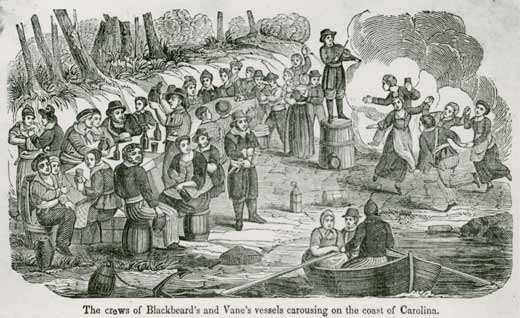
* Straight out of piracy central casting, no? Would you also believe his crew had a renowned “pirate party” rendezvous with Blackbeard’s?
[audio:John_Merbecke_Creed.mp3] (Part of John Merbecke‘s plainsong rendition of the Book of Common Prayer, as performed by the Virginia Theological Seminary motet choir. Via.)
Good Friday falls early this year, and gives pause to recollect the burning this date of Thomas Cranmer, Henry VIII’s Archbishop of Canterbury, author of this gentle prayer for Holy Week:
Almighty and everliving God, who, of thy tender love towards mankind, hast sent thy Son our Savior Jesus Christ to take upon him our flesh, and to suffer death upon the cross, that all mankind should follow the example of his great humility: Mercifully grant that we may both follow the example of his patience, and also be make partakers of his resurrection; through the same Jesus Christ our Lord, who liveth and reigneth with thee and the Holy Spirit, one God,for ever and ever. Amen.
Thomas Cranmer was an obscure middle-aged priest when happenstance acquainted him with the circle then endeavoring to engineer Anne Boleyn‘s elevation from Henry VIII‘s enamored to Queen of England.
Cranmer enthusiastically supported Henry’s position that his first marriage to Catherine of Aragon should be annulled, and the perspicacity of the doctrinal case he developed to that effect saw him admitted into the inner circle of royal theologians.
The papal case foundered because Catherine’s kinsman Charles V happened, in the course of politics on the Italian peninsula, to be holding the pope a virtual hostage in Rome. On such accidents of history do faiths arise — and the faithful burn.
The Break With Rome
The 16th century, yeasty with religious disputation widely circulated by the printing press, is thick with folk who are one sect’s martyrs and the other sect’s villains.
Cranmer is just such a character.
One could charge him — and Catholic partisans have, many times — with blowing with the wind, granting theological license to the whims of his sovereign. Henry pressed through Cranmer’s appointment as Archbishop of Canterbury in 1533, just in time for Cranmer to annul Henry’s marriage to Catherine and validate the secret vows he had taken with Anne, earning both bishop and king excommunication.
That Cranmer rose with Anne but was ready to hold against her when she fell from favor, that he authorized the king’s famous pattern of discarding his past wives, that he signed off on the crown’s seizure of monasteries — that, in the end, he navigated Henry’s bloody reign with his position intact and even enhanced puts the whiff of opportunism about him. As Cranmer expert Ashley Null says (the link is a .pdf):
Like his first royal master, Cranmer did not make himself easy to love. In an era noted for the fervent courage of many martyrs for faith, Cranmer’s very survival under a king as unprincipled, or at least unpredictable, as Henry VIII has made him suspect. His late vacillation under Mary has only seemed to confirm the image of a man ruled more by the grip of fear than the assurance of the faith.
Whatever kernel of truth one might discern in such a charge, the fact remains that the church Cranmer built has by the test of centuries proven itself far more spiritually significant than mere opportunism could have admitted.
The Archbishop truly came into his own after Henry’s death.
For six years during the regency of Henry’s sickly, doomed son Edward VI, Cranmer hammered together the Anglican liturgy, wrote prolifically and beautifully, and assembled the Book of Common Prayer, a text which still guides Anglican services to this day.
His words still retain their power, and in some cases, their recognizability:
One can read Cranmer, especially in this mature stage, through many prisms — the competing threads of Catholicism, Lutheranism and Calvinism in his developing thought; the attempt to steer his institutional church towards his vision of the Reformation; and certainly as an inconstant individual — for his recantation when the Catholic Mary Tudor took the throne shows us a man as prone as any to folly and weakness.*
It is not the headsman’s purpose, and certainly not on this day, to render judgment on Cranmer’s soul; still less to unpack his theology. If we find him a man of flaws to compensate his genius, we must do him the justice of remembering also his firmness at the last hour, dramatically abjuring the recantation that had been forced upon him and thrusting the offending right hand that had signed it first into the flames.
* Cranmer had endorsed Mary’s rival Lady Jane Grey in the contentious succession that followed Edward VI; for this, he was convicted of treason in a trial managed by his old friend and fellow-survivor Thomas Howard. (Source) The Queen spared him execution on this charge in order to have him up on heresy instead, and it was this that Cranmer attempted to avoid by submission to the pope.
On this date in 1741,* at Tyburn‘s largest mass-execution of the mid-18th century, renowned cutpurse Jenny Diver was hanged along with 19 others.
Born Mary Young in Ireland around 1700, the girl was abandoned as a child but deserted a benefactor’s household to take passage to London where she meant to work as a seamstress.
What the Newgate Calendar reads as ingratitude, the modern reader might more sympathetically see as the allure of a burgeoning city for a teenager full of dreams.
Dreams may nurture the spirit, but flesh must have bread. Like countless others through time — indeed, like countless other clients of Tyburn — Jenny found metropolis less than convivial to aspirations of honest labor.
Unable to live on her stitching, Jenny found more lucrative employment for her manual dexterity in a sizable gang of thieves — of which her uncovered criminal puissance gave her mastery.
The Newgate Chronicle bursts with almost doting memoirs of her agile fingers, like this one:
[S]he procured a pair of false hands and arms to be made, and concealing her real ones under her clothes she repaired on a Sunday evening to the place of worship above mentioned in a sedan-chair, one of the gang going before to procure a seat among the more genteel part of the congregation, and another attending in the character of a footman.
Jenny being seated between two elderly ladies, each of whom had a gold watch by her side, she conducted herself with seeming great devotion; but when the service was nearly concluded she seized the opportunity, when the ladies were standing up, of stealing their watches, which she delivered to an accomplice in an adjoining pew.
Not neglecting also to celebrate the gang’s more Sting-like ruses, like this hilarious turn of the tables on a credulous cuckolder:
Jenny dressed herself in an elegant manner, and went to the theatre one evening when the king was to be present; and during the performance she attracted the particular attention of a young gentleman of fortune from Yorkshire, who declared, in the most passionate terms, that she had made an absolute conquest of his heart, and earnestly solicited the favour of attending her home. She at first declined a compliance, saying she was newly married, and that the appearance of a stranger might alarm her husband. At length she yielded to his entreaty, and they went together in a hackney-coach, which set the young gentleman down in the neighbourhood where Jenny lodged, after he had obtained an appointment to visit her in a few days, when she said her husband would be out of town.
…
The day of appointment being arrived, two of the gang appeared equipped in elegant liveries, and Anne Murphy [another thief] appeared as waiting-maid. The gentleman came in the evening, having a gold-headed cane in his hand, a sword with a gold hilt by his side, and wearing a gold watch in his pocket, and a diamond ring on his finger.
Being introduced to her bed-chamber, she contrived to steal her lover’s ring; and he had not been many minutes undressed before Anne Murphy rapped at the door, which being opened, she said, with an appearance of the utmost consternation, that her master was returned from the country. Jenny, affecting to be under a violent agitation of spirits, desired the gentleman to cover himself entirely with the bed-clothes, saying she would convey his apparel into another room, so that if her husband came there, nothing would appear to awaken his suspicion: adding that, under pretence of indisposition, she would prevail upon her husband to sleep in another bed, and then return to the arms of her lover.
The clothes being removed, a consultation was held, when it was agreed by the gang that they should immediately pack up all their moveables, and decamp with their booty, which, exclusive of the cane, watch, sword, and ring, amounted to an hundred guineas.
The amorous youth waited in a state of the utmost impatience till the morning, when he rang the bell, and brought the people of the house to the chamber-door, but they could not gain admittance, as the fair fugitive had turned the lock, and taken away the key; when the door was forced open the gentleman represented in what manner he had been treated; but the people of the house were deaf to his expostulations, and threatened to circulate the adventure throughout the town, unless he would indemnify them for the loss they had sustained. Rather than hazard the exposure of his character, he agreed to discharge the debt Jenny had contracted; and dispatched a messenger for clothes and money, that he might take leave of a house of which he had sufficient reason to regret having been an inhabitant.
Alas to say, they all can’t come off like clockwork. Jenny was caught a couple of times, dodging the noose in 1733 and 1738, sentenced on both occasions to transportation to the American colonies.
Finding little to recommend colonial Virginia, she returned illegally from both sentences at the risk of her life (she only survived her second arrest by passing herself off under an alias). The third time broke the charm, however: one is saddened to find her in her last adventure nabbed like a tyro trying to pick a younger woman’s pocket of a few shillings. The victim snatched Jenny’s wrist in the act: perhaps those nimble hands, now pushing 40, had finally slowed down.
Jenny Diver’s hands, in their time, had profited her far more than needlework could have; they had given her a life of some comfort to compensate its perils; and at the end, they afforded their owner the last indulgence of a “mourning coach,” an enclosed carriage separate from the carts that hauled this day’s other 19 (unrelated) victims.
It was a rowdy hanging day with an unusual guard detail of soldiery: one of the prisoners had reported a pending rescue attempt, and for her resources and gang affiliations, Jenny was thought to be its intended beneficiary. (If the stool pigeon was hoping his own tattling would reprieve him, he was disappointed.) For reasons related or not, the crowd was in an ugly mood, as reported by the Newgate Ordinary:
In this Manner were they convey’d through a vast Multitude of People to Tyburn, some of whom, notwithstanding the Guard of Soldiers, were very rude and noisy, hallooing, throwing Brickbats, Mud, &c. at the unhappy Prisoners, as they passed.
We also have a modern context** for the name “Jenny Diver” as one of several women mentioned in the song “Mack the Knife”:
This song is an English riff on a German tune from The Threepenny Opera, concerning its principal male character, the highwayman Macheath. (Possibly inspired by the recently-executed Jack Sheppard.)
The Threepenny Opera updated the 18th-century Beggar’s Opera, a satiric (and extraordinarily popular) production setting operatic tropes among society’s whores, criminals and castoffs.
The sequence of female names Bobby Darin rattles off in this version of “Mack the Knife” all draw from these operas: Suky (sometimes Sukey or Sukie) Tawdry and Jenny Diver are underworld women in The Beggar’s Opera who set Macheath up for arrest; Lucy Brown is The Threepenny Opera‘s version of the original character Lucy Lockit, who under either name is the daughter of a law enforcement officer in love with Macheath who helps him escape.†
One might suppose such a fortuitous connection of Jenny Divers was a calculated one, but it seems both the character’s name and the thief’s were independently and coevally drawn from the rich vein of English thieves’ cant.
Strictly coincidental.
“Diver” as street slang for a pickpocket dated back 150 years, according to Philip Rawlings, so it was a natural sobriquet for an expert thief … and for an author (whose script is chock full of suggestively-named characters — Wat Dreary, Molly Brazen, Jemmy Twitcher) conjuring such a character. There’s no direct evidence indicating that either the cutpurse or the dramatist knowingly cribbed from the other.
A pity it was for the real Jenny that art and life couldn’t imitate one another more strongly.
PLAYER. But, honest Friend, I hope you don’t intend that Macheath shall be really executed.
BEGGAR. Most certainly, Sir.—-To make the Piece perfect, I was for doing strict poetical Justice—-Macheath is to be hang’d; and for the other Personages of the Drama, the Audience must have suppos’d they were all hang’d or transported.
PLAYER. Why then Friend, this is a downright deep Tragedy. The Catastrophe is manifestly wrong, for an Opera must end happily.
BEGGAR. Your Objection, Sir, is very just, and is easily remov’d. For you must allow, that in this kind of Drama, ’tis no matter how absurdly things are brought about—-So—-you Rabble there—-run and cry, A Reprieve!—-let the Prisoner be brought back to his Wives in Triumph.
* 1740, according to the original documentation; 1741 by modern reckoning, since the new year’s onset was at the time not recognized on January 1.
† The fourth name of the sequence originally was Polly Peachum, Lucy’s rival for Macheath’s affections — but when Louis Armstrong made the first popular recording of Mack the Knife, he ad-libbed the line “Look out for Miss Lotte Lenya!” referring the actress who played PollyJenny in both the original German production and the then-current Broadway importation, and who also happened to be present at Armstrong’s recording. Darin’s subsequent (and eventually canonical) version followed that lead and replaced the original name outright.
On this date in 1957, Cypriot guerrilla Evagoras Pallikarides was hanged by British colonial authorities for gun possession.
As it was throughout the Empire in the middle 20th century, independence was the order of the day in Cyprus. But it was not simply whether there would be self-rule in Cyprus: the form and terms of independence were themselves hotly contested.
Cyprus would be a fresh battleground between those bitter rivals Turkey and Greece, each asserting an interest in their ethnic cousins on the island; overlapping that, it would be a battleground between the institutional Communist opposition AKEL, which opposed military action for separatism, and the nationalist EOKA, demanding not simply independence but enosis, union with Greece as part of the pan-Hellenic project so inflammatory to the Turks.
From 1955 to 1959, EOKA conducted a four-year campaign of bombing, assassinations and military engagements.
As a 17-year-old, Palikarides — already facing trial and likely prison time for his resistance activities — disappeared to join an EOKA guerrilla cell. A poetic young soul, he bid his classmates farewell with this note left to explain his absence on their first morning without him:
Old classmates. At this time, someone is missing from among you, someone who has left in search of freedom’s air, someone who you might not see alive again. Don’t cry at his graveside. It won’t do for you to cry. A few spring flowers scatter on his grave. This is enough for him …
I’ll take an uphill road
I’ll take the paths
To find the stairs
That lead to freedom
I’ll leave brothers, sisters
My mother, my father
In the valleys beyond
And the mountainsides
Searching for freedom
I’ll have as company
The white snow
Mountains and torrents
Even if it’s winter now
The summer will come
Bringing Freedom
To cities and villages
I’ll take an uphill road
I’ll take the paths
To find the stairs
That lead to freedom
I’ll climb the stairs
I’ll enter a palace
I know it will be an illusion
I know it won’t be real
I’ll wonder in the palace
Until I find the throne
Only a queen
Sitting on it
Beautiful daughter, I will say,
Open your wings
And take me in your embrace
That’s all I ask …
Pallikarides fought for a year before being apprehended with a gun illegally in his possession — a hanging crime under British anti-terrorism laws, but as Pallikarides was just the ninth (and last) EOKA man executed, it seems plain that law was not receiving draconian enforcement. At least one author claims that the authorities threw the book at him on the gun charge because of a murder they believed he committed as a guerrilla but could not prove.
The fact that he turned 19 a fortnight before his execution likewise did not avail him clemency — as the young rebel predicted in court:
I know you will hang me. Whatever I did, I did as a Cypriot Greek fighting for liberty.
As youthful martyrs to nationhood are wont to become, Pallikarides (along with his poetry) lives on as a potent symbol to Greek Cypriots. Shortly after Cyprus achieved independence in 1960, his name and visage were affiliated with a Cyprus football club, Evagoras (which later merged with another club to become AEP Paphos).


 For a man of whom much is written and ponderous historical weight is imputed,
 Like his onetime lieutenant