1797: Martin Clinch and Samuel Mackley

Say’s Weekly Journal, May 13, 1797:

On Sunday evening, between eight and nine o’clock, as Mr. Fryer, of Southampton Buildings, Holborn, was returning home, accompanied by a young Lady, in passing through the fields near White Conduit-house, he heard the screams of a woman in distress. He hastened to her assistance, and perceived her in the hands of three footpads, who, on seeing him approach, shot him through the head.

Some of the Bow-street patrols, who go that road, hearing the report of the pistol, made up to the place, where they found Mr. F. lying, not quite dead, but who expired in a few minutes afterwards; he appeared to have been robbed of his watch and money, and near the spot lay a stick with a sword in it.

The young Lady, who was in company with him, it is supposed, ran away on the villains first attacking him.

Three men were last night taken up on suspicion of the above murder.

General Evening Post, May 11-13, 1797:

Mr. Fryer, who was murdered on Sunday evening last, in Islington fields, was a young man of some property, and had been brought up to the law.

The young Lady, who accompanied him at the time, was his intended bride. They had been to spend the day at the house of a Mrs. P. in Paradise-row, Islington, and were returning home when the murder took place.

Mrs. P. had come a short distance from her own house with them, and after they had bid her good night, and had got about 100 yards from her, she was attacked by three villains, who robbed her of her cloak and money.

Her cries alarming Mr. F. he ran back to her assistance, which being perceived by the robbers, one of them advanced and shot him through the head, and then robbed him.

The young Lady was a distant spectator of this shocking scene.

London Evening Post, May 16-18, 1797:

Yesterday evening three men were examined at Bow-street, for the murder of Mr. Fryer, in Islington Fields, but, after a long investigation, they were discharged.

London Star, May 25, 1797:

Tuesday Martyn Clynch and James Mackley were committed to Newgate by John Floud and William Brodie, Esqs. charged with the oath of Ann Fryer and others, on suspicion of being the persons guilty of the wilful murder of Sydney Fryer on Sunday the 7th inst. in the fields near the Work-house, in the black road, Islington.

London Chronicle, June 1-3, 1797:

OLD BAILEY.

Yesterday, 14 prisoners were tried at the Old Bailey, two of whom were capitally convicted, viz. Samuel Mackley and Martin Clinch, for the wilful murder of Mr. Fryer in the parish of St. Mary, Islington.

It appeared by the evidence, that the deceased and his cousin, Miss Fryer, were walking across the fields in their way from Southampton Buildings, Holborn, towards Islington: that when they arrived at the field called the Cricket field, near White Conduit House, they heard a noise as of some person in distress; this induced the deceased to go to the spot.

At this time, Miss Fryer, the principal witness on this occasion, was at some distance from him. By the time she came to the stile, which he had crossed in his way to the place, she saw Clinch fire, when the deceased fell into a small pond. Clinch then took his watch out of his fob, and a sum of money out of his pocket.

By this time Miss Frye [sic] had got on the other side of the stile, when the prisoner, Mackley, held a pistol to her head, and took her cloak from her. They then went away, and Mr. Fryer was taken to a house at a short distance from the spot, where he died at eleven o’clock the same evening.

The evidence in support of the above statement, as given by Miss Fryer, was clear, artless, and unembarrassed. When asked if she really believed Clinch to be the man who shot Mr. Fryer, she said she believed from her soul he was; with respect to Mackley she seemed not quite so positive; several witnesses, however, proved his being seen in the same field within a few minutes of the time the murder happened, who all had noticed him on account of his having red hair.

The prisoners being called on for their defence, they only said they were innocent, but could give no account where they were at the time the murder was committed.

The jury went out for about half an hour, and returned with a verdict — Guilty. They were both ordered for execution on Monday next.

Five were convicted of felony, and seven acquitted.

Hereford Journal, June 7, 1797:

This morning were executed at the front of Newgate, Clinch and Mackley, for the robbery and murder of Mr. Frye, in Islington Fields.

An extremely disagreeable circumstance happened. The floor of the scaffold, from some previous misarrangement gave way, and precipitated into the area of the apparatus, Messrs. Vilette and Gaffy, the latter a Catholic Priest, who attended Clinch, and the two executioners. Mr. Sheriff Staines had a very narrow escape.

Mr. Gaffy was very severely hurt, as were both the executioners; Mr. Villette escaped with a slight bruise.

The two malefactors swung off with their distorted features exposed to the view of the distressed spectators. Their bodies were removed for the purposes of dissection and exposure.

Lloyd’s Evening Post, September 11-13, 1797:

Burton Wood and William Harlington, the two persons executed a few days ago on Kennington Common, for highway-robbery and sheep-stealing, made voluntary confessions of the various depredations in which they had been concerned.

Burton Wood positively declared, that Clinch and Mackley, who were hanged for the murder of Mr. Fryer, in Islington Fields, were totally innocent of that crime, it having been committed by himself and two others.

Harling made a similar confession respecting the murder of Mrs. Gray at Waltham-Abbey, for which two men, of the names of Harold and Upsham, were taken up; but who, he averred, had no connection in that shocking transaction. The robberies mentioned in their confessions were very numerous.

Whitehall Evening Post, September 12-14, 1797:

The following is a copy of a Letter sent from Burton Wood (who was hanged a short time since on Kennington Common, for a footpad robbery) to Mr. Carpenter Smith, in the Borough, from which it appears that he was the person concerned in the murder of Mr. Fryer, in Islington-fields, and that Clinch and Mackley, who were hanged for that murder, died innocent; also the copy of another letter which was sent from William Harling, a person that was hanged with Wood for sheep-stealing, to a friend of his, in which it appears is a confession of the robberies that he has been guilty of.

Honoured Sir,

I confess to robbing Mr. Francis, near Dulwich; I was mounted a grey horse. To stopping the Chatham coach the other side of Shooter’s-hill: I was dressed in a blue great-coat: I was mounted on a brown crop mare; it was between four and five in the afternoon; and to the robbing and murder of Mr. Fryer, in Islington-fields; the two men, Clinch and Mackley, was innocent of it; and to breaking open the house of Mr. Emery, brass-founder, in Shoe-lane, Fleet-street, and taking away Bank notes, cash, and other articles to the amount of 130 l.: and to robbing the waggon of Mr. Newport and Sons, of Crayford, in Kent, on Blackheath, last Easter Wednesday night, about ten o’clock — the man that was tried at Maidstone for it in the name of George Rhodes, was innocent of it; and I was the person that stopped and robbed the carriage on the night of Thursday the 25th of May last near Ball’s Pond turnpike; and to breaking open the house of Mr. Parkes, the brewer, in Baldwin’s Gardens, Gray’s-inn-lane, Holborn; I was the person that broke open the iron chest in Mr. Parke’s Counting-house; and to breaking open the house of Mr. Sewell, Seward-street, Goswell-street, St. Lukes, and taking away two Bank-notes, one of 5 l. and one of 10 l. and cash to the amount of 15 l. on Sunday night the 14th of last February; I as by myself; and to robbing a Mr. Robert Morris, belonging to the Custom-house, of his watch and fourteen shillings in Locks Field’s; and to the robbery that I now suffer for; and to robbing the Fishman near Sutton, when I robbed George May, of Banstead, in Surrey, of 2 l. 16 s. 6 d. for which I now suffer.

The Lord have mercy upon my sinful soul!

Honoured Sir, I hope the robberies that I have confessed I hope will be the means of many innocent men’s escaping to be brought to justice for the same, for I am the transgressor thereof. It would have been a good thing if I had suffered while Clinch and Mackley were under confinement in Newgate, for the robbery and murder of Mr. Fryer, in Islington-fields; for they died innocent. I confess to being one of the party, but they was not with me; I might have been the saving of their two lives had I have suffered sooner, but now it is too late; but I hope they are happy, I hope my soul will meet them in Heaven.

These are the confessions of your long-lost and unfortunate

Humble servant,
Burton Wood
August 21, 1797


Dear Charles,

The following names are them that I have robbed, and therefore I hope that nobody else may be brought to justice when I am dead and gone concerning them, for nobody but me did them, except Alderson, that suffered last Thursday at Maidstone, rob robbing Mr. Robinson, at Sydenham.

1st. Mr. Polton, of his horse.

2nd. Mr. Spinks, the bricklayer, of his horse.

3rd. And broke open the house of Mr. Mason.

4. Mr. John Hudson, the shopkeeper; Mr. Pinner, butcher, of nine sheep and two beasts; to taking the eleven sheep off Mitcham Common; Mr. Mills, of Mordon, of eleven fat weathers; breaking open the house of Mr. Marriot, of Mitcham; Newton and Leache’s callico-grounds twice; Mr. John Waggoner’s callico-grounds once; Mr. Groves, of his ten hogs; Mr. Blink, last Easter Monday; the Epsom Fisherman, Easter Tuesday; the two Gentlemen that had been to Ewill with their children to a boarding-school, near the turnpike, in a single-horse chaise: and Mr. Robinson, at Sydenham; a Gentleman in a single-horse chaise, on Mordon Common, going to Ewill.

I am sorry that Robert Harrold and Frederick Upham was taken up for the murder of Mrs. Gray, at Waltham Abbey, for they were innocent: I was one that was concerned in it, and these sheep that I now suffer for; therefore I wish to let you know, that they may not give themselves any more trouble to take any body else into custody, for it was only me and Alderson, for that robbery at Mr. Robinson’s at Sydenham, which robbery I was concerned with.

Give my remembrance to Mason, and ask him if he has hanged that great black dog of his, that laid upon the basket of clothes; if not, it is high time he had, for he was a very neglectful servant, for he lay as still as a mouse while I and my Pall drank a bottle of peppermint over his head. But now they have got what they longed for, and it is to be hoped they will sleep in peace when I am dead.

William Harling.

On this day..

1621: John Rowse, unnatural father

(Thanks for the guest post to Thames boatman and picaresque pamphleteer John Taylor, the self-described “Water Poet”. Taylor has a minor cottage industry of social historians devoted to his varied output, like one of the first credited palindromes, “Lewd did I live, & evil I did dwel” … which would exactly suit John Rowse, the early modern sybarite turned murderer whom the Water Poet favored with the prose below, under the original title of “The Unnatural Father.” We’ve filled in wiktionary links to some of the more interesting archaic usages here; for the writer’s rich supply of loose-women synonyms please consult the Dungeons & Dragons random harlot table. — ed.)

As a chain consists of divers links, and every link depends, and is invoked upon one another, even so our sins, being the chain wherewith Satan doth bind and manacle us, are so knit, twisted, and soldered together, that without our firm faith ascending, and God’s grace descending, we can never be freed from those infernal fetters; for sloth is linked with drunkenness, drunkenness with fornication and adultery, and adultery with murder, and so of all the rest of the temptations, suggestions, and actions, wherewith miserable men and women are insnared and led captive into perpetual perdition, except the mercy of our gracious God be our defence and safeguard.

For a lamentable example of the devil’s malice, and man’s misery; this party, of whom I treat at this time, was a wretch, not to be matched, a fellow not to be fellowed, and one that scarce hath an equal, for matchless misery, and unnatural murder. But to the matter.

This John Rowse being a fishmonger in London, gave over his trade and lived altogether in the town of Ewell, near Nonsuch, in the county of Surrey, ten miles from London, where he had land of his own for himself and his heirs for ever to the valne of fifty pounds a year, with which he lived in good and honest fashion, being well reputed of all his neighbours, and in good estimation with gentlemen and others that dwelt in the adjoining villages.

Until at the last he married a very honest and comely woman, with whom he lived quietly and in good fashion some six months, till the devil sent an instrument of his to disturb their matrimonial happiness; for they wanting a maidservant, did entertain into their house a wench, whose name was Jane Blundell, who in short time was better acquainted with her master’s bed than honesty required, which in time was found out and known by her mistress, and brake the peace, in such sort, between the said Rowse and his wife, that in the end, after two year’s continuance, it brake the poor woman’s heart, that she died and left her husband a widower, where he and his whore were the more free to use their cursed contentments, and ungodly embracements.

Yet that estate of being unmarried, was displeasing to him, so that he took to wife another woman, who for her outward feature, and inward qualities was every way fit for a very honest man, although it were her hard fortune to match otherwise.

With this last wife of his he lived much discontented, by reason of his keeping his lewd trull in his house, so that by his daily riot, excessive drinking and unproportionable spending, his estate began to be much impoverished, much of his land mortgaged and forfeited, himself above two hundred pounds indebted, and in process of time to be, as a lewd liver, of all his honest neighbours rejected and contemned.

His estate and credit being almost past recovery wasted and impaired, he forsook his wife, came up to London with his wench, where he fell into a new league with a corrupted friend; who, as he said, did most courteously cozen him of all that ever he had, and whom at this time I forbear to name, because it was John Rowse his request before his execution, that he should not be named in any book or ballad, but yet upon a die his name may be picked out betwixt a Cinq and a Trois. This false friend of his, as he said, did persuade him to leave his wife for altogether, and did lodge and board him and his paramour certain weeks in his house, and afterward caused him and her to be lodged, having changed his name, as man and wife in an honest man’s house near Bishops-gate, at Bevis Marks.

Where they continued so long, till his money was gone, as indeed he never had much; but now and then small petty sums from his secret friend aforesaid, and he being fearful to be smooked out by his creditors, was counselled to leave his country and depart for Ireland. And before his going over sea, his friend wrought so, that all his land was made over in trust to him, and bonds, covenants, and leases made, as fully bought and sold for a sum of two hundred and threescore pounds. Of all which money the said Rowse did take the Sacrament at his death, that he never did receive one penny, but he said now and then he had five or ten shillings at a time from his said friend, and never above twenty shillings. And all that ever he had of him, being summed together, was not above three and twenty pounds, the which moneys his friend did pay himself out of his rents. But some more friend to him, than he was to himself, did doubt that he was cheated of his land; whereupon, to make all sure, he said that his false friend did so far prevail with him, that he the said Rowse took an oath in the open court at Westminster Hall, that he had lawfully sold his land, and had received the sum above said, in full satisfaction and payment, and his said friend did vow and protest many times unto him, with such oaths, and vehement curses, that he never would deceive his trust, but that at any time when he would command all those forged bonds and leases, that he would surrender them unto him, and that he should never be damnified by them or him, to the value of one half penny. Upon which protestations, he said, he was enticed to undo himself out of all his earthly possessions, and by a false oath to make hazard of his inheritance in heaven.

In Ireland he staid not long, but came over again, and was by his friend persuaded to go into the low countries; which he did, never minding his wife and two small children which he had by her, having likewise a brace of bastards by his whore, as some say, but he said that but one of them was of his begetting. But he, after some stay in Holland, saw that he could not fadge there, according to his desire and withal, suspecting that he was cheated of his land, and above all, much perplexed in his conscience for the false oath that he had taken, pondering his miserable estate, and rueing his unkindness to his wife, and unnatural dealing to his children, thinking with himself what course were best to take to help himself out of so many miseries which did incompass him, he came over again into England to his too dear friend, demanding of him his bonds and leases of his land which he had put him in trust withal. But then his friend did manifest himself what he was, and told him plainly, that he had no writings, nor any land of his, but what he had dearly bought and paid for. All which, Rowse replied unto him, was false, as his own conscience knew. Then said the other, have I not here in my custody your hand and seal to confirm my lawful possession of your land? and moreover, have I not a record of an oath in open court, which you took concerning the truth of all our bargain? And seeing that I have all these especial points of the law, as an oath, indentures, and a sure possession, take what course you will, for I am resolved to hold what I have.

These, or the like words, in effect passed betwixt Rowse and his friend, trusty Roger, which entering at his ears, pierced his heart like daggers; and being out of money and credit, a man much infamous for his bad life, indebted beyond all possible means of payment, a perjured wretch to cozen himself, having no place or means to feed or lodge, and fearful of being arrested, having so much abused his wife, and so little regarded his children, being now brought to the pit’s brim of desperation, not knowing amongst these calamities which way to turn himself, he resolved at last to go home to Ewell again to his much wronged wife for his last refuge in extremity.

The poor woman received him with joy, and his children with all gladness welcomed home the prodigal father, with whom he remained in much discontentment and perplexity of mind. The devil still tempting him to mischief and despair, putting him in mind of his former better estate, comparing pleasures past with present miseries; and he revolving that he had been a man in that town, had been a gentleman’s companion of good reputation and calling, that he had friends, lands, money, apparel, and credit, with means sufficient to have left for the maintenance of his family, and that now he had nothing left him but poverty and beggary, and that his two children were like to be left to go from door to door for their living.

Being thus tormented and tossed with restless imaginations, he seeing daily to his further grief, the poor case of his children, and fearing that worse would befall them hereafter, he resolved to work some means to take away their languishing lives by a speedy and untimely death, the which practice of his, by the devil’s instigation and assistance, he effected as followeth.

To be sure that nobody should stop or prevent his devilish enterprise, he sent his wife to London on a frivolous errand for a riding coat; and she being gone somewhat timely and too soon in the morning, both her children being in bed and fast asleep, being two very pretty girls, one of the age of six years, and the other four years old, none being in the house but themselves, their unfortunate father and his ghostly counsellor, the doors being fast locked; he having an excellent spring of water in the cellar of his house, which to a good mind that would have employed it well would have been a blessing, for the water is that of crystalline purity and clearness, that Queen Elizabeth of famous memory would daily send for it for her own use, in which he purposed to drown his poor innocent children sleeping. For he going into the chamber where they lay, took the youngest of them named Elizabeth forth of her bed and carried her down the stairs into his cellar, and there put her in the spring of water, holding down her head under that pure element with his hands, till at last the poor harmless soul and body parted one from another.

Which first act of this his inhuman tragedy being ended, he carried the dead corpse up three pair of stairs, and laying it down on the floor, left it, and went down into the chamber where his other daughter named Mary was in bed; being newly awakened, and seeing her father, demanded of him where her sister was? To whom he made answer that he would bring her where she was. So taking her in his arms he carried her down towards the cellar, and as he was on the cellar stairs she asked him what he would do, and whither he would carry her? Fear nothing, my child, quoth he, I will bring thee up again presently; and being come to the spring, as before he had done with the other, so he performed the last unfatherly deed upon her; and to be as good as his word, carried her up the stairs and laid her by her sister. That done, he laid them out and covered them both with a sheet, walking up and down his house weeping and lamenting his own misery and his friend’s treachery, that was the main ground of all his misfortunes and the death of his children; and though there was time and opportunity enough for him to fly, and to seek for safety, yet the burthen and guilt of his conscience was so heavy to him, and his desperate case was so extreme, that he never offered to depart, but as a man weary of his life, would, and did stay, till such time as ho was apprehended and sent to prison, where he lay till he was rewarded with a just deserved death.

What his other intents were after be had drowned his children is uncertain, for he drew his sword and laid it naked on a table, and after he gat a poor woman down into the cellar, and in the same place where the two infants lost their lives, he did help the woman to wring a buck of his clothes, and then he requested her to help to convey his goods out of his house, for he said that be feared that the sheriff of Surrey would come and seize upon all. But the woman not thinking of any of the harm that was done, imagined that he had meant that his goods would be seized for debt and not for murder.

But to return to the miserable mother of the murdered children, she said that her heart throbbed all the day, as fore-boding some heavy mischance to come; and having done her business that she came about to London, as soon as she came home she asked for her children, to whom her husband answered that they were at a neighbour’s house in the town. Then said she, I will go thither to fetch them home. No, quoth he, I will go myself presently for them. Then said his wife, let the poor woman that is here go and bring them home. But at last she saw such delay was used, she was going herself, then her husband told her that he had sent them to a kinsman’s of his at a village called Sutton, four miles from Ewell, and that he provided well for them, and prayed her to be contented and fear nothing for they were well. These double tales of his made her to doubt somewhat was amiss, therefore she entreated him for God’s sake to tell her truly where they were. Whereupon he said, “If you will needs know where they are, go but up the stairs into such a chamber and there you shall find them. But in what a lamentable perplexity of mind the poor woman was when she perceived how and which way they lost their lives, any Christian that hath an heart of flesh may imagine. Presently the constable was sent for, who took him into his custody, who amongst other talk, demanded of him why and how he could commit so unnatural a fact as to murder his children? To whom he answered that he did it because he was not able to keep them, and that he was loth they should go about the town a begging; and moreover, that they were his own, and being so, that he might do what he would with them, and that they had their lives from him, and therefore he had taken their lives from them, and was contented to lose his life for them; for he was sure that their miseries were past, and for his part, he had an assured hope to go to them, though they could not come to him.

So being had before justice his examination was very brief, for he confessed all the whole circumstances of the matter freely, so that he was sent to the common prison of Surrey called the White Lion, where he remained fourteen or fifteen weeks a wonderful penitent prisoner, never, or very seldom, being without a bible or some other good book meditating upon; and when any one did but mention his children, he would fetch a deep sigh and weep, desiring every one to pray for him; and upon his own earnest request, he was prayed for at Paul’s Cross, and at most of the churches in London, and at many in the country, and at the Sessions holden at Croydon the latter end of June last. He made such free confession at the bar, declaring the manner of his life, his odious drinking, his abominable whoring, his cruel murder, and the false dealing of his deceitful friend, which was the cause of his final wreck, with which relations of his pronounced with such vehemency and protestations, he moved all that heard him to commiseration and pity.

So according to law and justice, he was there condemned and judged for the murdering of his two children to be hanged; which judgment was executed on him at the common gallows at Croydon, on Monday the second day of June, 1621, where he died with great penitency and remorse of conscience.

This was the lamentable end of John Rowse, a man of the age of fifty years, and one that might have lived and died in better fashion, if he had laid hold on the grace of heaven, and craved God’s protection and fatherly assistance. But of all that herein is declared, this one thing which I now declare, is most lamentable and remarkable, which is that Ewell being a market town not much above ten miles from London, in a Christian kingdom, and such a kingdom where the all-saving Word of the ever-living God is most diligently, sincerely, and plentifully preached; and yet amidst this diligence, as it were in the circle or centre of his sincerity, and in the flood of this plenty, the town of Ewell hath neither preacher nor pastor. For although the parsonage be able to maintain a sufficient preacher, yet the living being in a layman’s hand, is rented out to another for a great sum, and yet no preacher maintained there. Now the chief landlord out of his portion doth allow but seven pounds yearly for a reader, and the other that doth hire the parsonage at a great rent doth give the said reader four pounds the year more out of his means and courtesy. And by this means the town is served with a poor old man that is half blind, and by reason of his age can scarcely read. For all the world knows that so small a stipend cannot find a good preacher, books, and very hardly bread to live on; so that the poor souls dwelling there are in danger of famishing for want of a good preacher to break the Bread of Life unto them. For a sermon amongst them is as rare as warm weather in December or ice in July; both which I have seen in England though but seldom.

And as the wolf is most bold with the sheep when there is either no shepherd or an impotent, insufficient one, so the devil perhaps took his advantage of this wretched man, seeing he was so badly guarded and so weakly guided to withstand his force and malice; for where God is least known and called upon, there Satan hath most power and domination. But howsoever, I wish with all my heart, that that town and many more were better provided than they are, and then such numbers of souls would not be in hazard to perish; nor so many sufficient scholars that can preach and teach well, live in penury through want of maintenance. I could run further upon this point, but that I shortly purpose to touch it more to the quick in another book.

By this man’s fall we may see an example of God’s justice against drunkenness, whoredom and murder. The devil being the first author, who was a murderer from the beginning; who filled Cain with envy that he murdered his brother Abel; who tempted David first to adultery and afterwards to murder; who provoked Herod to cause the blessed servant of God, John Baptist, to lose his head, because he told him it was not lawful for him to marry his brother Philip’s wife; and who was the provoker of the aforesaid Herod to murder all the innocent male children in his kingdom. And let us but mark and consider the plagues and punishments that God hath inflicted upon murderers, adulterers, and incestuous persons. First Cain, although by his birth he was the first man that ever was born, a prince by his birth, and heir apparent to all the world, yet for the murder by him committed on his brother, he was the first vagabond and runagate on the face of the earth, almost fearful of his own shadow; and after he had lived a long time terrified in conscience, was himself slain, as is supposed, by Lamech, Simeon, and Levi. The sons of Jacob were accursed of their Father for the slaughter of the Sichemites; Joab, the captain of David’s host, was slain for the murdering of Abner; David himself, for the death of Urias and the adultery committed with Bethsheba, was continually plagued and vexed with the sword of war, with the rebellion of his own sons, and with the untimely deaths of Amnon and Absalom. Banuah and Rechab, for the slaying of Ishbosheth the son of Saul, they were both by David’s commandment put to death, who had both their hands and feet cut off, and were afterwards hanged over the Pool in Hebron, (Samuel 2. 4.) The examples are infinite out of divine and human histories, that God did never suffer murder to go unrewarded; and this miserable man, of whom I have here related, is a most manifest spectacle of God’s revenging vengeance for that crying and heinous sin.

As concerning lust and incontinency, it is a short pleasure bought with long pain, a honeyed poison, a gul of shame, a pickpurse, a breeder of diseases, a gall to the conscience, a corrosive to the heart, turning man’s wit into foolish madness, the body’s bane and the soul’s perdition. It is excessive in youth and odious in age, besides God himself doth denounce most fearful threats against fornicators and adulterers, as the apostle saith, that whoremongers and adulterers shall not inherit the kingdom of heaven, (1 Cor. 6. 9). And God himself saith, that he will be a swift witness against adulterers, (Mal. 3. 5). And the wise man saith, that because of the whorish woman, a man is brought to a morsel of bread, and a woman will hunt for the precious life of a man; for saith he, can a man take fire in his bosom, and his clothes not be burnt 1 or can a man go up on hot coals, and his feet not be burnt? So he that goeth into his neighbour’s wife, shall not be innocent, (Prov. 6, 27, 28, 29). Abimeleoh, one of the sons of Gideon, murdered three-score and ten of his brethren, and in reward thereof, by the just judgment of God, a woman with a piece of a millstone beat out his brains, after he had usurped the kmgdom three years (Judges 9th). Our English chronicles make mention that Roger Mortimer, Lord Baron of Wallingford, murdered his master, King Edward the second, and caused the King’s uncle, Edmund, Earl of Kent, causelessly to be beheaded; but God’s justice overtook him at last, so that for the said murders he was shamefully executed. Humphrey, Duke of Gloucester, was murdered in the Abbey of Bury by William de la Poole, Duke of Suffolk, who afterwards was beheaded himself on the sea by a pirate. Arden of Faversham, and Page of Plymouth, both their murders are fresh in memory, and the fearful ends of their wives and their aiders in those bloody actions will never be forgotten.

It is too manifestly known what a number of stepmothers and strumpets have most inhumanly murdered their children, and for the same have most deservedly been executed. But in the memory of man, nor scarcely in any history, it is not to be found, that a father did ever take two innocent children out of their beds, and with weeping tears of pitiless pity and unmerciful mercy, to drown them, showing such compassionate cruelty and sorrowful sighing, remorseless remorse in that most unfatherly and unnatural deed.

All which may be attributed to the malice of the devil, whose will and endeavour is that none should be saved who lays out his traps and snares, entangling some with lust, some with covetousness, some with ambition, drunkenness, envy, murder, sloth or any vice whereto he sees a man or a woman most inclined unto, as he did by this wretched man lulling him, as it were, in the cradle of sensuality and ungodly delight, until such time as all his means, reputation, and credit was gone, and nothing left him but misery and reproach. Then he leads him along through doubts and fears to have no hope in God’s providence, persuading his conscience that his sins were unpardonable, and his estate and credit unrecoverable.

With these suggestions he led him on to despair, and in desperation to kill his children and make shipwreck of his own soul, in which the diligence of the devil appeareth, that he labours and travels incessantly; and as Saint Bernard saith, in the last day shall rise in condemnation against us, because he hath ever been more diligent to destroy souls than we have been to save them. And for a conclusion, let us beseech God of his infinite mercy to defend us from all the subtle temptations of Satan.


JOHN ROWSE his prayer for pardon of his lewd life, which he used to pray in the time of his imprisonment.

God of my soul and body, have mercy upon me; the one I have cast away by my folly, and the other is likely to perish in thy fury, unless in thy great mercy thou save it. Sly sins are deep seas to drown me; I am swallowed up in the bottomless gulf of my own transgressions. With Cain I have been a murderer, and with Judas a betrayer of the innocent. My body is a slave to Satan, and my wretched soul is devoured up by hell. Black have been my thoughts, and blacker are my deeds. I have been the devil’s instrument, and am now become the scorn of men; a serpent upon earth, and an outcast from heaven. What therefore can become of me, miserable caitiff? If I look to my Redeemer, to him I am an arch-traitor, if upon earth, it is drowned with blood of my shedding, if into hell, there I see my conscience burning in the brimstone lake. God of my soul and body have mercy therefore upon; save me, O save me, or else I perish for ever. I die for ever in the world to come, unless, sweet Lord, thou catchest my repentant soul in thine arms. O save me, save me, save me.


JOHN ROWSE of Ewell, his own arraignment, confession, condemnation, and judgment of himself whilst he lay prisoner in the White Lion, for drowning of his two children.

I am arraign’d at the black dreadful bar,
Where sins, so red as scarlet, judges are;
All my indictments are my horrid crimes,
Whose story will affright succeeding times,
As, now, they drive the present into wonder,
Making men tremble as trees struck with thunder.

If any asks what evidence comes in?
O ’tis my conscience, which hath ever been
A thousand witnesses: and now it tells
A tale, to cast me to ten thousand hells.

The jury are my thoughts, upright in this,
They sentence me to death for doing amiss:
Examinations more there need not then,
Than what’s confess’d here both to God and men.

That crier of the court is my black shame,
Which when it calls my jury doth proclaim,
Unless, as they are summon’d, they appear,
To give true verdict of the prisoner,
They shall have heavy fines upon them set,

Such, as may make them die deep in heaven’s debt;
About me round sit and innocence and truth,
As clerks to this high court; and little Ruth
From peoples eyes is cast upon my face,
Because my facts are barbarous, damn’d and base.

The officers that ’bout me, thick, are plac’d,
To guard me to my death, when I am cast,
Are the black stings my speckled soul now feels,
Which like to furies dog me, close at heels.
The hangman that attends me, is despair,
And gnawing worms my fellow-prisoners are.

His Indictment for Murder of his Children.

The first who, at this Sessions, loud doth call me
Is murder, whose grim visage doth appal me;
His eyes are fires, his voice rough wind out-roars,
And on my head the Divine vengeance scores;
So fast and fearfully I sink to ground,
And wish I were in twenty oceans drownd.

He says, I have a bloody villain been,
And, to prove this, ripe evidence steps in,
Brow’d like myself, justice so brings about,
That black sins still hunt one another out;
‘Tis like a rotten frame ready to fall,
For one main post being shaken, pulls down all.

To this indictment, holding up my hand,
Fettered with terrors more than irons stand,
And being asked what to the bill I say,
Guilty, I cry. O dreadful Sessions day!

His Judgment

For these thick Stygian streams in which th’ast sworn,
Thy guilt hath on thee laid this bitter doom;
Thy loath’d life on a tree of shame must take
A leave compelled by law, e’er old age make
Her signed pass-port ready. Thy offence
No longer can for days on earth dispense.
Time blot thy name out of this bloody roll,
And so the Lord have mercy on my soul.

His speech what he could say for himself.

O wretched caitiff! what persuasive breath,
Can call back this just sentence of quick death?
I beg no boon, but mercy at God’s hands,
The King of Kings, the Sovereign that commands
Both soul and body, O let him forgive
My treason to his throne, and whilst I live,
Jibbets and racks shall torture limb by limb,
Through worlds of deaths I’ll break to fly to him.
My birth-day gave not to my mother’s womb,
More ease, than this shall joys, whene’er it come.
My body mould to earth, sins sink to hell,
My penitent soul win heaven, vain world farewell.

On this day..

1660: Mary Dyer, Quaker

Mary Dyer was hanged in Boston on this date in 1660 — the most famous of that city’s four “Quaker martyrs”.

Monument in Boston to Mary Dyer as “witness for religious freedom”. (cc) image by Andrea Schwartz.

By the time of her last ordeal, Dyer already had a quarter century-old reputation for religious misbehavior in the New World.

She’d ditched England with her husband in 1635, part of that decade’s great outmigration of Puritan dissidents — “A Comely Grave Woman, and of a goodly Personage, and one of a good Report, having a husband of an Estate, fearing the Lord, and a Mother of Children,” according to an admiring account. Opinions varied: the colony’s governor found her “very censorious and troublesome, (she being of a very proud spirit, and much addicted to revelations).”

She brought with her a proclivity for the heretical: in Massachusetts, where the Puritan majority delivered the persecuting, Mary quickly fell foul of right-thinking folk by backing Anne Hutchinson in a theological controversy.* When Hutchinson was convicted by a church trial and banished, Mary Dyer cinematically walked hand-in-hand with her out of church. On top of everything else, she was known to have stillborne a deformed monstrosity (“a woman, a fish, a bird, & a beast all woven together”) which was the kind of thing these people understood as deadly serious.

Mary and her husband went to exile with Hutchinson, and were among the first English settlers of Rhode Island, before returning to spend most of the 1650s back in England. There, Mary Dyer converted to one of the new entrants to the Commonwealth’s welter of novel sects, Quakerism.

This new faith’s emphasis on egalitarian personal religious experience ungoverned by ordained clergymen met an instant ban once Massachusetts caught wind of it, with a statute imposing mutilated tongues and trips to the pillory for expounding the outlaw doctrine. To these would be added the threat of the gallows for repeat offenders with the temerity to return from banishment … and Mary Dyer is only the most famous of four Quakers who actually suffered this penalty.


The Heart of N-England Rent at the Blasphemies of the Present Generation: Boston Rev. John Norton‘s 1659 anti-Quaker tract advocates their execution.

Dyer’s defiance of the law was straightforward, keeping with the bold tradition of martyrdom in witness. Jailed in Boston in 1657, her husband (who had not yet followed his wife’s conversion) managed to arrange her release; she returned in 1659 to visit other imprisoned Quakers and they were all banished for their trouble. Shortly after, she returned to Boston with William Robinson and Marmaduke Stevenson: these were the first two Quakers put to death by the Puritans, but Mary Dyer was spared at the foot of the gallows and again expelled, finding temporary refuge in Rhode Island.

Edward Burrough’s A Declaration of the Sad and Great Persecution and Martyrdom of the People of God, called Quakers, in New-England, for the Worshipping of God, which also catalogues the many brutal punishments inflicted on Quakers up until 1661, preserves an account of Mary’s final return to Boston in May 1660 and her immediate arrest for same: it was enough for her to acknowledge her identity to reinstate her former sentence.

“I came in Obedience to the Will of God the last General Court, desiring you to Repeal your unrighteous Lawes of Banishment upon pain of Death; and that same is my work now, and earnest Request,” she told the court that doomed her. “If ye refused to Repeal them, the Lord will send others of his Servants to Witness against them.”

The very next day, she was drummed — to prevent her preaching — on a mile-long walk a gallows on Boston Common. This time there was no reprieve waiting: only immortality.

* This controversy drove the short-term governor Henry Vane back to England, and martyrdom during the interregnum.

On this day..

1940: Julien Vervaecke, Tour de France cyclist

On or around this date — exactly when is forever obscure* — the former Tour de France cyclist Julien Vervaecke was summarily executed by Polish and British soldiers in German-occupied Belgium.

The Belgian velocipeddler raced professionally from 1924 to 1936 and reached the top ten of cycling’s signature event four times — capped by a third-place ride in 1927.

He’s most famous in the annals of his sport for his controversial victory in the 1930 Paris-Roubaix race, when he crossed the finish line second after getting the worst of a late collision with French cyclist Jean Marechal, but was awarded the win by judges who faulted Marechal for the incident. (Vervaecke got the medal but not the branding: it’s known as l’affaire Marechal.)

By the time war clouds had gathered anew, Vervaecke (English Wikipedia entry | German | French) had retired to proprietorship of a restaurant in Menen, on the French border.

As the Wehrmacht blitz overran Belgium, Vervaecke’s home chanced to fall within the British pocket pinned to Dunkirk, 70 kilometers away away. The famous evacuation would commence on May 26.

On May 24, scrambling soldiers of the British Expeditionary Force, apparently including some officers of the exiled Polish army,* tried to ransack Vervaecke’s place for supplies, and the ex-cyclist resisted. As with Marechal all those years ago, Vervaecke had the worst of this collision, and the tetchy troopers led him away.

Nobody witnessed what happened to him; his body only turned up weeks later, over the border in France. It’s guessed that he might have been detained and then shot out of hand hours later — more prey to the fog of war.


At least he didn’t die of lung cancer: In a different era for athletics, Vervaecke and Maurice Geldhof take a trip to flavor country during the Tour de France.

* Poland had already been occupied by Germany and the USSR, in September 1939.

On this day..

1723: Christopher Layer, for the Atterbury Plot

On this date in 1723, Christopher Layer was hanged and quartered at Tyburn for the Jacobite Atterbury Plot

In the wake of the hegemonic Whigs’ political legitimacy crisis following the 1720 financial implosion of the South Sea bubble, supporters of the exiled Stuart dynasty rekindled* hopes of resuming the English throne.

The “Atterbury Plot” — so named for its sponsor and most prominent adherent, the Tory Anglican bishop Francis Atterbury — proposed to orchestrate a coup that would seize the persons of the usurping Hanovers and key points in London and Westminster, coordinated with both an internal Catholic/Tory rising and a landing by forces loyal to James Stuart. (He’s known as “the Pretender” or as King James III, depending on where the speaker’s treasons lie.) So particularly were the Tory ambitions developed that lists of expected supporters for each of England’s counties had been drawn up, the framework of a hypothetical replacement state.

This plot was broken up by 1722 and has been ridiculed as fanciful by outcome-oriented observers, but the government at the time took a plan by disaffected elites to kidnap the royal family — a plot which had only been betrayed to them by one of the conspirators’ French contacts — very seriously indeed. Paul Kleber Monod characterizes the 1714-1723 period (which compasses more than just the Atterbury scheme) as “the most widespread and the most dangerous” of “three great waves of Jacobite activity.”

Responding vigorously, the newly ascendant Prime Minister** Robert Walpole used anti-Jacobite security measures to lay his firm hand on the helm of state. A Dutch envoy in 1723 wrote that one of its progenitors, Sir Henry Goring, “had formed a company out of the Waltham Blacks for the Pretender’s service” and that this perceived Jacobite association of skulking soot-faced poachers and potential guerrillas “led to the bringing of the Waltham Black Act into Parliament.”†

In a conspiracy of disaffected nobles, Layer might have been the least august participant — and perhaps this explains why he was the one to pay the highest price.

A successful Middle Temper barrister of strictly commoner stock, Layer’s successful practice earned him the confidence of Lord North and Grey, one of the other chief Jacobite conspirators.

Himself a ready adherent of same, Layer communicated directly with the Pretender, even traveling to Rome in 1721 to brief him personally on the plot. The volume of incriminating correspondence thereby produced, some of it in the hands of a mistress who would shop him, brought Layer his death sentence — albeit only after dramatically attempting an escape. His severed head would cast a rotted warning mounted atop Temple Bar.

Many died for the Stuart cause down the years but in the present affair only Layer would quaff the cup of martyrdom.

For others involved, who had been more circumspect about their paper trails and associates, treason would meet with less lethal revenge. Held in the Tower of London for two years, Atterbury himself proved elusive for a proper prosecution despite having corresponded directly with the Pretender with suggestive but discreet language (e.g., “the time is now come when, with a very little assistance from your friends abroad, your way to your friends at home is become safe and easy” in April 1721); instead, the Commons voted a bill of pains and penalties depriving him of his office and exiling him. Lord North and Grey followed him to the continent; like combinations of dispossession and disgrace befell all the other conspirators too.


Plaque to Christopher Layer in Aylsham, where he once practiced.

Poet Alexander Pope,‡ a Catholic, was close with Bishop Atterbury and wrote him an epitaph upon his passing.

For Dr. Francis Atterbury,
Bishop of Rochester,
Who died in Exile at Paris, in 1732.

[His only Daughter having expired in his arms, immediately after she arrived in France to see him.]

DIALOGUE.

SHE.

Yes, we have liv’d — one pang, and then we part!
May Heav’n, dear Father! now have all thy Heart.
Yet ah! how once we lov’d, remember still,
Till you are Dust like me.

HE.

               Dear Shade! I will:
Then mix this Dust with thine — O Spotless Ghost!
O more than Fortune, Friends, or Country lost!
Is there on earth one Care, one Wish beside?
Yes — Save my Country, Heavn’,
               — He said, and dy’d.

* Jacobites had only recently been defeated in a 1715 rising; they retained enough vim to try again in 1745.

** Walpole is often regarded retrospectively as the first Prime Minister, but this was not an official rank in his time: indeed, it was a defamation used against him and which Walpole rejected. (“I unequivocally deny that I am sole or Prime Minister and that to my influence and direction all the affairs of government must be attributed.”)

† Quote from Katherine West Scheil in Shapeskeare Survey 51.

‡ In other Atterbury-related celebrity litterateur brushes, Edward Gibbon’s Stuart-sympathizing grandfather was obliged by the Jacobite scandal to retire to his estate, “disqualified from all public trust.” The erudite historian would recall that “in the daily devotions of the family the name of the king for whom they prayed was prudently omitted.”

On this day..

1946: Bruno Tesch and Karl Weinbacher, Zyklon-B manufacturers

On this date in 1946, British hangman Albert Pierrepoint hanged seven German war criminals at Hameln Prison.

These seven comprised two distinct groups charged in two very different misdeeds:

Karl Eberhard Schöngarth and four others hanged for executing a downed Allied pilot in 1944.

Bruno Tesch and Karl Weinbacher were executed for a critical support role in the Holocust: they were principles of the chemical manufacturer Testa, which sold Zyklon-B to the Reich for use in the gas chambers.


Zyklon was just a brand hame (“Cyclone”)

Hydrogen cyanide had been employed as a legitimate pesticide and de-lousing agent for many years before World War II. Because of its danger, the odorless deadly gas was sold spiced with an odorant to alert humans accidentally exposed to it.

Tesch and Weinbacher had their necks stretched because they were shown to have knowingly sold this product sans odor, reflecting Testa’s complicity in its intended use upon humans. (A third Testa employee was acquitted, having inadequate knowledge of the firm’s operations.)

On this day..

1946: Ten at Hameln for killing Allied POWs

On this date in 1946, the British hanged 10 convicted war criminals at Hameln Prison, notably including seven for the “Dreierwalde Airfield murders” of four Allied prisoners of war.

Picture from this book about RAF POWs in wartime Germany, which also supplies the unknown names: A.W. Armstrong and R.F. Gunn of the RAF; B.F. Greenwood and J.E. Paradise of the RAAF.

In that case, two British and three Australian airmen had been captured after bailing out during a March 21 raid. Taken to the nearby aerodrome between Dreierwalde and Hopsten in Westphalia, they were marched out the next day ostensibly for transport to a POW compound. Instead, they all ended up shot by their guards — although Australian Flight-Lieutenant Berick was able to escape, wounded, and survive the war.

The nub of the case was whether the guards cold-bloodedly murdered their prisoners (prosecutors’ version), or whether there was an escape attempt by the airmen that caused the guards to start shooting (defense version).

Berick’s affidavit to the effect that no escape had been attempted weighed very heavily here — that nothing was afoot until he suddenly perceived the guards cocking their weapons. Karl Amberger would testify on behalf of himself and his men that the five had been suspiciously taking their bearings as they marched and suddenly broke off running in different directions.

The defense counsel’s attempt to reconcile these accounts in the haze of war was not fantastical — “saying that the cocking of the action of a weapon by one guard was not unnatural given the fact that five prisoners had to be guarded in a lane in the growing dusk … [while] Berick and the other prisoners probably regarded it as likely that they were to be shot, as others in their position had been, and began to run when it was not necessary.” But it did not carry the day.

Three other Germans joined this bunch on the scaffold, for similar but unrelated POW abuses.

  • Erich Hoffmanm, condemned by a joint British-Norwegian court in Oslo for the murder of Allied POWs in occupied Norway.
  • Friedrich Uhrig, for murdering a downed Royal Air Force pilot at Langlingen.
  • Franz Kircher, for killing three airmen at Essen-West.

On this day..

1643: The Book of Sports

On this date in 1643, all copies of the Book of Sports were publicly burned by the common hangman.

Product of the queer eddies of a century’s religious reformation, the 1617 edict commonly going under this winsome title was no athletes’ According to Hoyle; rather, it authorized for Sundays “any lawful recreation, such as dancing, either men or women; archery for men, leaping, vaulting, or any other such harmless recreation, nor from having of May-games, Whitsun-ales, and Morris-dances; and the setting up of May-poles and other sports therewith used.”

The day of the week was the decisive thing here. These traditional pastimes had long multiplied upon the numerous feast-days speckling the Catholic medieval calendar, but with the English Reformation this clutch of Papist holidays had been collapsed into just … Sundays. And so sportive Englishmen took their May-poles and Morris-dances to the Sabbath.


The Sabbath Breakers, by J.C. Dollman (1895)

By the late 16th and early 17th century the burgeoning Puritan movement was burnishing its sourpuss bona fides by — among other things — espousing a strict Sabbatarianism requiring that on their one day of rest from holiday-less labor people be “taken up the whole time in the public and private exercises of His [God’s] worship, and in the duties of necessity and mercy.” No vaulting or any other such harmless recreation for you!

I allowe not of such excesse of ryot & superfluitie as is there used. I thinke, it convenient for one Friend to visite another (at sometimes) as oportunitie & occasion shall offer it selfe, but wherfore shuld the whole towne, parish, village and cuntrey, keepe one and the same day, and make such gluttonous feasts as they doo? And therfore, to conclude, they are to no end, except it be to draw a great frequencie of whores, drabbes, theives and verlets together, to maintai[n] […] whordome, bawdrie, gluttony, drunkennesse, thiefte, murther, swearing and all kind of mischief and abhomination. For, these be the ends wherto these feastes, and wakesses doo tende.

–Philip Stubbes, 1583

As one might well suppose from the eventual alliances in the English Civil War, the sports stuff was one of the fault lines between high church and low, and between crown and Parliament. Like any proper inbred royal, King James I loved himself a good hunt, and not only of witches — so he was nonplussed when passing through Lancashire to discover citizen grievances over killjoy blackrobes shutting down their Maypoles. He issued the Book of Sports explicitly in response, “to see that no man do trouble or molest any of our loyal and dutiful people, in or for their lawful recreations.”* This gave leisure-seeking commoners something to throw in the faces of their neighborhood nabobs, and Puritans another abomination to grow incensed about.

The Book of Sports remained law of the realm into the reign of James’s Puritan-allergic son Charles I but Puritan muscle grew stronger all the while,** eventually becoming irresistible when Parliament was recalled in 1640 and the high church bishop William Laud was ousted.

The outcome in 1643 was the rough impeachment of the sports book and I don’t mean Vegas.

It is this day ordered by the Lords and Commons in Parliament, that the Booke concerning the enjoyning and tollerating of Sports upon the Lord’s Day be forthwith burned by the hand of the common Hangman in Cheape-side, and other usuall places: and to this purpose, the Sheriffs of London and Middlesex respectively are hereby required to be assistant to the effectuall execution of this order, and see the said Books burnt accordingly. And all persons who have any of the said Books in their hands, are hereby required forthwith to deliver them to one of the Sheriffes of London, to be burnt according to this Order.

John Browne, Cler. Parl.
Henry Elsynge, Cler. P.D. Com.

The Sheriffes of London and Middlesex have assigned Wednesday next the 10th of this instant May, at twelve of the clock, for the putting in execution of the foresaid Ordinance; and therefore doe require all persons that have any of the Bookes therein mentioned, to bring them in by that time, that they may be burned accordingly.

John Langham,
Thomas Andrewes

London

Printed for Thomas Underhill in Great Wood strete, May 9, 1643

Obviously this is not an “execution” even in the metaphorical sense of executions by effigy but part of the wider remit of the hangman, whose duties ran to all sorts of public law enforcement as well as to cajoling society’s untouchables.

Still, “purging by fire” of the printed word was extraordinary treatment reserved for blasphemous or seditious books, not uncommonly accompanied by corporal punishment or even death for their authors. It would not far stretch matters to see in the Puritan Parliament’s disdainful lese-majeste against the hand of the past king its imminent regicidal stroke upon the neck of the current one.

* The Book of Sports wasn’t all license; for the amusements it authorized, it prohibited them to those who “are not present in the church at the service of God, before their going to the said recreations.” Even for the godly it evinced explicit preference for “such exercises as may make [subjects’] bodies more able for war,” therefore excluding “all unlawful games to be used upon Sundays only, as bear and bull-baitings, interludes and at all times in the meaner sort of people by law prohibited, bowling.”

This was a man with a philosophy on exercise as rigorous as any personal fitness coach. James, who was a prolific scribbler, elsewhere “debarre[d] all rough and violent exercises, as the footeball; meeter for laming, than making able the users thereof.” In four centuries since James so pronounced, England have only ever won the football World Cup once.

** Numerous Puritans fled oppressively pleasurable off-days and took their dour Sabbaths to New England where their descendants could one day propound several of the world’s most obnoxious sporting concerns.

On this day..

1887: Charles Smith

(Thanks to Meaghan Good of the Charley Project for the guest post. -ed.)

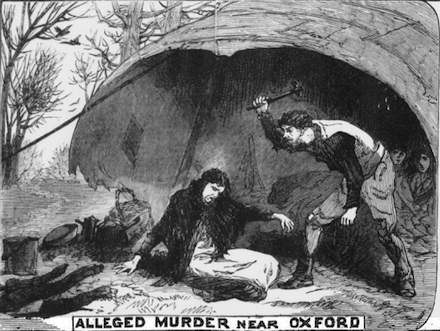
On this date in 1887, 63-year-old Charles Smith was judicially hanged at Oxford Castle Prison by James Berry. He’d brutally murdered his wife in front of their children that February.

The Smith family were Gypsies: Charles, his wife Lucy, their 17-year-old daughter Oceana (known as Oshey) and their 11-year-old son Prince Albert. As Nicola Sly notes in her book Oxfordshire Murders,

The lifestyle of Gypsy families in 1887 was not one to be envied. The traveling people were at the mercy of the weather all year round, whether the heat of summer or the bitter cold of winter. Forced to scratch a living any way they could, many supplemented their meager income with a little poaching or petty theft. Thus they were very rarely welcomed in any area and were always in fear of the local police who almost invariably moved them on wherever they tried to settle.

According to this account, Lucy had borne many children, but only four lived long. By the time of the murder, one of the children had died and one, a daughter named Elizabeth, had grown up and left home.

Charles’s siblings regularly got in trouble with the law, and at least one of his siblings was transported for sheep theft. He and Lucy, however, were somewhat more fortunate: Lucy possessed a valid peddler’s license. In the 1881 censuses, both had their occupations listed as “hawker.” Charles made baskets, skewers, roasting forks, meat stands and pegs which his wife sold.

Throughout their lives Charles and his family traveled around Oxfordshire, pitching a tent wherever they could find a place, and in February 1887, they were camped on public land near Headlington. They’d been there before and were friendly with some of the local residents, including a couple coincidentally also named Smith.

Charles was a violent man who regularly beat his wife and children; Oshey stated he beat his wife every day, and Prince Albert would later testify, “He has been knocking my mother about nearly all his life.”

At one point the domestic violence had gotten so bad that Lucy had gone so far as to take out a formal complaint against her husband for cruelty. She never followed up on it, though.

On the 18th of February, Kate and George Smith, who lived in a nearby cottage, visited the tent and noted Lucy was visibly bruised. They asked Charles why he’d beaten her and he wouldn’t give a reason, but said it was over something that happened thirty years before.

The visitors advised him to forgive and forget, but Charles acted surly and hostile for the rest of the day. Lucy was so frightened of him that for a long time she stayed outside the tent in the bitter cold, and only partially dressed, rather than go inside where her husband was. At bedtime she finally came in.

In the early hours of the next morning, Charles began shouting at his wife, waking the children. As Oshey and Prince Albert watched in horror, their father picked up a hammer and attacked Lucy, beating her on her head, back and legs until he was too tired to do it anymore. Then he laid down and went peacefully asleep.

Mortally wounded, Lucy crawled out of the tent to get some water from a nearby stream. She never returned, and eventually Oshey went out to check on her and found her dead.

When Charles realized what he’d done, he sank to his knees beside Lucy’s battered corpse and sobbed, crying, “My wench, my wench!”

Oshey and Prince Albert ran for help, going to the same neighbors who’d visited the night before. When Kate Smith answered the door, Oshey blurted, “My Mammy’s dead. He’s been and killed her with the hammer.”

Kate and George rushed to the scene of the crime. Charles had dragged Lucy’s body into the tent and lain it out on some straw. He told them Lucy had “fallen down” and died. George told everyone he was going to fetch a doctor, but instead he went to the police, returning with two constables. By then Charles had calmed down and said casually, “Good morning. I have got a dead ‘un this morning.”

One of the constables searched the tent and found the bloodstained hammer concealed under some straw. Charles, whose coat was also bloodstained, was placed under arrest for the willful murder of his wife. The autopsy showed she’d died of a fractured skull; Charles had hit her head with the hammer three or four times.

At the ensuing trial in April, Oshey was the star witness against her father, although Charles kept shouting that she was telling lies and was a “nasty, wicked wretch.” Prince Albert testified also, as did Kate and George Smith.

The defense argued that Charles had no intention of killing his wife and there was no motive, and so it was a case of manslaughter. However, the jury returned a verdict of murder.

After he was condemned to die, Charles turned to religion for solace, praying with the prison chaplain. Some of his relatives came to visit, although Oshey and Prince Albert stayed away. His eldest daughter Elizabeth made the strange observation that “when he was a drunkard there was not a kinder man living, that something or somebody turned him into a teetotaler, and from that time he had been a cruel wretch.”

While walking to the scaffold, Charles fainted on the trapdoor just before James Berry drew the bolt. The hanging went smoothly and it was judged he died quickly and painlessly.

As for the orphaned Oshey and Prince Albert, it was recorded that “through the noble hearted philanthropy, of Miss Skene, of this City, the girl Oceana has been placed in a Home in York, and boy the Prince Albert, through the same thoughtfulness, will also be brought up to acquire the means of earning an honest livelihood.”

On this day..

1805: Not Bartlett Ambler, possible buggerer

From “Buggery and the British Navy”, in History of Homosexuality in Europe and America

Unlike modern military law, which tends to distinguish in some way between homosexual acts between consenting adults and what is often the equivalent of rape of a shipmate, the navy during this period made no such distinctions. A boy who had been seduced or forced to commit buggery, therefore, was under great pressure to turn in his partner or attacker, for if they were caught and it appeared he had consented, the “victim” might well be as severely punished as the aggressor. Needless to say, there were serious problems in determining whether or not the boys called to testify were telling the truth, or simply using the buggery charge as a means of destroying a shipmate or officer they particularly disliked.

…

The courts were often acutely conscious of that possibility and there was even some objection to allowing young boys to testify in buggery trials. In 1772, the defense protested the testimony of John Ellis, a twelve year old boy who had accused one John Palmer of buggery. Despite the protest, however, it was decided that he could legally testify and Palmer was convicted of attempted buggery.

The problem of boys testifying against men in buggery cases are clearly revealed in the Bartlett Ambler case. Ambler was accused by four boys of sodomitic practices. Each testified that Ambler threatened to have them flogged if they told what had occurred. One of the boys, John Davy, said, “…and I had scarce buttoned up my breeches when he said be sure don’t tell no person of it. I’ll be very good to you, but if you tell any person of it I’ll get you flogged.” Ambler based his defense on the alleged wickedness of his accusers. Joseph Dorman, the ship’s corporal, was called upon to discuss the character of three of the witnesses.

Q. Do you know if the boys who have been examined in support of the charge against me are notorious liars?

A. Two of them Hopkins and Willcott have been several times punished for lying.

Court. What is the character of the boy Davy?

A. He bears a very bad character by the whole ship’s company.

Ambler also called upon Midshipman Robert Baker who told the court:

Davy is a very wicked boy indeed as ever lived everyone in the ship will say that if it was in his power he would hang his own father — I hear Hooper’s mother say that her son had denied to her all that had been said against the prisoner.

The court had to weigh the testimony of the four boys who accused Ambler of buggery against the evidence of Ambler’s witnesses, who denigrated the character of the boys and testified to his good reputation. The judges sentenced Ambler to be hanged, but as a sign of their unease, sent the following letter to the Admiralty Secretary, along with the minutes of the trial:

By desire of the members of a Court Martial assembled by me this day to try Mr. Bartlett Ambler, I have to request you will call their lordship’s consideration to the hardship the Court have labored under in being obliged to condemn a man to death, upon the evidence of four boys, the eldest not more than thirteen years of age, and therefore recommend him to mercy.

The recommendation was endorsed by His Majesty on May 8, 1805, and Ambler was pardoned.

It is clear that boys could be intimidated into testifying against innocent men. In one disturbing case, a boy was caught under the blanket of Edward Martin. Evidently, the boy did not have a bed or blanket of his own, and Martin took him in as an act of kindness. The captain of the ship had the boy flogged and threatened him with another whipping if he refused to testify. Under the threat of further punishment, the boy confessed that Martin had buggered him. The trial record reads:

Prosecutor. Did you inform me that the Prisoner had committed that unnatural crime on you twice?

James. Yes, but I was afraid that the Captain would flog me.

In this case, the prisoner was acquitted, but the case does suggest the many possible abuses in buggery trials: that the testimony of boys was suspect, that fear of punishment or promise of reward might be used to intimidate them into giving false evidence against a shipmate, that the boy could be motivated by dislike or a desire for vengeance.

Trial transcripts of the testimony offered against Bartlett Ambler — and summoned by Ambler in his defense, who averred the “wicked” and “very bad” character of the childish witnesses — are available in Gay Warriors: A Documentary History from the Ancient World to the Present.

On this day..