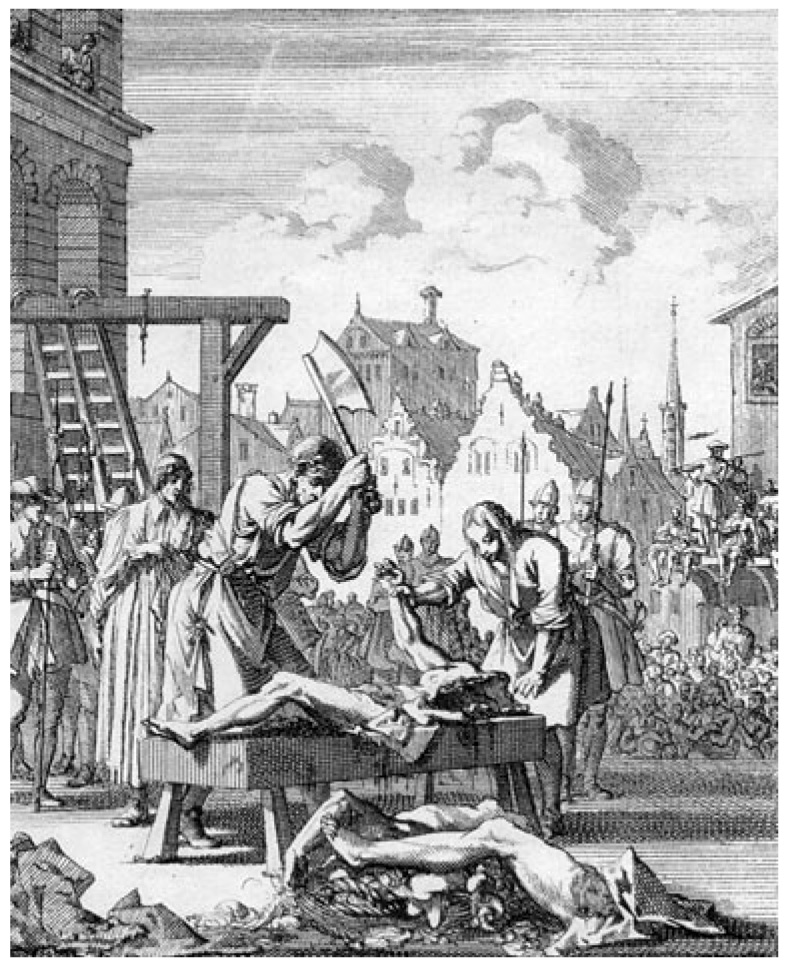
1242: William de Marisco, pirate knight

On this date in 1242, the knight, outlaw, and pirate William de Marisco was drawn by a horse to Coventry and put to the pains of disemboweling and quartering — albeit only after he had already been hanged to death.


Illustration of William de Marisco’s execution by the amazing 13th century chronicler Matthew Paris.

He’d eventually be damned as a kingslayer but Marisco’s doom began with the 1235 murder of a messenger of King Henry III named Henry Clement, slain at the very gates of Westminster “to our no small dishonour and scandal of the realm.” Suspicion settled on the Mariscos, who might have been motivated by Clement’s boasting of having helped recently lay in his grave the Earl of Pembroke, a magnate and great rival to the king.*

Marisco, whose architectural legacy for us is Coonagh Castle, County Limerick in Ireland, fled the scene of the crime and took refuge on Lundy Island, a gorgeous and remote fingerbone in the westerly Bristol Channel that had once been granted to the Knights Templar.**

There, as our chronicler-illustrator Matthew Paris describes, he made his way thereafter by piracy.

Whilst these occurrences were taking place, William Marsh [“de Marisco” means “of the Marshes” -ed.], son of Geoffrey Marsh, took up his quarters on an island near Bristol, called Lundy, a place impregnable by the nature of its situation, where he lived like a pirate with a number of proscribed and wicked men, indulging in plunder and rapine, and, attended by his companions, traversed the places on the neighbouring coast, despoiling the inhabitants of their property, especially wine and other provisions. By sudden incursions lie frequently carried off vast booty from the country lying near the island, and in many ways injured the kingdom of England both by land and sea, and caused great loss to the native and foreign merchants.

William de Marisco would manage seven years on the lam, seizing victuals and booty and ransomable hostages as he could from his island fastness. He’d been dispossessed of his lands in Ireland and nursed against King Henry the personal grudge of an aggrieved nobleman.

Such injuries were known to heal over time, and amid the tangle of authority and kinship among medieval Europe’s bluebloods, today’s rebel might become tomorrow’s hand of the king. But in 1238, William cut the roads behind him and made himself permanently anathema by allegedly sending an assassin after Henry III. Matthew Paris, again, with a story that will easily bear the interpretation that Marisco’s name was put into a deranged regicide’s mouth by his torturers:

on the day after the Nativity of St. Mary, a certain learned esquire, as it is said, came to the king’s court at Woodstock, pretending that he was insane, and said to the king, “Resign to me the kingdom, which you have unjustly usurped, and so long detained from me;” he also added, that he bore the sign of royalty on his shoulder. The king’s attendants wanted to beat him and drive him away from the royal presence, but the king prevented those who were rushing on him from violence, saying, “Let the insane man rave as becomes him, for such people’s words have not the influence of truth.” In the middle of the night, however, this same man entered the king’s bedchamber window, carrying an open knife, and approached the king’s couch, but was confused at not finding him there, and immediately began to look for him in the several chambers of his residence. The king was, by God’s providence, then sleeping with the queen. But one of the queen’s maids, named Margaret Biseth, was by chance awake, and was singing psalms by the light of a candle (for she was a holy maid, and one devoted to God), and when she saw this madman searching all the private places, to kill the king, and frequently asking in a terrible voice where the king was, she was greatly alarmed, and began to utter repeated cries. At her dreadful cry the king’s attendants awoke, and leaped from their beds with all speed, and running to the spot, broke open the door, which this robber had firmly secured with a bolt, and seized the robber, and, notwithstanding his resistance, bound him fast and secured him. He, after some time, confessed that he had been sent there to kill the king, after the manner of the assassins, by William Marsh, son of Greoffrey Marsh, and he stated that others had conspired to commit the same crime.

Paris has evident contempt for William, but he does note that “William boldly denied all these charges, yet he did not obtain any credit, nor was he listened to; he therefore, however unadvisedly, betook himself to out-of-the-way places, and became a fugitive and an outlaw.” It is not clear to this author that outlawry is “unadvisable” vis-a-vis standing to the judgment of a king who is certain you have attempted his life; nevertheless, it is usually little better than the temporary expedient for the doomed.

On the feast of St. James, by the king’s order, the said William, with sixteen of his accomplices taken with him, was tried and condemned, and, by the king’s order, was sentenced to an ignominious death. He was, therefore, first dragged from Westminster to the Tower of London, and from thence to that instrument of punishment called a gibbet† suspended on which he breathed forth his miserable life. After he had grown stiff in death, his body was let down and disembowelled; his entrails were immediately burnt on the spot, and his wretched body divided into four parts, which were sent to the four principal cities of the kingdom, that the sight of them might strike terror into all beholders.

His sixteen accomplices were all dragged through London at the horse’s tail, and hung on gibbets. The said William, after his condemnation, when about to imdergo the sentence pronounced upon him, invoking the divine judgment to witness, boldly declared that he was entirely free and guiltless of the crime of treason imputed to him, and likewise of the murder of the aforesaid clerk Clement; he also asserted that he had betaken himself to the aforesaid island for no other reason than to avoid the king’s anger, which he had always above all things wished to pacify by submitting to any kind of trial, or by any other humiliation; but that, after he had taken refuge as a fugitive in the said island, he was obliged to prolong his miserable life by seizing on provisions wherever he could find them. He then poured out his soul in confession before God, to J. de St. Giles, one of the brethren of the Preacher order, and confessed his sins with contrition, not excusing himself and giving vent to evil words, but rather accusing himself. This discreet preacher and confessor then administered gentle comfort to him, and dismissed him in peace, persuading him that he underwent the death to which he was doomed by way of repentance. And thus, as before mentioned, horrible to relate, he endured not one, but several dreadful deaths.

Readers of Latin can peruse the transcript of the trial, which has surprisingly survived the ravages of century, in this 1895 English Historical Review article.

* Pembroke’s brother and heir was also suspected initially, but was able to clear himself; however, he was later made to take a vow no longer to protect William de Marisco, suggesting that Pembroke was at least in simpatico with the hit. Both William and Geoffrey de Marisco had been fined previously for adhering to the Pembroke side in a fight with the king.

** The Templars at best barely possessed Lundy and the Mariscos who claimed it opposed those banker-knights’ stake, successfully.

† Paris’s unfamiliar marking of the term “gibbet” is interesting here; according to dictionary.com it was during the 13th century that this word for gallows entered Middle English from French.

On this day..

1587: George Gaspar, an English heretic in the Inquisition

We have noted previously the progress of the Spanish Inquisition on the Canary Islands in the early 16th century. We turn here to another auto de fe it authored there in 1587 from the same source, The Inquisition in Spanish Dependencies, available free from Google books here.

By this time, the Canaries boasted a population of some 35,000* — half or so on Tenerife, where this auto took place — and had become an important entrepot in the growing traffic to the New World. For the same reason these isles became a theater in the running (albeit undeclared) Anglo-Spanish War, the conflict of which the Spanish Armada forms the most scintillating chapter. English privateer Sir Francis Drake raided the Canary Islands repeatedly in the 1580s. Between commerce and war, English, Irish, and Flemish sailors began to turn up in Spanish prisons on the Canary Islands where holy inquisitors could begin to take an interest in them.

There was another auto, celebrated July 22, 1587, in which there were burnt three effigies of a remnant of the Lanzarote fugitives.** There was also the more impressive relaxation of a living man — the first since that of the Judaizers in 1526. This was an Englishman named George Gaspar who, in the royal prison of Tenerife, had been seen praying with his back to a crucifix and, on being questioned, had said that prayer was to be addressed to God and not to images.

He was transferred to the tribunal, where he freely confessed to having been brought up as a Protestant.

Torture did not shake his faith and he was condemned, a confessor as usual being sent to his cell the night before the auto to effect his conversion. He asked to be alone for awhile and the confessor, on his return, found him lying on the floor, having thrust into his stomach a knife which he had picked up in prison and concealed for the purpose.

The official account piously tells us that it pleased God that the wound was not immediately mortal and that he survived until evening, so that the sentence could be executed; the dying man was carted to the quemadero and ended his misery in the flames.

It bears noting here that the beheading in February of that same 1587 of Mary, Queen of Scots might have inflamed continental Catholic sentiment against an Englishman at this moment; and, the aforementioned Drake had famously harried Spanish shipping during that spring. Nevertheless, the steely Gaspar presents an atypical case. More usually, an ounce of discretion could buy the life even of a heretic of a hostile power, and most preferred to pay the torturer in that coin.

Another Englishman was Edward Francis, who had been found wounded and abandoned on the shore of Tenerife. He saved his life, while under torture, by professing himself a fervent Catholic, who had been obliged to dissemble his religion, a fault which he expiated with two hundred lashes and six years of galley service.

Still another Englishman was John Reman (Raymond?) a sailor of the ship Falcon; he had asked for penance and, as there was nothing on which to support him in the prison, he was transferred to the public gaol. The governor released him and, in wandering around he fell into conversation with some women, in which he expressed Protestant opinions. A second trial ensued in which, under torture, he professed contrition and begged for mercy, which he obtained in the disguise of two hundred lashes and ten years of galleys.

In addition there were the crew of the bark Prima Rosa, twelve in number, all English but one Fleming. One of them, John Smith, had died in prison, and was reconciled in effigy; the rest, with or without torture, had professed conversion and were sent to the galleys, some of them with a hundred lashes in addition.

* Source

** In 1569, a Morisco merchant named Juan Felipe, catching wind that the Inquisition meant to arrest him, took to the seas with about thirty fellow Muslim converts and escaped to Morocco. These refugees were punished in auto de fe effigies in 1569, 1581, and the present case.

On this day..

1450: Jack Cade posthumously quartered

On or around this date in 1450 the body of the rebel Jack Cade was posthumously beheaded and quartered.

He’s one of England’s first names in rebellion, and Cade’s Kentish rising indexed England’s catastrophic breakdown under the weak king Henry VI, a milepost between the waning Hundred Years’ War and the onrushing Wars of the Roses.


Panel of a 1964-1965 ceramic mural in Peckham, by Polish artist Adam Kossowski. (cc) image from Peter Gasston.

And for all of these, Cade included, Henry was the chaos-making variable.

He had just about finished squandering the entire French patrimony so gloriously won for him by the sword-arm of his doughty father Henry V, and defeated troops fleeing French advances in Normandy compounded, as they tramped up the southeast beaten and looting, the general fury at the king’s unpopular marriage to the French princess Margaret of Anjou. With shambolic governance allied to a slumping economy, corrupt taxation, and mounting public debt, things were coming unglued.

Like many kings, Henry benefited from the instinct to target overt blame away from the sovereign himself and towards the aides and counselors who surround him. One of the very most hated of those counselors was the man who had negotiated that French marriage — giving away to the French crown the hard-won provinces of Anjou and Maine as its price. William de la Pole, Duke of Suffolk, was so near to being attainted or lynched around London that King Henry exiled him for his own safety to France. But Suffolk didn’t make there: instead, he was captured at sea and murdered.

When his body washed up in Kent, rumors seem to have anticipated a royal reprisal against that region and in favor of the late hated favorite, perhaps the trigger for the events in this post.

Nevertheless, the “rebels” did not conceive themselves engaged in a seditious enterprise; this is apparent from the manifesto of grievances it issued, with moderating tones and language echoing complaints that the Commons was raising to no avail in Parliament.

Item. The law serves of nought else in these days but for to do wrong, for nothing is spread almost but false matters by colour of the law for reward, dread and favour and so no remedy is had in the Court of Equity in any way.

Item. We say our sovereign lord may understand that his false council has lost his law, his merchandise is lost, his common people is destroyed, the sea is lost, France is lost, the king himself is so set that he may not pay for his meat nor drink, and he owes more than ever any King of England ought, for daily his traitors about him where anything should come to him by his laws, anon they take it from him.

…

Item. We will that all men know we blame not all the lords, nor all those that are about the king’s person, nor all gentlemen nor yeomen, nor all men of law, nor all bishops, nor all priests, but all such as may be found guilty by just and true inquiry and by the law.

Item. We will that it be known we will not rob, nor plunder, nor steal, but that these defaults be amended, and then we will go home …

The man at the forefront is a cipher: he went by the potent alias of “John Mortimer”, the surname unmistakably linking his cause to the rival royal claimants over at the the House of York, but neither the name of “Jack Cade” by which history recalls his movement nor the antecedent experiences that thrust him into leadership can be attested with any confidence.

He appears by the half-glimpses we catch of him in the period’s chronicles to be a vigorous and intelligent character. He shied away from battle with a royal army, wisely avoiding the taint of treason that would come with entering the field against the king’s own person; but, it was an organized withdrawal that left his forces capable of ambushing and destroying the detachment from that army that the king had sent to pursue them, a testament to Cade/Mortimer’s adroit command.

Panicked when the news of this reversal resulted in his own forces taking up the rebels’ call to punish traitorous lords, King Henry beat feet for the safety of Kenilworth Castle and abandoned the stage of London to this mysterious new character.

The rebel militia seized it on the third of July that year, visiting its promised popular justice in the process upon several of those “false counsellors” detested among the populace — including the Bishop of Salisbury, the Baron Saye and Sele, and the former sheriff of Kent, William Cromer; Shakespeare gives us a bloody-minded* Cade bantering with his prey Saye and Sele in Henry VI, Part 2 — “Ye shall have a hempen caudle, then, and the help of hatchet … Go, take him away, I say, and strike off his head presently; and then break into his son-in-law’s house, Sir James [sic] Cromer, and strike off his head, and bring them both upon two poles hither.”


Charles Lucy, “Lord Saye and Sele brought before Jack Cade 4th July 1450”

Peasant risings like these are made for eventual failure, but it the unusually high water mark achieved by Cade’s rebellion before receding makes another measure of the crown’s weakness. After ceding the Kentishmen the run of London for several days, it took a desperate nighttime battle on London Bridge to finally push them out.

A general amnesty went abroad to induce the rebels to disperse, but it was not for Cade — who fled to Sussex where he was taken, and mortally wounded in the process, by the new sheriff of Kent, Alexander Iden. (A road called Cade Street now runs in the vicinity; there is a monument to his capture in Heathfield.) It was Cade’s good fortune to succumb to his injuries on the journey back to London but the pains of justice were inflicted upon his remains just the same.

Cade died on Sunday, July 12. The precise date for his posthumous disgrace is not certain from the sources available to us. Many writers report July 15, seemingly based on John Benet’s chronicle, which is a strong source and asserts the 15th unambiguously. I’m here guardedly preferring the 16th based on Gregory’s Chronicle, whose authors were clearly Londoners, and who narrated the progress of the week following Cade’s death with specificity.

And that day was that fals traytoure the Captayne of Kentte i-take and slayne in the Welde in the countre of Sowsex, and uppon the morowe he was brought in a carre alle nakyd, and at the Herte in Sowetheworke there the carre was made stonde stylle, the wyffe of the howse myght se hym yf hyt were the same man or no that was namyd the Captayne of Kente, for he was loggyd whythe yn hyr howse in hys pevys tyme of hys mys rewylle and rysynge. And thenne he was hadde in to the Kyngys Bynche, and there he lay from Monday at evyn [i.e., Monday, July 13] unto the Thursseday nexte folowynge at evyn [Thursday, July 16]; and whythe yn the Kynges Benche the sayde captayne was be-heddyde and quarteryde; and the same day i-d[r]awe a-pon a hyrdylle in pecys whythe the hedde by-twyne hys breste from the Kyngys Benche thoroughe owte Sowthewerke, and thenne ovyr Londyn Brygge, and thenne thoroughe London unto Newegate, and thenne hys hedde was takyn and sette uppon London Brygge.

Cade’s is the rebellion that gets the ink, but several other uprisings in the South of England followed in the months ahead … ill omen for the king who would soon experience the ruin of his reign and family.

The History of England podcast covers Jack Cade’s rebellion in Episode 161.

* It is one of Cade’s subalterns in this play who supplies posterity with the immortal quip, “The first thing we do, let’s kill all the lawyers.”

On this day..

1807: Richard Faulkner, scared straight

On this date in 1807 at Wisbech, 15-year-old Richard Faulkner hanged in a truly repentant frame of mind — as described by the Norfolk Chronicle of August 1, 1807:

At Ely assizes, held at Wisbech, there was but one prisoner for trial; viz. Richard Faulkner, convicted of the murder of George Burnham a lad about 13 years of age, at Whittlesea, on Sunday, the 15th of February last, by cruelly beating him to death, for no other cause than to revenge his (the deceased) mother’s having thrown some dirty water upon him.

The prisoner himself was not 16, but so shockingly depraved and hardened, that after condemnation he repeatedly clenched his fist, and threatened to murder the clergyman who attended the gaol, or any one who dared to approach him.

Indeed he was so ferocious that the gaoler found it necessary to chain him hands and feet to his dungeon, where he uttered the most horrid oaths and imprecations on all who came near him; and from the Friday to Saturday night refused to listen to any religious advice or admonition.

At length to prevent the termination of his existence in this depraved state, the expedient was devised of procuring a child about the size of the one murdered, and similar in feature and dress, whom two clergymen unexpectedly led between them, by the hands, into his cell, where he laid sulkily chained to the ground; but on their approach he started and seemed so completely terrified, that he trembled every limb, cold drops of sweat profusely falling from him, and was almost momentarily in such a dreadful state of agitation, that he intreated the clergymen to continue with him, and from that instant became as contrite a penitent as he had before been callous and insensible.

In this happy transition he remained till his execution on Monday morning the 13th inst. having fully confessed his crime and implored by fervent prayer the forgiveness of his sins from a merciful God!

On this day..

1723: Thomas Athoe the Elder, and Thomas Athoe the Younger

On this date in 1723, the 58-year-old former mayor of the Pembrokeshire town of Tenby was hanged along with his quarrelsome 23-year-old son.

This classic from the Select Trials annals finds Thomas Athoes Elder and Younger out at market-day when the young hothead picked a fight with, and got his ass kicked by, George Merchant. Merchant was Athoe the Younger’s own cousin, for his mother was Athoe the Elder’s sister; not only this, but in explaining their conduct to the chaplain endeavoring to save their souls, the Athoes would allege that Merchant had also swiped young Athoe’s girl.

The Athoes bided their time for the rest of that day, November 23 of 1722, and “advised by some Pettifogger, to bring an Action against the Deceased .. .answered, No, no, we won’t take the Law, but we’ll pay them in their own Coin.” And so when night fell, they followed Merchant and his brother Thomas (that’s the third Thomas on the pitch here, for those keeping count) to Holloway’s Water, the estuary of the river Ritec that in the 18th century swelled so high when the tide came in that the river became navigable four miles inland. The road that traversed it could only be crossed at low tide.

So it was in this muddy coastal defile, on a nigh-moonless night,* that father and son rounded on brother and brother as the latter watered their mounts.

The evidence in the case was given by Thomas Merchant, who survived the attack so narrowly that “at the Time of the Trial, tho’ it was four Months afterwards, he was in so weak a Condition that he could not stand, and therefore the Court permitted him to give his Evidence sitting.” Squeamish readers might wish to do likewise before proceeding to the rending of flesh he developed for the court.

The Prisoners coming up with great Sticks, I owe thee a Pass, and now thou shalt have it, said young Athoe to the Deceased, and knock’d him off his Horse. Thomas Merchant was serv’d in the like Manner by old Athoe, who, at the same Time cry’d out, Kill the Dogs! Kill the Dogs!

The Brothers begg’d ’em for God’s Sake to spare their Lives; but the Prisoners had no Regard to their Cries. Old Athoe fell upon Thomas Merchant, beating him in a terrible Manner, and taking fast hold of his Privities, pulled and squeezed him to such a violent Degree, that, had he continued so doing a few Minutes longer, it had been impossible for the poor Man to have survived it. The Pain he suffered, is past Expression, and yet it fell short of what his Brother endured.

Young Athoe, when he had tired himself with beating him, seized him by the Privy Members, and his Yard being extended, he broke the Muscles of it, and tore out one of his Testicles; and calling to his Father, said, Now I have done George Merchant’s Business! This horrible Action occasioned a vast Effusion of Blood: But young Athoe’s Revenge was not yet glutted, — for catching hold of the Deceased’s Nose with his Teeth, he bit it quite off, and afterwards tied a Handkerchief so tight about his Neck, that the Flesh almost covered it.

The last Words the Deceased was heard to say were, Don’t bite my Nose off. He lived a few Hours in the most grievous Agony imaginable, and then expired.

Although the younger Athoe briefly took refuge in Ireland, father and son were remanded to London for trial, convicted with ease, and doomed to hang at St. Thomas’s Watering on Old Kent Road in Surrey.

When they came to the fatal Tree, they behaved themselves in a very decent Manner, embracing each other in the most tender and affectionate Manner; and indeed the Son’s hiding his Face, bedewed with Tears, in his Father’s Bosom, was, notwithstanding the barbarous Action they had committed, a very moving Spectacle.

* November 23 maps as a full moon … but recall that England at this time was still on the Julian calendar, so the local date corresponds instead to December 4, at nearly the opposite end of the lunar cycle.

On this day..

1906: Four Egyptians for the Denshawai Incident

If her [England’s] empire means ruling the world as Denshawai has been ruled in 1906 — and that, I am afraid, is what the Empire does mean to the main body of our aristocratic-military caste and to our Jingo plutocrats — then there can be no more sacred and urgent political duty on earth than the disruption, defeat, and suppression of the Empire, and, incidentally, the humanization of its supporters.

-George Bernard Shaw

On this date in 1906, four Egyptian villagers were hanged by the British after a UK soldier died in riot begun by a pigeon hunt.

The Denshawai Incident — which is still to this day commemorated by its own museum — as an isolated event was one of those little local indignities that comprise a foreign military occupation. By the intersection of highhandedness on the one side and accumulated anger on the other it would become what George Bernard Shaw dubbed “the Denshawai Horror.”

On June 13, a mere 15 days before the executions in this post, a gaggle of bored Tommies* set out hunting pigeons in the Nile Delta. This was for the locals an irksome pastime inasmuch as the villagers raised these tame birds in brick towers for agrarian use — as Shaw noted:

Try to imagine the feelings of an English village if a party of Chinese officers suddenly appeared and began shooting the ducks, the geese, the hens and the turkeys, and carried them off, asserting that they were wild birds, as everybody in China knew, and that the pretended indignation of the farmers was a cloak for the hatred of the Chinese, and perhaps for a plot to overthrow the religion of Confucius and establish the Church of England in its place!

On this occasion, protesting villagers dared a little more resistance than was usual and before long a gun had discharged in the struggle, injuring several and felling a local woman (she survived, though onlookers took her wound for a mortal one in the moment). As if by metaphor, somewhere in the mayhem, somebody’s wheat caught fire.

Having clumsily escalated the disturbance that their presence had provoked, the Brits at length had to flee a small riot: one of their number died in the flight, the cause never clearly ascertained but attributed by a doctor to “heat apoplexy caused or aggravated by concussion of the brain.”** Several others were collared by the villagers, who abused them but did not kill them.

As Shaw notes, in a domestic English context it might have been the gendarmes who were punished for mismanaging the situation to the detriment of the public peace.

But the English occupation of Egypt disdained the hearts-and-minds approach, preferring bile and spleen. Fifty-two(!) villagers came up on charges of murder(!!) for the heatstroked officer, and the punishments meted out by a British-controlled court† seemingly aimed to maximize rancor with the understanding that cruelty was the only language the native could comprehend.

The husband of the woman shot by the hunting party, Shaw fulminated in an incandescent essay against imperialism,

in consideration of the injury to his wife, was only sentenced to penalty servitude for life … No such sentimentality was shewn to Hassan Mahfouz. An Egyptian pigeon farmer who objects to British sport; threatens British officers and gentlemen when they shoot his pigeons; and actually hits those officers with a substantial stick, is clearly a ruffian to be made an example of.

Penal servitude was not enough for a man of 60 who looked 70, and might not have lived to suffer five years of it. So Hassan was hanged; but as a special mark of consideration for his family, he was hanged in full view of his own house, with his wives and children and grandchildren enjoying the spectacle from the roof. And lest this privilege should excite jealousy in other households, three other Denshavians were hanged with him … ages of the four hanged men respectively, 60, 50, 22 and 20.

Hanging, however, is the least sensational form of public execution: it lacks those elements of blood and torture for which the military and bureaucratic imagination lusts. So, as they had room for only one man on the gallows, and had to leave him hanging half an hour to make sure work and give his family plenty of time to watch him swinging (“slowly turning round and round on himself,” as the local papers described it), thus having two hours to kill as well as four men, they kept the entertainment going by flogging eight men with fifty lashes each: eleven more than the utmost permitted by the law of Moses in times which our Army of Occupation no doubt considers barbarous. But they Moses conceived his law as being what he called the law of God, and not simply an instrument for the gratification of his own cruelty and terror.

It is unspeakably reassuring to learn from the British official reports laid before parliament that “due dignity was observed in carrying out the executions,” that “all possible humanity was shewn in carrying them out,” and that “the arrangements were admirable, and reflect great credit on all concerned.” As this last testimonial apparently does not refer to the victims, they are evidently officially considered not to have been concerned in the proceedings at all. Finally, Lord Cromer certifies that the Englishman in charge of the proceedings is “a singularly humane man, and is very popular amongst the natives of Egypt by reason of the great sympathy he has always shewn for them.” It will be seen that Parliamentary Papers, Nos. 3 and 4., Egypt, 1906, are not lacking in unconscious humor. The official walrus pledges himself in every case for the kindliness of the official carpenter.


Edinburgh Evening News, June 29, 1906

Shaw’s determination to humanize the “natives” by analogy to English country squires unsurprisingly stands in stark contrast to the dominant thrust of domestic reportage — which consistently describes the affair as an unprovoked attack or (still better) an outrage. Shaw, however, was far from alone in his sentiment: many British elites were discomfited by the harsh and arbitrary treatment meted out in the imperial hinterlands. Another writer, Wilfrid Scawen Blunt, bemoaned the “abominable case” and took up an editorial pen in the Egyptians’ defense — albeit more in hope than expectation, for as he confided to his diary, “English feeling on these matters has become absolutely callous, and I believe if Cromer ordered a dozen of the villagers to be crucified or impaled, no serious objection would be made to it here.” And he was right to despair.

Still, gentlemen of a liberal conscience have the luxury down the decades of forgetting the individual atrocities of empire.‡

Few in the West recognized the allusion when, following 2005 bombings in London by Islamic terrorists, Ayman al-Zawahiri “announced that Britain was one of Islam’s worst enemies; it had been responsible for the deaths of thousands of Muslims across the ages, from Palestine to Afghanistan, Delhi to Denshawai.” (Source)

But it had by that time been long since that the chickens of Denshawai had come home to roost. In his autobiography, Egyptian nationalist president Anwar Sadat mused on the formative influence worked upon his childhood by the sacrifice of one of the Denshawai martyrs.

[T]he ballad which affected me most deeply was probably that of Zahran, the hero of Denshway. I recall my mother reciting it to me as I lay stretched out on top of our huge rustic oven, half-asleep while my younger brothers (and our rabbits) had all fallen asleep. It appealed to me afresh every time I listened to it. Denshway was only three miles away and the ballad dealt with a real incident … Zahran was the hero of the battle against the British and the first to be hanged. The ballad dwells on Zahran’s courage and doggedness in the battle, how he walked with his head held high to the scaffold, feeling proud that he had stood up to the aggressors and killed one of them.

I listened to that ballad night after night, half-awake, half-asleep, which perhaps made the story sink into my subconscious. My imagination roamed free. I often saw Zahran and lived his heroism in dream and reverie — I wished I were Zahran.

His wish would come as near to fruition as wishes do. Sadat had the honor of announcing to the world the Egyptian Revolution of 1952 that would expel the British occupation … and thirty years later, of also giving his life for Egypt.

* Not Dickens nor Kubrick could not have bested the names of shooting party participants Captain Bull (the eventual fatality) or Brevet-Major Pine-Coffin.

** That is, running away from a bombardment of stones. It appears to be permanently obscure (and subject to partisan slanting) precisely how these factors weighed together at the moment of Bull’s death. The diagnosis is quoted in the London Times, June 25, 1906.

† The tribunal featured mixed Egyptian and British personnel, notably including Boutros Ghali, future Egyptian Prime Minister and grandfather of the eventual United Nations head Boutros Boutros-Ghali.

‡ At least, of their own empire. According to Aliens — Uneingeburgerte: German and Austrian Writers in Exile, the Third Reich produced a German-language play about the Denshawai incident by adapting Shaw’s account.

On this day..

1733: Champion and Valentine, slaves

Today’s tale from colonial Virginia’s slave power arrives via A Documentary History of Slavery in North America.

The Espy file gives June 29 for these executions, but the Wednesday of that week in 1733 (as designated in the court sentence) was June 27.


At a Court called for Goochland County the twenty-fifth day of June MDCCXXXIII, for the tryall of Champion a Negro man slave, Lucy, a Negro woman slave, both belonging to Hutchins Burton, Sampson, Harry, & George, three Negro men slaves belonging to William Randolph, Esq’r, & Valentine, a negro man slave belonging to Bowler Cocke gent.

A commission from the Hon’ble William Gooch Esq’r His Majesty’s Lieut Governor & Commander in chief of this Dominion to John Fleming, Tarlton Fleming, Allen Howard, Edward Scott, George Payne, William Cabbell, James Holman, Ishman Randolph, James Skelton, George Raine, & Anthony Hoggatt, gent to be Justices of Oyer and Terminer for the tryall of Champion a Negro man slave, Lucy a Negro woman slave both belonging to Hutchins Burgon, Sampson, Harry, & George, three Negro men slaves belonging to William Randolph Esq’e & Valentine a Negro man slave belonging to Bowler Cocke gent. being read as also the Dedimus for administering the Oaths & Test therein mentioned George Payne & Anthony Hoggatt gent. administer the oaths appointed by Act of Parliament to be taken instead of the Oaths of Allegiance and Supremacy the Oath appointed to be taken by an Act of Parliament made in the first year of the reign of his late Majesty King George the first Entitled An Act for the further security of his Majesty’s person and Government and the Succession of the Crown in the Heirs of the late Princess Sophia being Protestants and for extinguishing the hopes of the pretended Prince of Wales and his open & secret abettors, unto John Fleming & Daniel Stoner, gent. who Subscribe the Test take the Oath for duly executing the Office of a Commissioner of Oyer and Terminer, and then administer the said Oaths & Test unto Tarlton Fleming, George Payne, James Skelton & Anthony Hoggatt, gent.

Champion being brought to the Barr an Indictment against him for feloniously murdering Robert Allen of this County is read the prisoner confesses himself guilty of the said murder and it is thereupon considered by the court that he return to the place from whence he came and from thence to the place of Execution there to be hanged by the neck on Wednesday next between the hours of eleven and two till he be dead. The Court value the said Negro at thirty pounds Curr’t money.

George, Sampson & Harry, being brought to the Barr several Indictments against them for feloniously murdering Robert Allen of this County are read the prisoners plead not guilty whereupon the Witnesses & the prisoners defence being heard it is the opinion of the Court that they are not guilty and they are thereupon acquitted.

Valentine being brought to the Barr an Indictment against him for feloniously murdering Robert Allen of this County is read the prisoner pleads not guilty whereupon the Witnesses & the prisoners defence being heard it is the opinion of the Court that he is guilty and it is considered that he return to the place from whence he came and from thence to the place of Execution there to be hanged by the neck on Wednesday next between the hours of eleven & two till he be dead. The Court value the said Negro at forty pounds Curr’t money.

Lucy being brought to the Barr an Indictment against her for feloniously murdering Robert Allen of this County is read the prisoner pleads not guilty and whereupon the Witnesses and the prisoners defence being heard it is the opinion of the Court that she is not guilty of the murder but upon Consideration that she is supposed to have known of the murder after it was committed & did not discover the same it is Ordered that she receive on her bare back twenty one lashes well laid on at the Com[m]on whipping post & that she be then discharged.


It was then “Ordered that the heads & quarters of Champion & Valentine be set up in severall parts of this County.”

On this day..

1684: Sir Thomas Armstrong, Whig plotter

Whig knight Sir Thomas Armstrong was hanged, drawn, and quartered on this date in 1684, for adhering to Lord Russell‘s treasonable Rye House Plot.

Armstrong had been tempting the executioner for some years: he fell foul of the Cromwell protectorate for shuttling funds to the exiled Charles II, and in 1675 he slew a Mr. Scroope at a theater brawl. Both times he kept his head.

He would not be so lucky when conniving to kidnap the king.

Armstrong was shut out of the leadership clique of the Rye House Plot but he was active scheming with Monmouth and others about “how to surprize the Kings Guards” to get at the royal person, with Armstrong observing that “the Guards were very remiss in their places, and not like Souldiers, and the thing was feasible if they had strength to do it.”*

Briefly escaped to the Low Countries along with a number of other fellow-travelers,** Armstrong was arrested in Leiden and repatriated to face royal justice.


Detail view (click for a larger image) of the dismembering of Thomas Armstrong. Condemned to drawing and quartering, Armstrong was hanged to death and only “after such time the Sufferer had hung about half an Hour, and the Executioner had divested him of his Aparrel, he was cut down according to his Sentence; his Privy Members dissected from his Body, and Burnt; his Head cut off, and shewed to the People as that of a Traytor; his Heart and Bowels taken out, and committed to the Flames; and his Body Quartered into four Parts, which, with his Head, was conveyed back to Newgate, to be disposed of according to his Majesties Pleasure, and Order.” (

In an era of bitter factional politics spiced by burgeoning print culture, Armstrong’s delayed handling gave Tory squibs ample space to gleefully taunt the Whigs through him, and savor in doggerel (via repeat reference to executioner Jack Ketch) the inevitable rending of flesh that ensued.

The Bully WHIG: OR, The Poor Whores Lamentation for the Apprehending OF Sir THOMAS ARMSTRONG.

To the Tune of, Ah! Cruel Bloody Fate! &c.

I.

AH! Cruel Bloody Tom!
What canst thou hope for more,
Than to receive the Doom
Of all thy Crimes before?
For all thy bold Conspiracies
Thy Head must pay the score;
Thy Cheats and Lies,
Thy Box and Dice,
Will serve thy turn no more.

II.

Ungrateful thankless Wretch!
How could’st thou hope in vain
(Without the reach of Ketch)
Thy Treasons to maintain?
For Murders long since done and past,
Thou Pardons hast had store,
And yet would’st still
Stab on, and kill,
As if thou hop’dst for more.

III.

Yet Tom, e’r he would starve,
More Blood resolv’d to’ve spilt;
Thy flight did only serve
To justifie thy Guilt:
While They whose harmless Innocence
Submit to Chains at home,
Are each day freed,
While Traytors bleed,
And suffer in their room.

IV.

When Whigs a PLOT did Vote,
What Peer Justice fled?
In the FANATICK PLOT
Tom durst not shew his head.
Now Sacred Justice rules above,
The Guiltless are set free,
And the Napper’s napt,
And Clapper clapt
In his CONSPIRACY.

V.

Like Cain, thou hast a Mark
Of Murder on thy Brow;
Remote, and in the dark,
Black Guilt did still pursue:
Nor England, Holland, France, or Spain,
The Traytor can defend;
He will be found
In Fetters bound,
To pay for’t in the end.

VI.

Tom might about the Town
Have bully’d, huff’d and roar’d,
By every Venus known,
Been for a Mars ador’d:
By friendly Pimping and false Dice
Thou might’st have longer liv’d,
Hector’d and shamm’d,
And swore and gam’d,
Hadst thou no Plots contriv’d.

VII.

Tom once was Cock-a-hoop
Of all the Huffs in Town;
But now his Pride must stoop,
His Courage is pull’d down:
So long his Spurs are grown, poor Tom
Can neither fly nor fight;
Ah Cruel Fate!
That at this rate
The ‘Squire shou’d foil the Knight!

VIII.

But now no remedy,
It being his just Reward;
In his own Trap, you see,
The Tygre is ensnar’d:
So may all Traytors fare, till all
Who for their Guilt did fly,
With Bully Tom
By timely Doom
Like him, unpity’d die.


Sr. Thomas Armstrongs Last Farewell to the WORLD: He being Condemned for HIGH-TREASON, and Conspiring the Death of the KING and the DUKE, and subverting the Government of these three Kingdoms A SONG.

To the Tune STATE and AMBITION [no embeddable sound file, alas, but for the arrangement see here and here]

A Due to the pleasure of murther and whoring,
Of plotting conspiring the death of a King:
Confound the temptation of Bastard Adoring,
For which I confess I deserve for to Swing.
Poor Monmouth may Curse me, ’twas I over Ruled
In all his Intreagues by Tony’s black spell,
His timerous contrivance I constantly Schooled;
And told him how safe it was then to rebell.
I shew’d him the glimps of a Crown and a Scepter,
The strength of the Crow’d, and applause of the Town
Till glory did dazle his Soul in a Rapture;
That all things inferior appear’d but a Crown:
Then I was in hopes to be second Assistant;
Therefore to unKing him our party would bring:
But now as the Devil wou’d have it I mist on’t,
For which I before the damn’d Doctor must swing.
The Doctor confused three parts of the Nation;
He murthered thirty; I murthered but two,
With long sword and Codpiss I made it the fashion
Rogues Whores to advance, and the Kingdom subdue:
Brave Monmouth I shew’d him all ways of debauching,
And ne’r let him want procurer nor Whore;
Some Aldermens Wives they were proud to approach him,
I often as Grey have stood Pimp at the door.
Nay, many were sure, that their souls would be sainted
Had they but one hour his sweet grace to enjoy
How oft in my Arms they have sighed and panted,
Untill I conveyed ’em to their Princely Boy
But now all those pleasures are faded with glory,
His Grace in Disgrace and Tom is Condemn’d;
Jack Ketch now looks sharp for to shorten my story,
And leaves me no time to murder or mend.
Yet I must confess, I was oft Monmouths taster,
For fear, least some fire-ship might blow up her Prince,
Which caused our party to flock in much faster,
All Officers from the Plot Office advance.
Old Tony took Care too, that nothing was wanting,
In Wapping, the Square, and Algers-gate-street,
I brought in Bess Mackrel, to help out the taping,
And Tony swore damn him, theres nothing so sweet.
Sweet Betty farewell, ’twas for thee I abjured,
My Lady and Children, this fourteen long years;
They always were kind, but I still was obdured,
Seeking the Destruction of King, Church, & Peers
Had I Grey and Mellvin now here to condole with
And their Recommendations to’th’ Cabals below –,
I might have Commissions in Hell to controle with
But sure I shall find some Friends where I go.


The WHIGS laid open, OR, An Honest Ballad of these sad Times.

To a Mery Tune, called Old Symon the King.

Now the Plotters & Plots are confounded,
And all their Designs are made known
Which smellt so strong of the Round-head,
And Treason of Forty One.
And all the Pious Intentions
For Property, Liberty, Laws,
Are found to be only Inventions,
To bring in their Good Old Cause.
And all the Pious, &c.

II.

By their delicate Bill of Exclusion,
So hotly pursu’d by the Rabble;
They hop’d to have made such Confusion,
As never was seen at Old Babel.
The Shaftsbury’s brave City Boys,
And M—ths Countrey Relations,
Were ready to second the Noise,
And send it throughout the 3 Nations.
Then Shaftsbury’s, &c.

III.

No more of the 5th of November,
That Dangerous Desperate Plot;
But ever with horruor remember
Old Tony, Armstrong, and Scot.
For Tony shou’d ne’re be forgotten,
Nor Ferguson’s Popular Rules;
Nor M—th, or G—y, when they’re rotten,
For Popular, Politick Fools.
For Tony shou’d, &c.

IV.

The Murder of Father and King,
And Extinguishing all the right Line,
Was a Good and a Godly thing;
And worthy the Whigs Design:
The Hanging of Prelate, and Peer,
And putting the Guards to the Sword,
And Fleying, and Slashing Lord Mayors,
Was to do the Work o’the Lord.
The Hanging of, &c.

V.

But I hope they will have their Desert,
And the Gallows will have its due,
And Jack Ketch will be more Expert,
And in time be as Rich as a Jew,
Whilst now in the Tavern we Sing,
All Joy to great York and his Right,
A Glorious long Reign to our King;
But when They’ve occasion we’ll Fight.
Whilst now in the Tavern, &c.

VI.

The name of a Whig and a Tory,
No more shall Disquiet the Nation;
We’ll Fight for the Church and her Glory,
And Pray for this Reformation.
That ev’ry Factious Professor,
And ev’ry Zealous Pretender
May humble ’em, to the Successor
Of Charles, our Nations Defender.
That every Faction &c.


An Elegie On the never to be forgotten Sir Thomas Armstrong Knight; Executed for Conspiring the Death of His most Sacred Majesty, and Royal Brother, June 20. 1684. With some Satyrical Reflections on the whole Faction.

Stand forth ye damn’d deluding Priests of Baal,
And found from out each Trumpet Mouth a Call
Let it be loud and shrill, that ev’ry Man
May hear the noise, from Beersheba to Dan;
To summon all the Faction, that they may
In doleful Hums and Haws, bewail this day,
And to their Just Confusion howl and roar,
For the great Bully of their Cause, is now no more.

But now methinks I hear the Faction cry,
Ohone! Where’s all thy Pomp and Gallantry?
Thy Great Commands, thy Interest and thy State?
The many Crouds which did upon thee wait?

When thou like Atlas on thy shoulders bore,
That mighty World which we so much adore
(That Pageant Heroe, Off-spring of a Whore.)

Behold ye stubborn Crew, the certain Fate
That waits upon the hardened Reprobate.
See; the effects of Treason’s Terrible,
In this life Infamy, and i’th’ next a Hell,
While Heav’n attends on Kings with special Care,
The Traitor to himself becomes a snare:
Drove out like Cain, to wander through the World,
By his own thoughts into Distraction hurl’d,
Despis’d by all, perplext with hourly fear,
And by his Friends push’t like the hunted Deer,
Like a mad Dog, still houted as he ran,
A just Reward for th’ base Rebellious man.

How often has kind Heaven preserv’d the Crown,
And tumbled the Audacious Rebel down?
How many Warnings have they had of late?
How often read their own impending Fate?
That still they dare their wicked Acts pursue,
And know what Heaven has ordain’d their due?
That man who cou’d not reas’nably desire
To raise his Fortunes, and his Glories higher,
Who did enjoy, unto a wish, such store,
That all his Ancestors scarce heard of more,
Shou’d by his own procuring fall so low,
As if he’d study’d his own overthrow,
Looks like a story yet without a Name,
And may be stil’d the first Novel in Fame?
So the fam’d Angels, Turbulent as Great,
Who always waited ’bout the Mercy-Seat,
Desiring to be something yet unknown,
Blunder’d at all, and would have graspt the Crown,
Till Heaven’s Great Monarch, saw they wou’d Rebel,
Then dasht their Hopes, and damn’d them down to Hell.

And now methinks I see to th’fatal place
A Troop of Whiggs with Faction in each Face,
And Red-swoln Eyes, moving with mournful pace,

Pitying the Mighty Sampson of their Cause,
Curse their Fates, and Railing at the Laws.
The Sisters too appear, with sniveling Cryes
To celebrate their Stallions Obsequies;
From th’ Play-house and from Change, how they resort,
From Country, City, nay, there’s some from Court,
From the Old C—ss wither’d and decay’d,
To a Whigg Brewers Youthful Lovely Maid.
Gods! What a Troop is here? sure Hercules
Had found enough so many Whores to please.

Repent, ye Factious Rout, Repent and be
Forewarn’d by this bold Traytors Destiny.
Go home ye Factious Dogs, and mend your Lives;
Be Loyal, and make honest all your Wives.
You keep from Conventicles first, and then
Keep all your Wives from Conventicling Men.
Leave off your Railing ‘gainst the King and State,
Your foolish Prating, and more foolish Hate.
Obey the Laws, and bravely act your parts,
And to the Church unite in Tongues and Hearts;
Be sudden too, before it proves too late,
Lest you partake of this bold Traytors Fate.

And if the Faction thinks it worth the Cost,
(To keep this Bully’s Name from being lost)
To raise a Pillar, to perpetuate
His Wond’rous Actions, and Ignoble Fate,
Let’em about it streight, and when ’tis done,
I’le Crown the Work with this Inscription.

Bold Fame thou Ly’st! Read here all you
That wou’d this Mighty Mortal know;
First, he was one of low degree,
But rose to an Hyperbole.
Famous t’ excess in ev’ry thing,
But duty to his God, and King;
In Oaths as Great as any He,
That ever Grac’d the Tripple Tree;
So Absolute, when Drencht in Wine,
He might have been the God o’th’ Vine.
His Brutal Lust was still so strong,
He never spar’d, or old, or young;
In Cards and Dice he was well known,
T’ out-cheat the Cheaters of the Town.

These were his Virtues, if you’d know
His Vices too pray read below.

Not wholly Whig, nor Atheist neither,
But something form’d of both together,
Famous in horrid Blasphemies,
Practic’d in base Adulteries.
In Murders vers’d as black, and foul
As his Degenerated Soul.
In’s Maxims too, as great a Beast,
As those his honest Father drest. [his father was a groom -ed.]
The Factions Bully, Sisters Stallion:
Now Hang’d, and Damn’d, for his Rebellion.

* Per “An impartial and full account of the life & death of the late unhappy William Lord Russel eldest son and heir of the present Earl of Bedford, who was executed for high treason July 21, 1683, in Lincolns-Inn-Fields: together with the original and rise of the earls of Bedford, giving a brief account of each of them.” (1684)

** Notably joining Armstrong in continental refuge — and narrowly escaping recapture with him — were fellow plotters Lord Thomas Grey and Robert Ferguson. Both these worthies returned in power with the rest of the Whig party come the Glorious Revolution … an event for which Ferguson, a prolific pamphleteer, wrote the definitive justification.

On this day..

1658: John Hewett and Henry Slingsby, royalists

On this date in 1658, two royalist conspirators were beheaded at Tower Hill for plotting against Oliver Cromwell‘s Protectorate.

At this very late date, conflicts within the Lord Protector’s state raised the hopes of the exiled royal claimant Charles Stuart for a successful invasion. (Little did the imminent King Charles II suspect that Cromwell himself would die suddenly three months hence, collapsing the revolutionary government.) Plots and counterplots, spying and betrayal, were the order of the day; it was the bad luck of our men to set theirs in motion just a shade too early, but perhaps it was Charles Stuart’s good luck that Team Cromwell smashed it before it could ripen into a premature commitment of forces.

For the particulars, we turn to parliamentarian cavalryman and politician Edmund Ludlow, a regicide who had thirty-odd years cooling his spurs in continental exile during which to scribble his memoir of the grand experiment.

Another plot much more dangerous was about the same time carried on by the Royalists, and discovered to him by his spies. The persons concerned in it he used with more severity, because he accounted them to be of a more formidable party, and therefore referred them to be tried by those persons whom his last Assembly had nominated to be a High Court of Justice.

The prisoners were Dr. Hewet [John Hewett, onetime chaplain to King Charles I and an open royalist], Sir Henry Slingsby [a Yorkshire politician and Royalist veteran of the civil wars], and Mr. Mordaunt [eventually made a viscount by Charles II in recognition of his efforts on behalf of restoration], with some others of the meaner sort. The general charge against them was for endeavouring to levy war against the Government on the behalf of Charles Stuart.

The particular charge against Dr. Hewet was for dispersing commissions from the son of the late King, and perswading divers to raise forces by virtue of the same. That against Sir Henry Slingsby was for attempting to debauch some of the garison of Hull to the service of Charles Stuart, and delivering a commission from him to them. The prisoners of less note were charged with a design of firing the city in several places, at the time appointed for their party to be in arms.

Dr. Hewet being brought before the Court, moved that he might be tried by a jury, and demurred to the jurisdiction of the Court. But the Court over-ruled his demurrer, and told him, that unless he would plead to his charge, they would cause his refusal to be entred, and proceed against him as if the fact were confessed. This being twice said to him, he was required the third time to plead: to which he answered, that if the Judges would declare it to be according to law for him to plead, he would obey: but he was told that the gentlemen then present were his Judges, and that if he would not plead they would register his contempt the third time, and upon his refusal did so.

Mr. Mordaunt admonished by his example, pleaded not guilty; and after a full hearing of the witnesses on both sides, the Court acquitted him by one voice. Then Sir Henry Slingsby was called to the bar, and the witnesses on each side being heard, he was pronounced guilty, tho in the opinion of many men he had very hard measure. For it appeared that he was a prisoner at the time when he was charged to have practised against the Government; that he was a declared enemy, and therefore by the laws of war free to make any such attempt; besides it was alledged that the persons, whom he was accused to have endeavoured to corrupt, had trapan’d him by their promises to serve the king in delivering Hull, if he would give them a commission to act for him, which commission was an old one that had long lain by him. But all this being not thought sufficient to excuse him, he was adjudged to die.

The rest of the prisoners were also condemned, and sentence of death being pronounced, Sir Henry Slingsby and Dr. Hewet had the favour of being [June 8] 1658 beheaded; and the others, being men of a lesser figure, were hanged.

Cromwel’s daughter and favourite Mrs. Cleypole [Elizabeth Claypole, who was reputed to intercede frequently with her father on behalf of royalists], laboured earnestly with her father to save the life of Dr. Hewet, but without success: which denial so afflicted her, that it was reported to have been one cause of her death, which happened soon after with the concurrence Aug. 6. of an ulcer in her womb.

We have also an account of the dying behavior of both Slingsby and — much more detailed — Hewitt, each of whom slated the injustice of their sentence as having greatly exaggerated their “treasonable” designs.

On this day..

1730: Sally Bassett, Bermuda slave

(Thanks to Meaghan Good of the Charley Project for the guest post. -ed.)

Perhaps on this day in 1730,* an elderly mulatto slave named Sarah or Sally Bassett was burned at the stake for attempted murder in the British Caribbean colony of Bermuda.

Sally was the property of Thomas Forster, as was her granddaughter, Beck. (Thomas Forster was the grandson of Josias Forster, who was governor of Bermuda from 1642 to 1643.) The Forster family lived in Sandys Parish.

Being so old, Sally wasn’t worth much: her value was appraised at one pound, four shillings and sixpence, or about $160 in modern U.S. currency. She also had the reputation of a troublemaker: in 1713, for example, she was whipped the length of Southampton Parish after being accused of threats, property damage and killing livestock.

On December 18, 1729, Sally allegedly gave two bags of poison, said to be “white toade”** and “manchineel root”, to her granddaughter, Beck, and told her to poison Thomas, his wife Sarah, and Nancey, another slave in the Forster household.

Beck slipped a dose into the master and mistress’s food, “where if her Mistress did but smell on’t twould poison her.” She put the rest of the poison in the kitchen door, where Nancey found it and “by only looking at it ye said. Nancey was poyson’d.” (Quotes are as cited in Slaves and Slaveholders in Bermuda, 1616-1782.)

Sally was not arrested and charged with the crime until June 2, nearly six months later. The victims were all still “sick and Lye in a very Languishing and dangerous Condition,” but Sarah Forster was at least well enough to drag herself out of her sickbed and testify against her slaves.

Beck was acquitted but Sally, “not having the fear of God before her Eyes, Butt being moved and seduced by ye Instigation of the Devil,” was convicted of petit treason for her attempt on her master and mistress’s lives.

Although she maintained her innocence, she was sentenced to death.

Barefoot, wearing only pants and a loose blouse, on the way to the place of execution Sally is said to have looked at the crowds rushing to see the show and quipped, “No use you hurrying folks, there’ll be no fun ’til I get there!” When she looked at the logs waiting to fuel the fire she supposedly said, “Ain’t they darlin’?”

She was burned alive on an unusually hot day, in public, either on an island off Southampton Parish or at Crow Lane at the east end of Hamilton Harbor. After her death a purple Bermudiana, Bermuda’s official flower, is reputed to have grown in the ashes. Days later, Bermuda enacted new laws to tighten control of the “many heinous and grievous Crimes as of that Secret and barbarous way of Murdering by Poison and other Murders … many times Committed by negroes and other Slaves and many times malitiously attempted by them.”

Sally’s death has passed on into legend and is considered part of Bermuda’s cultural heritage. Even today, nearly three hundred years later, a very hot day in Bermuda is sometimes called a Sally Basset day. In 2009, a ten-foot statue of Sally was dedicated at the Cabinet Office grounds in Hamilton, the first time in Bermuda that a slave was so memorialized.

* There are some shouts for June 21, 1730. If there is an authoritative primary document establishing the execution date with certainty, we have not been able to unearth it.

** The involvement of white toad, as historian Justin Pope observes, points — alarmingly for 18th century white Bermudians; intriguingly for posterity — to transatlantic black (in multiple senses) economies.

There were no indigenous white toads in Bermuda. However, as noted by the Bermudian historian Clarence Maxwell, poisonous toads were used in ceremonies among Akan speaking peoples in the tropical forests of West Africa and carried into the voudou traditions of San Domingue.

… If there really was a white toad used in the Bermuda poisoning conspiracy, then it was almost certainly brought to the colony by a slave mariner who believed he was arming a spiritual practitioner against her enemies. It was not something that Sarah Bassett could have asked for lightly. The person who purchased the item would have easily been able to discover, or at least suspect, its usage. Whoever carried it had to be trusted. The toad would have had to been captured or cultivated in the tropical forests of West Africa or northern South America, purchased in the slave markets of towns like Paramaraibo, on the Surinam River of Dutch Guyana, or in the markets of Elmina, on the southern coast of West Africa. We can only surmise the origins of the poisonous toad, yet its very presence on the island of Bermuda suggests a trade in poisons, betweens slave societies and through the hands of black mariners.

On this day..