1536: Anne Boleyn’s supposed lovers

Beware, trust not in the vanity of the world, and especially in the flattering of the court … if I had followed God’s word in deed as I did read it and set it forth to my power, I had not come to this.

-From the last statement of George Boleyn

This was the execution date in 1536 of Anne Boleyn‘s co-accused, the undercard to the deposed queen’s beheading.

It was the accusation of adultery that furnished Anne’s downfall; some adulterers were perforce required. These were William Brereton, Henry Norris, Sir Francis Weston, Mark Smeaton … and the ex-queen’s own brother, George Boleyn.

They had just days prior been subjected to a trial whose outcome was a foregone conclusion. All pleaded their innocence save Smeaton, a commoner court musician who could not withstand torture and “admitted” fooling around with Queen Anne.*

Along with Smeaton, three gentlemen-doomed plucked from the Tudor court’s shadowy recesses — joined to the legendary queen at the chopping-block, if not very probably in her bed.

  • Norris, the Groom of the Stool
  • Weston, a Gentleman of the Privy Chamber
  • Brereton, a Groom of the Privy Chamber

“Everyone was moved at their misfortune, especially at the case of Weston, who was young and of old lineage and high accomplishments,” one contemporary recorded of the fearful pall cast upon King Henry’s court by the purge. “But no one dared plead for him, except his mother, who, oppressed with grief, petitioned the King, and his wife, who offered rents and goods for his deliverance.”

The most egregious charge, naturally, did not concern these men. To put the fallen queen beyond the reach of sympathy it was alleged that she

following daily her frail and carnal lust … procured and incited her own natural brother, Geo. Boleyn, lord Rocheford, gentleman of the privy chamber, to violate her, alluring him with her tongue in the said George’s mouth, and the said George’s tongue in hers, and also with kisses, presents, and jewels; whereby he, despising the commands of God, and all human laws, violated and carnally knew the said Queen, his own sister, at Westminster; which he also did on divers other days before and after at the same place, sometimes by his own procurement and sometimes by the Queen’s.

This outrageous smear on the extremely specious grounds that big brother “had been once found a long time with her, and with certain other little follies,” invited as much skepticism among the Boleyns’ contemporaries as it does for posterity. Even after Anne had been condemned for adultery and incest in her stage-managed trial, George — the last of the bunch to face the tribunal — fought his corner so vigorously “that several of those present wagered 10 to 1 that he would be acquitted, especially as no witnesses were produced against either him or her, as it is usual to do, particularly when the accused denies the charge.”

A foolish bet, but perhaps one placed from a position of willful hope. If a peer of the realm could be condemned a traitor for hanging out with his sister, then no Henrician nobleman could hope to sleep securely.

Little could their dread fathom the bloody years to come. Many who saw the Boleyns’ heads drop would in time have cause to make of their gambling winnings a purse to tip their own executioners.

Thomas Cromwell, who engineered the Boleyn faction’s fall, outlived it by barely four years. The Earl of Surrey, who sat in judgment on this occasion, lost his head in 1547; his father the Duke of Norfolk,** who was the presiding judge, only avoided execution because Henry VIII died hours before Norfolk was to go to the block. George Boleyn’s wife, Lady Rochford, is supposed to have provided evidence against him; she was later swept up in the fall of Catherine Howard and beheaded for her trouble on that occasion.

But those were tragedies for later days.

In the spring of 1536, from his window in the Tower, the poet Thomas Wyatt witnessed this date’s executions: the young Anne’s last lover before the king descended on her, Wyatt too had been initially implicated in debauching the queen and he was fortunate not to be among their number. (Wyatt’s son would not be as lucky.) The shaken Wyatt wrote his fellow courtiers’ heartbreaking eulogy, and perhaps that of his era too, in his verse reflection on that terrible fall from fortune. (Via)

V. Innocentia
Veritas Viat Fides
Circumdederunt
me inimici mei

by Sir Thomas Wyatt, the Elder

Who list his wealth and ease retain,
Himself let him unknown contain.
Press not too fast in at that gate
Where the return stands by disdain,
For sure, circa Regna tonat.†

The high mountains are blasted oft
When the low valley is mild and soft.
Fortune with Health stands at debate.
The fall is grievous from aloft.
And sure, circa Regna tonat.

These bloody days have broken my heart.
My lust, my youth did them depart,
And blind desire of estate.
Who hastes to climb seeks to revert.
Of truth, circa Regna tonat.

The bell tower showed me such sight
That in my head sticks day and night.
There did I learn out of a grate,
For all favour, glory, or might,
That yet circa Regna tonat.

By proof, I say, there did I learn:
Wit helpeth not defence too yerne,
Of innocency to plead or prate.
Bear low, therefore, give God the stern,
For sure, circa Regna tonat.

* In the Tower awaiting execution, Anne would voice worry for Smeaton’s soul when she learned that he had failed to retract this confession at the block. But Smeaton and all the men were beheaded in preference to a sentence of drawing and quartering, and had reason to be cautious about their comportment on the scaffold lest crueler torments be reinstated for them.

** Norfolk was Anne Boleyn’s uncle.

† Circa Regna tonat: “Around the throne it thunders”, from Seneca’s Phaedra.

On this day..

1746: Three Catholic servants

All stories from issues of the Maryland Gazette, datelined Annapolis. (via) Though not explicit in any of these stories, the attack by Catholic servants upon their master while the Jacobite rising was still afoot must have been read by Maryland’s grandees as more menacing than your everyday domestic crime.


Tuesday, April 22, 1746

The following Particulars of the murder of Richard Waters, in Kent Co., on the 5th inst., having been transmitted to us, are here inserted:

About two months ago Hector Grant, a Highland Papist, and James Horney, an Irish one, both Servants to Mr. Waters, communicated to a West Co. convict woman (servant to Mr. Waters, and of the same communion with the other two), and an orphan apprentice girl, their intention to murder their Master; to which the women agreeing, they all swore on a Bible not to make any discovery.

Having been several Times disappointed in their Design to way-lay him on the Road, in order to perpetrate their Villainy, it happened that on Saturday the 5th Instant, Mr. Waters being at a Muster, and having drank too freely; he was conducted home by two of his Neighbours, who had put him to Bed, and left him about an Hour within the Night: When the Woman, having put his two Children to Bed with him, persuaded the Orphan Girl to go over with her to a Neighbour’s.

In the meantime the two Men murder’d the poor Man, overcome with Liquor and Sleep, by giving him a desperate Blow on the Head with an Axe; after which they dragg’d him out of Bed upon the Floor, repeating their Blows, tho’ any one of them would have proved mortal: The Children sleeping sound all the While; it is thought prevented their undergoing the same Fate; tho’ the Highlander proposed setting the House on fire, and burning the Children therein.

The Girls returning, found the Fellows rejoicing in their Villany, who then put the Deceased’s Cloaths on him, and throwing his Body across a Horse carried it to a Branch about half a Mile from the House, and there buried it; They afterwards burnt the bloody Sheets, clean’d away the Blood, and the next Morning gave out, that their Master set out for Annapolis by Day-break. Nobody had any Suspicion of what had been transacted ’til about the Middle of the Week, when one of the Deceased’s Shoes and Buckles were found; and their carousing, buying Rum, and idling about, and the Horse’s being seen at home, gave the Neigbours reason to suspect the Matter; whereupon the Men were apprehended, and a bloody Shirt found, but no further Discovery made ’til Sunday; when the Orphan Girl, after she had at a solemn Examination denied she knew anything of the Fact, privately confess’d that she had been sworn to the Secresy: On being told that her Oath, being extorted by the Fellows, could not be binding, she related all she knew of it.

The same Evening, the Irishman, finding the Girl had made a Discovery, confess’d every Circumstance told; as also where the body was buried, and where he had concealed his Master’s Watch, Ring, Clasps, &c. which were all accordingly found. The two Men and the Woman, were brought in, by the Coroner’s Inquest, guilty of Wilful Murder.

The Highlander received the Sacrament at Mass, the Sunday before this tragic scene was executed; and, notwithstanding his most obstinate denial of knowing anything of the fact, appears to have been the first proposer and principal actor in this tragedy.


Tuesday, May 6, 1746

Friday last was held, at Chester in Kenty County, a Special Court of Oyer and Terminer, for trying the Murderers of Richard Waters; when the two Men and the Woman were found guilty of the Indictment, and received Sentence of Death; Grant and Horney are to hang’d and the Woman (Esther Anderson is to be burnt.)


Tuesday, May 20, 1746

On Friday last, Hector Grant, James Horney, and Esther Anderson, were Executed at Chester in Kent County, pursuant to their Sentence, for the Murder of their late Master. The Men were Hang’d, the Woman Burn’d. They died penitent, acknowleging their Crimes, and the Justice of their Punishment.

On this day..

1915: Basanta Kumar Biswas, bomber

Today is the centennial of Basanta Kumar Biswas‘s execution for the Delhi-Lahore conspiracy.

Said conspiracy was a project several years running by a circle of Bengalis and Punjabis to murder officials of the British occupation — “necessary,” as one of the accused explained at trial in 1914, “to awaken the masses, who are wrapped in sleep and under a foreign yoke.” (London Times, June 24, 1914)

Indeed, from a worse-is-better standpoint, the current Viceroy Lord Hardinge was a real pain since he had implemented reforms to make British authority a little more responsive to the subcontinent’s inhabiants.*

One of the conspirators’ signal blows was tossing a bomb into Hardinge’s elephant-mounted howdah.

This explosive lacerated Lord Hardinge with shrapnel, but it did not slay him — neither him, nor the Raj. (The poor elephant-driver was not so lucky.) But the authors of the deed remained obscure for many months despite the state’s intense investigation, and lucrative reward.

While the British hunted, the terrorists/freedom fighters authored a second bomb attack — one that would eventually form the basis of their prosecution. Biswas was tasked with assassinating another colonial official with another bomb, but finding that sentries prevented his approaching his target, he lodged the device on a carriageway, hoping it would detonate under the wheels of some passing viceregal envoy.

Instead, the roadside bomb was struck by a messenger on a bicycle — with lethal effect.

Three other men were condemned to death at the same trial: Amir Charid, Abadh Behari, and Balmokand. Biswas himself received only a prison sentence, but it was upgraded to hanging on appeal.

Several plaques in India — and one in Tokyo, placed by an expatriate — commemorate the young man as a national martyr.

* The measure of Hardinge’s success was London’s ability during World War I to deplo most of its occupation troops plus over a million Indian soldiers to other theaters without losing control of India — despite the best efforts of the Central Powers to foment a wartime mutiny on the subcontinent.

On this day..

1726: Three molly-house sodomites

Nine men and one notorious women died at Tyburn on this date in 1726 at a more than usually raucous execution-day.

“At the Place of Execution, Map got himself loose, threw himself out of the Halter, and jump’d 3 or 4 Yards from the Cart, upon the Heads of the numerous Crowd of People, but the Officers following after him, wounded him with their Pikes, and the Executioner and some others soon brought him back again,” the Ordinary’s account remarked. “Vigous got himself free of the Halter also, which was immediately observ’d: Gillingham was the more desirous of Prayers, having the Night before taken Poyson, and conscious of his Guilt.”

And that’s just what was happening under the nooses.

Out in the audience,

Just before the Execution, a Scaffold that had been built near Tyburn, and had about 150 People upon it, fell down. A Snuff Box Maker in Castle-Street, and a Gentleman then not known, were, as ’tis believed, mortally Wounded; and about 12 other Men and Women, Maimed and Wounded in a most cruel Manner: Some having their Legs, others their Arms, &c. broke.

Some part of the Scaffold being left standing, the Mob gathered upon it again in Numbers; and in about Half an Hour more, that also fell down, and several were hurt. Soon after another Scaffold broke down, with about 100 Persons upon it; but the People that were damaged by it, being immediately carried off on Mens Backs, and in Coaches, we must defer the Particulars of that Mischief … (Daily Journal, May 10, 1726)

We will leave for a future May 9th the notorious fate of the woman, Catherine Hayes, and focus for this post on the fate of the notorious men: sodomites Gabriel Lawrence, William Griffin, and Thomas Wright.

A mere three months before, this trio had been among dozens of men rounded up in a raid on London’s thriving “molly house”.

These establishments catered to what we might anachronistically call the gay scene of Georgian London — or the molly scene, if you like, from the slang term for effeminate, cross-dressing, or homosexual men encompassing a panoply of alternate sexual identities and preferences. What these behaviors “among Christians not to be named” had in common, of course, was the opprobrium of the surrounding world.

Rictor Norton, who keeps the voluminous Homosexuality in Eighteenth-Century Enland site and wrote a book about Mother Clap’s Molly House, records a 1726 letter to the editor demanding an exemplary punishment to check the misuse of genitalia.

It being too notorious, that there are vile Clubs of Miscreants in and about this City, who meet to Practise and Propagate the detestable Sin of Sodomy, a Crime which drew down the flaming Vengeance of God upon the City of Sodom, in a Day when they had not that Light which we are bless’d with now, ’tis humbly propos’d that the following Method may not only destroy the Practice, but blot out the Names of the monstrous Wretches from under Heaven, viz. when any are Detected, Prosecuted and Convicted, that after Sentence Pronounc’d, the Common Hangman tie him Hand and Foot before the Judge’s Face in open Court, that a Skilful Surgeon be provided immediately to take out his Testicles, and that then the Hangman sear up his Scrotum with an hot Iron, as in Cases of burning in the Hand.

Old Blighty was never favored with courtroom scrotum-searings, but connoisseurs of same-sex love “must risque our necks for” it well into the next century.

But what pleasures welcomed the man who was ready to wager his life! An informant reported from that same Mother Clap’s that he

found between 40 and 50 Men making Love to one another, as they call’d it. Sometimes they would sit on one another’s Laps, kissing in a lewd Manner, and using their Hands indecently. Then they would get up, Dance and make Curtsies, and mimick the voices of Women. O, Fie, Sir! – Pray, Sir. – Dear Sir. Lord, how can you serve me so? – I swear I’ll cry out. – You’re a wicked Devil. – And you’re a bold Face. – Eh ye little dear Toad! Come, buss! – Then they’d hug, and play, and toy, and go out by Couples into another Room on the same Floor, to be marry’d, as they call’d it.

Several such informers were stalking the city’s molly-houses in the 1720s, goaded (or forced) by both police and private bluenoses. One of the resulting court records notes that “[t]he discovering of the Molly Houses, was chiefly owing to a Quarrel betwixt Mark Partridge and – Harrington: For upon this Quarrel Partridge to be revenged on Harrington, had blab’d something of the Secret, and afterwards gave a large Information of a great many others.”

Many lives hung on this lover’s spat. Mother Clap’s was raided in February 1726, but it was just the most famous of a whole series that forced into public awareness “a new, distinct molly ‘sodomite’ identity.”

The saving grace for the twoscore arrestees at Mother Clap’s was that even in Bloody Code England, a fairly high bar was required to execute for same-sex sodomy: “penetratio, that is res in re“ (“thing in thing”)* — often quite difficult to prove.** As nobody had actually been caught in flagrante delicto, most of those initially arrested were simply released un-charged.

But the informants raise their scaly heads once more here: as they were themselves habitues of the molly circuit, they could provide firsthand eyewitness testimony about the acts of buggery several men had committed with them.

Five men were put on trial for their lives in April on the strength of accusations made by informants Mark Partridge, Thomas Newton, and Edward Courtney. The cases are described in some detail at Norton’s site: Gabriel Lawrence and William Griffin, both 43-year-old married men, were Mother Clap regulars who implausibly claimed to have no idea it was a molly house. (The place was a coffee shop/tavern.) Griffin actually lived there. Both these men were easily condemned but refused to the end to admit their proclivities to the Newgate Ordinary, and insisted that they had been framed.

Thomas Wright, seller of ale, had gone so far to set up his own molly house where he both slept with Newton, and procured Newton for his other customers. Wright, who “inclin’d to the Anabaptist-Way,” also said that Newton had perjured himself; nevertheless, he “could not deny his following this abominable Courses, only he refus’d to make particular Confessions.”

A third informant keyed two additional capital trials that didn’t end at Tyburn. George Kedger (Keger) and George Whittle (Whytle) both mounted much stronger defenses casting much greater doubt on the circumstances of their entrapment.

Charged with taking Courtney into his bed, Kedger contended that he had in fact resisted Courtney’s advances until the latter threatened to “swear my Life away”. Kedger was condemned, but pardoned. Whittle did still better by forcing his accuser to admit that he was a convict three times over and insinuating that rumors about his buggery were started by a disgruntled lodger. With a parade of character witnesses at his back, Whittle was acquitted outright.

* This was also the standard for same-sex rape; we’ve seen in these pages a man’s life hang on a question of just the tip.

** Attempted buggery — a charge which could result from making a sexual advance on another man that he rejected, or as a judicial punt when same-sex activity was afoot but no penetration could be proven — might land one a fine and a trip to the pillory. This was no mean sentence; the pillory could be quite a dangerous (sometimes lethal) ordeal for homosexuals or for anyone else.

Mother Clap herself, whose molly house we have referred to throughout this post, was also pilloried, not executed. Her eventual fate is not known; a marker in Holborn notes the former site of her famous establishment.

On this day..

1685: John Nevison, speed demon

It might have been this date in 1685* that the famously speedy highwayman John Nevison (or William Nevison) was hauled to York’s gallows on the Knavesmire and launched into eternity.

The 1660s and 1670s were his time, when the ex-soldier Nevison made the coachmen of the Great North Road stand and their their passengers deliver from York to Huntingdon. “In all his pranks he was very favourable to the female sex, who generally gave him the character of a civil obliging robber,” the Newgate Calendar would later memorialize. “He was charitable also to the poor, relieving them out of the spoils which he took from them that could better spare it; and being a true Royalist, he never attempted anything against that party.”

Not all that much is really known of Nevison, but he earned his place in outlaw lore with a reputed 1676 escapade. After the pre-dawn robbery of a traveler in Kent, in the southeast of Britain, Nevison hopped on a rocket horse and spurred it north all the way to York. Google Maps makes that 350+ km trip a nearly four-hour drive today, by the A1. Nevison miraculously made it on horseback by sundown, then cleaned himself up and strolled out to the bowling green to lay a friendly, and alibi-establishing, wager with the Lord Mayor.

Unfortunately for Nevison, Harrison Ainsworth appropriated the legend of the bandit’s impossibly fast ride for a later outlaw, Dick Turpin — who in Ainsworth’s Rookwood rides his famous mare Black Bess to death in a wholly fictitious sprint from London to York.

To be completely fair to that fickle muse Clio, it has been postulated that Nevison’s own legend was appropriated from yet another highwayman, Samuel Nicks, which would account for the nickname “Swift Nick” or “Swiftnicks” won by this feat of horsemanship. Nicks and Nevison might be one and the same man, but they might very well be two different humans whose legends were already conflated before Ainsworth was even a twinkle in his father’s eye.** If there was a distinct “Swiftnicks”, Nevison has the considerable advantage over him for our purposes of having some identifiable biography and an identifiable hanging-date. But it is to this other fellow, Nicks, that Defoe attributed the gallop in his A Tour Thro’ the Whole Island of Great Britain, available online here:

it was about four a clock in the morning when a gentleman was robb’d by one Nicks on a bay mare, just on the declining part of the hill [Gad’s Hill, Kent -ed.], on the west-side, for he swore to the spot and to the man; Mr. Nicks who robb’d him, came away to Gravesend, immediately ferry’d over, and, as he said, was stopp’d by the difficulty of the boat, and of the passage, near an hour; which was a great discouragement to him, but was a kind of bait to his horse: From thence he rode cross the county of Essex, thro’ Tilbury, Homden, and Bilerecay to Chelmsford: Here he stopp’d about half an hour to refresh his horse, and gave him some balls; from thence to Braintre, Bocking, Wethersfield; then over the downs to Cambridge, and from thence keeping still the cross roads, he went by Fenny Stanton to Godmanchester, and Huntington, where he baited himself and his mare about an hour; and, as he said himself, slept about half an hour, then holding on the North Road, and keeping a full larger gallop most of the way, he came to York the same afternoon, put off his boots and riding doaths, and went dress’d as if he had been an inhabitant of the place, not a traveller, to the bowling-green, where, among other gentlemen, was the lord mayor of the city; he singling out his lordship, study’d to do something particular that the mayor might remember him by, and accordingly lays some odd bett with him concerning the bowls then running, which should cause the mayor to remember it the more particularly; and then takes occasion to ask his lordship what a clock it was; who, pulling out his watch, told him the hour, which was a quarter before, or a quarter after eight at night.

The public gallows, nicknamed “York Tyburn”, was torn down in the early 19th century. A worn stone labeled simply “Tyburn” today marks the former site of the fatal tree.

* May 4, 1685 is one of several execution dates suggested for Nevison; all appear to lack recourse to any definitive primary document. The Ballads and Songs of Yorkshire, Transcribed from Private Manuscripts, Rare Broadsides, and Scarce Publications is our source here; it attributes its dating to Macaulay, although I have not found it in the latter’s History of England. Other possibilities include May 8, or March 15, in either 1684 or 1685.

** This site suggests that Nicks might also be the same as, or conflated with, yet another highwayman, Captain Richard Dudley.

On this day..

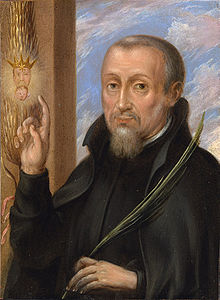
1606: Henry Garnet, Gunpowder Plot confessor

On this date in 1606, the English Jesuit Henry Garnet was hanged, drawn and quartered in the churchyard of Old St. Paul’s Cathedral.

Garnet, “the prime scholar of Winchester College” as a gifted young student, left England to enter the Society of Jesus and study under Robert Bellarmine, a theologian so Catholic that he would later bring the hammer down on Galileo’s heliocentrism.

After eleven years in letters on the continent, the Society called Garnet to return to England in 1586 as the lead missionary to his native realm’s Catholic minority. It was a lonely burden for Garnet, especially after his opposite number Robert Southwell was arrested in 1592. (Southwell, too, went to the scaffold.) But Garnet carried it off as well as anyone. He remained free for nearly twenty years — creating an underground press and numerous illegal cells.

“Under his care the Jesuits in the English mission increased from one to forty, and that not a single letter of complaint, it is said, was sent to headquarters against him,” lauds the Catholic Encyclopedia.

Theologically, Garnet was noted for his defense of the doctrine of equivocation — that is (in the hostile reading of its Protestant interlocutors) of finding hair-splitting rationales for lying. It was an intellectual exercise of many centuries’ vintage, but for England’s beleaguered Catholics it was as urgent as life and death. Most specifically, this doctrine reckoned an oath insufficient to compel a truthful response to official inquiries as to the whereabouts and activities of fellow-Catholics who’d be liable with discovery to attain martyrdom. The liberal definition of “truth” to include an outright lie with a “secret meaning reserved in [one’s] mind” was obviously ripe for the scorn of persecutors for whom it was little but treason neatly clothed.

Knock, knock! Who’s there, in th’ other devil’s name?
Faith, here’s an equivocator that could swear in both
the scales against either scale, who committed
treason enough for God’s sake, yet could not
equivocate to heaven. O, come in, equivocator.

–Macbeth (c. 1606), Act 2, Scene 3

Much of Garnet’s last weeks in custody ahead of his execution were spent in harrowing the doctrine of equivocation; indeed, this is even the very last exchange he had with doctors of the English church sent to accompany him.

One of those standing near him then asked him, “Whether he still held the same opinion as he had formerly expressed about equivocation, and whether he thought it lawful to equivocate at the point of death?” He refused to give an opinion at that time; and the Dean of St. Paul’s sharply inveighing against equivocation, and saying that seditious doctrine of that kind was the parent of all such impious treasons and designs as those for which he suffered, Garnet said, “that how equivocation was lawful, and when, he had shewn his mind elsewhere, and that he should, at any rate, use no equivocation now.”

There were nevertheless equivocations that Garnet would never countenance. His A Treatise of Christian Renunciation, compiling quotes from Church fathers detailing the things a good Catholic must be prepared to renounce for his faith, excoriated those who attended Anglican chuches. Their pretense, he said, was nothing but their own comfort.

Certaine private persons, who have wholly addicted them selves to make them Gods either of their belly and ease, or of the wicked mammon, setting God behind all things which may delight them … refuse also to beleeve that the do amisse …

Judas with a kisse dost thou betray me? amongst hereticks dost thou professe me? no other place to professe chastity, but in the bedd of a harlott?

Harried as they were, England’s Catholics greeted with anticipation the 1603 accession of King James: raised Protestant, but the son of the Catholic Mary, Queen of Scots. Garnet shared Catholics’ hope that James would ease off harassment of the Old Faith; he even authorized the betrayal of fellow-Catholics’ regicidal Bye Plot as a show of loyalty and to pre-empt a possible backlash. “Quiete et pacifice,” he begged.

But toleration was still not quickly forthcoming, and soon Catholics had reverted to “a stage of desperation.” James was only in his thirties: would the trials be neverending?

Garnet continued endeavouring to keep Catholics calm and give the new sovereign the political space necessary to relax persecution. But many of his flock soon tired of quiete et pacifice.

In 1605, there would be another try — one that is still remember, remembered to this day.

Here Garnet again gets into hot water with theological doctrine. Garnet caught indirect wind of Guy Fawkes’ terrorist plot — but he heard it kind-of-sort-of under the seal of the confessional: another priest who himself had heard the design under confession told it to Garnet in a more ambiguous circumstance.

Garnet’s excuses here might strike the reader as far too fine; certainly that is how his prosecutors viewed it. The circumstances of the plot’s revelation certainly appeared to give the priest enough leave to find a way to reveal it, especially since he knew about it for many months before that almost-fateful Fifth of November. Garnet seems to have wanted the resolution — or loathed to plant another Judas-kiss. Maybe he thought his exhortations could stop it without anyone winding up drawn on a hurdle. Maybe, after 19 furtive years knowing every morning that his next sleep might be in a dungeon, his heart of hearts wanted to see it to go ahead.

When the attempt to explosively decapitate the English state was discovered Garnet was hunted to ground; his last days of “liberty” were spent stuffed in a coffin-sized priest hole at Hindlip Hall before the “customs of nature which must of necessity be done” finally forced him to out into the sight of his captors.

His fate looks like a foregone conclusion in retrospect, but Garnet did fight it — for two months before his condemnation, and five more weeks after from trial until his execution during which he maneuvered to exculpate himself. (See Investigating Gunpowder Treason for an exploration of this.) Since Reformation English law of course did not recognize the seal of the confessional, the most charitable reading of Garnet’s own admissions start at misprision of treason. It is but a single step from there to the scaffold if one supposes his long silence shrouded any sort of approval of or aid to the plotters.

Garnet received the mercy of being hanged to death before he was cut down for the public butchery part of his sentence.

On this day..

1815: George Lyon, career thief and possible poltergeist

Two hundred years ago today, Lancaster Castle hosted a quintuple hanging, starring career thief George Lyon.

At age 54, Lyon could be considered a throwback: he openly styled himself “The King of Robbers”, inspiring a sarcastic hack “to congratulate the inhabitants of Wigan and the neighbourhood, and indeed the country at large, on the conviction of George Lyon.” (This notice ran in a number of publications at the time.) He was basically a well-known crook and authorities were thrilled to get one of his fellows to turn Crown’s Evidence on him and make a charge stick.

He had eleven indictments including a stickup of the Liverpool mail, and on this basis has been described as the last highwayman executed at Lancaster — but in the main his methods less romantic and more straightforward. The crime that hanged them — for Lyon died along with two confederates, plus two other unconnected men — was taking advantage of the access a house-painting hire afforded them to just loot the joint.

Lyon did make sure to class it up for his hang-day, however, in a natty black suit and jockey boots to be on point for some 5,000 Lancastrians who reportedly crowded the banks of the castle moat to gawp.

Lyon’s wife arranged to take the body — saving the old footpad from a posthumous anatomization — and buried it in Upholland in the grave of their daughter, Nanny Lyon. (The stone can still be seen to this date: it does not mention George.) It’s been alleged that his spirit has been spooking the place in the 200 years since, including at the venerable White Lion Pub, adjacent to Nanny and George’s final resting place.


Lancaster Gazette and General Advertiser, April 29, 1815

On this day..

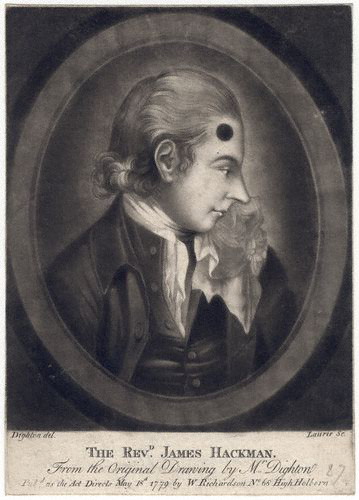
1779: James Hackman, sandwich wrecker

On this date in 1779, Londoners crowded Tyburn to witness the hanging of James Hackman for a sensational high-society murder.

Just twelve days before his date with the hemp, Hackman had walked up to Martha Ray at the Royal Opera and shot her in the head with a single-shot pistol. Then, he turned a second weapon on himself in a vain attempt to commit suicide.

The reader is not mistaken to detect here the mania of unrequited passion. Several years before the young Hackman was a handsome lieutenant introduced to Martha Ray’s social circle. She was a successful soprano on the London stage and though unmarried lived with the Earl of Sandwich as his wife in all but the illustrious name.


(cc image) from Molly Elliott.

Yes, this is the very Earl of Sandwich who pioneered the eating of things stuck between bread slices.* Sandwich — John Montagu to his parents — had other interests besides the munchies; he was the capable First Lord of the Admiralty throughout the 1770s. (As a result, Captain Cook, whose seafaring explorations were occurring at that time, kept naming islands for the Earl of Sandwich).

Domestic life for the Earl and his legal Countess — not “Earless”; that’s a different thing — wasn’t quite as satisfying. Dorothy Montagu, going gradually insane, separated from Sandwich. The lord plucked 17-year-old commoner Martha Ray — a quarter-century Sandwich’s junior — in 1759 and she lived as his mistress from there on out.*

Despite their age difference and never-formalized status they had a comfortable arrangement; Ray bore Sandwich five children** and the two appeared in public as a couple. The Earl sponsored Martha Ray’s opera career and education.

James Hackman met the Earl’s mistress around 1775 and the two formed an intimacy. Just how intimate they might have been has never been firmly established but is clear that as time passed the infatuation increasingly ran in only one direction. Hackman sold his commission in the 68th Regiment of Foot to become a Church of England deacon, perhaps angling by this expedient to woo Martha Ray away from Sandwich to a wholly respectable union.
She understandably demurred on this “opportunity” — leading the greenhorn Reverend to his blackguard act.

Hackman’s pointless waste of Martha Ray’s life and his own plucked his contemporaries’ sentimental heartstrings like nothing else. “All ranks of people … pitied the murderer’s fate,” remarks the Newgate Calendar. One newspaper report of the death sentence noted that “all present were greatly affected” at Hackman’s agitations “and however we may detest the crime, a tear of pity will fall from every humane eye on the fate of the unhappy criminal.” (General Advertiser and Morning Intelligencer, Apr. 17, 1779)

James Boswell was fascinated by the crime; he attended the trial and spilled many public and private words on its subject.

Boswell empathized with Hackman: in a report of the trial for the St. James’s Chronicle (Apr. 15-17, 1779) he opined that the “natural Effect of disappointed Love, however, shocking it may appear, is to excite the most horrid Resentment against his Object, at least to make us prefer the Destruction of our Mistress, to seeing her possessed by a Rival.” Not that Boswell condoned the murder, but “I would say to all that are conscious that their Passions are violent, Think ye that htis unfortunate Gentleman’s general Character is … worse than yours? No, it is not.”

While Human Justice is to be satisfied, let us consider that his Crime was neither premeditated‡ Cruelty, nor base Greediness. He is therefore an Object neither of Abhorrence nor of Contempt … Let us unite our fervent Prayers to the Throne of Heaven, that this our Brother may obtain Forgiveness through Jesus Christ, and be admitted in another State of Being to everlasting Happiness.

The kinship so many Londoners felt for this homicidal stalker moved print copy high and low, before Martha’s body had gone quite cold. Its most notable product was the 1780 Love and Madness, an epistolary novel of tragic passion presented via the (fictitious) letters exchanged by the supposed lovers. So heavily did this understanding of events by Hackman’s contemporaries color its subsequent remembrance that Love and Madness is also the title or subtitle of two 21st century nonfiction considerations of the affair. (1, 2 | Review of both)

Hackman for his part carried off the requisite public posture of resigned tragic nobility in the few days before he satisfied human justice. The General Evening Post, April 17-20 1779 described the execution:

This unfortunate gentleman received the sacrament in the morning with all the fervency and devotion of a sincere repenting criminal: — he repeated that affecting acknowledgment of his guilt, which on his trial drew tears from the audience, and seemed in a state of composure, unruffled with the idea of punishment, which, he said, was no more than he deserved.

At nine o’clock he came into the press-yard, where a great crowd of persons assembled to gratify their curiosity. That all might have an equal share of the sight, a lane was formed by the multitude on each side, through which Mr. Hackman passed, dressed in black, leaning on the arm of his friend the Rev. Mr. Porter, whose hand he squeezed as he muttered the solemn invocation to Heaven, not to forsake a sinner of so enormous a degree, in the trying hour of death.

…

Mr. Hackman was conveyed from Newgate in a mourning coach, attended by the Rev. Mr. Porter Mr. Villette, the ordinary of Newgate, and Mr. Leapingwell, a Sheriff’s officer.

He reached Tyburn about a quarter before eleven o’clock. When he arrived at the fatal tree, a cart lined with black was under the gallows ready to receive him. Mr. Porter and Mr. Villette ascended it by a pair of steps, and he followed them unsupported. As soon as he had got into it he walked forward, and fell on his knees, (a position seldom used by persons in his circumstances at Tyburn, as they always pray standing) and the Clergymen did the like, one on each side of him, where they remained praying for about fifteen minutes, then got up, when the rope was put about his neck, and tied to the gallows.

In this manner he remained praying between the two Divines for ten minutes more, when the Rev. Mr. Porter embraced him, and Mr. Villette took his leave, and both left the cart. The convict[‘]s cap being pulled over his face, he told the executioner to leave him to himself for a few minutes, and he would drop his handkerchief as a signal when he was ready, which he did after a few minutes pause, and was thereupon launched into eternity.

His whole behaviour was manly, but not bold: his mind seemed to be quite calm, from a firm belief in the mercies of his Saviour.

He wore not hat, not any bandage on his face where he gave himself the wound, that the public curiosity might not be interrupted in looking at him; saying, “that he wished to be made a public spectacle of, and hoped his death might be of service to mankind.”

He was no ways convulsed, nor was their [sic] any motion of the body that tended to shew it experienced any pain. Nothing more was to be seen than what proceeded from the jerk on quitting the cart.

The mob was more numerous than on any other occasion since the death of Dr. Dodd. It was expected Mr. Hackman would suffer at Covent-garden, and preparations were made by some speculating carpenters, who met with a mortifying disappointment.

After hanging the usual time, his body was put into a hearse, and taken to Surgeons-hall in the Old Bailey, where it was prepared for the inspection of the public.

Mr. Harkman expressed a wish to his friends, that the ceremony of anatomizing his body might be dispensed with; and that his corpse might be treated in the same manner as that of Lord Ferrers.

Mr. Hackman intimated to a particular friend, that if his remains could be deposited near those of Miss Ray he should feel inexpressible happiness in the hour of death.

A man who was standing near a dray in Oxford-street to see Mr. Hackman pass, was thrown down under one of the horses by the crowd; the horse being frightened, stamped on the man, and beat out his brains.

* Allegedly so that the Earl wouldn’t have to leave his beloved gambling table to dine.

** There is a wonderful bon mot that has enlivened compendia of anecdotes through the years, consisting of more or less the following exchange:

First speaker: You will either die on the gallows or of some social disease.

Second speaker: That depends upon whether I embrace your principles or your mistress.

Though it’s been variously attributed, it appears that the retort was originally delivered by the comic Samuel Foote to Lord Sandwich — about Martha Ray.

† Notable among the five children of Sandwich and Martha Ray: jurist Basil Montagu.

Sandwich’s wife also bore him a legitimate son, who eventually succeeded to the father’s Earldom; the title still exists today.

‡ Hackman had to be talked off simply pleading guilty but in the end he hung his trial hopes on arguing that he intended to kill himself, in Martha’s presence, and was overwhelmed by a momentary “phrensy”. A letter in his pocket meant to be delivered posthumously to his brother-in-law supported this claim; the fact that he brought two guns to meet her rebutted it.

Trial judge William Blackstone pointed out to Hackman’s jurors that the composure of the accused before and after the crime did not suggest a madman and that accepting Hackman’s claim of only an instant’s insanity could present a very slippery slope indeed for future murder prosecutions.

On this day..

1635: Elizabeth Evans, “Canonbury Besse”

On this date in 1635, Elizabeth Evans (known as “Canonbury Besse”) was hanged for murder.

Sometimes characterized as one of early modern Europe’s pioneer serial killers, Evans was not driven to slaughter by compulsion — merely by its emoluments. Using an early version of the timeless “Lonely Hearts killer” scheme familiar to a later era of classified adverts and Craigslist postings,* Evans and her beau Tom Sherwood committed at least five homicides via the expedient of Canonbury Besse’s allures.

Once the prospect had been enticed to a private rendezvous, Sherwood — “Country Tom” — would jump him, and the couple would rob the body. A straightforward enterprise, with a straightforward consequence. (Sherwood had already gone to the gallows on April 14th.)

The ballad “Murder Upon Murder” blames Evans for seducing Sherwood, “a man of honest parentage”, both bodily and spiritually:

she sotted so his minde,
That unto any villany,
fierce Sherwood was inclind,
His coyne all spent he must have more,
For to content his filthy (Whoore).

So shocking was the spree these lovebirds carried out — as reflected in nicknames that denote a degree of celebrity — that they were doomed to posthumous terrors as well.

Sherwood was hung in chains near St. Pancras Church where he so notably failed to deter crime that a later group of thieves, frustrated at finding their mark penniless, contempuously lashed him naked to Country Tom’s gibbet.

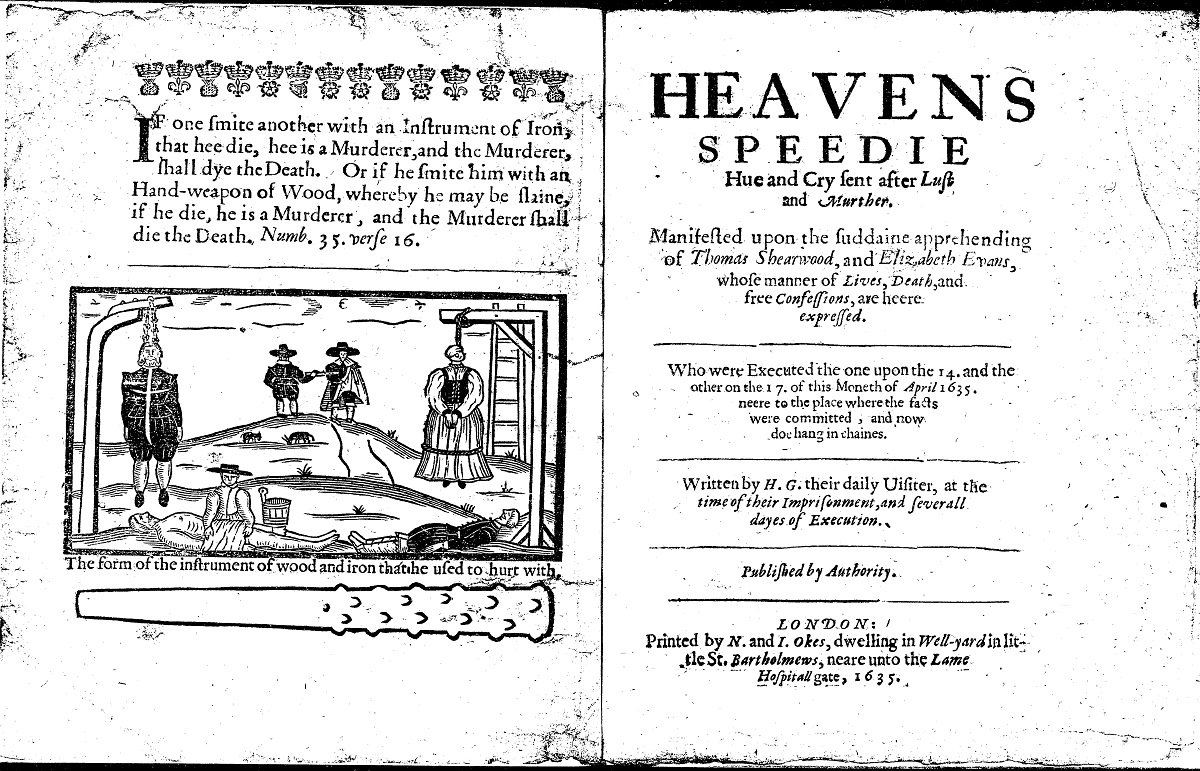
“Oh pity! Still running on to more mischief, having such a fearful spectacle before their eyes as Country Tom, which should rather have frightened and hindered them from doing this bold and insolent act,” laments Henry Goodcole in Heaven’s Speedie Hue and Cry, a narrative pamphlet trading on that same “fearful spectacle.”


Detail view (click for the full image) of Heaven’s Speedie Hue and Cry, a pamphlet narrating the crimes of Sherwood and Evans.

Canonbury Besse was bound over to the surgeons for anatomizing — well before this particular terror became a common extension of murder sentences. According to The Body Emblazoned: Dissection and the Human Body in Renaissance Culture, both Sherwood’s and Evans’s skeletons would ultimately became ornaments on permanent display at Inigo Jones‘s 1636 London anatomy theater,** and could be seen there as late as 1784.

* Consider, for instance, America’s Lonely Hearts Killers, Raymond Fernandez and Martha Beck — or Henri Landru, French predator of World War I widows.

** Diarist Samuel Pepys described a visit to this theater in 1663.

On this day..

1715: Thomas Nairne, Charles Town Indian agent

The generations-long conquest of indigenous peoples in North America might look from posterity like a historical ienvitability, but the 1715-1718 Yamasee War was perhaps “as close to wiping out the European colonists as ever [they] came during the colonial period.” (Gary Nash, quoted by William Ramsey in “‘Something Cloudy in Their Looks’: The Origins of the Yamasee War Reconsidered”, Journal of American History, June 2003. This post draws heavily from Ramsey’s article, which is the source of any quote not otherwise attributed.) In it, not only the Yamasee but a vast coalition of peoples throughout what is today the United States Southeast nearly swept the British out of South Carolina.

And it started three hundred years ago today with some executions.

British South Carolina had extensive trading contacts with the native peoples in their environs — acquiring deerskins and Indian slaves for the plantation colony — and said trading had too often been a flashpoint between alien cultures. South Carolina’s annals record a number of instances of natives crudely abused by Anglo merchants, including women whose bodies were next to sacrosanct for the matrilineal Yamasee, and traders aggressively taking slaves even from friendly tribes. Many years later a Lower Creek man would recall that “we lived as brothers for some time till the traders began to use us very ill and wanted to enslave us which occasioned a war.”

It has never been entirely clear just why and how such individual abuses, even as a pattern, triggered in 1715 something as drastic as military action; our source William Ramsey suspects that they only hint at much wider-ranging economic pressures of the Atlantic economy, which entangled native peoples in debt and warped traditional lifeways towards producing ever more deerskins for export, obtained at ever poorer prices from ever more belligerent merchants.

Just as trade relations were at their most antagonistic, the colonial capital Charles Town fell down on the diplomatic side of the job. (This is, again, per Ramsey.)

The colony had created in 1707 an office of Indian Agent.

Intended to manage the complications of its sometimes-delicate cross-cultural trade and police the traders, the post instead became a locus of bitter competition between two men: Thomas Nairne and John Wright. (There’s a 1710 account of South Carolina in Nairne’s hand available here.) These two men, South Carolina’s most expert Indian diplomats and the only two men ever to hold the Indian agent office, had by the 1713-1715 period become consumed with their internal rivalry. Wright, a trader who thought Nairne too accommodating of the natives generally and unduly meddlesome with Wright’s own commerce specifically, bombarded the latter with lawsuits; Nairne eventually had to stay in Charles Town almost permanently to protect his own affairs. The colony’s diplomatic voice fell silent — which meant that rapacious traders squeezing mounting debts on their spring rounds in 1715 were that voice.

In annoyance, one tribe returned an ultimatum to Charles Town: “upon the first Afront from any of the Traders they would down with them and soe goe on with itt.” (See The Southern Frontier, 1670-1732)

That warning got the colony’s attention.

The Indian Agent rivals Wright and Nairne were dispatched together to meet with the Yamasees at Pocotaligo and smooth things over. But just as these men stood at loggerheads professionally, they were noted for quite distinct policies towards the Indians: Nairne was the friendly hand, the man who sympathized with natives. Wright was the asshole. If their joint presence was intended to be a good cop-bad cop act, they carried it off as clumsily as their mutual antipathy might suggest.

In a famous meeting on the night of April 14, Nairne, Wright, and a number of traders seemingly reassured the Yamasees over a feast that their grievances would be redressed, and went to sleep satisfied that matters were well in hand.

It was not so for the Yamasees, who held council that night after the Europeans were tucked away. An unknown Indian leader who signed himself “the Huspaw King” would later dictate a letter to a hostage charging that at the April 14 meeting

Mr. Wright said that the white men would come and fetch [illegible] the Yamasees in one night and that they would hang four of the head men and take all the rest of them for slaves, and that he would send them all off the country, for he said that the men of the Yamasees were like women, and shew’d his hands one to the other, and what he said vex’d the great warrier’s, and this made them begin the war.

We don’t know if this was on-message for the delegation — a glimpse of the iron fist that Nairne’s politesse was to glove — or delivered privately in Wright’s going campaign to undermine his opposite number. What we do know is that the Yamasees had seen both these men in authority over colonial-Indian trade over the past several years: on the night of April 14-15, they had to decide between mixed messages. Could they count on Nairne’s reassurances of comity? Or should they believe, as Wright intimated, the increasingly obnoxious inroads of traders presaged the outright destruction of their people?

April 15th was Good Friday. And the Europeans awoke to their Calvary.

The Yamasees’ decision about the intentions of their European counterparts was far from internally unanimous — but it was instantly effected.

“The next morning at dawn their terrible war-whoop was heard and a great multitude was seen whose faces and several other parts of their bodies were painted with red and black streaks, resembling devils come out of Hell,” a plantation owner later wrote to London. Most of the Europeans were killed on the spot, Wright apparently among them. A couple of them escaped.

And for Thomas Nairne, a stake in the center of the little village awaited, with an agonizing torture-execution said to have required three days before Nairne mercifully expired on April 17th.

The red indicates War, and the black represents the death without mercy which their enemies must expect.

They threw themselves first upon the Agents and on Mr. Wright, seized their houses and effects, fired on everybody without distinction, and put to death, with torture, in the most cruel manner in the world, those who escaped the fire of their weapons. Amongst those who were there, Captain Burage (who is now in this town, and from whom I derive what I have just said) escaped by swimming across a river; but he was wounded at the same time by two bullets, one of which pierced his neck and came out of his mouth, and the other pierced his back and is lodged in his chest, without touching a vital spot. …

Another Indian Trader (the only one who escaped out of a large number) saved his life by crawling into a marsh, where he kept himself hid near the town. He heard, during the whole day, an almost continual fire, and cries and grievous groans. He often raised his head in his hiding-place, and heard and saw unheard-of things done; for the Indians burned the men, and made them die in torture. They treated the women in the most shameful manner in the world. And when these poor wretches cried O Lord! O my God! they danced and repeated the same words mocking them. Modesty forbids me to tell you in what manner they treated the women: modesty demands that I should draw a veil over this subject.

This man who had witnessed so many cruelties, stripped himself naked so as completely to resemble the Indians; and in this state, made his escape by night, crossing the town without being perceived, he heard many people talking there, and saw several candles in each house; and having avoided the sentries, God granted that he should arrive here safe and sound.

Mr. Jean Wright, with whom I had struck up a close friendship, and Mr. Nairne have been overwhelmed in this disaster. I do not know if Mr. Wright was burnt piece-meal, or not: but it is said that the criminals loaded Mr. Nairne with a great number of pieces of wood, to which they set fire, and burnt him in this manner so that he suffered horrible torture, during several days, before he was allowed to die.

On this day..