1534: Elizabeth Barton, the Holy Maid of Kent

On this date in 1534, Elizabeth Barton was hanged at Tyburn with her “conspirators” for having prophesied the death of Henry VIII and (in the words of the parliamentary attainder against them) “traterously attempted many notable actes intendyng therbye the disturbaunce of the pease and tranquyllytie of this Realm.”

A country servant-girl, this Elizabeth Barton had begun having divine visions around Easter 1525, and developed a popular following for her gift of prophecy, generally delivered during spooky (perhaps epileptic) fits and trances.

This was all just fine with everyone, since King Henry was still a good Catholic at the time; Barton took orders in the St. Sepulchre Nunnery and continued her career in the seer business.

Elizabeth Barton wasn’t going to leave her place in Henrician England … but to paraphrase Ronald Reagan, Henrician England was about to leave her.

And like so many entries that age has given this site, it all went back to Henry’s leaving his first queen, Catherine of Aragon.

If one likes to see in the prophetic tradition a refracted expression of popular sentiment, speaking a religious rather than a political language, Elizabeth Barton’s divine gift set her up to be the mystical exponent of the English populace’s visceral reaction against Henry’s ascending paramour, Anne Boleyn.

Rather rashly, Barton began publicly warning her sovereign against his bedchamber gambit, threatening that if the proposed Boleyn union should come to pass, he “should no longer be King of this realm…and should die a villain’s death.”

That would be compassing the death of the king — which is treason.

Barton articulated a fear of Henry’s policies which was shared by many of his subjects. The anticipated breach with Rome made the citizens of England insecure about the future stability of the realm, and prognostications concerning the state of the country abounded. Barton was not alone in foretelling that wars and plagues would soon rack the country; or in prophesying that the King would be overthrown, that his death was imminent, that he would die as a villain. Many people were discussing such prophecies, by means of which they could “objectify their fears and hopes” in an age of change and disruption.

-Diane Watt, “Reconstructing the Word: the Political Prophecies of Elizabeth Barton (1506-1534)”, Renaissance Quarterly, Spring 1997

So it’s probably only fitting that this creature of her times would be devoured by the Tudor state which made its Reformation from the top.

Devoured, not only bodily.

As the Tudor king breaks with Rome, Barton becomes almost totally obscure to us, the real person who dared to stand openly against her king subsumed entirely by the edifice of state propaganda. As Watt observes, “as a result of her fate … almost all the first-hand evidence concerning Barton’s life and revelations has been destroyed” and “the surviving image of her has therefore been shaped by those who suppressed her visions and prophecies.”

We have her mystical utterances mostly indirectly, through the interlocutors charged with refuting her, and we have the expedient charges against her of fraud, contumacy, and (of course) sexual indiscretion leveled by her foes.


“The Imposture of the Holy Maid of Kent”

Arrested with a circle of supporters, Barton was forced into a public recantation in November 1533 by her persecutors. One supposes such a recantation was in any event obtained under some duress; undoubtedly it was, as the disgusted Spanish ambassador recorded, staged “to blot out from people’s minds the impression they have that the Nun is a saint and a prophet.” (Cited by Watt)

If said duress included an easing of the charges against herself or her associates, Barton was to be disappointed.

She was attainted for treason* in January (the evidence against her being insufficient for a judicial verdict of treason); the bill of attainder also required the public to hand over any writings about her alleged prophecies or revelations, like the popular pamphlets that had circulated with official approval in the 1520’s: there would be nothing to nurture a people’s cult for this exponent of resistance. Over the decades to come, the early writings sympathetic (and proximate) to Barton would be almost completely annihilated, supplanted by Protestant works that rendered Barton a trickster, a puppet, a sham — magnified her retraction into the definitive statement. It was a propaganda victory almost as chilling as Barton’s corporeal fate: even her potentially sympathetic Catholic audiences can latterly make no reliable judgment about her.

And so Barton moulders.

In April 1534, the usurping consort once more apparently pregnant with Henry’s long-sought heir, the once-popular, now-deflated prophetess of the old queen and the old faith was emblematically put to death with her former adherents on a most significant day in the city of London.

[T]his day the Nun of Kent, with two Friars Observant, two monks and one secular priest, were drawn from the Tower to Tyburn, and there hanged and headed. God, if it be his pleasure, have mercy on their souls. Also this day the most part of this City are sworn to the king and his legitimate issue by the Queen’s Grace now had and hereafter to come, and so shall all the realm over be sworn in like manner.

-Letter from John Husee to Lord Lisle, April 20, 1534 (Source)

We trust everybody got the message.

But in case anyone missed the point, there would be plentiful reminders still to come.

* Chancellor Thomas More had some traffic with Barton — very cautious, as befits a skeptical elite’s approach to a loose cannon commoner — and was briefly in some danger of being named in the indictment against her. When his loyal daughter Meg joyously reported to him that he’d been cleared, he’s supposed to have replied, “In faith, Meg, ‘quod differtur non aufertur’, what is put off is not put away.” But it probably didn’t require heavenly foresight for More to perceive the wheel of fortune about to turn on him, too. By the time of Barton’s actual execution, More had already been clapped in the Tower himself.

On this day..

1996: John Martin Scripps, British serial killer

On this date in 1996, the first westerner hanged for murder in Singapore got his deserts in Changi Prison.

Mild-mannered John Martin Scripps had created a sensation in the city-state for turning South African tourist Gerard Lowe into a sack full of dismembered body parts at Clifford Pier.

“The tourist from hell” argued in defense that it had all been a gay panic after Lowe came onto him. Not a bit of it.

Turns out Scripps, recently absconded from British custody after his latest in a series of drug and theft arrests,* had used the same chop-shop m.o. on a Canadian mother and son in Thailand and, as with Lowe, leached their electronic assets thereafter.

(Ever the jet-setter, Scripps was also a suspect in three other murders — of two Brits in Central America and of an American male prostitute in San Francisco.)

“John disappeared on several trips and went to the United States and South-East Asia,” his Mexican ex-wife said later. “I knew something awful was happening, but I could not believe he had started killing people.”

After conviction, Scripps declined to appeal or petition for clemency, saying he wanted the law to take its course quickly. He was hanged alongside two drug traffickers.

* He’d learned butchery in prison — so well that he’d talked about opening a shop when he got out. Which is sort of what he did.

On this day..

1705: Captain Thomas Green and two of his crew on the Worcester

On this date in 1705, another century’s supposed terrorist was hanged on Leith Sands with two of his “pirate” crew by a Scottish court “drunk with patriotic prejudice.”*

This execution took place in the feverish run-up to England and Scotland’s Acts of Union welding the neighboring realms into Great Britain in 1707.

Arising as it did from the same causes that animated that national marriage of convenience, Green’s execution also endangered it: Daniel Defoe, who was at this time a pro-Unionist mole (and prolific pamphleteer) for English pol Robert Harley, described this hanging as one of the six crises that had to be overcome en route to the Union.

A Man, A Plan, A Calamity

Panama.

That’s where it all started, for Green and Union alike.

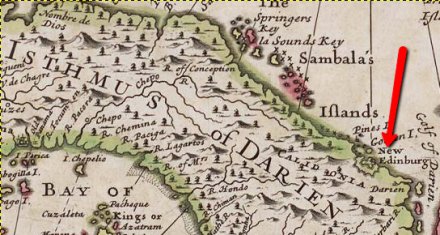
Mired in economic backwardness as neighboring European states carved up the world, Scotland made a bold, doomed bid for a chit in the empire game: the Darien scheme. One part visionary and (at least) two parts daft, this venture attempted to establish a Scottish colony on the Isthmus of Panama (aka the Isthmus of Darien) with a view to porting freight across the narrow strip of land separating Atlantic and Pacific, and dominating the dramatically more efficient east-west trade route that would result.


The intended Scottish colony in Panama; map from this University of Glasgow exhibit.

Students of the Panama Canal project will be aware that this malarial tropic would not be described as especially hospitable; to the natural disadvantages of the climate were added the political interpositions of England herself, whose hostility to the advent of her Caledonian neighbor as a New World rival was expressed in legislation choking the Darien adventure of foreign aid.

(Also a problem: Spain. The colony was abandoned at last under Spanish siege.)

So Scotland went it intrepidly, injudiciously alone in this last bid for real independent muscle in Europe. The hyperbole of the Isthmus’s publicists eventually sucked in 20 percent or more of the capital circulating in Scotland. And when Darien-dot-com went bust by 1700 at the cost of a couple thousand lives, it cratered the Scottish economy too. That set the stage for Edinburgh’s partnership in a different scheme: Great Britain.

Green with Envy

In the years following the Darien catastrophe, the Scottish corporation chartered to undertake it was still throwing stuff against the wall in the world trade game, trying to get something to stick to at least take the edge off the losses.

This company (theoretically a potential rival of England’s own East India Company) had suffered the further national indignity of having one of its ships, the Annandale, seized in the Thames for infringing the East India Company’s royal monopoly. Its appeals for redress falling on deaf ears, the Darien company apparently induced Scottish authorities to undertake the retaliatory seizure of an English merchant ship, the Worcester, that had the ill luck to weather a storm at the Firth of Forth.

Rumor soon connected this ship to another vanished Darien company vessel overdue from its return trip from the East Indies … and, as it quickly became understood by all right-thinking Scots, overtaken in the Indian Ocean by this same Worcester and its crew butchered.

Captain Thomas Green and his English crew were hailed before an Admiralty court** on piracy charges on this extremely fantastical connection in a virtual mob atmosphere.

It never was clearly established that an act of piracy had been committed as a distinct fact, but by putting certain circumstances together it was inferred that Green was guilty of piracy. The very shape in which the accusation is set forth, shows that the accusers could not point to the specific act of piracy which had been committed …

[There] was no specification as to the vessel taken, which might enable the accused to prove that it had not been taken; no names of parties murdered, who might be shown still to be alive; no ownership of cargo, which might admit of proof that the owner’s goods had arrived safe. As Green himself is made justly to say in the document published as his dying speech, “We are condemned as pirates and murderers on a coast far distant from this place — is there any of you who wants either a friend whom we have murdered, or whose goods we have taken?”

Worcester Sauce

The Worcester‘s Malabari cook provided a highly dubious charge — dubious, for he was not yet among the crew when it last called at the location he claimed the crime took place — of Green and crew hatchet-murdering approximately ten English-speaking mariners on an unnamed vessel off the Indian coast.

Upon this evidence, 14 or more members (the ready sources are a little loose on the total number) of the Worcester crew were condemned for piracy, and initially slated for three batches of hangings. Queen Anne‘s personal intervention managed a stay,

The Scottish Privy Council unto the very last hours debated what to do with the diplomatic appeals, with evidence forwarded from London to the effect that the crew these Worcester men had supposedly slaughtered were alive, their vessel having been hijacked in another place, by another man.

But a surging Scottish mob aggrieved by the preceding years’ misadventures and the impending shotgun marriage to Westminster rather than anything Green himself had really done was already engorged on the blood of the supposed English corsairs. Most of the Council thought better than to deny them their sacrifice.†

The Streets fill’d with Incredible Numbers of Men, Women and Children, calling for Justice upon those ENGLISH Murtherers. The Lord Chancellor Seafield‘s Coach happening to pass by, they stop’d it, broket he Sashes, haul’d him out, and oblig’d him to promise Execution should speedily be done before he could get from ’em … According to the Chancellors promise, soon after, on the same Day, being Wednesday, Captain Green, Madder [the mate], and Sympson [the gunner] were brought out, and convey’d to Execution, which was at Leith Road upon the Sands, and all the way was Huzza’d in Triumph as it were, and insulted with the sharpest and most bitter Invectives. Being come to the place of Execution, Good God! what a moving sight was it to see those Men stand upon the very Varge of Life, just launching in to Eternity, and at the same time see the whole Multitudet ransported with Joy!”

-From an anonymous Letter From Scotland To a Friend in London, quoted by James Kelly, “The Worcester Affair,” The Review of English Studies, Feb. 2000

In the event, these three were the only ones actually hanged; passions cooled enough for the other “pirates” to be quietly released.

But the wider, national passions unleashed by this date’s executions would long provide fodder for intemperate patriotic recrimination, and specifically anti-Unionist propaganda — on both sides of the border.

Competing propagandistic broadsides framed and re-framed the events, as the affair of unscrupulous English buccaneers or perfidious highland barbarians. (Defoe, maneuvering for Union, wrote to chill such bad-for-business hostility: “Nothing could be more horrid, than that the Scots should Execute these Men on a meer Pique at the English Nation. Nothing can be more like it, than to conclude rashly, that it is so, and improve it on purpose to Exasperate our People against the Scots.” (Kelly))

And that, of course, is precisely the viewpoint that prevailed.

While the hemp neckties issued to Green et al this date threatened to (ahem) scotch the Union project, that very danger might have ultimately hastened its completion — as elites recognized, in Defoe’s words, that Union represented “the only way to preserve the publick Tranquillity, and prevent the certain Mischiefs that threatened the whole Body,” (Kelly, again) and rammed it through with dispatch.‡

* English historian G.M. Trevelyan.

** A lengthy account of the trial can be found in this Google books freebie

† In their very scanty defense, the Scottish magistrates had reason to fear Scottish citizens.

‡ The ebb and flow of national resentment continued long after the Acts of Union, of course; continuing Scottish support for the restoration of the Stuart monarchy was one expression of Scottish nationalism and anti-Union sentiment.

On this day..

Unspecified year: Snowball’s animal fifth column

“Four days” after an unspecified “early spring” date in George Orwell’s classic allegory of Soviet communism, Animal Farm, a show trial and mass execution of animals purporting to work for the book’s Trotsky figure signals the titular farm’s unmistakable collapse into dystopia.

In the book, a revolution of animals displaces the farm’s human owner, Jones — the hated ruler of the ancien regime.

The farm’s early cooperative elan soon shatters, with a pig bearing the unsubtle name of Napoleon becoming the revolution’s autocrat, and fostering a paranoid security climate against phantasmal plots by his fellow swine and onetime comrade, the exiled Snowball.

Let’s watch.

Napoleon ordered all the animals to assemble in the yard. When they were all gathered together, Napoleon emerged from the farmhouse, wearing both his medals (for he had recently awarded himself “Animal Hero, First Class”, and “Animal Hero, Second Class”), with his nine huge dogs frisking round him and uttering growls that sent shivers down all the animals’ spines. They all cowered silently in their places, seeming to know in advance that some terrible thing was about to happen.

Napoleon stood sternly surveying his audience; then he uttered a high-pitched whimper. Immediately the dogs bounded forward, seized four of the pigs by the ear and dragged them, squealing with pain and terror, to Napoleon’s feet.0 …

The four pigs waited, trembling, with guilt written on every line of their countenances. Napoleon now called upon them to confess their crimes. … Without any further prompting they confessed that they had been secretly in touch with Snowball ever since his expulsion, that they had collaborated with him in destroying the windmill, and that they had entered into an agreement with him to hand over Animal Farm to Mr. Frederick. They added that Snowball had privately admitted to them that he had been Jones’s secret agent for years past. When they had finished their confession, the dogs promptly tore their throats out, and in a terrible voice Napoleon demanded whether any other animal had anything to confess.

The three hens who had been the ringleaders in the attempted rebellion over the eggs now came forward and stated that Snowball had appeared to them in a dream and incited them to disobey Napoleon’s orders. They, too, were slaughtered. Then a goose came forward and confessed to having secreted six ears of corn during the last year’s harvest and eaten them in the night. Then a sheep confessed to having urinated in the drinking pool — urged to do this, so she said, by Snowball — and two other sheep confessed to having murdered an old ram, an especially devoted follower of Napoleon, by chasing him round and round a bonfire when he was suffering from a cough. They were all slain on the spot. And so the tale of confessions and executions went on, until there was a pile of corpses lying before Napoleon’s feet and the air was heavy with the smell of blood, which had been unknown there since the expulsion of Jones.

When it was all over, the remaining animals, except for the pigs and dogs, crept away in a body. They were shaken and miserable. They did not know which was more shocking — the treachery of the animals who had leagued themselves with Snowball, or the cruel retribution they had just witnessed. In the old days there had often been scenes of bloodshed equally terrible, but it seemed to all of them that it was far worse now that it was happening among themselves. Since Jones had left the farm, until today, no animal had killed another animal.

Animal Farm was published in 1945. In this 1954 British animated feature, the downer of an ending — with the corrupt pig rulers becoming literally indistinguishable from people — was dumped in favor of an ending where the animals revolt again.

On this day..

1868: The native prisoners of Emperor Tewodros II

On this date in 1868, on the eve of his rout at the hands of a British expeditionary force, the frustrated Emperor Tewodros II had hundreds of prisoners executed en masse.

Our setting is the 1868 British Expedition to Abyssinia, “one of the most expensive affairs of honour in history.” And it all got started from a bad experience with technical support.

Tewodros — generally known to the Europeans as Theodore — had risen from a humble station to the throne of Abyssinia, but by the 1860s held it but tenuously against various rival warlords. Tewodros lodged appeals for aid with a number of European powers, including the British, who evidently took the emperor’s letter for Queen Victoria and stuck it indefinitely in a file called “Pending”.

After two years without an answer, Tewodros took hostage the British consul Charles Duncan Cameron, a missionary named Henry Stern (whose unflattering report of Tewodros’s mean origins particularly enraged the monarch), and other Europeans.


Illustration of the hostages from Henry Stern’s The Captive Missionary.

And then he took hostage the Ethiopian sent to negotiate their release.

He wasn’t “Pending” any longer.

Gaze not into Abyssinia

Tewodros, perhaps, had depended on the notoriously treacherous Ethiopian highlands to protect him from any effective reprisal. But when the Brits decided in 1867 to let men with guns resolve the dispute, they spared no expense at all.

Months of planning and millions of pounds were poured into the operation, which landed 13,000 soldiers and 40,000 animals organized by the Bombay Army.

“For a total cost of about £9,000,000,” writes Harold Marcus in a biography of another former Tewodros hostage, the future Emperor Menelik II, “Napier set out to defeat a man who could muster only a few thousand troops and had long ago ceased to be Ethiopia’s leader in anything but title.”

The forces converged on Tewodros’s last stronghold, Magdala, with the mercurial king refusing repeated demands of the invader to release his European captives.

Angrily refusing, at least according to the accounts of the hostages who were the subject of all this … and whose accounts have just enough consciousness of the privilege their own skin has given them as they witness these bloodlettings.

On April 8, the king put to death seven of the native prisoners in his train. These prisoners comprised generally people on the political outs with Tewodros, adherents of once-rebellious chiefs and the families of those adherents. It was no mean thing to slaughter a few of them arbitrarily.

But much worse was to come the following day, when the hunted emperor espied the British advance guard reconnoitering his position.

According to a report by European hostage W.F. Prideaux in the May 21, 1868 London Times, the Emperor

had seen the British troops descending the Bashilo, and had remarked among them four elephants and some white animals, which we surmised to be Berbera sheep. A short time afterwards a friend of ours (for we had a few friends at Magdala) … implored us to keep within our tents, for the King was in a fearful passion, and was then issuing an order to kill all his native prisoners, who were confined in a few houses a couple of hundred yards off. The repeated discharge of firearms, which we heard soon afterwards, confirmed the sad story, and it was with many misgivings that we asked ourselves, “What next?” At dusk, however, the King returned, and we returned to our tents comparatively at our ease. From what I have heard it appears that the King rushed down mad with rage and arackee, and calling out one of the prisoners hacked him to pieces with his own sword. Another speedily met the same fate. The third was a boy about ten years of age. His youth and innocence (for it was his father who had been the offender) were no protection. He was mangled in the same way as the two others. The cutting and slashing went on in this manner for some time, when the King, finding this mode of execution too slow for his impatient spirit, ordered out the musketeers. The remainder were then quickly shot down, and thrown over the low cliff, the force of the shock in several cases opening the chains of the wretched victims. Those whose quivering limbs showed any signs of life were fired on from above till the murderous work was completed.

The account of the Rev. Stern:

[W]e were suddenly startled by the sound of an intermittent musketry. … The rattle of musketry blended with the yells of despair, and the shouts of rage fell, however, with an ominous and appalling horror on our ears. “What is the matter?” I inquired of my neighbour. “Hist,” was the response, “the king is killing all the prisoners.” These terrible words diffused an aguish chill through my very heart. … The sun had already disappeared from the horizon, and twilight spread a dismal, dusky hue over the scene around, and still the firing continued unabated. With night it gradually diminished, and then only isolated shots reverberated across the panic-stricken camp.

The slaughter lasted about three hours, and during that interval three hundred and seven human beings* were, unwarned, and perhaps unprepared, hurled into eternity. Some of the prisoners did not unresistingly yield to their woeful doom. One, Immer Ali, a native of Ferga, near the Tzana Lake, formerly a chief of consideration in his province, in spite of hand and foot chains, with a convulsive grasp dragged his executioner towards the precipice over which he was to be hurled. The hangman, who dreaded the doom which he intended to inflict on his fellow man, shouted for help. On hearing the cry the tyrant, tiger-like, sprang forward and with his gory sword literally hacked the man to pieces.

And to hear Stern tell it, it was by dint of nothing but great fortune — or in his view, divine providence — that saved the British hostages from joining them.

One victim after another lay writhing and quivering in the last pangs at the foot of the dizzy precipice, and still the tyrant’s rage was un-appeased. “Bring the white men, and let their blood flow, mingled with that of my own subjects,” was the order that fell from his lips. Already, we were informed, whole bands of ruffians stood prepared to seize the intended prey, when several chiefs, no friends of the foreign captives, stepped forward, and requested that our execution might be deferred till next day. “Your Majesty,” they respectfully remarked, “the white men do not deserve the easy death of the sword and bullet; no, keep them till to-morrow, and then let the slow torture of a flaming hut put an end to their existence.” “You are right,” was the response.

Since the next day was Good Friday, the Christian Tewodros, “though a perfect fiend and coarse blasphemer, repaired, from a superstitious impulse, at a very early hour to church,” Stern says. The decisive British attack began later that day, and would end with the un-executed hostages liberated, and Tewodros taking his own life rather than fall captive.

Among the spoils of war was the crown of the dead emperor, which in 1925 King George V would personally present to Haile Selassie.

* The provenance of the very precise figure of 307 is not apparent in Stern’s account; presumably, he knew through his friendly contacts (of from relieving the boredom of captivity in recreational head-counting) the overall number of prisoners beforehand.

On this day..

1789: Skitch, amidst the tears of thousands

London Times, April 14, 1789:

Exeter, April 8. Friday last were executed at Heavitree-gallows, William Snow, alias Skitch, for breaking the house of Richard Adams, in the parish of Romansleigh, and stealing a quantity of plate thereout; and James Waybourn, for robbing farmer Stokes, near Bickley-wood. They were perfectly resigned to their fate; yet it was with difficulty that Waybourn was induced to answer any questions respecting his guilt.

The behaviour of Skitch manifested how little there is in the approach of death, when the human mind is brought into a calm and pious disposition, by serious meditation on the attributes of an all powerful and gracious Deity. He declared that day to be the happiest of his life; and exhorted the spectators to avoid his errors. He had hung but a few seconds, when the rope slipped from the gallows, and he fell to the ground. It is impossible to describe the feelings of the multitude at the thought of his being again suspended; yet was this painful interval less afflicting to the magnanimous sufferer than to the spectators. Skitch heard their sorrowful exclamations, and said, with an air of compassion, “Good people, be not hurried; I can wait a little:” and the executioner wishing to lengthen the rope, which had slipped, Skitch calmly waited till Waybourn was quite dead, when the rope was taken from the deceased’s arms, in order to compleat the execution of Skitch, who was a second time launched from the cart amidst the tears of thousands.


An overgrown gravestone in a Heavitree church cemetery. (cc) image from HayneZ.

On this day..

1677: Giles Bland

On this date in 1677, Giles Bland was hanged in the Virginia colony for the late Bacon’s Rebellion.

Bland was in that remote colony as the agent of his father, the London merchant John Bland.

This John Bland fellow had an interesting career — as suggested by the title of Neville Williams’s “The Tribulations of John Bland, Merchant: London, Seville, Jamestown, Tangier, 1643-1680” in The Virginia Magazine of History and Biography (Jan. 1964). We elide here the former two and the last one except to observe that they made John Bland a very wealthy man, and landed him in Samuel Pepys’s diary.

Accordingly, John Bland’s New World interests were considerable, and we suppose that his son Giles, dispatched thither after John’s brothers had died in the New World, was a bit too conscious of the weight his surname carried.

He griped about colonial corruption, put about “malicious reports” of royal governor William Berkeley, “bespattered with … dirt … thrown upon the whole government of Virginia,” and — foreshadowing alert! — got into the drink to the detriment of his good judgment:

[G]oing to the house of Thomas Ludwell in company with Sir Henry Chicheley after they had drank plentifully there happened a discourse in which Giles Bland thought Ludwell’s speech too severe in relation to his father, and told Ludwell’s that he dealt basely and unworthily to cast such aspersions upon his father and himself, and being transported with passion upon “further exchange of language” came to blows, and exchanged gloves to meet in the morning. His son slept not all night, and continuing hot headed, hastened to the place appointed, where, missing Ludwell, he nailed the glove on the door of the Grand Assembly [house] writing some words under it. Ludwell more wisely sought reparation before the Governor and Council, where Giles Bland was ordered to ask forgiveness which he performed, and the Court fined him 500l. for his abuse done to the Assembly, the payment to be suspended for two years to enable him to supplicate his Majesty to remit the same, it being intended rather to deter him from the like rash actions in time to come, than to ruin him for what he had unadvisedly committed.

Put Giles down for “undeterred.”

As conflicts between the Virginia planters and Berkeley’s party came to a head — planters were sore about taxes, trade, and overly friendly Indian relations — Bland was tapped to represent the former back in the mother country.

But rather than sail for England, the young hothead hitched onto the rising of Nathaniel Bacon — and then was almost immediately intercepted by his foes. “Those who are best able to render an account of this affair do aver,” we read, “that there was no other treason made use of but their want of discretion, assisted by the juice of the grape.”

(Getting captured while distracted by more hedonistic pursuits was a pattern with these Bacon’s rebels, or at least a pattern of the propaganda written about them.)

Rather than summary execution, Giles Bland faced several months’ ill-treatment in irons. Still, Berkeley was in enough of a hurry to get the lad into the ground as the last of the Bacon’s Rebellion martyrs that he seems to have suppressed the prisoner’s legitimate appeal for royal clemency.

John Bland was in the winter of his years when this grim news arrived in London; he would die there in 1680 — having committed yet one more member of his family, his wife Sarah, to the Atlantic crossing, and “feeling no greater grief under my many adversities and infirmities … than her necessary absence in Virginia about my unhappy affairs and estates there.”

On this day..

1647: Mary Martin, infanticide

From Portland in the Past: With Historical Notes of Old Falmouth, by William Goold.


[Michael Mitton] came from England … in 1637 … [and] lived near the Cape Elizabeth landing of Portland bridge … “One Mr. Mitton related of a triton, or mere-man which he saw in Casco bay. The gentleman was a great fowler, and used to go out with a small boat or canoe, and fetching a compass about a small Island for the advantage of a shot, was encountered with a triton, who laying his hands upon the side of the canoe, had one of them chopped off with a hatchet by Mr. Mitton, which was in all respects like the hand of a man. The triton presently sunk, dying the water with his purple blood, and was no more seen.” …

There is one indelible blot on the character of Mitton. In 1640, Winter wrote to Trelawney from Richmond’s island this: “Mr. Francis Martin is here with us, and is not settled in any place as yet to remain. This next week I shall go up to Casco with him to seat him in some place there. I know not how he will lie here well, except he have brought money with himself, and here is nothing to be gotten without hard labor.” Martin was evidently a decayed gentleman, or he would not have been styled Mister by Winter. This was an honorable title then. Two years later Winter again mentions Martin to his principal: “Also herein goes a bill upon Mr. John Martin for his uncle Francis Martin. Also he was with us five months and spent upon our provision, and cannot pay for anything. He is in a bad way of living here with his two children. He plants a little Indian corn and that is all he hath to live upon. He hath neither goat nor pig, nor any thing else. He is old and cannot labor, and his children are not brought up to work, so I know not what shift he will make to live.”

These “two children” were daughters. The fate of the eldest is given by Willis, being the substance of her history as written in Winthrop’s journal. Willis says: “Martin, an early inhabitant of Casco, was the father of two daughters, whom, being about to return to England to arrange his affairs, he left in the family of Michael Mitton. During their residence of several months with him in 1646, he insinuated himself into the favor of the eldest, named Mary, whom he seduced. She afterwards went to Boston and was delivered of a bastard child, of which she confessed Mitton to be the father. Overcome with shame, she endeavored to conceal her first crime by the commission of a more heinous one in the murder of her infant; for this she perished on the scaffold at the early age of twenty-two years, in March, 1647.” Cotton Mather says of her trial: “When she touched the face of the child before the jury, the blood came fresh into it, so she confessed the whole truth concerning it.” He also says: “Her carriage in her imprisonment and at her execution was very penitent. But there was this remarkable at her execution. She acknowledged her twice essaying to kill the child, and now through the unskilfulness of the executioner she was turned off the ladder twice, before she died.”

The York records give the date of Mitton’s death to be in 1660.


From the Journal of John Winthrop (also available on Google books):

finding herself to be with child, and not able to bear the shame of it, she concealed it, and though divers did suspect it, and some told her mistress their fears, yet her behavior was so modest, and so faithful she was in her service, as her mistress would not give ear to any such report, but blamed such as told her of it. But, her time being come, she was delivered of a woman child in a back room by herself upon the 13 (10) (December 13) in the night, and the child was born alive, but she kneeled upon the head of it, till she thought it had been dead, and having laid it by, the child, being strong, recovered, and cried again. Then she took it again, and used violence to it till it was quite dead. Then she put it into her chest, and having cleansed the room, she went to bed, and arose again the next day about noon, and went about her business, and so continued till the nineteenth day, that her master and mistress went on shipboard to go for England.

They being gone, and she removed to another house, a midwife in the town, having formerly suspected her, and now coming to her again, found she had been delivered of a child, which, upon examination, she confessed, but said it was still-born, and so she put it into the fire. But, search being made, it was found in her chest, and when she was brought before the jury, they caused her to touch the face of it, whereupon the blood came fresh into it. Whereupon she confessed the whole truth, and a surgeon, being called to search the body of the child, found a fracture in the skull. Before she was condemned, she confessed, that she had prostituted her body to another also, one Sears. She behaved herself very penitently while she was in prison, and at her death, 18 (1,) (March 18) complaining much of the hardness of her heart. She confessed, that the first and second time she committed fornication, she prayed for pardon, and promised to commit it no more; and the third time she prayed God, that if she did fall into it again, he would make her an example, and therein she justified God, as she did in the rest. Yet all the comfort God would afford her, was only trust (as she said) in his mercy through Christ. After she was turned off and had hung a space, she spake, and asked what they did mean to do. Then some stepped up, and turned the knot of the rope backward, and then she soon died.


Cotton Mather’s father Increase Mather favored the occasion with a sermon on Ezekiel 16:20-21 — “‘is this of thy whoredoms a small matter, that thou hast slain my children?'” Whereof great notice was taken.”

On this day..

1816: Five Boers for the Slachter’s Nek Rebellion

“All those who know anything of the history of South Africa,” writes Ian Colvin, “have heard of Slachter’s Nek. (English Wikipedia entry | the more detailed Afrikaans)

“The very name has something of evil omen about it, and it is the gallows-tree on which the ravens of discord have sat and croaked ever since the five rebels were hanged in the memorable year of Waterloo.”

You’ve got to admit that a place like “Slachter’s Nek” (or Slagtersnek) definitely ought to be associated with a hanging. Luckily for this site, it is.

Though subsequently a grievance for the Dutch-descended Boers — a monument was erected in the hanged men’s honor on the centennial of their execution — this particular evil omen barely even registered when it came to British colonial disturbances.

A farmer, one Frederik Bezuidenhout, started the trouble by defying an order to appear in court for his maltreatment of a native; the Brits hunted him to a cave and killed him in a shootout.

This led to a very slightly wider spasm of resistance which one could very generously account “Quixotic”: a few dozen other Afrikaner farmers bent on driving out the “tyrants”, most of whom wisely threw in the towel when the tyrants’ military showed the colors. (With the literal boots-on-the-ground support of the colony’s preponderance of Dutch burghers.)

Thirty-nine stood trial, with a half-dozen death sentences meted out. In defiance of a widespread expectation of clemency, only one was spared.

Four of the five hanging ropes broke. Still no reprieve: fresh nooses were procured.

On this day..

1811: Thomas White and John Newbolt Hepburn of the Vere Street Coterie

Two centuries ago today, two men were hanged at Newgate Prison for buggery as a result of one of 19th century England’s most notorious anti-gay police raids.

Brits whose sexual palate ran beyond the stiff upper lip braved the force of the law to frequent molly houses, private clubs catering to homosexuality, cross-dressing, and the like.

In 1810, bobbies* busted mollies at one such establishment at the White Swan in London’s Vere Street. A press which evidently preferred its nicknames as vanilla as its coition dubbed these apprehended sodomites the Vere Street Coterie.

According to Phoenix of Sodom, a lasciviously queer-loathing account of the Coterie’s misadventures and of “the vast geography of this moral blasting evil” infesting London,

The fatal house in question was furnished in a style most appropriate for the purposes it was intended. Four beds were provided in one room – another was fitted up for the ladies’ dressing-room, with a toilette, and every appendage of rouge, &c. &c. A third room was called the Chapel, where marriages took place, sometimes between a “female grenadier”, six feet high and a “petit maitre” not more than half the altitude of his beloved wife! There marriages were solemnized with all the mockery of “bridesmaids” and “bridesmen”; the nuptials were frequently consummated by two, three or four couples, in the same room, and in the sight of each other. The upper part of the house was appropriated to youths who were constantly in waiting for casual customers; who practised all the allurements that are found in a brothel, by the more natural description of prostitutes. Men of rank, and respectable situations in life, might be seen wallowing either in or on beds with wretches of the lowest description.

It seems the greater part of these quickly assumed feigned names, though not very appropriate to their calling in life: for instance, Kitty Cambric is a Coal Merchant; Miss Selina a Runner at a Police Office; Blackeyed Leonora, a Drummer; Pretty Harriet, a Butcher; Lady Godiva, a Waiter; the Duchess of Gloucester, a gentleman’s servant; Duchess of Devonshire, a Blacksmith; and Miss Sweet Lips, a Country Grocer. It is a generally received opinion, and a very natural one, that the prevalency of this passion has for its object effeminate delicate beings only: but this seems to be, by Cook’s account, a mistaken notion; and the reverse is so palpable in many instances, that Fanny Murry, Lucy Cooper, and Kitty Fisher, are now personified by an athletic bargeman, an Herculean Coal-heaver, and a deaf Tyre-Smith: the latter of these monsters has two sons, both very handsome young men, whom he boasts are full as depraved as himself. These are merely part of the common stock belonging to the house; but the visitors were more numerous and, if possible, more infamous, because more exalted in life.

This intriguing little window into proto- or pre-gay culture opens to us at some cost to its participants, six of whom were confined to the pillory where the dangerous mob (“chiefly consisting of women”) bombarded them

with tubs of blood, garbage, and ordure from their slaughter-houses, and with this ammunition, plentifully diversified with dead cats, turnips, potatoes, addled eggs, and other missiles … They walked perpetually round during their hour [the pillory swivelled on a fixed axis]; and although from the four wings of the machine they had some shelter, they were completely encrusted with filth … On their being taken down and replaced in the caravan, they lay flat in the vehicle; but the vengeance of the crowd still pursued them back to Newgate, and the caravan was so filled with mud and ordure as completely to cover them.

Worse was to come.

Not arrested on the initial bust or included on the pillory, a 16-year-old regimental drummer named Thomas White was snitched out by a fellow-drummer for having also been a White Swan regular … and in fact, “an universal favourite … very deep in the secrets of the fashionable part of the coterie.”

The stool pigeon’s motivation was the usual in such cases: said pigeon was also making a bit on the side from the Coterie, and he had a mind to avoid his own self being completely covered with mud and ordure and dead cats and turnips.

This James Mann’s report to his superior officer, and subsequent testimony to the magistrates, got White and his partner in vice Ensign John Hewbolt Hepburn hanged for sodomy.

Our correspondent in Phoenix of Sodom notes the presence among that “vast concourse of people” who witnessed their deaths several nobles whom he clearly takes to be a vanguard of that homosexual agenda, “the Duke of Cumberland, Lord Sefton, Lord Yarmouth, and several other noblemen.” No word on Miss Sweet Lips or Blackeyed Leonora.

Merrie Olde England would go on issuing hempen discharges to gay soldiers for years to come.

As a footnote, the Rev. John Church, who might be the earliest openly homosexual Christian minister in England, was rumored to have performed gay marriages at the club.

* Okay, technically, “bobbies” didn’t yet exist.

On this day..