1781: Tupac Amaru II, Incan insurgent

On this date in 1781, the last name in Incan rebellion met a horrible end in the ancient Incan capital of Cusco.

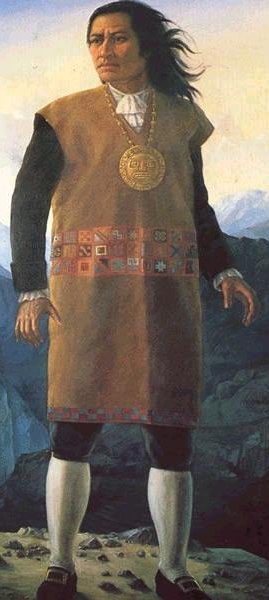
José Gabriel Condorcanqui — rechristened Tupac Amaru II, as he was a distant descendant of the last Incan king — was a member of the privileged indigenous population depended upon by the Spanish to administer the forced and extorted labor that made its New World empire worth having.

Condorcanqui evidently had an epiphany.

In November 1780, he launched a well-planned rebellion by engineering the public execution of a hated corregidor Antonio de Arriaga at the hands of his own servant.

“From this day, no longer shall the Spanish feast on your poverty!”

This attention-grabbing entry onto the political chessboard was followed with an exemplary victory over Spanish forces. His revolt rapidly metastasized into an ethno-religious crusade, with all the accumulated bitterness of the Indians’ two-plus centuries maltreatment ferociously visited upon the Spanish.

It was a heady moment — but only a moment; within a few months, the Spanish had rallied and Tupac Amaru was betrayed into their hands.

The rebel had seized Incan symbology for his own purposes — speaking at ancient shrines, for instance — and the Spanish sentence against him included not only the inevitably horrific execution (of both Tupac Amaru and his wife and family) but a comprehensive and explicit programme of cultural annihilation to consign the Incan identity to the past. This lengthy sentence is well worth the read. (Sourced here, a pdf file; the bolded sections are my highlights.)

I must and do condemn José G. Túpac Amaru to be taken out to the main public square of [Cuzco], dragged out to the place of execution, where he shall witness the execution of the sentences imposed on his wife, Micaela Bastidas [Spanish link]; his two sons, Hipólito and Fernando Túpac Amaru; his uncle, Francisco Túpac Amaru; and his brother-in-law, Antonio Bastidas, as well as some of the principal captains and aides in his iniquitous and perverse intent or project, all of whom must die on the same day.

And once these sentences have been carried out, the executioner will cut out his tongue, and he will then be tied or bound by strong cords on each one of his arms and feet in such a way that each rope can be easily tied or fastened to others hanging from t he saddle straps of four horses, so that, in this position, each one of these horses, facing opposite corners of the square, will pull toward his own direction; and let the horses be urged or jolted into motion at the same time so that his body be divided into as many parts and then, once it is done, the parts should be carried to the hill or high ground known as “Picchu,” which is where he came to intimidate, lay siege to, and demand the surrender of this city; and let there be lit a fire which shall be prepared in advance and then let ashes be thrown into the air and a stone tablet placed there detailing his main crimes and manner of his death as the only record and statement of his loathsome action.

His head will be sent to the town of Tinta where, after being three days on the gallows, it shall be placed on a stake at the most public entrance to the town, one of his arms will go to the town of Tungasuca, where he was chief, where it will be treated in like manner, and the other in the capital of the province of Carabaya; one of the legs shall likewise be sent for the same kind of demonstration to the town of Libitaca in the province of Chumbilcas, while the remaining one shall go to Santa Rosa in the province of Lampa along with the affidavit and order to the respective chief magistrates, or territorial judges that this sentence be proclaimed publicly with the greatest solemnity as soon as it arrives in their hands, and on the same day every year thereafter; and they will give notice in writing of this to their superiors in government who are familiar with the said territories.

Since this traitor managed to arm himself and form an army and forces against the royal arms by making use of or seducing and leading with his falsehood the chiefs who are the second in command in the villages, since these villages, being of Indians, are not governed by such chiefs but rather by mayors who are elected annually by the vote or nomination of the chiefs: let these same electoral communities and the chief magistrates that care to give preference to candidates who know Spanish, and who are of the best behavior, reputation, and customs so that they will treat their subjects well and lovingly, honoring only those who have demonstrated honestly their inclination and faithfulness, eagerness, respect, obedience, submission, and gratitude to the greater glory of our great Monarch through the sacrificed of their lives, properties, or ranches in deference of their country or religion, receiving with brave disdain the threats and offers of the aforesaid reel leader and his military chiefs, yet taking care that these elected leaders are the only ones with the right to the title of chief or governor of their ayllus [communities] or towns, and that they cannot transmit their position to their children or other family members.

To this same end, it is prohibited that the Indians wear heathen clothes, especially those who belong to the nobility, since it only serves to symbolize those worn by their Inca ancestors, reminding them of memories which serve no other end than to increase their hatred toward the dominant nation; not to mention that their appear is ridiculous and very little in accordance with the purity of our relics, since they place in different parts images of the sun, which was their primary deity; and this prohibition is to be extended to all the provinces of this southern America, in order to completely eliminate such clothing, especially those items which represent the bestialities of their heathen kings through emblems such and the unco, which is a kind of vest; yacollas, which are very rich blankets or shawls of black velvet or taffeta; the macapaycha, which is a circle in the shape of a crown from which they hand a certain emblem of ancient nobility signified by a tuft or tassel of red-colored alpaca wool, as well as many other things of this kind and symbolism. All of this shall be proclaimed in writing in each province, that they dispose of or surrender to the magistrates whatever clothing of this kind exists in the province, as well as all the paintings or likenesses of their Incas which are extremely abundant in the houses of the Indians who consider themselves to be nobles and who use them to prove their claim or boast of their lineage.

These latter shall be erased without fail since they do not merit the dignity of being painted in such places, and with the same end in mind there shall also be erased, so that no sign remains, any portraits that might be found on walls or other solid objects; in churches, monasteries, hospitals, holy places or private homes, such duties fall under the jurisdiction of the reverend archbishops or bishops of both viceroyalties in those areas pertaining to the churches; and in their place it would be best to replace such adornments with images of the King and our other Catholic sovereigns should that be necessary. Also, the ministers and chief magistrates should ensure that in no town of their respective provinces be performed plays or other public functions of the kind that the Indians are accustomed to put on to commemorate their former Incas; and having carried out the order, these ministers shall give a certified account to the secretaries of the respective governments. In like manner shall be prohibited and confiscated the trumpets or bugles that the Indians use for their ceremonies and which they call pututos, being seashells with a strange and mournful sound that celebrate the mourning and pitiful memorial they make for their antiquity; and there shall also be prohibited the custom of using or wearing black clothing as a sign of mourning, a custom that drags on in some provinces in memory of their deceased monarchs and also of the day or time of the conquest which they consider disastrous and we consider fortunate since it brought them into the company of the Catholic Church and the very loving and gentle domination of our Kings.

With the same goal it is absolutely forbidden that the Indians sign themselves as “Incas,” since it is a title that anyone can assume but which makes a lasting impression on those of their class; and it is ordered, as is required of all those who have genealogical trees or documents that prove in some way their descent, that they produce them or send them certified and without cost by mail to the respective secretaries of both viceroyalties so that the formalities may be observed by those persons responsible to their excellencies the viceroys, consulting His Majesty where necessary according to each case; and the chief magistrates are charged to oversee the fulfillment of such requirements, to seek out and discover anyone who does not observe them correctly, in order to have it done to collect the documents with the aim of sending them to the proper authorities after giving their owners a receipt.

And so that these Indians renounce the hatred that they have conceived against the Spaniards, and that they adhere to the dress which the laws indicate, adopting our Spanish customs and speaking Castilian [Spanish], we shall introduce more vigorously than we have done up to now the use of schools, imposing the most rigorous and fair penalties on those who do not attend once enough time has passed for them to have learned the language; the duties and responsibilities involved in this plan going to the very reverend ecclesiastical prelates so that, in the opposition between parishes and doctrinas, they take care that those candidates bring affidavits from the provincial judges as to the numbers of people who speak the Said Castilian in those provinces … it being left up to the sovereign discretion of His Majesty to reward and honor those towns whose inhabitants have rendered, under the present circumstances, their due loyalty and faithfulness.

Finally, the manufacture of cannons of all kinds shall be prohibited under the penalty that any noble found manufacturing such items will be sentenced to ten years of prison in one of the presidios in Africa and any commoner will receive two hundred lashes as well as the same penalty for the same time period; reserving for a future time a similar resolution with regards to the manufacture of powder. And since there cannons of almost every caliber in the many ore-crushing mills and timber yards in these provinces, they will be gathered up by the magistrates once of the pacification of this uprising has been completely terminated in order to give account of them to the respective captaincy general so that he may determine whatever use he deems proper for them. Thus have I visualized, ordered, and signed: this is my final judgment.

José Antonio de Areche.

Tupac Lives.

The Spanish campaign to eradicate his name and identity didn’t exactly have legs.

The savagery of the crackdown helped generate Incan support for the rebellions that would shake off Spanish authority in the generations to come. He entered the official iconography of the post-colonial state, and can be found on Peruvian currency.

The very name Tupac Amaru became pregnant with the spirit of resistance — both in Peru, where it was adopted by a 1990’s revolutionary movement, and abroad, where a New York City Black Panther activist (pdf) gave the name to a son: Tupac Amaru Shakur.

On this day..

1381: Eppelein von Gailingen

On this day in 1381, probably the most infamous robber baron in Germany was flogged, done in on the breaking wheel, and beheaded in Postbauer, near Nürnberg.

Eppelein von Gailingen (or Egkelein Geyling, or some variation thereof) has been dramatized across the ages, but little is known of the man’s life. His death, certainly, but his life is clouded in myth and folklore. What’s clear is that von Gailingen met his grisly end for robbery and a subsequent escape from incarceration. The rest is a tad murky (German link).

Von Gailingen belonged to the class of original robber barons, who supplemented their income with unauthorized tolls and, sometimes, flat-out theft. While the term is more popularly known for its application to the so-called industrial robber barons, it derived from a literal description from centuries past — Raubritter, in German, “men of birth who elected to live, in a lawless age, by saddle and by sword; who sought gain by masterful spoliation, and strove for glory by despiteful deeds of arms.” (Source)

A combination of factors led to the slow and steady dissolution of the former feudal system in favor of a money-based economy during the Middle Ages, and after the Plague swept through Europe around 1350, the accumulated changes and decimated population left much of the continent short on labor and, as a result, short on production. This really was a spot of bother for barons who, unlike their monarchical brethren, had no way to draft extra manpower. With resources thinning and a social lifestyle to keep up, many of these former lords turned to theft and exploitation. Although Rome established the rules governing tolls and trade, many local lords, now charged with obeying distant regulations, opted for a more convenient route: they stopped ships at unauthorized points, shook down the merchants, and sometimes seized wares to stock their own shelves.

Eppelein von Gailingen (German link), a lord in the castle at Gunzenhausen, near Illesheim, was of this group, but apparently one of its more bold and populist members.

He was often felt to be a kind of Robin Hood, and the earliest celebrations of the man were largely in this vein: a knight’s knight, fighting against an out-of-control state disregarding its people. Eppelein got away with his skulduggery until 1369, when he was captured by a political rival and imprisoned in Nürnberg. Von Gailingen was sentenced to death, but shortly before his hanging, an accomplice managed to sneak him a horse, on which he rode out the tower gates and hurdled the enclosing wall and moat.

Now the leader of a loyal band of brigands flouting the Roman Catholic Church, Eppelein went on the run for six years, eventually making his way back near his home. It was there that, after six more years, his minimal forces finally yielded to the Count of Nürnberg, who carried out a much more unpleasant version of the death sentence.

Eppelein’s rise to prominence began in the 16th century, when he was immortalized by a folk song, a medium that continues to be kind to him. Locals still tell a variety of tales of his exploits, and a rendition of these classics is vaguely effected through the film Ekkelins Knecht.

Others have simply waxed poetic on the topic.

As if all that attention weren’t enough, von Gailingen’s run from the law lives on through the legend of Nürnberg: locals pushing the town on tourists claim that two hoofprints from his daring escape are imprinted in the stonework near the the castle’s five-pointed tower.* And perhaps most indicative of his endurance as a cultural icon, a neighboring town has devoted a festival to him, which is more than most robber barons of any day can claim.

* Not surprisingly, the tower was destroyed and rebuilt at least once — just five decades after Eppelein’s alleged leap. But the new sandstone structure does bear the marks of what could conceivably be a horse’s hooves.

On this day..

1948: U Saw and the assassins of Aung San

On this date in 1948, Burma hanged six for a shocking assassination that haunts the country to this day.

The previous summer — specifically, at 10:37 a.m. on July 19th — independence hero/proto-head of state Aung San and six members of his cabinet had been massacred by gunmen

The trail quickly led back to rival pol U Saw, himself a former Prime Minister of under British colonial rule.

U Saw had once defended in court the hero of a peasant revolt that the British had quelled with some difficulty. His own maneuverings were heretofore of a more slippery character, having negotiated with the British government early in World War II for independent dominion status — and then turned around and negotiated with the Japanese for consideration in their occupation government.

(The British caught him at his act, and locked him up for the rest of the war. Aung San — “hands … dyed in British and loyal Burmese blood,” Winston Churchill charged* — had also collaborated with the Japanese, who were viewed as liberators by many who had struggled against British domination.)

U Saw was executed with three collaborators in this plot this day at Insein prison, while two others were hanged at Rangoon prison.

But were the British the unindicted co-conspirators?

The damage done by the assassination, in any event, could not be undone with the noose. Aung San appeared to be the only person with sufficient stature to govern Burma effectively. After his death, the newly independent country suffered impotent governments, ethnic conflict, and eventually coups that have today brought to power one of the more repugnant military dictatorships in the world.

The current Burmese junta has for a generation held under house arrest the most recent person to democratically win (but not assume) the office of Prime Minister: Aung San’s daughter, Nobel laureate Aung San Suu Kyi.

* Churchill said this after Aung San’s assassination. See London Times, Nov. 6, 1947, p. 4.

On this day..

1826: Matthew Brady, gentleman bushranger

On this date in 1826, “gentleman bushranger” Matthew Brady was hanged in the Hobart jail for one Australia’s most colorful outlaw careers.

Shipped from England on penal transportation, Matthew Brady was repeatedly flogged for escape attempts before he successfully busted out of Macquarie Harbour prison in 1824.
He made for the bush and began an 18-month spell as an outlaw, self-consciously constructing the persona of the gentleman outlaw — polite to his victims, never violent towards women, that sort of thing.

Among Brady’s best-known exploits: after the colonial governor George Arthur posted a reward for his capture, Brady posted a public counter-offer:

It has caused Matthew Brady much concern that such a person known as Sir George Arthur is at large.
Twenty gallons of rum will be given to any person that can deliver his person to me.

The authorities hunted him doggedly, and he was at last captured by settler John Batman, later famous for his founding role in the history of Melbourne.

The love letters and gifts that filled his cell attested his place in the folklore, but his fate was never in question. Ever the gentleman, Brady’s main protest was sharing his scaffold with (among several other bushrangers) the murderous cannibal Mark Jefferies.

On this day..

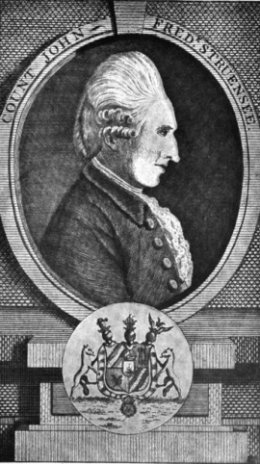
1772: Johann Friedrich Struensee, the doctor who ran Denmark

The 1700s were a time of radical reform, and as the Enlightenment reached the shores of Denmark, it suddenly became possible to be a professed atheist and not lose your head. That is, of course, as long as you didn’t also try to usurp the crown, undermine the aristocracy, and agitate the commoners while you were at it.

Such was the course that ended the rise of Johann Friedrich Struensee on this date in 1772. His friend and sometime cohort Enevold Brandt (Danish Wikipedia entry) was put on the block on the same day.

Struensee was born in 1738 in present day Germany and educated in Prussia, a doctor by trade and a budding Enlightenment political writer by practice. He seemed an unlikely character to involve himself in the court of King Christian VII of both Denmark and Norway, but Struensee was a vain and social man who managed to befriend the right people at the right time.

The first was Brandt. The second was Count Schack Karl Rantzau. A lawyer and Supreme Court justice, Brandt was a court favorite* and planted Struensee’s name as a capable doctor: young, kind, and competent, he would make a perfect personal physician for a king known for being a bit off: Christian was likely schizophrenic. Rantzau, meanwhile, was Count of the Holy Roman Empire, exiled from Copenhagen some 15 years before he met young Struensee, and eager to get back into politics.

In June 1768, Struensee took a post as the king’s traveling physician in England, and he immediately attached to Christian’s loneliness. The regent was interested in literature, philosophy, and music, and Struensee obliged him with patient regard for his charge, for which he was duly rewarded with access to a social life much more fulfilling than in Prussia. As a traveling physician, though, Struensee’s post had a finite span, and he lobbied hard to become a member of the Danish court.

With some help from others in the king’s court, Struensee managed to retain a permanent post, and his clamber up the nearest cliff to power began.

The young doctor, it seems, had a talent for playing two sides for personal gain. It started with the king, who had immense trust in Struensee and began to confide almost everything. Struensee was tactful with this information, adhering to an early form of patient-doctor privilege that endeared him to Christian. The other side was Queen Mathilde, Princess of Wales, by all accounts a beautiful woman who was not happy in Denmark and even less happy to be married to a mad and deteriorating king.

Mathilde initially disliked Struensee — or, at the very least, was indifferent to his actions. But near the end of 1769, the queen finally admitted Struensee into her chambers, and their relationship took off. He ably gamed Mathilde by convincing her that she was the kingdom’s future; Christian, meanwhile, remained ill, and Struensee remained a steady presence in his life. Come spring, Crown Prince Frederick VI also came under Struensee’s care, and as smallpox ravaged Copenhagen, the doctor pressed for inoculation. The king and queen assented, Frederick survived the epidemic, and Struensee garnered himself an official advisorship. It’s also suspected that, while Struensee and Mathilde watched over Frederick as he recovered from the inoculation,** their love affair began.

With a taste of power, Struensee pressed King Christian VII for cabinet changes — which he got — and was named Privy Councilor before 1770 was out. Now the principal advisor to the king, Struensee was able to advance his Enlightenment agenda, notably freedom of the press, the abolition of torture, limiting the death penalty, changing the rules of appointments, numbering the houses in Copenhagen, lighting the streets, and, perhaps in anticipation, removing penalties against those who produced illegitimate children. He was a bold visionary, but he also intoxicated by his growing power … and his programme obviously gored many an ox.

Struensee ascended still further early in 1771 when the king became practically unfit to rule. He was mentally faltering, and Struensee was all but running the show, and more.

In early July, the queen gave birth to a daughter who was widely assumed to be Struensee’s child. Days later, and just three years after being introduced to King Christian VII, Johann Friedrich Struensee effectively appointed himself Privy Cabinet Minister with dictatorial authority through one of King Christian’s edicts. Struensee’s orders would now have the force of law, and, as Christian’s proclamation noted, “They shall be immediately obeyed.”


Enevold Brandt (top), not to be confused with Brandt, the Big Lebowski lackey (bottom).

Struensee spent the next six months turning the European aristocracy inside-out and foisting an aggressive set of cabinet orders on the Danish people — over 1,000, by some counts. Having ridden on the coattails of a queen and king, he now pushed them aside. He moved the court to Schleswig-Holstein, in Prussia, and pleasingly enjoyed both the prerogatives of aristocracy and a middle class contempt for them.

Struensee was, to say the least, not a favorite abroad;† that he and his friends dominated the king and queen did not sit well with Danish commoners. Even Brandt was becoming disaffected, writing in a letter asking for either a larger salary or a resignation from the court:

No despot ever arrogated such power as yourself, or exercised it in such a way. The King’s pages and domestics tremble at the slightest occurrence: all are seized with terror. They talk, they eat, they drink, but they tremble as they do so. Fear has seized on all who surround the minister, even on the Queen…

But Brandt stayed on, and as 1771 drew to a close, Copenhagen became hostile territory for the royal family and their favorite doctor.

After the season’s first masquarade ball, on 16 January 1772, the Queen Dowager — Christian’s step-mother — Juliana Marie exposed Struensee’s affair and had Struensee, Brandt, the queen,‡ and many other Struensee accomplices arrested, ostensibly by order of the king.

Struensee was charged with lèse-majesté, a crime against the crown, for his affair with the queen; though he initially denied the charges — and though Mathilde did her best to shield him from harm — he was found guilty. Brandt was charged with the same crime for allegedly assaulting the king after being himself threatened with a flogging for impertinence (he even had a nip at Christian’s finger). Brandt’s punishment was the same. Each had his right hand chopped off, then was beheaded, drawn, and quatertered.

The queen, meanwhile, went into exile in France. Juliana Marie effectively ruled the kingdom through her son for over a decade, rolling back many of Struensee’s reforms and reverting power back to the aristocracy. This also turned out to be unpopular (the Danes and Norwegians are fickle people), and Mathilde’s son Frederick VI was able to regain power for his father in 1784, eventually moving to liberal reforms more in line with his erstwhile physician’s ideals.

Struensee’s epic rise and fall have spawned a variety of writings since his death. A memoir appeared just months after his execution which detailed his final months. He was also the subject of the Per Olov Enquist novel The Royal Physician’s Visit, which examines his life from multiple perspectives. Queen Mathilde’s life was put to ballet by Peter Maxwell Davies. And for a more contemporary cultural artifact, there’s the 2012 film A Royal Affair.

* Brandt was a court favorite, but after attempting to destroy the position of another minister, he was briefly expelled from Copenhagen, shortly after Struensee accepted his post.

** These inoculations predated “safe” inoculations by non-fatal, related disease strains such as cowpox. Frederick would have been made ill through the small pox strain Variola Minor, which had a mortality rate of about 1%. By contrast, Variola Major was fatal in about 30% of cases.

† While Struensee seems to have been book smart, his feel for international politics was limited, and his standing abroad would have unraveled had it ever raveled in the first place. He repeatedly upset the Russians, and Mathilde’s relatives were not pleased with him. Had he not been downed by public sentiment, it seems likely he would have fallen victim to one of his many royal detractors abroad.

‡ In a curious twist, Rantzau was the queen’s arrestor, and one of the principal conspirators in the dowager’s plot was a cabinet minister Struensee was responsible for ejecting very early in his career.

On this day..

1521: The Comuneros of Castile

On this date in 1521, the day after winning the decisive battle in the Castilian War of the Communities, royalist forces beheaded its three principal leaders in Villalar.

Even while the Spanish Empire was burgeoning in the New World, its home peninsula remained a house divided.

The Iberian Kingdoms of Aragon and Castile had joined in a personal union with the marriage of Ferdinand and Isabella in the late 15th century.

When the couple passed, it was not a given that their conjoined territory would become, as it did, the germ of a unified Spain.

Instead, the royal power couple’s crazy daughter was kept under lock and key while her infant son grew into the redoubtable Emperor Charles V. To exacerbate the local annoyance, Chas had continent-spanning territories, and ambitions; Spain was not his base, merely one of his provinces. (He’d grown up in Flanders. Ah, dynastic politics.)

The Emperor was only a teenager when his Castilian subjects rose against his levies, and against the paradoxical perception that the first true King of Spain was a foreign ruler.

A riot in Toledo mushroomed into a revolt, and everyone started drawing up sides. (Spanish link) Things went south when the commoner rebels started adopting an unwelcome radicalism (beyond rebelling against the king, that is), enabling the imperial rep (and future pope) Adrian of Utrecht to pull back into the royalist camp rebellious nobles increasingly fearful of expropriation at the hands of the firebrands.

After the balance of forces decided in Charles V’s favor, all that remained was to give the chop to the primary troublemakers. Juan Lopez de Padilla, Juan Bravo and Francisco Maldonado were obligingly captured after the Battle of Villalar.


The Execution of the Comuneros of Castile, by Antonio Gisbert. Segovian Juan Bravo allegedly asked to die first, so as not to witness the death of so good a knight as Padilla.

The demise of the “Caballeros Comuneros” pretty much squelched the revolt — although Padilla’s widow Maria Pacheco defended the rebel ground zero of Toledo for several months more.

The comuneros have lived on ever since as a symbol in literature and propaganda, among monarchists (for whom they are a symbol of perfidy), liberals (rather the reverse) and Castilian nationalists. Though “comuneros” was for a period an all-purpose smear against agitators in the Spanish dominions, April 23 (the date of the fateful battle) has been Castile and Leon Day, a public observance, since 1986.


This monolith in the Villalar town plaza commemorates the Comuneros. Image (c) Julio Alvarez, and used with permission.

On this day..

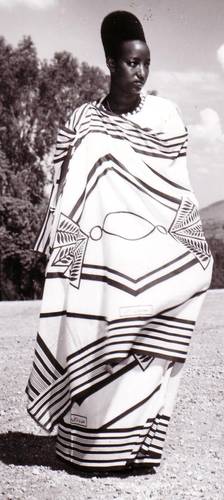
1994: Rwandan Queen Dowager Rosalie Gicanda, and six attendants

When the Rwandan genocide erupted following the April 6, 1994 assassination of President Juvenal Habyarimana, the southern province of Butare went initially unscathed. Its large and powerful Tutsi population had limited the foothold of violent Hutu paramilitaries.

That calm lasted a mere fortnight, however, and was shattered this date in 1994 when the aged widow of Rwanda’s last monarch was hauled to Butare city’s national museum and shot along with several of her caregivers.

Taken in marriage in 1942 (French link) by King Mutara III, Rosalie Gicanda had stayed out of politics after he died mysteriously and Rwanda became a republic.

Being an emblematic Tutsi in April 1994, however, was all the political involvement needed to doom her. According to Human Rights Watch.

At 11 a.m. … a detachment of soldiers commanded by Lt. (jg) Pierre Bizimana, acting under the orders of Capt. Nizeyimana, invaded the modest home of Rosalie Gicanda … About eighty years old, she lived a quiet life as a devout Catholic, sharing her home with her bed-ridden mother and several women and girls who cared for them both. Because she eschewed any involvement in politics and behaved with discreet dignity, even the most anti-Tutsi politicians had left her largely undisturbed throughout the thirty years of Hutu rule…. The soldiers passed through the wooded enclosure that protected the house from the main street and entered the little house with its air of faded respectability. They seized the former queen and six others, leaving her bed-ridden mother and one girl to care for her. The soldiers passed by the ESO and then took Gicanda and the others to a place behind the national museum where they shot them. One teenaged girl, left for dead, survived to recount the murders. The soldiers returned to pillage Gicanda’s home in the afternoon and, two days later, they killed her mother. …

The news that this gracious lady and others from her household had been taken away by soldiers in the back of a pickup truck spread rapidly and alarmed Tutsi and all others who opposed the genocide. They concluded that if soldiers dared to seize even this revered person, then no one was safe.

That conclusion, of course, was well-founded. Over 200,000 Butare Tutsis are thought to have suffered Gicanda’s fate (or worse) in the ensuing months, making it the Rwandan genocide’s bloodiest province.

Pierre Bizimana was sentenced to death for Gicanda’s killing in 1998; I have been unable to document whether that sentence was ever carried out. His commanding officer, Idelphonse Nizeyimana, was arrested in October 2009.

On this day..

1859: Tantia Tope, Indian independence hero

This is the sesquecentennial of Tantia Topi’s hanging for what is sometimes called India’s First War of Independence.

Tantia Topi — there are many variations of the name — commanded Indian troops when a mutiny mushroomed into outright revolt.

Putatively in the service of a rebellious lord, Topi immediately established himself as the cause’s most capable commander. His forces bloodily seized Cawnpore (Kanpur) in a heady surprise victory during the conflict’s opening stages.

A British counterattack overturned that promising development. The Indian lord was captured, but “all the capacity for resistance that he ever displayed” had been supplied by Topi. Now, Topi found a more impressive liege in Rani Lakshmibai, and deployed his genius for soldiery in a fast-evolving war — harrying the occupiers in both conventional and (increasingly) guerrilla-style combat.

The rebels were outclassed; the time was not yet ripe — but Topi’s was the model of anticolonial guerrilla insurgency that would figure so prominently in the next century.

Topi’s exploits and elusiveness, maintaining his freedom in the field long after every other pillar of the uprising had collapsed, made him a domestic hero, and formed a continuing theme in the British press in 1858 and 1859. He was genuinely admired by his enemies as a soldier, however much his cause was abhorred. (The stiff-upper-lippers dinged him for inadequate personal courage, however.)

Topi was taken, at last, by betrayal, and dead at the order of a drumhead military court within days.

But the day after the London Times published its report of the popular hero’s hanging (“a great scramble was made by officers and others to get a lock of hair, &c”), it editorially eulogized* Topi with the gusto of victor catching, perhaps, the foreshadow of Indian resistance awaiting in generations still to come.

He raised armies as fast as we could disperse them, took up one position after another to our infinite annoyance, and led us a chace which, despite of unexampled efforts on the part of our soldiers, seemed to be really endless. Our troops pursued him without intermission, contrived more than once to surprise him, repeatedly captured his artillery and scattered his troops, but could never deprive him entirely of followers or guns. He seemed to summon forces from the earth as if by magic. As the pursuit grew hotter and hotter he mounted his men on ponies and camels, and marched, it is said, at the average rate of 60 miles a-day. Wherever we found him he had always cavalry and guns, and these he posted with remarkable skill.

…

Be it remembered that for half a century we had been training soldiers, and that in Bengal alone there were 150,000 natives under arms when this revolt broke out. Now, in all this enormous host there was not a single man who, when the bonds of allegiance and discipline were abruptly removed, displayed the intuitive capacities of a military commander. … The two years of the revolt, with all their opportunities, never produced one native General. … One man alone reproduced the old Indian character, and that man was TANTIA TOPEE — an obscure civilian, without place or power. He, by the light of nature alone, discerned the strong points of the rebels’ position and our own weak points. By the exercise of that faculty with which heroes are gifted he could always, even in his most desperate straits, draw followers to his standard. …

Nothing could more forcibly illustrate the reputation which this man had acquired than the fact that his fate has been attended with some regret … if he had not met his match in those opposed to him he might have founded a dynasty.

* May 21, 1859. Information moved a little slower.

On this day..

1548: Gonzalo Pizarro and Francisco de Carvajal

On this date in 1548, the Spanish crown cemented its authority over the territory of the former Incan Empire by beheading its rebellious conquistador authorities.

Gonzalo Pizarro (English Wikipedia entry | Spanish) had served in the force that late elder half-brother Francisco used to destroy the Incas. The poor bloke was always second banana in the conquistador game; when he wasn’t being one-upped by his flesh and blood, he was bailing on the expedition that “discovered” and navigated the Amazon River. (Francisco de Orellana earned those honors instead.)

No, Gonzalo had a more prosaic specialty: killing.

While big bro went off to pacify more territory, Gonzalo along with siblings Hernando and Juan, the Baldwin brothers of New World conquest, chilled in the former Incan capital Cusco and sparked a rebellion in the 1530’s with their iron-fisted rule.

Appointed Governor of Quito in 1541 — he forced the appointment with some exemplary hangings — Gonzalo was just the sort to get a burr in his saddle when the Emperor Charles V promulgated the New Laws requiring slightly less crappy treatment of the natives.

And that was a low bar to clear indeed.

Although the following passage is not particular to Gonzalo Pizarro, gadfly monk Bartolome de las Casas described (perhaps exaggeratedly, but still) the previous Spanish depredations in “Perusia”:

[T]he Spaniards, without the least provocation on their part, as soon as they entred [sic] upon these Territories, did burn at the Stake their most Potent Caciq Ataliba, Prince of the whole Country, after they had extorted from him above Two Millions of Gold, and possessed themselves of his Province, without the least Opposition … As also some few days after, the Ruler of the Province of Quitonia, who was burnt, without any Cause given, or Crime laid to his Charge … and in like manner, burnt the Feet of Alvidis, the greatest of all the Quitonian Lords, and rackt him with other Torments to Extract from him a discovery of Ataliba’s Treasure, whereof as appear’d after, he was totally ignorant …

[T]hese Eyes of mine the Spaniards for no other reason, but only to gratifie their bloody mindedness, cut off the Hands, Noses, and Ears, both of Indians and Indianesses, and that in so many places and parts, that it would be too prolix and tedious to relate them. Nay, I have seen the Spaniards let loose their Dogs upon the Indians to bait and tear them in pieces, and such a Number of Villages burnt by them as cannot well be discover’d: Farther this is a certain Truth, that they snatched Babes from the Mothers Embraces, and taking hold of their Arms threw them away as far as they would from them: (a pretty kind of barr-tossing Recreation.) They committed many other Cruelties, which shook me with Terror at the very sight of them, and would take up too much time in the Relation …

More urgent than “recreation,” Pizarro (and many of the New World’s new landholding elite) were miffed that meddlesome European bleeding hearts types were going to cut into their profit margins.

Pizarro revolted, enlisting the brilliant officer Francisco de Carvajal, a longtime fixture of the Old World battlefield. Now an octogenarian, he had lost neither vigor in command, nor cruelty in conquest. (He played bad cop to Gonzalo’s good cop.) The two killed the guy sent to impose the emperor’s decree.

This uprising forced the next Spanish viceroy to repeal the hated New Laws in order to win political support against Pizarro and Carvajal — a happy outcome for Pizarro’s base, but not for the conquistador himself.

Pedro de la Gasca’s adroit diplomacy caused the entire rebel force to desert before the fight at the “Battle” of Jaquijahuana in Sacsayhuaman.

The two principals were quickly arraigned. Carvajal, at his age, could be wry about being singled out for punishment: “very merciful is the Lord President; for, if the victory had been ours, there would have fallen on this spot nine hundred men.”

Carvajal was hanged and Pizarro beheaded, both of them winding up on pikestaffs at the gates of the city Francisco Pizarro had founded — Lima.

Their partnership — and the arc of Spanish exploits in the New World — is covered in this Google Books freebie.

On this day..

1739: Dick Turpin, outlaw legend

On this date in 1739, famed desperado Richard “Dick” Turpin rode through York on an open cart, saluting his admirers, then sat upon his gallows at the York raceway for half an hour, chatting with spectators and executioners, until he “with undaunted courage looked about him, and after speaking a few words to the topsman, he threw himself off the ladder and expired in about five minutes.”

Turpin was the ultimus Romanorum, the last of a race, which (we were almost about to say, we regret) is now altogether extinct. Several successors he had, it is true, but no name worthy to be recorded after his own. With him expired the chivalrous spirit which animated successively the bosoms of so many knights of the road; with him died away that passionate love of enterprise, that high spirit of devotion to the fair sex, which was first breathed upon the highway by the gay, gallant Claude Du-Val, the Bayard of the road — le filou sans peur et sans reproche — but which was extinguished at last by the cord that tied the heroic Turpin to the remorseless tree…

Turpin, like the setting sun, threw up some parting rays of glory, and tinged the far highways with a lustre that may yet be traced like a cloud of dust raised by his horse’s retreating heels.

The cloud hasn’t settled since William Harrison Ainsworth wrote those words.*

The “knight of the road”, one understands, is an artifice — a romantic construct. One name to bear its lustre to the present may be as good as another. Even so, in Dick Turpin, it has an exponent who bore very scant resemblance to the archetype … save for celebrity.

Turpin washed out of his apprenticed career as a butcher and took to the road, where he joined the “Essex Gang”. Far from dashing post-road stickups, this troupe specialized in invading domiciles where they would torture women into revealing the household stashes of valuables.


The Newgate Calendar captions this image, “Dick Turpin placing an old woman on the fire, to compel the discovry [sic] of her treasure”

Turpin’s highwayman career commenced when the gang was busted — our principal leaping out a window to evade capture — and he had a profitable couple of years plundering the traffic around Epping Forest.

Many are the colorful tales of Turpin’s career; the one of most moment for his legacy may be this chance encounter with a fellow outlaw, as related in the Newgate Calendar.

On a journey towards Cambridge, he met a man genteelly dressed, and well mounted: and expecting a good booty, he presented a pistol to the supposed gentleman, and demanded his money. The party thus stopped happened to be one King, a famous highwayman, who knew Turpin; and when the latter threatened destruction if he did not deliver his money, King burst into a fit of laughter, and said, “What, dog eat dog? — Come, come, brother Turpin; if you don’t know me, I know you, and shall be glad of your company.”

The well-mannered Tom King — “the gentleman highwayman” — seems to have had his courteous mien conjoined in legend with his much more villainous partner’s prolific career.

Nor is King the only fellow-outlaw whose exploits Turpin has absorbed.

Our anti-hero’s days pillaging the environs of London came to an end in an escapade that saw Turpin shoot his accomplice while trying to rescue him — a klutzy critical miss not usually associated with the swashbuckling rogue character kit. The dying King is supposed to have repaid this bit of friendly fire by revealing to the authorities the pair’s Epping Forest hideouts.

Escaping capture once again, Turpin changed his address, and it is said that the highwayman shed his pursuers with a marvelous 200-mile ride north to Yorkshire in 15 hours.

This feat was not Turpin’s originally, but ascribed to the 17th-century robber John “Swift Nick” Nevison, although even that might be folklore.

Ainsworth, bless his heart, fabricated (pdf) the Turpin ride in the interest of his yarn — “they were distancing Time’s swift chariot in its whirling passage o’er the earth … [Turpin] rode like one insane, and his courser partook of his frenzy. She bounded; she leaped; she tore up the ground beneath her; while Dick gave vent to his exultation in one wild prolonged halloo.” (Picturesquely, he rides his famous steed Black Bess to death on the trip.)

The story has been fixed ever since in the firmament, and licenses every pub along the route to claim Turpin’s patronage.

His end, if not heroic, was certainly attention-grabbing. Turpin settled in Yorkshire under the alias “John Palmer” and passed as a gentleman farmer … with a larcenous side business rustling stock.

His career, in a sense, had come full circle: ’twas a youthful cost-cutting practice of abducting animals that had put the kibosh on his legitimate butcher’s business.

His cover was blown most ingloriously, when he was detained as a possible horse thief and sent a pseudonymous letter to his brother in London asking for help. The brother was too cheap to pay the postage due, so the letter returned to the post office where Turpin’s schoolmaster chanced to see writing in a hand he recognized, and journeyed to York to identify the wanted man and pocket the reward.

So it was not housebreaking, highway heists, or his homicide that hung Turpin, but horse-rustling … although Turpin’s celebrity career attracted curiosity-seekers from far and wide when word of his capture got out. Whatever Ainsworth may have made of Turpin, he did not fabricate the man’s fame; Dick Turpin earned his own ballad sheets and made his own legend possible playing the man at his death.

This man lived in the most gay and thoughtless manner after conviction, regardless of all considerations of futurity, and affecting to make a jest of the dreadful fate that awaited him.

Not many days before his execution, he purchased a new fustian frock and a pair of pumps, in order to wear them at the time of his death: and, on the day before, he hired five poor men, at ten shillings each, to follow the cart as mourners: and he gave hatbands and gloves to several other persons: and he also left a ring, and some other articles, to a married woman in Lincolnshire, with whom he had been acquainted.

On the morning of his death he was put into a cart, and being followed by his mourners, as above-mentioned, he was drawn to the place of execution, in his way to which he bowed to the spectators with an air of the most astonishing indifference and intrepidity.

When he came to the fatal tree, he ascended the ladder; when his right leg trembling, he stamped it down with an air of assumed courage, as if he was ashamed of discovering any signs of fear, Having conversed with the executioner about half an hour, he threw himself off the ladder, and expired in a few minutes.

The spectators of the execution were affected at his fate, as he was distinguished by the comeliness of his appearance … The grave was dug remarkably deep, but notwithstanding the people who acted as mourners took such measures as they thought would secure the body: it was carried off about three o’clock on the following morning; the populace, however, got intimation whither it was conveyed, and found it in a garden belonging to one of the surgeons of the city.

Having got possession of it they laid it on a board, and carried it through the streets in a kind of triumphal manner, they then filled the coffin with unslacked lime, and buried it in the grave where it had been before deposited.

* LibriVox has a well-done free reading of Rookwood.

[audio:http://ia360943.us.archive.org/0/items/rookwood_pc_librivox/rookwood_26_ainsworth.mp3]

Part of the Themed Set: Selections from the Newgate Calendar.

On this day..