1976: Christian Ranucci, never yet rehabilitated

On this date in 1976, Christian Ranucci, 22, was guillotined in Marseilles … with the last words addressed to his attorneys, “Réhabilitez-moi”.

If that has not yet occurred, it has not been for want of trying.

Many people think Ranucci was the last person executed by France; in fact, this is not correct. But the confusion is understandable: Ranucci has persisted in the headlines and the public imagination owing to a running controversy over whether he was wrongly convicted. It’s a vexing case rife with ambiguous circumstantial evidence, and observers are usually able to see in it what they want to see.

On June 3, 1974, two incidents — a minor traffic accident, and the request by a young man of a local mushroomer to help his car out of a muddy gallery where it was stuck — placed a gray Peugeot 304 at La Pomme, outside Marseilles. This also happened to be the date that 8-year-old Maria-Dolores Rambla was abducted from St. Agnes by an unknown man in a red sweater reportedly driving a gray Simca 1100, a vehicle that would be possible to mix up with the Peugeot 304.

When news of the abduction broke on the radio the morning of June 4, the people who saw the Peugeot(s) later called it in as a tip.

Police got to the bespectacled young Ranucci (English Wikipedia entry | French; most of the links from here on out are French) via the accident. His car didn’t stop for the other motorist, but limped on down the road another kilometer. The other driver’s vehicle was inoperable, but that driver sent a passerby to follow the hit-and-run Peugeot’s path to see if he could track down a license plate number. Indeed he did do that.

And when that good citizen called police, he said he had seen the driver running into the nearby woods with either a sizable package or a small child. (The story has … evolved.) You can see where this is going: when the area was searched after the tip came in, poor Maria’s dead body was steps away from the spot the car stopped. She’d been knifed to death.

The mushroom-gallery, for its part, yielded up a red pullover sweater like the one the abductor wore, and a bloody knife.

After 17 hours’ grilling by the police, Ranucci broke down and confessed. He would later retract the confession, blaming police pressure. (Here in 2013, everybody does know — right? — that false confessions happen with alarming frequency, and that they’re widely associated with exonerations.)

As open-and-shut as this sounds, Ranucci’s many defenders have found a great deal wanting in the case

Journalist Gilles Perrault has been on about this case for decades. His L’ombre de Christian Ranucci drew a 50,000 euro judgment for defaming the Marseilles police.

Among the sticking-points for skeptics:

  • There’s the inconsistency in the reported make and model of the vehicle vis-a-vis what Ranucci was driving.
  • None of the eyewitnesses to the abduction could identify Ranucci in a lineup … until the lineup was pared down to make it a gimme. Sloppy lineup work has been a significant factor in wrongful convictions; on the other hand, eyewitnesses are extremely unreliable in general.
  • The recovered red pullover was much too small for Ranucci, possibly suggesting that this apparent link to the observed abductor did not reach all the way to the accused.
  • Mr. Red Pullover Simca 1100 was allegedly seen attempting other abductions at times and places that made it certain that he was not Christian Ranucci.
  • Questionable handling of physical evidence by investigators.

That’s basically just to scratch the surface. Here (pdf) is a much lengthier exegesis of the potentially exculpatory evidence, in French. Here’s an English summary covering the same stuff on a site whose resources are mostly also in French. (“We do not assert Christian Ranucci is innocent.”) Countless additional search hits en francais await the interested researcher.

Ranucci himself insisted against advice on pursuing an actual-innocence defense, rather than mounting a mitigation case focusing on avoiding the guillotine while conceding guilt. He was convicted on just a 9-3 jury vote.

But neither in his own time nor latterly has that case gained much purchase on the conscience of his prosecutors. The President who denied Ranucci’s clemency petition, Valéry Giscard d’Estaing, has recently given his 1976 decision a vote of confidence; the father of the victim feels likewise.

On this day..

1793: Joseph Chalier, Jacobin martyr

On this date in 1793, Joseph Chalier was guillotined in Lyon(s).

Chalier (English Wikipedia entry | French*), a knockabout silk merchants’ agent from Lyon, oddly became that city’s exemplary Jacobin fire-eater and the leading spirit in its Jacobin clubs. He was elected to the Lyon municipal council in 1792, and while in Paris even took part in the August 10, 1792 insurrection deposing Louis XVI.

Lyon, France’s “second city” and the hub of a considerable silk-weaving industry, was not nearly so amenable as Paris to the French Revolution’s radicals: indeed, the wartime anathema most of Europe had laid upon regicidal France devastated the weaving trade, and the particular grievances of established silk weaver artisans were here advanced but there complicated by the advent of the Revolution.**

Consequently, liberal Girondins, merchant elites, some craftsmen, and even outright royalists made a formidable coalition checking radical Jacobins in municipal politics. (Chalier even warned the National Assembly of this dynamic.)

Jacobins could never quite get political control of the city, until political crisis toppled the Lyon government in March 1793 and finally put Chalier et al in the saddle. (They immediately erected a public guillotine, of course.)

Their brief ascendancy expired 80 days later, when a municipal revolt put Chalier and his allies in chains, and reasserted more moderate control — just as the moderate Gironde was being expelled from the National Convention. After terse negotiations between Lyon and Paris hit a quick impasse, Lyon guillotined Chalier. “My death will cost this city dear,” Chalier warned his tribunal.

The next month, it lay under a terrible siege by the central government.

In the aftermath of that conquest, the Committee of Public Safety ruthlessly suppressed the seditious Lyonnaise, even going so far as to decree (without effect) the forfeit of the city’s very name — henceforward to be known as Ville-Affranchie, the Liberated City.

Hastening to the city and then hastening back to make political hay of the bloodbath, Committee of Public Safety member Collot d’Herbois “sent to Paris — over and against Robespierre‘s religion — quite another god, a horrible fetish, the head of Chalier, thrice crushed by the Girondin blade.”† This ghastly relic was then paraded in triumph in Paris for Collot d’Herbois’s heroic homecoming, its former owner apotheosized into the Revolution’s martyrs’ pantheon alongside Marat.

As a result, one can still today see porcelain busts of Chalier, of the type widely manufactured in early 1794 for posturing in churches, homes, civic clubs, and anywhere else a display of conspicuous patriotic sentiment might be advisable.


Chalier’s bust. By David Monniaux (self photo) [GFDL (http://www.gnu.org/copyleft/fdl.html), CC-BY-SA-3.0 (http://creativecommons.org/licenses/by-sa/3.0/) or CC-BY-SA-2.5-2.0-1.0 (http://creativecommons.org/licenses/by-sa/2.5-2.0-1.0)], via Wikimedia Commons.

* One of the best biographical resources on Chalier is an 1887 French scholarly article available (for free) from JSTOR.

** See David Longfellow, “Silk Weavers and the Social Struggle in Lyon during the French Revolution, 1789-1794” in French Historical Studies, Spring 1981. Despite the title, this article also explicates the background of labor dynamics in the Lyon silk industry and its history of class conflict going back to the 17th century.

Jules Michelet, quoted by Chantal Thomas and David F. Bell in “Terror in Lyon”, SubStance, Vol. 27, No. 2, Issue 86: Special Issue: Reading Violence (1998).

On this day..

1960: Manfred Smolka, East German border guard

On this date in 1960, Manfred Smolka was guillotined in Leipzig.

Smolka was among three million East Germans or more who escaped over the border to West Germany in the 16 years after the defeat of the Nazis divided the country.

In the earliest years, people sluiced over the long border just anywhere. By Smolka’s time, that perimeter was buffered by an “internal border” that made it difficult for ordinary people to approach near enough to West Germany to escape. Consequently, most emigration by the the late 1950s occurred in the divided city of Berlin — a flow that East Germany would finally stanch in 1961 with the ultimate in immigration reform, the Berlin Wall.


One of the Cold War’s iconic photographs: East Berlin border guard Conrad Schumann leaps over the barbed-wire barrier into West Berlin on Aug. 15, 1961, just days after construction of the Berlin Wall began.

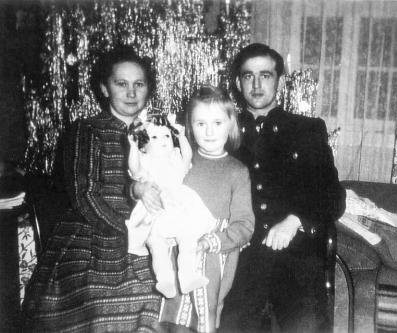
Like that more famous later escapee, Manfred Smolka (German link, as are most that follow) was a border guard; indeed, he was an officer. That gave him the ability, in 1958, to be far enough within the “internal border” to defect into West Germany

The very next year, he arranged to meet his abandoned wife and daughter on the Bavaria-Thuringia frontier to smuggle them over, too. Alas, it was a trap (pdf) laid by the feared East German secret police, the Stasi.


Happier times: Manfred Smolka with his wife and child.

According to press reports, Smolka was actually on West German soil when the Stasi men captured him.* (The Stasi were often up for a bit of kidnapping.)

West Germans were outraged by Smolka’s capture and subsequent death sentence for “military espionage,” but the case was deemed an apt one for the education of East Germany’s border security agents.

Only with post-Cold War German reunification could his family examine his file. “I am innocent, I can prove it a hundred times,” they read in the last letter the onetime defector wrote to his family — a letter which had never been delivered. “You need not be ashamed of me.” In 1993, a reunified, post-Cold War Germany officially agreed and posthumously rehabilitated Manfred Smolka.

There’s a few minutes of documentary video about him, in German, here.

* By a July 5, 1960 account in the London Times, Smolka was shot at and wounded as he crossed into East Germany but still managed to “crawl” back to West Germany — where his pursuers did not fear to follow him.

On this day..

1794: Simon-Nicholas Henri Linguet, who defended Nero

On this date in 1794, Simon-Nicholas Henry Linguet was guillotined during the French Revolution for having written praise of foreign tyrants.

Linguet (English Wikpiedia entry | French) was a brilliant lawyer and a prolific but prickly man of letters. Famous in his own day for his prose, he’s of less account to a modernity that’s long forgotten the various axes he had to grind.

The one sure constant in his life was a gift for making enemies.

Linguet was an Enlightenment philosophe at the start of his public life, and made an early name for himself when his forceful intervention in the case of the Chevalier de la Barre helped save La Barre’s friends from sharing his fate.

He soon apostatized from the Reason-worshipping “fanatical” philosophes, and eventually found himself disbarred for irritating too many fellow barristers. Turning instead to journalism, his Annales politiques, civiles et litteraires — published mostly in exile from 1777 to 1792 — became, as his biographer put it, “a quasi-independent force for molding opinion and policy in the power centers of Europe. Maneuvering among the great powers of Europe wielding the power of his public’s opinion, Linguet institutionalized political influence for himself, and liberty as well.” And of course the writing business really let Linguet’s native gift for pissing people off shine.

He scalded the French Academy and settled scores with rivals old and new. Eventually a suit by one of them landed Linguet in the Bastille when the latter tried to return to Paris in 1780.

Linguet got out (and left France again) in 1782, turning his spell in the Bourbon dungeons into a Memoirs of the Bastille,* which didn’t buy him as much sympathy as one might assume come revolutionary times since he had scarcely incurred his sufferings on behalf of the masses.

Linguet was finally able to return to his country with the Austrian embassy courtesy of ennoblement conferred by Marie Antoinette‘s brother Emperor Joseph II. His restored relations with Europe’s crowned heads, however, did not prevent him taking up the cause of Belgium’s Brabant Revolution as well as the Haitian Revolution.

An early member of the Cordeliers and temporary enthusiast of the Revolution, Linguet would later be bold enough to write Louis XVI offering to defend him. He was easy pickings in the end for a revolutionary tribunal that accused him of prostituting his literary gifts to Europes various ancien regimes: Linguet had taken refuge in his time with all of revolutionary France’s principal enemies, and had flattered their princes for his trouble; his provocative pen had set his name to a defense of slavery; and he’d even mounted an attack on Alexander the Great which in the great tradition of contrarian provocateurs compared the legendary conquerer unfavorably (on the body count metric) with the Emperor Nero. Literally defended Nero was the epitaph his prosecutors pinned to him, and it’s never fully come unstuck. It’s unfair, sure … but Linguet was the last man in a position to complain, and not just because he’d had his head cut off.

A manuscript of a history of France Linguet was working on was found among his papers after his visit to the guillotine. It made fine cartridge paper for France’s muskets.

* At one point in this text — an overwrought rant against the rigors of his imprisonment from the pen of a man whose previous treatises had scornfully defended absolutism against his former buddies among the philosophes — he mounts a defense of executioners, who “ought to be much less ignominious in the public opinion.” After all, they

are only the ministers of an indispensible severity: they are officers, and necessary officers, of a lawful power they may sometimes execute unjust orders; but they act constantly in obedience to justice and the laws. They are certain that the unfortunate being who is delivered to them, either has had, or will have, the means of defending himself: they are sure, or at least must believe, that an equitable and impartial enquiry has preceded the rigorous decision under which they act. They are authorized to think that none but the guilty, or at least men justly suspected, have ever been the objects of them.

On this day..

1930: 13 Viet Nam Quoc Dan Dang cadres, for the Yen Bai mutiny

June 17 is an honored day in Vietnam for the sacrifice under the French guillotine this date of 13 early martyrs for national independence.

These were members of the nationalist Viet Nam Quoc Dan Dang (VNQDD, or Viet Quoc). Not averse to the propaganda of the deed, these revolutionaries labored secretly under onerous French pressure following the previous year’s assassination of a labor recruiter.*

A year later (almost to the hour), with the movement crippled by arrests, the VNQDD tried an audacious gambit to revive its fortunes and trigger a general rising against the French.

The Yen Bai mutiny — named for the Tonkin city where it transpired** — saw 40 or 50 Vietnamese riflemen of the Fourth Régiment de Tirailleurs Tonkinois† and a like number of civilian sympathizers attacked the regiment’s officers in concert.

Alas, most of the other Vietnamese tirailleurs declined to join the rising, and it was suppressed within a few hours.

Over 1,000 accused revolutionaries stood trial for the Yen Bai mutiny, and the top leadership paid the top penalty this date — but as quietly as the French could manage. They were whisked out of their cells on the preceding evening and taken by secret convoy on a four-hour ride to the Yen Bai execution grounds, where a guillotine had been covertly erected.

We are going to go to pay our debt for the country. The flag of independence must be dyed with blood. The flower of freedom must be sown with blood. The country needs more and more sacrifices of its people. The revolution would meet success finally. We want to say goodbye to all of you with our respects.

-Nguyen Thai Hoc, taking his final leave of imprisoned VNQDD comrades

From 4:55 a.m. at Yen Bai, the thirteen men one by one were each lashed to the plank. One by one, each of their necks were fixed by the lunette under the blade. One by one, each cried out “Vietnam!” as the blade fell.

  • Bui Tu Toan
  • Bui Van Chuan
  • Nguyen An
  • Ha Van Lao
  • Dao Van Nhit
  • Ngo Van Du
  • Nguyen Duc Thinh
  • Nguyen Van Tiem
  • Do Van Su
  • Bui Van Cuu
  • Nguyen Nhu Lien
  • Pho Duc Chinh, who allegedly asked (it’s unclear to me whether it was granted) to be guillotined face-up — perhaps a show of bravado
  • The founder of the VNQDD Nguyen Thai Hoc, whose name now graces a major street in the heart of Hanoi

The VNQDD at this point was organizationally shattered, and many of its un-arrested cadres fled to China — whose sponsorship would revive it and return it to Vietnam in the 1940s.

By then, the communists were in the saddle in Vietnam. In 1946, Ho Chi Minh purged the VNQDD from the national independence coalition. Its remnants would wind up in South Vietnam; today the Viet Quoc persists mostly in exile.

* The labor recruiter is only tangential to the Yen Bai story, but their function, to dragoon Vietnamese peasants into brutal plantation work on terms next door to slavery, made them particularly hated characters. More about that racket in this 1930 text (pdf) by an outraged Frenchman.

** A few other minor secondary incidents occurred elsewhere in the area, but the epicenter of the rising was always Yen Bai.

† After the mutiny, the French army tried to reduce its dependence on Vietnamese recruits.

On this day..

1937: Helmut Hirsch, secret bomber

On this date in 1937, the German-American Jewish terrorist Helmut “Helle” Hirsch was decapitated at Plotzensee Prison.

Hirsch (English Wikipedia entry | German) was an architecture student who had been driven from Germany by anti-Semitic laws and studied, therefore, in Prague. (Before the Reich gobbled up Czechoslovakia, of course.)

There he became involved in the Strasserite anti-Hitler “Black Front”. To Hirsch’s grief, this organization had been thoroughly penetrated by pro-Hitler spies.

In December 1936, Hirsch embarked on a train. His mission was to bomb something in Germany. The details of the plan remain murky to this day; Hirsch’s subsequent trial was held in secret and his worried family only learned the whereabouts of their son three months missing when they heard a radio broadcast in March announcing his condemnation for “preparation of high treason and criminal use of explosives endangering the public.”

It seems that Hirsch was supposed to have disembarked in Nuremberg and there picked up some left luggage deposited by a fellow conspirator; he may have been meant to deliver this payload Nazi party headquarters in Nuremberg, or perhaps to the offices of Julius Streicher’s propaganda sheet Der Stürmer.

The young would-be terrorist would tell his family in prison letters that he had instead bypassed Nuremberg and kept going all the way to Stuttgart to meet a friend, hoping the latter would talk him out of his wavering commitment to the plot. Instead, he was arrested that night by the Gestapo.

This case made news in the United States during the spring of ’37 because Hirsch’s father, Siegfried, was a naturalized American. That made Helmut a U.S. citizen, too, even though the son had never set foot in the United States.* U.S. Secretary of State Cordell Hull and the American ambassador to Germany William Dodd lobbied the Nazi government to spare Hirsch** — but to no avail.

Hirsch’s sister Kaete Hirsch Sugarman later donated her brother’s papers — letters, photos, architectural drawings — to Brandeis University, which maintains them as the Helmut Hirsch Collection. They include this touching final letter the young man wrote to his family on the eve of his execution.

Dear Mother, dear Father,

I have just been told that my appeal for clemency was turned down. I must die then.

We need not say anything any more to each other. You know that in these last months I have really found the way to myself and to life. Real beauty must stand before unswerving honesty. You know that I have lived every moment fervently and that I have remained true to myself until the end. You must live on. There can be no giving up for you. No becoming soft or sentimental. In these days I have learned to say “yes” to life. Not only to endure it but to love life as it is. It is our own inner gravity, the force by which we have entered life.

It must help you in some way that I know I have finally reached my own inner image and feel complete. And in this feeling is much of our time and our world.

The only way I know how to thank you is by showing you until the last moment that I have used all your love and goodness towards becoming a whole being of my time and my heritage. Do not think of the unused possibilities, but take my life as a whole. A great search, a foolish error, but on its path to finding of final truth, final peace.

Please care for Vally [his girlfriend, Valerie Petrova] as for a child. I embrace you, dear mother and you, my father, once more for a long, long time. Only now have I realized how much I love you.

Yours forever,

Helmut.

* Siegfried Hirsch was a naturalized American who had lived in the U.S. for a decade prior to World War I. Siegfried’s U.S. citizenship had been revoked in 1926 because he had left to live abroad, but when the matter came to prominence in 1937 it was reinstated and Helmut Hirsch explicitly acknowledged as a U.S. national.

** The shoe has been on the other foot for death-sentenced German nationals in the present-day U.S.

On this day..

1794: Elisabeth of France, sister of the king

The 25-strong batch dispatched to the guillotine on the Place de la Revolution during the Terror on this date in 1794 included Princess Elisabeth, the sister of the late guillotined King Louis XVI.

Princess Elisabeth (English Wikipedia entry | French) was the staunch conservative* of her family’s generation and not afraid to advertise it.

Required by the revolutionary tribunal to identify herself, she retorted (since her brother’s death passed the succession to the imprisoned child Louis XVII), “I am called Elizabeth Marie de France, sister of Louis XVI, aunt of Louis XVII, your King.” The papers just reported that she said “Elizabeth Marie.”

This fate cannot have surprised her: her correspondence anticipates a bloody reckoning with the revolutionary “monsters from hell” from years earlier, and reflects the figure in the royal household pushing the king and queen on immoderate courses like their famous attempted escape. (Elisabeth posed as a maid with the fugitive party.) “The Assembly is still the same; the monsters are the masters,” she wrote in February 1790. “The king, and others, from the integrity of their own natures, cannot bring themselves to see the evil such as it is.”

Elisabeth was nevertheless quite attached to her brother and her sister-in-law, and swore an oath to keep with Louis XVI and Marie Antoinette during the royal couple’s harrowing attempt to ride out the revolution. She courageously quaffed the every terror that family endured all the way to the dregs; when the mob stormed the Tuileries on June 20, 1792, she was momentarily mistaken for the queen and thereby put in peril of her life. “Do not undeceive them!” she warned an associate who was about to save her by correcting the misapprehension.

Elisabeth’s correspondence shows her not “merely” self-sacrificing but a keen observer of events who pushed her brother to rein in the revolution by force … and pushed her exiled brother the Comte d’Artois** to do likewise. For Elisabeth, bloodshed would be necessary, and desirable sooner than later — in contrast to the national-reconciliation stuff the doomed king was still hoping for.

By the end Paris of the Terror probably didn’t really need any better reason to cut off Elisabeth’s head than the fact of her bloodlines — “sister of the tyrant.” There are enough little hagiographies out there concerning Elisabeth’s piety and loyalty, however, that some think she should eventually be proposed as a candidate for Catholic canonization.

* She might as well be: royals couldn’t save themselves even by going full Republican.

** The future King Charles X.

On this day..

1940: Wilhelm Kusserow, Jehovah’s Witness

(Thanks to Meaghan Good of the Charley Project for the guest post. -ed.)

On this date in 1940, 25-year-old Wilhelm Kusserow was executed by firing squad at Münster Prison in Germany.

A Jehovah’s Witness, he interpreted God’s command “thou shalt not kill” literally and refused to serve in the German army — a big no-no in Hitler’s Third Reich.

Kusserow had actually been born Lutheran, but his parents became Jehovah’s Witnesses after World War I and raised their eleven children in the faith. Jehovah’s Witnesses, in addition to not serving in the army, also refused to Heil Hitler, since the tenets of their religion required them to make obeisance only to Jehovah.

They were persecuted by the Nazis from the beginning of Hitler’s regime, and by 1935 the religion was banned altogether. The Kusserows, and many others, continued to practice their faith in secret.

During the Nazi era, some 10,000 Jehovah’s Witnesses did time in prisons and concentration camps (where they were required to wear a purple triangle), Wilhelm’s parents and siblings among them. 2,500 to 5,000 died.

The children in Jehovah’s Witness families were taken from their parents and sent to orphanages, foster families or reform schools.

(French Witness Simone Arnold Liebster would write a memoir about the years she spent in institutions as a child because she and her parents refused to renounce their beliefs.)

At Wilhelm Kusserow’s trial, the judge and the prosecutor were apparently reluctant to condemn this young man. They pleaded with him to back down, promising to spare his life if he did so, but Wilhelm refused. Some things were more important to him than life itself.

In his final letter to his family he wrote,

Dear parents, brothers, and sisters:

All of you know how much you mean to me, and I am repeatedly reminded of this every time I look at our family photo. How harmonious things always were at home. Nevertheless, above all we must love God, as our Leader Jesus Christ commanded. If we stand up for him, he will reward us.

Hitler later decided the firing squad was too honorable a death for Jehovah’s Witnesses and ordered that they be decapitated instead. Wilhelm’s younger brother Wolfgang, who had also refused to serve in the army, was executed in this manner in 1942.

On this day..

1913: Bonnot Gang members, anarchist illegalists

A century ago today, Raymond Caillemin, Elie Monnier and André Soudy were guillotined in Paris for their exploits with Third Republic France’s most celebrated band of anarchist bank-robbers, the Bonnot Gang.

It was actually not Bonnot but Octave Garnier who was the original moving spirit for the gang, which took shape in 1911 around a core of anarchist adherents to the philosophy of illegalism — criminality as resistance. The outlaws were revolutionaries, vegetarians, working-class. Though respectable anarchist communists fled from them, the philosophy bit wasn’t a pose.

“It’s because I didn’t want to live this life of present-day society, because I didn’t want to wait and maybe die before I’d lived, that I defended myself against the oppressors with all the means at my disposal,” Garnier wrote in a memoir discovered after he was killed in a police shootout.

To Garnier the gang owed its signature innovation of using automobiles: they were the first ever to use this novel machine to flee the scene of a crime after knocking over a Paris bank in December 1911. Between their internal combustion engine and their repeating rifles, they had a decided technological advantage on the police who pursued them.

For obvious reasons they were initially dubbed the “Auto Bandits.” But Jules Bonnot stole the marquee by marching into the office of La Petit Parisien in January 1912 to indignantly correct some of its reporting. The newspaper gave him an interview, and started branding the outlaws the “Bonnot Gang” (La bande a Bonnot), a name which has stuck for posterity and titles a 1968 film about them.

And the “Bonnot Gang” moved plenty of papers.

For the next three months, they would repeatedly crash the headlines on either side of the French-Belgian border by stealing cars to perpetrate new robberies, often shooting policemen and bank tellers into the bargain.

Meanwhile, they magnetized admirers and enemies alike with their Gallic intrepidity and self-confessedly impossible struggle. Garnier mailed his fingerprints to the police chief. Ground-down proletarians fell into their orbit, cracking bitter fatalistic jokes. Under the pen name La Retif, a young writer extolled the masculine, doomed outlaws: he was the Russian expatriate Victor Serge, at the start of a long revolutionary career.*

To shoot, in full daylight, a miserable bank clerk proved that some men have at least understood the virtues of audacity.

I am not afraid to own up to it: I am with the bandits. I find their role a fine one; I see the Men in them. Besides them I see only fools and nonentities.

Whatever may result, I like those who struggle. Perhaps it will make you die younger, or force you to experience the man-hunt and the penal colony; perhaps you will end up beneath the foul kiss of the guillotine. That may be! I like those who accept the risk of a great struggle. It is manly.

Besides, one’s destiny, whether as victor or vanquished, isn’t it preferable to sullen resignation and the slow interminable agony of the proletarian who will die in retirement, a fool who has gained nothing out of life?

The bandit, he gambles. He has therefore a few chances of winning. And that is enough.

The bandits show strength.

The bandits show audacity.

The bandits show their firm desire to live.

By April and May the authorities were finally overcoming the audacious bandits, though desires to live showed firm to the last: both Bonnot and Garnier were overcome and killed only after holding off protracted sieges against overwhelming numbers.

Although the headline attractions were gone, the ensuing massive trial soon fitted four for death:

  • Raymond Callemin, Serge’s own friend and reading-companion since childhood
  • Elie Monier (or Monnier), the onetime refugee draft-dodger whose will grandiloquently bequeathed to the Paris library his copy of Darwin, and to the Paris museum the pistol he was arrested with, provided it be engraved with the phrase “Thou Shalt Not Kill”
  • The sickly Andre Soudy, reckless in his outlaw adventure since tuberculosis that he was too poor to fend off already had him coughing his way to an earl grave
  • The joiner Eugene Dieudonne, a friend and compatriot of the gang members but not an actual bank-robber himself. Dieudonne was reprieved on April 20th and dispatched instead to the French penal colony at Devil’s Island

Other prison sentences from a few years up to a lifetime at hard labor were meted out to various other Bonnot gang members and fellow-travelers, several of whom showed themselves dedicated enough to their heroic fatalism to take their own lives. One who attempted an escape only to find himself stymied when he attained the roof of the prison worked fellow-inmates into a frenzied chant of Viva l’anarchie as he hurled slate shingles at the guards who treed him, then wrapped up the performance by hurling himself off the roof, too.

“I would have liked to eat black bread with black hands,” that man’s last testament read. “But I was forced to eat white bread with red hands.”

* Serge got himself in some hot water as an anti-Stalinist in the Soviet Union. Serge’s mature (1945) appraisal of his youthful infatuation with the Bonnot gang, as well as his first-person recollections of the Bonnot gang trial (which got Serge himself a five-year sentence) can be read here

On this day..

1934: Georges-Alexandre Sarrejani, vitriolic

On this date in 1934, Georges-Alexandre Sarrejani (alias Sarret) became the last person guillotined at Aix-en-Provence

This charmer — most of the links today are in French — ticked one off the bucket list by seducing a pair of sisters, Catherine and Philomene Schmidt.

These he used as partners in a simple insurance scam way back in 1920: get them to marry a couple of men at death’s door, produce bogus medical exams declaring them to be in robust health, and pocket the proceeds when they kick the bucket. Sarrejani got the lion’s share because he threatened to denounce the Bavarian sisters as World War I spies. Insurers had their suspicions but couldn’t prove anything.

In 1925, a defrocked priest and said priest’s mistress threatened to turn in the scam artists.

Sarrejani, again with the full complicity of his women, horrifyingly disposed of the threat.

After shooting both dead, he ducked off to Marseilles to pick up a bathtub and 100 liters of vitriol (aka sulfuric acid). With this, Sarrejani and his mistresses marinated their victims until they had dissolved into a foul brackish puddle, which was nonchalantly poured out into the garden.

It’s this stomach-turning crime that Sarrejani is most famous for, and got the “trio infernale” immortalized on the silver screen in a gruesome 1974 film.

However, this murder was unknown for six years and might have gone permanently undetected had not the infernales attempted an even more primitive insurance scam in 1931. How many victims, one wonders, have been successfully acid-bathed by murderers restrained enough to get away with it.

At any rate, in 1931 Catherine Schmidt insured herself and faked her own death, substituting a tuberculotic corpse. She had the carelessness to show herself in Marseilles where someone recognized her as a “dead” woman … and in the ensuing interrogation, she turned the denunciation game right around on Serrejani. I’ll show you a Bavarian spy, mister.

The result was France’s most headline-grabbing trial since the bluebeard Henri Landru, pictures of which can be gawked at this French forum thread. Sarrejani had some legal training, enabling him to drag out the melodrama even further to the great delight of the nation’s editors.

When all was said and done, Sarrejani was set to lose his head; the Schmidts got just 10 years in prison. Call it the dividend on that insurance-fraud money he’d muscled out of them.

The whole ghastly affair had one last horror when Sarrejani met the blade this morning just outside the prison walls: the blade stuck halfway down, leaving embarrassed executioners to do 10 minutes of live troubleshooting while their patient below (justifiably) fulminated against their incompetence.

On this day..