1786: Tom, “faithful, industrious, healthy slave”

(Thanks to Meaghan Good of the Charley Project for the guest post. -ed.)

On August 9, 1786, in the state of Franklin (in what is now eastern Tennessee), a black slave named Tom was hanged for murder.

Tom had poisoned John Fuller Lain, a white man. The circumstances of the murder and Tom’s motive for it have been lost to history; all we know is that Lain was not his owner. Tom’s owner, William Evans, actually hired counsel to defend him, but the court refused to hear it.

Tom was imprisoned in July of that year, tried and convicted on August 8 and put to death the next day.

Aptly for a man of Franklin, Evans was concerned about the Benjamins. He filed a lawsuit against the sheriff for wrongful destruction of his personal property, but this was dismissed. Doggedly, on May 2, 1799 — nearly thirteen years after Tom’s death — Evans petitioned the General Assembly asking to be reimbursed for the value of the dead man, whom he described as “faithful, industrious, healthy slave … in the prime of life.”

Edwards reckoned Tom was worth £100. A hundred people signed the petition, but the General Assembly — by now the Tennessee General Assembly, since “Franklin” had failed as an independent entity — refused to cough up the funds.

On this day..

1846: John Rodda, nobody chokes baby on acid

John Rodda was hanged on this date in 1846 behind York Castle on “a charge so unusual and so repugnant to the ordinary feelings of human nature.”

Rodda murdered his 18-month-old daughter Mary by pouring sulphuric acid down her throat.

The motive: as a member of a burial society — a sort of community insurance pool for defraying funeral costs — Rodda stood to pocket two pounds, 10 shillings for the death of his little girl. (Was that a lot of money in those days? Not really.)

The most complete account of this event The Criminal Chronology of York Castle, and it underscores what a rum job Rodda did of cashing in on Mary.

On April 18th of that year, while the baby was on the mend from some routine affliction of infancy, John Rodda bought a penny’s worth of vitriol from a druggist.

The next day, Mary’s condition took an abrupt turn for the worse after being left a few minutes in her father’s care, and the acid was found in her stomach. Hmmmmm.

A few days previously to his execution, he made a full confession of his guilt, and stated that avarice was his only motive for sacrificing his innocent and unoffending child, whom it was his duty as a parent to have succoured and protected; but whom he coolly, deliberately, and cruelly murdered for the sake of filthy lucre. But the day of execution at last arrived, and the greatly erring young man’s earthly hopes and fears were soon to terminate. At an early hour on Saturday morning, August 8th, the workmen commenced erecting the drop in front of St. George’s Field, and the solemn preparations for the awful ceremony were speedily completed. At the usual hour the wretched man, with blanched cheek and dejected look — his arms pinioned — appeared on the scaffold, attended by the regular officials; after spending a few minutes in prayer, the executioner proceeded to perform the duties of his office, by drawing the cap over his eyes and adjusting the rope, when the fatal bolt was withdrawn — the drop fell — a convulsive struggle ensued — and the unhappy mortal ceased to exist.

There was a large concourse of spectators assembled in St. George’s Field, and the intervening road, to witness the appalling spectacle, amongst whom were a great number of the lower orders of the Irish, who had congregated to witness the last moments of their fellow-countryman.

On this day..

1899: Three in the Klondike Gold Rush

On this date in 1899, the gallows of gold rush boom down Dawson City, Yukon strained for three murderers.

The 1896 gold strike in the Klondike triggered a huge rush of prospectors warming sub-Arctic climes with visions of sudden wealth. “When the world rang with the tale of Arctic gold, and the lure of the North gripped the heartstrings of men,” as put by that lure’s great muse Jack London, who himself had already come and gone from the Dawson City by this time, and struck his own variety of fortune in the process.

Miners pouring into the Yukon did not, of course, enter virgin territory. Native peoples had occupied it for thousands of years.

In May 1898, two prospectors, Christian Fox and William Meehan, camped near the mouth of McClintock Creek were only mildly uneasy about the arrival of the Nantucks, Tagish brothers who set up an adjacent camp. Relations were amicable for a while, but when returning one afternoon from the day’s work the prospectors were suddenly fired upon from ambush by their neighbors.

Meehan was slain in the fusillade. The injured Christian Fox managed to float away, get to land, and reach a miners’ settlement. He described the attack thus:

I was lying on the sacks against the side of the boat … and I saw Joe standing with his gun like this … and all the boys went into the brush, and I says to myself “Now they have shot us for our outfit, and are hurrying down to the next bend in the river to catch the boat … My only show is to get to the opposite side of the river and try to make for a white habitation” … I took the paddle in my hand and tried to paddle the boat but I was too weak, so I … used it as a pry … The boat ran up to a nice little level place where it was grassy and as I stepped out I stepped over the leg of my partner as he was stretched out over the boat with his head back and his mouth open and I saw that he was dead, and I said “Good by Billy old boy, I can do nothing for you here.”

By Fox’s report, the four Nantucks were soon taken into custody.


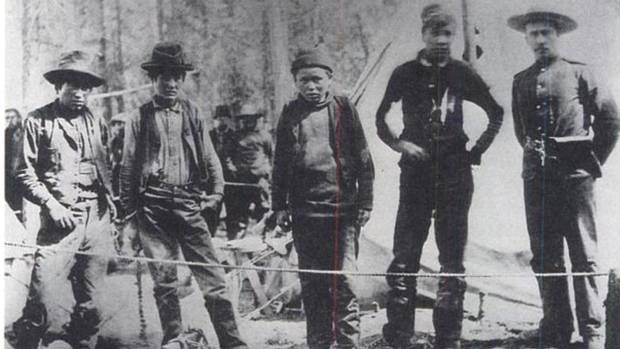
The four Nantuck brothers, shackled after arrest.

The trial unfolded in a court at the territorial capital of Dawson City. A compelling chapter in Strange Things Done: Murder in Yukon History does wonderful work with the cultural disconnections, including a two-page exchange between judge and interpreter (and, off-camera, Frank Nantuck) in which the court struggles to get the accused sworn “so help me God” since Frank’s cosmology has no idea of an afterlife. “He says, when he is dead he is dead — that is all I can get out of him,” the helpless middleman reports.

Q Has he any knowledge of God at all or any idea about a future state of rewards and punishments?

A No sir.

Q Or any clear belief in religion of any kind?

A No sir.

Q Will you say to him that we want him to tell us the truth and not to tell us anything that is not the truth; that he may be punished if he tells us anything that is not the truth; that we are going to ask him some questions and that he must tell us just the truth; ask him if he will agree to do that.

The outcome of the trial will not surprise and there was no question but that the Nantucks had done the shooting. What the Dawson court only barely noted was that brothers had been detailed to avenge two Tagish deaths. An old woman had previously been given or found some “baking powder” and proceeded to make bread with it: in fact, it was arsenic, which was used in mining. Here again is the cultural dislocation; the Nantucks living next to Fox and Meehan were trying to feel out whether those two prospectors were of the tribe that had provided this poison, and of equivalent social rank to the two men who died eating the arsenic-bread. Basically, neither side in this subarctic tragedy had any concept of what the other was on about.

There’s a play about this case, Justice. Peruse the play’s pdf companion study guide on the real historical case here.

In the end, all four Nantucks were condemned to die; Frank was probably still a minor, and he had cooperated with the investigation, so his sentence was commuted to life imprisonment … which did not turn out to be very long at all, since Frank and his condemned brother Joe both died in jail of tuberculosis during the 1898-99 winter.

Dawson Nantuck and Jim Nantuck remained to hang.

Momentarily sensational, the case was long forgotten among whites; it has, however, remained in the oral tradition of Yukon First Peoples. Both communities, however, saw the case brought to the fore when excavations accidentally turned up their remains — along with those of two other hanged men.

One of the other two was the third man to hang this date, a fellow by the name of Ed Henderson. Henderson was an American prospector whose fate might be a bit less instructive for posterity. He suffered from a horrible bladder infection that caused him to pass bloody water every 15 or 20 minutes. “The tortures of the damned,” he described it to court. Wincing yet?

The fact that Henderson suffered from it meant his two prospector-mates suffered from it as well — call it purgatory-level suffering; a member of their party had to relieve himself constantly and thrashed about in his sleeping bag all night for the agony it caused him.

Their empathy for his situation was overturned along with Ed Henderson’s inside-the-tent piss-bowl one night. The drenched and vengeful Tomberg Peterson started an immediate brawl, but Henderson’s leaky plumbing didn’t impair his ability to shoot Peterson dead. Henderson himself reported the incident when the prospectors reached their destination, possibly thinking that no jury would convict him.

The trio comprises the first men hanged by the Yukon Territory, which was only separated from the Northwest Territory in 1898. In fact, there was a bizarre procedural deficiency for the Nantucks (but not for Henderson): they were condemned by the court of the wrong, former territory since word of the territories’ separation had not reached Dawson City at the time of the trial. Nobody saw fit to remedy this blunder, however.

On this day..

1949: Jacob Bokai, the first Israeli spy executed

On this day in 1949, Jordan hanged Jacob Bokai. The Syrian Jew was the first Israeli intelligence agent put to death in service of the infant state. (At least, the first that’s been publicly acknowledged.)

The flight of Palestinians displaced by the Arab-Israeli War gave Israel a convenient means to insert its agents into its neighboring countries: just disguise them as refugees.

Posing as a Palestinian named Najib Ibrahim Hamuda, Bokai’s mission to infiltrate Jordan started at a Palestinian refugee camp in Jaffa, where he was abused by the guards to establish his credentials. Those beatings went for naught, however, as Bokai never made it past the checkpoint: he was arrested immediately upon passing the Mandelbaum Gate into Jordan on 4 May 1949. Since he refused to cop to his mission or his Jewish identity, he was given a Muslim burial after hanging for espionage.

That charge was indeed well-founded: Bokai is now openly honored at a memorial to Israeli agents opened in 1985.

According to the story related by a former Mossad chief who gave a tour of this place to Tom Friedman back when the latter was the Times‘ Middle East scribe and not its leading nutter columnist — just mind the source is what I’m saying here — the doomed “Mr. Hamuda” still managed to get a message back to his Israeli handlers reassuring them that the enhanced interrogation he enjoyed in Jordan prior to execution had not compromised whatever operations he was privy to: “I did not commit treason.”

On this day..

1879: Kate Webster, of the Barnes Mystery

(Thanks to Richard Clark of Capital Punishment U.K. for the guest post, a reprint of an article originally published on that site. (I’ve added some links and done a bit of minor reformatting.) The images accompanying this post are also provided by Mr. Clark. -ed.)

Kate Webster was a rather incompetent career criminal who had served several prison terms for various thefts and offences of dishonesty, both in her native Ireland and in England. These included a period of 12 months in 1877 in London’s Wandsworth prison, where she would ultimately die.

She was born Catherine Lawler in 1849 in Killane, Co. Wexford in what is now the Irish Republic and started her criminal career at an early age. She claimed to have a married a sea captain called Webster by whom, according to her, she had had four children. Whether this is true is doubtful, however.

She moved to Liverpool (stealing money for the ferry fare) and continued stealing once she arrived there. This was to earn her a four-year prison sentence at the age of 18. On release, she went to London and took work as a cleaner — often “cleaning out” her employer’s possessions before moving on.

In 1873, she settled at Rose Gardens in London’s Hammersmith area. Her next door neighbours were Henry and Ann Porter whom she got on well with and were to feature later in her story. She moved to Notting Hill to a new job as a cook/housekeeper to Captain Woolbest and whilst in his employ, met a man named Strong with whom she went to live and became pregnant by. She duly gave birth to a son on the 19th of April 1874 and was promptly abandoned by Mr. Strong. Without any means of support (there was no Social Security then), Kate resorted to her usual dishonest practices and served several prison sentences as a result.

On release from Wandsworth in 1877, she again sought domestic work — firstly with the Mitchell family in Teddington, of whom she was to say that they didn’t have anything worth stealing. She was constantly on the move at this time and used several aliases including Webster and Lawler.

Sarah Crease, another domestic servant, became friends with Kate somewhere around this period, and it was Sarah who found herself looking after Kate’s son during his mother’s spells in prison.

The murder.

On the 13th of January 1879, Kate entered the service of Mrs Julia Martha Thomas at No. 2 Vine Cottages, Park Road, Richmond. To begin with, the two women got on well and Kate recorded that she felt she could be happy working for Mrs. Thomas, who was comfortably off, although a rather eccentric woman in her mid 50’s.

Soon, however, the poor quality of Kate’s work and her frequent visits to local pubs began to irritate Mrs. Thomas and after various reprimands, she gave Kate notice with Kate’s dismissal to take effect on Friday, the 28th of February. This period of notice was a fatal mistake on the part of Mrs. Thomas and she became increasingly frightened of her employee during its period, so much so that she asked friends from her church and relatives to stay in the house with her.

Friday the 28th arrived and as Kate had not managed to find a new job or any accommodation, she pleaded with Mrs. Thomas to be allowed to remain in her house over the weekend. Sadly, Mrs. Thomas agreed to this — a decision that was to cost both women their lives.

On the Sunday morning (the 2nd of March 1879), Mrs. Thomas went off to church as usual. Kate was allowed Sunday afternoons off work but had to be back in time for Mrs. Thomas to go to the evening service. This Sunday afternoon Kate went to visit her son, who was as usual in the care of Sarah Crease, and then went to a pub on the way back to Vine Cottages. Thus she got back late which inconvenienced Mrs. Thomas, who again reprimanded her before rushing off so as not be late for the service. Fellow members of the congregation noticed that she seemed agitated, whether this was because she suspected Kate’s dishonesty and feared her home was being robbed, is quite possible.

Whatever the reason, Mrs. Thomas left church before the end of the service and went home, sadly without asking anyone to accompany her. Precisely what happened next is unclear. In her confession prior to her execution, Kate described the events as follows:

We had an argument which ripened into a quarrel, and in the height of my anger and rage I threw her from the top of the stairs to the ground floor. She had a heavy fall. I felt that she was seriously injured and I became agitated at what had happened, lost all control of myself and to prevent her screaming or getting me into trouble, I caught her by the throat and in the struggle choked her.

At her trial, the prosecution painted a rather different picture. Mrs. Thomas’ next door neighbour, Mrs. Ives, heard the noise of the fall followed by silence and at the time thought no more of it. Little was she to suspect what was to happen next.

Kate, of course, had the problem of what to do with the body but instead of just leaving it and escaping, she decided to dismember it and then dispose of the parts in the river.

She set about this grim task with a will, firstly cutting off the dead woman’s head with a razor and meat saw and then hacking off her limbs. She par-boiled the limbs and torso in a copper on the stove and burned Mrs. Thomas’ organs and intestines.

Even Kate was revolted by all this and the enormous amount of blood everywhere. But she stuck to the job and systematically burnt or boiled all of the body parts and then packed the remains into a wooden box, except for the head and one foot for which she could not find room. It has been said that Kate even tried to sell the fatty remains from boiling the body as dripping.

Mrs. Ives was later to report a strange smell from next door (which was caused by the burning).

Kate disposed of the spare foot on a manure heap but was left with the problem of the head, which she decided to place into a black bag.

She continued to clean up the cottage on the Monday and Tuesday and then “borrowing” one of Mrs. Thomas’ silk dresses went to visit the Porter family on the Tuesday afternoon, taking the black bag containing the head with her.

She told the Porters that she had benefited under the will of an aunt who had left her a house in Richmond which she wanted to dispose of, together with its contents, as she had decided to return to Ireland. She asked Henry Porter if he knew a property broker (estate agent) who might be able to assist her.

Later in the evening Kate excused herself and went off, ostensibly to visit another friend, returning later without the black bag which was never found. Both Henry Porter and his son Robert had carried the bag for Kate at various stages of their walk to the railway station and two pubs along the way and both noticed how heavy it was.

This still left Kate with the rest of the human remains in the box to dispose of and she sought the services of young Robert Porter to help her in this, taking the lad back home with her for the purpose. She and Robert carried the box between them to Richmond Bridge, where Kate said she was meeting someone who was taking the box and told Robert to go on without her. Robert was to hear a splash of something heavy hitting the water below a few moments before Kate caught up with him again.

The box was discovered the next morning by a coal man who must have had a horrible shock when he opened it. He reported his discovery to Inspector Harber at Barnes police station and the police had the various body parts examined by a local doctor who declared that they were from a human female and noticed that the skin showed signs of having been boiled. Without the head, however, it was not possible to identify the body.

Kate meanwhile was calling herself Mrs. Thomas and wearing the dead woman’s clothes and jewellery. She kept up pressure on Henry Porter to help her dispose of the property and he introduced her to a Mr. John Church, who was a publican and general dealer, who she persuaded to buy the contents of the house. Kate and Church seemed to rapidly become friends and went drinking together several times. The real Mrs. Thomas had not been reported missing at this stage and the papers referred to the human remains in the box as “the Barnes Mystery,” a fact known to Kate as she could read, as could the Porter family. Robert told his father about the box he had helped Kate carry which was like the one described in the papers.

Kate agreed a price for the furniture and some of Mrs. Thomas’ clothes with John Church and he arranged for their removal. Unsurprisingly, this was to arouse the suspicion of Mrs. Ives next door who questioned Kate as to what was going on. Mrs. Church was later to find a purse and diary belonging to Mrs. Thomas in one of the dresses. There was also a letter from a Mr. Menhennick to whom Henry Porter and John Church paid a visit.

Menhennick knew the real Mrs. Thomas and it became clear from the discussion that it could well be her body in the box. The three men, together with Menhennick’s solicitor, went to the Richmond police station and reported their suspicions. The next day a search was made of No. 2 Vine Cottages and an axe, razor and some charred bones were recovered, together with the missing handle from the box found in the river. Thus on the 23rd of March, a full description of Kate Webster was circulated by the police in connection with the murder of Mrs. Thomas and the theft of her effects.

Kate had decided to flee to Ireland taking her son with her — which was to be the first place the police looked for her. She was arrested on the 28th of March and kept in custody awaiting collection by two detectives from Scotland Yard. She was brought back to England and taken to Richmond police station where she made a statement on March 30th and was formally charged with the murder.

The statement accused John Church of being responsible for Mrs. Thomas’ death and he was subsequently arrested and charged with the murder too. Fortunately, he had a strong alibi and had also assisted the police in discovering the crimes. At the committal hearing, the charges against him were dropped while Kate was remanded in custody. She was transferred to Newgate prison to save the journey by horse drawn prison van across London each day for her trial.

Trial.

Kate Webster’s trial opened on the 2nd of July 1879 before Mr. Justice Denman at the Central Criminal Court (the Old Bailey) next door to Newgate. In view of the seriousness of the crime, the Crown was led by the Solicitor General, Sir Hardinge Giffard, and Kate was defended by Mr. Warner Sleigh.

A hat maker named Mary Durden gave evidence for the prosecution telling the court that on the 25th of February, Kate had told her she was going to Birmingham to take control of the property, jewellery, etc. that had been left her by a recently deceased aunt. This, the prosecution claimed, was clear evidence of premeditation, as the conversation had occurred 6 days before the murder.

One of the problems of the prosecution case, however, was proving that the human remains the police had found were actually those of Mrs. Thomas. It was a weakness that her defence sought to capitalise on, especially as without the head there was no means of positively identifying them at that time. Medical evidence was given to show that all the body parts had belonged to the same person and that they were from a woman in her fifties.

The defence tried to suggest that Mrs. Thomas could have died of natural causes, in view of her agitated state, when she was last seen alive leaving church on the Sunday afternoon. Both Henry Porter and John Church gave evidence against Kate describing the events of which they had been involved, and her defence again tried to point the finger of suspicion at them. In his summing up, the judge, however, pointed to the actions and previously known good characters of both of them. Two of Kate’s friends, Sarah Crease and Lucy Loder, gave evidence of her good nature.

Late on the afternoon of Tuesday, the 8th of July, the jury retired to consider their verdict, returning just over an hour later to pronounce her guilty. Before she was sentenced, Kate yet again made a complete denial of the charge but cleared Church and Porter of any involvement in the crime. As was normal, she was asked if she had anything to say before she was sentenced and claimed to be pregnant. She was examined by a panel of matrons drawn from some of the women present in the court and this claim was dismissed as just another of her lies. She went back to Newgate and was transferred the next day to Wandsworth to await execution. It has been suggested that Wandsworth did not have a condemned cell at this time although it would seem unlikely. In any event, Kate was guarded round the clock by teams of female prison officers.

Kate was to make two further “confessions” in Wandsworth, the first implicating Strong, who was the father of her child. These allegations were also found to be baseless.

Kate was informed by her solicitor that no reprieve was to be granted to her, despite a small amount of public agitation for commutation. So on the eve of her hanging, Kate made another confession to the solicitor in the presence of the Catholic priest attending her, Father McEnrey, which seemed somewhat nearer the truth. She stated that she was resigned to her fate and that she would almost rather be executed than return to a life of misery and deception.

Execution.

The actual execution of the sentence of death had changed a great deal over the 11 years between the ending of public hangings and Kate’s death, even though the words of the sentence had not.

No longer was it a public spectacle with the prisoner being given a short drop and allowed to die in agony. William Marwood had made great improvements to the process and had introduced the “long drop” method, designed to break the person’s neck and cause instant unconsciousness.

The execution was, as usual, to take place three clear Sundays after sentence and was set for the morning of Tuesday, the 29th of July at Wandsworth prison. Wandsworth was originally the Surrey House of Correction and had been built in 1851. It took over the responsibility for housing Surrey’s condemned prisoners on the closure of Horsemonger Lane Gaol in 1878.

Kate was to be only the second person and the sole woman to be hanged there.

At 8.45 a.m., the prison bell started to toll and a few minutes before 9.00 a.m. the Under Sheriff, the prison governor, Captain Colville, the prison doctor, two male warders and Marwood formed up outside her cell.

Inside, Kate was being ministered to by Father McEnrey and attended by two female wardresses. She would have typically been offered a stiff tot of brandy before the execution commenced. The governor entered her cell and told her that it was time and she was led out between the two male warders, accompanied by Father McEnrey, across the yard to the purpose built execution shed which was nicknamed the “Cold Meat Shed.” (See photo)

Having the gallows in a separate building spared the other prisoners from the sound of the trap falling, and made it easier too for the staff to deal with the execution and removal of the body afterwards. As Kate entered the shed, she would have been able to see the large white painted gallows with the rope dangling in front of her with its simple noose laying on the trapdoors. The idea of coiling up the rope to bring the noose to chest level came later, as did the brass eyelet in the noose. Marwood stopped her on the chalk mark on the double trapdoors and placed a leather body belt round her waist to which he secured her wrists, while one of the warders strapped her ankles with a leather strap. She was not pinioned in her cell, as became the normal practice later.

She was supported on the trap by the two warders standing on planks, (one is just visible in the bottom left hand corner of the photo) set across it. This had been the normal practice for some years in case the prisoner fainted or struggled at the last moment. Marwood placed the white hood over her head and adjusted the noose, leaving the free rope running down her back. Her last words were, “Lord, have mercy upon me.”

He quickly stepped to the side and pulled the lever, Kate plummeting down some 8 feet into the brick-lined pit below. Marwood used significantly longer drops than later were found to be necessary. Kate’s body was left to hang for the usual hour before being taken down and prepared for burial. The whole process would have taken around two minutes in those days and was considered vastly more humane than Calcraft’s executions.

The black flag was hoisted on the flag pole above the main gate, where a small crowd of people had gathered for her execution. They would have seen and heard nothing and yet these rather pointless gatherings continued outside prisons during executions until abolition.

As the criminal was female no newspaper reporters were been allowed to attend the execution but the Illustrated Police News did one of their famous drawings of the scene as they imagined it, with Marwood putting the hood over a pinioned Kate’s head.*

The Sheriff’s Cravings show that William Marwood received £11 for hanging Kate, presumably £10 plus £1 expenses.

Later in the day, her body was buried in an unmarked grave in one of the exercise yards at Wandsworth.** She is listed in the handwritten prison records as Catherine Webster, interred 29/07/1879. Although she was the second person to be executed at Wandsworth, she was buried in grave no. 3 as the graves were numbered 1, 3, 5, etc. on one side of the path, while on the other side they were numbered 2, 4, 6, etc. and it was decided to use those on one side first.

In all, 134 men and Kate were to be hanged at Wandsworth up till the 8th of September, 1961, when Henryk Niemasz became the last to suffer for the murder of Mr. and Mrs. Buxton.

Comment.

If the events of that Sunday evening were exactly as Kate described them, it is strange that Mrs. Ives did not hear the quarrel or any other noises from next door. Again why were there bloodstains at the top of the stairs if Mrs. Thomas’ injuries had occurred at the bottom?

It is generally held that Kate lay in wait for Mrs. Thomas and hit her on the head with an axe causing her to fall down the stairs, where she then strangled her to prevent any further noise. This would, of course, make the crime one of premeditated murder and is much more in line with the forensic evidence.

Whether Kate decided to kill Mrs. Thomas in revenge for her earlier telling off or whether it was because she saw a great opportunity to steal from Vine Cottage, or both, is unclear. It is not unknown for previously non-violent criminals to turn to violent murder. John Martin Scripps became, to date, the last British man to be hanged for murder when he was executed in Singapore in April 1996. He too had convictions for dishonesty.

But what turned Kate to such appalling violence? Did she just snap or had she spent two hours or so thinking about it? We will never know the answer to these questions because there was no psychiatric assessment carried out on murderers back then.

Postscript.

It was reported in October 2010 that Julia Martha Thomas’s skull has finally been discovered in the grounds of Sir David Attenborough‘s property in Park Road, Richmond by workmen excavating for an extension. He had purchased a former pub called “The Hole in the Wall” which was adjacent to his property and has had demolished the rear of the pub. It is highly likely that Kate Webster frequented “The Hole in the Wall”.

The coroners report stated that the skull had fractures consistent with falling down stairs and also had depleted collagen which suggested it had been boiled.

* Interesting sidelight on the popular circulation of crime news here, using a comparison of this case and that of another noteworthy 1879 hanging, Charles Peace. -ed.

** After the 90th Wandsworth execution, the authorities started to re-use some graves of previously hanged male prisoners. Nobody else was ever buried in Kate’s grave, however.

On this day..

1781: Francois Henri de la Motte, French spy

On this date in history, the French spy Francois Henri de la Motte was hanged at Tyburn — and, only after hanging, his head was cut off and his heart carved out. Old Blighty was going a bit soft: it didn’t do actual drawings and quarterings at this late enlightened date. (Well, just one.)

Those old enemies Britain and France had renewed hostilities over the American Revolution, which France backed to twist the neighboring lion’s tail.
De la Motte was a French expat living in England, in which capacity he supported the statecraft of his native realm by coyly picking up British army and naval dispositions and sending word home of who was going where, when. His intelligence allegedly enabled the French navy to turn an unusually aggressive gambit against the British in an engagement in the East Indies, with the loss of 207 souls.

“In the whole history of mankind, an instance was not to be produced of a more ingenious, able, and industrious spy than Mr. De La Motte,” his prosecutors charged. (There’s an account of the trial here.)

Perhaps this was flattery, since the operation was not defeated by counterintelligence except de la Motte’s own counter-intelligence. The guy dropped a bunch of incriminating notes he had taken on naval movements in a staircase, and they were there snatched up by King George’s true subjects and forthwith sent their owner to Newgate. His English accomplice quickly turned Crown’s evidence

Days after the spy’s ignominious end, General Cornwallis’s army in the American south arrived from Charleston at Yorktown, Va., a deep-water port from which he meant to command the Chesapeake. There, Cornwallis was surrounded by an overwhelming force of both American rebels and their French armies. The British defeat at Yorktown that October clinched independence for the colonies.


De la Motte’s trial — accused perfidious Frenchman in danger of barbaric old-timey punishment — appears to be the model for the London trial against Charles Darnay depicted at the start of A Tale of Two Cities. See if this sketch by noted death penalty skeptic (but also death penalty obsessive) Charles Dickens doesn’t essentially depict Francois de la Motte’s situation:

“What’s coming on?”

“The Treason case.”

“The quartering one, eh?”

“Ah!” returned the man, with a relish; “he’ll be drawn on a hurdle to be half hanged, and then he’ll be taken down and sliced before his own face, and then his inside will be taken out and burnt while he looks on, and then his head will be chopped off, and he’ll be cut into quarters. That’s the sentence.”

“If he’s found Guilty, you mean to say?” Jerry added, by way of proviso.

“Oh! they’ll find him guilty,” said the other.

Charles Darnay had yesterday pleaded Not Guilty to an indictment denouncing him (with infinite jingle and jangle) for that he was a false traitor to our serene, illustrious, excellent, and so forth, prince, our Lord the King, by reason of his having, on divers occasions, and by divers means and ways, assisted Lewis, the French King, in his wars against our said serene, illustrious, excellent, and so forth; that was to say, by coming and going, between the dominions of our said serene, illustrious, excellent, and so forth, and those of the said French Lewis, and wickedly, falsely, traitorously, and otherwise evil-adverbiously, revealing to the said French Lewis what forces our said serene, illustrious, excellent, and so forth, had in preparation to send to Canada and North America.

Darnay is acquitted, obviously, as Dickens was only three chapters in and being paid for a novel-length serial.

On this day..

1909: Dervish Vahdeti, for the 31 March Incident

EXECUTIONS IN CONSTANTINOPLE

(From our own correspondent.)

CONSTANTINOPLE July 19.

Cherkess Mehmet Pasha, popularly known as Kaba Sakal — i.e., “twisted beard,” the torturer and former aide-de-camp of [Sultan] Abdul Hamid, Yusuf Pasha, Commandant of Erzerum, the Dervish Vahdeti, chief of the Jemiyeti Mohammadeieh, Hakki Bey, the notorious spy, and eight officers and soldiers who took part in the recent mutiny, were publicly executed at dawn.

London Times, July 20, 1909

The Ottoman Empire in 1908 experienced the Young Turk Revolution, curbing the power of the sultan in a brief constitutional-monarchy era that would take the foundering state through the First World War.

Unsurprisingly, the reigning, formerly-supreme monarch was nonplussed at this brake on executive authority.

He backed the 31 Mart Vakasi, or 31 March Incident,* a counter-coup by conservative and Islamist elements in Istanbul to overthrow the Young Turks and re-establish the sultan’s power. Already the Porte was resorting to an assertion of Islamic political identity to hold the “sick man of Europe” together — and already that had resulted in some appalling atrocities.

For a few days the rightists, incited by Dervish Vahdeti, had Istanbul in hand. Vahdeti was a 40-year-old Cypriot who published Volkan, an Islamist newspaper in Istanbul; the 31 March Incident is sometimes also known as the Revolt of Dervish Vahdeti. (Biographical details source)

Once again, Armenian blood flowed. News of the revolt triggered an attack by Turks in the Anatolian city of Adana upon that city’s Armenian Christians. The resulting Adana Massacre claimed 15,000 to 30,000 lives throughout the Adana province.

Indeed, the Adana massacre quite outlasted the counter-coup, resulting in going debate over the extent to which the Young Turks themselves blessed the pogroms. These guys had their own fraught relations with Turkey’s Armenians; of course, they’d eventually have the Armenian genocide to answer for.

As for the event at hand, Second Army Corps and Third Army Corps dispatched Dervish Vahdeti’s revolt with ease. These units still loyal to the Young Turks reached Istanbul from Salonika within days of the uprising. (Among their number was the 27-year-old Mustafa Kemal — later known as Ataturk, the founding statesman of modern, post-Ottoman Turkey.)

The mutiny collapsed with little effective resistance upon this Macedonian intervention, and the military had the run of the place — not for sack but for a severe clamp-down on the Islamic party. According to Nader Sohrabi, “some two hundred movement participants were hanged en masse, on row after row of scaffolds erected in public space by the order of military courts” in the crackdown.

The 74 constitutionalist soldiers who died to put down the 31 March Incident are honored at a Monument of Liberty in Istanbul.

* The Ottomans were on the Julian calendar-based Rumi calendar, so March 31 in Istanbul corresponded to April 13 in western Europe. Similarly, this date’s hangings took place on July 6, not July 19, per the local Turkish date.

On this day..

2003: Lehlohonolo Bernard Kobedi

Ten years ago today, Botswana controversially hanged a South African national named Lehlohonolo Bernard Kobedi.

Kobedi was one of three men in a vehicle whose shootout with pursuing police left Sergeant Kebotsetswe Goepamang dead in the village of Palapye in 1993; despite insisting that the lethal bullet was not his, Kobedi was condemned for the homicide.

He resided thereafter on death row in relative obscurity. He was there in December 1999 when white South African emigre Mariette Bosch was sentenced to die, and he was still there 16 months later when she hanged. Bosch’s high-profile case, to hear Kobedi’s lawyer explain it, cast a pall over her client.

“I think it was at that very moment he started feeling that execution was a reality,” Themba Joina* told South African press. “You can imagine what he went through on realising that even international pressure and threats could not save Bosch.”

Kobedi would not enjoy such publicity. “The foreign media were only concerned about Bosch because she is white. Since she was hanged, we don’t see cameras in Botswana anymore,” Joina said.

Even so, he fought zealously for his client. Supported by the Botswana human rights organization DITSHWANELO, Joina mounted (pdf) both a claim of Kobedi’s actual innocence and a challenge to the constitutionality of Botswana’s death penalty. The country’s high court turned him down early in 2003.

It must have been a terrible ordeal for Kobedi. Packed four to a cell, and bracing every morning for the prospect of a sudden execution, the South African was finally put to death in secrecy the morning of July 18, 2003.

“I got cold. I had no hope at all,” one of his cellmates remembered of the hanging-day. But it’s a narrow space between life and death, and this fellow with only one frightening degree of separation from the gallows was the very next week cleared of his charges and released.

* Joina also happens to preside over a Marxist political party.

On this day..

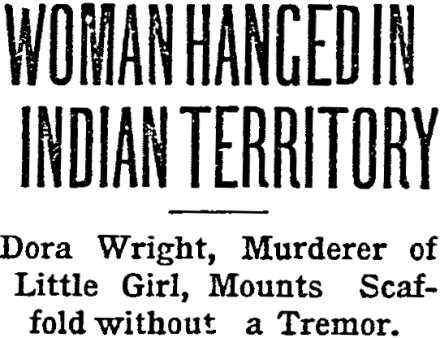
1903: Dora Wright, in Indian Territory

On this date in 1903, Dora Wright was hanged at McAlester in Indian Territory — the present-day U.S. state of Oklahoma.

Wright beat and tortured to death a 7-year-old orphan in her charge named Annie Williams. Wright tormented the little girl over several months until she finally succumbed to a thrashing in February 1903. It was, the local paper said, “the most horrible and outrageous” crime in memory in the area; Wright’s jury only needed 20 minutes’ deliberation to condemn her.

As Oklahoma was yet four years shy of statehood, “Indian Territory” jurisdiction — and with it any decision on executive clemency — fell to U.S. President Theodore Roosevelt. The inclination of the Rough Rider is aptly conveyed by the words of Attorney General Philander Knox‘s brief on the case to the President, which were released for press consumption:

The real facts in this case are that this woman tortured to death a little child seven years old, her niece, whom she was pretending to care for and support. She whipped the child most unmercifully with large switches, struck it about the hand and face so as to cause wounds sufficient to produce death, burned holes in its legs and thighs with a heated poker, and committed other nameless atrocities upon the person of the child. The testimony shows that the woman pursued a course of cruelty which was fiendish and barbarous … The only ground upon which her pardon is sought is that she is a woman, and that the infliction of the death penalty upon a woman would be a shock to the moral sense of the people in the community.

T.R. was incredulous at the feminine special pleading.

“If that woman was mean enough to do a thing like that,” Roosevelt said, “she ought to have the nerve to meet her punishment.”

Wright did have that nerve in the end, and was noted for the calm with which she comported herself on the scaffold. (She was hanged alongside another fellow, Charles Barrett, who shot a man dead in a robbery.)


From the Duluth (Minn.) News-Tribune, July 18, 1903.

On this day..

1955: Ruth Ellis, the last woman hanged in England

On this date in 1955, Albert Pierrepoint escorted the alluringly tragic Ruth Ellis to the gallows at Holloway Prison — the last woman ever hanged in Great Britain.

The former hostess had tracked her inconstant and abusive lover David Blakely to a Hampstead pub a few months before — getting the ride, and the murder weapon, from her unrequited hanger-on Desmond Cussen — and shot Blakely dead on the street. Five bullets: the last, a coup de grace. (Another missed entirely and winged a passerby.)

A bitterly controversial case from the moment it entered the public eye, Ellis’s hanging bolstered the movement to abolish Britain’s death penalty. Juridically, however, it was resolved in the blink of an eye when a crown’s attorney cross-examined the murderess:

Christmas Humphreys: Mrs. Ellis, when you fired that revolver at close range into the body of David Blakely what did you intend to do?

Ellis: It was obvious that when I shot him I intended to kill him.

Book CoverThe jury, which never heard that Blakely regularly beat his killer (including once to induce a miscarriage), needed 14 minutes to convict her.

We’re pleased to mark this anniversary with Carol Ann Lee, author of a recent biography A Fine Day for a Hanging: The Real Ruth Ellis Story. (Here’s a review. Also check out two long pieces Lee wrote about Ruth Ellis for the Daily Mail: 1, 2)

ET: I think at a certain point in time, everyone in Great Britain would have known who Ruth Ellis was, and quite a few abroad, too. How true is that still, nearing 60 years after her execution?

I think her name is still quite familiar, to be honest.

When I began researching the book, everyone I discussed it with either already knew the very basic facts of Ruth’s story, and at the very least that she was the last woman to be hanged in England. The 1985 biopic Dance with a Stranger left a big impression too, even though it wasn’t entirely faithful to Ruth’s character, making her seem much more hysterical a personality than she actually was, although I thought Miranda Richardson was brilliant in the role — as she always is!

What led you to the Ruth Ellis story?

I’ve always been interested in Ruth and that period in history — and I vividly remember going to see ‘Dance with a Stranger’ when it came out in the cinemas here. But it always struck me that her full story had never been told, particularly the last few months of her life after she shot David Blakely. And a couple of years ago there was quite an intense debate about bringing back capital punishment; Ruth’s name was always mentioned in relation to that particular argument, and I really felt it was time to explore her whole story.

What are the greatest misconceptions people have of her? Have her previous biographies and screen portrayals fed those misconceptions?

Without doubt, many people see Ruth as she was shown in ‘Dance with a Stranger’ — very screechy, out of control and violently jealous.

I think it’s true to say that she and David were both deeply jealous of each other (both giving the other reason to be so), but Ruth was not as hysterical as she was portrayed in the film. In fact, it was quite the opposite — the men were hysterical and it was Ruth who usually vented a sort of quiet fury. There is one scene in the film which shows her smashing the windows of David’s car and screaming in the street. Reading the original police statement about that night reveals a very different story; she was described as very calm and rational. There was no screaming, and although she did damage the vehicle, it was not remotely as it was shown in the film.

I think other adaptations have also done her a disservice. Ironically, probably the most accurate portrayal is in the film ‘Pierrepoint,’ where the character of Ruth appears for no more than a minute or two on screen.

I get the sense that Ruth was always running uphill against her class position, trying to climb a little higher than she could reach — right up to the end where her lover is a well-off cad and the rivals for the lover’s affection are his middle-class friends. What role did England’s class relations have in Ruth Ellis’s life and death, and in the way that others perceived her? Do they still shape the way we talk about her all these years later?

Class and politics played a huge role in Ruth’s life generally.

England was distinctly class-led at the time and when the case hit the headlines, she was described as a working-class floozie who attached herself to the upper-class David Blakely purely in order to hoist herself up the class ladder.

That couldn’t have been further from the truth; if she was only interested in using men to better herself socially, she would surely have married her sometime-lover Desmond Cussen, who was a much steadier prospect with money and property and who wanted very much to marry her. Ruth worked hard to better herself but she didn’t use the men she loved to do so.

And when it came to her trial, the class values of the time were heavy in the courtroom with the male barristers and judge and so on all very much men of the upper classes — and who viewed her accordingly. I hope we have got beyond all that nonsense now — but it does add a very distinct dimension to discussions of her case.

She was working as a hostess when she met David Blakely. What would a hostess do, who worked in this trade, and who were the clientele? Was it usual for “real” relationships to evolve? Do people still have this job in the same form as Ruth had it?

Hostessing in the clubs in which Ruth worked was quite straightforward — or it should have been, but there was Morris Conley to contend with, and he was quite a character.

Ruth’s basic job description was to look good and to chat to customers (mostly men) in the clubs, laugh at their jokes and keep them buying food and drink for as long as possible. Most hostesses were in their late teens and early twenties, working-class girls who thought the lifestyle was more glamorous than toiling in a factory or in a shop.

They were usually paid badly and relied on tips to make ends meet, but were given a dress allowance so that they could look as alluring as possible. The clientele mainly consisted of demobbed servicemen who suddenly seemed to have lost their attractiveness to women after the war — where once they had been heroes, by the late 1940s many of them were down on their luck and working as door-to-door salesmen, very lonely and eager to talk to pretty young girls about their war exploits.

The girls who worked for Morris Conley, like Ruth, were expected to sleep with the clients if that was asked of them, and often had to sleep with ‘Morrie’ and his less than respectable friends too. Many of them were very poor young women who lived in flats owned by Conley and his wife — and if they didn’t toe the line, they lost their jobs and their homes in one fell swoop.

Did real relationships evolve? Yes, they did, but very rarely. There are girls all over the world doing very similar jobs today — from London to Japan and everywhere in between too, no doubt.

You have this quote from Ruth about David Blakely: ‘I thought the world of him; I put him on the highest of pedestals. He could do nothing wrong and I trusted him implicitly.’ Ruth had an alcoholic, abusive father, and then she had two children from marriages with two different men that both fell apart — one from bigamy and abandonment, the second from alcoholism and domestic violence. Blakely himself cheated on her. Why wasn’t she more cynical about Blakely? If you take away the tragic ending to this particular relationship, was something like this a pattern she was doomed to keep repeating ad infinitum?

She loved him — it’s really as simple as that.

Although she obviously had a good degree of self-awareness and knew what David was and always would be, she truly loved him and for a time believed they had a future together. As for a pattern — I don’t know. Perhaps if she had met one good, steady man to whom she was attracted as much as she was to David, her life — and David’s too of course — might have been very different.

I’m going to phrase this inelegantly: what is the DEAL with Desmond Cussen?

Good question! I really think that he was as confused and tormented by everything that was happening as a result of Ruth’s and David’s relationship as Ruth herself.

I think he did love Ruth, and he tried hard to make things work with her, but he knew her heart was with David. His apparent lack of self-respect and backbone is baffling — quite why he kept ferrying her across London and out to Buckinghamshire in pursuit of David is a bit mystifying. I did question in the book why no one seemed to query his state of mind as much as Ruth’s — and as to whether he gave her the gun or not, knowing what she intended to do … I am sure he did, even though he must have known where it would end for Ruth herself.

Perhaps he hoped that with David out of the way, she would be reprieved and they could then have a life together. But I really don’t know!

Ruth’s legal defence was legendarily feeble. That said, I’m very interested in the barrister’s attempt to frame its insanity defense around feminine hysteria — “the effect of jealousy upon a female mind can so work as to unseat the reason and can operate to a degree in which a male mind is quite incapable of operating.” This was bound to be undermined by Ruth’s own calm and the statements about her intent to kill that she gave to police and in court. Was it the case that the law at the time didn’t have the instruments to situate Ruth’s context and state of mind, other than hysterical/not? Or could an abler barrister have presented a different story?

I think part of the difficulty is obviously that the defence of diminished responsibility was not introduced in the courts here until 1957 — largely as a direct result of this particular case.

Ruth’s lawyers tried to argue this as a defence for her to some extent, but it just wasn’t possible legally. That said, I think they served her quite badly and didn’t bring out so much that might have enabled the jury to see her crime in context. There was no mention of the abuse in her childhood, no mention of the violence she had suffered at the hands of her ex-husband and very little said about David’s own brutal treatment of her.

But Ruth herself did not seem to care much what happened in the courtroom, once it became evident that the story as she saw it — David’s friends having, in her view, deliberately destroyed the relationship between them — was not going to come to light. She gave up, and volunteered nothing that could have helped her, minimizing the violence to which she had been subjected and dismissing most of the questions put to her in a short sentence or two.

She also infamously replied to the prosecution’s question of what she intended to do when she set out to find David with the gun, “It is obvious when I shot him I intended to kill him.” That one line completely sealed her fate.

Despite all this, the public did seem to be shocked by Ruth Ellis’s hanging, and it’s supposed to have boosted the anti-death penalty campaign. If one may phrase it this way, were people shocked for the right reasons? How much did the symbolic “Ruth Ellis” that even her supporters among the general public had in view have to do with the real person as you understand her?

I think any case is always immeasurably more complex than it is presented in newspaper columns and headlines.

I think, again, the outcry at her execution has to be seen in context — people were becoming more and more opposed to the death penalty and there had been some very high-profile, contentious cases that really did cause a great deal of debate, anger, and distress: the hanging of Timothy Evans in 1950 and of Derek Bentley in 1953 for instance (both of whom were posthumously pardoned).

The fact that Ruth was a young, attractive, lively woman with two small children caused many people to question the validity of capital punishment. It was her death on the scaffold that gave the abolition movement its emotional spur.

What became of Ruth Ellis’s body after her hanging? And what became of her family and the others who were part of the story?

Ruth was buried in the confines of Holloway Prison after her execution, sharing her unmarked grave with four other women who had been hanged there. In 1971, when the prison was demolished and rebuilt, her body was released to her son for burial.

He had hoped to lay his mother to rest alongside David Blakely at the Holy Trinity churchyard in Penn but the vicar there would not allow it. Ruth was instead buried in the churchyard of St Mary’s in Amersham, a few miles away.

As to what became of her family: her son Andre (who was ten when Ruth was executed) was diagnosed with schizophrenia as a very young man and never came to terms with the loss of his mother. He committed suicide in 1982. Ruth’s daughter, Georgina, had quite a colourful life, becoming a successful model who was in the newspapers fairly often as part of the George Best ‘set.’ She married and had children and worked hard to win a posthumous pardon for her mother, of whom she spoke often. She died of cancer at the age of only 50.

As for Desmond Cussen: he emigrated to Australia and opened a flower shop there. He never married and became an alcoholic, dying in Perth on 8 May 1991 of pneumonia and organ failure following a fracture dislocation of the neck in a fall at his home.

On this day..