1849: Frederick and Marie Manning, a Dickensian scene

On this date in 1849, husband-and-wife murderers Frederick and Marie Manning (or Maria Manning) were publicly hanged together outside Horsemonger Lane Gaol in London.

An image of Marie Manning (nee Marie de Roux) from the Victorian popular press — from this romantic biography of Tolstoyan length available free from Google books.

The felonious pair — she a Swiss-born domestic; he a shifty laborer with a penchant for the inside job — lured to dinner in their Bermondsey home a wealthy friend who had designs on the redheaded knockout, then murdered him for his loot and stuffed the limed body under the floorboards. They were apprehended separately on the lam.

As is typical when a heartthrob femme fatale stands in the dock, a sensational trial of the “here today, gone tomorrow” variety ensued. The crime, nicknamed “the Bermondsey Horror” (here (pdf) is a book chapter-scale recounting), had each accusing the other, with the outcome usual for this site.

A massive, jeering throng turned out to see the two off (Mrs. Manning’s choice of black satin for the occasion is said to have caused the look to go out of fashion).

Among that crowd was Charles Dickens,* who took a break from working on David Copperfield to write The Times a letter published Nov. 14 demanding that executions be removed within prison walls on account of the unedifying conduct of the spectators.

Sir — I was a witness of the execution at Horsemonger-lane this morning. I went there with the intention of observing the crowd gathered to behold it, and I had excellent opportunities of doing so, at intervals all through the night, and continuously from daybreak until after the spectacle was over.

I believe that a sight so inconceivably awful as the wickedness and levity of the immense crowd collected at that execution this morning could be imagined by no man, and could be presented in no heathen land under the sun. The horrors of the gibbet and of the crime which brought the wretched murderers to it, faded in my mind before the atrocious bearing, looks and language, of the assembled spectators. When I came upon the scene at midnight, the shrillness of the cries and howls that were raised from time to time, denoting that they came from a concourse of boys and girls already assembled in the best places, made my blood run cold. As the night went on, screeching, and laughing, and yelling in strong chorus of parodies on Negro melodies, with substitutions of “Mrs. Manning” for “Susannah,” and the like, were added to these. When the day dawned, thieves, low prostitutes, ruffians and vagabonds of every kind, flocked on to the ground, with every variety of offensive and foul behaviour. Fightings, faintings, whistlings, imitations of Punch, brutal jokes, tumultuous demonstrations of indecent delight when swooning women were dragged out of the crowd by the police with their dresses disordered, gave a new zest to the general entertainment. When the sun rose brightly — as it did — it gilded thousands upon thousands of upturned faces, so inexpressibly odious in their brutal mirth or callousness, that a man had cause to feel ashamed of the shape he wore, and to shrink from himself, as fashioned in the image of the Devil. When the two miserable creatures who attracted all this ghastly sight about them were turned quivering into the air, there was no more emotion, no more pity, no more thought that two immortal souls had gone to judgment, no more restraint in any of the previous obscenities, than if the name of Christ had never been heard in this world, and there were no belief among men but that they perished like the beasts.

… I am solemnly convinced that nothing that ingenuity could devise to be done in this city, in the same compass of time, could work such ruin as one public execution, and I stand astounded and appalled by the wickedness it exhibits. I do not believe that any community can prosper where such a scene of horror and demoralization as was enacted this morning outside Horsemonger-lane Gaol is presented at the very doors of good citizens, and is passed by, unknown or forgotten.

Dickens would base a French maid named Mademoiselle Hortense in his next novel, Bleak House on Marie Manning.

This question of public as opposed to private hangings was a lively debate at the time, and Dickens’s view was hardly uncontested. A letter in response from one F.B. Head of Oxenton countered thus:

The merciful object of every punishment which the law inflicts is not so much to revenge the past crime as to prevent its recurrence. Now, Mrs. Manning’s last moments clearly explain, or rather indisputably prove, the benefit which society practically derives from a public execution. … as for a few fleeting moments she stood, with bandaged eyes, beneath the gibbet, how unanswerably did the picture mutely expound the terror which the wicked very naturally have of being publicly hanged before the scum and refuse of society! “The whistlings — the imitations of Punch — the brutal jokes and indecent delight of the thieves, low prostitutes, ruffians and vagabonds,” so graphically described by Mr. Charles Dickens were — by her own showing — not only the most fearful portion of her sentence but, under Providence, these coarse ingredients may possibly have effected that momentary repentance which the mild but fervent exhortations of the chaplain had failed to produce.

But, besides the impolicy of divesting the death by law of a murderer of the most effective portion of its terrors, there are, Sir, I submit, higher and infinitely more important reasons, which make it our bounden duty to require that every criminal who suffers death should be executed in public.

So long as it shall be deemed advisable by us, by laws divine as well as human, to deprive the murderer of his life, the whole process of his trial, ending in an act of such awful responsiblity, ought to be performed in open day, in order that the community may at all events clearly see what it is they are doing — what it is they have done. The purple hands of the wretched sufferer sufficiently explain what the white nightcap hypocritically conceals, namely, the dreadful act that has been performed; and, although thieves and prostitutes may ridicule the convulsions they witness, there will, it is to be hoped, in a free country and with a free press, always be found among an English crowd some one fellow-creature possessing the kindly feelings of Mr. Charles Dickens, who, should he see sufficient reasons for doing so, will not only call upon the country most seriously to consider whether the punishment he delineates has not exceeded the offence, but, as an honest witness, will condemn and expose any unnecessary harshness or cruelty that may have accompanied it.”

Even the legendary British humor magazine Punch weighed in, with a famous cartoon skewering the mob who turned up for public hangings.**


“The Great Moral Lesson at Horsemonger Lane Gaol”, Punch magazine’s rendition of the Mannings’ execution — turning its gaze not on the scaffold but on the unruly crowd beneath it. It comes with a poem.

Public executions would continue in England until 1868.

* Not the only literary big wheel in the crowd: Herman Melville also checked it out. No indication they bumped into each other, and no surprise: the crowd was so huge that at least one spectator was crushed to death against a police barricade. (As reported by Hanging in the Balance: A History of the Abolition of Capital Punishment in Britain, which numbers the onlookers at 30,000 and claims 2.5 million execution broadsheets were sold.)

** According to Dickens and Crime, Dickens actually observed the hanging with the Punch cartoonist who sketched “The Great Moral Lesson” (the two went in together to rent out a well-placed roof “for the extremely moderate sum of Ten Guineas”). That artist, John Leech, had illustrated Dickens’ A Christmas Carol a few years before.

On this day..

1874: William Udderzook, because a picture is worth a thousand words

On this date in 1874, William Udderzook was hanged in West Chester, Pennsylvania for an insurance scam gone horribly macabre — accidentally making judicial history in the process.

Udderzook and his brother-in-law Winfield Scott Goss had contrived to pick up some easy scratch by insuring Goss’s life and having him “burned to death” in a laboratory fire; Udderzook procured a medical cadaver for the purpose, and duly identified its charred remains the late lamented Goss, who was in fact laying low in Newark under an assumed name.

An amateurish stunt by today’s standards, but forensic science was still in its infancy. During the Civil War just a decade before, the majority of the dead had been buried unidentified. Personal recognition was still the best way available in most cases to tell who was who.

Udderzook and Goss’s wife therefore collected on their say-so, but insurance adjusters smelled fraud. It was through their pressure that the “Goss-Udderzook tragedy” unfolded, and became an object lesson and test case in the science of establishing identity.

Goss was the first hoisted on his own petard, for his faked death meant that Udderzook could not afford to have investigators find him alive. So Udderzook murdered Goss, this time for real — real gruesome, that is. When the body was discovered, it had been dismembered, disemboweled, and repeatedly stabbed.

When Udderzook faced trial, Goss’s identity with “Wilson” (his assumed name) was the central question, and it was established using photography. (The same way they identified the body, actually, per a contemporary New York Times account here. (pdf))

Udderzook fought the photographic identification all the way to the Pennsylvania Supreme Court — which turned aside the appeal with a landmark ruling whose embrace of the photographic science would unlock its forensic potential:

That a portrait or a miniature painting from life and proved to resemble the person may be used to identify him cannot be doubted, though, like all other evidences of identity, it is open to disproof or doubt, and must be determined by the jury. There seems to be no reason why a photograph, proved to be taken from life and to resemble the person photographed, should not fill the same measure of evidence. It is true that the photographs we see are not the original likenesses; their lines are not traced by the hand of the artist nor can the artist be called to testify that he faithfully limned [sic] the portrait. They are but paper copies taken from the original plate, called the negative, made sensitive by chemicals, and printed by the sunlight through the camera. It is the result of art, guided by certain principles of science. . . .

It is evident that the competency of the evidence in such a case depends on the reliability of the photograph of a work of art, and this, in the case before us, in which no proof was made by experts of this reliability, must depend upon the judicial cognizance we make of photographs as an established means of producing a correct likeness. The Daguerrean process was first given to the world in 1839. It was soon followed by photography, of which we have nearly a generation’s experience. . . . We know that its principles are derived from science; that the images on the plate, made by the rays of light through the camera, are dependent on the same general laws which produce the images of outward forms upon the retina through the lenses of the eye. The process has become one in general use, so common that we cannot refuse to take judicial cognisance of it as a proper means of producing correct likeness.

On this day..

1887: Parsons, Spies, Fischer and Engel, the Haymarket Martyrs

On this date in 1887, the Chicago political machine hanged four at Cook County Jail to defend civilization from the eight-hour day.

The Haymarket martyrs, as they would be remembered ere the hysterical atmosphere of their sentencing had passed, were four from a group of eight anarchist agitators rounded up when a never-identified person threw a bomb at Chicago police breaking up a peaceful rally. The bomb killed one cop; the indiscriminate police shooting that followed killed several more in friendly fire, plus an uncertain number of civilians.

The incident occurred just days after nationwide strikes began on May 1, 1886, in support of the eight-hour day. Nowhere were the tensions greater than Chicago, an epicenter of militant organizing. When tens of thousands poured into the streets on May 1, the Chicago Mail darkly said of high-profile radicals Albert Parsons and August Spies,

Mark them for today. Hold them responsible for any trouble that occurs. Make an example of them if trouble does occur.

Sure enough …

Most of the eight hadn’t even been present at the time the bomb was thrown, but the state put anarchism itself on trial under the capacious umbrella of “conspiracy,” in a proceeding so absurdly rigged that a relative of a slain cop was on the jury. Quoth the prosecutor,

Law is upon trial. Anarchy is on trial. These men have been selected, picked out by the grand jury and indicted because they were leaders. They are no more guilty than the thousand who follow them. Gentlemen of the jury; convict these men, make examples of them, hang them and save our institutions, our society.

That was the argument for hanging them. And right-thinking burghers applauded it.

Seven of the eight were condemned to die; two had their sentences commuted, but the other five refused to ask for clemency on the grounds that, innocent, they would “demand either liberty or death.” One of those five, Louis Lingg, painfully cheated the hangman by setting off a blasting cap in his mouth the night before his execution. (Lingg might have made, though seemingly not thrown, the mysterious bomb.)

The others — Parsons and Spies, along with Adolph Fischer and George Engel — hanged together, with their epitaphs upon their lips — literally so for Parsons, whose parting remark is at the base of the Haymarket Martyrs Monument*

“The time will come when our silence will be more powerful than the voices you are throttling today.”

“Throttle” was right, as the Chicago Tribune reported the next day, taking up when the trap was sprung:

Then begins a scene of horror that freezes the blood. The loosely-adjusted nooses remain behind the left ear and do not slip to the back of the neck. Not a single neck is broken, and the horrors of a death by strangulation begin.

Six years later, Illinois Gov. John Altgeld granted the free pardon the hanged men had demanded to the three surviving Haymarket anarchists. There is no institutional mechanism to determine erroneous executions in American jurisprudence — a fact that occasionally leads to smugly circular avowals that nobody recently executed has ever been “proven” innocent — and death penalty researchers Michael Radelet and Hugo Bedau believed as of this 1998 paper (pdf) that Altgeld’s executive statement flatly asserting the injustice of the Haymarket convictions was the most recent official acknowledgment of a wrongful execution in U.S. history. If true, its uniqueness would be understandable: the gesture cost Altgeld his political career.

Long gone as all these principals are, the legacy of Haymarket remains very much with us, and not just as a magnet for digital archives like this, this and this (don’t miss the brass gallows pin).

May 1, now rich with the symbolism of the Haymarket Passion, was soon selected by the international labor movement as the date to resume the eight-hour-day push — thus becoming the global workers’ holiday it remains to this day.

* Opposing interpretations of the Haymarket affair — which can be the “Haymarket riot” or the “Haymarket massacre,” depending on where you line up — were marked by opposing memorials. The police memorial was itself eventually bombed by the Weather Underground, and subsequently squirreled away from easy public view. Paradoxically, the Haymarket Martyrs Monument has been federally dignified as a National Historic Landmark.

On this day..

2001: Mona Fandey, witch doctor

On this date in 2001, former pop singer and shaman Mona Fandey was hanged with two accomplices at Kajang Prison outside Kuala Lumpur, closing the noose on one of the world’s weirdest and most sensational recent crimes.

Aging B-list pop crooner Maznah Ismail — “Mona Fandey” was her stage name — had transitioned to a gig as a high-rent spiritualist and healer, known locally as a bomoh.

In that capacity, she and hubby Mohd Affandi Abdul Rahman landed a politician with more money than sense. After collecting a bunch of cash from him, they got him to lie down with his eyes closed as part of a ritual that was supposed to make money fall from the skies. Instead, the couple’s assistant Juraimi Hussin chopped off his head, and Mona went on a shopping spree.

The effect of the grisly celebrity murder was heightened by Mona’s cheery demeanor throughout the trial and thereafter, as if a murderess’ notoriety was the pinnacle she never achieved as an entertainer.

She and her husband maintained an unsettling placidity about their demise to the very end. Some sources say she uttered the mysterious remark, “I will never die” just before her hanging. (Others have everyone silent.)

The end of the three killers was hardly the end of such a headline-grabbing case in the public memory. Her cell is becoming a protected “heritage site”, and her story has been treated on screens both small and silver.

On this day..

1864: Klatsassin and four fellow Tsilhqot’ins

On this date in 1864, five Tsilhqot’in warriors were hanged as common criminals in Quesnel, British Columbia, for resisting white incursion during the Chilcotin War.

The only possibly authentic image of Klatsassin extant. (From this image archive.)

An indigenous nation in northern B.C., the Tsilhqot’in or Chilcotin* had been relatively insulated — though not completely isolated; they had well-established fur-trading contacts from the early 19th century — from the colonization that had swept the continent over the preceding centuries.

In 1862, two cataclysms turned that world upside down.

First, a smallpox epidemic sweeping out of mining camps decimated the Tsilhqot’in population.

Second, gold was discovered in the adjacent inland Cariboo region — and the ensuing gold rush to the inaccessible vein saw whites laying multiple roads through Tsilhqot’in territory. At least one of the entrepreneurs racing to complete the first road might have exploited tribal labor and forced women into prostitution.

The specific internal mechanisms and deliberations that triggered the response are lost to us, but the community must have felt itself under siege — and certainly the building projects, unchecked, would serve to project crown authority into the tribal land. The roads, too, are a specific trigger in the European encounter with North American natives. If it had not been gold, it would have been something else, and soon.

The Chilcotin War or Chilcotin Uprising erupted in April 1864 when a Tsilhqot’in party slew a civilian road-building crew. Bloodthirsty rumors (sometimes unreliable) of Indian atrocities quickly set abroad in the colonial capitals.

Despite almost limitless land to disappear into, the leader, Klatsassin (or Klattasine, or Klatsassan), was captured that August with seven of his followers by the expedient of luring him under assurance that they would be treated as prisoners of war.

Instead, they were tried as common murderers. Five were condemned — including both Klatsassin and his son. (Two others were arrested the following year, and one of them hanged as well.)

In 1993, the government of British Columbia apologized for the executions.

There’s an out-of-print (but available used) book, The Chilcotin War by a descendant of one of the whites killed in it. Several links in this piece go to the excellent canadianmysteries.ca site on this incident, which contains a trove of text from primary documents of the time.

And “Canadian Mysteries” is the apt title. “Klatsassin,” in the native tongue, simply means, “we do not know his name.”


The peak in the center of this photograph is “Mount Klattasine,” and the glacier stretching towards the upper right is also named for the hanged war chief.

* Many other transliterations are possible: e.g., Tsilqut’in, T?inlhqot’in, Chilkhodin, Tsilkótin, Tsilkotin.

On this day..

2007: Five young men

Last year on this date, according to a Deutsche Presse-Agentur report of the Syrian news service, five youths were publicly hanged in Aleppo, Syria.

Syria executed five youths by hanging in a public square on Thursday after they were convicted of murder and robbery, the Syrian news agency reported.

The hanging was carried out in Bab al-Faraj, a public square in the centre of the city of Aleppo, 350 kilometres north of Damascus, in the early hours on Thursday, according to the agency.


Bab al-Faraj square.

A military court had convicted the men, aged between 18 and 23, of premeditated murder for the purpose of committing robbery, according to the online news service, Syriano.

Syrian human rights groups have called for the abolition of military courts, which were installed under emergency law in 1963.

On this day..

1858: Marion Ira Stout, for loving his sister

It’s the sesquicentennial of a then-sensational, now-forgotten hanging in Rochester, N.Y.

At dawn on December 20, 1857, the city had awoken to the discovery of a mangled corpse by the Genesee River’s High Falls … and more than enough evidence to have the corpse’s killers in hand by tea time.

Marion Ira Stout — he just went by Ira — had made a dog’s breakfast of the job, according to History of Rochester and Monroe County New York from the Earliest Historic Times to the Beginning of 1907.

[W]hen they got near the edge of the bank, Ira struck his victim a sudden blow with an iron mallet, smashing the skull and producing death instantly. Stout then threw the body over the precipice, supposing that it would fall into the river and be swept into the lake before sunrise, but instead of that it landed on a projecting ledge thirty feet below the upper level. Perceiving that there had been some failure in the matter, Ira started to go down a narrow path that led sideways along the cliff, but in the darkness he missed his footing and fell headlong, breaking his left arm in the descent and landing beside the corpse. Summoning all his remaining strength he was just able to push the body over the bank, when he sank in a dead faint. On recovering from which in a few minutes, he called to his sister, who was still above, to come and help him. When she started to do so, the bushes to which she clung gave way; she stumbled, broke her left wrist, and fell beside her prostrate brother. But it would not do to remain there, wretched as was their plight. So, after searching in vain for Ira’s spectacles, which they had to leave behind them, but taking with them the fatal mallet, they scrambled slowly and painfully up the bank and made their way laboriously to their home on Monroe Street.

In lieu of a last statement, Stout referred his audience to this writing, which was published posthumously. Courtesy of the New York State Historical Association Library, Cooperstown, N.Y.

Sure enough, the glasses were waiting near the victim for the cops to find come daylight.

How did Ira, his sister, and the late Charles Littles — the sister’s husband — find themselves in this macabre dance?

That’s the murky bit, though it’s fair to say there was some negative energy in the family.

Littles was a violent, jealous, philandering drunk. His wife Sarah seems like the classic abused spouse. Ira was an ex-con who seemingly had his life back together. Oh, and Ira and Sarah were sleeping together — professedly true in the literal sense (they were observed to sleep in bed together in their underthings), and possibly true in the Biblical sense.

Now, where in this tangled knot of incestuous desire, domestic violence, protectiveness, jealousy and intrigue lies the motive is less than self-evident, but Ira and Sarah most definitely schemed to lure Charles to his demise. (Charles was found with a club which he’d brought to clobber a lover of Sarah that he’d been told would make a rendezvous.)

Still, the condemned charmer garnered sympathy for having saved his sister from an abusive marriage; Susan B. Anthony and Frederick Douglass rallied to his defense, and a female admirer smuggled him poison to cheat the hangman … which said admirer managed to end up ingesting herself, and barely survived.

Death got all ten-thumbed around Ira Stout, it seems. His hanging was no different.

The New York Times‘ archive has free access to the report of Stout’s execution, interestingly detailing the upward-jerking “sudden suspension” hanging apparatus in use for the job:

The gallows is the same which has always been in use in the jail — the rope, a hempen cord, alone being new. A weight of 186 pounds rests upon a swing door set in the garret floor of the jail. From this weight, the rope runs over two pulleys above, and the end of it drops through two doors, and nearly to the main floor of the jail. The weight falls about eight feet, jerking the slack end that distance. The halter attached to the main rope is a long distance below the main enginery of death, and the latter is not seen by the spectators or prisoner. The Sheriff stood at the foot of the stairs, some forty feet from the prisoner, and by a small cord pulled the latch which let the fatal weight fall.

But since this is Ira Stout, you know it didn’t come off without a hitch.

The death of the ill-fated man was not as sudden as could be desired. His struggles for eight or ten minutes were severe, and caused the spectators to turn away in disgust.

His neck was probably not dislocated, and he died by a slow process of strangulation. Doctors Hall, Avery, James and Miller stood near, and in eight minutes after the drop fell they said his pulse was as full as in life.

Sort of puts a grim twist on Stout’s own (fairly self-pitying) letters to the papers, in one of which he remarked, “I do not wish to show a cowardly tenacity for life, but I consider it my right and duty to live as long as I can.”

According to a feature story in the newsletter of Mount Hope Cemetery where Ira Stout takes his eternal rest, he might have tried to hang on quite a bit longer.

A rumor was current last night at a late hour that Stout was not dead, and that efforts were being made to resuscitate him by the use of galvanic batteries and other means sometimes employed for the restoration of persons supposed to be dead. How much truth there is in the rumors thus made we cannot say, as we have not taken pains to inquire at the house of Mrs. Stout.

No surprise, that didn’t work either.

On this day..

1865: Champ Ferguson, Confederate guerrilla

On this date in 1865, Champ Ferguson was controversially hanged at Nashville for the “murders” he committed as a Confederate guerrilla.

There seems to be some slight difference of opinion (and do click that link) over Champ‘s role in the War Between the States.

Had the Confederate cause prevailed, he probably would have been a hero. Since history is written by the winners … here he is instead.

For reasons that lie in the uncertain junction between personal enmity and sectional loyalty, the war’s start saw Ferguson terrorizing Union supporters in the Kentucky-Tennessee borderlands, operating primarily around Sparta, Tenn.

These were not only state borders, but borders between the rival federal and Confederate territories. Civil War borders, obviously, were hazy and violently contested affairs: Kentucky was northern-controlled but claimed by both sides (it had rival governments); Tennessee seceded only after Fort Sumter.

Loyalties within Kentucky and Tennessee were divided as well. Ferguson’s own brother died fighting for the Union, and his cousin was killed by Ferguson’s own men. But the main battles were fought far away, leaving the conflict to play out locally.

In many cases … guerrillas identifying with the Confederacy operated well outside Confederate lines and Confederate control, leading to a certain ambiguity in official attitudes, since they did have their uses.

Guerrilla activity was … a feature of those up-country or back-country areas of states like North Carolina, Georgia, Alabama, Tennessee and Kentucky, in which there were significant internal divisions in terms of sympathy for Confederacy or Union … guerrilla conflict was the only direct face of war experienced by many in Tennessee and Kentucky, since the movements of the main armies remained distant from them throughout. Unionist guerrillas, for example, controlled many of the counties of eastern Tennessee, while Confederate guerrillas disputed Union control of western Kentucky and middle Tennessee. One of the ironies of the situation in the Appalachians, the Cumberlands and the Ozarks was that, while these areas of rugged terrain were favoured by Confederate guerrillas, they were also the very areas within the Confederacy which most Union sympathisers inhabited

-Ian Beckett, Modern Insurgencies and Counter-Insurgencies

That was Ferguson — a “legendary Confederate partisan and guerrilla” or little better than a bandit, depending on your point of view. Either way, he was feared by area Unionists and renowned for killing prisoners. Stories of his savagery — severing heads and the like — made the rounds. Ferguson would argue (and did) that he did nothing his enemies weren’t also doing. (The New York Times printed a lengthy account (.pdf) of Ferguson’s versions of the many killings he was accused of — disputing some, frankly acknowledging many.)

That brings us back to winners and losers.

Ferguson, of course, got the losers’ treatment after the war; while vendettas against rank and file Confederate officers were not on the agenda, Ferguson’s irregular status and unbecoming reputation set him up for a war crimes trial. All attempts to claim wartime protections were rejected.

The Times account of his hanging this day — witnessed by his wife and 16-year-old daughter; their alleged rape is sometimes given as the reason for Ferguson’s campaign — is picturesque. (.pdf)

He stood composedly on the drop some twenty minutes, while the charges, specifications and sentence were read by Col. Shafter. He nodded recognition to several persons in the crowd, and shifted his position in an impatient manner while the sentence was being read. To some specifications he inclined his head in assent. To others he shook his head. That about Elam Huddleston caused him to say, “I can tell it better than that.” When the speaker read, “To all of which the prisoner pleads not guilty,” he said, “I don’t now.”


An 1865 Harper’s illustration of the hanging. See the way the troops surround the scaffold? There’s a bit of folklore that the military did that in order to fake the hanging and cut him down still alive.

Along with Henry Wirz, commandant of the notorious Confederate prison Andersonville, Ferguson was the only Confederate executed for Civil War “war crimes.”

Arguably somewhat neglected as a Civil War figure, Ferguson still has a few books detailing his life. An interview with the a author of the newly-published Cumberland Blood: Champ Ferguson’s Civil War is here.

A few books about Champ Ferguson

On this day..

1959: Genzo Kurita, serial killer

On this date in 1959, a disturbed Japanese serial killer was hanged for eight murders.

A past generation’s emblem of monstrousness, Genzo Kurita (English Wikipedia page | Japanese) was invoked on the floor of the Diet as a reason to keep the death penalty.
And no wonder.

He was caught early in 1952 for murdering a 24-year-old and her 63-year-old aunt, and defiling the younger woman’s body. Those murders led to a death sentence a few months later, but they also led to a string of unsolved homicides: another murder-necrophilia crime the previous summer, and the notorious Osen Korogashi incident, when he threw a rape victim’s family over the Osen Korogashi cliffs.*

He got a separate death sentence for those murders (plus two other earlier ones) later in 1952.

A touch unstable — obviously — Kurita withdrew his own appeals in 1954 to get it over with, but it still took the ponderous Japanese death penalty system the best part of the decade to see him to the gallows.

Most of what’s online about Genzo Kurita is in Japanese, like this more detailed survey of his life in crime.

* The raped mother, and three children; one of the children survived. The Osen Korogashi (or Osenkorogashi) cliffs, as it happens, have their own eerily topical legend of the generous daughter of a cruel lord being thrown over the precipice in her father’s place, prompting him to see the error of his ways.

On this day..

1780: Major John Andre, Benedict Arnold’s handler

On this date in 1780, the honorable British Major John Andre got what Benedict Arnold had coming to him.

Piqued that his (quite considerable) brilliance in the field did not earn honors he thought his due, General Benedict Arnold contrived to betray West Point to the British during the American Revolution — the plot that made his name a synonym for treachery.

As the scheme ripened, the turncoat asked Sir Henry Clinton for “a personal interview with an officer that you can confide in.”

Enter Clinton’s adjutant John Andre, head of British Special Intelligence.

The dashing officer, well-liked in society on either side of the permeable divide between Tories and Patriots on the continent, slipped into Haverstraw, N.Y. to make the arrangements. On his way back — when he already thought himself safely clear of American-held territory — he was nabbed with the incriminating documents.

The narrowly-averted betrayal was mirrored by the narrowest of escapes: luckily for Benedict Arnold, Andre was received in custody by a subordinate officer of his, whose initial report to Arnold alerted the general to his danger and enabled him to escape to the British a whisker ahead of the law.

Treason, of the blackest dye, was yesterday discovered. General Arnold, who commanded at West Point, lost to every sentiment of honor, of private and public obligation, was about to deliver up that important post into the hands of the enemy. Such an event must have given the American cause a dangerous, if not a fatal wound; happily the treason has been timely discovered, to prevent the fatal misfortune. The providential train of circumstances which led to it, afford the most convincing proofs that the liberties of America are the object of Divine protection.

It was a gentlemanly war, and Andre didn’t seem like the guy to hang in the whole exchange. But his argument before a court-martial that he was merely availing “an advantage taken in war” by agreeing to talk to an enemy general who wanted to hand them the keys to a fort didn’t fly: he’d been behind enemy lines, out of uniform, sneaking around. That made him a spy.

And the British refused to obtain Andre’s liberty by trading the man the Americans really wanted to execute.

Instead, by year’s end, the hero of Saratoga was commanding redcoats in the field — perhaps a little nervously; when he asked a captured American what might happen to him should he be taken, the reply was “Cut off your right leg, bury it with full military honors, and then hang the rest of you on a gibbet.”

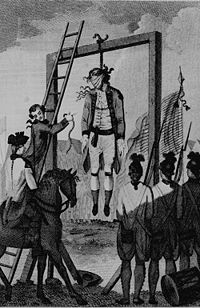
John Andre was left holding the bag, to the dismay of just about everyone American and British alike. This extended account of the luckless major’s last moments* is from the pen of Continental Army surgeon James Thacher.

Major Andre is no more among the living. I have just witnessed his exit. It was a tragical scene of the deepest interest. During his confinement and trial, he exhibited those proud and elevated sensibilities which designate greatness and dignity of mind. Not a murmur or a sigh ever escaped him, and the civilities and attentions bestowed on him were politely acknowledged…

The fatal hour having arrived, a large detachment of troops was paraded, and an immense concourse of people assembled; almost all our general and field officers, excepting his excellency [George Washington] and his staff, were present on horseback; melancholy and gloom pervaded all ranks, and the scene was affectingly awful … Major Andre walked from the stone house, in which he had been confined, between two of our subaltern officers, arm in arm; the eyes of the immense multitude were fixed on him, who, rising superior to the fears of death, appeared as if conscious of the dignified deportment which he displayed. He betrayed no want of fortitude, but retained a complacent smile on his countenance, and politely bowed to several gentlemen whom he knew, which was respectfully returned. It was his earnest desire to be shot, as being the mode of death most comformable to the feelings of a military man, and he had indulged the hope that his request would be granted. At the moment, therefore, when suddenly he came in view of the gallows, he involuntarily started backward, and made a pause. “Why this emotion, sir?” said an officer by his side. Instantly recovering his composure, he said, “I am reconciled to my death, but I detest the mode.” While waiting and standing near the gallows, I observed some degree of trepidation; placing his foot on a stone, and rolling it over and choking in his throat, as if attempting to swallow. So soon, however, as he perceived that things were in readiness, he stepped quickly into the wagon, and at this moment he appeared to shrink, but instantly elevating his head with firmness, he said, “It will be but a momentary pang,” and taking from his pocket two white handkerchiefs, the provost-marshal, with one, loosely pinioned his arms, and with the other, the victim, after taking off his had and stock, bandaged his own eyes with perfect firmness, which melted the hearts and moistened the cheeks, not only of his servant, but of the throng of spectators. The rope being appended to the gallows, he slipped the noose over his head and adjusted it to his neck, without the assistance of the awkward executioner. Colonel Scammel now informed him that he had an opportunity to speak, if he desired it; he raised the handkerchief from his eyes, and said, “I pray you to bear me witness that I meet my fate like a brave man.” The wagon being now removed from under him, he was suspended, and instantly expired; it proved indeed “but a momentary pang.” He was dressed in his royal regimentals and boots, and his remains, in the same dress, were placed in an ordinary coffin, and interred at the foot of the gallows; and the spot was consecrated by the tears of thousands.

Thus died, in the bloom of life, the accomplished Major Andre, the pride of the royal army, and the valued friend of Sir Henry Clinton. He was about twenty-nine years of age, in his person well proportioned, tall, genteel and graceful. His mien respectable and dignified. His countenance mild, expressive and prepossessing, indicative of an intelligent and amiable mind. … considered as a skilful, brave and enterprising officer, and he is reported to have been benevolent and humane to our people who have been prisoners in New York. … The heart of sensibility mourns when a life of so much worth is sacrified on a gibbet. General Washington was called to discharge a duty from which his soul revolted; and it is asserted that his hand could scarcely command his pen, when signing the warrant for the execution of Major Andre. … Could Arnold have been suspended on the gibbet erected for Andre, not a tear or a sigh would have been produced, but exultation and joy would have been visible on every countenance.

Andre makes a sort of loyalist counterpart to Nathan Hale. Interestingly, Thacher’s account — in which he uses his old diaries for a book that was published in 1823 — footnotes an extended narration of Nathan Hale in a comparative vein, complaining that “whilst almost every historian of the American Revolution has celebrated the virtues and lamented the fate of Andre, Hale has remained unnoticed, and it is scarcely known that such a character ever existed.” Today, in terms of their public recognizability, the two are rather reversed.

* Andre was to have been hanged October 1, but the matter was stayed when a British deputation arrived under flag of truce to make one last parley for their man’s life.

On this day..