1964: Nguyen Van Nhung, Diem executioner

Vietnamese General Nguyen Van Nhung was (apparently) executed on this date in 1964.

He was the victim of a South Vietnamese coup, after having been a key operative in the previous one. Back on 2 November 1963, he’d piled into the back of an armored personnel carrier with the fresh-deposed President Ngo Dinh Diem, and Diem’s brother Ngô Dình Nhu. When the APC arrived at its destination, Diem and Nhu were both dead.

According to the other putchist in the vehicle with him,

As we rode back to the Joint General Staff headquarters, Diem sat silently, but Nhu and the captain [Nhung] began to insult each other. I don’t know who started it. The name-calling grew passionate. The captain had hated Nhu before. Now he was charged with emotion … [and] lunged at Nhu with a bayonet and stabbed him again and again, maybe fifteen or twenty times. Still in a rage, he turned to Diem, took out his revolver and shot him in the head. Then he looked back at Nhu, who was lying on the floor, twitching. He put a bullet into his head too. Neither Diem nor Nhu ever defended themselves. Their hands were tied. (Source)

Nhung’s turn as executioner — no unfamiliar role; the guy was notorious for tallying his career kills in notches on his gun barrel — made his boss Duong Van Minh the new President … for all of three months. By all accounts he was a useless executive:

the ruling generals were paralyzed by ineptitude. They had formed a military revolutionary council, composed of twelve members who bickered endlessly. Their normal chairman, General Minh, boasted that the collegial arrangement would guarantee against the autocratic excesses of the old regime. In reality, Minh had contrived the committee in order to bolster his prestige without increasing his responsibility. He was a model of lethargy, lacking both the skill and the inclination to govern. As he confided to me one morning as we chatted in his headquarters, he preferred to play tennis and tend to his orchids and exotic birds than to preside over tedious meetings and unravel bureaucratic tangles … In a cable to Washington, [U.S. ambassador Henry Cabot Lodge] described Minh as a “good, well-intentioned man,” but added a prophetic note: “Will he be strong enough to get on top of things?”

On 30 January 1964, Minh was overthrown by another general, Nguyen Khánh, in a bloodless dawn coup. Well, virtually bloodless. The sole casualty was Nguyen Van Nhung, who paid for the assassination of Diem the next day via a pistol shot to the head at a Saigon villa. The official story promulgated by the new regime described him instead committing suicide in shame for the Diem murder.

On this day..

1953: Mat Indera, for the Bukit Kepong incident

Muhammad Indera — popularly known as Mat Indera — was executed on this date in 1953 in British-controlled Malaysia.

The imam turned Communist insurgent directed one of the signal bloodbaths of the Malayan Emergency — the tumultuous decade of political and guerrilla struggle against the British Empire for sovereignty.

Mat Indera’s contribution was the 1950 Bukit Kepong incident — an armed attack on a police station in that town that killed 19 policemen.


The 1981 movie Bukit Kepong dramatizes the events in question.

The British put a handsome price on the man’s head, and in 1952 someone took it.

His name and his deed are still controversial enough in Malaysia that a politician in 2011 found himself upon a sticky wicket for suggesting that Mat Indera was an anti-imperial hero.

On this day..

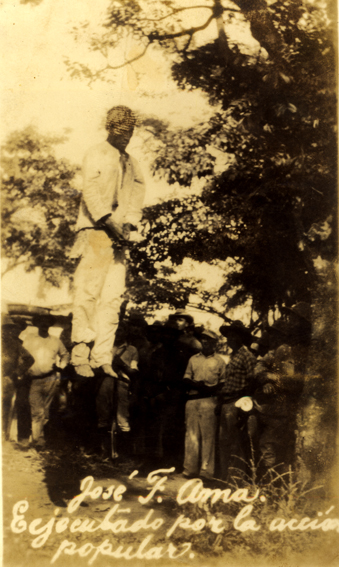
1932: Jose Feliciano Ama, Izalco indigenous peasant

El Salvador campesino Jose Feliciano Ama was hanged in the town square of Izalco on this date in 1932 during a ferocious repression of the peasantry.

In an environment of desperate economic immiseration for nearly all Salvadorans below the landed oligarchy, the heavily indigenous western peasantry rebelled on January 22, 1932 — aided or led by the Communist Party.*

This fate of this rebellion might be inferred by its historiographical sobriquet, the Salvadoran peasant massacre — or simply la Matanza, the slaughter.

In numerical terms, it ran to well into the tens of thousands, maybe up to 40,000 — indiscriminately visited on peasants of originario complexion in the zone of rebellion, batches of them summarily shot into mass graves they’d been forced to dig for themselves.

In the Pipil town of Izalco, where coffee latifundias dominated the best agricultural land,* up to a quarter of the population was butchered. None of those put to la Matanza were more recognizable nor more vividly recalled than the local rebel leader Feliciano Ama English Wikipedia entry | Spanish), extrajudicially noosed in front of the Izalco church. Today a small plaque in this square honors him as a popular martyr.

* See States and Social Evolution: Coffee and the Rise of National Governments in Central America. An heiress of coffee magnate and former president Tomas Regalado allegedly forced our Feliciano Ama off his lands by dint of brute force.

On this day..

1774: John Malcom, tarred and feathered

On this date in 1774,* in the British official John Malco(l)m was tarred and feathered and mock-executed by enraged Bostonians during the tense run-up to the American Revolution.

Malcom’s militant Loyalism put him sharply at odds with his city’s’s rising Patriot ultras — the sorts of people who, just a month before, had provocatively dumped British East India Company tea into Boston Harbor.

Malcom himself hadn’t been proximate to that event but as a customs official he’d made himself obnoxious on the docks before. In October of 1773, he seized a ship in Falmouth,** threatening “to sheath his sword in the bowels of any one who dared dispute his authority.” The sailors responded by sheathing John Malcom in a coat of tar and feathers and marching him through the streets.

This vigilante justice was meant to come up short of serious physical injury, and it did. But it was a crippling public disgrace, far beyond the streets of Falmouth — an ironic situation since Malcom’s own late brother Daniel was a celebrated Patriot bootlegger.† Back in Boston, Malcom found himself heckled in the streets about the incident to such an extent that he complained to the governor. (The governor told him to suck it up.) And it bubbled right to the surface in the incident that brings today’s post, too.

On January 25 of 1774, one of the Patriot participants in the aforementioned Boston Tea Party named George Robert Twelves Hewes‡ happened across the hated crown agent — “standing over a small boy who was pushing a little sled before him, cursing, damning, threatening and shaking a very large cane with a very heavy ferril on it.” (That’s according to the next week’s (Jan. 31, 1774) Boston Gazette, as are the subsequent quotes in this post.) Apparently the kid had crashed his conveyance into Malcom while out frolicking in the deep winter’s snow.

Hewes interceded for the child, and Malcom rounded on him: “you are an impertinent rascal, it is none of your business!” Flexing his class rank, Malcom further scolded the “vagabond” that he ought not address a gentleman in public. Hewes dissented and after an exchange of barbs cut Malcom to the quick with the retort, “be that as it will, I never was tarred or feathered.” This own brought Malcom’s heavy cane crashing into Hewes’s head, crumpling the Good Samaritan to the cobblestones.

Angry bystanders to the incident trailed Malcom home, and heaven only knows what hard words were traded on the way. He should have been worried and maybe he was, but his blood was up from Hewes’s insult: Malcom stood on the threshold and verbally sparred with his angry neighbors — “you say I was tarred and feathered, and that it was not done in a proper manner, damn you let me see the man that dare do it better! I want to see it done in the new-fashioned manner.” The man’s Falmouth tarring, you see, had been leniently poured over his clothes, which might have been hell on his dry cleaning bills but also minimized the injury that hot tar could do to naked skin. Now he was daring a rougher treatment at the hands of Bostonians who had certainly proven up to that challenge in the past.

Calmer heads knew this situation could spiral out of control and judiciously steered the irate official into his house. But Malcom was not to be stilled; when his wife opened a sash to implore the crowd to disperse, her husband exploited the opening to thrust a sword into the breast of a bystander. Luckily for both parties the blade struck bone, causing only a glancing flesh wound.

Somehow the irascible coot restrained himself in the house long enough for this disturbance to subside, while Hewes shook off his concussion well enough to swear out a warrant.

But by evening, word of this politically charged provocation had circulated in Boston, along with all Malcom’s bluster — “among other things, that he would split down the yankees by dozens, and receive 20l. sterling a head for every one he destroyed.” A crowd started assembling again at Mr. Malcom’s door, now dangerously intent on its purpose.

they got ladders and beating in an upper window, entered the house and took him without loss of blood, and dragging him out put him on a sled, and amidst the huzzas of thousand[s], brought him into King street. Several Gentlemen endeavoured to divert the populace from their intention, alledging that he was open to the laws of the land which would undoubtedly award a reasonable satisfaction to the parties he had abused; they answered he had been an old, impudent and mischievous offender — he had joined in the murders at North Carolina — he had seized vessels on account of sailors having a bottle or two of gin on board — he had in office, and otherwise, behaved in the most capricious, insulting and daringly abusive manner — and on every occasion discovered the most rooted enmity to this country, and the defenders of its rights — that in case they let him go they might expect a like satisfaction as they had received in the cafes of Richardson and the soldiers, and the other friends of government. With these and such-like arguments, together with a gentle crouding of persons not of their way of thinking out of the ring, they proceeded to elevate Mr. Malcom from his sled into the cart, and stripping him to buff and breeches, gave him a modern jacket, and hurried him away to liberty-tree, where they proposed to him to renounce his present commission, and swear that he would never hold another inconsistent with the liberties of his country; but this he obstinately refusing, they then carted him to the gallows, passed a rope round his neck, and threw the other end over the beam as if they intended to hang him: But this manoeuvre he set at defiance. They then basted him for some time with rope’s end, and threatened to cut his ears off, and on this he complied, and they the brought him home.

See, reader, the effects of a government in which the people have no confidence!


“Bostonians Paying the Excise-Man, or Tarring and Feathering” (color version of same). This print and the next one make reference to a dubious report in London papers that Malcom was made to guzzle tea to the point of bursting for “your whole Fraternity at the Custom house would drench us with this Poison, and we are to have our Throats cut if it will not stay upon our Stomachs.”


“A new method of macarony making, as practiced in Boston”. (A different print with a nearly identical title shows an expanded view of a gallows here.) The number 45 seen on the hat above was code for Liberty at this period, due to the daring anti-monarchist sentiment in issue no. 45 of radical agitator John Wilkes‘s The North Briton.


A French engraving of the event, from 1784.

* There are a few other dates besides Tuesday, January 25 to be found out there, but newspaper reports from the time clearly place it on that day. Malcom himself later circulated a strange bulletin to Boston churches confirming the date with the words “John Malcom returns thanks to Almighty God, that again he is able to wait on him again in the public worship, after the cruel and barbarous usage of a cruel and barbarous savage mob in Boston, on the 25th evening of January last past confined him to house, bed and room.”

** The town of Falmouth is now Portland, Maine. Its most famous revolutionary war incident was put it to the torch by the British in 1775.

Daniel Malco(l)m’s grave is pocked by musket balls fired at the marker for good luck by redcoats.

‡ Hewes lived to the ripe old age of 98. Enjoy a public domain 1830s biography drawn from personal conversation with the old veteran here … including Hewes’s recollection of the tarring and feathering, which in his telling was clearly extremely traumatic to his antagonist.

The people, however, soon broke open the door, and took Malcom into their custody. They then took him to the place where the massacre was committed, and their flogged him with thirty-nine stripes. After which, they besmeared him thoroughly with tar and feathers; they then whipped him through the town, till they arrived at the gallows, on the neck, where they gave him thirty-nine stripes more, and then, after putting one end of a rope about his neck, and throwing the other end over the gallows, told him to remember that he had come within one of being hanged. They then took him back to the house from whence they had taken him, and discharged him from their custody.

The severity of the flogging they had given him, together with the cold coat of tar with which they had invested him, had such a benumbing effect upon his health, that it required considerable effort to restore his usual circulation. During the process of his chastisement, the deleterious effect of the frost, it being a cold season, generated a morbid affection upon the prominent parts of his face, especially upon his chin, which caused a separation and peeling off of some fragments of loose skin and flesh, which, with a portion of the tar and feathers, which adhered to him, he preserved in a box, and soon after carried with him to England, as the testimonials of his sufferings in the cause of his country. On his arrival in England soon after this catastrophe Malcom obtained an annual pension of fifty pounds, but lived only two years after to enjoy it.

On relating this adventure, the very excitement which the affront must have wrought upon him, evidently began to rekindle, and he remarked with emphasis, I shall carry to my grave the scar which the wound Malcom gave me left on my head; and passing my finger over the spot to which he directed it, there was obviously such a scar, as must have been occasioned by the wound he had described.

On this day..

1522: Didrik Slagheck

Danish scheming archbishop Didrik Slagheck was burned in Copenhagen on this date in 1522 — sacrificed to his sovereign’s convenience.

Slagheck rolled into Stockholm in 1517 in the train of the papal legate who had been vainly dispatched to calm tempers during the run-up to what became the Swedish War of Liberation.

That’s liberation from Denmark, the effective overlord via the Kalmar Union joining those two countries and Norway besides. In 1520, with ecclesiastical mediation a bust and Sweden restive, the Danish king Christian II invaded. Slagheck made his villainous historical reputation by opportunistically hitching on with the vengeful king, the same king who would execute him in the end.

Things went great for Slagheck at first: he helped queue up the enemies list for the victorious Christian’s demonstrative mass beheading, the Stockholm Massacre. And he got his 30 pieces of krona right away in the form of an archbishopric which had come open along with its former owner’s neck on the occasion of said massacre. Thereafter he commanded troops in the field during the rebellion of Gustav Vasa. By 1521 he’d been kicked upstairs,

promoted to the position of archbishop of Lund, then a Danish see, entering the cathedral at his installation on November 25th with great pageantry and to the sound of martial music. During the same autumn, however, a papal legation in Copenhagen had been investigating what had taken place in Stockholm after the coronation, and five days after his installation as archbishop Slagheck was summoned to give an account of the advice he had given and the manner in which he had acted. Christian II decided to abandon him in an attempt to clear his own reputation, and Slagheck was executed and burnt in Copenhagen on January 24th 1522. (Source)

On this day..

1952: Võ Thị Sáu

Eighteen- or nineteen-year-old student and revolutionary Võ Thị Sáu was shot by the French on this date in 1952.

(cc) image from Michal Manas.

A Viet Minh activist from childhood, Sáu (English Wikipedia entry | the more extensive Vietnamese) got her start in revolutionary praxis chucking a grenade at a group of French soldiers when she was 14.

She did three different turns in French custody over the very few years remaining her, the last of which was at Côn Đảo Prison* awaiting execution for murdering a French officer and a number of Vietnamese collaborators — “crimes” committed before she had attained majority. She poured invective upon the court that condemned her, correctly prophesying that Vietnamese resistance would defeat it.

Today Sáu is well-represented in monuments around Vietnam where she is of course honored as a patriotic hero; her tomb in Côn Đảo receives a steady tribute of offerings from admirers. She’s valorized in the 1994 film Daughter of the Red Earth:

* Later infamous as the location where the next imperial power kept its political prisoners in tiny “tiger cages”.

On this day..

1779: Claudius Smith, Cowboy of the Ramapos

Claudius Smith, a feared Tory guerrilla during the American, was hanged in Goshen, N.Y., on this date in 1779.

“The Cowboy of the Ramapos” for his penchant for livestock-rustling in the Ramapo Mountains, Smith headlined a gang of pro-British criminals/partisans operating out of Monroe, N.Y., near the New Jersey border — a zone of dirty irregular warfare.

Quite a lot of legends apparently proliferated about this guy, including in his own time: one wanted poster described him as seven feet tall.

If you were a British loyalist in his neighborhood you might have figured him along the lines of an Anglo hajduk — the Balkan freebooters who straddled the line between social bandit and hero insurgent. To a Patriot, he was little better than a brigand, and not satisfied with riding off cattle and horses ventured also to invade farm houses for plunder. After one of his band’s deadly raids, Orange County Whigs complained to New York Gov. George Clinton, “we have not thought ourselves secure for a long time. We live so scattered that they can come in the dead of night to any one family & do what they please.”

So unsettled were the wartime frontiers that Gov. Clinton was notably unable to satisfy their petition for quite some time, and Smith’s raids, sometimes working in concert with the pro-British Mohawk commander Joseph Brant, continued to frighten those scattered revolutionists.

A Continental Army major named Jesse Brush finally captured Smith on Long Island late in 1778, and delivered him back to authorities at Orange County who gave him a proper trial and condemned him to hang for several robberies. (Murder wasn’t on the rap sheet.)

One month later, Smith’s son Richard with a band of cowboys revenged the execution by slaying a Goshen man named Richard Clark — and pinning to his corpse a warning to their persecutors.

A Warning to the Rebels

You are hereby warned from hanging any more friends to the government as you did Claudius Smith. You are warned likewise to use James Smith, James Flewelling, and William Cole well and ease them from their irons, for we are determined to hang six for one, for the blood of the innocent cries aloud for vengeance. Your noted friend, Capt. Williams and his crew of robbers and murders we have got in our power, and the blood of Claudius Smith shall be repaid. There are particular companies of us who belong to Col. Butler’s army, Indians as well as white men, and particularly numbers from New York that are resolved to be revenged on you for your cruelty and murders. We are to remind you that you are the beginners and aggressors, for by your cruel oppressions and bloody actions drive us to it. This is the first and we are determined to pursue it on your heads and leaders to the last till the whole of you is massacred.

Dated New York February 1779.

It was tall talk that the raiders couldn’t back up: rewards and informants soon broke up the band, leaving the cowboys and Claudius Smith to pass into history.

Ramblers might enjoy a visit to Claudius Smith’s Den, a cave that formerly served as a refuge for Smith’s gang. Beware of ghosts!

On this day..

1877: Dato Maharaja Lela, Perak War rebel

On this date in 1877, the British put a bow on a suppressed rebellion in Malaysia by executing one of its leaders.

The conflict is known as the Perak War. Perak was a sultanate on the Malaysian peninsula that had been torn by conflict for much of the 19th century and in 1874 sought protectorate status from the trade-hungry British who were only too happy to grant it.

Many Malayans were much less happy, and the very next year the first British Resident of Perak, James W. W. Birch, was assassinated by nationalists chuffed at his meddling — launching in the process the brief and unsuccessful Perak War.

The sultan-appointed mufti Dato Maharaja Lela (English Wikipedia entry | Malaysian) was the author of this murder* and then one of the primary leaders of a very short-lived rebellion. It was all done and dusted in a matter of weeks with the British carrying a couple of decisive early engagements and our Maharaja sinking into the wilderness for a few months as a fugitive. Add in some mopping up and there’s your war.

He’d be captured and eventually executed for the Birch assassination, in Taiping, Perak (Not to be confused with Taiping Island, in Taiwan); in this he had a better fate than the sultan, whom the British merely exiled to the Seychelles — where the deposed sovereign occupied his time adapting a French ditty into what became the Malaysian national anthem.

* Birch’s ham-handed carelessness of local mores is the stock motivation imputed to his killers, but some have pointed to his move towards outlawing the slave trade as a serious ding to Dato Maharaja Lela’s bottom line.

On this day..

1957: József Dudás, Hungarian Revolution wild card

Hungarian politician József Dudás was hanged on this date in 1957, for participation in the previous year’s abortive Hungarian Revolution.

Although he’d been a Communist in his prewar youth, Dudás won election to the postwar government on the Independent Smallholders line. This agrarian opposition party was gradually pushed out of power and eventually suppressed over the course of the late 1940s; Dudás himself ended up getting arrested and detailed for a long visit to the feared Romanian Securitate.

He’d long since been repatriated as a non-political engineer when the Hungarian Revolution briefly cracked open the horizon of possibilities in the autumn of 1956.

Dudás immediately proved himself not so non-political — and a distinct thorn in the side of the Imre Nagy government. He advocated not only for Hungarian Independence (which was also the title of his newspaper) but also for a multiparty reformulation of the Hungarian state, which was a bit much for Nagy to process during the revolution’s two-week lease on life. Dudás’s penchant for off-script revolutionary improvisations, such as putting out feelers to Soviet commanders and also having his militia lynch agents of the temporarily disempowered secret police, made him an unwelcome wild card and Nagy had him arrested shortly before Soviet tanks re-established control.

The Soviets, of course, also had no use themselves for the peasants’ party deputy who’d been trying to subvert Nagy from the right.

On this day..

1938: Vladimir Beneshevich, Byzantinist

One of Russia’s most cherished national myths is that of the “Third Rome” — Russia (via its protean polity, Muscovy) as the successor to Byzantium, which in turn succeeded Rome. Modern humans might no longer do the thing where the official lineage of the sitting dynasty traces to the loins of the local war-god, but claiming a through line all the way back to Romulus and Remus is a pretty good simulacrum.

Like all national mythologies, it’s an idea with a history of its own — and not one that enjoyed anything like its contemporary popularity at the moment that, say, Byzantium fell to the Turks. After all, those Byzantines were were an emblem of defeat.

“Political thinkers of this period, for example Ivan Peresvetov, warned Ivan the Terrible against imitating the Byzantine basileis [emperors], who had lost their empire because they had ceded their prerogatives to their magnates,” as S.A. Ivanov puts it in a chapter of The Reception of Byzantium in European Culture since 1500 — our primary source for this post. “Generally speaking, Byzantium was viewed ultimately as a failure, and nobody particularly cherished that pedigree. The same Peresvetov presented Mehmet the Conqueror as a true role model for the Muscovite tsar.”

It was a Pskov monk named Filofei (Philotheus) who formulated the Rome-Constantinople-Moscow succession around the turn of the 16th century but according to Ivanov the appeal to Byzantium was no more than occasionally and superficially grasped at in the centuries that followed, and then completely binned by Peter the Great — oriented as he was towards those counter-Byzantine values of efficiency, modernity and the west. (It’s only quite recently that western interest in Byzantium has revived.)

Only in the 19th century did Byzantium as a kindred civilization emerge widely for Russians in something like the shape of the myth as it exists today. No surprise, the scholarly field associated with it, fascinated as it was with kingship and Orthodox Christianity, became associated in the subsequent generations with right-wing politics … and by the end of this post, we will come to the execution during the Stalinist purges of an eminent scholar of Byzantium named Vladimir Beneshevich. While this fate is not surprising on its face for the circumstances, we think the journey of the idea — continuing as it does down to the present day — is well worth the taking. The following is excerpted from Ivanov:

The Byzantine question reappeared in the nineteenth century, when the Russian elite became aware of Russia’s uncertain status among the civilizations of the world. Yet the tone of the discussion had changed: in 1836 the philosopher Pyotr Chaadaev in his ‘Philosophical Letters’, asserted that the very choice made by Rus’ in favour of Constantinople, not Rome, had rendered inevitable the misfortune of Russia: … ‘Driven by a baneful fate, we turned to Byzantium, wretched and despised by nations, for a moral code that was to become the basis of our education’. This was the opening of the debate that has continued until today without any substantial variations in its terms or arguments …

Byzantium as an empire once again gained importance in the middle of the nineteenth century. When the notorious Jakob Fallmerayer [a race theorist later beloved of the Nazis -ed.] enunciated his theory regarding the Slavicization of the Balkans in Byzantine times, he wanted to warn the West against the ‘Russian menace’; the Russophobic nature of his theory notwithstanding, the new trend of thought in Russia, the so-called Slavophiles used it to substantiate their claim to the Byzantine legacy. The earliest Slavophile and the great Russian poet Fyodor Tyutchev had many conversations with Fallmerayer in Munich ‘de fatis byzantinis’, as the latter notes in his diary, in which he also briefly recorded Tyutchev’s ideas: ‘Byzanz Heilige Stadt. Pruritus Rezidenz zu verlegen’. For Tyutchev, as for the other ‘Slavophiles’, Constantinople was a ‘natural’ goal, but it was not an end in itself: in his poem ‘Prophesy’ (1850) Tyutchev implored the Russian tsar: ‘And the vaults of ancient Sophia / In resurrected Byzantium / Will again shelter the altar of Christ. / Throw yourself down in front of it, oh, Tsar of Russia, / And rise as the Tsar of all the Slavs’. The fact that the outbreak of the Crimean War in 1853 coincided with the 400th anniversary of the Fall of Byzantium inspired a new upswing of imperialistic dreams. The poet Apollon Maikov wrote: ‘Let everyone know that the dream of Christian Byzantium is still alive in Russia!’

There were two facets to the Russian debate on the Byzantine legacy: the political one dealt with the fate of Constantinople and the Orthodox Christians after the imminent demise of the Ottoman Empire. Some, like Fyodor Dostoevsky, insisted that ‘Constantinople must become Russian’; others thought that it should become the capital of a Pan-Slavic federation. Saltykov-Shchedrin, a great Russian satirist of the second half of the nineteenth century, mocked the Russian obsession with Byzantium in ‘The History of a Town’. Yet, this discussion on the fate of Constantinople seemed exciting and flattering to wide circles of learned society, especially in the 1870s, when a successful war with Turkey brought Russian troops to the very outskirts of Istanbul.

The other aspect of the Byzantine debate concerned domestic issues: is Russia a unique civilization, with only one predecessor, Byzantium, or is it part of Europe? When the famous German historian Zacharia von Lingenthal proposed a theory that the Byzantine peasant commune had been a Slavic innovation, this hypothetical construct was enthusiastically embraced by the Slavophiles. However, not everyone in Russia regarded the Slavic ‘link’ as indispensable. Konstantin Leontiev, a diplomat and philosopher, despised the Slavs and adored Byzantium. He used it as a symbol of theocracy, which he then offered as a model for emulation. ‘Byzantium gave us all our strength’, he wrote. ‘Under its banner we shall withstand the onslaught of the entire Europe if indeed it dares impose on us the rot and filth of its prescriptions for an earthly paradise’. Of course, he knew next to nothing about Byzantium — to him it was but an ideal construct. In his book Byzantism and Slavdom, which has been highly respected, praised and criticized ever since its publication in 1875, Byzantium proper is mentioned just a few times. Yet Leontiev was the first to coin the term ‘Byzantism’ (as opposed to ‘Byzantinism’), which became commonly used by the admirers of the Empire as a label for a benign tyranny. As a counterbalance, another new coinage, ‘byzantischina’,* emerged as the equivalent of the Western derogatory epithets, such as the German ‘Byzantinismus’ or the French ‘Byzantiner’. The debate about the Byzantine legacy involved prominent public figures such as Alexander Herzen, who condemned Byzantium for ‘debility’, as well as Vladimir Soloviev and Vasilii Rozanov. Rozanov, one of the greatest and most original thinkers of the Russian ‘Silver Age’, objected to Leontiev’s utopian constructs; his observations were so sharp that they are worth quoting at some length:

When, in what epoch were we particularly imbued with Byzantine principles? Wouldn’t everyone agree that it was during the time when Moscow was building the Russian state? But if that is so, why did we absorb these principles not during the period of our child-like receptiveness when Byzantium was alive and close to us, but at the time of our distrustful seclusion when Byzantium had already fallen? … Don’t the Byzantine origins of the Muscovite way of life represent a phenomenon that is far more illusory than real? … So when Byzantium was transformed from a powerful and attractive empire into a slave of Islam … that’s when we want Russia to be imbued with the principles of Byzantium. Isn’t that an illusion? Aren’t we ascribing to the imitation our deeply original and unique aspects? … Sophisticated and depraved Byzantium that mixed abstract disputes of theological and philosophical nature with orgies, with the noise and debauchery of the circus, can hardly be seriously regarded as an antecedent and prototype for Muscovy — morosely silent, stubbornly persistent, far more forceful than devious, so universally unrefined in its thought, taste and emotional inclinations.

Never afraid of internal contradictions, Rozanov in his later writings embraced the idea that Byzantium in fact did play a great role in Russian history, but that its role was negative: ‘Has the millennium of Byzantism in Russia done any good? One can answer with one’s hand on one’s heart: no, it has not! Then be consistent and help liberate Russia from the yoke of Byzantism’.

As the Russian Empire entered the twentieth century, Russian Byzantinism was at its peak: the conquest of the Straits (Bosphoros/Dardanelles) and the erection of a cross over St Sophia were the prime goals of Russian foreign policy. The public sentiments of the time can be illustrated by the fact that in 1912, a young Osip Mandelshtam, whose family tradition barely had any connection with the imperial Orthodox yearnings — he was a Jew who had recently moved with his parents from Poland to St Petersburg — wrote enthusiastic poems about Sophia of Constantinople:

1.
Hagia Sophia — here to stop and stare
The Lord has ordered people and the tsars!
Your dome, as an eyewitness once described it,
As if by chains is hanging from the stars.

2.
To all a shining light — age of Justinian,
When to steal off for foreign gods unseen
Dedicated Diana the Ephesian
Hundred and seven marble columns green.

3.
To what aspired your generous creator,
When high in spirit and in reason blessed,
He laid your features on the ground
And pointed them directions east and west?

4.
The temple shines, in the world’s aura bathing,
And forty windows — triumph of the light;
On sails under the dome the four archangels
Finest of all and basking in delight.

5.
This building will outlast people and ages
So wise and spherical and nobly built
And incandescent weeping of the angels
Will not corrode away the darkened gilt.

The idea that Russia itself was the reincarnation of Byzantium was mot graphically reflected in the architectural style referred to as ‘Byzantine’. This emerged in the second half of the nineteenth century and reached its peak in the first decade of the twentieth century, when 40 ‘Byzantine’ cathedrals were completed all across the Russian Empire as well as beyond Russian borders: in Greece, in Bulgaria, and even in France and Germany (in Biarritz and Kissingen). The most ostentatious and grand among them was the Naval Cathedral of St Nicholas in Kronstadt, whose similarity to Hagia Sophia of Constantinople, both in its exterior and interior decorations, is striking.

Byzantine Studies was one of the pillars of the Russian humanities. In Turkey, the Russian Archaeological Institute in Constantinople held a leading position among the city’s European academic institutions. Naturally the vast majority of scholars involved in Byzantine Studies were monarchists or at least conservatives. The only republican among them was Pavel Bezobrazov, whose book about Michael Psellos was a veiled critique of the Russian imperial bureaucracy. This tradition of ‘Aesopian language’, talking of Byzantium but implying Russia, was later used by Soviet Byzantinists.

The outbreak of World War I further spurred public debate. In 1915, the leading Byzantinist Fyodor Uspenskii submitted to Tsar Nicholas II a memo detailing the urgent steps to be taken after the Russian takeover of Constantinople. In the same year, Archbishop Antonii Khrapovitskii, one of Russia’s most influential clerics (he was the first contender for the Patriarchate) published a plea for the restoration of the Byzantine Empire in its original borders — in a sense, his dreams were even bolder than the appetites of the [Greek irredentist -ed.] ‘Megali Idea’. Yet the official position on Istanbul was less favourable to the Greeks. On 3 March 1915, Tsar Nicholas II told the French ambassador (whose name, ironically, was Paleologue), ‘The city of Constantinople and southern Thrace must be annexed to my Empire’. After the Entente Cordiale accepted his claim, the capture of Tsar’grad looked imminent. On Christmas Day, 1916, the mystical poet Vyacheslav Ivanov implored, ‘Oh Rus’, when you wrap yourself in the purple robes of Tsar’grad, do not serve worldly interests’.

The February revolution of 1917 did not stop the imperial hysteria; instead, the Byzantine question became even more acute. In the atmosphere of overwhelming uncertainty after the fall of the monarchy, some theologians blamed Byzantium for excessive gnosticism and asceticism, which, in their minds, were later planted into the Russian psyche.

The Bolsheviks who came to power in October 1917 could not have cared less about Byzantium, but those on the other side of the barricades did not forget about it: the abrupt collapse of the formidable edifice of the Russian Empire compelled religious and political thinkers to search for the roots of this catastrophe. The famous theologian Sergii Bulgakov,** for example, blamed Byzantium for the loneliness of the Russian culture, which made it vulnerable to pernicious influences.

Together with Christianity, at that fateful moment Russia also adopted all Byzantine insularity and its constraints; it became separated from the whole Western, Christian Europe by a “Great Wall” and remained isolated … Meanwhile, Byzantium’s attitude towards Russia was never sincere or warm, but always arrogant and hollow-hearted.

Bulgakov’s book At the Walls of Chersonnesos, written at the end of the brutal Civil War, in the atmosphere of terror and despair, was all about Byzantium and its legacy, as if they were the primary concerns of the time. The writer Alexei Tolstoy, one of the Russian emigres in Constantinople in 1920, describes the bitter disappointment of a White-Guard officer in this deceptive imperial dream: ‘Byzantium, may it go to hell! So much of our Russian blood has been spilled for this damn Byzantium. It’s the usual Russian stupidity all over again!’

To the Bolsheviks, Byzantium was one of the attributes of tsarism; more generally, for people of the new, avant-garde era, it became a symbol of everything dilapidated, moth-eaten and dusty. From the late 1920s through to the late 1930s, the very word ‘Byzantine’ was banned and was used only in quotation marks. Byzantine scholars became the targets of repressions; Vladimir Beneshevich, the most prominent among them, was executed.

* Russian uses the -schina suffix to attach an evaluative negative judgment to a period or concept; for example, a term like Stalinism (whatever its specific connotations) is a neutral description, whereas Stalinschina conveys the speaker’s scorn. One common way to refer to Stalinism’s apex of secret policing and internal purges is by reference to his notorious police chief, Nikolai Yezhov — hence, the yezhovschina.

** No relation to the novelist Mikhail Bulgakov.

On this day..